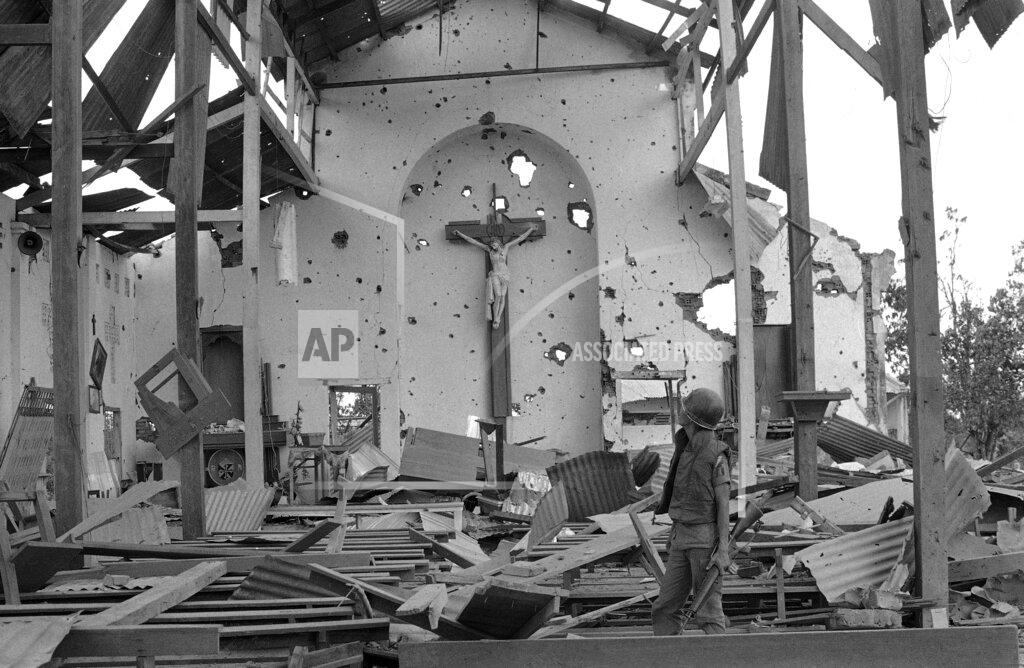
The Greek Cypriot Government charged today that at least 130 ethnic Greeks had been “murdered in cold blood by Turks” in the recent fighting on Cyprus. The Government of President Glafkos Clerides, the head of the Greek Cypriot community, said that “documented evidence” gathered by the police showed that the alleged murders had taken place as recently as August 17, three days after the second offensive of the Turkish Army on the island. The government said that the 130 victims included women and children, as well as men up to the age of 90. The government allegation followed by three days a Turkish Cypriot charge that during the warfare Greek Cypriot soldiers had committed “mass murder” of ethnic Turkish civilians. Today’s accusations were the Greek Cypriots’ most extensive allegation of atrocities by Turks.
In the exchange of atrocity charges, neither the Greek nor the Turkish side has formally applied for an independent investigation by the two nonpartisan organizations on the island, the United Nations Peacekeeping Force and the International Red Cross. Both Cypriot sides stated publicly earlier in the week that the case of several dozen bodies uncovered near the Turkish Cypriot village of Maratha should be investigated by the two international agencies, but they did not follow up with the necessary formal requests. In the Maratha case, the head of the Turkish Cypriot administration, Rauf Denktash, said that about 70 bodies of Turkish Cypriote had been found. Newsman who visited the rubbish dump when the bodies were uncovered found them decaying and virtually impossible to identify as to ethnic origin. In its statement today, the Greek Cypriot Government said, that 65 of the murders had occurred in villages near the east coast city of Famagusta, which is now controlled by the Turkish Army. Thirty-five other murders, the statement, said had been committed in the Turkish‐held Kyrenia district on the northern coast and 30 near Palekythron, a Turkish‐held village north of Nicosia.
The heaviest shooting in Nicosia since the cease‐fire of 20 days ago broke out for two hours tonight along the line separating the Greek and Turkish Cypriot communities, sending thousands of Greek Cypriots fleeing the city in panic. Sporadic shooting had been heard almost nightly in Nicosia, but tonight’s barrage was the heaviest since August 16 ceasefire. Earlier today, Turkish Cypriot leader, Mr. Denktash, said the Turkish invasion force had occupied another pocket of northwestern Cyprus, extending the area under Turkish control by 12 miles.
Secretary General Waldheim of the United Nations told the General Assembly in his annual report that profound economic and social problems were threatening the world with a “crisis of extraordinary dimensions.” He said there was an “almost universal sense of apprehension” about the direction in which the world might be heading, and feelings of “helplessness and fatalism which I find deeply disturbing.” Inflation and insufficient food supplies, Mr. Waldheim said, were immediate problems that had to be solved.
German and American officials in Bonn said that the United States had sought the reaction of its 14 NATO allies to the possible appointment of General Alexander Haig as supreme commander of the alliance. Bonn, according to a West German government source, has no objection. The Dutch, however, are reported trying to organize opposition to the appointment.
Three men were arrested at Westminster Abbey shortly after midnight for an alleged attempt to steal the Stone of Scone, the ancient artifact used in the coronations of monarchs of Scotland.
An administration official said that President Ford intended to appoint Peter Flanigan, a prominent member of the Nixon administration, as Ambassador to Spain and that he has offered Senator William Fulbright the Ambassadorship in Britain. Mr. Flanigan reportedly has accepted, but Mr. Fulbright has expressed misgivings.
An Israeli court ruled today that the Greek Catholic Archbishop of East Jerusalem must remain in jail until charges involving the smuggling of weapons to Palestinian guerrillas have been resolved. In her ruling, Judge Miriam Ben‐Porat of the Jerusalem District Court also rejected an appeal by the Archbishop, the Most Rev. Hilarion Capucci, for diplomatic immunity. She said that his Vatican passport and Israeli visa did not give him diplomatic status and noted that the Vatican and Israel did not have diplomatic ties. The Syrian‐born Archbishop, detained since August 18, has been indicted on charges of contact with Palestinian guerrilla agents, an offense punishable by 15 years’ imprisonment. He is also charged with carrying and possessing illegal weapons and performing services for an unlawful association, each count punishable by 10 years,
The Ethiopian armed forces coordinating committee accused Emperor Haile Selassie of exploiting public funds for his own benefit and said action against him would be announced shortly. The committee said he received about $7.2 million income from a brewery established 50 years ago when he was crown prince. The brewery has been nationalized. Although he established a well-intentioned trust, the money went for prestigious projects while Ethiopians were dying of famine and epidemics, the committee said.
One of the worst droughts in years has struck northern India and, with fertilizer shortages and a lack of fuel for irrigation pumps, threatens to destroy rice and wheat crops. Tens of millions face food scarcities and perhaps famine. The drought, coupled with fertilizer shortages and a lack of fuel for irrigation pumps threatens to destroy rice and wheat crops. It has led to grim forecasts of widespread hunger even famine, in such states as Uttar Pradesh, Rajasthan, Madhya Pradesh, Bihar, West Bengal and Gujarat. In Lucknow, the capital of India’s most populous state Uttar Pradesh, which has 90‐million inhabitants, an official said privately: “It is a dangerous situation. The monsoon has been terrible.”
Communist forces attacked several government outposts south of Da Nang, continuing a seven-week-old drive along the northern coast of South Vietnam, the Saigon command reported. Farther south, Viet Cong troops attacked government positions near the district town of Tan Uyen, 25 miles northeast of Saigon. In Cambodia, government troops continued an advance into insurgent territory along Highway 4, military sources said. The troops. were trying to link up with 500 men besieged in the Das Kanchor garrison, 40 miles from Phnom Penh.
Five raiders armed with bolo knives and automatic rifles and described by villagers as Christians, attacked a settlement on the Philippine island of Mindanao and massacred 28 Muslims, police reported. Police said 15 children, 10 men and three women were slain. They said one man died of bullet wounds and the rest were hacked to death. The police commander in Zamboanga City, 23 miles to the southwest, said the killings appeared to be in retaliation for a bus ambush two weeks ago in which 26 Christians were killed.
Seven persons were killed and 18 injured, four seriously, when a boiler explosion destroyed a laundry run by Catholic nuns at a convent near Hobart, Tasmania. Four of the dead were women working in the laundry at the convent at Sandy Bay and three were workmen installing a new boiler when the blast rocked the laundry. Hobart is the capital of Tasmania, an Australian island-state about 150 miles south of the Australian mainland.
Wallace Edward Rowling was chosen today as the next Prime Minister of New Zealand to succeed Norman E. Kirk, who died last Saturday. Mr. Rowling, who will be one of New Zealand’s youngest Prime Ministers at 46, was previously Minister of Finance. The Minister of Health, Robert J. Tizard, was chosen as Deputy Prime Minister. Selections were made in Wellington today by a caucus of Labor Party members of Parliament. New election’s were not necessary, since the Labor party holds a parliamentary majority and thus the right to name the head of government. In making their choice, Labor party members passed over the acting Prime Minister and former Deputy, Prime Minister, Hugh Watt, who is 62.
Samora Machel, leader of Frelimo, the Mozambique Liberation Front, met with Portuguese Foreign Minister Mario Soares in Lusaka, Zambia, to put the finishing touches to an independence settlement ending 10 years of guerrilla war in Mozambique. Soares indicated he hoped to sign an agreement with Machel by Saturday. A probable date for installation of a provisional government headed by Frelimo is September 25, the 10th anniversary of the front’s armed struggle for independence from Portugal.
Tropical Storm Carmen became a full-fledged hurricane again and aimed 95 mph winds at the north-central Gulf coast of the United States. Although still dawdling in its northward path, the season’s third tropical twister was picking up muscle over the warm open waters of the Gulf of Mexico off the Yucatan Peninsula and showed indications of turning more toward the east.
The United States imposed tighter controls on foreign fishing over the U.S. continental shelf. The action, to be effective in 90 days, was reported to the Senate Foreign Relations Committee by John Norton Moore, chairman of the National Security Council interagency task force on the law of the sea.
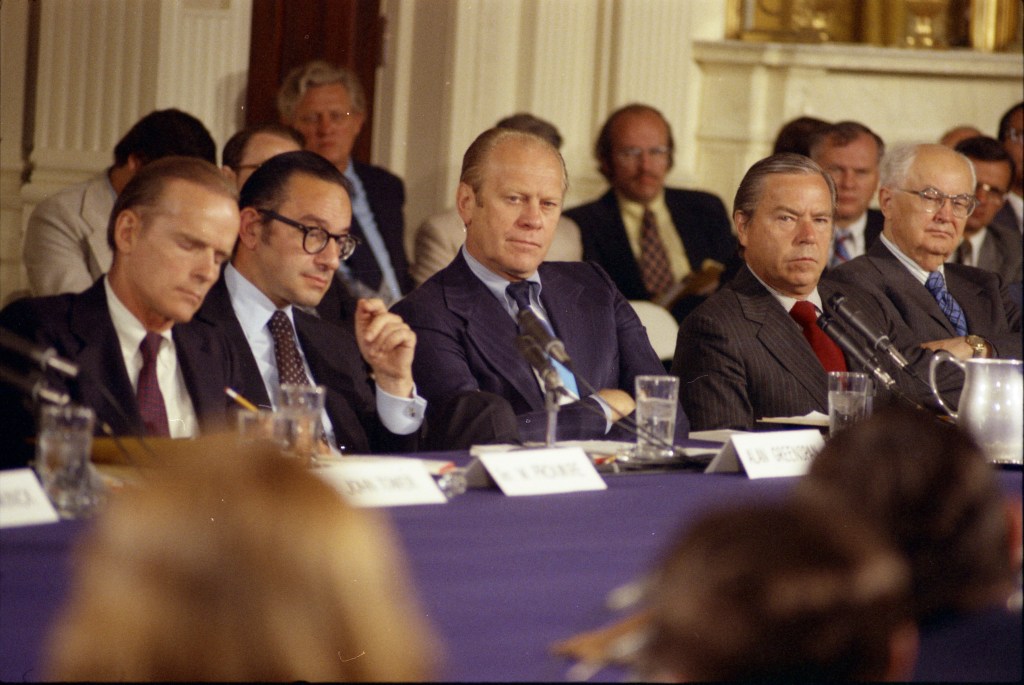
In the first of the meetings on the nation’s economy, leading economists told President Ford that the country did not face a big depression, but that its economy was likely to remain painfully sluggish. Despite their widely differing philosophies, they approached unanimity in concluding that the time had came for the Federal Reserve Board to ease its relentlessly tough monetary policy that has affected money, credit, interest rates and, indirectly, the stock market.
President Ford opened the conference an inflation with an appeal for “action that is practical, possible and as rapid in its effect as we can reasonably expect.” The meeting, he said, “unites Republicans and independents and Democrats in an election year against an enemy that doesn’t recognize one political party from another.” Meanwhile, Senate Democrats resolved to stay in session for the rest of the year if necessary to act on administration proposals dealing with inflation and other national economic problems.
In his first official statement as President Ford’s principal economic adviser, Alan Greenspan said that he foresaw a “flattened” economy in the months ahead, with some increase in unemployment. He saw no reason for extreme pessimism about the economic outlook.
The Senate adopted a bill requiring that 30% of U.S. oil imports be carried in American-flag ships. The measure now goes to conference to resolve differences with a similar bill passed by the House. The bill’s supporters said it should force no cost increases and contended it would make the nation more secure by reducing dependence on foreignflag vessels. Opponents, mainly from New England where home heating costs are high, denounced the measure as dangerously inflationary and claimed it could cost consumers as much as $60 billion by 1985.
Florida filed charges against one of its biggest condominium developers in an effort to break recreation leases that cost condominium buyers millions of dollars a year. The state’s Attorney General said the suit was “very much a test case,” and that developers who invest in recreation facilities attached to condominiums would typically have an “unconscionable” windfall profit of between $3 million and $6 million annually for as long as 99 years.
Dr. Fred Ikle, director of the Arms Control and Disarmament Agency, warned that a nuclear war could destroy the ozone layer in the stratosphere that protects all living things from the sun’s ultraviolet radiation. The potential depletion of the ozone area by nuclear explosions is a new, accidental discovery that arms control officials believe adds an awesome new element to the destructive effects of a nuclear war.
Seven major oil companies pleaded not guilty as indictments were formally presented, charging them with violating New York state’s antitrust laws. The companies — Texaco, Shell, Exxon, Gulf, Sunoco, Amoco and Mobil — were accused of restraining competition from independent dealers.
A federal judge has ordered police to remove the arrest records of thousands of persons detained during the 1971 antiwar demonstration in Washington, D.C., and also refund any bail money. The order by U.S. District Judge Howard F. Corcoran resulted from an appeals court ruling that places the burden on the District of Columbia government to prove that the arrests were legal. Corcoran said this was impossible becat se police had suspended use of field arrest forms during a series of sweeps and could not prove they followed legally required procedures. The judge ordered that the arrest records be turned over for destruction to lawyers for plaintiffs in the suit that challenged the legality of the arrests.
The Kanawha County, W.Va., Circuit Court granted an injunction to blunt the efforts of protesters who think some textbooks approved by the school board are anti-American and un-Christian. The protesters have caused scattered work stoppages and blocked almost half of the county’s school buses. An estimated 8,000 of 44,800 students have remained home. School officials said the injunction would keep the buses running and the schools operating. Meanwhile, pickets, ignoring a temporary restraining order, remained outside several coal mines and 4,500 miners were honoring the lines.
Former Montana Gov. Tim Babcock has been identified as the source of $54,000 in cash delivered to the 1972 Nixon political campaign under the names of various donors, the Washington Star-News reported. It is illegal for donors to give to federal candidates under the names of other persons. The Star-News said it understood that the donations were under investigation by Watergate prosecutors. Babcock was an official of Occidental Petroleum Co., whose chairman, Armand Hammer, gave $46,000 to former President Richard M. Nixon’s campaign. Babcock resigned his job a month ago and refused to discuss the $54,000, the newspaper said.
A three-judge federal panel in Detroit ended a dispute between truck carriers and their independent drivers by ordering the carriers to begin paying the independents what could amount to an additional $2 million a year. The dispute centered on a recent Interstate Commerce Commission decision ordering the carriers to pay the drivers for increased fuel costs. Independents are truck drivers who own their own trucks. Almost all of them work for “carriers,” middleman companies that contract to haul loads for shippers. The carriers announced they would appeal.
Oil can be recovered from oil shale for about $5 per barrel by an underground nuclear blast, a geologist at Lawrence Livermore Laboratory estimated. Dr. A. E. Lewis told an oil shale workshop in San Diego that an underground nuclear explosion in the oil shale-rich area of Rifle, Colorado, would recover oil with minimum impact on the environment, He said the blast would create a giant underground “chimney” in which fire fed by natural gas and air would raise temperatures high enough to cause oil to flow from broken rocks. Radioactive leakage into groundwater could be a problem, Dr. Lewis said, but this leakage could be monitored.
A two-day Bicentennial reconvening of the First Continental Congress began in Carpenters’ Hall, Philadelphia, Pennsylvania. The current governors of the 13 original American colonies had been invited to serve as delegates at the reenactment; all of them were present except Francis Sargent of Massachusetts, who was campaigning for renomination. U.S. President Ford spoke at a banquet on the evening of the second day. Unlike the original 1774 Congress, the reconvening included female and African-American delegates.
In Kanawha County, West Virginia, hundreds of coal miners stayed off the job to join protesters demanding the removal of school textbooks which they regarded as containing inappropriate content.
A gas explosion in Oxnard, California, killed a Southern California Gas Company foreman who was evacuating residents and injured five other people.
One of the falcon statuettes made for the 1941 film The Maltese Falcon, valued at $200, was stolen from the Los Angeles County Museum of Art, where it was on loan from Warner Bros.
Milwaukee hands Boston its 7th straight loss as Brewers’ rookie Gorman Thomas hits a 2–run shot in the 9th inning. It was Thomas’ first game of the year for Milwaukee after hitting 51 homers for Sacramento (PCL) this year, combining with Bill McNulty (55 homers) to set a minor league record for homers by teammates. Billy Champion (10–3) picks up the win for the 5th–place Brewers. The Red Sox, losing their seventh straight, dropped a half‐game behind the idle New York Yankees. Boston had been first since July 14.
Jim (Catfish) Hunter won his 22nd game, highest in the majors and a career-high for him, as he stopped the Texas Rangers on four singles tonight for a 3–0 Oakland A’s win. Hunter has four consecutive 20-win years.
Steve Busby’s throwing error on a bases-loaded pickoff attempt in the sixth inning let in two runs and helped the Minnesota Twins to a 4–1 victory over slumping Kansas City Thursday night. It was the eighth straight loss for the Royals. Busby, 19–13, failed for the third time to get his 20th victory.
The Chicago White Sox downed the California Angels, 1–0, as rookie Bart Johnson gets the win. Eduardo Figueroa goes the distance for the Angels and gives up just four hits, but takes a tough loss. The only run comes home on Ken Henderson’s double which drops a foot inside the left field foul line.
Bob Boone’s bases‐loaded single in the 11th inning today delivered two runs and the Philadelphia Phillies defeated the Chicago Cubs, 6–5. The Cubs had tied the score, 4–4, in the eighth on triples by Jose Cardenal and Peter Lacock. The triumph snapped a three‐game losing streak for the third‐place Phillies, who moved within 6½ games of the Pittsburgh Pirates, leaders of the National League East. The loss was the fourth straight for the last‐place Cubs.
Dow Jones Industrial Average: 670.76 (+22.76, +3.51%).
Born:
Calvin Maduro, Aruban MLB pitcher (Philadelphia Phillies, Baltimore Orioles), in Santa Cruz, Aruba.
Died:
Jimmy Swinnerton, 98, American cartoonist (The Little Bears, Little Jimmy) and landscape painter, died of complications from a broken leg.


 History Diaries