Major General Nguyễn Khánh resumed the Premiership today and began attempting to patch together a Government for South Vietnam. His first actions, after his return from a period of rest in Đà Lạt, were to dissolve the military triumvirate set up last week and to restore Major General Dương Văn Minh to the position of chief of state. These moves suggested General Khánh’s desire to return to the type of government he headed before August 16, when he ousted General Minh, assumed the title of President and greatly expanded his own powers under a new constitution.
In Huế, General Minh sternly, warned Buddhist and student groups today that they must support the central Government. “We must have unity to avert a catastrophe,” he said, “and we must unite before the country falls to the Communists.” United States observers in Huế, a university city that is a center of dissatisfaction with the military Government, were impressed by the grim and urgent note sounded by General Minh. He also urged the Buddhists to put aside their distrust and end their harassment of the Cần Lao, a predominantly Roman Catholic political party formed by supporters of President Ngô Đình Diệm, who was killed last November 2 after the overthrow of his regime. “Not all members of the Cần Lao are criminals,” the general said. “Those who are should be tried for their acts. The others should be let alone.”
Nguyễn Xuân Oánh, who has been acting Premier during General Khánh’s absences promised gatherings in Hue that a 15‐member citizens’ committee, representative of the diverse Vietnamese population, would soon he named. The return of General Khánh and his apparent willingness to compromise seemed to mark the end of his shortlived one-man rule. After his assumption of full power August 16, protest demonstrations began almost at once. Buddhist and student leaders were quick to denounce General Khánh and to liken him to President Diệm. General Khánh did not attempt to suppress the protests. But as they spread throughout the country, bringing bloodshed and vandalism, he announced August 27 the formation of triumvirate of generals.
General Khánh, General Minh and Lieutenant General Trần Thiện Khiêm, the Defense Minister and armed forces commander, were to have led the country for two months until a new government could be devised. When the street rioting persisted, however, General Khánh went north Saturday to Đà Lạt. He indicated that he would return only with full powers. It was believed here that the resignation Tuesday night of the First Deputy Premier, one of General Khánh’s chief political rivals, hurried his return. The deputy, Nguyễn Tôn Hoàn, is a leader of the nationalist Đại Việt movement. Another Đại Việt member, Brigadier General Nguyễn Văn Thiệu, has been an enigmatic figure to the Khánh supporters. They feared that General Thiệu, as army chief of staff, might lead a coup against the government. But an ally of General Khánh said today that the Premier was now convinced that General Thiệu would not jeopardize his position by engaging in Đại Việt politics.
In Washington, officials regarded the return of General Khánh as Premier as pointing to a new stability in Saigon.
Two Saigon newspapers were suspended during last week’s anti‐government demonstrations, the Ministry of Information said today. An announcement said the newspapers had violated publication laws and encouraged violence. More than 70 newspapers have been closed or suspended by the Government in the last six months.
Assistant Secretary of Defense John T McNaughton draws up a crucial memorandum to Secretary McNamara outlining a specific series of provocative actions that the United States might take, culminating in a sustained air war against North Vietnam.
South Vietnam told the Security Council today that it was ready with evidence to back up its charges that Communist forces were operating from five bases inside Cambodia. In a letter to the Council, Foreign Minister Phan Huy Quat said Saigon would give its data to the United Nations or to an impartial investigating commission but not to the Cambodian Government. Cambodia and South Vietnam have blamed each other for border incidents. Last month Cambodia challenged Vietnam to state the location of the bases and suggested that an inquiry mission check the scene.
The South Vietnamese reply implied that Cambodia’s agreement to an inquiry had come only after Cambodia arranged for the demobilization of Chinese Communists who had joined Cambodian paramilitary forces as “volunteers.” The letter also objected that Cambodia had laid a bill of accusations against South Vietnam before the United Nations in July but now rejected the findings of the three‐man inquiry team sent out to recommend ways of eliminating border strife.
Prince Souvanna Phouma, the neutralist Premier of Laos, urged President de Gaulle today to take a hand in the Laotian dispute. The Premier said after a 45minute call on General de Gaulle that he had asked him to do all he could to help bring about a new Geneva conference. The 14‐nation Geneva parley of 1962 led to the neutralization of Laos under a coalition government of the warring rightist, leftist and neutralist factions. President de Gaulle’s response to the request was not made known, but France is believed to be unwilling to take an active role in the intricate Laotian problem. Tomorrow General de Gaulle will receive the Laotian Premier’s half‐brother and chief adversary, Prince Souphanouvong, who is here as chief negotiator for the pro‐Communists. The Prince is expected to echo the Premier’s request for French involvement — and to receive as little encouragement from the general as the Premier did.
Lieutenant Charles F. Klusmann, the United States naval pilot who escaped from a Pathet Lao prison earlier this week, was aided in his escape by soldiers who were guarding him, reliable sources said today. The Pathet Lao guards were said to have been bribed by guerrilla soldiers of the Meo tribe under orders from a rightwing general, Vang Pao, who is also a Meo. Lieutenant Klusmann was shot down by a Pathet Lao antiaircraft installation June 6 while he was flying a reconnaissance jet on a photographic mission over Communist‐held areas in north‐central Laos. He was subsequently listed as missing in action but was believed to be a prisoner of the Pathet Lao, who are pro‐Communist. This was confirmed when his wife received a number of letters from him stating that he was imprisoned but in “good health.” According to the informed source, some of the Pathet Lao guards helping Klusmann escape joined him in his flight, along with some other prisoners.
Zenon Rossides of Cyprus said today he might ask for a meeting of the Security Council tomorrow if incidents continued on the island. He accused Turkey in a letter Tuesday of continued overflights in violation of the cease‐fire in Cyprus. At that time he told the President of the Council for September, Platon D. Morozov of the Soviet Union, that he reserved his right to call for an immediate meeting of the Council. On Tuesday he accused the Turks of flying over Cyprus or along the coast on Saturday, Sunday, and Monday. He said these flights were contrary to assurances by the Turkish Premier to the Secretary General, U Thant, on Aug. 21 that there would be further reconnaissance flights. A second letter to the Council President made public today denied Turkish charges that the Cypriot authorities were keeping food supplies from Turkish Cypriot villages.
Greek officials today feared a rift between Athens and Nicosia over policy in the crisis over Cyprus. The Cypriot Foreign Minister, Spyros Kyprianou, who is expected here tomorrow, is said to be carrying a letter from Archbishop Makarios, President of Cyprus, to the Greek Premier, George Papandreou, who is known to be vexed by what he views as the prelate’s embarrassing initiative” in foreign affairs. Officials said the Greek Government was wary of President Makarios’s recent negotiations with Cairo and Moscow in moves to obtain help from them in the event of a Turkish attack on Cyprus. The officials said Mr. Papandreou sent Archbishop Makarios a letter Tuesday severely reprimanding him for making promises without consulting Athens.
Published excerpts from Premier Papandreou’s “strongly worded” letter to President Makarios, confirmed by high sources tonight, stressed that Nicosia should not undertake initiatives on its own that might have serious repercussions elsewhere. Greece is known to have told Archbishop Makarios that she will not go to war with Turkey over the issue of the replacement of 335 men of the 650 Turkish troops stationed in Cyprus. A crisis was threatened last week when the Greek Cypriots refused Turkey permission to replace the troops. Ankara, at the request of the Greek Government, agreed to a “short” delay.
Greek concern has been growing over reports that a Greek Cypriot mission was scheduled to visit Moscow soon to seeks a Soviet guarantee for the territorial integrity and independence of Cyprus in case of a Turkish attack. Two weeks ago Greece, a member of the North Atlantic Treaty Organization, induced Archbishop Makarios to cancel visit to Moscow by his Foreign Minister, Mr. Kyprianou, Thy promising the Cypriot President that if Turkey attacked Cyprus, Greece would defend the island as if it were a Greek territory.
Premier İsmet İnönü said at an emergency session of Parliament today that Greece was moving toward war with Turkey “with her eyes closed.” If such war broke out, he said, the Cyprus problem would become of secondary importance. The Premier again said that Turkey had the right, under the Treaty of Guarantee that formed part of the 1960 Cyprus agreements, to intervene, if necessary with military force, in Cyprus. Evidence that the Greek Cypriot Government planned a new assault on the Turkish Cypriot community might compel Turkey to move into Cyprus to defend the Turks. “If that should happen,” said İnönü, “the consequences could not be limited to our intervention. From the very first clash, we should be at war with Greece. Greece is marching with her eyes closed to the brink of war.”
Prime Minister Tunku Abdul Rahman of Malaysia proclaimed a state of emergency in a nationwide radio and television broadcast, after concluding that Indonesia was preparing to stage a massive attack on the Malaysian mainland. The day before, Indonesian paratroopers had landed in the Malaysian state of Johore.
Malaysia accused Indonesia today of “blatant and inexcusable aggression” and asked for an urgent meeting of the U.N. Security Council. The Malaysian charge was presented to Platon D. Morozov of the Soviet Union, the President of the Council for September. However, it was generally believed that the Council would not meet to take up the dispute until Tuesday. Several representatives in the Council have planned to return from vacation only after Labor Day. Also, Malaysia is sending her Minister of Home Affairs, Dr. Ismail bin Dato Abdul Rahman, to speak to the Council and the time of his arrival has not been fixed. Malaysia brought the complaint under Article 39 of the United Nations Charter, which authorizes the Council to make recommendations if it determines the existence of a threat to the peace, a breach of the peace or an act of aggression.
Second incident this year of race riots in Singapore between Chinese and Malays; 13 people are killed, 106 injured.
Prime Minister Nikita Khrushchev of the Soviet Union accepted an invitation from Chancellor Ludwig Erhard to visit West Germany, to take place in November or December after the U.S. presidential election. Khrushchev, however, would be deposed in October, before the state visit could take place.
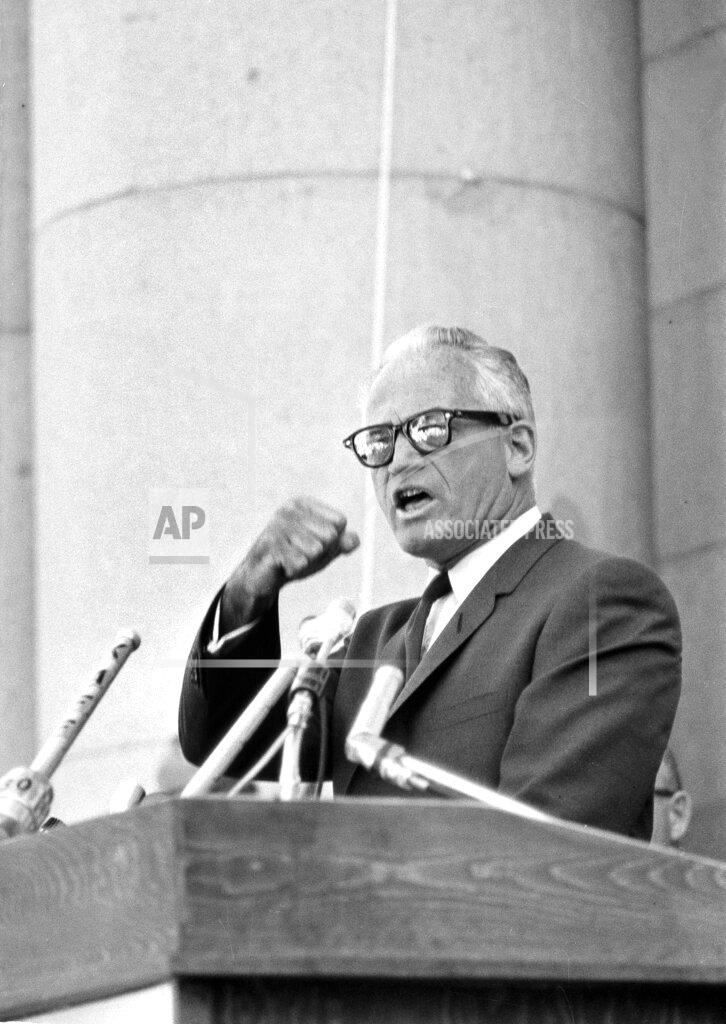
The Chinese Communist party accused the Soviet Union today of helping President Johnson in his campaign because of fears that Senator Barry Goldwater of Arizona would destroy hopes of United States‐Soviet cooperation. An article in Jenmin Jih Pao, the organ of the Chinese Communist party, said that Soviet leaders are mortally afraid that their painstaking quest for U.S.‐Soviet cooperation to dominate the world will be dashed to the ground” if Senator Goldwater, the Republican Presidential nominee, is elected.
The rebel commander of Stanleyville told the United Nations today that he was holding all of the city’s white men, women, and children as hostages against any air raids by the Congolese Government. The commander, Nicolas Olenga, warned the United Nations that his forces would fire at any plane approaching Stanleyville, the capital of Eastern Province. About 350 whites, most of them women and children, including about 45 Americans, were evacuated from Stanleyville at the beginning of August when the rebels were taking control there. This left about 500 whites, predominantly Belgians. In a message to the United Nations Secretary General, U Thant, the commander accused the United Nations, the International Red Cross, the World Health Organization and other international agencies of being part of an “imperialist plot” against the Congolese rebels. The commander holds the rank of general in the rebel army.
The Senate voted its approval today of a bill combining health insurance for the aged with increases in Social Security cash benefits and sent it along to an uncertain fate .in the House. The vote of 60 to 28 was in contrast to the five‐vote margin by which the Senate had nailed in the medical‐care feature yesterday. Senator Barry Goldwater, the Republican nominee for President, did not vote on final passage. He had flown here yesterday to vote against the medical‐care proposal, then returned to Arizona to start his campaign today. Twelve other Republicans joined with 48 Democrats in passing the bill. Voting against were 18 Republicans and 10 Democrats.
The bill goes back to the House in a far different form from what emerged July 29. That body is expected to delay consideration of the bill for some time. Originally designed to channel about $1.5 billion in cash benefits annually into the hands of 20 million Americans on the Social Security rolls, the bill would now provide cash and health‐insurance benefits costing $4.2 billion a year. The most costly — and controversial — feature added by the Senate was the federally financed program of health insurance for persons 65 years of age and over. It would cost $1.5 billion a year. The Senate also scrapped the House plan of 5 per sent across-the-board benefit increases. Instead, the bill now calls for $7 monthly cash increases in Social Security checks. This would cost $700 million more than the House version. Another major Senate change — to liberalize the amount of outside income a person can earn without having to forgo Social Security benefits — would cost $400 million.
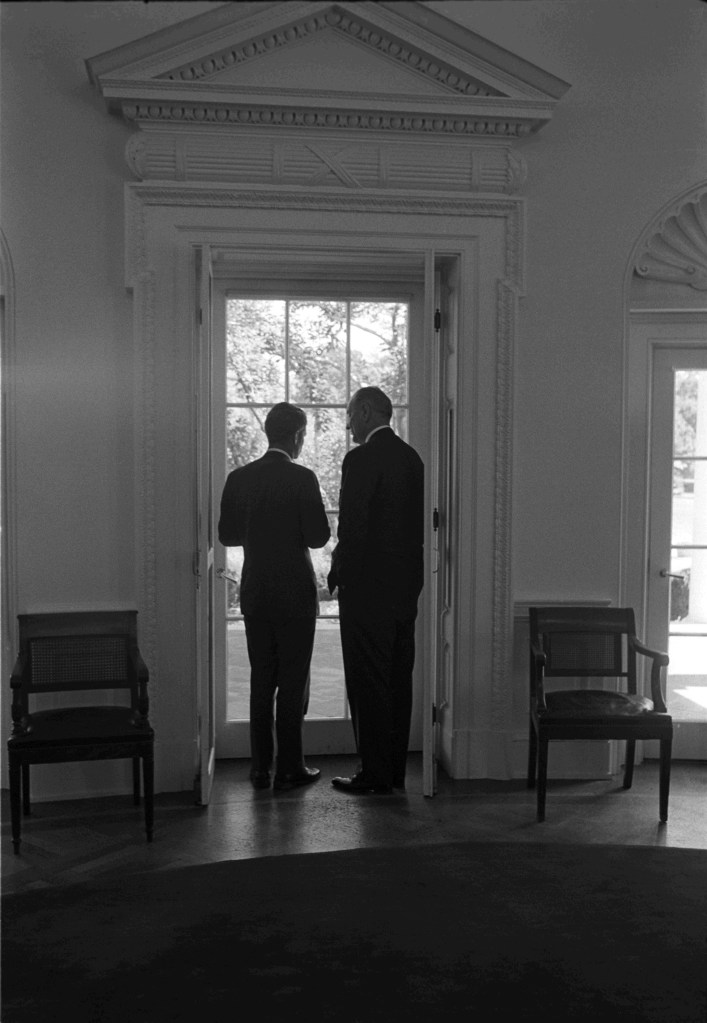
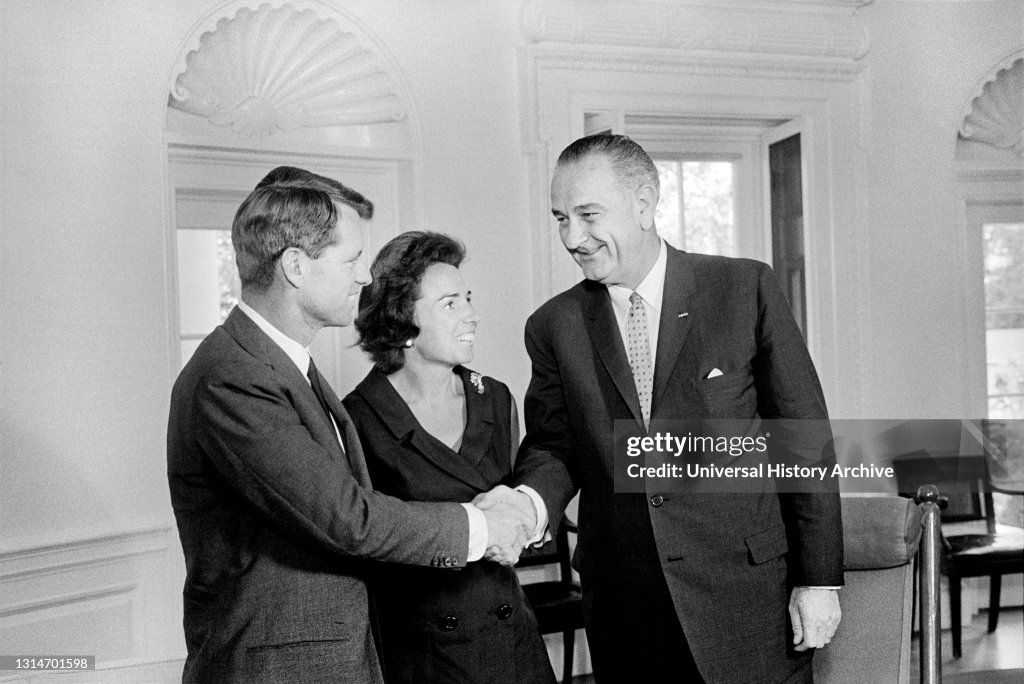
Two days after his nomination for U.S. Senate, Robert F. Kennedy announced his resignation as United States Attorney General. Robert F. Kennedy closed the door today on his career in the Cabinet and prepared to begin in earnest his quest for a career on Capitol Hill. Mr. Kennedy went to the White House just before noon to deliver to President Johnson his resignation as Attorney General, the position to which he was appointed by his brother, President Kennedy, three years and eight months ago. In a letter that began with the salutation “Dear Bob,” Mr. Johnson said his regret was “tempered by satisfaction” that Mr. Kennedy intended to remain in public life. “You will soon be back in Washington where I can again call upon your judgment and counsel,” the President added.
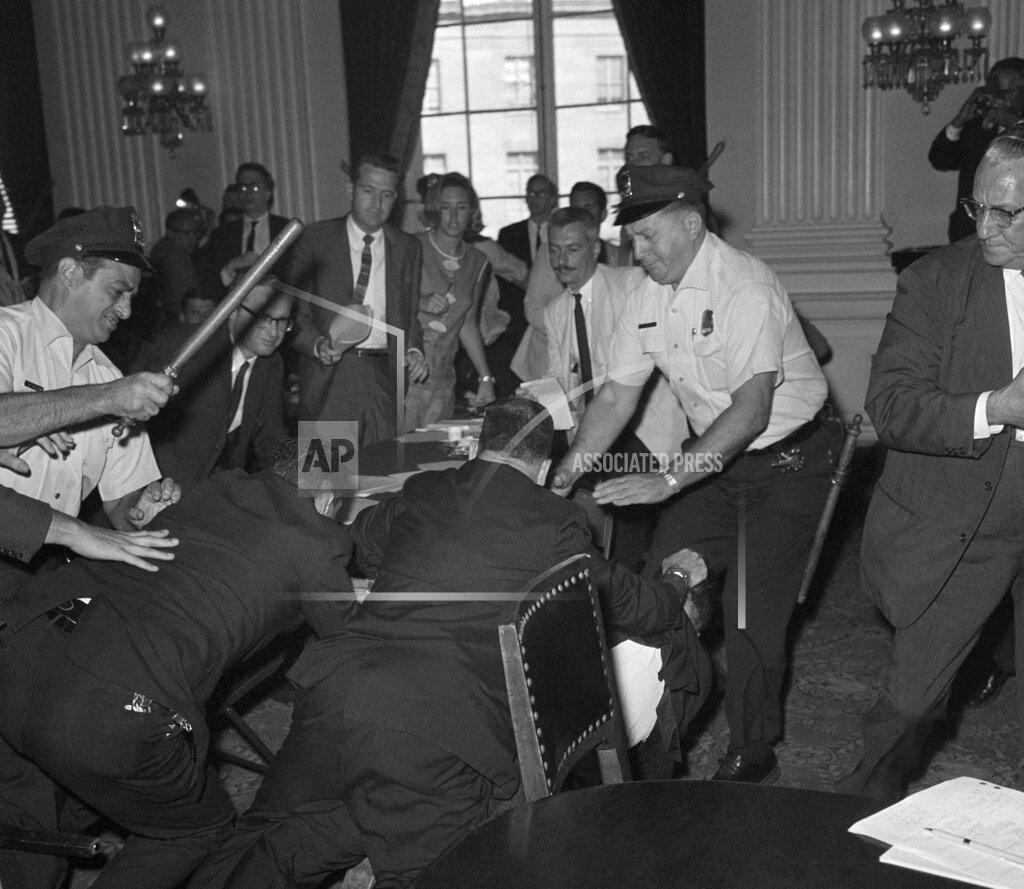
A Congressional hearing broke up in sudden tumult today when a man dashed from the audience, vaulted onto the witness table and started to grapple with the witness while shouting ”Down with Castro.” Chairs, tables and water pitchers were overturned as the man was wrestled to the floor and carried from the room by police officers and deputy Federal marshals. Apparently nobody was seriously injured. ‘The police identified the assailant as Lon L. Dunaway, 28 years old, of Arlington, Virginia, a member of George Lincoln Rockwell’s American Nazi party. He was booked at a nearby police station on charges of simple assault and disorderly conduct. The incident occurred in the caucus room of a House office build‐ ing, where a House Un‐American Activities subcommittee was investigating unauthorized travel to Cuba by a group of American students. The witness at the time was Morton B. Slater, 21, of New York, who helped to organize a visit to Cuba in July and August by 73 youthful sympathizers of Fidel Castro’s Cuban regime. Mr. Slater, who had just been sworn in, was challenging the subcommittee’s authority to investigate the trip and was calling the hearing “a farce.”
The unemployment rate crept back up to 5.1 percent in August, reflecting mainly an increase in jobless teenagers. However, the strong recent trend in adult employment was maintained last month, the Labor Department’s monthly unemployment survey showed today. In July, the unemployment rate dropped below 5 percent for the first time in four and a half years. The July rate of 4.9 percent reflected an improvement in every group of workers — men, women and teenagers. Despite the slight increase in the unemployment rate during August, the trend has been toward lower levels since February of this year. Since May, the rate has averaged 5.1 percent, which is lower than in any four‐month period since early 1960.
The House voted a three‐year extension of the Food for Peace program today and an authorization of $6.4 billion to finance its operation. The vote on final passage was 349 to 6. Earlier, by 182 to 175, the House declared “any nation or area dominated or controlled by a Communist government or by the world Communist movement” ineligible to purchase surplus food commodities from the United States at bargain prices under the program. This language, amounting to the strictest anti‐Communist legislative sanction to date, was incorporated in the bill on a Republican‐sponsored motion in which 143 Republicans and 39 Democrats joined. The restriction was opposed by 162 Democrats and 13 Republicans. It was introduced by Representative Paul Findley, Republican of Illinois.
The New York County grand jury that cleared Police Lieutenant Thomas R. Gilligan of criminal liability this week in the killing of a 15‐year‐old Black boy was unanimous in its finding. George S. Schuyler, one of the two Blacks on the jury, said yesterday: “Our decision was unanimous. I did the right thing, and so did the rest of the jury.”
However, the controversy over the finding continued. The Unity Council of Harlem Organizations called on Governor Rockefeller last night to appoint a special prosecutor to restudy the case. It also asked Louis J. Lefkowitz, the State Attorney General, to investigate “all information in the District Attorney’s office pertaining to the James Powell killing.” The council, which is made up of representatives of many civic and political organizations, also scheduled a mass rally for September 20. It said it would “demand” that Mayor Wagner and Police Commissioner Michael J. Murphy appear to “speak to the people of Harlem and inform them of their findings.”
A 37‐year‐old white man was arrested today in the firing of a shotgun at a house next to the home of Mrs. Fannie Chaney in Meridian, Mississippi. Her son, James, a civil rights worker, was slain this summer. The police said a man identified as Charles Barfield was charged with disturbing the peace and released on $500 bond. He was accused of taking part in a shooting Monday night in which the home of Tollie Patterson was peppered with buckshot. Mr. Patterson lives next door to Mrs. Chaney. Detectives said two other white men also were being sought in the shooting.
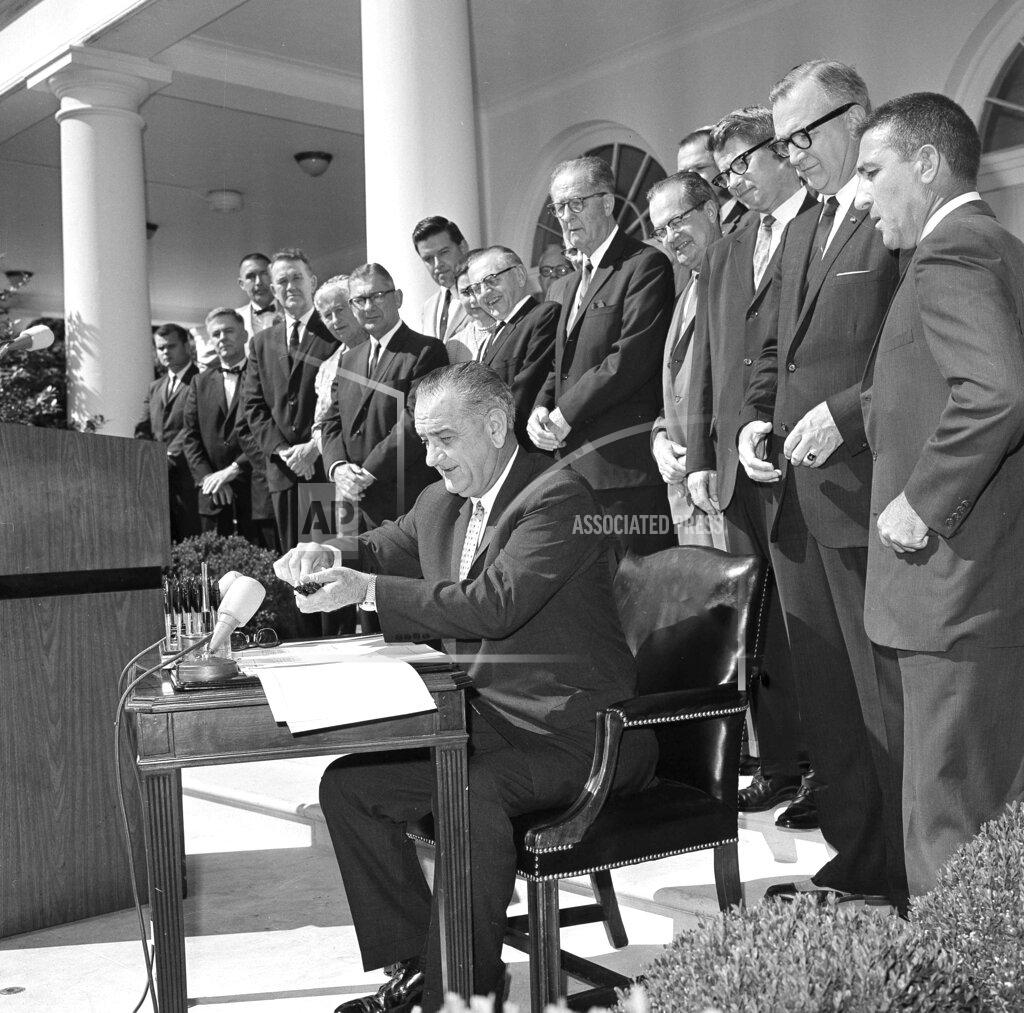
The Wilderness Act was signed into law in the United States, protecting 9,139,721 acres (14,280 square miles or 36,987 km²) of federal land in 54 areas and providing a legal definition of “wilderness” as “an area where the earth and its community of life are untrammeled by man, where man himself is a visitor who does not remain”, and creating the National Wilderness Preservation System. The act had passed, 374 to 1 in the U.S. House of Representatives and 73 to 12 in the U.S. Senate. Fifty years later, the protected wilderness would have added almost exactly 100 million more acres and would be cover 109,138,248 acres (171,000 mi² or 443,000 km²) in 801 protected sites.
Because the Democratic Party was a day late on filing the necessary papers to place incumbent President Johnson and his running mate, Hubert H. Humphrey, on the ballot in South Dakota for the November general election. Secretary of State of South Dakota, Essie Wiedenman, refused to certify the candidates because the party had missed the deadline that had expired at midnight the day before. In place of the required forms, she said, she had been handed “a piece of paper” that was typed up and signed by state Democratic Party leaders to attest that Johnson and Humphrey were the party nominees. South Dakota’s Attorney General (and future Governor) Frank Farrar voiced his opinion that the required paper, which was put in the mail and didn’t arrive until the morning after the deadline, “arrived too late too be certified,” raising the possibility that Johnson and Humphrey would not be eligible for the state’s four electoral votes. However, Farrar ruled the next day that South Dakota law was ambiguous about certifying presidential candidates for the ballot, and cleared the way for President Johnson to be on the ballot in all 50 states.
A four‐room office suite at 400 Park Avenue in New York has been leased by the General Services Administration for Mrs. John F. Kennedy and her staff to handle the more than one million letters she has received since her husband’s death. The office was opened last Monday in the 21‐story building at the northwest corner of 54th Street.
Jackie Brandt lashed a three‐run double with two out in the seventh inning today that carried the Baltimore Orioles to a 4–1 triumph over the Minnesota Twins. The victory opened a one-game lead for the Orioles over the idle Chicago White Sox in the American League race. Brandt’s blow up the leftcenter‐field alley on a 3–2 pitch came after Baltimore had filled the bases on Luis Aparicio’s single, a fielder’s choice, Brooks Robinson’s double and an intentional walk to Charlie Lau. The victim of the drive. Camilo Pascual, was thrown out of the game following Brandt’s hit by the plate umpire, Larry Napp. Pascual protested vehemently that Brandt should have been called out on a third strike when the count was 2–2. Pascual had to be forcibly restrained by the Twins’ catcher, Ron Henry, after his banishment. Pascual retired 12 Oriole batters in order before Brooks Robinson led off the fifth by whacking his 24th homer into the left‐field bleachers. Minnesota scored its run off Wally Bunker, the rookie star. Bunker surrendered only six hits, but had to pitch out of two other jams. Killebrew and Hall again hit successive singles with one out in the sixth, but Bunker got Bob Allison to pop out and Henry to strike out. A pinch‐hitter, Frank Kostro, doubled to lead off the Twins’ seventh, but was stranded on third.
In a display of general ineffectiveness, the New York Yankees today lost ground in the American League pennant race by dropping a 4–2 decision to the Los Angeles Angels. They couldn’t generate any worthwhile attack against a starter with a 3–12 won‐lost record, they were completely squashed by a strong young reliever, their own starter was hit hard and they were unable to make a key defensive play that could have saved them. All this anti‐pennant‐winning behavior put the Yankees four games behind Baltimore in the standing, three behind in the loss column, with 30 games to play. It also gave the Angels this series, 2 games to 1. Ken McBrlde was the Angel starter with the undistinguished record. He picked up his fourth victory by lasting just long enough. When he walked Mickey Mantle to open the sixth, Bob Lee went in and held the Yankees hitless the rest of the way.
Felix Mantilla hit two homers and two singles and Dick Radatz posted his 13th victory in relief against eight losses as the Boston Red Sox defeated the Kansas City Athletics, 7–5. Radatz gave up just two hits and struck out six in four innings of work.
The Houston Colts’ Don Larsen tosses a four-hit shutout at Philadelphia, 6–0. It is his first shutout in more than five years. Mike White paces the Colts attack with four hits while Eddie Kasko chips in three. The Colts put the game out of reach with a five‐run sixth inning rally during which Carroll Hardy smashed a two‐run homer. The Colts added a run in the ninth when Jack Baldschun hit Joe Gaines with a pitch while the bases were filled.
A remarkable weekday throng of 49,808 persons gave the San Francisco Giants a roaring sendoff yesterday as they made their farewell appearance of the year in Shea Stadium by defeating the New York Mets, 3–1. The Giants won as they had Wednesday night, with another first‐class pitching performance. This time, a five‐hitter by Gaylord Perry gave the Mets little opportunity for mischief until the final inning. Until then, Perry had allowed only three singles and three walks. After Joe Chrlstopher tripled and Jim Hickman singled in the ninth, he left the tylng run at the plate by retiring two Met pinch‐hitters. When Perry fired a third strike past Charlie Smith, he sent the third‐place Giants on to Philadelphia with 27 games to go, three of which they will play this weekend against the league‐leading Phillies. The Mets, meanwhile, will take their final shots at the defending — but apparently deposed — Los Angeles Dodgers.
Lew Burdette’s four‐hit pitching and a two‐run homer by Billy Williams sparked the Chicago Cubs to a 3–0 victory over the Cincinnati Reds tonight. The loss left the second‐place Reds 5½ games behind the Philadelphia Phillies, who were beaten by Houston, 6–0. Billy McCool, the Reds’ rookie relief pitcher, turned in a sharp performance over the final three innings, striking out seven of the nine men he faced. The Cubs, however, had already put the game out of reach.
The Milwaukee Braves knocked the St. Louis Cardinals out of third place in the National League standings tonight with a six-run, seventh inning surge that helped produce a 7–0 victory. Wade Blasingame evened his season record at 4–4, limiting St. Louis to seven hits and striking out seven. The Cards had 10 men stranded through the sixth inning.
Dow Jones Industrial Average: 846.02 (+0.94).
Born:
Adam Curry, American Internet entrepreneur, podcasting entrepreneur known for “No Agenda”, in Arlington County, Virginia.
Ernest Givins, NFL wide receiver (Pro Bowl 1990, 1992; Houston Oilers, Jacksonville Jaguars), in St. Petersburg, Florida.
Mark Moore, NFL defensive back (Seattle Seahawks), in Nacodoches, Texas.
Ron Bohm, NFL defensive tackle (St. Louis Cardinals), in Princeton, Illinois.
Holt McCallany, American actor (“Mindhunter”), in New York, New York.
Spike Feresten, American television writer (“Seinfeld”), in Fall River, Massachusetts.
 History Diaries