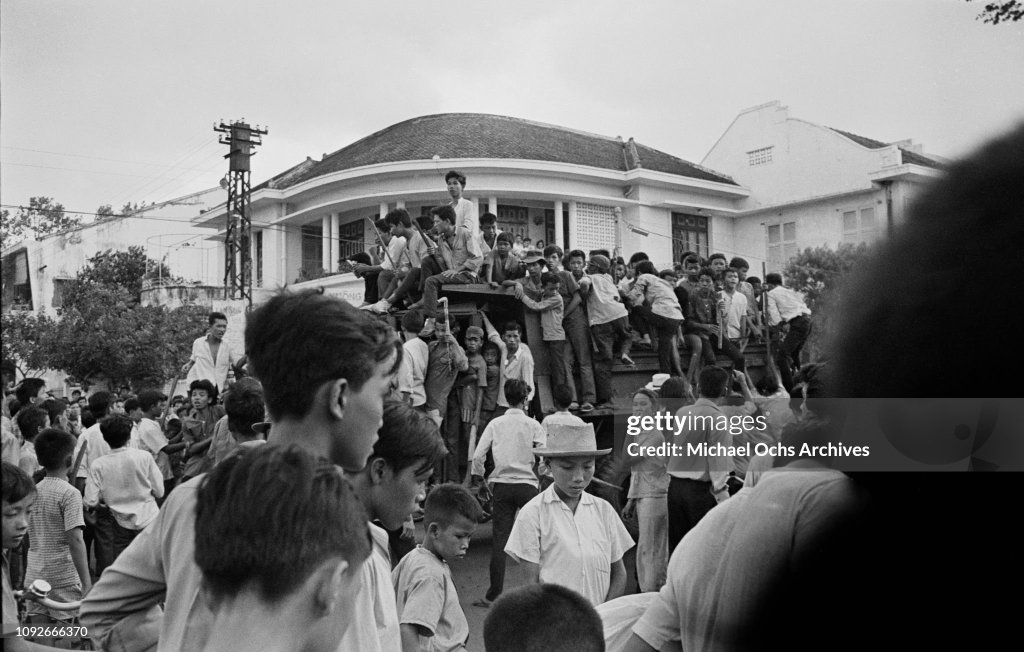
Nguyễn Khánh returns to Saigon on 2 September and holds talks with Generals Minh and Khiêm, the two other members of the ‘triumvirate’; unknown to them, however, he has secretly met with two of the most influential Buddhist leaders and promised them $200,000 in return for pledges of mutual support. The following day Khánh resumes his position as premier, dissolves the triumvirate, reappoints Dương Văn Minh as chief of state, and appeals to Buddhists and students to support the government.
General Khánh made no comment on his arrival at Saigon airport from the mountain resort of Đà Lạt, 140 miles northwest of Saigon, where he retired temporarily late last week after violent anti-Government demonstrations. A government spokesman indicated that General Khánh would resume his duties as government head if all members of the caretaker government in Saigon agreed to give him full support. General Khánh drove straight from the airport to the heavily guarded office of the Premier for an emergency session, of the Cabinet. Acting Premier Nguyễn Xuân Oánh, who has been running things here during General Khánh’s absence, was believed to be in the office.
Cambodia charges that South Vietnamese planes spread poisonous chemicals on Cambodian territory in August, and South Vietnam charges that Việt Cộng forces are operating from five bases in Cambodia. The South Vietnamese Defense Ministry charged today that machine-gun fire from a post inside Cambodia allowed more than 200 Communist guerrillas to escape across the Cambodian border Sunday. A spokesman said Vietnamese troops had made contact with the Việt Cộng guerillas about 500 yards from the border. The guerrillas were on the verge of defeat when the fire from across the border permitted them to escape into Cambodia, according to the spokesman.
Charles F. Klusmann, the United States navy jet pilot who escaped from pro Communist captors in Laos, landed tonight at Travis Air Force Base in Fairfield, California and was greeted by his wife, Sara. “It’s great to be back,” was all the 30‐year‐old flier said. Lieutenant Klusmann and his wife took off immediately for San Diego, where members of his Photo Reconnaissance Squadron, VFP‐63, were to greet him at North Island Naval Air Station. He will get a hospital check there.
The three Laotian factions have made no significant progress in their talks in Paris in the last week, diplomatic sources said today. Of the three factions, only two, the neutralists and the pro‐Communists, are negotiating. Prince Boun Oum of the third faction, the rightists, said last week that he was placing his cause in the hands of Prince Souvanna Phouma, the Laotian Premier, who heads the neutralists. The pro‐Communist faction’s leader, Prince Souphanouvong, has contended that no real negotiations are possible without the rightists.
Prince Souvanna Phouma’s Government, in the pro‐Communists’ view, has been dominated by the rightists since a military coup last April. Prince Boun Oum would not be able to make binding commitments for his side even if he were to take an active part in the negotiations, Prince Souphanouvong maintains. The rightists’ power, he insists, is in the hands of the generals, particularly Phoumi Nosavan and Kouprasith Abhay. General Phoumi Nosavan, who is Deputy Premier of the Laotian coalition Government, has remained in Laos as acting Premier despite demands by Prince Souphanouvong that he attend the Paris conference. The pro‐Communist leader is said to feel that any accord reached here would be sabotaged by the rightists, whose troops far outnumber the neutralist forces.
Diplomats in Paris that there is little disposition on the Communist side to stabilize the Laotian situation while the major conflict in neighboring South Vietnam continues. That belief is said to be shared by the French Government. For that reason, qualified sources say, there is little likelihood that France will veer from her publicly stated hands‐off attitude on Laos. President de Gaulle is considered to be too shrewd a politician to assume the role of arbiter in a dispute that he believes unlikely to be resolved soon. At the Laotians’ request, he will receive Premier Souvanna Phouma tomorrow and Prince Souphanouvong Friday. The announced purpose of the Paris talks has been to clear the ground for a formal conference, which vas originally scheduled to open August 24. But even diplomats connected with the conference are unable to detect any difference between the “preparatory” talks and negotiations on the issues.
The Cyprus Government rejected tonight a United States demand that it retract a charge that Washington and London were behind recent Turkish air raids on Cyprus. A government statement reiterated the contention that the Turkish attacks were carried out “with the tolerance” of the United States and Britain. Foreign Minister Spyros Kyprianou added that the two Western countries had refused “even after the events to condemn this barbarous attack on a noncombatant population.” Turkish jets attacked Greek Cypriot areas in Northwest Cyprus last month to help Turkish Cypriots who were pinned against the sea by encircling Greek Cypriot forces.
The new statement by the Greek Cypriot Government of President Makarios came after the United States Ambassador, Taylor G. Belcher, demanded “an immediate public denial that such statements have the support of the President of the republic.” A protest note referred to remarks attributed to President Makarios, an Orthodox Archbishop, after a church service in Alexandria on his visit last week to the United Arab Republic. A report from Cairo said that the Archbishop had referred to ”barbaric and bestial bombings” of Cyprus. When a member of the congregation shouted “From the Anglo‐Americans,” he was said to have replied: “I do not wish to deny this.”
The British High Commissioner, General Sir William Bishop, had an audience with Archbishop Makarios Monday to seek a clarification of the President’s remarks. An authoritative Cypriot Government source, meanwhile, said that an official delegation would visit Moscow soon for talks on the Soviet offer of military aid. Earlier in the day Archbishop Makarios conferred with the Soviet Ambassador, Pavel K. Yermoshin. It was their second meeting in two days. The President also conferred with the United Nations special representative on Cyprus, Galo Plaza Lasso, and the commander of the United Nations peace force, General Kodendera S. Thimayya.
The United Nations cease‐fire was broken for about 25 minutes today. Greek and Turkish Cypriots exchanged about 200 shots in the hills near the town of Lefka in northwest Cyprus. A Swedish United Nations patrol was rushed to the area. The peace force reported each side accused the other of firing first. No casualties were reported.
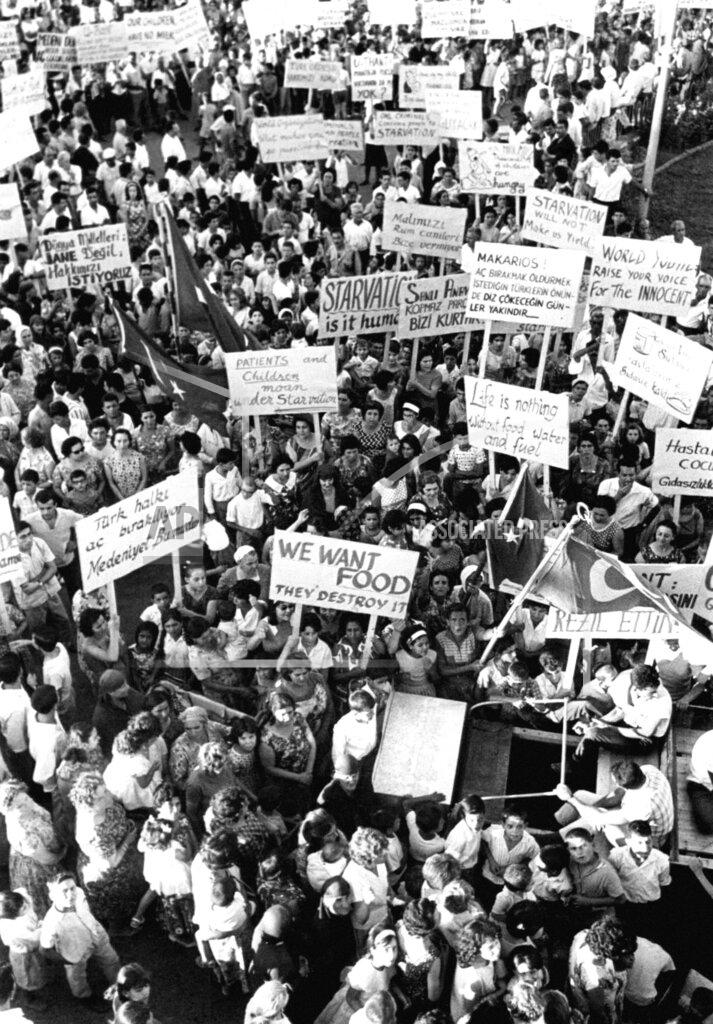
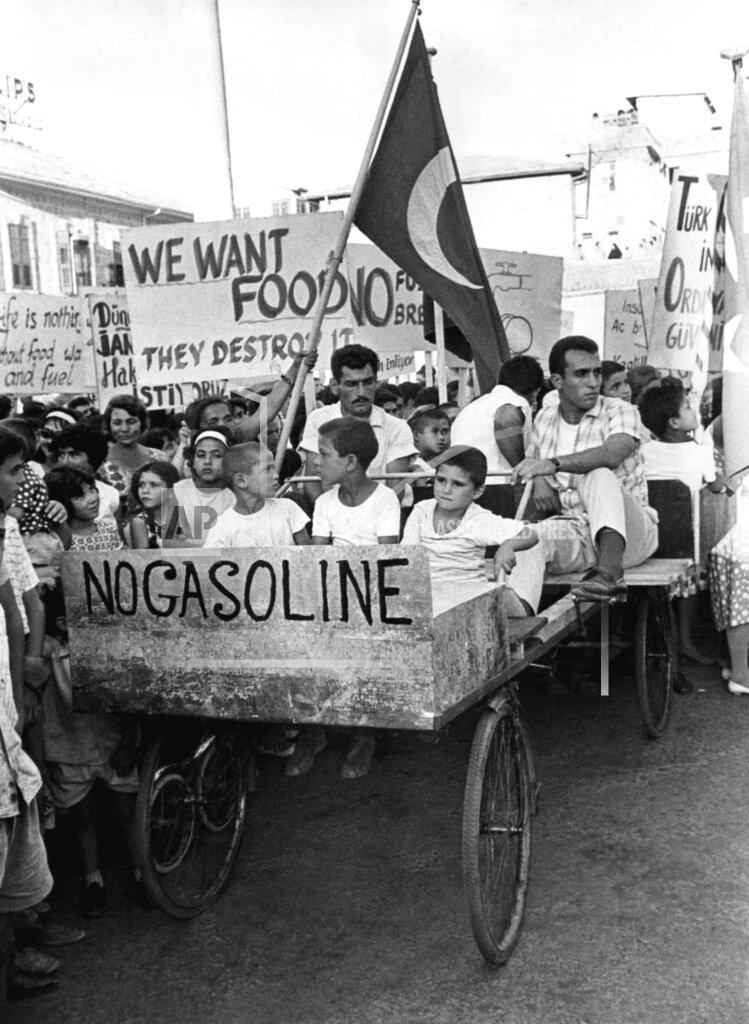
The Turkish Cypriots of Nicosia demonstrated tonight against the economic blockade by the Government of President Makarios. A crowd of about 8,000 took part in the protest in Ataturk Square.
Indonesian paratroopers land in Malaysia. The Malaysian Government, charging Indonesia with ”naked aggression,” pressed a search today for guerrillas still at large from a small group parachuted onto southern Malaya early in the day. About 30 Indonesia‐based guerrillas, described by government spokesmen here as regular paratroopers, landed near Labis, 12 miles south of Segamat, on the main SingaporeKuala Lumpur road and 85 miles southeast of Kuala Lumpur. A Defense Ministry spokesman said one of the invaders was killed by Malaysian policemen soon after the landing and three others were captured. “Several more” were captured later in the day, he said. The parachuting of the guerrillas, believed to be the first attempted by the Indonesians, was the fourth incursion by Indonesia based guerrillas into Malaya since August 17.
Three groups of about 30 guerrillas each made seaborne landings on that date in the vicinity of Pontian, 30 miles northwest of Singapore and 55 miles from the air drop. Malaysian troops and policemen have killed 14 of the seaborne raiders and have captured more than 40 of them. Malaysian security officers had been expecting new landings last weekend when the Malaysian Federation — formed of Malaya, Singapore, Sarawak and Sabah, formerly North Borneo — was celebrating its first anniversary. For more than a year, Indonesia‐based guerrillas have been raiding Sarawak and Sabah. These incursions have been part of Indonesia’s attempt to ”crush” Malaysia and “liberate” two northern Borneo provinces that border Indonesian Borneo. But the landing in Malaya itself opened a new front in the struggle to break up the new federation, which President Sukarno contends is a British creation aimed against Indonesia.
Britain, Australia and New Zealand agreed Thursday at a Cabinet‐level meeting in Kuala Lumpur to expand their defense aid to Malaysia, Reuters reported. Washington foresaw recourse to the United Nations Security Council, The Associated Press said, if the raiders were identified as Indonesian regulars.
The murder of a Malay rickshaw driver in the Geylang Serai section of Singapore, believed to have been committed by Singaporean Chinese assailants, triggered rioting within the Malay community. Before the violence abated, 36 people would be killed and more than 500 injured.
Peking charged today that the Soviet Union had been creating constant border incidents in the Ili region of Sinkiang, China’s far northwestern province. Last year the Chinese Communists declared that in 1962 Soviet personnel in the Ili region ”enticed and coerced tens of thousands of Chinese citizens into going to the Soviet Union.” The latest charge is contained in a report made to a party congress of Ili and Kazakh peoples in Sinkiang and reproduced by Hsinhua, the Chinese Communist press agency.
The Communist movement in Japan is expected to face a deepening crisis soon over differences among leftists here on the nuclear test‐ban treaty, coexistence with the West and other issues that have divided Moscow and Peking and shaken Communist unity everywhere. The normal feeling of kinship between Japanese and Chinese, who feel artificially separated by their rival political systems — Communism in China and democracy in Japan — is thought to aid Peking’s side in the quarrel with Moscow. However, observers believe that the pro‐Peking extremists in the Japanese Communist party have erred seriously in not allowing for the popularity of the nuclear test ban in Japan, the only country that has suffered atomic bombing. Peking and its adherents have bitterly opposed the test‐ban treaty.
The U.N. Secretary General, U Thant, informed the Security Council today that the United Nations observation group would be withdrawn from Yemen on Friday. Mr. Thant, in a written report, said he still hoped that Saudi Arabia and the United Arab Republic would try to settle “their needless and now senseless dispute over the Yemen of today.” He expressed hope that the two governments would soon meet “at the highest level” and said that this now offered “the best hope for significant progress towards disengagement and towards peace and stability in Yemen.” The Secretary General apparently based his hope for such a meeting on the fact that President Gamal Abdel Nasser of the United Arab Republic and Crown Prince Faisal of Saudi Arabia would attend a conference of Arab Kings and Presidents in Alexandria on Saturday.
Threatening flood waters flowed into the suburbs of western New Delhi tonight as weathermen forecast continued monsoon rains. Many roads around the Indian capital were already cut off by the worst floods since 1924, which also have aggravated the nation’s serious food shortage. Amphibious army vehicles evacuated hundreds of persons from about 30 villages as the Indian Government prepared a mass inoculation campaign against epidemics that could follow.
The Senate handed President Johnson a major victory today by voting to provide health insurance for the aged under Social Security. The vote was 49 to 44. It marked the first time either body of Congress had endorsed any such proposal for medical care, although repeated attempts had been made over the last 15 years. President Johnson immediately hailed the action as “a victory not only for older Americans but for all Americans.” “The health of every citizen — old and young, rich and poor — is vital to our strength as a nation,” he said.
But the Administration is not yet over the hurdles. The proposal is expected to run into strong opposition in the House. Only President Johnson’s success as a master persuader could possibly clear the way for the plan on medical care to become law, most Capitol observers believe. The showdown, with the vote seesawing all the way through the roll‐call, came in a hushed chamber in midafternoon. Visitors in the crowded galleries could see a major campaign issue shaping up on the Senate floor.
Senator Barry Goldwater, the Republican nominee for President, flew back from Phoenix, Arizona, to vote against the proposal. He issued a statement describing the program for medical care as an insult to the intelligence of the American people. In a two‐page statement put into The Congressional Record, Senator Goldwater said: “I face with deep foreboding the consequence of our embarking on this course.” He criticized the passage of the plan as a “most significant step” toward making the Social Security system a relief and charity organization.
Five liberal Republicans joined with 44 Democrats in voting to put health insurance into the Social Security bill. Voting against were 28 Republicans and 16 Democrats. The Republicans supporting the move were Jacob K. Javits and Kenneth B. Keating, both of New York; Clifford P. Case of New Jersey; Margaret Chase Smith of Maine, and Thomas H. Kuchel of California.
President Johnson signed a $1.1 billion housing program today that will reach slum apartments, farm and suburban homes, loans to the elderly and neighborhood remodeling. It will, the President said, help people rehabilitate their homes and neighborhoods rather than move “from the path of bulldozers.” The bill is a compromise — nearly $700 million less than Mr. Johnson wanted. But he said the $1,131,800,000 measure would benefit all of America. There is, Mr. Johnson said, a commitment to assure every American the chance to live in a decent home and a safe and decent neighborhood. The bill, he said, is “a milestone to assure that commitment.”
The House voted tentatively today to cancel the President’s authority to use local currencies resulting from “sales” of surplus farm products as grants for development and common defense purposes in the recipient countries. The 125‐to‐96 vote banning use of such funds unless appropriated by Congress for specific purposes was a severe, if temporary, setback for the Administration. If sustained on a roll‐call vote tomorrow, it would mean lumping together the annual foreign aid and Food for Peace appropriations. The effect of this fusion of programs would be to give opponents of both overseas efforts in support of United States foreign policy a king-size target of about $5.2 billion to shoot at. Congress has demonstrated its unwillingness in the last few years to appropriate much more than $3 billion for the foreign aid program alone.
The House action came when it was sitting as a legislative committee. Thus it must be confirmed tomorrow by a record vote. And the House Democratic leadership appeared confident that today’s tentative action would be reversed at that time. Representative Paul Findley, Republican of Illinois, offered the proposal to cut the Food for Peace authorization vehicle back to the two‐year program of $3.5 billion passed by the Senate. The House version calls for $6.4 billion over a three‐year period but lacks the Senate’s many policy restrictions. Administration spokesmen contend these restrictions would stifle the flexible Presidential authority — available since 1954 — to use surplus food of this country as a powerful instrument of United States foreign policy.
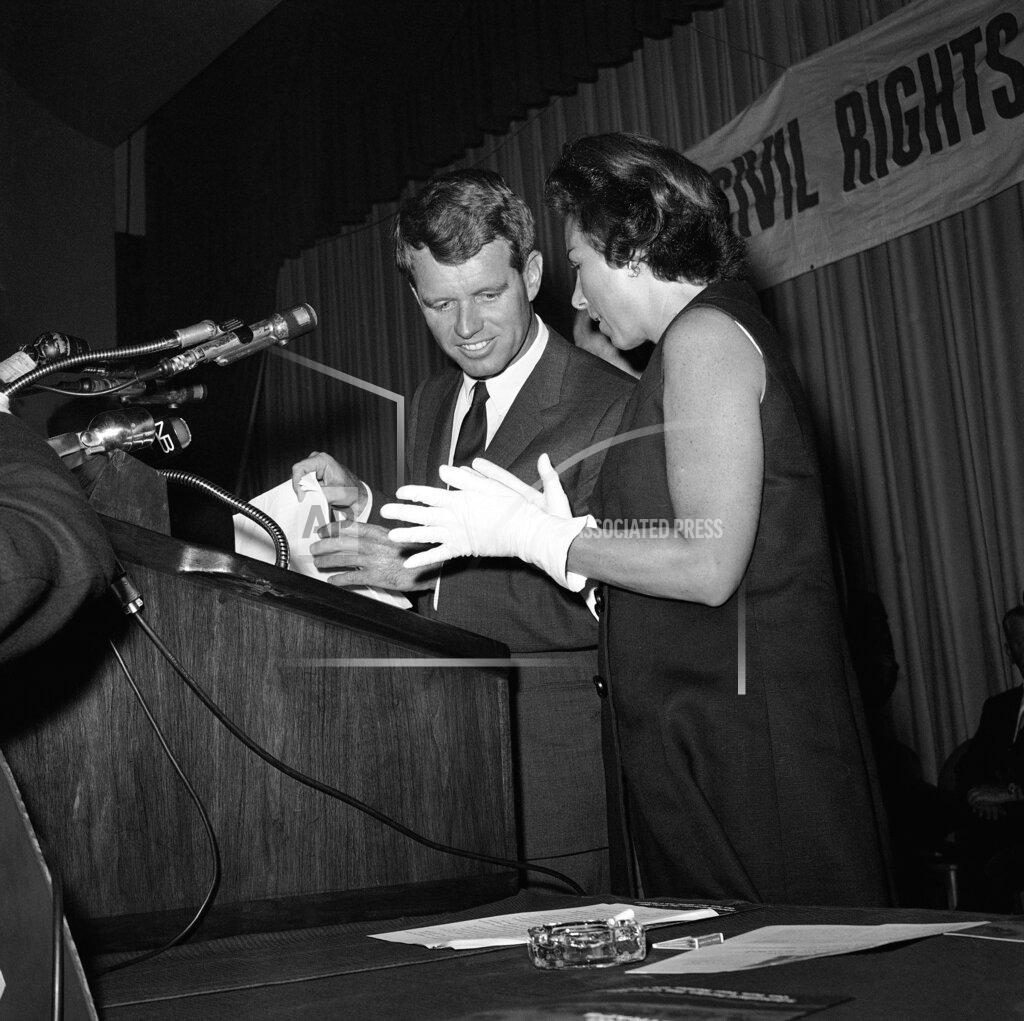
The American Federation of Labor and Congress of Industrial Organizations began today a major effort to carry out the purposes of the new Civil Rights Act. At a meeting that emphasized politics as much as civil rights, 250 national, state and local, labor leaders listened to George Meany, federation president, outline the stepped‐up civil rights program. They also heard from Roy Wilkins, executive secretary of the National Association for the Advancement of Colored People, and LeRoy Collins, director of the Community Relations Service set up under the Civil Rights Act.
Mr. Wilkins’s presence was a sign that the A.F.L.‐C.I.O. and the N.A.A.C.P., which have been feuding over association charges of union discrimination that the federation regarded as unfair, have entered a period of cooperation. Their common opposition to Senator Barry Goldwater, the Republican Presidential nominee, appeared as much responsible for this as anything. The federation’s leaders hope that one immediate result of their civil rights program will be to encourage political alliances with Black groups. They also hope the program will counteract so‐called white backlash among union members stemming from misconceptions of what the fair employment practices section of the new law does. Union leaders fear that many members may vote for Senator Goldwater, who opposed the Civil Rights Act, because they think the act requires employers to displace white workers with Blacks and destroys union seniority protection.
The Federal Bureau of Investigation, at President Johnson’s request, has begun an inquiry into charges of a conspiracy to divert $25,000 from a public stadium contract to the 1960 Democratic campaign chest. The charges were made in the Senate yesterday by Senator John J. Williams, Republican of Delaware. The President ordered the investigation last night, George E. Reedy, his press secretary, reported today. Mr. Williams and other Senators endorsed the President’s action. But Republicans continued to press for a separate Senate investigation. They said the bureau’s inquiry must not be used as an excuse for Senate inaction.
Organized labor gave Attorney General Robert F. Kennedy its overwhelming endorsement for the United States Senate yesterday. His supporters at the convention of the New York State American Federation of Labor and Congress of Industrial Organizations overrode fragmentary opposition to win Mr. Kennedy the official backing of the two million‐member body. Mr. Kennedy did not get the unanimous endorsement that the 1,500 delegates gave President Johnson and Senator Hubert H. Humphrey earlier in the week. About 40 delegates representing two maritime unions and a union of plastics and toy makers abstained from voting. Only three persons voted against the endorsement.
James R. Hoffa said tonight that he would attempt to block the election of Robert F. Kennedy as United States Senator from New York. Mr. Hoffa, who is president of the International Brother hood of Teamsters, the largest union in the nation, charged that Mr. Kennedy was “temperamentally and morally unfit” to hold public office. The union leader made his comments in an interview following a meeting with Teamster officials to discuss election strategy. Mr. Hoffa and Attorney General Kennedy, who was nominated by the Democrats yesterday, have been at odds since 1954. At that time Mr. Kennedy, as counsel to a Senate committee investigating labor‐management relations, began a campaign against corruption and coercion in labor unions and nation. He centered his attack on the leadership of the teamsters, the largest union in the nation.
A Ku Klux Klansman said in a signed confession today that two fellow Klansmen fired the shots that killed a prominent Washington Black on a lonely North Georgia highway. The confession, signed by 29year‐old James S. Lackey, implicated two of his friends, Joseph Howard Sims, 41, and Cecil William Myers, 25, in the slaying July 11 of Lemuel A. Penn. Lackey’s confession, which his lawyer said Lackey later repudiated, was introduced at the murder trial of Sims and Myers. Lackey is also charged in the crime, but his case has been separated from that of Sims and Myers. Mr. Penn, a 48‐year‐old lieutenant colonel in the Army Reserve, was killed by shotgun blasts while he and two Black companions were driving along a rural highway near Athens on the way from summer training at Fort Benning.
”They told me, ‘If you don’t want to, you don’t have to send your child to the white school,’ and I told them, ‘I know how to stay in my place.’” The speaker was Mrs. Minnie Pearl Boyd, one of several Black parents who were visited by white men the day before they were to have sent their children to the Carthage white school under Federal Court order. Only one of nine eligible Black children showed up for registration yesterday and the National Association for the Advancement of Colored People said the visits by Carthage businessmen were the reason. Mrs. Boyd, her husband and six children live in the middle of a cotton field on the banks of the Yockanookany River. They occupy one of a dozen houses in the Ofahoma community 10 miles east of Carthage, the county seat. The small intense woman paused from her cotton picking today to tell reporters of the subtle relationship between whites and Blacks in which little is said but much is understood. She also said that what she was seeking was not integration but relief from the poverty that has ruled her life.
In Carthage, the Black girl who registered in the white school attended classes today without incident. Debora Lewis was brought to the school by her parents, Mr. and Mrs. J. A. Lewis, who live in a small bungalow one mile from town. A dozen city police and sherriff’s deputies stood guard in front of the new brick building as the three drove up in a 1952 Chevrolet. The 8:15 bell had just rung and all the other students were in their rooms. The streets were empty except for the officers and a few reporters. An officer stopped Mrs. Lewis at the gate and a school official came out and escorted the child into the building. Three hours later, Mr. and Mrs. Lewis drove back to the school and picked up Debora just before the bell rang. There was no trouble.
Attorney General Robert F. Kennedy filed suit today against officials in Selma, Alabama, in the first action of its kind against alleged violation of the Civil Rights Act of 1964. The Attorney General asked a special three‐judge Federal panel to prevent law enforcement and judicial officials from arresting, jailing, punishing or threatening without just cause any person trying to exercise his civil rights. A second suit filed by the Attorney General charged the owners of five Selma restaurants with deliberate violation of the public accommodations section of the Civil Rights Act. It charged the owners and operators of the eating establishments with refusing to serve Blacks as required by law. “The defendants follow the policy and practice of discriminating against Negroes by refusing to sell food for consumption on the premises and to provide service to Blacks on the same basis as they sell food and serve food to non‐Blacks,” the Attorney General’s brief charged.
At the request of President Johnson, FBI Director J. Edgar Hoover initiated a COINTELPRO (counter intelligence program) against various Ku Klux Klan organizations and other white supremacist hate groups. “The purpose of this program”, Hoover wrote in a memorandum to the FBI field offices, “is to expose, disrupt and otherwise neutralize the activities of the various klans and hate organizations, their leadership and adherents.”
Melvin D. Synhorst, a Republican as well as being the Iowa Secretary of State, set politics aside and announced that he would order November’s election ballots to include the names of U.S. President Lyndon Johnson and his running mate, U.S. Senator Hubert H. Humphrey, despite the state Democratic Party’s failure to file certification papers before the midnight deadline on August 31. “The placing of the names of national candidates before the voters on equal footing is of primary importance to the voters of the nation,” said Synhorst, adding that “The people of Iowa and the country should not be penalized by an oversight on the part of others or for a lack of courage on my part.” Johnson and Humphrey would win Iowa’s nine electoral votes in November.
Sgt. Alvin C. York, the reluctant World War I infantryman who became an American legend, died this morning at Veterans Administration Hospital after a long illness. He was 76 years old. On October 8, 1918, during the final offensive of the war, the Tennessee mountaineer whose religious convictions at first kept him from fighting, singlehandedly captured or killed an entire German machine‐gun battalion. Sergeant York had been in a coma since Sunday. His death at 10:40 AM today was caused, a hospital statement said, by “general debility resultant of a combination of conditions incident to his age and complicating illnesses over the past 10 years.”
Having caused considerable damage and deaths in the United States, Cuba, Haiti, the Dominican Republic and Guadeloupe during late August, Hurricane Cleo, now over the Atlantic, intensified to hurricane force again, before dissipating three days later.
Dean Chance, making a strong bid for recognition as baseball’s best pitcher of 1964, defeated the New York Yankees tonight for the fourth time this year and dropped them three games off the pace in the American League pennant race. The tall young right‐hander, prize possession of the Los Angeles Angels, pitched a four-hit, 4–0 shutout, facing only 30 batters. He walked one, struck out four, and allowed only one man to reach third. A three‐run homer by Joe Adcock ended a streak of 40 scoreless innings Jim Bouton had compiled against Los Angeles and gave Chance all the support he needed in the fourth inning. Chance, for his part, has given the Yankees only one run all season, a home run by Mickey Mantle the last time the Yankees were here. That’s the only time New York has scored off Chance in 48 innings, going back to September 25 of last year.
Milt Pappas keeps the Baltimore Orioles in first place with a one-hit 2–0 win against the Minnesota Twins. Zoilo Versalles gets the single in the 8th for the only hit. The only other Twin to reach base was Earl Battey, who walked in the third inning. The Twins hit only three balls out of the infield aside from Versalles’s single. Sam Bowen’s 19th home run in the second inning helped the right‐hander gain his 13th victory, his fifth in succession. Luis Apiricio hit his ninth homer in the ninth inning. Dick Stigman, the Minnesota loser, allowed only four hits until he was relieved by John Klippstein in the ninth. The loss was Stigman’s 14th against six victories.
Gary Peters’s five-hit pitching and a four‐run fifth inning keyed by Bill Skowron’s single with the bases filled gave the Chicago White Sox a 7–0 victory over the Detroit Tigers tonight. Peters brought his won‐lost record to 16–7 with his third shutout of the season and the White Sox got four of their nine hits in the big fifth, when they chased Hank Aguirre and batted around. Gerry McNertney’s single, a sacrifice by Peters, a walk to Jim Landis and Don Buford’s single sent in one run and knocked out Aguirre. Ed Rakow went in, hit Ron Hansen with a pitch to fill the bases and Skowron followed with a two‐run single. Peters then singled in the final run.
Lee Stange ties a Major League record with 4 strikeouts in the 7th inning, as the Cleveland Indians beat the Washington Senators, 9–0. Stange struck out 10 in all. His four strikeouts in the seventh inning made him the fourth American League pitcher to perform that feat. Stange struck out Don Lock, but Lock reached first base on a passed ball by the catcher, Jose Azcue. Stange then fanned Willie Kirkland and was touched for a single by Brumley before striking out Don Zimmer and John Kennedy.
The Kansas City Athletics drove Bill Monbouquette from the mound with four runs in the third inning tonight and defeated the Boston Red Sox, 9–5, with a 14‐hit attack. Orlando Peña scattered 11 hits to get the win. Boston right fielder Lee Thomas hit two home runs and Félix Mantilla added another in a losing effort for Boston.
Tony Taylor’s two‐run single in the fourth inning and Chris Short’s four‐hit pitching carried the National League leading Philadelphia Phillies to a 2–1 victory over the Houston Colts tonight. Wes Covington led off the fourth with a single and took second as Clay Dalrymple singled off Don Nottebart. Frank Thomas sacrificed before Taylor drove home the runs with a single to center. Short, beating Houston for the third time in four starts, recorded his 15th victory against seven defeats.
Bob Gibson pitched the St. Louis Cardinals to their eighth victory in their last nine games tonight, scattering seven Milwaukee Braves’s hits to record his 13th victory of the season, 6–2. Ken Boyer’s sacrifice accounted for the first Cardinal run in the first and Boyer took part in a two‐run. third when he tripled home one run and scored on Dick Groat’s single. The Cardinals added three runs in the fourth on two hits and Denis Menke’s two successive errors.
Juan Marichal overcame his aching back and the New York Mets simultaneously last night, pitching a 4–0 shutout for his 16th victory and allowing only four Mets to reach base — all on singles. The ace of the San Francisco Giants’ staff made his second appearence since July 29 and his first since August 25, when he pitched five innings and lost to the Los Angeles Dodgers, 3–1. Last night, with 36,589 persons in Shea Stadium on another cool, colorful evening and with the Giants trailing the Philadelphia Phillies by 7½ games with 29 to go, Marichal volunteered to give it another try as an epidemic of sore arms plagued the Giants staff. He pitched six perfect innings and three nearly perfect ones, permitted four singles and no walks, and struck out nine Mets for his eighth straight over New York in three seasons.
John Griffith drove in two runs with a bases‐filled double that snapped a 5–5 tie in the 12th inning and gave the Los Angeles Dodgers an 8–5 victory over the Pittsburgh Pirates tonight. Griffith’s hit, his first of the game, came off Vernon Law, the fifth Pirate hurler. Maury Wills and Dick Tracewski had singled to open the inning and advanced on Willie Davis’s sacrifice. Wes Parker was walked intentionally before Griffith doubled down the right‐field line. The Dodgers added another run in the inning on an infield groundout.
Mel Queen hit a single to center in the 12th inning tonight, driving in the game’s only run as the second‐place Cincinnati Reds beat the Chicago Cubs, 1–0, behind Jim O’Toole’s seven-hit pitching. The victory kept the Reds 5½ games behind the National League leading Philadelphia Phillies, who defeated Houston, 2–1. The Reds scored the winning run in the 12th on consecutive singles by Marty Keough, a pinch‐hitter, Chico Ruiz and Queen off Don Elston, the Cub’s reliever. O’Toole’s victory was his 14th against six losses.
Dow Jones Industrial Average: 845.08 (+1.08).
Born:
Keanu Reeves, Canadian film actor (“Bill & Ted’s Excellent Adventure”, “The Matrix”, “John Wick”), to an American father and a British mother, in Beirut, Lebanon.
Greg Lathan, NFL wide receiver (Los Angeles Raiders), in San Diego, California.
Anthony Burke, NFL defensive tackle (St. Louis Cardinals), in Kankakee, Illinois.
Died:
Alvin York, 76, American war hero and Medal of Honor winner whose life was commemorated in the popular film Sergeant York in 1941.
Francisco Craveiro Lopes, 70, President of Portugal from 1951 to 1958.
Glenn A. Black, 64, American archaeologist.
Morris Ankrum, 67, American actor (Kronos, Earth vs Flying Saucers).
 History Diaries