Into the Abyss
Turning and turning in the widening gyre
The falcon cannot hear the falconer;
Things fall apart; the centre cannot hold;
Mere anarchy is loosed upon the world,
The blood-dimmed tide is loosed, and everywhere
The ceremony of innocence is drowned;
The best lack all conviction, while the worst
Are full of passionate intensity.
Surely some revelation is at hand;
Surely the Second Coming is at hand.
The Second Coming! Hardly are those words out
When a vast image out of Spiritus Mundi
Troubles my sight: a waste of desert sand;
A shape with lion body and the head of a man,
A gaze blank and pitiless as the sun,
Is moving its slow thighs, while all about it
Wind shadows of the indignant desert birds.
The darkness drops again but now I know
That twenty centuries of stony sleep
Were vexed to nightmare by a rocking cradle,
And what rough beast, its hour come round at last,
Slouches towards Bethlehem to be born?
— William Butler Yeats
World War II begins in Europe.
Adolf Hitler issues Directive No. 1 for conduct of the war.
The Supreme Commander Of The Armed Forces.
Berlin, OKW / WFA Nr. 170/39 g. K. Chefs. L I.
31st August, 1939.
MOST SECRET
Senior Commanders only 8 copies
By hand of Officer only Copy No. 2
Directive No. 1 For The Conduct Of The War
- Since the situation on Germany’s eastern frontier has become intolerable and all political possibilities of peaceful settlement have been exhausted, I have decided upon a solution by force.
- The attack on Poland will be undertaken in accordance with the preparations made for Case White, with such variations as may be necessitated by the buildup of the Army which is now virtually complete. The allocation of tanks and the purpose of the operation remain unchanged. Date of attack: 1st September, 1939. This time also applies to operations at Gdynia, in the Bay Of Danzig, and at the Dirschau Bridge.
- In the west it is important to leave the responsibility for opening hostilities unmistakably to England and France. Minor violations of the frontier will be dealt with, for the time being, purely as local incidents. The assurances of neutrality given by us to Holland, Belgium, Luxembourg, and Switzerland are to be meticulously observed. The western frontier of Germany will not be crossed by land at any point without my explicit orders. This applies also to all acts of warfare at sea or to acts which might be regarded as such. The defensive activity of the Air Force will be restricted for the time being to the firm repulse of enemy air attacks on the frontiers of the Reich. In taking action against individual aircraft or small formations, care will be taken to respect the frontiers of neutral countries as far as possible. Only if considerable forces of French or British bombers are employed against German territory across neutral areas will the Air Force be permitted to go into defensive action over neutral soil. It is particularly important that any infringement of the neutrality of other States by our western enemies be immediately reported to the High Command Of The Armed Forces.
- Should England and France open hostilities against Germany, it will be the duty of the Armed Forces operating in the west, while conserving their strength as much as possible, to maintain conditions for the successful conclusion of operations against Poland. Within these limits enemy forces and war potential will be damaged as much as possible. The right to order offensive operations is reserved absolutely to me. The Army will occupy the West Wall and will take steps to secure it from being outflanked in the north, through the violation by the western powers of Belgian or Dutch territory. Should French forces invade Luxembourg the bridges on the frontier may be blown up. The Navy will operate against merchant shipping, with England as the focal point. In order to increase the effect, the declaration of danger zones may be expected. The Naval High Command will report on the areas which it is desirable to classify as danger zones and on their extent. The text of a public declaration in this matter is to be drawn up in collaboration with the Foreign Office and to be submitted to me for approval through the High Command Of The Armed Forces. The Baltic Sea is to be secured against enemy intrusion. The Commander In Chief Of The Navy will decide whether the entrances to the Baltic Sea should be mined for this purpose. The Air Force is, first of all, to prevent action by the French and English Air Forces against the German Army and German territory. In operations against England, the task of the Air Foice is to take measures to dislocate English imports, the armaments industry, and the transport of troops to France. Any favourable opportunity of an effective attack on concentrated units of the English Navy, particularly on battleships or aircraft carriers, will be exploited. The decision regarding attacks on London is reserved to me. Attacks on the English homeland are to be prepared, bearing in mind that inconclusive results with insufficient forces are to be avoided in all circumstances.
Adolf Hitler.
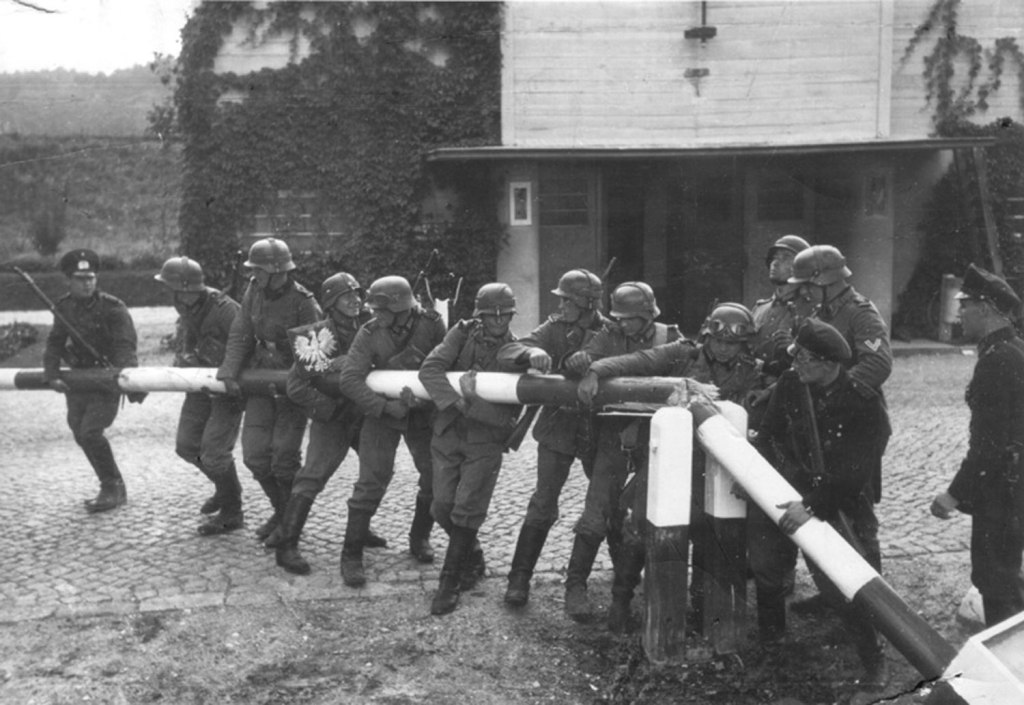
1:40 AM: At the Polish-German border post in Jeziorki, near Piła (Schneidemühl), an exchange of fire occurred between a group of several dozen German saboteurs and a Polish border patrol. The 38-year-old Corporal Piotr Konieczka on the Polish side was killed.
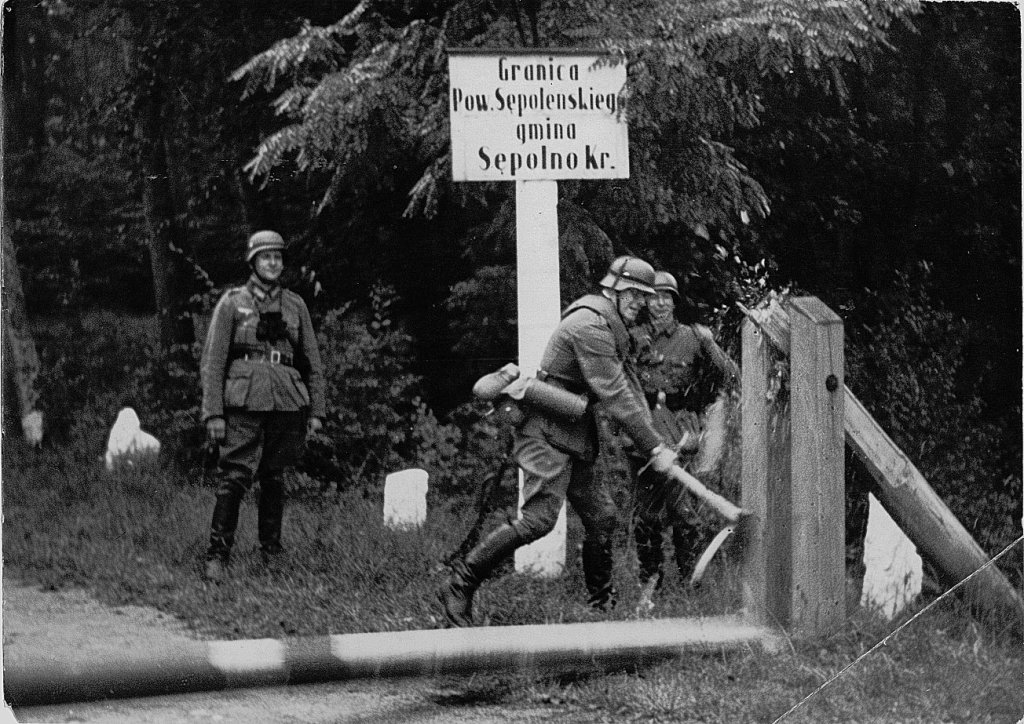
3:30 AM: The Polish border patrol on bikes was fired on by German soldiers near Krzepice. German soldiers had already crossed the border line.
4:00 AM: The telephone line and the power supply to the Polish Post Office in Danzig were cut off.
4:30 AM: A bridge in Praszka was blown up by Corporal Józef Górecki with German soldiers on it who were attempting to cross the Polish border.
4:34 AM: Dive bombers, commanded by Bruno Dilley, began bombing the Polish sappers positions of the bridge in Tczew to try to prevent the bridge from being blown up. However, the bridge on the important railway line connecting East Prussia and the Reich was blown up around 6.00 AM and started the German invasion of Poland.
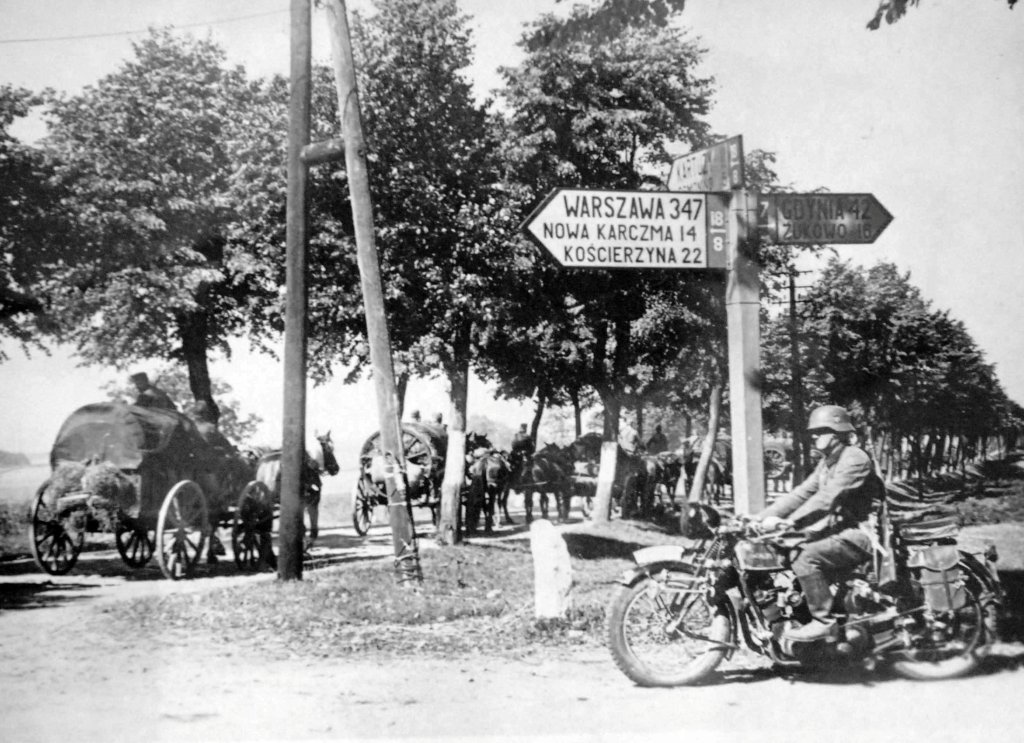
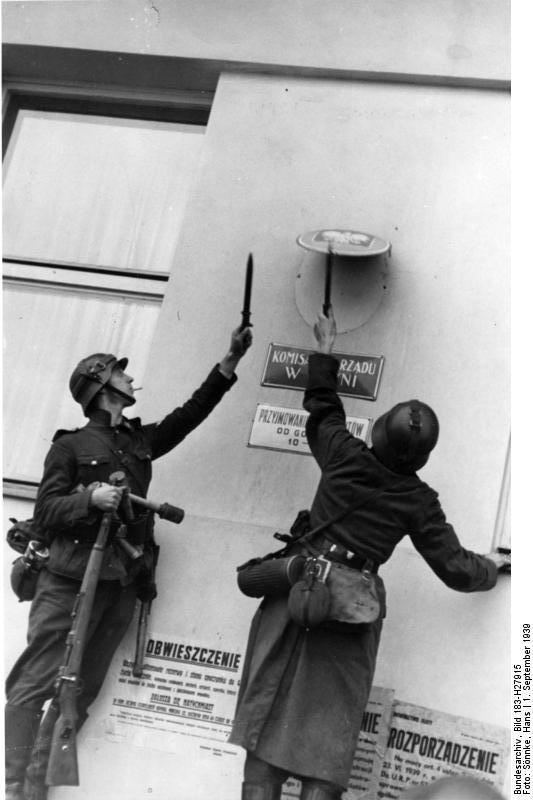
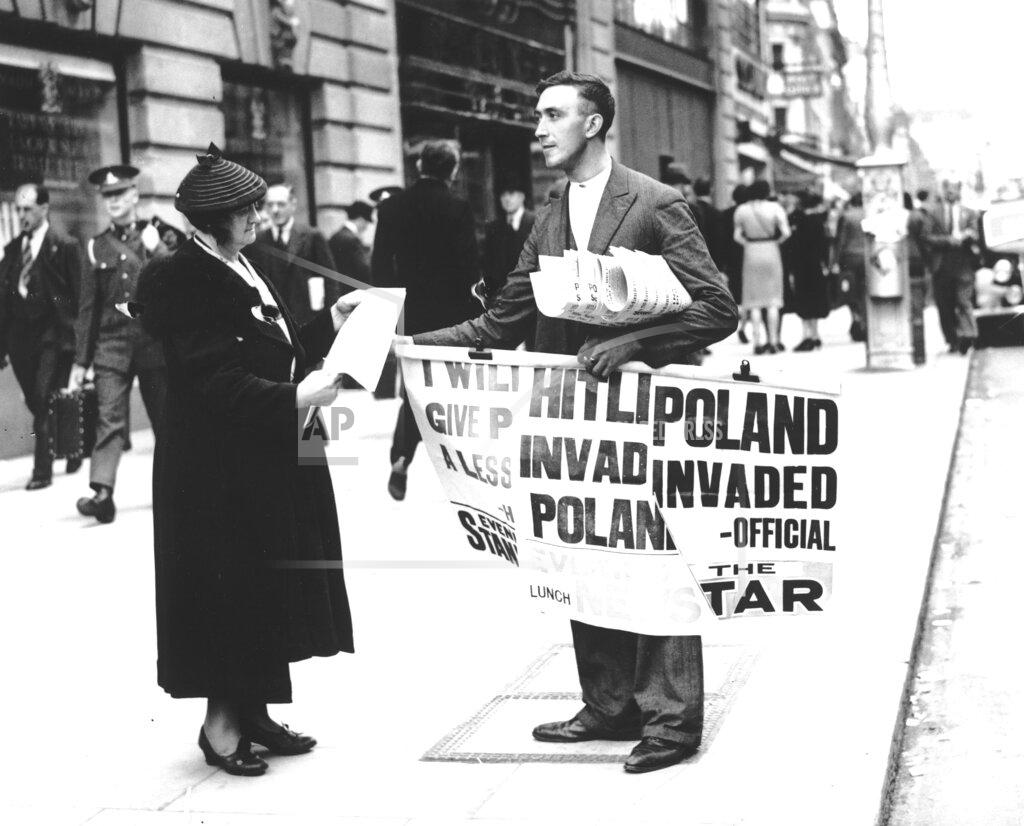
In the first Luftwaffe operation of WWII, Ju 87 ‘Stuka’ dive bombers attack targets near the bridges over the Weichsel. Over 1.7 million troops (53 divisions) advance into Poland from East Prussia, Silesia, and Slovakia. Led by tactical air strikes by the Luftwaffe, armor divisions strike deep into Polish territory. While the Poles can field an army of 600,000 men, they are unable to mobilize efficiently or coordinate their defense. Within four weeks, the Germans will destroy most of the Polish army and occupy the western and central regions of Poland. The British and French governments mobilize their military forces, but express a readiness to negotiate a settlement if the Germans withdraw their military forces from Polish territory.
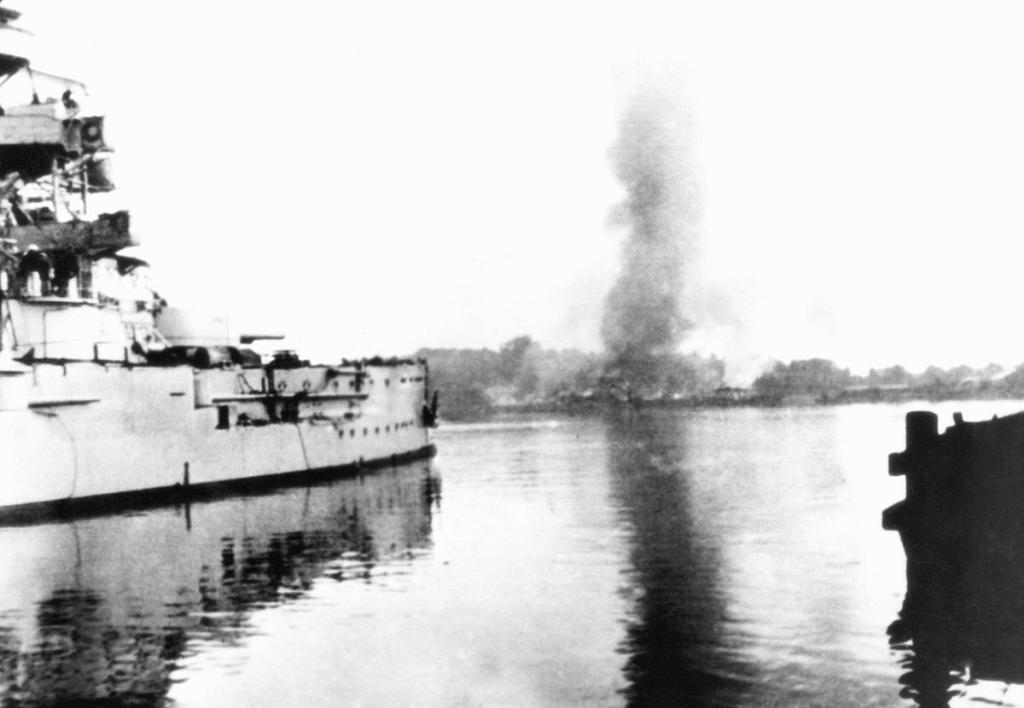
4:45 AM: The old battleship Schleswig-Holstein opened fire on a garrison in Westerplatte, the first cannon shots of World War II. Schleswig-Holstein fired a broadside at the Polish garrison. That salvo’s time has been variously stated as 04:45, 04:47, or 04:48. Polish historian Jarosław Tuliszka explains that 04:45 was the planned time, 04:47 was the time the order was given by Kleikamp and 04:48 was the time the guns actually fired. Shortly after, on Westerplatte, Sucharski radioed the nearby Polish military base on the Hel Peninsula, “SOS: I’m under fire.” The battleship’s initial bombardment was not very successful, failing to inflict a single casualty among the defenders, as due to the battleship’s proximity to its target its heavier shells did not have time to arm and did not explode upon impact.
Eight minutes later Henningsen’s marines from the Schleswig-Holstein, who had disembarked two hours earlier on the eastern side of the peninsula, advanced, expecting an easy victory over the Poles. However, after crossing the artillery-breached brick wall at the border, advancing about 200 metres (220 yd), and engaging the Polish Prom outpost, the Germans ran into an ambush. They found themselves in a kill zone of Polish crossfire from concealed firing positions, while barbed-wire entanglements impeded their movements. Around 05:15, the field gun, commanded by Pająk, opened intense fire on the advancing Germans, firing 28 rounds and knocking out several machine-gun nests atop warehouses across the harbour canal. Meanwhile, the German infantry was also shelled by the Polish mortars, and even the battleship itself was targeted by the Polish 37 mm guns. Around that time, the Poles also repulsed an attempt by a small maritime unit of the Danzig Police to land on the western side of the depot. In that initial engagement, Poles sustained two casualties, and a Polish soldier, Staff Sergeant Wojciech Najsarek, was killed by machine-gun fire. Najsarek has been described as the first Polish combat casualty of the battle and perhaps of the war.
At 06:22, the German marines frantically radioed the battleship that they had sustained heavy losses and were withdrawing. Casualties were approximately fifty Germans and eight Poles, mostly wounded. A longer bombardment from the battleship, lasting from 07:40 to 08:55, preceded a second attack and succeeded at knocking out the Polish field gun. The Germans assaulted again from 08:35 to 12:30 but encountered mines, felled trees, barbed wire and intense fire. By noon, when the Germans retreated, Henningsen had been gravely wounded. Eberhardt requested air support, but it was delayed due to bad weather over Westerplatte. On that first day’s combat, the Polish side had sustained four killed and several wounded. The German marines had lost sixteen killed and a hundred and twenty wounded.
The Germans had expected an easy victory. Instead, the Poles woud hold out in the Westerplatte until September 7. Westerplatte’s defence inspired the Polish Army and people even as German advances continued elsewhere; beginning on 1 September 1939, Polish Radio repeatedly broadcast the phrase that made Westerplatte an important symbol: “Westerplatte broni się jeszcze” (“Westerplatte fights on”). The Polish historian Krzysztof Komorowski writes that “Westerplatte has become one of the symbols of the Polish struggle for independence, and is inscribed in the list of the most heroic battles of modern Europe.”
Naval forces consist of Naval Group Command East (Gen-Adm Albrecht, Chief of Staff Rear-Adm Schmundt) with overall responsibility. Under its command are Commander Reconnaissance Forces, Vice-Adm Densch, with the light cruisers Nurnberg, Leipzig and Koln; Officer Commanding Torpedo Boats, Rear-Adm Lutjens, with the destroyers Leberecht Maass, Georg Thiele, Richard Beitzen, Friedrich Ihn, Erich Steinbrinck, Friedrich Eckoldt, Bruno Heinemann, Wolfgang Zenker, Bernd von Arnim and the 1st S-Boat Flotilla with S11, S12, S18, S19, S 20, S 21, S 22, S 23 and the tender Tsingtau; Officer Commanding Minesweepers, Capt Ruge, on board the torpedo boat T196 with the escort boats F 7, F 8, F9 and F10, the 1st Minesweeping Flotilla with 7 minesweepers, the Experimental Barrage Command with the old minesweepers Nautilus, Otto Braun, Pelikan, Arkona and Sundewall and the 3rd Motor Minesweeping Flotilla with the tender Von der Groben and R 33, R 34, R 35, R 36, R 38, R 39 and R 40; Officer Commanding U-Boats East, Cdr Schomburg, with U 5, U6,U7, U14, U18, U22, U 31, U 32, U 35 and U 57; and Officer Commanding Naval Air Forces East, Maj-Gen Coeler, with ten naval air squadrons. There are also harbour protection flotillas and the old predreadnought battleship Schleswig-Holstein (Capt Kleikamp) at Danzig-Neufahrwasser.
Polish naval forces (CinC Rear-Adm Unrug) consist of the destroyer Wicher, the minelayer Gryf, the submarines Sep, Orzel, Wilk, Rys and Zbik, two old torpedo boats, two gunboats and six small minesweepers, as well as auxiliary and training vessels.
The first shots of the war are fired by German battleship Schleswig Holstein at the Polish Gdansk (Danzig) fortifications of Westerplatte, whose defenders beat off an attack by a naval assault company.
At 4:45 AM, German troops cross the Polish frontier. Germany initiates the operation code named Fall Weiss (Case White) and invades Poland without a declaration of war.
Early morning: The Luftwaffe began bombing raids on airfields, ships and troops.
Over Warsaw, Poland, Oberst Walter Grabmann’s Messerschmitt Bf 110 squadron (I.(Z)/Lg.1) led by Hauptmann Schleit, shoots down five Polish PZL P.11 fighters while escorting the Heinkel He 111P bombers of II/KG.1. He sustained wounds as one of the P.11 fighters damaged his Bf 110 fighter.
Early morning: The series of battles collectively known as the Battle of the Border began in Poland.
Early morning: The Slovak Republic began a limited invasion of disputed Polish territories and met little resistance.
6.30 AM: Warsaw radio and all Polish radio stations broadcast a special message about the beginning of the war.
about 6:30 AM: Aerial combat occurred near Krakow. A Polish PZL P.11c, piloted by Mieczysław Medwecki, was shot down by a Junkers Ju 87, piloted by Frank Neubert. A German Dornier Do 17 E, of the 77th Luftwaffe Bomber Regiment, was shot down by a Polish PZL P.11c, piloted by Władysław Gnyś. As it fell to earth, it collided with a second German bomber, which also crashed. They were the first Allied and Axis aircraft shot down during World War II. Gnyś and Neubert would meet decades later, in 1989.
about 6.30 AM: From the observation point in Mława, a report was received by the staff of the Polish Pursuit Brigade about a bombing expedition headed for Warsaw. Colonel Pawlikowski ordered the start of the entire Brigade. At about 7:00 a.m. about 54 Polish fighters attacked in the Bugo-Narew region about 80 He 111 from LG 1 and KG 27 “Boelcke” in the cover of 20 Bf 109 from I (Z) / LG 1. German bombers are scattered, dropped bombs and hastily turned back. The expedition does not reach Warsaw.
Polish President Ignacy Mościcki declared a state of emergency.
Benito Mussolini ordered his ambassador in Berlin to ask for a telegram releasing Italy from any obligation to take part in the war. At 9:40 a.m. Hitler obliged with a cordial telegram saying he did not “expect to need Italy’s military support in these circumstances.”.
about 10:00 AM: The Battle of Mokra took place near the village of Mokra, 5 km north of Kłobuck and 23 km north-west of Częstochowa, Poland. It was one of the first battles of the Invasion of Poland, during the Second World War, and was one of the few Polish victories of that campaign and the first German defeat of the conflict. The Poles inflicted heavy casualties on 4th Panzer Division, knocking out between 100 and 160 AFVs (at least 50 of them tanks). The Germans lost approximately 800 men (killed, captured, wounded or missing). The German 4th Panzer Division was forced back to its initial positions in Opatów and Wilkowiecko, and only the 12th Schützen Regiment managed to reach the rail road crossing at Izbiska. However, upon learning that the German 1st Panzer Division had managed to take Kłobuck, the Polish forces were obliged to be withdrawn overnight southeastwards, to the village of Łobodno located northeast of Kłobuck, and then to the second line of defence, some 12 km to the east.
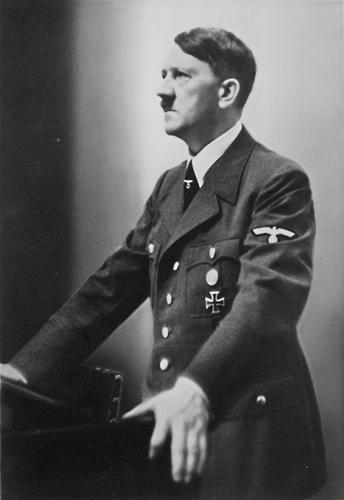
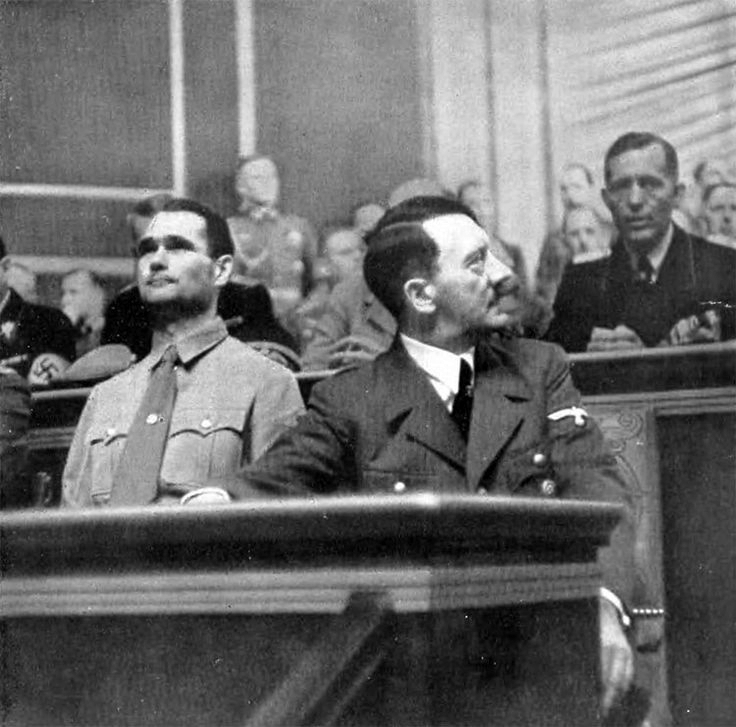
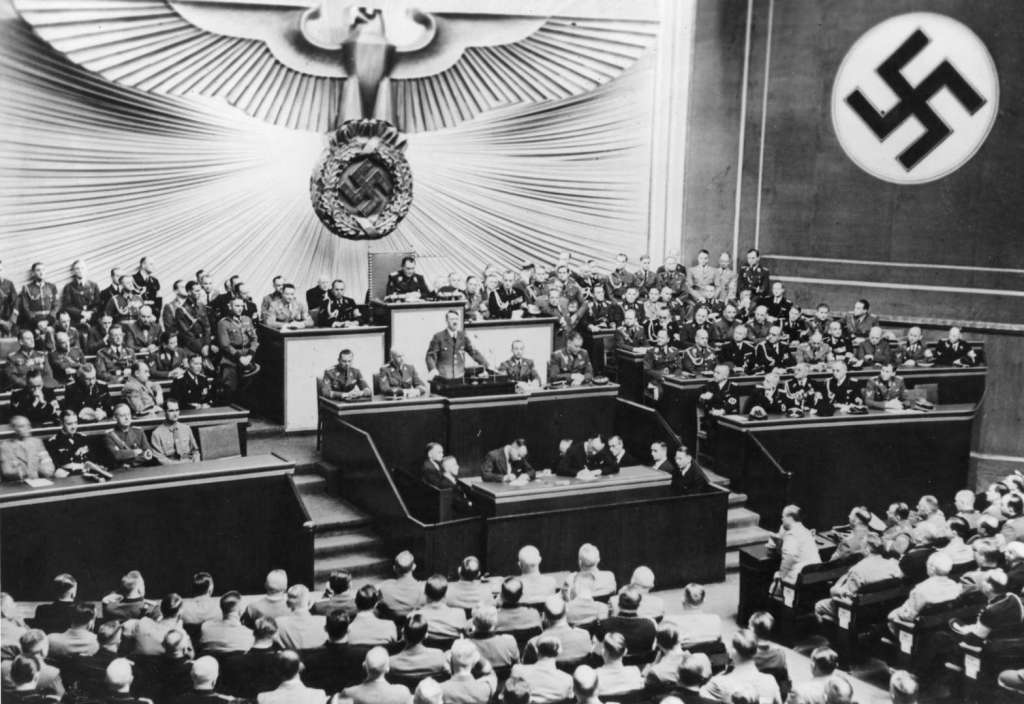
about 11:00 AM: German Chancellor Adolf Hitler appeared before the Reichstag to explain his decision. Those in the audience who didn’t notice that Hitler was wearing a field-gray uniform instead of his usual brown jacket would have done so after he declared toward the end: “From now on I am just the first soldier of the German Reich. I have once more put on that coat that was the most sacred and dear to me. I will not take it off again until victory is assured, or I will not survive the outcome.” Hitler addresses the Reichstag in Berlin, with the audio broadcast to nations around the world. Some quotes: “I have offered England friendship and, if necessary, close cooperation. Germany has no interests in the West. The Westwall is and remains our border on the west.”, “Neutral powers have assured us of their neutrality and we have assured them they will be respected. We mean this.” “Germany and Russia fought against each other in the World War, and that shall not occur again.”
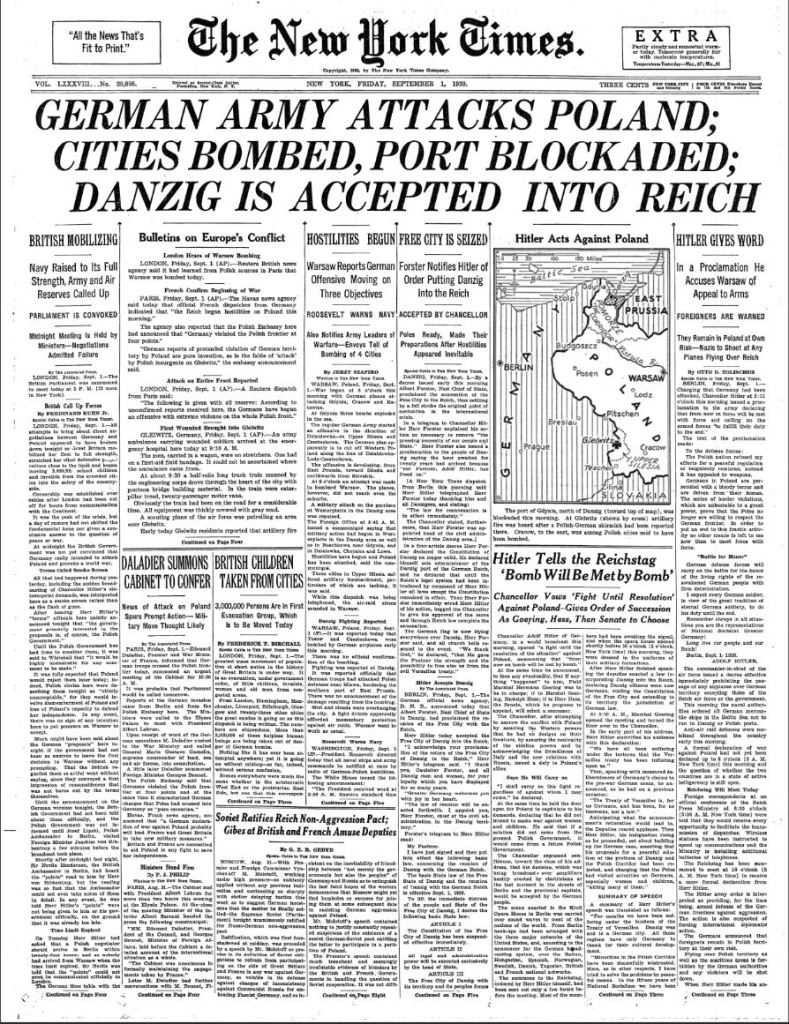
Chancellor Adolf Hitler of Germany, in a world broadcast this morning, opened “a fight until the resolution of the situation” against Poland, announcing that “from now on bomb will be met by bomb.”
about 1:00 PM: A second German attack on Westerplatte collapses after heavy losses on the German side.
Polish ships took minor damage in the Battle of the Danzig Bay.
Albert Förster cancelled the constitution of the Free City of Danzig and decreed the region’s reincorporation into Germany.
Germany annexes the Free City of Danzig. Adolf Hitler advises the United Kingdom and France that he would withdraw from Poland if allowed to keep Danzig and the Polish Corridor.
British censorship slows dispatches. Despite restrictions of censorship, communication connections with Europe were functioning efficiently but with some delay yesterday as cable and radiogram companies here reported a 25 per cent increase over normal traffic in cables and a normal transmission in radio messages.
British Prime Minister Neville Chamberlain appeared before the House of Commons shortly after 6:00 in the evening. “It now only remains for us to set our teeth and to enter upon this struggle, which we ourselves earnestly endeavoured to avoid, with determination to see it through to the end”, he declared. “We shall enter it with a clear conscience, with the support of the Dominions and the British Empire, and the moral approval of the greater part of the world”.
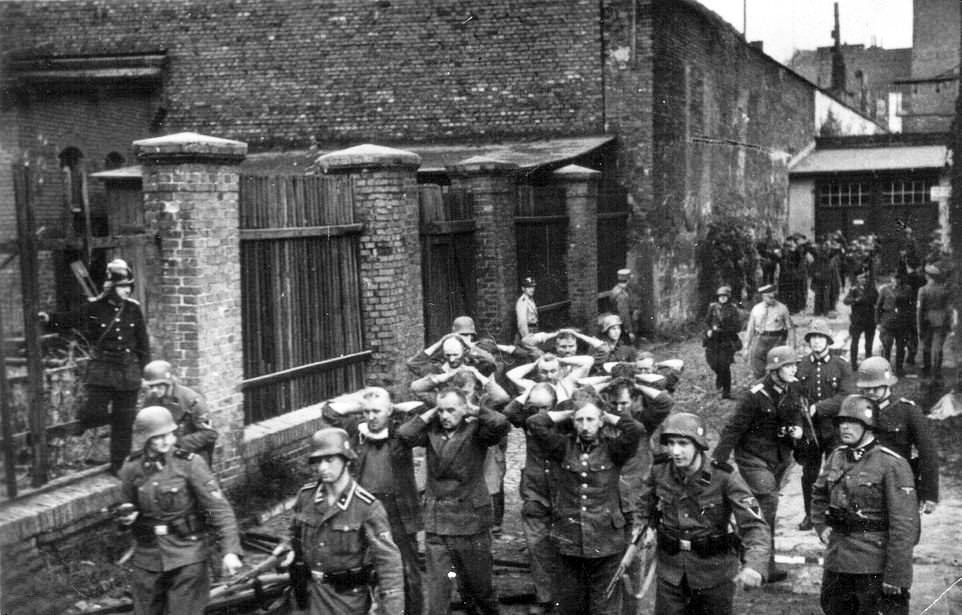
7.00 PM: Personnel surrendered the Polish Post Office in Danzig after some 15 hours of fight. Its director, Jan Machoń, carried a white flag but was shot immediately. Most of the defenders would be executed a month later.
Ambassadors of the British and French governments issues an ultimatum to the German government to pull out of Poland.
9.00 PM: British Ambassador to Germany Sir Nevile Henderson handed an ultimatum to Joachim von Ribbentrop. It declared that unless the British government received “satisfactory assurances” that Germany was prepared to withdraw from Polish territory, “His Majesty’s Government will without hesitation fulfill their obligation to Poland”. One hour later, the French ambassador delivered an identical note. The text:
“Early this morning the German Chancellor issued a proclamation to the German Army which indicated clearly that he was about to attack Poland. Information which has reached His Majesty’s Government in the United Kingdom and the French Government indicates that Ger- man troops have crossed the Polish frontier and attacks on Polish towns are proceeding.
“In these circumstances it appears to the Governments of the United Kingdom and France that by their action the German Government have created conditions-namely, an aggressive act of force against Poland threatening the independence of Poland-which call for the immediate implementation by the Governments of the United King- dom and France of the undertaking to Poland to come to her assistance.
“I am, accordingly, to inform Your Excellency that unless the German Government are prepared to give His Majesty’s Government an assurance that the German Government have suspended all aggressive action against Poland and are prepared promptly to withdraw their forces from Polish territory, His Majesty’s Government in the United Kingdom will, without hesitation, fulfill their obligations to Poland.”
German U-boats are deployed in the Baltic to aid the German attack. U-5, U-6, and U-7 patrol the Kattegat near Laeso. U-22 patrols inside the Irben Strait. U-31, U-32, U-35 are off the Gulf of Danzig for minelaying and U.14 and U-18 on patrol off the Gulf of Danzig. U-57 patrols off Libau.
The Polish gunnery training vessel ORP Mazur is bombed and sunk near Hel, at Oksywie by Luftwaffe Ju-87 Stuka aircraft with the loss of about 40 of her crew. The Polish auxiliary ship ORP Nurek is also sunk off Gdansk.
In Puck Bay, near Gdynia, the Polish naval force is attacked by German dive bombers, and minelayer ORP Gryf and minesweeper ORP Mewa are seriously damaged. ORP Gryf is forced to jettison her mines to prevent the explosion of those still on deck. ORP Mewa is towed to Hela by ORP Rybitwa.
The Polish submarine ORP Wilk attacks the German destroyer Erich Steinbrinck unsuccessfully and is then damaged by depth charges dropped by that destroyer and Friedrich Ihn, but is able to continue on patrol.
Among the opening acts of the European War, the German Luftwaffe bombs the town of Wielu in Poland, causing 1,200 civilian casualties.
German armored ship Admiral Graf Spee, which has left Wilhelmshaven on 21 August for the South Atlantic, makes rendezvous with tanker Altmark southwest of the Canary Islands. The fuel oil carried in Altmark’s bunkers was obtained in August at Port Arthur, Texas. Admiral Graf Spee’s sister ship Deutschland, which had departed Wilhelmshaven on 24 August, is deployed to raid commerce in the North Atlantic.
Albert Förster, leader of the National Socialists in Danzig, announces the reunion of Danzig with Germany in response to the German invasion of Poland.
D’Arcy Osborne, British Ambassador at the Vatican, reports to Lord Halifax that he had suggested to Papal Secretary of State Luigi Maglione that publication of the last-minute unsuccessful peace appeal of Pope Pius XII be accompanied by an expression of regret that the German government, despite the Papal appeal, has plunged the world into war. Maglione, he says, has turned down this request as too specific an intervention into international politics.
The Polish government appeals for British and French intervention under the terms of the Mutual Assistance Treaties.
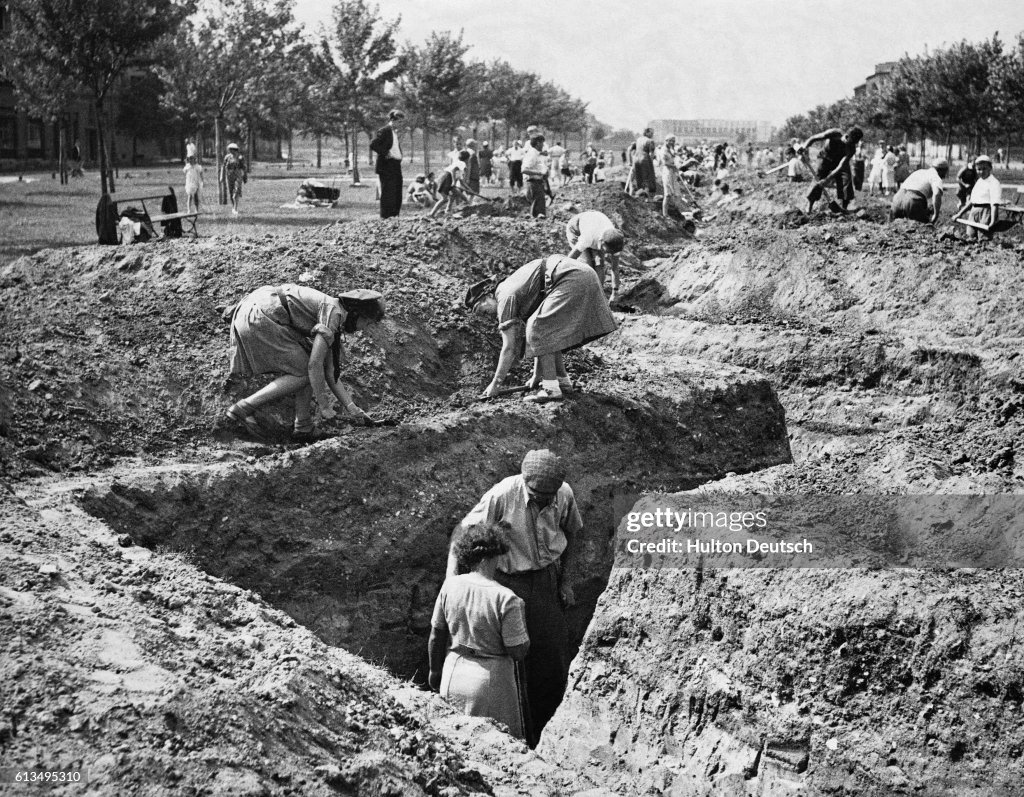
General mobilization begins in the United Kingdom. On the civilian front, three million women and children are evacuated from London and other large cities, though most of these will return when the anticipated air raids do not materialize. Also, Air Raid Precautions are introduced and a blackout enforced from sunset to sunrise.
France mobilizes; 8 million are on call. A state of martial law is declared.
Nazi efforts center on keeping the conflict from spreading in Europe.
In Paris, evacuation begins in earnest.
The Gestapo orders all Jews in Germany between 16 and 55 years of age to report for compulsory labor.
An 8 PM, curfew is established for all German Jews.
The Euthanasia Decree, which will not actually be written until October 1, is predated to go into effect on this date in Greater Germany. This decree orders that all Germans with incurable diseases are to be killed in order to free up needed hospital space and eliminate “useless eaters.” Adolf Hitler authorized Reichsleiter Bouhler and Dr. Brandt to “grant merciful deaths” for the mentally ill and those who were suffering from incurable diseases. This was the beginning of Aktion T4 euthanasia program.
Reinhard Heydrich presides over a meeting attended by the heads of Security Police and Commanders of Special Units, during which the deportation of the “remaining 30,000 Gypsies” from Germany to the soon-to-be-conquered territory of Poland is ordered.
The second Uranverein (Uranium Club), essentially the beginning of the German nuclear program during World War II, was founded.
World’s largest balloon, the Star of Poland, was unable to make an attempted stratospheric flight because of the German invasion. The United States had provided helium gas in August for this Polish effort and several American experts, including A. W. Stevens, provided technical assistance.
Coulondre telegrams Daladier: “Stay firm, Hitler will knuckle under.” France revokes its acceptance of Mussolini’s peace proposals.
Premier Édouard Daladier summons the French Cabinet to confer. News of the attack on Poland spurs immediate reaction; a military response is likely.
Soviet aid to the Reich is limited, but Soviets ratify the nonaggression pact with the Reich.
Italy prepares and divides its forces. The Crown Prince commands one army. The Italian government declares its intention to remain neutral in the crisis.
Mussolini proposes a suspension of hostilities and the immediate convening of a Conference of the Big Powers, Poland included, to discuss terms for a peaceful settlement. Germany, France and Poland immediately accept Mussolini’s proposals. Britain categorically rejects any negotiations before withdrawal of German troops from all occupied Polish territory (30 kilometers deep). Britain does not consult with Warsaw before making its decision.
The governments of Norway, Finland, Yugoslavia, Bulgaria, Romania, Denmark, Switzerland, Portugal, Ireland, Latvia, and Cuba declare their neutrality.
Switzerland mobilizes its forces and the Swiss Parliament elects Henri Guisan to head the Swiss Army (an event that can happen only during war or mobilization).
Hungary decrees censorship of the press.
The first International Film Festival (the forerunner to the Cannes Film Festival) was supposed to open on this day but was postponed indefinitely because of the day’s events. The festival wound up screening only a single film, “The Hunchback of Notre Dame.”
Moscow City Party Committee secretary Semyon Korytny is executed for the crime of having married the sister of military leader Iona Yakir, a perceived enemy of Joseph Stalin.
Egypt hides the treasures of King Tutankhamen.
U.S. President Franklin D. Roosevelt said at a press conference that “every effort” would be made by his administration to stay out of the war. President Roosevelt pledged the nation today to make every effort to keep this country out of war. He said he hoped and believed it could be done. Then he made a final check-up on the machinery already set up for preserving American neutrality, as well as for swinging military, naval and industrial forces into action in event of any unexpected emergency.
The President’s promise to do all in his power to keep the nation at peace was given as he gravely faced his regular Friday morning press conference. There was little he could say at this critical period in the world’s history, he remarked, except to appeal to the newspaper men present for their full cooperation in adhering as closely as possible to the facts, since this was best not only for this nation but for civilization as a whole.
In this regard, the President set an example for his auditors. He said what he had to say without attempting to minimize or exaggerate the gravity of the European situation. He appeared to be neither exuberant nor depressed by the turn of events that kept him from his bed for all but a few hours last night. Occasionally he was humorous, but throughout his manner was calm.
Later in the day the President let it be known that he would address the nation over the three major radio broadcasting networks on Sunday night from 10 to 10:15 PM, Eastern Daylight Time, in an effort to allay anxiety and relieve suspense.” Stephen T. Early, his secretary, who hurried back to Washington from a brief vacation today, said Mr. Roosevelt would speak on international affairs in a manner that would “clearly state our position” and would be of international interest.
The President began his memorable press conference with the explanation that there was little if anything he could say on such anticipated questions as when he would call a special session of Congress and issue a neutrality proclamation. These things, he explained, would have to await developments “over there” during the day, and possibly tomorrow, which would have a direct bearing on any American action.
But if any one had any questions that he was able to answer, Mr. Roosevelt said, he would answer gladly. A reporter observed that the question uppermost in every one’s mind just now was: “Can we keep out of it?” The President cast his eyes downward for a moment as he pondered the request for comment. Then he replied: “Only this — that I not only sincerely hope so, but I believe we can, and that every effort will be made by the Administration to so do.” The President consented readily when permission was asked to quote him directly on his statement.
President Roosevelt appeals to the European nations not to bomb civilian populations or unfortified cities. An appeal by President Roosevelt to the five governments of Europe which may be involved in war that they abstain from aerial bombing of civilian populations and unfortified towns met with the following response today:
Great Britain was the first to accept formally, through a note to Secretary Hull by the Marquess of Lothian, the British Ambassador, at noon.
France agreed in a formal communication received at the State Department at 6:15 o’clock tonight, after having been transmitted by Ambassador Bullitt in Paris.
Germany was expected to make no formal reply, according to Dr. Hans Thomsen, chargé d’affaires, who explained that Chancellor Hitler, in his address to the Reichstag earlier today, had said that “I have no intention of fighting women or children,” thus anticipating the intent of President Roosevelt’s message.
Italian officials informed Ambassador Phillips in Rome, orally, that the President’s plea did not apply in her case because the Italian Government had already announced that “Italy will not take any initiative in military operations.”
Poland replied, through the medium of a note transmitted to Mr. Hull by Count Jerzy Potocki, the Polish Ambassador, that orders had already been given to the effect desired by Mr. Roosevelt, but pointed out that German airplanes had already bombed open towns in Poland.
Mr. Roosevelt’s appeal was dispatched at 4:30 o’clock this morning, as soon as possible after he had learned, from a telephone conversation with Ambassador Bullitt, that actual hostilities had broken out in Poland. The text of the message, addressed to the governments of Great Britain, France, Italy, Germany and Poland, was as follows:
“The ruthless bombing from the air of civilians in unfortified centers of population during the course of the hostilities which have raged in various quarters of the earth during the past few years, which has resulted in the maiming and in the death of thousands of defenseless men, women and children, has sickened the hearts of every civilized man and woman, and has profoundly shocked the conscience of humanity.
“If resort is had to this form of inhuman barbarism during the period of the tragic conflagration with which the world is now confronted, hundreds of thousands of innocent human beings who have. no responsibility for, and who are not even remotely participating in, the hostilities which have now. broken out will lose their lives.
“I am therefore addressing this urgent appeal to every government which may be engaged in hostilities publicly to affirm its determination that its armed forces shall in no event, and under no circumstances, undertake the bombardment from the air of civilian populations or of unfortified cities, upon the understanding that these same rules of warfare will be scrupulously observed by all of their opponents. I request an immediate reply.
“ — FRANKLIN D. ROOSEVELT.”
President Roosevelt was undecided tonight whether to yield to growing demands from many sections of the country to call Congress into special session. The President’s indecision about calling Congress was due to the peculiarities of the situation in Europe and not to any reluctance on his part to ask again for changes in existing neutrality legislation. He preferred to await developments of the next few days, which, most officials dealing with the subject believe, will indicate clearly whether today’s outbreak is to be localized or whether it will grow into a general European war.
The Administration is not clear in its own mind as to exactly what, if any, changes it might deem necessary in the present Neutrality Act to carry out its purpose to stay out of the conflict, while at the same time leaving itself free to use its offices toward restoring peace and minimizing the horrors of modern warfare. It was in line with this latter intention that President Roosevelt, immediately upon hearing of the German invasion of Poland, addressed communications to all governments likely to be engaged in military operations to refrain from bombing civilian areas.
Since the United States is far removed, for the present at least, from any danger of military involvement, the first thought of the Administration today was to protect the financial system. Heads of various news bureaus handling public finances kept constant eyes on the reactions in American markets to the unhappy news from abroad. Officials expressed themselves tonight as very much gratified at the behavior of the stock market during the first day’s shock.
Secretary of Agriculture Henry A. Wallace sent out an appeal to American farmers during the day exhorting them to proceed with their production plans “as if the outbreak in Europe had not occurred.” He warned them especially against overplanting for 1940 crops with any expectation of higher prices as a result of war. The urging for the President to call an extra session of Congress came from virtually every section of the country, and especially from those members of the national legislature who stood with him at the last session for revision of the Neutrality Act.
President Roosevelt appoints Admiral William D. Leahy, who has recently retired as Chief of Naval Operations, as Work Projects Administrator for the Territory of Puerto Rico.
General George Marshall is sworn in as the United States Army Chief of Staff.
The U.S. Navy Hydrographic Office begins issuing, by dispatch and bulletin, special warnings of restrictions and dangers to navigation incident to the outbreak of hostilities between Germany and Poland. Special Warning Number One is that the German government has announced that Danzig Bay is a danger area due to military operations taking place there.
Office of the Chief of Naval Operations (OpNav) sends dispatch to commanders in chief of Asiatic Fleet, United States Fleet, Atlantic Squadron, Special Service Squadron and Squadron 40-T: “Reliably informed [that] German submarines are set to operate on Atlantic trade routes and that a dozen German merchant vessels will operate as armed raiders [and that] neutral merchantmen may expect Great Britain may institute similar practices as in last war.” Additional addressees to this warning include the three new warships on shakedown cruises: light cruiser St. Louis (CL-49) (at Punta Delgada, Azores), destroyer Anderson (DD-411) (at Montreal, Canada) and submarine Spearfish (SS-190) (en route from New York City to Bahia, Brazil).
Light cruiser Marblehead (CL-12) transports marines from Chinwangtao, China, to Shanghai. The emergency movement is to bring the Fourth Marine Regiment to full strength in the event that the Japanese take advantage of the European war to force an incident at Shanghai.
The U.S. Navy in September 1939 is, for the most part, concentrated on the west coast of the United States, reflecting the nation’s traditional interest in the Far East and its isolationist leanings away from Europe. Although the matter is discussed as hostilities have loomed on the horizon late in August 1939, there are no plans to use U.S. naval vessels to repatriate American citizens except in “collecting small groups [of Americans] in the Mediterranean area for transportation to places where they can move to safe ports for embarkation.”
The paper “On Continued Gravitational Contraction” by J. Robert Oppenheimer and his student Hartland Snyder is published, with the included Oppenheimer–Snyder model proving for the first time in contemporary physics how black holes could develop.
The paper “The Mechanism of Nuclear Fission” by Niels Bohr and John Archibald Wheeler is published in Physical Review.
The mystery-adventure film “The Adventures of Sherlock Holmes,” starring Basil Rathbone, was released.
Paced by the matchless Joe DiMaggio, who put on a gorgeous show as he hit two triples and a single to smash home six runs, the New York Yankees wound up their final Western trip of the year today by battering Ossie Vitt’s Cleveland Indians into submission, 11–8. The Yankees chased Indians’ starter Bob Feller to the showers in the 4th inning after racking up ten hits.
The Detroit Tigers advanced to within a half-game of the fourth place Cleveland Indians in the American League standing as they downed the Red Sox, 14–10, today to score a sweep of the three-game series. The Tigers hammered out fifteen hits, one less than Boston, the victors’ blows including two homers by Frank (Pinky) Higgins and one by George Tebbetts.
The Brooklyn Dodgers and Chicago Cubs use an open date to play a doubleheader of two rained out games. The visiting Cubs take the opener, 6–2 behind Larry French, and the Dodgers take the nitecap, 3–1. In game 2, Gabby Hartnett sets a Major League record for games caught of 1,722. The old mark was held by Ray Schalk. Leo Durocher’s two-run double off the right field wall is the big blow in the nitecap.
Bill Posedel won his fifteenth game of the season for the Boston Bees tonight, shutting out the Philadelphia Phillies, 6–0, with eight hits before 8,674 at Shibe Park. Ray Harrell, who pitched a four- hitter against the Cubs last Sunday, kept on even terms with Posedel until the sixth, when Buddy Hassett’s single and Henry Majeski’s triple drove in three runs. A home run by Al Lopez in the seventh gave the Bees their fourth tally.
Canada seeks talks with the United States on defense.
The Royal Canadian Navy, Royal Canadian Navy Reserve and Royal Canadian Navy Volunteer Reserve are placed on active service.
Germany was reported unofficially tonight to be making feverish diplomatic efforts to arrange a non-aggression pact between Soviet Russia and Japan — which are engaged in an unofficial war on the Manchukuoan-Outer Mongolian frontier. Immense difficulties obviously lie in the way of such an agreement, but German diplomats were said nevertheless to be trying desperately to engineer such a pact. On another diplomatic front, informed sources said they were skeptical of rumors from abroad that Russia and Germany would enter a military alliance as sequel to their non-aggression pact.
The suggestion of a non-aggression pact between Japan and Russia seemed a bit distant in view of a Tass (Soviet news agency) report today that Russian forces had “liquidated” masses of Japanese troops fighting on the eastern border. The Tass communiqué asserted Soviet and Outer Mongolian troops had annihilated Japanese and Manchukuoan army commands, compelling the remainder of those forces to “adopt defensive operations.”
The report said that between August 8 and 27 the Japanese had lost 164 planes, as compared with sixteen lost by the Soviet-Mongolian forces. Tass said thirty-one Japanese planes were shot down August 30 and that the Japanese-Manchukuoans were moving up heavy reinforcements, indicating that severe fighting still was continuing.
“On the night of August 28-29 the remnants of the Japanese-Manchukoan troops in the territory of the Mongolian People’s Republic were liquidated and Mongol-Soviet troops. firmly established themselves in positions along the State frontier of the Mongolian People’s Republic,’ Tass said. In the “liquidation,” Tass said, 294 Manchukuoan soldiers voluntarily went over to the Soviet side and the Soviet force captured 124 field guns of various sizes, 67 heavy machine-guns, 98 light machine guns, 36 trench mortars, 9,000 rifles, 12,000 shells of various calibers, 8 tanks, 8 armored cars, 14 tractors, 68 trucks and 19 passenger cars.
The formation of the new moderate Japanese Cabinet also, it was suggested, would present more complications for German diplomats seeking non-aggression ties between Russia and Japan.
The extraordinary session of the Soviet Parliament, which last night ratified the non-aggression pact with Germany, concluded its work tonight. In the final session both houses in separate meetings devoted themselves exclusively to the ratification of final drafts of the conscription and agricultural taxation bills, which differed only in minor details from the bills originally presented.
Tokyo doubts the Soviet Union can be a German ally in war, holding that Russia will benefit only if it stays out of battle.
Citizens of Chungking left their radios, where they were listening to accounts of the bombing of Polish cities, for the dugouts today when Japanese planes raided the capital’s environs four times.
The premier says Japan will keep its ties to the Reich. He indicates he expects U.S. relations to worsen.
Dow Jones Industrial Average: 135.25 (+0.84).
Born:
Lily Tomlin, actress and comedian (“Laugh-In”; “9 to 5”; “The Search for Signs of Intelligent Life in the Universe”; “All Of Me”), in Detroit, Michigan.
Heinrich Messner, Austrian downhill skier (winner first ever World Cup slalom; Olympic bronze 1968, 1972), in Obernberg am Brenner, Austria.
Rico Carty, Dominican MLB outfielder, designated hitter, and first baseman (All-Star, 1970; Milwaukee-Atlanta Braves, Texas Rangers, Chicago Cubs, Oakland A’s, Cleveland Indians, Toronto Blue Jays), in San Pedro de Macoris, Dominican Republic.
Dan Sullivan, NFL guard and tackle (NFL Champions, Super Bowl V-Colts; Baltimore Colts), in Boston, Massachusetts.
Naval Construction:
The Kriegsmarine (German Navy) battleship “J” is laid down by the Blohm und Voss, Hamburg, Germany. She will never be completed.
Patrol craft (ex-fishing vessels) hired for Canadian West Coast – HMCS Algie, Santa Maria, San Tomas, Marauder, West Coast, Mitchell Bay, Cape Beale & Taklat.
Schooner HMCS Venture paid off to become tender to RN 3rd Battle Squadron in Halifax.
Address by Adolf Hitler, Chancellor of the Reich, before the Reichstag, September 1, 1939.
“For months we have been suffering under the torture of a problem which the Versailles Diktat created – a problem which has deteriorated until it becomes intolerable for us. Danzig was and is a German city. The Corridor was and is German. Both these territories owe their cultural development exclusively to the German people. Danzig was separated from us, the Corridor was annexed by Poland. As in other German territories of the East, all German minorities living there have been ill-treated in the most distressing manner. More than 1,000,000 people of German blood had in the years 1919-1920 to leave their homeland.
“As always, I attempted to bring about, by the peaceful method of making proposals for revision, an alteration of this intolerable position. It is a lie when the outside world says that we only tried to carry through our revisions by pressure. Fifteen years before the National Socialist Party came to power there was the opportunity of carrying out these revisions by peaceful settlements and understanding. On my own initiative I have, not once but several times, made proposals for the revision of intolerable conditions. All these proposals, as you know, have been rejected – proposals for limitation of armaments and even, if necessary, disarmament, proposals for limitation of warmaking, proposals for the elimination of certain methods of modern warfare. You know the proposals that I have made to fulfill the necessity of restoring German sovereignty over German territories. You know the endless attempts I made for a peaceful clarification and understanding of the problem of Austria, and later of the problem of the Sudetenland, Bohemia, and Moravia. It was all in vain.
“It is impossible to demand that an impossible position should be cleared up by peaceful revision and at the same time constantly reject peaceful revision. It is also impossible to say that he who undertakes to carry out these revisions for himself transgresses a law, since the Versailles Diktat is not law to us. A signature was forced out of us with pistols at our head and with the threat of hunger for millions of people. And then this document, with our signature, obtained by force, was proclaimed as a solemn law.
“In the same way, I have also tried to solve the problem of Danzig, the Corridor, etc., by proposing a peaceful discussion. That the problems had to be solved was clear. It is quite understandable to us that the time when the problem was to be solved had little interest for the Western Powers. But that time is not a matter of indifference to us. Moreover, it was not and could not be a matter of indifference to those who suffer most.
“In my talks with Polish statesmen I discussed the ideas which you recognize from my last speech to the Reichstag. No one could say that this was in any way an inadmissible procedure on undue pressure. I then naturally formulated at last the German proposals, and I must once more repeat that there is nothing more modest or loyal than these proposals. I should like to say this to the world. I alone was in the position to make such proposal, for I know very well that in doing so I brought myself into opposition to millions of Germans. These proposals have been refused. Not only were they answered first with mobilization, but with increased terror and pressure against our German compatriots and with a slow strangling of the Free City of Danzig – economically, politically, and in recent weeks by military and transport means.
“Poland has directed its attacks against the Free City of Danzig. Moreover, Poland was not prepared to settle the Corridor question in a reasonable way which would be equitable to both parties, and she did not think of keeping her obligations to minorities.
“I must here state something definitely; German has kept these obligations; the minorities who live in Germany are not persecuted. No Frenchman can stand up and say that any Frenchman living in the Saar territory is oppressed, tortured, or deprived of his rights. Nobody can say this.
“For four months I have calmly watched developments, although I never ceased to give warnings. In the last few days I have increased these warnings. I informed the Polish Ambassador three weeks ago that if Poland continued to send to Danzig notes in the form of ultimata, and if on the Polish side an end was not put to Customs measures destined to ruin Danzig’s trade, then the Reich could not remain inactive. I left no doubt that people who wanted to compare the Germany of to-day with the former Germany would be deceiving themselves.
“An attempt was made to justify the oppression of the Germans by claiming that they had committed acts of provocation. I do not know in what these provocations on the part of women and children consist, if they themselves are maltreated, in some cases killed. One thing I do know – that no great Power can with honour long stand by passively and watch such events.
“I made one more final effort to accept a proposal for mediation on the part of the British Government. They proposed, not that they themselves should carry on the negotiations, but rather that Poland and Germany should come into direct contact and once more pursue negotiations.
“I must declare that I accepted this proposal, and I worked out a basis for these negotiations which are known to you. For two whole days I sat in my Government and waited to see whether it was convenient for the Polish Government to send a plenipotentiary or not. Last night they did not send us a plenipotentiary, but instead informed us through their Ambassador that they were still considering whether and to what extent they were in a position to go into the British proposals. The Polish Government also said that they would inform Britain of their decision.
“Deputies, if the German Government and its Leader patiently endured such treatment Germany would deserve only to disappear from the political stage. But I am wrongly judged if my love of peace and my patience are mistaken for weakness or even cowardice. I, therefore, decided last night and informed the British Government that in these circumstances I can no longer find any willingness on the part of the Polish Government to conduct serious negotiations with us.
“These proposals for mediation have failed because in the meanwhile there, first of all, came as an answer the sudden Polish general mobilization, followed by more Polish atrocities. These were again repeated last night. Recently in one night there were as many as twenty-one frontier incidents: last night there were fourteen, of which three were quite serious. I have, therefore, resolved to speak to Poland in the same language that Poland for months past has used toward us. This attitude on the part of the Reich will not change.
“The other European States understand in part our attitude. I should like here above all to thank Italy, which throughout has supported us, but you will understand that for the carrying on of this struggle we do not intend to appeal to foreign help. We will carry out this task ourselves. The neutral States have assured us of their neutrality, just as we had already guaranteed it to them.
“When statesmen in the West declare that this affects their interests, I can only regret such a declaration. It cannot for a moment make me hesitate to fulfill my duty. What more is wanted? I have solemnly assured them, and I repeat it, that we ask nothing of those Western States and never will ask anything. I have declared that the frontier between France and Germany is a final one. I have repeatedly offered friendship and, if necessary, the closest co-operation to Britain, but this cannot be offered from one side only. It must find response on the other side. Germany has no interests in the West, and our western wall is for all time the frontier of the Reich on the west. Moreover, we have no aims of any kind there for the future. With this assurance we are in solemn earnest, and as long as others do not violate their neutrality we will likewise take every care to respect it.
“I am happy particularly to be able to tell you of one event. You know that Russia and Germany are governed by two different doctrines. There was only one question that had to be cleared up. Germany has no intention of exporting its doctrine. Given the fact that Soviet Russia has no intention of exporting its doctrine to Germany, I no longer see any reason why we should still oppose one another. On both sides we are clear on that. Any struggle between our people would only be of advantage to others. We have, therefore, resolved to conclude a pact which rules out for ever any use of violence between us. It imposes the obligation on us to consult together in certain European questions. It makes possible for us economic co-operation, and above all it assures that the powers of both these powerful States are not wasted against one another. Every attempt of the West to bring about any change in this will fail.
“At the same time I should like here to declare that this political decision means a tremendous departure for the future, and that it is a final one. Russia and Germany fought against one another in the World War. That shall and will not happen a second time. In Moscow, too, this pact was greeted exactly as you greet it. I can only endorse word for word the speech of Russian Foreign Commissar, Molotov.
“I am determined to solve (1) the Danzig question; (2) the question of the Corridor; and (3) to see to it that a change is made in the relationship between Germany and Poland that shall ensure a peaceful co-existence. In this I am resolved to continue to fight until either the present Polish government is willing to continue to bring about this change or until another Polish Government is ready to do so. I am resolved t remove from the German frontiers the element of uncertainty, the everlasting atmosphere of conditions resembling civil war. I will see to it that in the East there is, on the frontier, a peace precisely similar to that on our other frontiers.
“In this I will take the necessary measures to se that they do not contradict the proposals I have already made known in the Reichstag itself to the rest of the world, that is to say, I will not war against women and children. I have ordered my air force to restrict itself to attacks on military objectives. If, however, the enemy thinks he can form that draw carte blanche on his side to fight by the other methods he will receive an answer that will deprive him of hearing and sight.
“This night for the first time Polish regular soldiers fired on our territory. Since 5.45 A.M. we have been returning the fire, and from now on bombs will be met by bombs. Whoever fight with poison gas will be fought with poison gas. Whoever departs from the rules of humane warfare can only expect that we shall do the same. I will continue this struggle, no matter against whom, until the safety of the Reich and its rights are secured.
“For six years now I have been working on the building up of the German defenses. Over 90 millions have in that time been spent on the building up of these defense forces. They are now the best equipped and are above all comparison with what they were in 1914. My trust in them is unshakable. When I called up these forces and when I now ask sacrifices of the German people and if necessary every sacrifice, then I have a right to do so, for I also am to-day absolutely ready, just as we were formerly, to make every possible sacrifice.
“I am asking of no German man more than I myself was ready throughout four years at any time to do. There will be no hardships for Germans to which I myself will not submit. My whole life henceforth belongs more than ever to my people. I am from now on just first soldier of the German Reich. I have once more put on that coat that was the most sacred and dear to me. I will not take it off again until victory is secured, or I will not survive the outcome.
“Should anything happen to me in the struggle then my first successor is Party Comrade Göring; should anything happen to Party Comrade Göring my next successor is Party Comrade Hess. You would then be under obligation to give to them as Führer the same blind loyalty and obedience as to myself. Should anything happen to Party Comrade Hess, then by law the Senate will be called, and will choose from its midst the most worthy — that is to say the bravest — successor.
“As a National Socialist and as German soldier I enter upon this struggle with a stout heart. My whole life has been nothing but one long struggle for my people, for its restoration, and for Germany. There was only one watchword for that struggle: faith in this people. One word I have never learned: that is, surrender.
“If, however, anyone thinks that we are facing a hard time, I should ask him to remember that once a Prussian King, with a ridiculously small State, opposed a stronger coalition, and in three wars finally came out successful because that State had that stout heart that we need in these times. I would, therefore, like to assure all the world that a November 1918 will never be repeated in German history. Just as I myself am ready at any time to stake my life – anyone can take it for my people and for Germany – so I ask the same of all others.
“Whoever, however, thinks he can oppose this national command, whether directly of indirectly, shall fall. We have nothing to do with traitors. We are all faithful to our old principle. It is quite unimportant whether we ourselves live, but it is essential that our people shall live, that Germany shall live. The sacrifice that is demanded of us is not greater than the sacrifice that many generations have made. If we form a community closely bound together by vows, ready for anything, resolved never to surrender, then our will will master every hardship and difficulty. And I would like to close with the declaration that I once made when I began the struggle for power in the Reich. I then said: ‘If our will is so strong that no hardship and suffering can subdue it, then our will and our German might shall prevail.’ ”
I sit in one of the dives
On Fifty-second Street
Uncertain and afraid
As the clever hopes expire
Of a low dishonest decade:
Waves of anger and fear
Circulate over the bright
And darkened lands of the earth,
Obsessing our private lives;
The unmentionable odour of death
Offends the September night.
Accurate scholarship can
Unearth the whole offence
From Luther until now
That has driven a culture mad,
Find what occurred at Linz,
What huge imago made
A psychopathic god:
I and the public know
What all schoolchildren learn,
Those to whom evil is done
Do evil in return.
Exiled Thucydides knew
All that a speech can say
About Democracy,
And what dictators do,
The elderly rubbish they talk
To an apathetic grave;
Analysed all in his book,
The enlightenment driven away,
The habit-forming pain,
Mismanagement and grief:
We must suffer them all again.
Into this neutral air
Where blind skyscrapers use
Their full height to proclaim
The strength of Collective Man,
Each language pours its vain
Competitive excuse:
But who can live for long
In an euphoric dream;
Out of the mirror they stare,
Imperialism’s face
And the international wrong.
Faces along the bar
Cling to their average day:
The lights must never go out,
The music must always play,
All the conventions conspire
To make this fort assume
The furniture of home;
Lest we should see where we are,
Lost in a haunted wood,
Children afraid of the night
Who have never been happy or good.
The windiest militant trash
Important Persons shout
Is not so crude as our wish:
What mad Nijinsky wrote
About Diaghilev
Is true of the normal heart;
For the error bred in the bone
Of each woman and each man
Craves what it cannot have,
Not universal love
But to be loved alone.
From the conservative dark
Into the ethical life
The dense commuters come,
Repeating their morning vow;
“I will be true to the wife,
I’ll concentrate more on my work,”
And helpless governors wake
To resume their compulsory game:
Who can release them now,
Who can reach the deaf,
Who can speak for the dumb?
All I have is a voice
To undo the folded lie,
The romantic lie in the brain
Of the sensual man-in-the-street
And the lie of Authority
Whose buildings grope the sky:
There is no such thing as the State
And no one exists alone;
Hunger allows no choice
To the citizen or the police;
We must love one another or die.
Defenceless under the night
Our world in stupor lies;
Yet, dotted everywhere,
Ironic points of light
Flash out wherever the Just
Exchange their messages:
May I, composed like them
Of Eros and of dust,
Beleaguered by the same
Negation and despair,
Show an affirming flame.
 History Diaries