The Final Day.
For tens of millions of people in Europe, this will be the last day of peace in their lifetime. Millions are already dead in China, and the pace will only quicken. By the time the guns fall silent in August 1945, some sixty to eighty-five million human beings will be killed, well over half of them civilians.
The German government publishes a 16-point proposal for the Polish government. Before the proposal could be transmitted to Warsaw, communications between the two states are cut off. Germany in any event has already decided on war.
While the world waited for a ray of light to break through the war-clouds hovering over Europe, Germany continued preparations for mobilizing her entire civilian resources in case the clouds should prove impenetrable. A Military Penal Code, seemingly drawn up on August 17, 1938, was, it was learned today, put into force as of August 28, 1939. This military penal code which was signed by Chancellor Hitler and Colonel General Wilhelm Keitel, concerns itself chiefly with questions of espionage and “franctireur” in the war zones wherein the armies of Germany and her allies are operating.
Violations, most of which are punishable by death and the confiscation of property, are to be judged by military courts consisting of three or five members. Verdicts will be passed by the majority opinion of the court, subject to ratification by a military commander with local discretion, and pardons may be issued only by the Chancellor himself or by the Commander in Chief of each of the defense force branches. The code has application whether the deeds are committed within the Reich’s borders or not. Convicted men will be shot by firing squads of ten at a distance of five paces. Women will be beheaded.
Italian Prime Minister Benito Mussolini offers to arrange a conference to be held on September 5, 1939: “With the object of examining the clauses of the Treaty of Versailles which are the cause of the present trouble.”
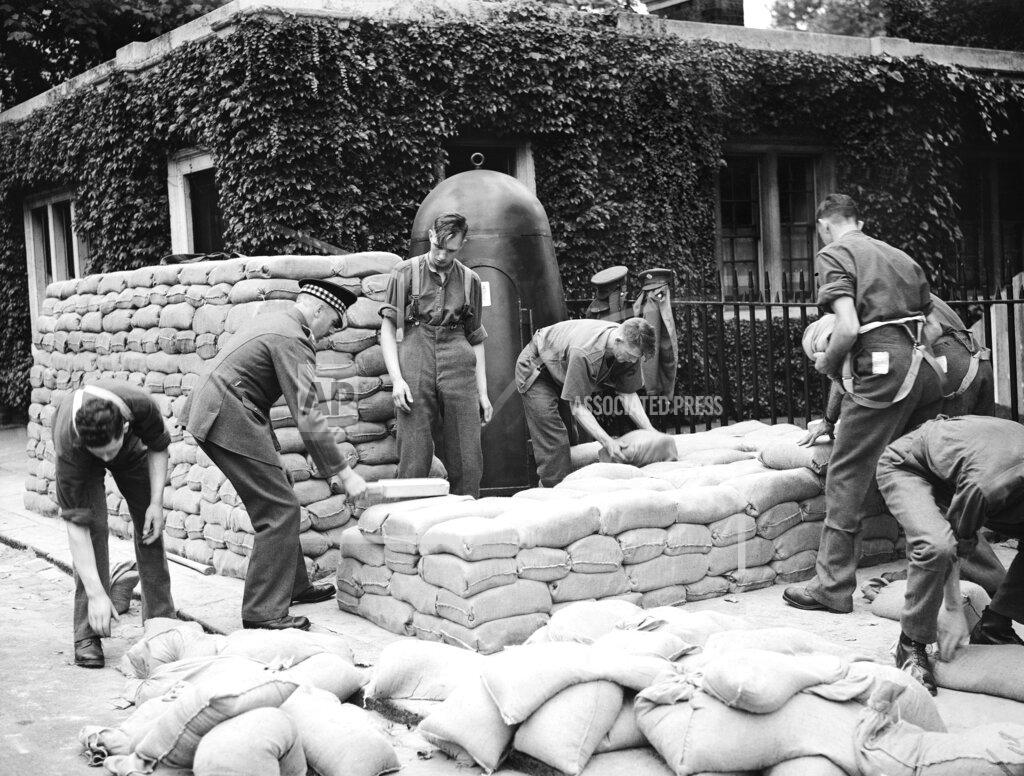
The Royal Navy was mobilized and Army and Royal Air Force reserves were called up.
The British Home Fleet (Adm. Sir C. Forbes), comprising the 2nd Battleship Squadron, with Nelson, Ramillies, Rodney, Royal Oak, and Royal Sovereign, the Battle Cruiser Squadron, with Hood and Repulse, the carrier Ark Royal, the 18th Cruiser Squadron, with Aurora, Sheffield, Edinburgh, and Belfast, the 12th Cruiser Squadron, with Effingham, Emerald, Cardiff and Dunedin, the 7th Cruiser Squadron, with Diomede, Dragon, Calypso and Caledon, and the 6th and 8th Destroyer Flotillas with 17 destroyers, eight ‘Tribals’ and nine ‘F’ class, searches in the waters between Scotland, Iceland and Norway for returning German merchant ships, in particular for the fast Atlantic liner Bremen. In home waters there are in addition, at Rosyth, the carrier Furious, in the Humber, the 2nd Cruiser Squadron with Southampton and Glasgow and the 7th Destroyer Flotilla with eight ‘J’ class destroyers; and at Portland the battleships Resolution and Revenge, the carriers Courageous and Hermes, the cruisers Ceres, Caradoc and Cairo and the 18th Destroyer Flotilla with nine ‘A’ class destroyers.
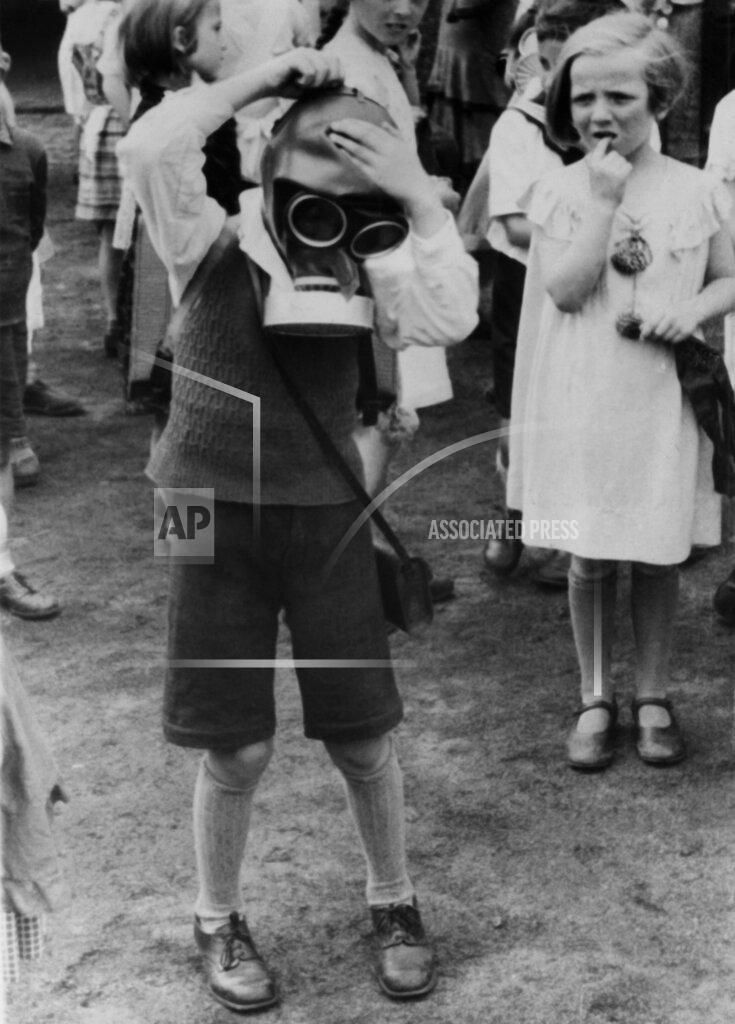
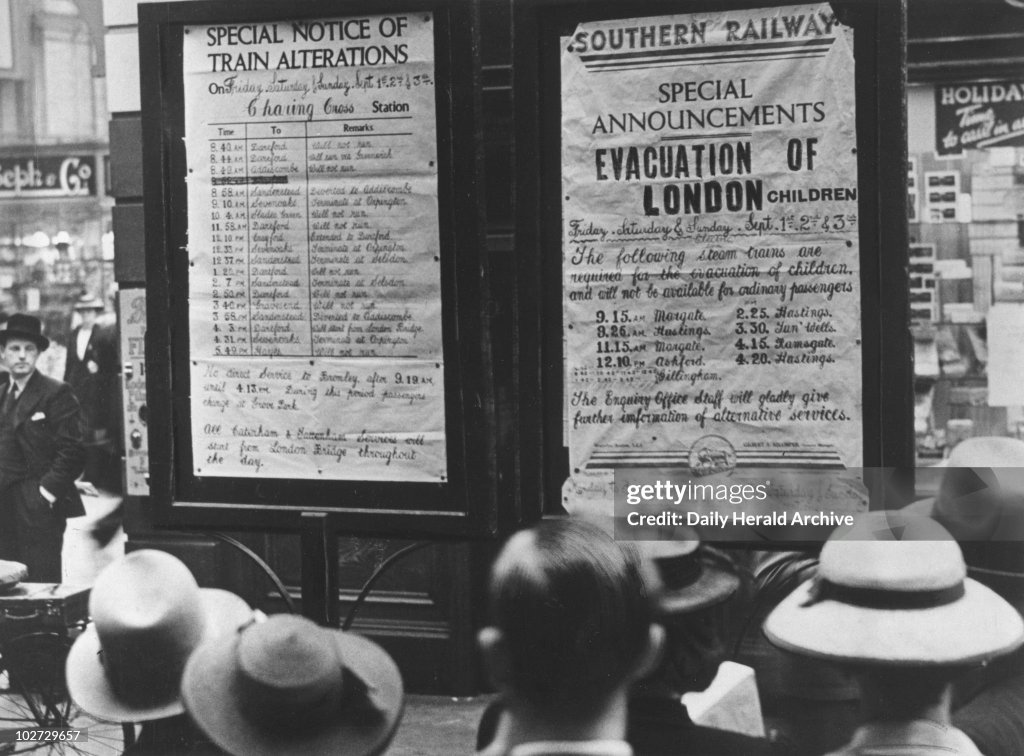
Britain begins precautionary evacuations of its major eastern cities. At 11:07 AM, an official order was given in Britain to evacuate civilians from cities and towns that were likely targets for enemy bombing. Most of the evacuees were schoolchildren. Over the next few days nearly 3 million people would be relocated.
The British Ministry of Health announced tonight that evacuation of children and others would be from the following areas: Greater London, which includes London County Council area, the county boroughs of West Ham and East Ham, the boroughs of Walthamstow, Leyton, Ilford and Barking in Essex; The boroughs of Tottenham, Hornsey, Willesden, Acton and Edmonton in Middlesex; the Medway towns of Chatham, Gillingham and Rochester; Dagenham, Thurrock, Gravesend and Northfleet, Portsmouth, Gosport and Southampton, Birmingham and Smethwick, Liverpool, Bootle, Birkenhead, Wallasley and Crosby. Manchester, Salford and Stretford, Sheffield, Leeds, Bradford, Hull and Rotherham, Newcastle and Gateshead, Runcorn and Widnes and in Scotland, Edinburgh, Glasgow, Dundee, Clydebank and Rosyth.
A London note to Berlin bluntly refuses to discuss the demand for territory and insists on talks.
The French Army today is held to be the decisive factor in the international situation. It is difficult to understand what is happening unless, from the welter of rumors and secondary events, one disengages the essential element. That element is constituted by the fact that France has 3,000,000 men fully mobilized and supposedly ready to fall upon the Germans. But in fact, they are not ready; or at least, their generals are not ready. France will stand on the defensive and waste the opportunity presented on the Rhine.
The sarcophagus of King Tutankhamen and the priceless jewels and furniture found in his tombs were taken from Egypt’s National Museum today, packed in forty cases, and hidden in bombproof cellars thirty feet underground to protect them from possible wartime destruction.
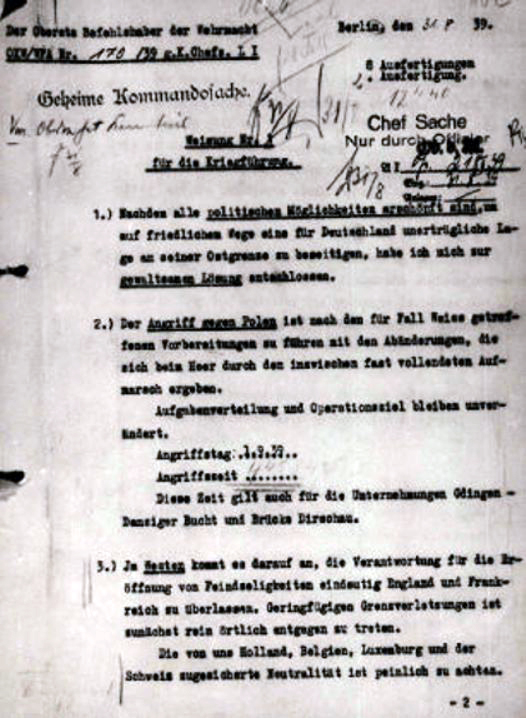
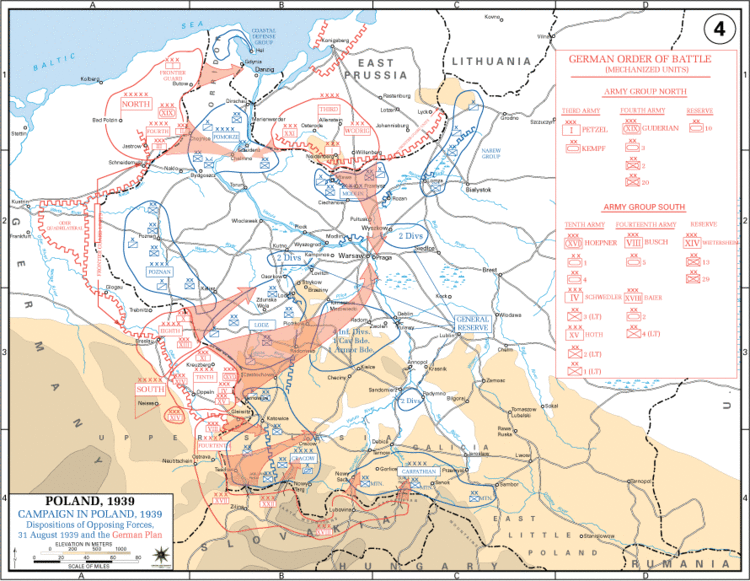
German Chancellor Adolf Hitler, arguing that his proposals to the Polish government have been rejected, issues orders to invade Poland.
At 12:30 PM, Hitler issued Directive No. 1, ordering an attack on Poland to begin September 1 at 04:45. At half past noon, Hitler issues Directive #1 for the conduct of the war:
(1) Now that all the political possibilities of disposing by peaceful means of a situation which is intolerable for Germany are exhausted, I have determined on a solution by force.
(2) The attack on Poland is to be carried out. Date of attack: September 1, 1939. Time of attack: 4:45 AM.
An address written by Ignace Jan Paderewski, former Premier of Poland and noted pianist, who failed to get permission from the Swiss Government to broadcast to America from Lucerne on Wednesday, was read over a CBS network from London this afternoon. He asserts that the guilt for the coming war rests with Adolf Hitler.
Henderson, instead of informing the Poles of Hitler’s proposals and the granting of an extension, tries to dissuade Lipski from meeting with von Ribbentrop at all. Henderson, in his Final Report, writes “I suggested that he (Lipski) recommend to his government an interview between Marshal Smigly-Rydz and Göring. I felt obliged to add that I could not conceive of the success of any negotiations if they were conducted by Ribbentrop.” A telegram from Sir Howard Kennard, British Ambassador in Warsaw to Lord Halifax states that Polish Foreign Minister Beck has informed him that Lipski has been forbidden to receive any documents from von Ribbentrop. Lipski telegrams Beck that French Ambassador Coulondre has told him that Henderson has been informed of Germany’s intention to wait until midnight August 31st. Lipski writes: “Coulondre advises me to inform the German government, only after midnight, that the Polish Embassy was always at its reach.”
At 6:15 PM, Joachim von Ribbentrop met with Polish ambassador Józef Lipski, more than five hours after Lipski had requested an audience. Lipski said the Polish government would be making a formal reply about direct negotiations in the next few hours. Ribbentrop asked him if he was empowered to negotiate, and when Lipski replied that for the time being he was not, Ribbentrop dismissed him. Lipski returned to the embassy and found that his telephone line had been cut.
The Slovak Government, replying to a Polish protest concerning occupation of Slovakia by German troops, called on Poland tonight to return territory.
Gleiwitz incident: In a false flag operation, Nazis posing as Poles seized the Gleiwitz radio station and broadcast an anti-German message in Polish. At 8 PM the German radio station at Gleiwitz near the Polish border announces it is under attack. Most contemporary historians believe Hitler staged this attack as an excuse to invade Poland. Holocaust deniers and historical revisionists, however, suggest that British or Jewish secret agents were responsible. SS Sturmbannfuehrer Alfred Helmut Naujocks is said to have received the code words “Grandmama dead,” thus ending a 14-day wait at the German radio station at Gleiwitz, where he and Gestapo head Heinrich Mueller are to carry out a mock attack. The “canned goods:” a dozen “condemned criminals” dressed in Polish military uniforms are believed to have been given fatal injections before being shot.
At 8.20 PM, Ciano is informed by the telephone central office that London has cut its communications with Italy.
At 9:00 PM, German radio interrupted regular programming to present the government’s 16-point proposal for Poland. The demand for the restoration of Danzig to the Reich was maintained, but the question of the Polish Corridor was now to be settled by a plebiscite. The port of Gdynia is to be recognized as Polish, thus leaving Poland with access to the sea. It will not be delivered to the Polish ambassador until September 1. Warsaw never heard the proposal because communications between the two countries were cut off.
The Supreme Soviet of the Soviet Union ratified the Molotov–Ribbentrop Pact. Molotov blames the British for the failure of the recent talks between the Anglo-French alliance and the Soviet Union.
The Soviets lower the age for conscription from 19 to 17.
A huge banquet is held in Ribbentrop’s honor at the Kremlin in Moscow. Ribbentrop, Stalin, Molotov, Voroshilov, Kaganovich, Mikoyan and Beria are all seated at the head table. The party ends at 3:00 AM, Friday, September 1.
Officials in Washington, guided only by incomplete and delayed dispatches from Europe, were inclined today to take the gravest view of the situation abroad, some of them fearing war was merely a matter of hours. Only private and confidential opinions were expressed, as both the State Department and the White House maintained official silence. President Roosevelt spent most of his day reading press bulletins which were relayed to him and listening to radio news broadcasts. Late in the afternoon, he motored to Carderock, Maryland, a few miles from Washington, to inspect the Navy Department’s new testing tank there, where large-scale ship models are put through their paces under various conditions. On his return he detoured a short distance to look at the site of the new Naval Hospital under construction at Bethesda, Maryland. The terms for a peaceful solution of the crisis outlined in a Berlin broadcast were felt to leave little hope of averting conflict, because they were considered obviously unacceptable to Poland.
The general belief here is that Poland will fight if Germany makes any move into Danzig and that Great Britain and France will at once join as belligerents. The continued German intransigence on the Danzig question, despite the repeated appeals and representations from almost every quarter of the globe has tended in the past few days to diminish official optimism that war will be averted. The Marquess of Lothian, the new British Ambassador, reflected these grave sentiments at the first press conference he has held since arriving in the capital. He declined to discuss the immediate situation, on the ground of its delicacy and of inadequate information at hand. He took the position that the question of peace or war was even then being settled across the Atlantic and that no remarks here would help.
In that connection, Secretary of State Cordell Hull, at his own press conference today, said that President Roosevelt was planning no new intervention in the crisis, but left the door open for a change of mind at any moment. He pointed out that events were developing with such rapidity that it would be impossible to predict the administration’s course except from hour to hour. Lord Lothian, however, was willing to discuss the broad outlines of British foreign policy. He said that the British public is far more united now than it was in 1914, pointing to the virtual disappearance of leftist labor and pacifist opposition in British politics.
The British public demands, he said, that “every free nation must be allowed to live its own life.” Later in the interview, he expanded this to say that “all nations must have a decent standard of living and their freedom.” The attainment of this broad objective, the Ambassador said the British public appreciates, would necessarily involve revision of treaties by peaceful means. It would be willing to consider the whole colonial economic question if concessions in that field could be accompanied by a disarmament which would “give us a generation of peace.”
“If this goes on,” he said, referring to current disregard of treaty obligations and unilateral adjustments, “the world will become a jungle.” The Ambassador received the press under the portico of the British Embassy on which King George VI and Queen Elizabeth made their appearance at the garden party during their visit last June. Victor A. L. Mallet, counselor of the embassy and often chargé d’affaires during the last two years, shepherded the newspaper representatives and stood close to his new chief’s elbow during the interview, but the Ambassador needed no prompting.
Senator Henry Cabot Lodge Jr., told delegates to the annual encampment of the Veterans of Foreign Wars today that American democracy would not survive participation in another world conflict. He asserted that it was the prime duty of every American to help keep the country at peace. “We insist that there be no dietators here,” said Mr. Lodge, “and that, my friends, is our business. And we know that American democracy cannot withstand another major war in which America is engaged. “In the World War our democracy was suspended. In the war of the future, it would be even more promptly and decisively stifled.”
After a spirited debate, led on behalf of the measure by J. E. Van Zandt of Pennsylvania, a former national commander, a resolution was adopted demanding that World War veterans receive pensions equivalent to those awarded to Spanish War veterans. Under the proposal veterans would receive pensions when reaching the age of 65, if they had been honorably discharged after serving at least ninety days. Disabled veterans would get pensions on a graduated scale, depending on the degree of disability.
The Veterans of Foreign Wars cheered today the demands of Major General Smedley Butler, Marine Corps, retired, and of Senator Lodge for a neutrality policy strong enough to keep this nation out of any European war. “There are only two things for which Americans should be permitted to fight,” shouted General Butler, “defense of home and the Bill of Rights. Not a single drop of American blood should ever again. be spilled on foreign soil. Let’s build up a national defense so tight that even a rat couldn’t crawl through.”
The Department of Justice has already started a campaign against foreign spies, Attorney General Murphy said today. Murphy says there will be no repetition of the situation in 1917 when the country was unprepared to deal with the espionage problem.
A warning to American citizens against “aping the methods of foreign dictators” was voiced today by the House Committee Investigating Un-American Activities in a preliminary report on its study of Nazi-Fascist groups in recent months. The committee, which is in recess until Tuesday when it will hear Earl Browder, general secretary of the Communist party, directed its counsel to demand that Fritz Kuhn, head of the German-American Bund, supply the information about local units which he promised when on the stand two weeks ago.
Following a conference of committee counsel with officials of the State Department, Chairman Dies announced that a report on the propaganda activities in this country of a Dr. Colin Ross, described as an agent of the Nazi government, would be withheld for the present so as not to “embarrass the State Department at this crucial moment in international affairs.” The preliminary report on the Nazi-Fascist groups in this country stated that their “primary aims appear to be (1) a radical change. in the American form of government and (2) the collection of dues from such misguided citizens as will support them.”
A Japanese aerial party, on a world goodwill flight, made its first landing in the United States late today and anti-Japanese demonstrators gathered to protest against the visit. While a crowd of Japanese and American-Japanese estimated at 3,000 gathered at Boeing Field to cheer the fliers, about 50 demonstrators with anti-Japanese banners appeared across the highway from the airport. The demonstrators, whose banners said “Unload Jap guns, boycott Japanese goods,” were kept off the airport by police.
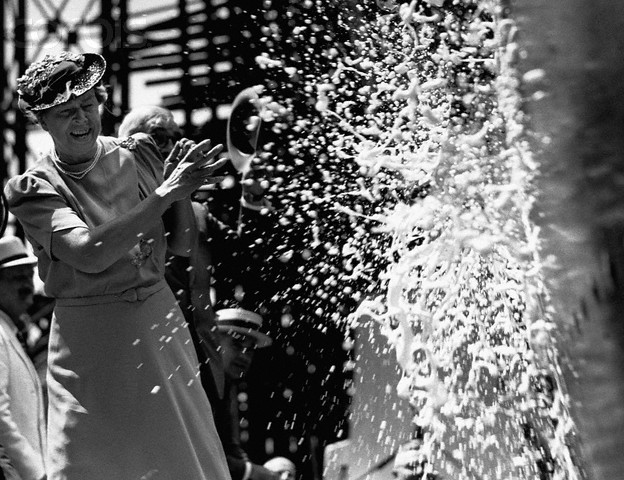
Sponsored by Mrs. Franklin D. Roosevelt and favored by fine weather, the United States liner America, largest merchant ship ever built in this country, was launched punctually at 11:50 A.M. today.
The first issue of Marvel Comics (cover date October) was published by Timely Comics, the predecessor of the Marvel Comics publisher of today. Issue #1 included the first appearances of the characters Sub-Mariner and the Human Torch.
The comedy-drama film “The Women” starring Norma Shearer, Joan Crawford and Rosalind Russell premiered at Grauman’s Chinese Theatre in Hollywood.
For the first time this year and for the second time in two seasons the Detroit Tigers were able to beat Robert Moses (Lefty) Grove today. Making the most of thirteen hits and four enemy misplays, the Bengals accomplished this rare feat as they downed the Boston Red Sox, 11–4, to clinch the three-game series that closes tomorrow.
The defeat knocked the 39-year-old Grove from a tie with Atley Donald of the Yankees for the league’s pitching leadership. Each had won thirteen times against two defeats until today.
Dutch Leonard, the Washington Senators’ knuckleball artist, won his sixteenth game and his fourth over Chicago this season by defeating the White Sox, 4–3, on a six-hit performance tonight.
Wally Moses assumed the personal responsibility today of leading the Philadelphia Athletics to a 4–2 triumph over the St. Louis Browns to give the A’s a sweep of the three-game series. After doubling in the opening inning and tallying the first Philadelphia run, Moses walloped a home run in the fourth, sending Sam Chapman and pitcher Nelson Trotter across the plate ahead of him. The Browns outhit the Athletics, ten to six, but couldn’t get their men all the way around the paths. Thirteen were left stranded.
The Cincinnati Reds purchase vet Al Simmons from the Boston Bees.
The sixth-place Pittsburgh Pirates and the Philadelphia Phillies divided a doubleheader today as the Pirates’ Max Butcher shut out his former teammates, 1–0, with five hits in the opener to win his third straight game, while Walter Beck pitched the Phils to an 11–6 triumph in the nightcap for his second straight and his sixth victory of the campaign. Kirby Higbe, the Phillies’ star rookie, kept on even terms with Butcher until the eighth, when Lloyd Waner led off with a single, was sacrificed to second and scored on Arky Vaughan’s one-base smash over George Scharein’s head. The Phils collected fourteen hits off four enemy pitchers in the second game. Bob Klinger started, but was knocked out before retiring a man as the Phils pushed across five runs and Truett Sewell and Bill Swift were routed by another five-run splurge in the fifth.
HMCS Fraser & HMCS St Laurent, both Canadian River-class frigates, sail from Vancouver for Halifax via the Panama Canal, for war duty in the Atlantic.
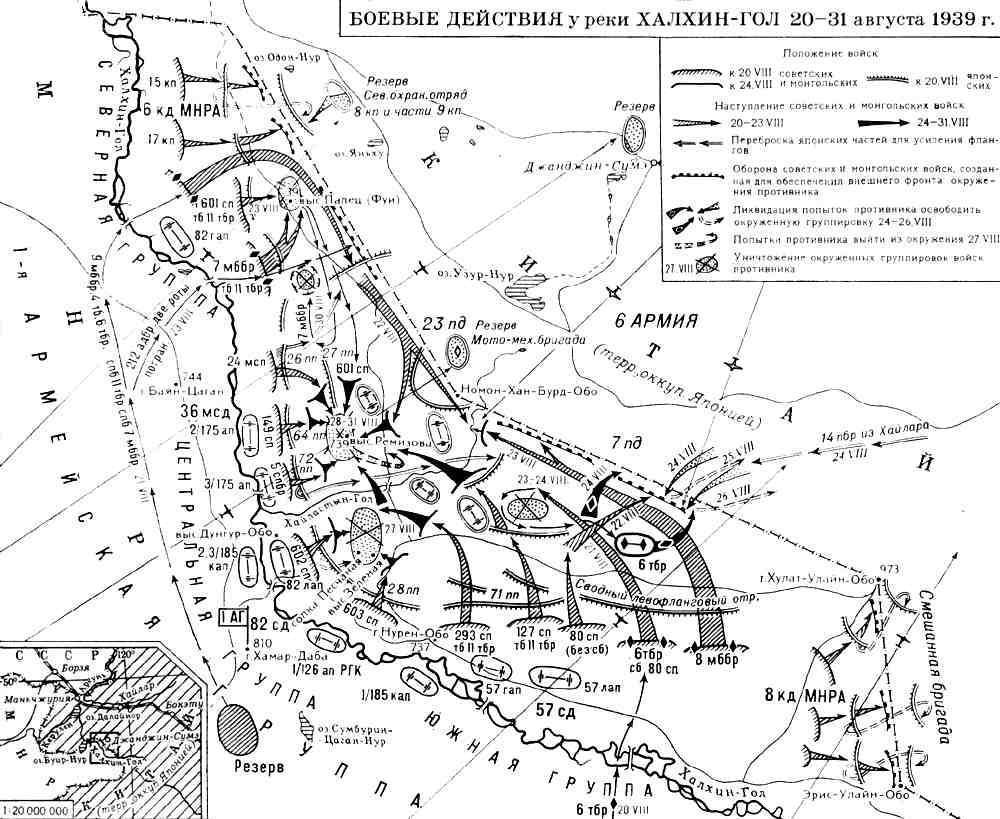
The Japanese invasion army is destroyed in Mongolia by the Soviets. By this day, Japanese forces on the Mongolian side of the border were destroyed, leaving remnants of the 23rd Division on the Manchurian side. The Soviets under Zhukov had achieved their objective. The Japanese are now forced to seek a cease-fire and to end their adventures in Mongolia.
Consquently, the enthusiasm of the Japanese for the Northern Option — war with the Soviets to seize Siberia all the way to Lake Baikal — falls into eclipse. The Navy’s favored Southern Strategy — seizing resources in the Pacific — is now in ascendance, and will lead to the Empire of Japan’s “Act of National Hara-kiri” in December 1941.
The U.S. submarine rescue vessel USS Pigeon (ASR-6) is driven aground at Tsingtao, China by a typhoon.
Dow Jones Industrial Average: 134.41 (-1.75).
Born:
Jerry Allison, American rock drummer and songwriter (Buddy Holly & Crickets – “That’ll Be The Day”; “Peggy Sue”), in Hillsboro, Texas (d. 2022).
Jim McCrary, American photographer and album cover artist (Tapestry: Ticket to Ride), in Los Angeles (d. 2012).
Paul Winter, American new age music saxophonist, composer, and bandleader (The Paul Winter Consort), in Altoona, Pennsylvania
Bruce Spraggins, ABA small forward (New Jersey Americans), in Williamsburg, Virginia (d. 2021).
Naval Construction:
The Вое́нно-морско́й флот СССР (ВМФ) (Soviet Navy) Project 68 (Chapayev class) light cruiser Kuybyshev (Куйбышев) is laid down by the Marti Yard (Nikolayev, U.S.S.R.) / Yard 198.
The Вое́нно-морско́й флот СССР (ВМФ) (Soviet Navy) Project 68 (Chapayev class) light cruiser Chkalov (Чкалов) is laid down by Sergo Ordzhonikidze (Sevastopol, U.S.S.R.) / Yard 201.
The Royal Navy Lake-class ASW whalers HMS Ullswater (FY 252) and HMS Wastwater (FY 239) are launched by Smith’s Dock Co., Ltd. (South Bank-on-Tees, U.K.).
The Marynarka Wojenna (Polish Navy) Jaskółka-class minesweeper ORP Czapla {“Heron”} (CP) is commissioned.
The Marynarka Wojenna (Polish Navy) Jaskółka-class minesweeper ORP Zuraw {“Grus”} (Z) is commissioned.
That I have seen colour, smelled dawn, heard music, tasted wine,
Touched bodies – and learned that none, not one, of these things was mine,
But all of them precious lendings from Thee, and all therefore divine:
I thank Thee, Lord.
That I have misused and squandered this Thy trust, have taken
Where I should wholly give, have let my mind be shaken
By anger, sorrow, hatred, fear, have believed myself forsaken:
Pardon me, Lord.
For laughter and courage, for beauty and kindness, for joy, for the boon of friends,
For the power of thought, for silence, for all the wealth which Thy bounty spends,
For the love in my heart, for the slow sure knowledge that Truth not ends–
For the knowledge of Thee in all men and me, in all that be,
I thank Thee, Lord
— Maurice Brown, Prayer Before Battle, August 31st, 1939.
 History Diaries