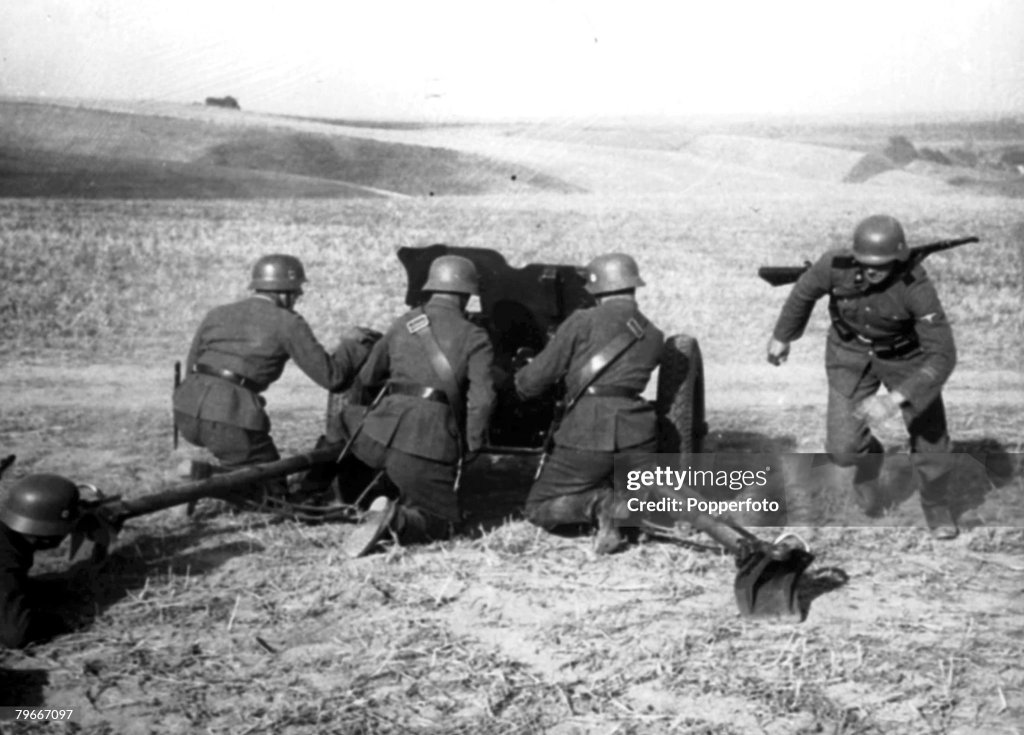
Two days to war in Europe.
Ambassador Nevile Henderson is advised by the Home Office that Hitler’s demand for the arrival of a Polish plenipotentiary that day is unreasonable. Henderson and Ribbentrop meet again, and on this occasion come close to blows. Ribbentrop goes over Hitler’s latest proposals, but Henderson claims Ribbentrop refuses to give him a copy of the text.
Chancellor Hitler’s answer to Britain is in London this morning and it will be considered by the Cabinet later in the day. Its contents are being wrapped in elaborate secrecy, like all the diplomatic interchanges between Berlin and London in the last few days. But enough is known to show that Herr Hitler is attempting to win his extreme demands on Poland by expressing a willingness to “negotiate” — if his demands can be conceded in advance. He has refused with utmost vehemence to keep within the limits of his so-called “minimum demands” of last March, which called for the cession of Danzig; a corridor across Pomorze — the Polish Corridor — and frontier “rectifications” along the Polish-German border. Instead, Herr Hitler has insisted that he must have a great deal more, but he has done so with a show of reasonableness, as if to induce the British to support his demands and put pressure on Poland in any negotiations that may be held.
It remains to be seen how Prime Minister Chamberlain and his colleagues will regard such an “offer” from Germany. The mere word “negotiation” is always likely to appeal to British politicians, and there is also the instinctive idea among some Britons that one can always arrive at a fair settlement by drawing a line halfway between the demands of one side and the position of the other. Nevertheless, there is no open indication yet that Herr Hitler will win his game with the British. They had experience a year ago of “negotiation” under such conditions and public opinion is in no mood for a repetition, even if the Ministers were ready for it, of which they have given no public sign.
British diplomacy seemed to have succeeded tonight in momentarily narrowing the issues of the European deadlock to the difference over conditions in which direct German-Polish negotiations might take place. Armies were still massed menacingly on the Polish border, and it was still within the power of Chancellor Hitler — as it had been ever since last March — to give the word. that would precipitate another world war. In this respect the danger was as great as ever, and preparations went forward uninterruptedly in this country and elsewhere to meet it.
But Britain’s efforts today were concentrated upon bringing the Germans and the Poles to sit around. a table in the spirit of President Roosevelt’s appeal of last week. Late tonight, when it was learned in London that a possibly momentous broadcast in Germany had been canceled, the British were distinctly pleased with themselves. They felt they were on the right track.
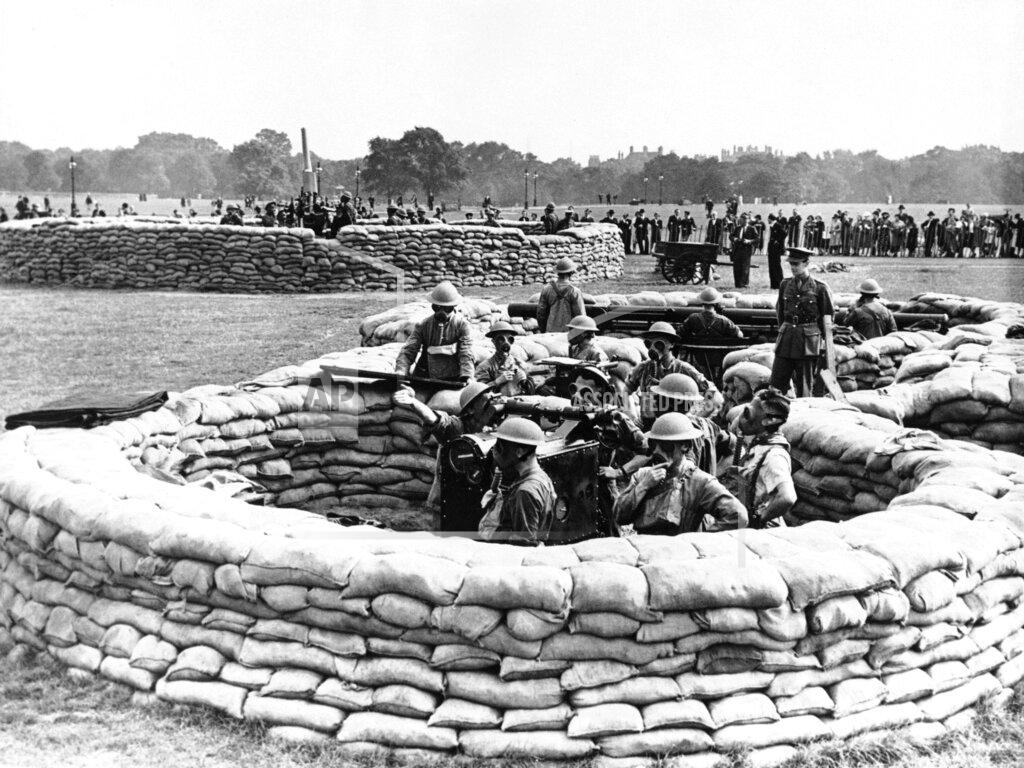
It seemed to the British, behind the sandbagged walls of their government buildings, that Herr Hitler had been faced for the first time with the certain alternative of a world war or a peaceful way out of the crisis that he himself had brought upon Europe. If he was searching for a way out, the British were ready to help him on condition that any formula did not make the Poles give up the means of maintaining their independence.
The British Cabinet met this morning to approve a brief reply to Herr Hitler’s latest communication — his third in a week — which had arrived in London last night. The Hitler note had repeated his extreme territorial demands upon Poland; it had also expressed a willingness to begin “negotiations” if the Germans could be assured in advance of getting their demands. In addition, Herr Hitler had added that he would expect Polish plenipotentiaries to arrive in Berlin by tonight-that is, within twenty-four hours after he had handed his note to Sir Nevile Henderson, the British Ambassador in Berlin.
In the small hours of this morning, long after most of London had gone to sleep, Viscount Halifax, the Foreign Secretary, and his experts sat up in the Foreign Office examining this document. They were troubled by the twenty-four-hour provision in it. Was this, they wondered, the German ultimatum that had been foreshadowed for so long from Germany? An urgent message was flashed to Ambassador Henderson instructing him to ask whether this was an ultimatum. The Germans replied that it was not.
The British Cabinet met this morning to discuss Herr Hitler’s note, which was received by the Foreign Office last night. They met for an hour and a half and it was sufficient for them to compose their reply, which has now been sent to Berlin. Although this exchange of notes continues, there seems to be little change in the European crisis. Neither side is giving anything away about what they’ve been saying to each other. It seems clear that their basic attitudes have not changed. Britain is still standing firm in her undertaking to help Poland should she be threatened by any other country, while Germany continues to pursue her claims that Danzig and the corridor should be returned to the Reich.
Nevile Henderson handed Joachim von Ribbentrop the British government’s reply at midnight. “His Majesty’s Government repeat that they reciprocate the German Government’s desire for improved relations, but it will be recognised that they could not sacrifice the interests of other friends in order to obtain that improvement”, the note explained. “They fully understand that the German Government cannot sacrifice Germany’s vital interests, but the Polish Government are in the same position and His Majesty’s Government believe that the vital interests of the two countries are not incompatible.” The note expressed “reservation in regard to the statement of the particular demands put forward” by Germany, but said that German proposals would be “fully examined” during discussions.
The Polish government decrees a mobilization to meet the German threat. Beck tells Ambassador Kennard that Polish mobilization will resume at midnight. Drastic measures are taken to stop any possible sabotage by pro-German elements. By 4.30 PM, all Polish towns are covered with posters summoning all men up to the age of 40 to report for enlistment. All able-bodied men up to the age of 40 have been called up for military service and must report to their depots by tomorrow. Meanwhile, all horses, cars, motorcycles and bicycles have been requisitioned. It’s understood that the country will be ready to face an invasion by midnight tomorrow – the latest information suggests that German military preparations for an invasion are unlikely to be completed for a couple of days.
The Polish Government has today sent a strongly worded protest to Slovakia about their broadcast, urging the Slovak people to co-operate with the German occupying force against their ‘common Polish enemy’. They added that this was proof that Slovakia was now completely under the influence of Germany and had no control over her own affairs. But regardless of Polish protest, the German occupation of Slovakia has continued throughout the day. The country is now full of German soldiers, most of them stationed on the Polish border. Between 5,000 and 10,000 German troops remain in the capital, where they have been confined to barracks. Reports claim that more than 500 tanks have been seen on roads in Slovakia, some of them visible in the capital city of Bratislava.
Some of the Gestapo officers have now moved into the headquarters of the Slovak police, of which they are now in charge. Only a few uniformed SS men have been seen, but there are reports that large contingents of them in plain clothes are working in Bratislava and other cities. German soldiers with fixed bayonets guard the water and electricity works, armament factories, railway stations and post offices. Most Slovaks have now accepted the occupation as being inevitable. Some small shopkeepers and businessmen hope that the German troops will spend a lot of money and bring extra trade, but the most noticeable impression is that the Germans are there to stay.
Hitler agrees to Britain’s request for a 24-hour extension to permit a Polish negotiator to meet with von Ribbentrop.
In Germany, Chancellor Adolf Hitler sets up a six-man cabinet council for the defense of the Reich under Marshal Hermann Göring.
Germans prepare against blockade. Germany continued mobilization of all her resources and population against the possibility of any blockade yesterday. Detailed explanations of obscure portions of the rationing system put into effect Monday and an announcement of new regulations for restaurants were issued.
Danzig traffic — road, rail, and sea — is cut except to Germany. Two Polish customs inspectors visit the Danzig Senate to discuss the situation. On leaving, they are arrested by the Gestapo. Despite Polish protests, they remain in custody.
Large crowds gather to admire and gawk at the German pre-Dreadnought battleship Schleswig-Holstein in port for a visit at Danzig.
The French claim Germans are deserting over the Rhine. Troops flee by swimming and then ask to join the foreign legion. This is largely self-delusion and wishful thinking.
Paris has been the scene of much diplomatic activity today, as politicians there continue to assess both the signing of the Soviet-German Pact and the occupation of Slovakia. At the same time, a number of defence preparations are now well advanced. This morning the French President, Monsieur Monnet, received his Ambassador to Moscow, Monsier Maggiar, who has returned to give his report on how matters in Moscow stand after the signing of the Pact. Mr Lukasiewicz, the Polish Ambassador, called on the French Premier, Monsieur Daladier, to express the grave concern of Poland at the German occupation of Slovakia. Meanwhile, French defence preparations are in full force. From tomorrow, the railways will come under military control and private passengers and freight will only be carried if their transport does not conflict with the military.
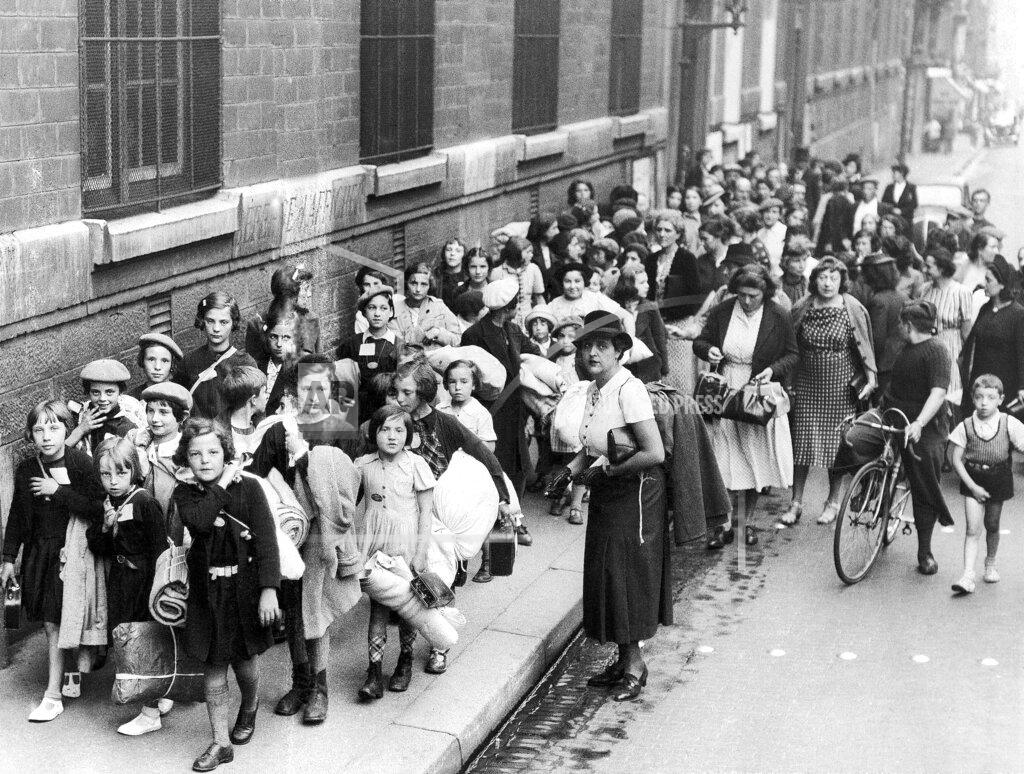
The major event of the day was the evacuation of over 16,000 school children from Paris. They travelled in 27 special trains. A communiqué issued tonight by the Ministry for National Education states that 45,000 children will have left the capital by noon tomorrow. The distribution of gas masks to all children aged between two and ten has been speeded up, and a special distribution camp was opened today. The evacuation of the Paris hospitals is also in hand. Nine Red Cross trains are standing by at Austerlitz Station, ready for instant departure with those too sick to travel alone, should the need arise. The gloomy atmosphere cannot be relieved by a visit to the beautiful Vincennes Zoo, since all the inmates have been sent off to private collections in the safety of the French countryside.
By a decree to be published tomorrow, French railways may be taken over without any preliminary steps by publication or the posting of notices. This means that the Government may take whatever it needs of material belonging to the companies and appropriate it for military uses.
The Duke of Windsor last night sent a personal message to King Victor Emmanuel of Italy asking him to intervene in the cause of peace. After expressing his personal esteem for the King, the Duke recalls that he fought side by side with Italian soldiers during the World War and that it is by virtue of this association that he now begs the King to use his influence to prevent the catastrophe that now seems imminent. The Duke adds that he regrets importuning the King at this difficult time, but that as a simple citizen of the world he cannot refrain from sending this personal message.
Only Italy has yet to reply to the joint offer of mediation in the European crisis made by King Leopold of Belgium and Queen Wilhelmina of the Netherlands.
The Hungarian border worries Slovakia.
An evacuation order for London civilians is given by the United Kingdom Ministry of Health, to be executed on the next day; with special note stressing that it did not necessarily meant war was inevitable.
The British Foreign Office sends a message at 5:30 PM to Berlin after it receives reports of German sabotage in Poland. It says in part, “Germany must exercise complete restraint if Poland is to do so as well.”
The Duke of Windsor last night sent a personal message to King Victor Emmanuel of Italy asking him to intervene in the cause of peace. After expressing his personal esteem for the King, the Duke recalls that he fought side by side with Italian soldiers during the World War and that it is by virtue of this association that he now begs the King to use his influence to prevent the catastrophe that now seems imminent. The Duke adds that he regrets importuning the King at this difficult time, but that as a simple citizen of the world he cannot refrain from sending this personal message.
Henri Guisan was elected General of the Swiss Army and was given the directive to safeguard the independence of the country and to maintain the integrity of the Swiss territory in case of World War II.
General Reijnders is appointed supreme commander of the Dutch army.
Liechtenstein declared its neutrality in all future conflicts from diplomatic representation through Switzerland.
The Turkish Government and people are watching developments in Europe with complete calm. Beyond the strengthening of troops in Thrace there has been no sign of military activity or even talk of a general mobilization.
The British coaster Saint Conan ran aground on Sanda Island, Argyllshire, and was wrecked.
The Finnish cargo ship Ållotar collided with the Finnish Dagny off Smygehuk, Sweden, and sank with the loss of three of her seven crew. The survivors were rescued by Dagny.
A peace note was struck by President Roosevelt today in reply to the Marquess of Lothian when the new British Ambassador presented letters of credence at the White House. He asserted that the principal task of international statesmanship was to effect peaceful and constructive solutions of controversies between nations and thus to obviate the folly of war, which unhappily seems to overshadow the world today. Lord Lothian had stated that he was assuming office “at a time when the whole world is disturbed by war, by rumors of war, and by preparations for war.” The new Ambassador assured Mr. Roosevelt that the first purpose of the British Government was “to do everything in its power to maintain peace, to bring about whatever political and economic adjustments reason and justice may require by pacific means and so help to bring the nations back to stable prosperity and stable peace.”
The United States Government released its hold last night on transatlantic passenger liners that had been held in the Port of New York while Federal agents searched for arms and satisfied themselves that all conditions necessary for clearance were complied with. Chief among the departing liners was the German express steamship Bremen, which had tarried for two days at her dock, with steam up and officials fretting at the delay that ran at cross-purposes with orders from the Reich Government to speed homeward without passengers or cargo. The French liner Normandie, also released, did not sail because her passenger list was considered too small.
The German liner Bremen finally sailed from New York harbor. It had been detained there for two days while U.S. customs officials searched it to find out whether it can be converted to carry weapons. Many foreign liners have also been searched. However the Bremen has been subjected to a particularly detailed one, much to the annoyance of the German Government and the liner’s crew — one of whom was heard to say that officials have even searched the swimming pool.
Other ships in the logjam that threatened to paralyze shipping were the Aquitania, which sailed not long after the Bremen, and the liner Columbus, which had been held at Curaçao in the West Indies, on order of the German Government. The Columbus had been in the Dutch port of Willemstad since last Saturday, and the 745 passengers, marooned in a small city which they had traversed and examined. time and again, were beginning to wonder if they were destined to settle down permanently in the cruise port. The ship sailed yesterday afternoon, however, and will reach New York Saturday. Plans for the liner after that date remain uncertain.
U.S. unemployment rose 3.5 percent last month, reversing a downward trend that began in mid-February, the National Industrial Conference Board reported yesterday. The number of persons out of work increased from 9,528,000 in June to 9,860,000 in July. The total in July, 1938, was 10,894,000. Total employment dropped from 45,052,000 in June to 44,774,000 last month. The largest losses were recorded in agriculture, manufacturing and trade, distribution and finance. Gains were noted in construction, transportation and the service industries. The drought was held responsible for a large part of the decline in farm employment. Most of the other changes were seasonal in character, according to the report. The emergency labor force maintained by the Federal Government through the WPA, the CCC and other agencies dropped from 2,894,000 in June to 2,603,000 in July. This was the fifth consecutive monthly decline.
The U.S. WPA drops 25,000 more employees due to funding cuts. This completes the laying off of 70,000 during an 18-month period.
RMS Queen Mary sets sail from Southampton for New York City on her last prewar commercial voyage, with 2,332 passengers, including Mr. & Mrs. Bob Hope, and a cargo of gold bullion. The ship will remain berthed at New York until the end of the year while it was decided what role the ship would play in the war.
The eleven plays and musical comedies on Broadway are to be closed by a strike of actors Tuesday night if the stagehands refuse to work with the actors Monday night, it was decided yesterday by officials of the Associated Actors and Artistes of America, A. F. of L. parent of actor unions. Hollywood film stars were expected to go on strike simultaneously on Tuesday, closing the motion-picture studios at the near-peak of their production schedule. Radio, the concert stage and grand opera also would be affected, though probably to a lesser degree.
George E. Browne, president of the International Alliance of Theatrical Stage Employees, the stagehands’ group, reaffirmed yesterday afternoon that members of his union would not work Monday night with the actors in the company of “Leave It to Me!” unless Sophie Tucker were in the cast. Miss Tucker is president of the American Federation of Actors, composed primarily of vaudeville and night-club performers, which Mr. Browne chartered after it was expelled by the Four A’s, thereby prompting the grave jurisdictional dispute. For accepting Mr. Browne’s charter Miss Tucker was suspended by the Actors Equity Association, a move that prevents all other Equity members from appearing on the same stage with her.
6th NFL Chicago All-Star Game: New York Giants 9, All-Stars 0 (81,456).
New York Yankee rookie Atley Donald, who will win 12 straight games to set an American League record for the most consecutive victories thrown by a rookie, throws a recorded pitch at 139 feet per second (94.7 mph) to establish a new record for a fastball. The velocity of ‘Swampy’s’ throw was measured by a speed meter owned by the Indians and the Cleveland Plain Dealer.
On the field, the Yankees did not fare as well. Ken Keltner lined a walkoff base hit off reliever Johnny Murphy in the 10th inning that gave the Cleveland Indians a 4–3 victory over New York. Lefty Gomez had walked in the tying run in the bottom of the ninth to send the game into extra innings.
The Detroit Tigers bunched two hits and two walks with a Boston error today to come from behind in the eighth inning and defeat the Red Sox, 7–6, in the series opener. Boston’s sensational rookie outfielder, Ted Williams, batted a home run with two mates on base to put the Sox in the lead in the third inning, but it was his error on Birdie Tebbetts’s single that permitted Pete Fox to score from first base with Detroit’s winning run in the eighth. Williams’s homer was his twenty-second of the season. Jim Tabor and Moe Berg of Boston and Earl Averill of Detroit also hit home runs.
The veteran Ted Lyons returned to duty today after a sixteen-day layoff because of a wrenched ankle and pitched the White Sox to an even break in a doubleheader with the Senators. Lyons allowed four hits in winning the first game, 5–2, his eleventh victory of the season. Joe Krakauskas’s seven-hit pitching, coupled with Buddy Myer’s pinch triple in the ninth and Krakauskas’s own sacrifice fly, gave Washington the second, 4–3, after Chicago had tied the score with two runs in the eighth. Luke Appling drove in three Chicago runs in the opener with two singles, while Mike Kreevich’s double with two on in the first inning scored the other two.
The St. Louis Browns dug themselves a deeper hole in the cellar of the American League today by losing a doubleheader to the seventh-place Philadelphia Athletics, 9–8 and 2–0. They now trail Philadelphia by eight games. Lynn Nelson pitched the shutout in the nightcap, which was called on account of darkness after seven innings. An error permitted the Athletics’ first run and the other came across on Bob Johnson’s single and Earl Brucker’s double. A nine-run rally in the seventh inning gave the Athletics the verdict in the first game. Sam Chapman hit a double and a home run during the busy session and Frankie Hayes homered with two men on.
It is understood orders were issued today to the Mexican Government oil monopoly to interrupt all negotiations with foreign countries entailing commitments for future deliveries. Contracts already concluded are not affected. The order is believed to be an outcome of the European situation, since the outbreak of war would deprive Mexico of her best customers, Germany and Italy, and would bring new customers into the market, notably Great Britain.
In India the last session of the Central Legislative Assembly to be held in Simla, was opened today. Members of the Congress Party boycotted the meeting in protest against the dispatch of Indian troops abroad. One adjournment motion, which criticised the movement of troops from India for purposes other than defence of India, and at the cost of the Indian exchequer, was disallowed by the Governor General. Meanwhile, the Viceroy issued a decree requiring all British males to register within a fortnight.
Japan’s fears that Soviet Russia, freed from European pressure by her nonaggression pact with Germany, may seize the initiative in the Far East, are causing a great flow of Japanese troops through Korea and North China into Manchukuo. On a journey just completed through Manchukuo as far as the Outer Mongolian battle zone border this correspondent found troop and supply trains choking the railways. They were being rushed toward vulnerable points along the more than 1,000 miles of frontier across which Japanese troops face those of the Red Army.
Japanese military men are convinced that one of the major considerations of the German-Soviet nonaggression pact was an undertaking by Germany-so recently linked to Japan by the anti-Comintern treaty-not to interfere with any Russian moves against Japan.
Hitherto most Japanese have felt that in a new Russo-Japanese war, which they believed bound to come, they could choose the time and place for its opening. The MoscowBerlin pact, however, has changed this confidence into anxiety, expressed by Japanese in all walks of life throughout Japan, Korea and Manchukuo. No estimates are available on the reinforcements for the Kwantung Army, Japan’s powerful garrison in Manchukuo. Its strength has been estimated at 500,000, approximately equal to that of all the Russian forces in Far Eastern Siberia. But all indications are that the reinforcements are very large.
Japanese expressions concerning prospects of a war with Russia vary. Army officers naturally express confidence in Japan’s ability to win, although some admit that the necessity of keeping large forces. in China might prove an important difficulty. Japan has about 1,000,000 men engaged in her 2-year-old effort to conquer China. Lieut. Gen. Rensuke Isogal, chief of staff of the Kwantung army, said he did not believe a full dress war was imminent. He and other Kwantung army officers pointed to the difficulty of supplying major Russian armies at the end of the long Trans-Siberian Railway, in spite of recent completion of its double-tracking. It is known, however, that the Red Army has done all it could, by establishing arsenals and supply depots in the Far East, to make its forces there self-sufficient.
Among great numbers of Japanese, however, there is genuine dread of the Russian conflict that they believe is imminent. Manchukuo’s chief cities, Mukden, Harbin and Hsinking, the capital, are under light control as a precaution against Russian air raids. Manchukuo also is full of rumors of Russian troop movements to the Far East, matching those of Japan into Manchukuo. There were reports also that the struggle between Japanese and Russians along the Khalkhin Gol River, the Mongolian battlefield, was expanding. In Tokyo, however, available communiqués reported only the now commonplace artillery duels.
[Ed: The Japanese, of course, have gotten their heads handed to them in the Khalkhin Gol fighting, courtesy of Comrade Zhukov, and have lost their enthusiasm for tangling with the Soviets; but this is not to be told to the general public.]
A Chinese editor, Chu Hsin-kung, is slain on a Shanghai bridge. He was a close friend of Chiang Kai-shek. Suspicion has fallen on followers of the pro-Japanese collaborator Wang Ching-wei.
Japan announces it will renew its drive against China, saying it will “inflexibly oppose those who obstruct our mission” in East Asia.
Isoroku Yamamoto is promoted to full Admiral and appointed supreme commander of the Japanese combined fleet.
Dow Jones Industrial Average: 136.16 (-1.23).
Born:
Elizabeth Ashley, American actress (“Coma”, “Evening Shade”); in Ocala, Florida.
John Peel, English disc jockey; in Heswell, Merseyside, England, United Kingdom (d. 2004).
Willie Jones, AFL fullback (Buffalo Bills), in Angleton, Texas (d. 2016).
Died:
Wilhelm Bölsche, 78, German author and editor.
Naval Construction:
The Royal Navy naval trawler HMS Marsona (FY 714) is commissioned.

 History Diaries