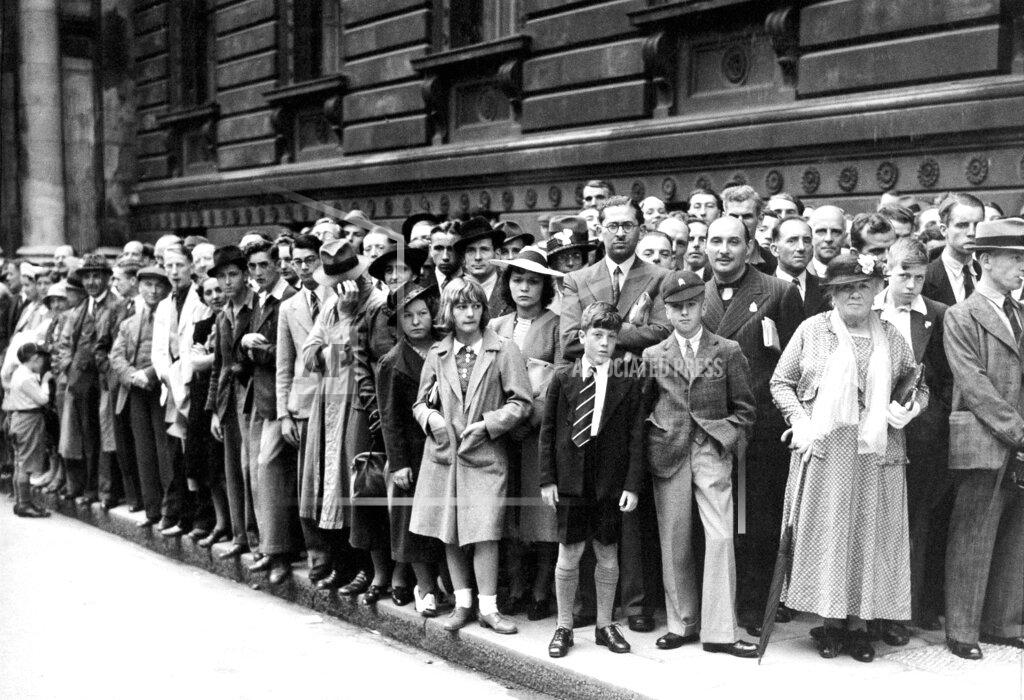
Five days to war in Europe.
European security was still balanced tonight on the knife edge between war and peace. The acute crisis forecast in these dispatches a week ago has been all that was then predicted, but it has not yet brought a final break, and with each hour gained new hopes arise.
These hopes fluctuate. They were brighter again tonight, for news from the continent indicated that Germany was still engaged in pressing to the utmost the “war of nerves,” by which her skilled propagandists believe they can. break down resistance without resort to actual hostilities. It is a futile expectation as far as this country is concerned, but while it endures the worst is likely to be postponed.
Certain small indications lend encouragement to a belief in postponement. One is that, according to a North German Lloyd announcement, the liner Europa, inbound from New York, will make her customary call tomorrow at Southampton. Since it will take her another day to reach home waters the assumption is that there will be no break during that period. Every day thus gained strengthens the forces working for peace.
Another news item from Germany is that ration cards not only for food but all other necessaries have now been issued throughout the nation. For the first time this has driven home to the German people the utter gravity of the situation to which they have been brought, and the effect upon them is far from the enthusiasm that is needed in Germany as much as anywhere else before plunging into war.
The ordinary German, who is unable to follow the intricacies and significance of diplomatic exchanges, has thus learned for the first time that a war situation confronts his country. He has learned it not from his newspapers, but from the visit of a policeman with cards imposing restrictions upon purchases of such things as bread, sugar, soap and other household necessaries, and he is naturally appalled over the prospect.
Hitler was woken up just after midnight and met with Birger Dahlerus and Göring. Dahlerus later recalled Hitler as appearing glassy-eyed and highly agitated, at one point going on a bizarre rambling monologue repetitively asserting that Germany could win a rapid war and that he would “build U-boats, build U-boats, U-boats, U-boats, U-boats” and “airplanes, airplanes, airplanes, and I shall annihilate my enemies.” After calming down Hitler laid out a set of proposals more detailed than Nevile Henderson had been given, which included annexation of Danzig and the Polish Corridor. Dahlerus flew back to London, conferred with Halifax and Chamberlain and then flew back to Germany that same day to relay Britain’s mixed reaction to the proposals.
Dahlerus has an early morning meeting with Göring and Sir George Ogilvie-Forbes, Counsellor of the British Embassy, before breakfasting again with Göring.
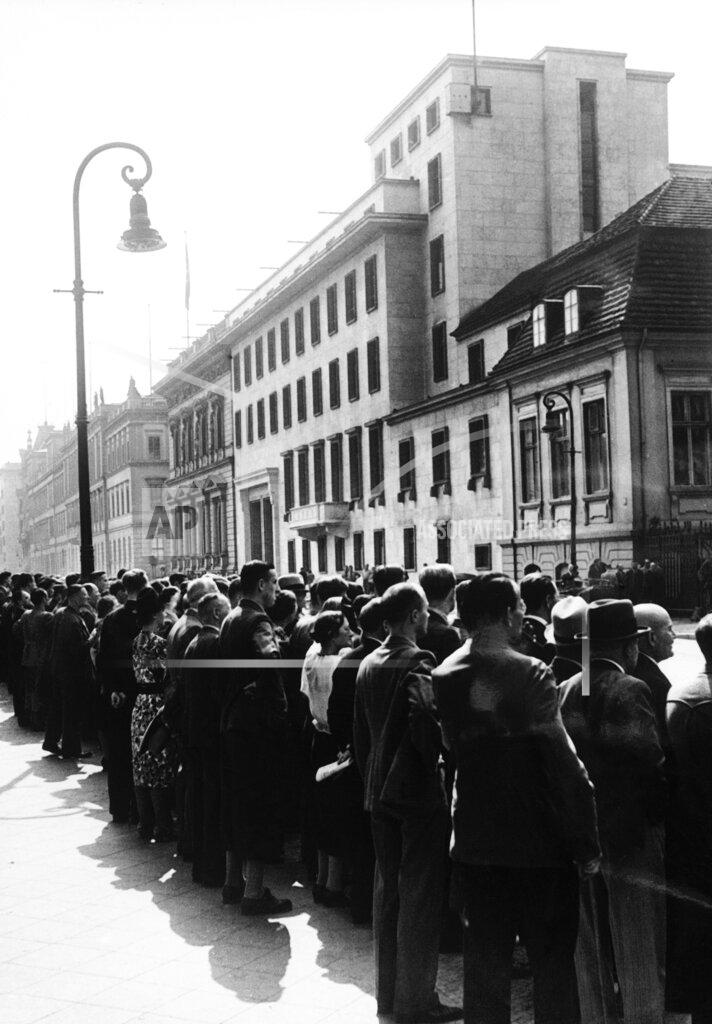
Citizens in Berlin, Germany observe troops moving toward the east.
While German preparations for possible armed conflict were continued at top speed today, foreign military attachés accredited to Berlin were “requested” by the authorities to remain in the Reich capital unless they had special permission to leave. Despite their diplomatic status, therefore, they find themselves virtual prisoners in Berlin.
All preparations for Danzig’s defense have been completed, and the city is now awaiting events, tense but calm, despite the fact that almost all believe war between Poland and Germany is imminent.
The Danzig Senate confiscated stocks of wheat, salt and petrol that belonged to Polish businesses that were in the process of being exported or imported via the Free City, an action that led to sharp Polish complaints. The same day, 200 Polish workers at the Danzig shipyards were fired without severance pay and their identification papers revoked, meaning that they legally could not live in Danzig anymore.
German Chancellor Adolf Hitler replies to French Premier Eduoard Daladier’s appeal from the previous day that he hoped for Franco-German peace, but continues to press his demands against Poland. Chancellor Hitler, in a letter to Premier Edouard Daladier of France made public at a press conference early today, firmly asserted that Danzig and the Polish Corridor “must return to Germany” and that “the Macedonian conditions on our Eastern frontier must be removed.” It was the first time Herr Hitler openly demanded the return of the Corridor as well as Danzig.
The seven-page letter, sent to Paris yesterday, revealed an uncompromising attitude regarding Poland, but this does not necessarily mean that the door to a peaceful solution to the GermanPolish crisis was slammed completely shut. It probably does mean, however, that negotiations between Germany and France for a peaceful settlement may have been impaired. For it was made clear that Herr Hitler published this letter to the French Premier because he felt that M. Daladier, in a press statement last night, had “misrepresented” the German viewpoint as contained in an exchange of messages the last two days between. the two statesmen.
Herr Hitler’s letter was a historical summary of recent FrenchGerman relations and of the present German-Polish crisis. Herr Hitler said he saw “no way of persuading Poland to accept a peaceful solution.” “In the event of conflict, Poland will bear the greatest burden, regardless of who wins,” he added. “Poland will be lost any way you calculate.”
The Chancellor said to the French Premier that if over the present crisis “our two countries should be destined to meet again on the field of battle, I shall be leading my people in a fight to rectify a wrong, whereas the others will be fighting to preserve that wrong.” Herr Hitler said he shared the “misgivings” expressed by M. Daladier in his letter to Herr Hitler over another war, and declared that he had hoped to prevent such an eventuality by attempting to “clear away” all possible inflammable material between the two countries that might “disturb the French people.” He reasserted that no questions separated the French and German people since the Saar territory was returned to the Reich in 1935. The entire letter was a plea for France to stay out of Germany’s quarrel with Poland.
Germany reassures the Baltic States that the pact with the Soviets is not aimed at them.
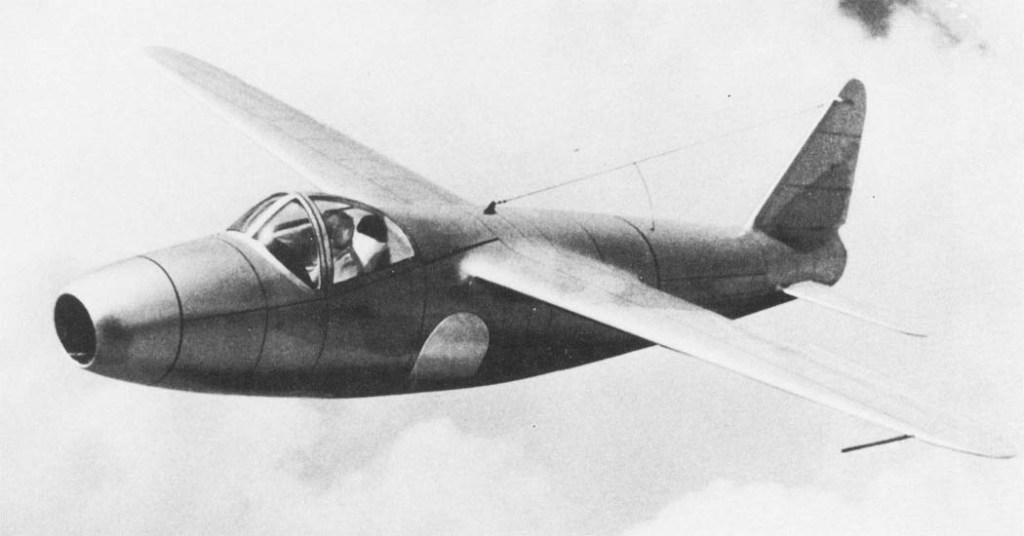
First complete flights of jet-propelled aircraft are made secretly at Rostock-Marienehe in northern Germany, by a Heinkel-178 powered by the He S-3B jet engine, piloted by Luftwaffe Flugkapitän Erich Warsitz. It becomes the first jet-powered airplane to fly. It remains airborne for six minutes. The He 178 was designed by German physicist Hans von Ohain, who worked for Ernst Heinkel, and was intended to have a cruise speed of 360 miles per hour and a maximum speed of 435 miles per hour. However, during the flight, the He 178 only reached a top speed of 393 miles per hour. The aircraft also had a relatively short endurance and didn’t impress high-ranking Nazi officials who attended a demonstration flight.
The Kriegsmarine (German Navy) torpedo boat Tiger collides with the destroyer Max Schultz off Bornholm, Denmark and sinks with the loss of two crewmen.
Ambassador Henderson returns to Berlin from London. Chamberlain requests information concerning Hitler’s intentions towards Poland.
The London Cabinet rules out any retreat but sees hope in playing for time. A note to Hitler is expected to propose a six-month period to precede negotiations.
Chamberlain sent a letter to Hitler, which was intended to counteract reports that he had heard from intelligence sources that Ribbentrop had convinced Hitler that the Molotov-Ribbentrop Pact would ensure that Britain would abandon Poland. In his letter to Hitler, Chamberlain wrote:
“Whatever may prove to be the nature of the German-Soviet Agreement, it cannot alter Great Britain’s obligation to Poland which His Majesty’s Government have stated in public repeatedly and plainly and which they are determined to fulfill.
“It has been alleged that, if His Majesty’s Government had made their position more clear in 1914, the great catastrophe would have been avoided. Whether or not there is any force in that allegation, His Majesty’s Government are resolved that on this occasion there shall be no such tragic misunderstanding.
“If the case should arise, they are resolved, and prepared, to employ without delay all the forces at their command, and it is impossible to foresee the end of hostilities once engaged. It would be a dangerous illusion to think that, if war once starts, it will come to an early end even if a success on any one of the several fronts on which it will be engaged should have been secured.”
Polish Foreign Minister Beck refuses to go to Berlin. Beck says he accepts the principle of direct negotiations, but towards midnight tells British Ambassador Kennard that Polish mobilization is proceeding.
In a famous football match known in Poland as The Last Game, Poland defeated the highly renowned Hungarian team 4–2 in the greatest Polish football victory up to that time.
Italian Foreign Minister Ciano recommends British acceptance of Hitler’s latest offer. Nazi Germany demanded Danzig and Polish Corridor.
Italy still lags on war preparedness. Following a mediation request. Italy awaited developments of the negotiations between London and Berlin today with complete calm and confidence. There has been nothing more striking during the crisis than Italy’s failure to keep pace with her Axis partner in war preparations. Premier Benito Mussolini promises Canada every effort for lasting and just peace.
Croats are jubilant over the new accord. The press sees a new era in the country with an increase of democracy.
Slovak Premier Josef Tiso invites the Germany army to occupy Slovakia.
Hungarian police end a Nazi demonstration, seizing 66. Scores are hurt in fighting.
The pact with the Soviets spurs Reich trade.
Queen Wilhelmina of the Netherlands receives German ambassador Grave Zech.
The Netherland (Holland) orders a general military mobilization.
An urgent report received at the Foreign Ministry during the afternoon from the French Ambassador to Angora said that Turkey had formally promised to remain faithful to France and Britain in the face of “extraordinary pressure” from Germany.
French Ambassador Paul-Emile Naggiar is flying to Paris tomorrow to report on the general situation. It is understood tonight that among other reasons for this journey is, upon inquiry as to whether the Soviet-French pact of mutual assistance was still operative, M. Naggiar was informed by the Commissariat of Foreign Affairs that the Soviet Government considered that pact rendered invalid by the GermanFrench non-aggression pact. Foreign Minister Georges Bonnet of France and Joachim von Ribbentrop, German Foreign Minister, concluded a no-war pact when Herr von Ribbentrop visited Paris last Spring.
The meeting of the Supreme Soviet [Parliament] tomorrow evening is being awaited with great interest in diplomatic circles here, as Premier and Foreign Commissar Vyacheslav Molotov is scheduled to speak on the Soviet-German non-aggression pact. It is expected that, without making sensational disclosures, he will reveal something of the history of the negotiations in recent months and of the motives that induced the Soviet Government to change its policy from urging a pact of non-aggression against Germany last March to the conclusion of a pact of non-aggression with Germany last week.
All eyes in Washington were turned anxiously today toward London and the decisions of the British Cabinet in the expectation that the character of its reply to Chancellor Adolf Hitler and his reaction would show whether the Polish question was to be resolved through war or peaceful processes. In the absence of definite information from Europe, officials marked time but watched the situation closely. President Roosevelt remained in the Executive Mansion, studying latest reports and consulting by telephone with Secretary of State Cordell Hull. He was prepared to move again for peace, if events provided an opportunity; but until some new occasion arose, he was standing on the appeals he made to the heads of state in Italy, Germany and Poland last week.
Following a day spent in his study reading dispatches — but sending out no messages — President Roosevelt reverted to White House routine tonight to formally entertain at dinner the Prince Consort and Crown Prince of Luxembourg. Later the party attended a special showing of motion pictures. At 11:45 PM, Brigadier General Edwin C. Watson, one of the White House secretaries, who was a guest at the dinner, met with newspapermen, as he had arranged to do earlier, but only to convey reassurances that nothing had happened in connection with the international situation to disturb the President this evening.
General Watson said the President had not received a dispatch since 4:30 PM and that this last one had been only “routine.” He added that the President sent word that newspapers were as well informed on the general situation as he was. The General also stated that the special train ordered to take President Roosevelt to Hyde Park tomorrow evening was still available but that no one expected the President to leave then. At the State Department there was an atmosphere of tense expectation but little action in view of the uncertain status of affairs with reports throwing not too much light upon them. Secretary Hull and his chief aides were on duty in their office morning and afternoon. The European division remained open continuously under the direction of its chief, Jay Pierrepont Moffatt.
Press and radio reports supplemented official dispatches from United States Embassies in the capitals of the countries involved in the crisis. These were studied carefully by Secretary Hull during morning and afternoon conferences with his chief advisers. Those who conferred with him and discussed the situation and the possibilities. included Sumner Welles, UnderSecretary of State; A. A. Berle Jr., Assistant Secretary of State; Green H. Hackworth, legal adviser of the department, and Mr. Moffatt. As they read and discussed the official dispatches, messengers from the code rooms brought additional reports which were promptly taken under consideration. From all this, however, the only word that emanated was that the crisis was being considered in all its aspects, but none that a new move by the United States was immediately in prospect.
Prince Consort Felix of Luxembourg and his 18-year-old son, Crown Prince Jean, were supper and overnight guests of President Roosevelt tonight. They arrived in Washington at 5:30 PM to be greeted by Secretary of State Cordell Hull and other high government officials. A troop of cavalry escorted them from the station to the Capitol, en route to the White House, after they had been saluted by a marine drum corps at the Union Station. The Crown Prince, looking younger than his 18 years, was dressed like his father in formal afternoon attire. The Royal pair will be guests at a White House. luncheon tomorrow, after which they will leave for New York to attend the World’s Fair.
Tax revenues of Federal, State and local governments in the United States during the fiscal year which ended June 30, 1938, were 79.6 per cent greater than in the corresponding 1932 period, the Treasury reported today. Annual expenditures increased by 44 percent.
A simplified financing plan to encourage construction of small homes costing not more than $2,500, was announced today by the Federal Housing Administration coinciding with the mailing of regulations involved in the plan to all banks and lending institutions in the country. It is to become effective September 1. The plan was said by Stewart McDonald, FHA Administrator, to have been designed to supplement rather than displace the regular FHA program. Like the general program, it does not involve actual lending of federal funds but operates through a mortgage-insurance plan, with the FHA collecting one-half of 1 percent of the original face value of mortgages as a premium to offset possible losses. The new regulations would permit home-builders — principally those in small cities and towns where real estate values are low — to pay off mortgages in periods as long as fifteen years. The mortgages will be limited to families with incomes ranging from $900 to $1,500 annually.
The U.S. Resource Committee asks for regulation of energy sources, asserting a federal policy would aid in defense and the economy.
The Rev. Charles E. Coughlin, commenting on nazism and communism in view of the Russian-German non-aggression pact, declared today that “two abominable systems have pledged their mutual support.”
In the second 1939 Negro League East-West Game, Josh Gibson drives in four and Ed Stone gets three hits to lead a 10-2 rout by the East.
Amid crashing of base hits that included three home runs and a bruising ten-run explosion in the eighth inning, Charlie Ruffing swept majestically into his twentieth pitching triumph of the 1939 campaign today as the New York Yankees crushed Schoolboy Rowe and Detroit the Tigers, 13–3. Frankie Crosetti, Bill Dickey, and Red Rolfe hit the homers for the Yankees.
Cleveland’s Indians scalped the Boton Red Sox, 1–0 and 5–3 in a doubleheader today, running their current victory string to seven games and climbing to within a half-game of the third-place White Sox.
The Washington Senators withstood two last-inning uprisings by the St. Louis Browns today and won both ends of a double-header by one-run margins, 8–7 and 4–3. The nightcap, tied, 1-1, after nine innings, went two extra rounds. The Browns scored twice and had the tying and winning runs on base in the ninth inning of the opener. Roxie Lawson and Southpaw Ken Chase had a tight mound duel in the nightcap. The Senators scored three in the 11th to take a 4–1 lead, but had to sweat out a Browns rally that pulled to within a run before the game ended with the tying and winning runs at third and seocnd.
The Chicago White Sox, fresh from three straight victories over the Red Sox, fell before the lowly Philadelphia Athletics today, 2–0. Bill Beckman hurled the seven-hit shutout for the A’s.
The Cincinnati Reds thumped the New York Giants, 7–2, at the Polo Grounds. Paul Derringer got his 17th win of the season. The Reds pounded Carl Hubbell for six runs in the fifth inning. The Reds end the day with a five-game lead over the Cardinals in the National League race.
In Boston, the Bees slow the St. Louis Cardinals pennant rush by splitting a pair, winning 10–4 before losing 6–5. Hank Majeski has a grand slam for Boston in the opener. With the Reds winning, the Cards trail by 5 games.
The last-place Philadelphia Phillies dealt the Chicago Cubs’ pennant hopes a crushing blow today by taking both ends of a doubleheader, 4–3 and 3–2. Walter Beck outpitched Bill Lee in the opener to chalk up his fifth triumph of the year. A single by Catcher Spud Davis that scored two runs in the fourth was the deciding blow.
The Brooklyn Dodgers had 20,119 Flatbush fans almost hysterically happy and cheering madly when they nosed out the Pittsburgh Pirates, 3–2, in the first game of a double header. But with the Dodgers leading in the nitecap, the Pirates scored eight runs in the fifth inning and won the second game, 9–5.
At Khalkhin Gol (Nomonhan), the encircled Japanese 23rd Division mounts a determined break-out attempt, but this fails. The Japanese position is now hopeless; the Soviets have won the short war for the Khalkhin Gol region.
Germans started leaving Tientsin today as the result of numerous incidents in which Japanese gendarmes have slapped German citizens since the conclusion of the German-Soviet non-aggression pact. Repercussions of the Nazi-Communist pact were reported from numerous other Chinese cities. Swastika emblems, which got a friendly Japanese salute until last week, virtually disappeared from autos in Shanghai and Peiping. Japanese in Peiping were reported to have received instructions to “cease provoking the feelings of whites” and not to stage any further anti-British demonstrations.
Born:
Edward Patten, American soul singer (Gladys Knight & the Pips), in Atlanta, Georgia (d. 2005).
Joe Taylor, NFL cornerback (Chicago Bears), in Miami, Florida (d. 2001).
Jerry Tarr, AFL wide receiver (Denver Broncos), in Bakersfield, California.
Bob Clemens, NFL fullback (Baltimore Colts), in North Braddock, Pennsylvania.
 History Diaries