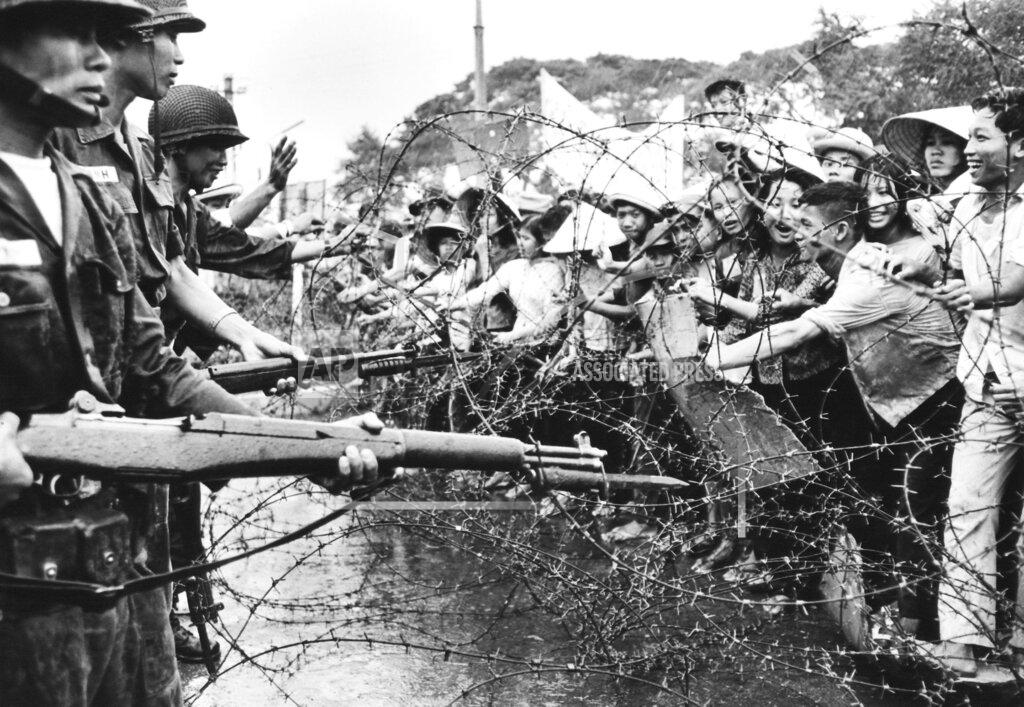
In South Vietnam, troops of the Army of the Republic of Viet Nam (ARVN) opened fire on a crowd of 3,000 unarmed Roman Catholic demonstrators who were protesting outside of the national military headquarters. During the final hours of the Military Revolutionary Council’s two‐day deliberations, a predominantly Roman Catholic crowd surrounded the gates of the military headquarters where the meeting was taking place, demanding an end of the three‐day political crisis. At the same time, Buddhist-Catholic street fights broke out in several sections of downtown Saigon. At least six lives were lost and many other persons were injured. For the first time since the start of street brawling Sunday, Government troops opened fire. Some soldiers fired into the air and others onto the ground. A number of shots went into the crowd.
After about a minute of concentrated fire from carbines land automatic weapons, a hush fell over the crowd. Six victims were taken away in ambulances; at least four were dead. One of the injured was a German television cameraman. In the Saigon market place, at the radio station, and in front of schools in fashionable residential sections, mobs clashed with clubs, stones and knives. At one school two teen‐age boys were killed and five were seriously injured. Buddhist terrorists seized five Catholic schoolboys as hostages. Evidence from many sources indicates Communist agents are operating in all parts of Vietnamese society, seeking to exploit and utilize a divisive situation.
Three Vietnamese generals, including Major General Nguyễn Khánh, finally reached a provisional agreement today to “lead the nation” as a triumvirate. Their action came shortly after government troops opened fire to quell thousands of demonstrators who were threatening to storm military headquarters. Six lives were lost during the day and, at nightfall, crowds were still in the streets. With what was reliably reported to he insistent American backing, General Khánh is to remain as a caretaker Premier over a crumbling government structure. Under the agreement, he will act in conjunction with the former chief of state, Major General Dương Văn Minh, and the former Defense Minister, Lieutenant General Trần Thiện Khiêm. The three men are supposed to hold equal power under the agreement. After approving this shaky compromise, the Military Revolutionary Council, the country’s supreme governing body since the overthrow of Ngô Đình Diệm last November, dissolved itself.
No one of the three can command the support of all segments of South Vietnam’s population. The Catholics resent General Minh’s role in the overthrow of President Diem, who was a Catholic. The Buddhists suspect General Khiem of Diemist tendencies. General Khanh struggled to isolate both in his step‐by‐step drive toward stronger one‐man rule.
The Johnson Administration expressed hope today that law and order would be restored in South Vietnam following the creation of a triumvirate of generals, but the dominant sentiment here was one of pessimism and worry. Pending more complete reports on the latest events in Saigon, Robert J. McCloskey, the State Department spokesman, said only that the Administration lacked “sufficient information” to provide an analysis of the events or to offer “substantive comments.” Mr. McCloskey made a point of saying that the United States had not been consulted during the negotiations that led to the establishment of the triumvirate and that no United States officials had been present during the deliberations of the Military Revolutionary Council. “We are satisfied, however, that the members of the council have been diligently seeking a solution which they believe best to meet their difficulties and we hope, of course, that this will restore law and order,” he said.
As the Administration was clearly preparing to face the possibility of a further deterioration in the situation, including anarchy in Saigon, a disagreement appeared to develop as to what had been the United States role in recent events. Official sources denied reports from Saigon that the United States had urged or encouraged Major General Nguyễn Khánh to assume th. presidency and near-dictatorial powers on August 16. His move led to demonstrations1 against him and forced General, Khánh to abrogate the Constitution that gave him presidential powers, leading to a further state of confusion. The official sources said that Ambassador Maxwell D. Taylor had been consulted by General Khánh but that the idea of taking the Presidency had been entirely General Khánh’s. It was indicated by authoritative sources here, however, that Ambassador Taylor, in effect, had approved of the plan after General Khánh insisted that the regime needed additional power to conduct successfully the war against the Communist guerrillas, a war the United States is supporting heavily.
Henry Cabot Lodge arrived in Spain today and termed the current rioting in Saigon part of South Vietnam’s political evolution. Mr. Lodge, former United States Ambassador to Saigon, is here as President Johnson’s special envoy on a tour to explain American policy in Southeast Asia to European leaders. He flew to Madrid from San Sebastián, where he met with Maria Castiella y Maiz. Mr. Lodge said the fall of the regime headed by Ngô Đình Diệm last November was part of the political evolution in South Vietnam, and added: “today’s developments in Saigon are also part of that evolution and we should not panic.” The envoy expressed gratitude for the warmth and sympathy he said he had received from Spanish leaders. He declared Spain had offered to contribute medical and technical assistance to South Vietnam.
Cyprus appeared today to be on the verge of a new crisis that could lead to Turkish military intervention and war with Greece. The critical issue was Turkey’s demand to rotate on Monday part of her regular army contingent based on the island. President Makarios has refused to permit the move and the Turkish Government has let it be known that it is prepared to use force to carry out the rotation. Diplomatic and United Nations efforts to get the Cypriote and Turkish Governments to modify their positions have so far been unsuccessful, according to qualified sources. U Thant, Secretary General of the United Nations, has been urgently informed of the situation and has been asked to intervene directly to avert warfare.
The Turkish Army contingent was reported by a diplomatic source to be prepared to provide two heavily armed companies to escort the replacements from the port of Famagusta, on the east coast of Cyprus, to Nicosia. The Turkish Government also was reported to be ready to provice air and naval cover for the ship bringing the replacements to the island from Turkey. A Greek Cypriot minister indicated that the Government of Cyprus was counting on the United States and Britain to restrain Turkey from a new military intervention. A British source said that if the Greek Cypriots thought the two Western powers could restrain Turkey, “they couldn’t be more wrong.”
A ranking United Nations official said the world body was prepared, as in the past, to provide observers and an escort for the rotation operation provided the Cyprus Government permitted the Turkish replacements to enter the island. But the official added that if the government continued to refuse permission and there was a clash, the United Nations would “stand aside” as was the case three weeks ago when the Turkish Air Force bombed and strafed Greek Cypriot positions in northwest Cyprus to help Turkish Cypriot forces pinned against the sea. Fighting between the Turkish aid Greek Cypriots broke out last December after Greek Cypriot attempts to alter co‐ stitutional for the Turkish minority.
Makarios has informed the United Nations and Western diplomats that he cannot permit new Turkish troops to land in Cyprus after the Turkish air attack in the northwest. Western officials believe the only way to avoid war is for Turkey to agree to postpone the rotation or for the Archbishop to change his mind. The rotation originally was to have taken place August 16, but the Archbishop also apposed it then and Turkey postponed the rotation for two weeks. This time a Turkish Embassy official said this morning, the rotation will go ahead regardless of what the Archbishop says, although so far no formal reply has been received to the Turkish request. It is the intention of Turkey to replace 61 officers and 274 men of its 650‐man garrison. The Greek Army contingent numbers 950 men. The Turkish Government’s position is that it has the right to rotate members of the contingent under the treaty of alliance.
Archbishop Makarios, according to informants who have talked with him about the issue, is not opposed to the departure of the soldiers on the island but is adamantly opposed to the arrival of new ones. The mounting fear of new violence on the island and the prospect that Greece would be bound to in£ervene militarily if Turkey did, apparently has brought no change in the plans of the Archbishop to leave tomorrow for Cairo and talks with President Gamal Abdel Nasser of the United Arab Republic. Two interpretations were being placed on the Archbishop’s decision to be absent from Cyprus at this critical moment. One was that he intends to permit the Turkish troop rotation at the last moment and the other is that he does not believe Turkey is prepared to risk war.
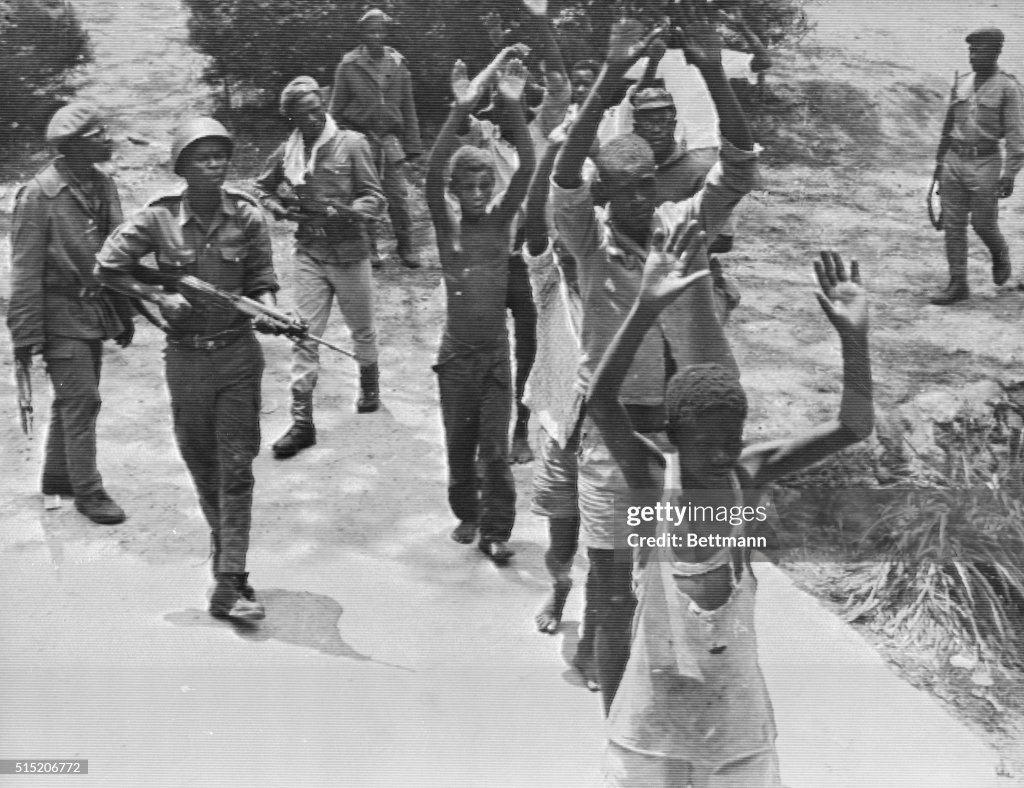
The Democratic Republic of the Congo announced that its troops had recaptured the city of Albertville from rebels who had held it for two months. Stanleyville, however, still remained under rebel control. Congolese troops under the command of Colonel Kikuji retook the city (now called Kalemie) with mercenaries led by Mike Hoare, and freed 135 Western hostages who had been captured during the Simba rebellion. The Congolese Government said today that its troops had recaptured most of Albertville, the North Katanga capital, which has been held by the rebels since June. A Government spokesman said troops moving north from Baudouinville and Kafcalo entered the city late yesterday and now controlled most of it. Diplomatic sources confirmed that an attack was under way against Albertville, but they said they had no indication of a government victory. It is believed that the forces now fighting at Albertville may include some of the foreign mercenaries who were recently assembled at the Kamina base in Katanga.
The recapture of Albertville would be an important victory for Premier Moise Tshombe’s Government. The city, on the western shore of Lake Tanganyika, has been the rebels’ chief stronghold in the southeastern Congo. Until recently, Gaston‐Emile Soumialot, who calls himself “President of the Revolutionary Government of the Eastern Congo,” made Albertville his headquarters. Recent reports from Albertville said the situation there had become “catastrophic” following the departure of Mr. Soumialot and other rebel leaders about 10 days ago.
The reports said the city appeared to be in the hands of gangs of young Baluba tribesmen who were looting, raping and killing. Two European priests were reported to have been killed there about a week ago. At last report there were about 130 Europeans in Albertville. Fears have been growing for their safety. A rescue operation that was said to have been planned to get the Europeans out of the city before it was attacked by government forces apparently never got under way. A radio broadcast from Stanleyville, the northeastern city captured by the rebels early this month, said Mr. Soumialot was touring “liberated zones.”
Premier Tshombe’s decision to hire white mercenaries for the Congo has become a major obstacle in his campaign to get African military aid for his fight against the rebels. Last week the former secessionist leader of Katanga called for help from Nigeria, Senegal, Malagasy, Ethiopia and Liberia. The first reaction in most of these countries was lukewarm. Now all the old antagonisms against Mr. Tshombe appear to have hardened with the reappearance in the Congo of many of the mercenaries who backed him in Katanga. In Nigeria leftist groups like the Nigerian Youth Congress have urged all African states to ignore Tshombe’s appeal for aid. Radical nationalists in other West African states have done the same. What is particularly galling to all Nigerians is Mr. Tshombe’s reported recruitment of a large number of white South Africans.
Tanganyikan troops were rushed to Kigoma today after reports reaching Dar Es Salaam told of several hundred Congolese Army and rebel troops crossing Lake Tanganyika in the last 48 hours. The Minister for External Affairs, Oscar Kambona, telling of the reports, said Tanganyikan units had been sent to the area to reinforce troops already there. Mr. Kambona said troops of both the Congolese Army and the rebels were believed to be fleeing following the bombing of Albertville. He said he did not know which side was responsible for the bombing.
The United States tried today to counteract Soviet charges that President Johnson’s disarmament plan would establish an espionage network on Soviet soil. “We don’t want to go poking into every garbage can in the Soviet Union,” Clare H. Timberlake, the United States representative, said at the 17‐nation disarmament conference. The Johnson plan calls for a freeze on the production of systems to deliver nuclear weapons. These systems include rocket launchers, aircraft, and ships. Mr. Timberlake said the inspection details for the freeze, while making sure that there would be no violations, would be as unobtrusive as possible. The Russians have rejected the proposal as “control without disarmament.” The Soviet delegate did not speak at today’s brief session.
Soviet Premier Khrushchev said today that Communists were “especially alarmed and concerned about the subversive and disruptive activities of the Chinese leaders.” The Soviet leader addressed a large meeting in Prague, Czechoslovakia. He is on a 10‐day visit to commemorate the 20th anniversary of the wartime Slovak uprising against the Nazis. Mr. Khrushchev’s speech ranged over the spectrum of world trouble spots. “The last thing I want to do is frighten anyone,” he said, and then proceeded to attribute the world’s current troubles to “American imperialists.” He declared Soviet interest and concern in events in Vietnam, Cyprus, the Congo and elsewhere.
Troops from the People’s Republic of China crossed the border from Tibet into the neighboring Buddhist kingdom of Sikkim, invading through the Himalayan Mountains pass at Nathu La in the first of numerous incursions.
A major battle is reported to be under way in the northwestern corner of Yemen, in the triangle formed by Sada, Haradh and the Imam’s headquarters in the Qara Mountains. Although the Cairo radio has reported that Imam Mohamad al‐Badr has been put to flight and the border of Yemen and Saudi Arabia sealed, an authoritative Yemeni royalist source said tonight that revolutionary forces had suffered serious reverses in the northwestern area. In Yemen’s long civil war, the United Arab Republic is supporting Arab nationalist forces against the royalist armies of Imam Mohamad, who is backed by Saudi Arabia. The royalist source, newly arrived from Yemen, via Qatar, said that since last Friday the Egyptian‐led forces had waged “probably the biggest single military operation the Egyptians have conducted in nearly two years of campaigning.” He estimated that 5,000 Egyptians were involved in a two‐pronged thrust aimed principally at killing or capturing the Imam.
With the opening of the Tsukuda Bridge over Japan’s Sumida River, the residents of the island of Tsukishima were able to drive to neighboring Tokyo for the first time, and the ferryboat that had serviced the residents for years made its last run.
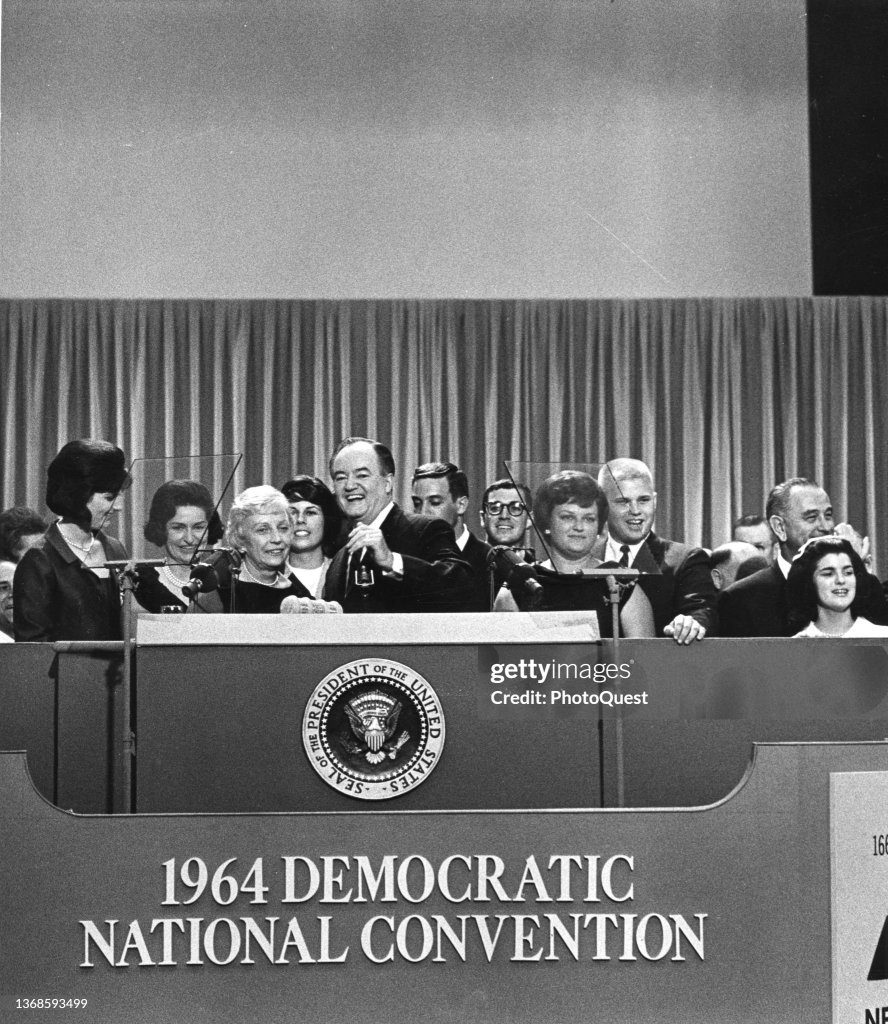
President Johnson accepted the Democratic Party nomination on his 56th birthday, Johnson, who had become President of the United States the previous November 22 after the assassination of John F. Kennedy, invoked the late President’s name and told delegates, “Let us here rededicate ourselves to keeping burning the golden torch of promise which John Kennedy set aflame!” Lyndon B. Johnson accepted the Presidential nomination of the Democratic party last night with a pledge of “answers, not retreats” —“unity, not division” — “hope, not fear or smear.” Answering time and again the challenges laid down by the Republicans and their nominee, Barry M, Goldwater, Mr. Johnson told a roaring and happy convention:
“We do offer the people a choice. A choice of continuing on the courageous and compassionate course that has made this nation the strongest and the freest and the most prosperous and the most peaceful nation in the history of mankind.” He said: “Tonight we offer ourselves on our records and by our platform as a party for all Americans, an all‐American party for all Americans!” He asked for “a mandate to begin” on the task of building “a great society, a place where the meaning of man’s life matches the marvels of man’s labor.” Mr. Johnson’s speech brought to an end the 34th Democratic National Convention, which nominated him to run with Hubert H. Humphrey of Minnesota this fall. The convention adjourned shortly after midnight.
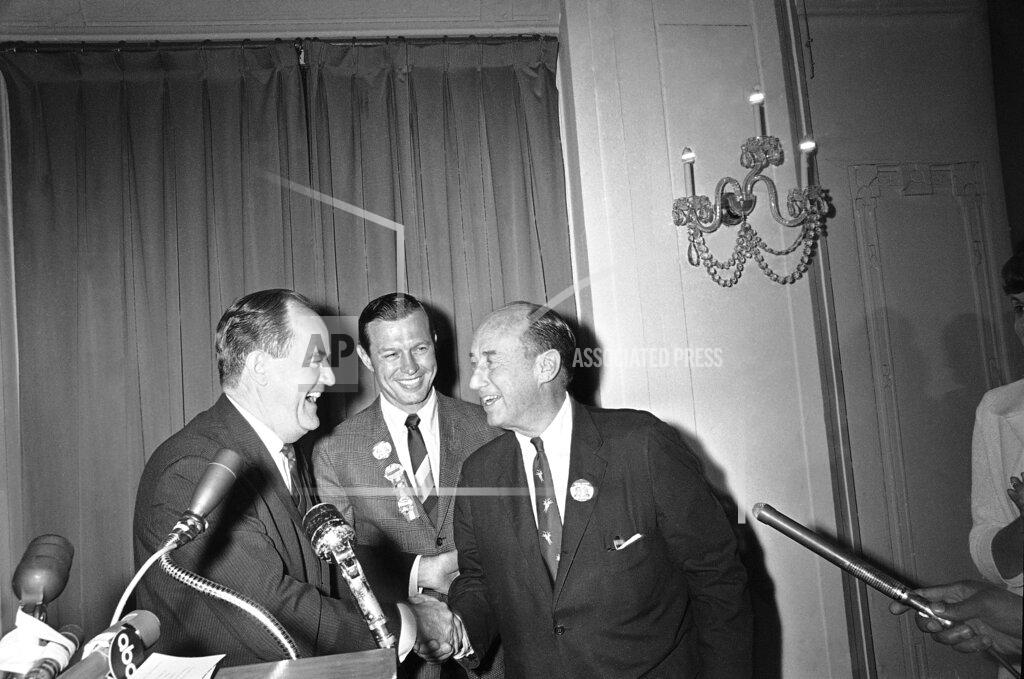
Before the acceptance speeches, the convention gave Attorney General Robert F. Kennedy, the brother of President Kennedy, a tremendous ovation. Mr. Kennedy introduced a memorial film to John F. Kennedy, the young leader nominated in 1960 and assassinated in 1963. The convention also heard memorial tributes by Adlai E. Stevenson to Mrs. Franklin D. Roosevelt and by James A. Farley to Speaker of the House Sam Rayburn, both of whom died since the last Democratic National Convention. Mr. Johnson came last on a lengthy program, after having sat in a special box with, his wife and Mr. Kennedy to hear Mr. Humphrey give a vigorous and enthusiastically received acceptance speech.
Senator Hubert H. Humphreylauded President Johnson tonight as a wise and courageous champion of all the people and called Senator Barry Goldwater an impetuous “temporary spokesman” for the Republican party. In a speech accepting the Democratic nomination for Vice President, Mr. Humphrey invited non‐Goldwater Republicans to adopt Mr. Johnson as their candidate. Mr. Humphrey sounded two themes for his party’s national campaign. One was a charge that Mr. Goldwater was not an authentic spokesman of the conservative tradition or of the Republican party. The other was the contention that Mr. Johnson was the spokesman of all Democrats as well as of “responsible and forward‐looking Republicans.”
“I believe in the two‐party system,” the Vice‐Presidential nominee said, “but there must be two responsible parties. It is imperative that [their leaders] move within the mainstream of American thought and philosophy.” Then he went on: “I say to those responsible and forward‐looking Republicans who put our country above their party — and there are thousands of them — we welcome you to the banner of Lyndon B. Johnson. We welcome your support.”
Senator Barry Goldwater welcomed the nomination of Hubert H. Humphrey as the Democratic Vice‐Presidential candidate today, saying it “destroys the myth that the Johnson Administration is conservative.” The Republican Presidential nominee said he wanted to “thank” President Johnson for his choice of Senator Humphrey and “for drawing the differences between us so sharply.” Mr. Goldwater made his remarks by ship‐to‐shore telephone, to his press secretary, Paul Wagner, from a yacht anchored in Smuggler’s Cove on Santa Cruz Island. Senator Goldwater and his wife, Margaret, are vacationing until Monday or Tuesday aboard an 83‐foot PT boat converted into a comfortable yacht called the Sundance. The yacht is owned by Marvin Whiteman, a Beverly Hills, California, real‐estate man.
Mr. Goldwater, who watched last night’s nomination of President Johnson and Senator Humphrey on a portable television set, said: “I want to congratulate President Johnson for selecting Hubert Humphrey as his running mate. This move more emphatically emphasizes the differences between the Republican and Democratic parties than anything I can think of. It destroys the myth that the Johnson Administration is conservative. Hubert is a friend whose friendship I have enjoyed. He is very articulate and expresses the liberal point of view better than anyone in the Senate. His philosophy is that of the Americans for Democratic Action, which proposes bigger and bigger government programs and more and more government control. I welcome Hubert to the Democratic ticket and thank Lyndon for drawing the differences between us so sharply.”
Attorney General Robert F. Kennedy stood for 16 minutes on the podium of the Democratic National Convention tonight, unable to speak because of the applause surging up from the delegates below him. The demonstration was as remarkable for its character as for its duration. Throughout the enormous Convention Hall, in the galleries and on the floor, delegates and spectators stood and clapped, but there was no shouting, no music, no parading and only the most modest waving of state placards. The Attorney General had come to the arena tonight to introduce a memorial film about President John F. Kennedy. It was the first time that a member of the Kennedy family had stood before the convention, which has been almost completely dominated by President Johnson.
Dressed in a black suit and the black tie he has worn almost continuously since his brother was assassinated last November, Mr. Kennedy watched the demonstration impassively. His face bore only the slightest suggestion of a smile. When the tumult had finally subsided, he said in a small voice that he wanted to thank the delegates for all that they had done for President Kennedy — ”for the encouragement and the great strength” that they had given to him. “His idea,” Mr. Kennedy said of his brother, “really was that this country… and this world really should be a better place when we turn it over to the next generation.” After admonishing the delegates not to “look to the past,” Mr. Kennedy asked them to give “the same dedication” to President Johnson and Hubert Humphrey that they had given to President Kennedy.
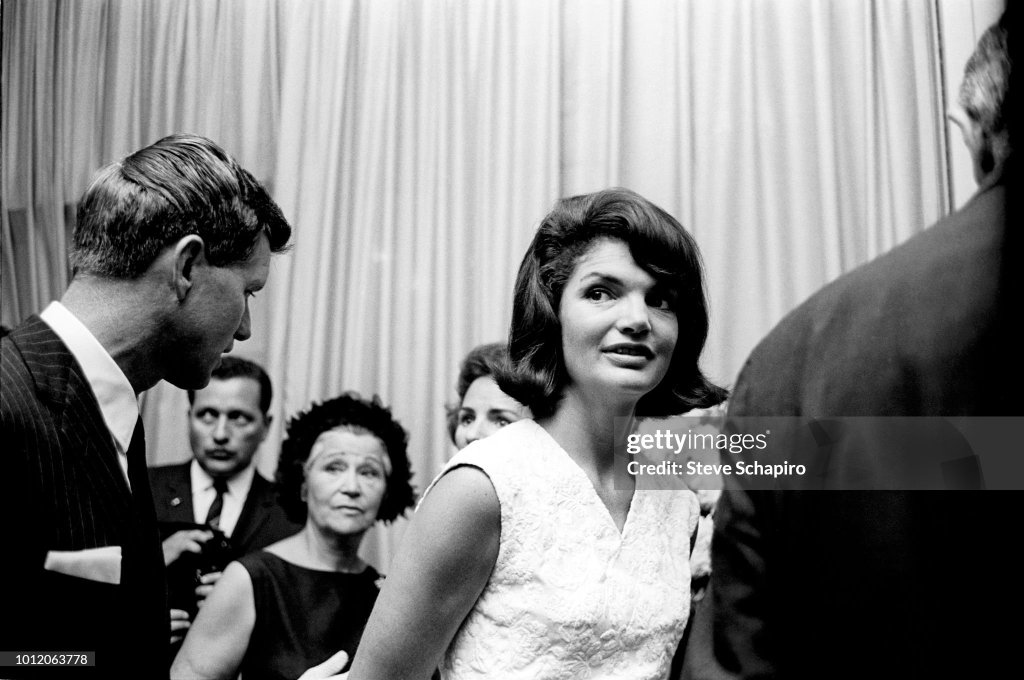
Mrs. John F. Kennedy moved serenely today through a painful past. It was evoked for her and thousands of delegates to the Democratic National Convention at a hotel reception where selections of prose and poetry from which her husband took comfort were read. More than 5,000 delegates and alternates were invited to meet the young widow of President Kennedy and her brother-in-law and sisters‐in‐law, Attorney General Robert F. Kennedy and his wife, Ethel, Mrs. Eunice Shriver, Mrs. Patricia Lawford, Mrs. Jean Smith and Mrs. Joan Kennedy. The former First Lady flew black to her summer home in Newport, Rhode Island, immediately after the reception.
Mrs. Lyndon B. Johnson promised “a hectic period” of campaigning for herself and her husband today. She told a breakfast meeting that she was “glad and grateful” for the opportunity to play a role in the race for the Presidency. Mrs. Johnson declared that she would stump the country on her own, as she did in past campaigns, as well as with the President. She also said that her two daughters would “help their father in the ways that are suitable to their age and without conflict with their schooling.” Lynda is 20 years old and will be a junior at George Washington University in the capital. Luci, 17, is entering her senior year at the National Cathedral School for Girls in Washington.
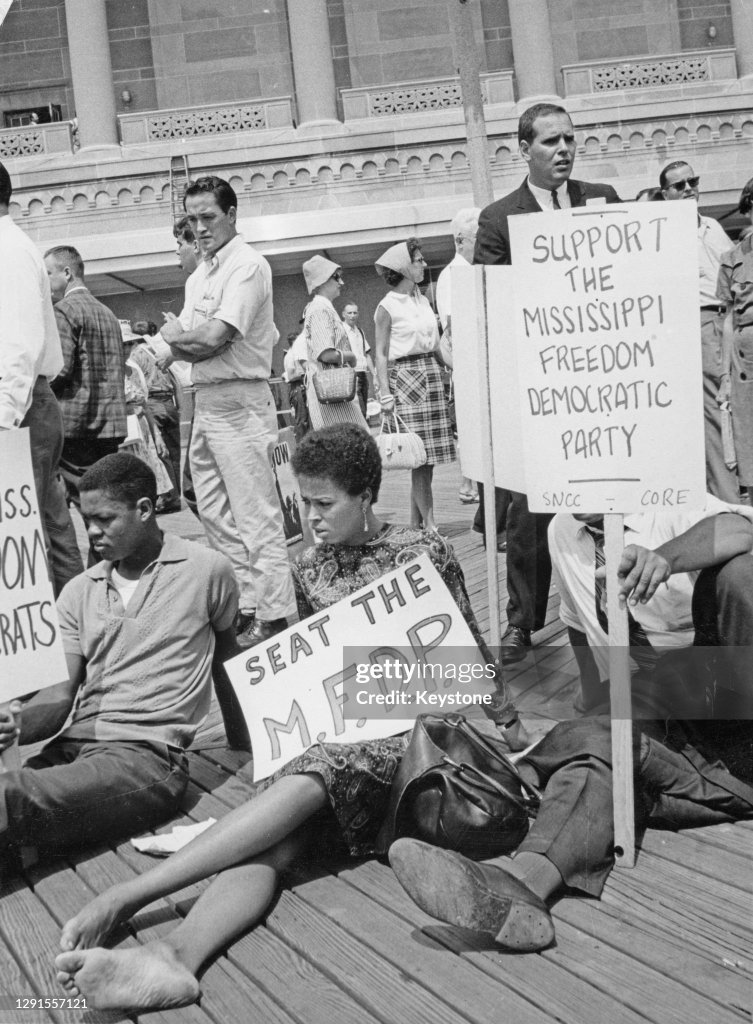
Six Black members of the Mississippi Freedom Democratic party blocked an aisle tonight at the Democratic National Convention by standing silently in a circle, hands clasped, as a symbol of unity. Members of the sergeantat‐arms staff and New Jersey state police sealed off the aisles. Bob Moses, one of the six, said the demonstration was both a tribute to President Kennedy and a protest at not being seated as delegates from Mississippi. Three members of the regular Democratic delegation of Mississippi were permitted to take their seats in the Mississippi section after pledging that they would support the party’s nominees.
Fourteen Blacks entered previously all‐white schools in South Carolina without incident today and 19 more were expected to begin classes tomorrow. The desegregation today took place at schools in Pickens, Spartanburg and Sumter Counties. It more than doubled the amount of school integration in the state. At Orangeburg, 19 Black students are expected to desegregate schools tomorrow and officials said that within a week about 230 would be attending mixed classes in the state.
In Shelby County (Memphis), Tennessee, 14 Black students attended mixed classes for the first time, also without incident.
The Montgomery (Alabama) School Board announced today that it had assigned eight Black students to white schools under court order.
In Charlottesville, Virginia, a group of segregated private schools threatened to sue the National Association for the Advancement of Colored People for any damages that may result from a Black suit opposing Virginia’s tuition grants.
Fifty‐three persons were indicted today for alleged participation in Rochester’s three‐day race riots last month. A grand jury cleared 33 other persons of related charges. A total of 976 arrests were made during and after the riots July 24, 25, and 26. Today’s indictments inyolved 45 Blacks.
A hurricane lashed the sprawling Cape Kennedy space center with gales tonight after cutting a multimillion‐dollar path of destruction across Miami and up Florida’s populous Gold Coast. Winds of 50 miles an hour whipped across Cape Kennedy, and emergency crews kept close watch on six space rockets lashed securely on launching pads. The Weather Bureau said at 11 PM that the storm was just west of Cape Kennedy and moving north at about 10 miles an hour. The bureau said that the storm had lost some force and that the highest winds were now estimated at 80 miles an hour with gales extending about 100 miles in all directions. The northward movement was expected to continue for the next 12 to 24 hours. This would bring the center over the water and east of Jacksonville about noon tomorrow, the bureau reported. It warned that the hurricane “will likely intensify again” and advised coastal residents from Stuart, Florida, to Brunswick, Georgia, to prepare for tides of four to seven feet.
A tornado funnel struck a cluster of homes near the San Xavier Indian Mission south of Tucson, Arizona today, killing a Papago Indian mother and her baby son, injuring eight other persons and destroying four houses.
25th Venice Film Festival: “Red Desert” directed by Michelangelo Antonioni wins Golden Lion.
Walt Disney’s hit film “Mary Poppins,” starring Julie Andrews in the title role and Dick Van Dyke, made its first appearance, with a première at Grauman’s Chinese Theatre in Hollywood, California. The film would go on to become Disney’s biggest moneymaker, and would win of five Academy Awards, including an Academy Award for Best Actress for Andrews.
Don Demeter slammed a two‐run double off Dick Radatz, the Boston relief ace, in the eighth inning today and Fred Gladding choked off a Red Sox uprising with the bases filled as the Detroit Tigers rallied for a 5–4 victory. Gladding came to the rescue of Julio Navarro after two singles and a walk in the bottom of the eighth, retiring Dick Stuart on a grounder to short.
Joe Adcock belts his 300th career home run, off Diego Segui, to pace the California Angels to a 7–1 victory over host the Kansas City A’s. Adcock is the 23rd player to reach the mark. He has 17 homers this year, 15 on the road. In the 6th he receives congratulations from Rocky Colavito, who reaches first base on a single. Rocky has 299 homers.
At Comiskey, the Minnesota Twins score 3 in the 9th to snap a tie and beat the Chicago White Sox, 5–2. The loss drops Chicago to 2nd place in the American League. After Jimmie Hall’s single and a walk by Hoyt Wilhelm to Bob Allison with one out in the ninth inning, Hall and Allison attempted a double steal. Martin’s throw to third base bounded into left field, scoring Hall and sending Allison to third. The run broke a 2‐2 tie that had lasted from the fifth. Two more runs counted as Bernie Allen singled across Allison from third and the third Chicago pitcher, Ed Fisher, allowed another run on a wild pitch. For the third game in a row against Minnesota, Don Buford grounds into a double play. Buford will finish his career as the toughest batter in history to double up (1 in every 138 at bats).
Two rookies, Rico Carty and Woody Woodward, drove home four runs apiece and Hank Fischer tossed a three‐hitter tonight to lead the Milwaukee Braves to a 13–0 victory over the San Francisco Giants. The loss dropped the Giants eight full games behind the league ‐ leading Philadelphia Phillies and kept San Francisco in third place in the National League behind Cincinnati. Carty led off with his 14th home run of the year and Woodward finished with a threerun double as the Braves chased the Giant starter, Bob Bolin, and took a 6–0 lead in the first inning. Four more runs, three of them earned, were scored off John Pregenzer in the sixth inning. Carty’s bases‐filled triple was the big blow. Woodward drove home one of the two seventh‐inning runs with a single.
Dow Jones Industrial Average: 835.25 (+6.04).
Born:
Frankie Thorn, American actress (“The Nun”), in Minnesota.
Paul Bernardo, Canadian serial killer and rapist; in Scarborough, Ontario, Canada.
Died:
Gracie Allen, 69, American actress and comedian who teamed with her husband, George Burns, in “The Burns and Allen Show,” died of a heart attack.
Aleksey Semyonovich Zhivotov, 59, Soviet Russian composer


 History Diaries