Lyndon B. Johnson is nominated by the Democratic Party to run for the presidency, with Hubert Humphrey as his vice-president. Republican candidate Goldwater announces that he believes that talks with Communist China might be helpful in ending the war and that he sees the solution to the conflict as ‘not military in the long run.’
The JCS send a memo to Defense Secretary McNamara and concur with a cable from Ambassador Taylor (dated 18 August) calling for ‘a carefully orchestrated bombing attack on North Vietnam’ — ‘essential,’ the JCS state, ‘to prevent a complete collapse of the U.S. position in Southeast Asia.’
Buddhist rioters broke into an American-staffed civil hospital in Đà Nẵng today. They dragged four patients from their beds and beat them to death. Despite the apparent resignation of Khánh and the withdrawal of the constitution that gave him the presidency, demonstrations and violence continue. In Đà Nẵng, at least nine people are killed in clashes between Buddhists and Roman Catholics; and in an attack on a Roman Catholic hamlet of Thành Bo, the Buddhists raze 450 out of the 500 houses as well as burn down the two Catholic churches.
South Vietnam’s political crisis deepened today with the failure of its military rulers to agree on a new head of state and a new form of government. “The situation is very serious,” said Major General Nguyễn Khánh after emerging from protracted talks with members of the Military Revolutionary Council — talks that were supposed to formulate a new framework to supplant General Khánh’s seven‐month-old regime. General Khánh was Premier until he became President on August 16 on the basis of a new Constitution. He and leaders of the armed forces agreed yesterday to step aside under the pressure of Buddhist and student protests against the dictatorial aspects of the government. Today’s meetings made it clear that the generals and colonels could not agree on how much power they were preparing to relinquish or to whom they would relinquish it. The council has controlled the country since the ouster and assassination of President Ngô Đình Diệm last November. Another meeting of the council is scheduled tomorrow.
The Revolutionary Council meets but can only propose a compromise: a provisionary triumvirate of Nguyễn Khánh, Dương Văn Minh, and General Trần Thiện Khiêm. Khánh — to retain the title of prime minister — will rule for two months, by which time a national convention will elect a provisional leader. Even then the violence does not stop; Catholic activists converging on the military headquarters where the council is meeting are fired on by soldiers guarding the gates and six are killed and many others wounded. As exaggerated rumors of the incident sweep Saigon, gangs of youths riot; the police are powerless and paratroopers are required to restore order.
Nguyễn Khánh, after a news conference at which he denounces the politicians who thwarted him, leaves for Đà Lạt. It is announced that he has suffered a physical and mental ‘breakdown’ and has gone there to recuperate. Meanwhile, Nguyễn Xuân Oánh, a Harvard-educated economist, is named acting premier to lead the caretaker government for the next two months. Through all this turmoil, the United States in the person of Ambassador Taylor attempts to support Khánh without tainting either him or the United States with the image of a “puppet government,’ but Taylor does postpone his planned visit to Washington.
All the crucial steps in the South Vietnamese political crisis were taken by Major General Nguyễn Khánh in full consultation with the United States and with its advance knowledge. Authoritative sources said today that Washington had been informed by General Khánh that he planned to assume South Vietnam’s Presidency with almost dictatorial powers on August 16, and then that he would state his intention to resign it in the face of popular protest and violence. Informants suggested that while the United States Ambassador, Maxwell D. Taylor, indicated to General Khánh prior to the August 16 change that Washington “did not like” some aspects of the Constitution about to be promulgated Mr. Taylor accepted the argument that the regime had to be strengthened to help win the anti‐Communist war.
When anti‐Government demonstrations erupted Monday, triggering what the Administration regards as a profoundly dangerous situation, General Khánh consulted in the middle of the night with Ambassador Taylor and Deputy Ambassador U. Alexis Johnson about his decision to step down from the Presidency and rescind the Constitution. At that meeting, it was reported, General Khánh told the Americans that he was reluctant to use force against the demonstrators and that he would be prepared to make wide‐ranging concessions to his opponents. Ambassador Taylor, it was understood, took the position during their long discussion that the principal concern of the United States was to see South Vietnam maintain its war effort against the Việt Cộng guerrillas. He was understood to have said that concessions might be in order to help restore political stability so that the Vietnamese could concentrate on the war.
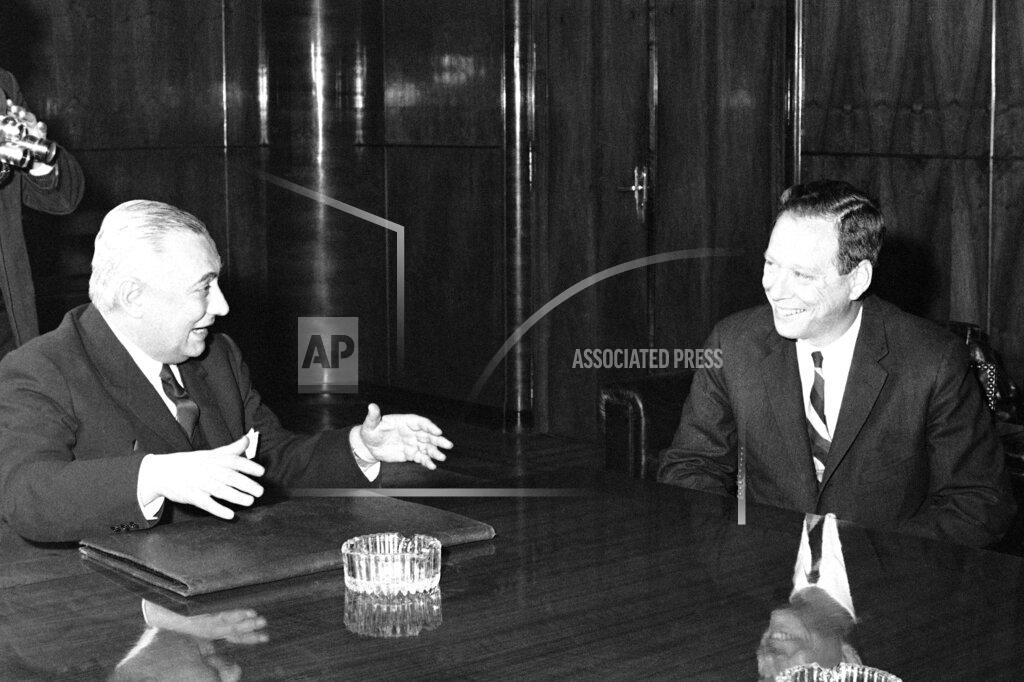
The French Government said today that the latest upheaval in Saigon confirmed its conviction that only negotiations leading to the neutralization of Vietnam could solve the Southeast Asian problem. This reassertion of President de Gaulle’s disagreement with the United States’ policy in Vietnam was couched in language that shocked and offended American diplomats. The statement was made by the Minister of Information, Alain Peyrefitte, after a Cabinet meeting at which President de Gaulle presided. The President’s chief spokesman said of Major General Nguyễn Khánh’s intention to step aside as President: “It is a development that conforms to France’s predictions to such a degree that it would be in poor taste to stress the point.” In reiterating France’s advocacy of negotiation and neutralization, Mr. Peyrefitte said: “That is something so evident that it isn’t worth the trouble to say so.”
The Cambodian press agency charged today that three South Vietnamese planes violated Cambodian territory August 19. The planes flew over a guard post, the agency said.
The Laotian national army reported today the surrender on Monday of 12 more pro‐Communist Pathet Lao guerrillas along strategic Route 13, which links Vientiane, the administrative capital, with the royal capital of Luang Prabang. The surrenders took place at Ban Many, a village northwest of Muong Kassy, the army said. Muong Kassy, 100 miles north of Vientiane, fell to Government forces a month ago during a thrust that forced most of the guerrillas to flee into the mountains. Since then a food shortage and harassment by rightwing troops have caused many pro‐Communists to surrender.
A civilian American pilot killed yesterday in the crash of a single‐engine plane in southern Laos was identified as Albert Sandoval, 32 years old, of San Diego. His widow lives in Vientiane. Mr. Sandoval was employed by Air America, a private company under contract to the United States Agency for International Development.
On its face, Air America is a commercial airline, chartered by the United States Government to do the risky job of supplying remote refugee camps and American outposts. The daily routine involves low flying through mountain passes obscured by clouds. Most of the landing fields are dirt strips in jungle clearings. Air America’s pilots in Laos, South Vietnam, Okinawa and Japan are considered, ironnerved and resourceful, their mechanics the best in the Far East. The policy of the airline has been to wave away all questions. “We’re under contract exclusively to the United States, and of course we can’t talk about our client,” one official said. It has long been suspected, however, that Air America was not merely hired by the Government but is, in fact, the United States Government operating under a commercial cover.
[Ed: Air America. It rhymes with, CIA.]
Pope Paul VI, in a vibrant appeal for peace, said today that some of the basic principles of peace were crumbling. The Pontiff said there were new symptoms of the reappearance of divisions among peoples, races and cultures. “This spirit of division is guided by nationalistic pride, by prestige politics, the armaments race, social and economic antagonisms,” he said. He called on all “men of goodwill” to “listen to our humble voice” and place above “every other interest” the values of human dignity and fraternal accord. The Pope did not specify any areas or countries, but L’Osservatore Romano, the Vatican newspaper, remarked in commenting on the speech that “to name islands or peninsulas or near and far hinterlands in which there is fighting” was superfluous. Vatican sources commented that there was no doubt the Pope had Cyprus, the Congo and South Vietnam in mind.
Senator Barry Goldwater said today that he had long believed “talks with Red China might be profitable” to end the war in South Vietnam. If he were elected President, he indicated, he would be willing to permit negotiations with Peking. He also expressed a qualified belief that the Johnson Administration was working for a negotiated settlement of the war in South Vietnam. A little later, however, Mr. Goldwater appeared to modify his remarks to indicate that he had in mind some form of ultimatum rather than negotiations in the usual sense.
The Italian Communist Party selects Luigi Longo as chairman. Luigi Longo was unanimously elected today to head the Italian Communist party, the largest in Western Europe with 1.7 million members. He succeeds Palmiro Togliatli, who died last week in the Soviet Union. In a brief acceptance speech, Mr. Longo said that among the problems that must be resolved “as soon as possible” was “widening and renovation of the executive framework and all of the elements of the party.” His remark gave rise to speculation that a shake‐up in the upper ranks of the party was in the offing.
An East German, his left leg blown off by a land mine, hung entangled in barbed wire for more than an hour today before mustering the energy to drag him‐self to the West. His 12‐year‐old son and 13‐year‐old daughter accompanied him. Just before reaching the last East German barricade, the father stepped on a mine. It exploded and flung him into the barbed wire. He ordered his children to crawl on and seek asylum. Minutes later, the children met a West German, who took them to a border‐police station. They led border guards and a physician to the spot where their father hung, and at their urging he rallied strength to disentangle himself and crawl to Western territory as Communist guards looked on.
Communist East Germany has quietly begun to release a large number of political prisoners, the majority of them West Germans and West Berliners, official sources said here today. They declined to confirm on deny that the release was an outcome of secret talks between East and West German justice officials. Observers said there was evidence that West German authorities had been informed and consulted. On Monday, West German authorities freed Günther Hofe, an East Berlin publisher. He had been held in pretrial detention for almost 11 months on charges of having acted as a Soviet and East German agent. Bonn refused to explain the release.
Two unidentified East German seamen deserted the ship Peter Nell at Saint John’s, Newfoundland, last night, bringing defections from the vessel to three within three days. All are reported to have asked for asylum in West Germany.
The Cabinet Crisis of 1964 in Malawi began in the West African nation’s third month of existence, when three of the most prominent members of the cabinet (Foreign Minister Kanyama Chiume, Home Affairs Minister Yatuta Chisiza and Justice Minister Orton Chirwa) confronted Prime Minister Hastings Kamuzu Banda and angrily criticized his leadership abilities. Shaken, Banda at first offered to resign; on September 8, he angrily began reprisals by dismissing most of his cabinet and assuming dictatorial powers.
The white-minority government of Rhodesia outlawed the two main black African resistance parties, the Zimbabwe African People’s Union (ZAPU) and the Zimbabwe African National Union (ZANU), and arrested their leaders, including future Prime Minister and President Robert Mugabe of the ZAPU.
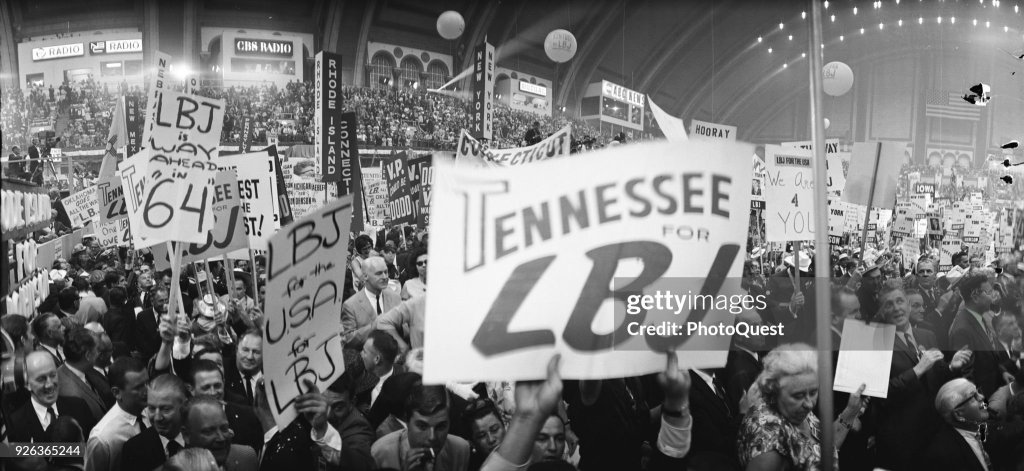
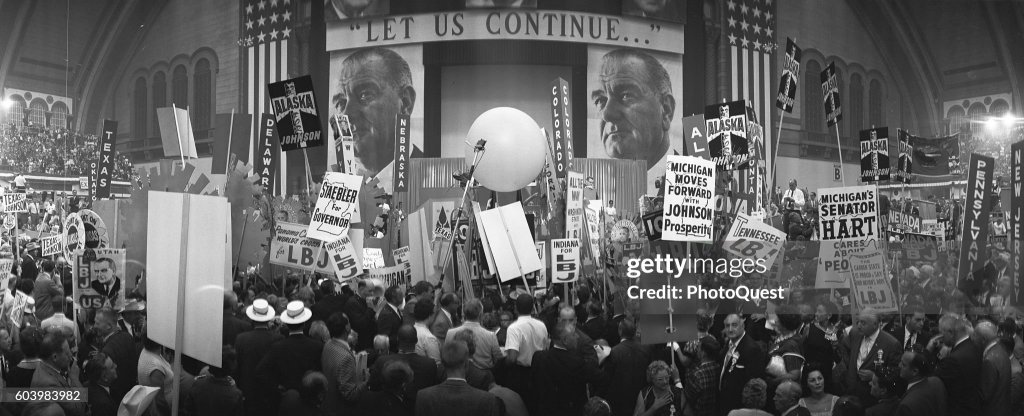
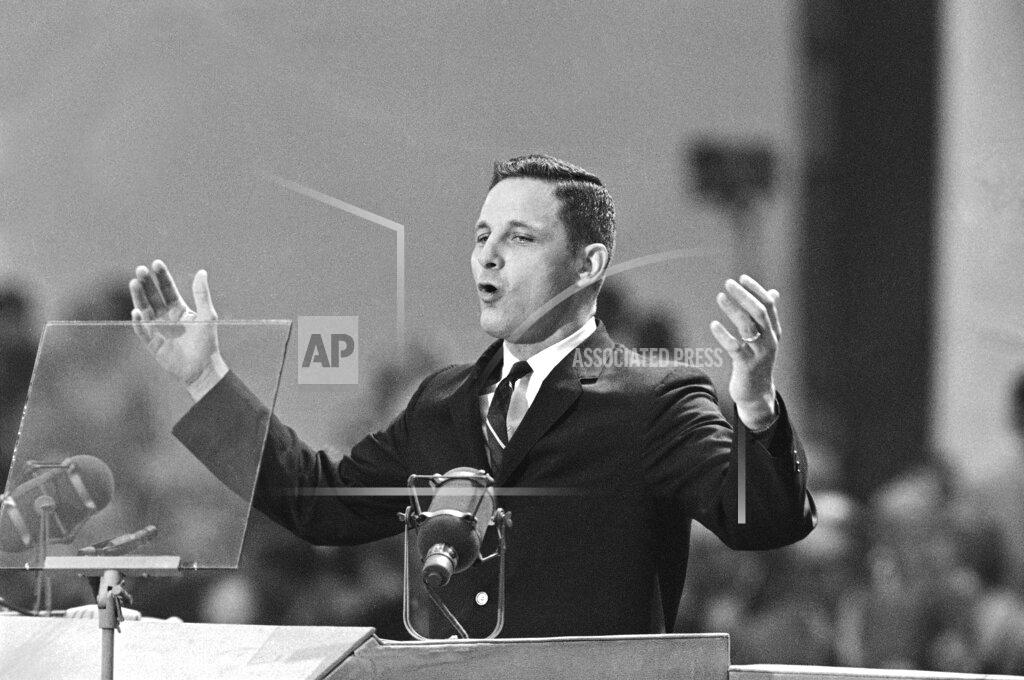
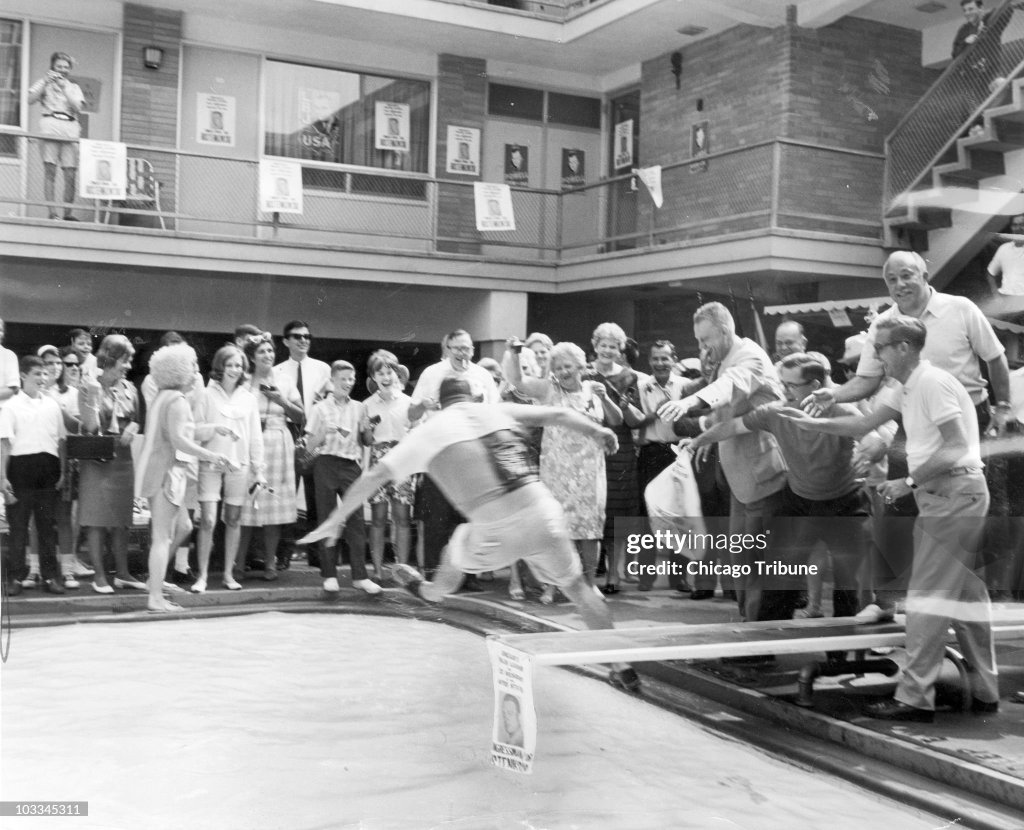
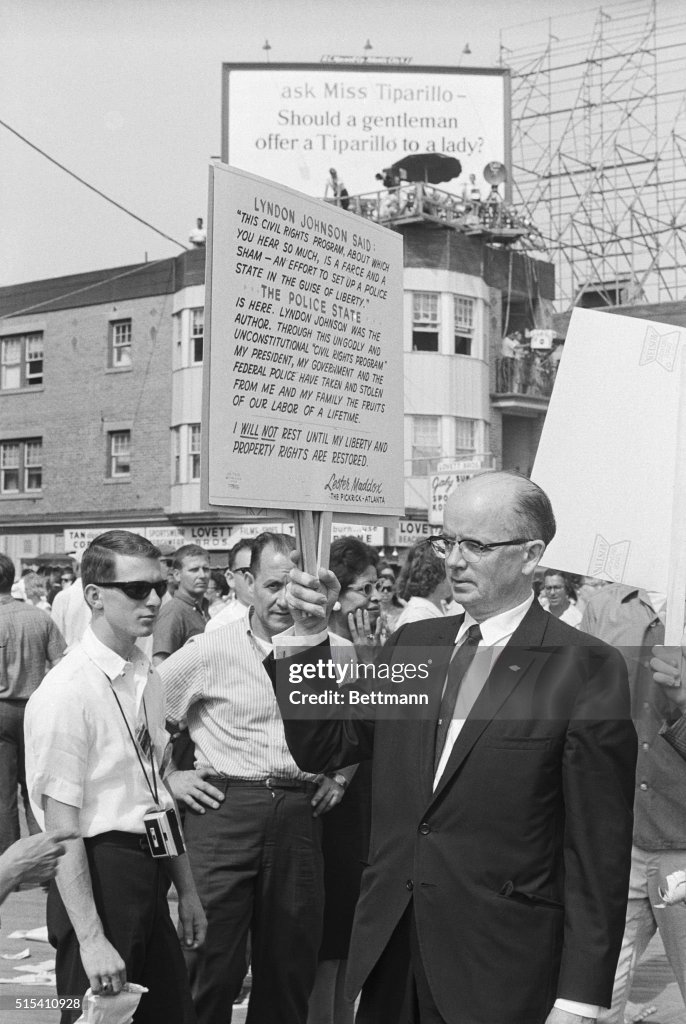
Incumbent U.S. President Lyndon Johnson received the Democratic Party nomination for President, by acclamation, at the national party convention in Atlantic City, New Jersey. Earlier in the day, President Johnson took the unprecedented action of personally appearing before the delegates to urge delegates to endorse his choice for a running mate, U.S. Senator Hubert H. Humphrey of Minnesota. In the past, party nominees would not come to the national convention until the evening of giving a speech accepting the nomination.
Lyndon Baines Johnson of Texas, the man who took over the Presidency last November 22 in the shattering hour of John F. Kennedy’s assassination, was nominated for a term of his own last night by the 34th Democratic National Convention. Then Mr. Johnson did what he loves to do. He smashed precedent by going before a turbulent and happy gathering of more than 5,000 delegates and alternates to name Senator Hubert H. Humphrey of Minnesota as his choice for the Vice‐Presidential nomination.
The Johnson nomination set off an enthusiastic demonstration. All over the hall banners waved, balloons soared toward the lofty curved ceiling, bands played in an ear‐splitting cacophony, the great organ bellowed and men struggled through the jammed aisles, screaming at the top of their lungs. When it was quieted with much gaveling, Mr. Johnson came to the platform and set off another booming demonstration. He stood quietly through it, smiling, waving and nodding once or twice to friends. His wife and two daughters stood with him through the thunderous ovation. As if to symbolize his grip on this convention, Mr. Johnson himself gaveled the delegates to order.
In his opening greeting, he included a friendly salutation to “columnists and commentators.” That brought a laugh, in recollection of the Republican’s anger at the press at their convention in San Francisco. Mr. Johnson also asked with a smile: “Did we really need all of these lights on?” That recalled his economy drive which included darkening many lights in the White House. He said he and his party would begin tonight “the march toward an overwhelming victory for our party and for our nation.”
Then he paid high tribute to President Kennedy, to the platform the Democrats had written under his close direction, and to the officers and delegates of the convention. He said the Credentials Committee had found a “fair answer” to the thorny Mississippi and Alabama seating disputes. Then Mr. Johnson reached what he said was his “obligation under a very old American tradition,” the recommendation of a Vice‐Presidential candidate. Mr. Johnson said he could make such a recommendation after his wide consultations with other Democrats and after “long prayerful consideration and private thought.” His “single guide,” he said, had been “to find a man best qualified to assume the office of President of the United States should that day come.”
Mr. Humphrey’s name was placed in nomination by Senator Eugene J. McCarthy, his colleague from Minnesota, after President Johnson had appeared before the convention to name Mr. Humphrey as his choice and describe him as “the best man in America for the job.” In the seats of honor at Convention Hall for the long series of speeches supporting the nomination of Mr. Humphrey were the President and the Johnson and Humphrey families. After the voice vote just after midnight Thursday by which Mr. Humphrey was unanimously nominated, the Vice‐Presidential candidate joined the President in the box of honor.
The Alabama delegation to the Democratic National Convention followed the Mississippi delegation today in withdrawing rather than signing pledges of loyalty to President Johnson for the coming election. They left behind only token groups of loyalists — nine from Alabama and three from Mississippi — to take part in the President’s nomination by acclamation. Eugene “Bull” Connor, Alabama’s national committeeman, was turned away by sergeants‐at-arms when he sought to take his seat. Mr. Connor, former Birmingham police commissioner, predicted that the action would hurt President Johnson politically in the South. The refusals by the two delegations to participate in the proceedings came after the convention’s adoption yesterday of a recommendation by the Credentials Committee that the Mississippians take the loyalty pledge. The convention had earlier approved a similar requirement for the Alabamians. Many of the Mississippians, who had made known their intention last night to quit the convention, left Atlantic City earlier today.
Mayor Jess Lanier of Bessemer, chairman of the unpledged group in the Alabama delegation, and its other leaders said tonight before the convention opened that they would suffer no further “insults” and that they were returning to Alabama. Seymore Trammell, Alabama’s finance director and the key aide to Governor George C. Wallace present at the convention, said Mr. Wallace “recognizes that the Alabama delegation has been kicked out of the Democratic party. “The donkey has used its heels instead of its head,” he said.
Convention officials were prepared tonight to prevent a resumption of the events of Monday and Tuesday nights, when members of the unpledged faction entered the Conventional Hall and took seats. Aides filled all but 11 seats in the Alabama section two hours before the session started tonight. When Mr. Connor approached the seats, accompanied by Connor Vermont, his 11‐year‐old grandson, sergeants-at-arms blocked his way. A convention official told him he must take the oath. “That’s not for me,” he said. “I will retire.” “I’ll go like a gentleman,” Mr. Connor said. “I’ll let the people of Alabama decide who represents them—me or the Democratic National Committee.”
The Republican National Committee announced today Senator Barry Goldwater’s itinerary for the first eight days of his Presidential campaign and opened its attack on the Democratic National Convention and platform. The Republican national chairman, Dean Burch, called the Democratic convention a “depressing spectacle.” Represenative Melvin R. Laird, Republican of Wisconsin, chairman of the Republican Platform Committee, termed the Democratic platform “the most misleading document ever presented to the American people by a major political party.” “The same tired old faces are presenting the same tired old ideas with the baleful eye of Lyndon Johnson looking down disapprovingly over the whole proceeding,” Mr. Burch said in a statement.
Mr. Laird charged that the Democratic platform “deliberately evades almost every major issue that confronts the American people.” “Where, for example, is there any meaningful reference to the Congo situation or to Cyprus or to Cuba as a growing base of subversion?” he asked. “Where do they make reference to the shameful Berlin Wall, to the disarray in NATO or to the critical situation we face in Southeast Asia? There is no expression that we mean to win in Southeast Asia. There is not even an indication that they believe we could win if we had the will,” Mr. Laird said. Top officers of the Citizens for Goldwater and Miller held an organizational meeting today to work for the election of Mr. Goldwater and his running mate, Representative William E. Miller of upstate New York.
A scuffle with political overtones erupted briefly to‐night on the boardwalk outside the Convention Hall where the Democratic National Convention was in session. It lasted only a minute or two and there were no serious injuries or arrests. A state policeman said a group of youths chanting, “We Want Barry” and a group of young Johnson backers scuffled. One youth was cut on the head. But Jim Reilly of Pittsburgh, a spectator, who said he helped break up the fight, gave this version: “The Goldwater people started to break up when some white youths standing to the side threw two eggs. One struck a Negro and one struck a white boy. The Negro and the boy who threw the egg got into a fight and others joined in. The fight lasted about a minute and then was broken up.”
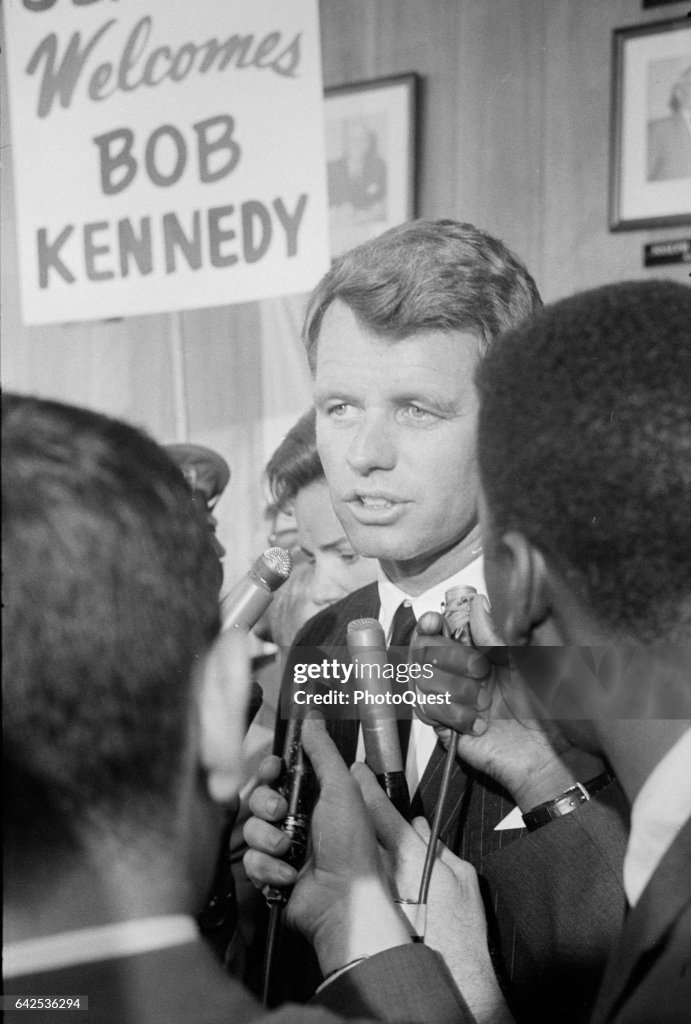
Senator Kenneth B. Keating said today that he had received promises of personal and political support from a number of New York Democrats in the 24 hours since Robert F. Kennedy announced his Senate candidacy. The list of those who telephoned or sent personal messages, Mr. Keating reported, includes “some Democratic officeholders and at least two party officials,” as well as others prominent in Democratic circles in New York City and upstate.
President Johnson signed legislation today that ends an 18-year government monopoly of atomic fuels. Under the law, by June 30, 1973, the nuclear power business will be on its own within the framework of the free‐enterprise system. The amendment is the most far‐reaching change in atomic legislation since the postwar McMahon Act was supplanted in 1954.
The Transport Workers Union and Pan American World Airways reached an “agreement in principle” last night on new contracts, and the union agreed to end a day-old strike against the line. Shortly after 1 AM today employes began returning to work, A spokesman for the airline said flights would be resumed this morning. Michael J. Quill, international president of the union, and James F. Horst, international vice president and director of the air transport division, announced the tentative agreement in Washington. “Details of the contracts will be revealed as soon as there is agreement on language,” the union said. “At the present time there is full agreement in principle.”
High‐fashion models and beauty salon patrons with their hair in curlers were among 5,500 persons forced into the streets from Saks Fifth Avenue in New York City by a smoky fire yesterday morning. The fire, which broke out in a subbasement shortly after 11 AM, sent clouds of dense smoke up through elevator shafts and air‐conditioning ducts, and forced the store to close for the rest of the day. Two firemen were injured in fighting the blaze, which was brought under control an hour after it had started. An employe of the store inhaled smoke and was given oxygen at the scene.
A hurricane struck Miami early today with winds of 75 miles an hour. After toying with the city for hours, the hurricane, named Cleo, sent gusts across Miami’s Key Biscayne that reached hurricane intensity. Sustained gales — winds 25 to 75 miles an hour — tattered the rest of the city as the storm’s center churned just 25 miles to the southeast. Forecasters warned that the storm center might go ashore north of the city and subject the coast from Fort Lauderdale to West Palm Beach to winds of 60 to 80 miles an hour.
American actress Jayne Mansfield and Hungarian-American bodybuilder Mickey Hargitay’s Mexican divorce is recognized by the state of California.
Leslie Frederick (Buster) Narum, a Washington Senators righthander with a losing record and a high earned‐run average, humbled the New York Yankees yesterday, pitching a 2‐0 shutout and gaining a split in the two‐game series for the Senators. Narum, who was purchased from Baltimore in the spring, throttled the Yanks on five hits, two of them in the ninth inning. A crowd of 14,237 (plus Yankee juniors) at Yankee Stadium watched Narum turn in an easy effort with the aid of three double plays. The Washington pitching staff has recorded only two shutouts this year. Narum has both of them. The 23‐year‐old Narum did not allow a Yankee runner beyond first base until the seventh inning. Tom Tresh singled with two out in the first. The Yankees’ prize rookie Mel Stottlemyre, who pitched eight innings and gave four hits, yielded the Senators’ runs in the fifth in taking his first major league loss after three wins.
Don Demeter’s fourth homer in five games and Dave Wickersham’s pitching gave the Detroit Tigers a 4–1 victory over the Boston Red Sox tonight. Demeter’s 19th homer of the season was hit off Bob Heffner, the Boston starter, in the sixth inning. It broke a scoreless tie and Heffner’s streak of 19 scoreless innings. The Tigers scored what proved to be the clincher moments later when Bill Freehan doubled, advanced on an infield hit and scored as Dick McAuliffe bounced in to a force play.
The Chicago White Sox pushed across a run in the 12th inning on an error by Rich Rollins, a passed ball and Don Buford’s single to defeat the Minnesota Twins, 2–1, tonight. This lifted Chicago to within one percentage point of the American League lead. The White Sox trailed the first‐place Baltimore Orioles, .606 to .605. The Orioles lost to Cleveland, 3–2, tonight. Rollins opened the door in the 12th when he grabbed Gerry McNertney’s grounder and fired over first base as McNertney raced to second. After McNertney took third on a passed ball by Earl Battey, Gene Stephens was intentionally walked. Jim Landis then drew another walk off Johnny Klippstein, filling the bases, before Buford rapped his game‐winning hit.
The Cleveland Indians collected three hits, two of them bunt singles, in the eighth inning, scored two runs and defeated the Baltimore Orioles, 3–2, tonight. The Indians posted their 10th victory over the American League leaders in 15 meetings. John Romano broke a 1–1 tie when he laid down a perfect squeeze bunt with two strikes on him and two out to score Chico Salmon. Salmon had led off the inning with a bunt single, advanced to second on a sacrifice bunt by Dick Howser and gone to third on a fielder’schoice hit by Leon Wagner. Vic Davalillo then doubled, scoring Wagner, who had gone to second on Romano’ single. Lee Stange picked up his fourth victory over the Orioles this year although he yielded nine hits, one of them an eighth-inning homer to Norm Siebern.
The Los Angeles Angels turned on John O’Donoghue, who had beaten them three straight times, for three runs and six hits in four innings en route to a 5‐2 victory over the Kansas City A’s tonight.
The National League‐leading Philadelphia Phillies today supported Chris Short’s six‐hit pitching with 13 hits, including four home runs, and salvaged the finale of a three‐game series with the Milwaukee Braves, 6–1. Gus Triandos hit two homers and Ruben Amaro and Tony Gonzalez one each as Short registered his 14th victory. The Braves had scored 19 runs in winning the first two games of the series. The twogame losing streak was the first the Phils had suffered since July 26.
Mike Cuellar, a rookie lefthander, hurled the St. Louis Cardinals to a 4–2 triumph over the Pittsburgh Pirates tonight. Cuellar scattered six hits as he registered his fifth victory against three defeats. The Cards got 11 hits. Lou Borck hit his eighth home run of the season. Donn Clendenon and Gene Alley went deep for Pittsburgh.
The New York Mets resumed their trouble‐making in the upper echelons of the National League tonight by defeating the Cincinnati Reds, 3–1, on Tracy Stallard’s five‐hitter. The victory was only Stallard’s eighth of the year against 16 defeats, but it was his second straight and the Mets’ eight in their last 10 games. Moreover, it ended a five‐game winning streak acquired by Joey Jay during Cincinnati’s strong pursuit of the Philadelphia Phillies. Before wrapping it up, Stallard had to survive a ninth inning threat in which the Reds put two men on base with one out. But he threw a fastball past Deron Johnson on a 3‐and-2 pitch and got Don Pavletich, his chief nemesis of the night, on a grounder to third base.
Doug Camilli singled in a run in the ninth tonight to give the Los Angeles Dodgers a 2–1 victory over the San Francisco Giants. The triumph was Don Drysdale’s (14–13) first in nearly a month. Jim Hart of the Giants was struck on the forehead at close range by a thrown ball, suffering concussion — but no skull fracture. The accident forced Willie Mays to play third base in place of Hart for the first time in his major league career. Bob Hendley (10–8) took the loss for the Giants.
Home runs by Ernie Banks (16th of the year) and Ron Santo (25th) helped Larry Jackson to gain his 16th victory as the Chicago Cubs stopped the Houston Colt’s six‐game winning streak with a 3–1 triumph tonight.
Dow Jones Industrial Average: 829.21 (-2.99).
Born:
Bobby Jurasin, American-born Canadian Football League defensive end (CFL Hall of Fame, 2006; CFL Champions, Grey Cup-Roughriders, 1989; CFL All-Star, 1987, 1988, 1992, 1997; Saskatchewan Roughriders, Toronto Argonauts), in Wakefield, Michigan.
Chad Kreuter, MLB catcher (Texas Rangers, Detroit Tigers, Chicago White Sox, Anaheim Angels, Kansas City Royals, Los Angeles Dodgers), in Greenbrae, California.
Carsten Wolf, East German racing cyclist, 1989 world champion in the 4000m pursuit; in Potsdam, East Germany.
Daphne Caruana Galizia, Maltese journalist (Panama Papers), born in Sliema, Malta (d. 2017).
 History Diaries