South Vietnamese President Nguyễn Khánh bowed today to student and Buddhist unrest by pledging to liberalize his regime, but the students reacted with another demonstration demanding an end of one‐man rule. In a communiqué read over the Government radio station, President Khánh promised that his week‐old Constitution, which gave him sweeping powers, would be revised by a special committee. Two hours later, students marched through the streets of Saigon to the Presidential Palace and shouted “Down with Nguyễn Khánh!” They acted in defiance of the President’s statement, which had warned that the Government would take “strong measures” if disorder continued.
While the students were demonstrating, a bomb exploded on the fifth floor of Saigon’s most fashionable hotel, the Caravelle. At least four persons were injured. A European was seen staggering through a smoke‐filled hallway, his head wrapped in temporary bandages. A Vietnamese girl was carried away on a stretcher.
About 35,000 to 40,000 demonstrators stormed through four of South Vietnam’s cities yesterday demanding the President’s resignation. The mounting show of discontent was; thought to threaten the overthrow of his United States-backed Government. In the broadcast, repeated at half‐hour intervals, General Khánh also promised to revise the curfew, putting it into effect from midnight to 4 AM. It had been in effect from 11 PM to 4 AM. Under the concessions, press censorship will be entrusted to a press council and “all mistakes committed by local authorities will be tried by a field court and sentences executed immediately.” The “mistakes” in question were not specified, but members of the Buddhist majority in various parts of the country have complained of discrimination under the Khánh regime.
President Khánh, announced that a student rally scheduled for today would be permitted but, he said, “all acts harming the security and honor of the country will be punished.” The title of President and vast new powers were assumed August 16 by General Khánh, until then Premier, after a three‐day meeting of the Military Revolutionary Council. The action was explained by citing the peril of Communist aggression against the nation. General Khánh held an emergency meeting last night with Buddhist leaders in an apparent attempt to mollify them, amid reports that the Buddhists were planning an all‐out protest against his rule.
In Huế, a northern Buddhist center where the discontent started that led to the overthrow last November of the regime of President Ngô Đình Diệm, about 4,000 to 5,000 students rioted yesterday, sacking a Roman Catholic high school. Complaints from Buddhists of persecution from Roman Catholic officials have been reminiscent of the first stirrings of discontent under the Diệm regime, and Buddhists have complained that Diem officials still remain in many Government agencies.
The dissension in South Vietnam had begun to threaten the efficiency of the prolonged war against the Communist Việt Cộng guerrillas. Government loudspeaker trucks cruised the streets broadcasting President Khánh’s concessions. Planes with loudspeakers flew over the city making the announcement.
The United States reaffirmed today its support for the South Vietnamese regime in the face of opposition to it by student and religious groups. Commenting on anti‐Government violence that has spread throughout the country in the last two days, a State Department spokesman, Robert J. McCloskey, said, “Obviously, anything of a divisive nature is in the interest of neither the Vietnamese Government nor its people.” Although Mr. McCloskey ininternal matter for the Vietnamese Government” and that it was “too early” to discuss the demonstrators’ motivations, other officials privately expressed concern.
The anti‐Government unrest was viewed as another dangerous element in weakening the structure of the Saigon regime at a time when the Việt Cộng guerrillas are pressing their attacks with growing vigor and when pressures for a negotiated settlement of the war are rising in many quarters.President Johnson met at 6 PM at the White House with Secretary of State Dean Rusk and Secretary of Defense Robert S. McNamara. It was not immediately known whether the Vietnam situation had been a topic of discussion. Mr. McNamara has just returned from a European vacation.
The main theme of the official comments was emphasis that the United States would take an extremely serious and negative view of any move to oust the regime of President Nguyễn Khánh. The officials cautioned against any analogies between the present charges of “dictatorship” being directed at President Khánh and the situation that prevailed a year ago when opposition was rising against the regime of President Ngô Đình Diệm. To make the United States’ position clear, Mr. McCloskey read the following statement: “The United States Government fully recognizes the need for national unity in South Vietnam and is, therefore, supporting the Khánh Government as the best means of building such unity at the same time that the war effort is being prosecuted.”
The latest Pentagon report on United States casualties in South Vietnam, covering the period through August 17, lists a total of 182 deaths from hostile action. At least five other deaths have teen reported, bringing the total dead to 187. Four of the five were Army men killed in an ambush August 20. The other was killed in an ambush on the following day. Through August 17, the wounded totaled 1,909, the missing 18. Deaths from noncombat causes, mainly aircraft accidents, stood at 87.
Five pro‐Communist Pathet Lao soldiers were killed yesterday when Laotian Government troops attacked an advance Pathet Lao command post 15 miles north of here, a military spokesman said today. The spokesman said that government troops, acting on “precise information,” attacked two companies of Pathet Lao soldiers late last night but found that most of the force had left before the attack. Government troops in this area have been victims of guerrilla night raids for several months now. The spokesman said the government troops found that the two companies of Pathet Lao had left behind only a small unit.
Vientiane residents said they heard heavy weapons firing and saw battle flares last night. The spokesman said Laotian Air Force T‐28 fighter bombers attacked the positions two days ago. He added that this was the nearest strike to Vientiane yet made by the fighter planes. The attack took place near Route 13, the road leading north from Vientiane to the royal capital of Luang Prabang. Villages along this road are for the most part encircled with fences of sharpened bamboo stakes, and at least a company of government troops is stationed at each. This outbreak of fighting between Government and pro-Communist troops was closer to Vientiane than any of recognizable scale yet.
The Soviet Union’s offer of aid to Cyprus amounts to $30 million in economic credits, an authoritative source said today. The Soviet offer is firmly conditioned on President Makarios’s continued insistence on self‐determination, which would demilitarize the island as far as the North Atlantic Treaty Organization is concerned, the source said. The informant said Soviet military aid was not ruled out in future discussions. Archbishop Makarios is under pressure from Greece to refuse Soviet help and has been weakening in his decision to send Foreign Minister Spyros Kyprianou to Moscow to start negotiations. Mr. Kyprianou flew to Athens today for his fourth visit in less than two weeks. He again denied that he was discussing the Soviet offer, though in fact, informed sources insist, he has discussed little else in his previous visits.
In Nicosia, an informed Cypriote Finance Ministry source denied reports that the Soviet Union had offered Cyprus $30 million in credit, according to Reuters. The source said no details about Russian aid for Cyprus had been decided.
Usually reliable sources said Greece now hoped for a solution along the lines of a plan proposed by Dean Acheson, a former United States Secretary of State, who represents President Johnson in the Cyprus talks being held in Geneva under United Nations auspices. President Makarios has rejected the Acheson formula. According to this reported plan, Cyprus would be joined to Greece with assurances given to the Turkish Cypriote minority. Also, a North Atlantic Treaty Organization base would be established on the island.
A foreign mercenary force will begin military operations against rebels in the eastern Congo within a few days, authoritative sources said today. Although a government spokesman denied reports that mercenaries were being hired, the sources said such a force had been assembled at the Kamina military base in Katanga and would be pressed into use almost immediately. According to the sources, about 80 mercenaries are training at Kamina, a huge former Belgian base 260 miles northwest of Elisabethville. Most of the mercenaries at Kamina are South Africans or Rhodesians, many of whom fought for Premier Moïse Tshombe when he was president of secessionist Katanga Province. Another group of about 30 mercenaries, including men from most European countries, arrived in Leopoldville today. They are expected to go to Kamina within the next few days.
More than 1,100 people have been arrested in eight Indian cities in Communist-organized nonviolent demonstrations against the food scarcity and rising prices. The figure is based on police reports today from Bombay, Calcutta, Delhi, Jaipur, Chandigarh, Lucknow, Hyderabad and Nagpur. The demonstrations are known as satyagraha, a Sanskrit word made famous by Mohandas K. Gandhi. It means “insistence on truth.” An image of the goddess Chandika, an eight‐armed manifestation of Kali, patron of cruelty and destruction, was seized in the central Indian city of Nagpur after devotees had brought the image to the main square of the city. They said they were counting on her to hold the price line. The last time Chandika came out of her temple was in the Nagpur language riots of 1960. Her new appearance is reported to have provoked no violence, but the police decided not to take chances.
In a letter to the Security Council today, India accused Pakistan of presenting a distorted account of recent incidents in Kashmir. Nevertheless, India reaffirmed her willingness to discuss the 16‐year-old Kashmir dispute. The letter from Birendrh N. Chakravarthy, India’s chief delegate, was sent in reply to a Pakistani letter to the Council in July complaining of “dastardly attacks” by Indian troops in violation of the ceasefire agreement. India’s reply asserted that the New Delhi Government so far this year had protested 29 times to Pakistan about border violations. The letter added that India was nevertheless prepared to discuss with Pakistan ways to eliminate such incidents.
Thirty-seven people were killed in an explosion in the Mexican village of Atlatlahucan, after fireworks exploded near two tanks of butane gas. The fireworks had been gathered for an upcoming festival for the town’s patron saint.
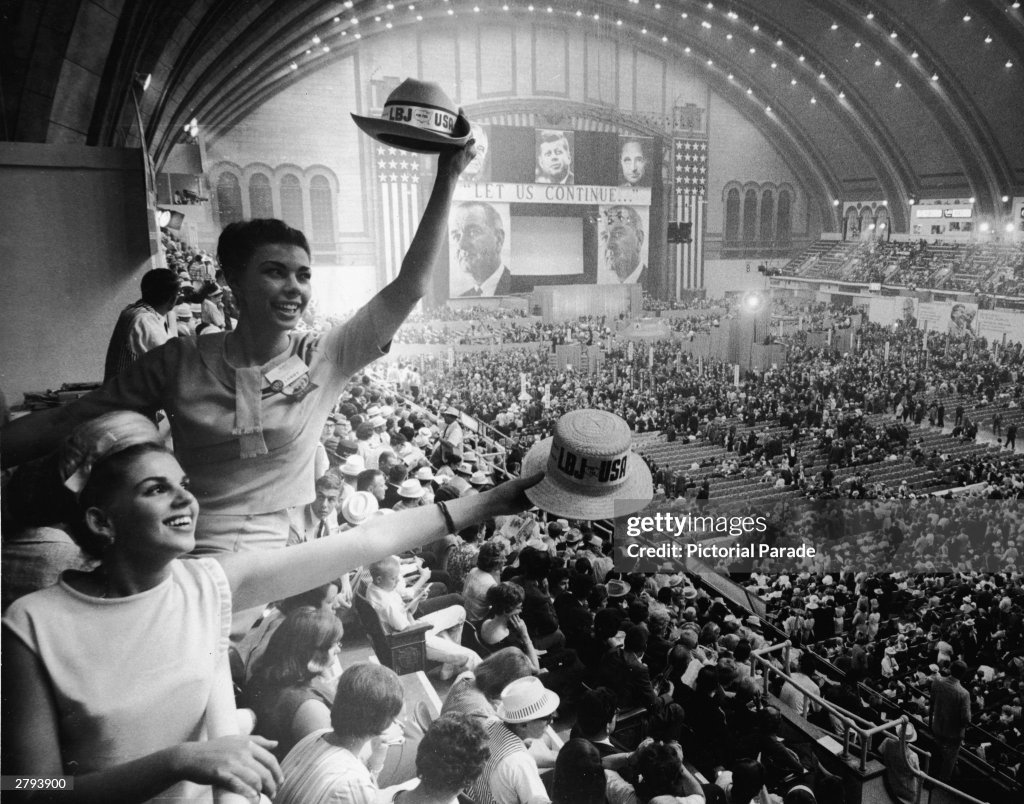
A blistering attack on Senator Barry Goldwater featured the opening session of the 34th Democratic National Convention in Atlantic City tonight. Among the delegates and spectators in Atlantic City’s Convention Hall, however, the greatest interest was in increasingly stronger reports that President Johnson would name Senator Hubert H. Humphrey of Minnesota to run for Vice President. Mr. Johnson and all his associates maintained official silence on the Vice‐Presidential question. So did Senator Humphrey. On the rostrum, high above the mass of delegates seated on the main floor, there was no mention of the Vice‐Presidency as the routine opening business of the convention went forward and Senator John O. Pastore of Rhode Island delivered a fiery and partisan keynote address.
Senator Pastore denounced Mr. Goldwater, the Republican nominee, for voting against the nuclear test ban treaty, for speaking “glibly and loosely” on the question of controlling nuclear weapons, and for language that “has to be explained away tomorrow and tomorrow and tomorrow.” Senator Pastore pictured “Mr. Goldwater and the Republican party as captives of “reactionaries and extremists.” And he said the “clear choice” Mr. Goldwater had said he would offer the American people was really a “Trojan horse” that threatened the test ban treaty, the United Nations, the Social Security system, labor unions and the “war on poverty.”
The Senator, his voice rising and falling histrionically, his fist often thumping the podium, got a roaring reception from the more than 5,000 delegates and alternates, and from the galleries. At one point, the audience gave him a standing ovation as Senator Pastore pledged with a flourish that the Democrats would keep control of nuclear weapons in the hands of the President. So enthusiastic was the reception for the keynote speaker that he may have catapulted himself into greater consideration for the Vice‐Presidential nomination. Mr. Johnson is known to rank him on the list of eligibles. Mr. Johnson, watching the proceedings on television in the White House, put in a congratulatory call to the keynoter at the end of his speech.
President Johnson remained silent today on whether he had picked a running mate and on when and how he would disclose his choice. His press secretary, George E. Reedy, could offer no enlightenment in response to questions today, nor were other White House sources more informative. The consensus of these sources is that the President still has not made up his mind on his choice for the Democratic Vice‐Presidental nominee, improbable as this seems to many. It is known, however, that President Johnson, over the last several weeks, has given extraordinary thought to this choice, and that he has had some original research done on the background and the potentialities of the Vice‐Presidential office. One consequence of this effort is that Mr. Johnson, who was himself one of the most active Vice Presidents in history, is also known to intend that the man who would fill that post in his next Administration shall have an even more important role in high level governmental affairs. The President is said to believe that the first criterion for a Vice‐Presidential candidate is that he should be competent to move into the Presidency if tragedy or other circumstances should require.
Both the White House and Senator Eugene T. McCarthy of Minnesota denied a report that Mr. Johnson had asked Senator McCarthy to nominate Senator Humphrey for the Vice‐Presidency. Senator McCarthy, who is ranked a strong contender himself, was working actively on the convention floor for the nomination. Bill Erskine, the official sign painter here, was busy turning out “Welcome Vice President Humphrey” signs. But he said he did not know the name of the person who had ordered them. It was also reported that large amounts of communications equipment had been moved nto Senator Humphrey’s summer house in Minnesota. These and other reports suggesting his nomination were frequently heard in convention hall tonight.
Democratic platform drafters ended their work today by approving the plank that the Republicans refused to write — a rejection of extremists. “We condemn extremism, whether’ from the right or left,” the Democratic platform said, “including the extreme tactics of such organizations as the Communist party, the Ku Klux Klan and the John Birch Society.” Moderate forces at the Republican convention last month offered an almost identical plank, but it was overwhelmingly rejected by Senator Barry Goldwater’s majority. One of the dramatic moments of the meeting came when Governor Rockefeller was booed as he spoke for this plank.
The final section of the Democratic platform, on domestic affairs, was released this evening. It included what was regarded as moderate language on civil rights and quite liberal planks on labor, urban affairs, immigration, education, Congressional procedures and other subjects. The aura of harmony that has marked the platform deliberations during the last week continued to the end. Barring some unexpected development, no minority reports or floor fights were expected. Miss Dixie Harrington of Des Moines, Iowa, a Platform Committee member, summed up the mood of the closed committee sessions by saying, “There’s no unhappiness about anything.”
A number of amendments to the original draft were asked, and some adopted, during the meetings. But President Johnson’s wishes remained commands, in general, and the platform should be approved with the display of unity he desired. The closest committee vote, 39 to 38, approved a new paragraph supporting a constitutional amendment to give residents of the District of Columbia Representatives in Congress and, pending such an amendment, a non‐voting delegate. The platform also supported municipal home rule for the District. The Republican platform did not mention either topic.
An unexpected plank called for changes in the rules of Congress “to assure majority rule after reasonable debate and to guarantee that major legislative proposals of the President can be brought to a vote after reasonable consideration in committee.” That seemed to propose a change in the closure rule of the Senate, which now requires a two‐thirds vote to end debate, and further weakening of the House Rules Committee’s grip on legislation. President Johnson, in his Senate career, always opposed majority closure, and there has been no sign that he has changed his mind. This plank was added in the committee on the motion of Senator Joseph S. Clark of Pennsylvania, a long‐time critic of the Congressional “establishment” and advocate of rules reform. A similar plank on majority rule in Congress was in the platform four years ago.
On civil rights, one proposal was put forward in the committee by Senator Philip A. Hart of Michigan but then dropped for lack of support. It would have called for enforcement of the 14th Amendment’s forgotten provision requiring reduction in House seats for those states that discriminate in voting. The civil rights section says that the new Civil Rights Act “deserves and requires full observance by every American and fair, effective enforcement if there is any default.”
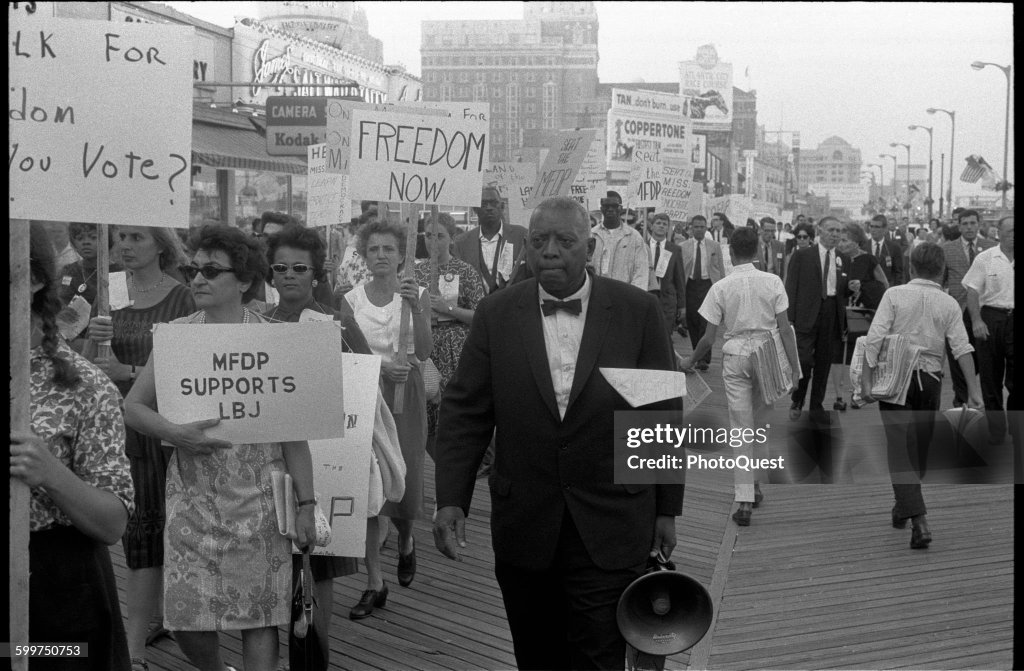
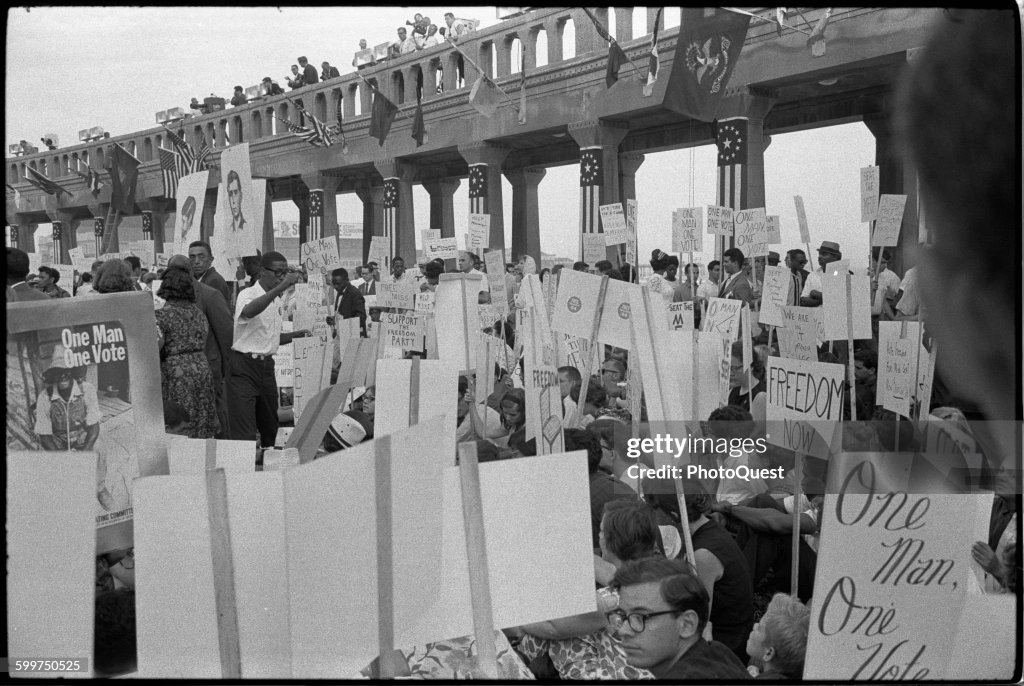
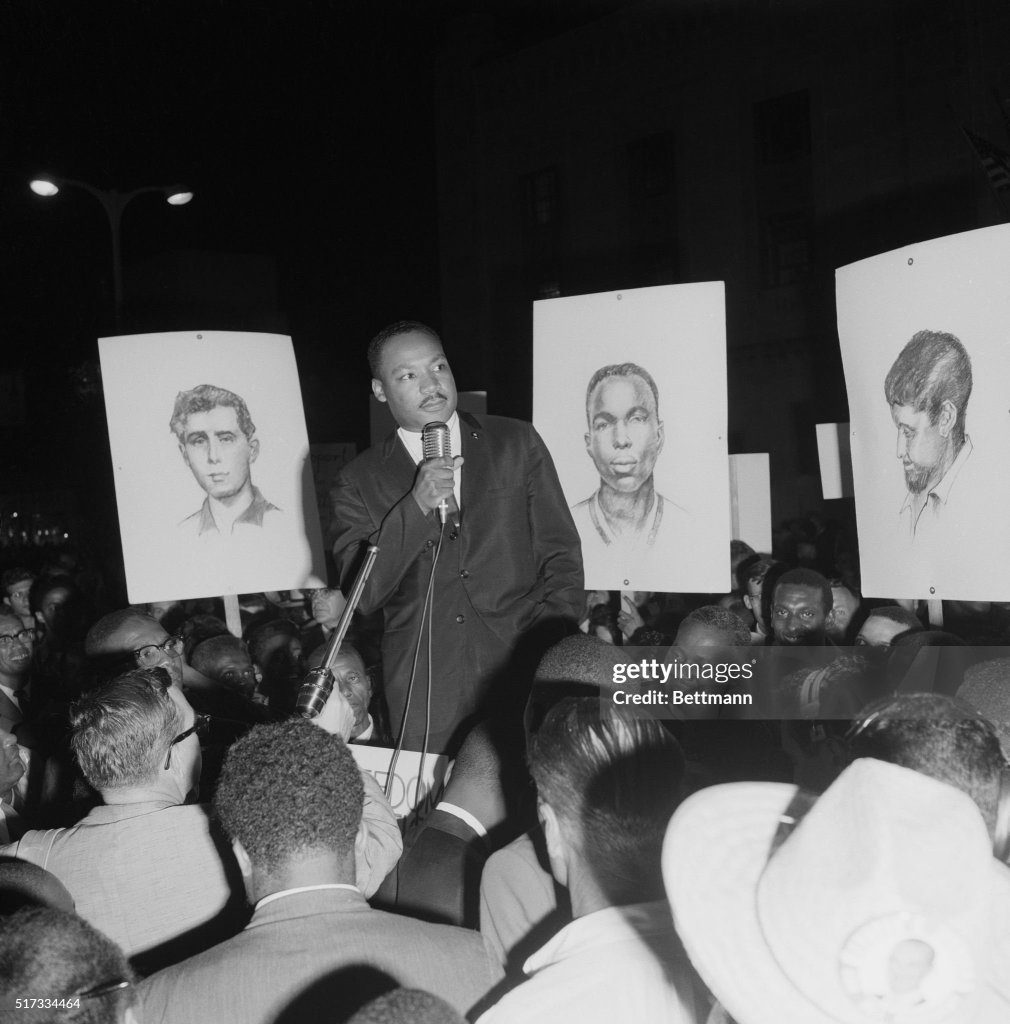
An embattled and divided delegation from Alabama entered the Democratic National Convention tonight and took seats. Some of the delegates had taken the required pledge to support the party’s nominees, but most had not.No effort was made to remove any of them from the Convention Hall, and the delegates remained in their seats or in the convention area for most of the evening, drifting out in small groups as the program drew to a close. White House aides met with some key delegates in a hideaway under the convention platform tonight to discuss the Mississippi seating crisis. Their talk, which continued as the speeches droned on above, underlined the serious view being taken of the situation. But if any solution for the Mississippi delegation was reached, it was not immediately apparent.
Almost the entire population of the White House has moved from 1600 Pennsylvania Avenue to the Pageant Motel, across the street from Convention Hall, for the Democratic National Convention. Huddled in conference upstairs, splashing in the pool on the roof or traipsing through the tiny, coral‐colored lobby are many of the men and women who surround President Johnson. They include the President’s and Mrs. Johnson’s press secretaries, speech writers, consultants, liaison men with Congress and culture, court jesters, Secret Service men, relatives and friends — several hundred in all.
This morning, Mr. Johnson’s younger daughter, Luci, joined the crowd. Saying that she felt “out of it” in Washington, she flew to Atlantic City after begging her parents to let her go to the convention early. Her mother and 20‐year‐old sister, Lynda, are flying in Wednesday. The President is due Thursday.
The Roman Catholic Mass was performed in the English language for the first time, as permitted by a decision from the Second Vatican Council allowing religious services in the vernacular, or native, languages rather than in Latin. Reverend Frederick R. McManus of the Catholic University of America celebrated the mass in front of 11,000 people at the Kiel Auditorium in St. Louis, Missouri at the National Liturgical Week conference, in advance of the November 29 services where the vernacular would be permitted worldwide. Father McManus opened the service with the words, “Lord, have mercy” in place of the traditional Greek prayer “Kyrie eleison”, and the congregation responded, “Christ, have mercy” instead of Christe eleison.
President Johnson signed today a bill amending the so-called collapsible-corporations provisions of the tax laws. Under the amendment, those provisions may not apply to the sale of stock in a corporation that consents to a special tax treatment of any later disposition of its assets. The bill also provides procedures under which some royalties received by a company for the privilege of using its patents, inventions or similar property may be treated as income from rent to a limited extent.
In a 113 page document the FTC rules that the Topps Gum Company has a monopoly on baseball cards. They forbid Topps to enforce any existing contract after November 31, 1966.
Al Worthington relieved Jim Kaat for the Minnesota Twins tonight and saved a 4–3 victory over the Chicago White Sox. The defeat pushed the White Sox two games off the American League pace. Kaat was credited with his 14th victory. Worthington took over with Sox runners on second and third and one out in the eighth. He gave a run‐producing single to Ron Hansen before Moose Skowron and Don Buford flied out to end the threat. It was Kaat’s third straight victory over Chicago. He gave five hits, struck out four and walked only one in seven and one‐third innings.
Rico Carty hit three doubles, a single and home run tonight in pacing a 16‐hit attack as the Milwaukee Braves scored a 12–9 victory over the Philadelphia Phillies. Wes Covington drove in six Philadelphia runs with a threerun homer in the first, a tworun homer in the ninth and two doubles. Hank Aaron hit a single and home run and batted in three runs for the Braves, whose starting pitcher, Bob Sadowski, hung on for his eighth victory despite yielding 13 hits for nine runs.
Bob Gibson (11–10), going the distance for the first time in more than a month, pitched the St. Louis Cardinals to a 5–1 victory over the Pittsburgh Pirates tonight. Bill White and Ken Boyer homered for the Cards.
Jim Ray Hart’s two-run, 415‐foot homer and Willie Mays’s spectacular catches provided Jim Duffalo and the San Francisco Giants with a 4–2 victory tonight over the Los Angeles Dodgers. A Dodger Stadium crowd of 36,034 gave Mays a standing ovation for his second fine catch of the game — a one‐handed grab of Tommy Davis’s blast to right‐center in the eighth. Mays took another potential extra‐base hit away from Ron Fairly in the first inning.
Walt Bond’s two‐out single in the eighth inning broke up a pitching duel between Bob Bruce (12–7) and Lou Burdette (9–7) and lifted the Houston Colts to a 2–0 victory over the Chicago Cubs tonight.
Dow Jones Industrial Average: 837.31 (-1.31).
Born:
Salizhan Shakirovich Sharipov, Uzbek Kyrgyzstani space traveler who served as an astronaut and mission specialist on the American Space Shuttle Endeavour (STS-89) in 1998, and as a cosmonaut and flight engineer on the Russian Soyuz TMA-5 from 2004 to 2005; in Uzgen, Kirghiz SSR, Soviet Union.
Pebbles [Perri Reid (née McKissack)], American pop singer (“Girlfriend”), minister, and gospel singer, in Oakland, California.
Oteil Burbridge, American bassist (Allman Brothers Band, 1997-2014; Dead & Company, 2015-2023), in Washington, District of Columbia.
Dana Gould, American comedian, actor, and writer (“The Simpsons”, 2001-2007), in Hopedale, Massachusetts.
Kip Gross, MLB pitcher (Cincinnati Reds, Los Angeles Dodgers, Boston Red Sox, Houston Astros), in Scottsbluff, Nebraska.
Mike Black, NFL tackle (Philadelphia Eagles, New York Giants), in Auburn, California.
Died:
Umberto D’Ancona, 68, Italian biologist.
Maurice Schoemaker, 73, Belgian composer (Fireworks).
 History Diaries