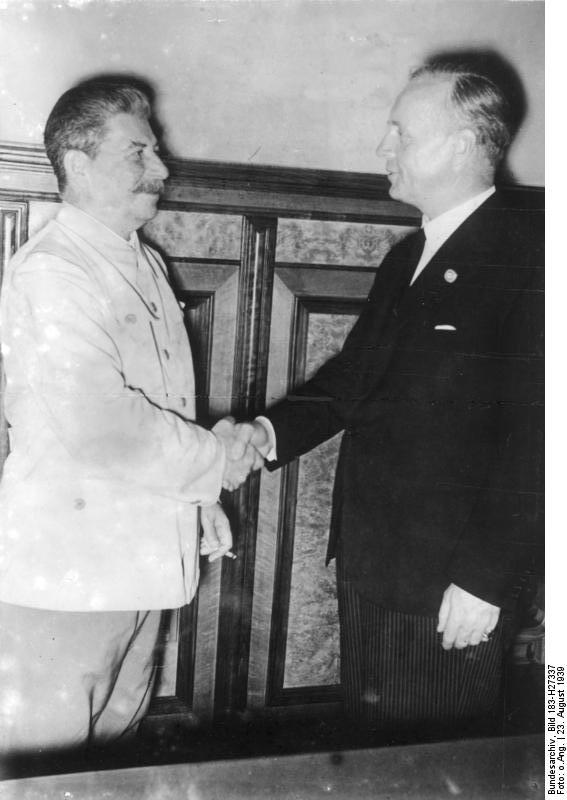
The German-Soviet Non-Aggression Pact is signed in Moscow. Sometimes called the Ribbentrop-Molotov Agreement of Non-Aggression, it sets up plans for a ten-year collaboration between Germany and Soviet Russia. Both parties agree that if either became involved in a war, the other would give no help to the enemy; nor would either join any group against the other. There is no clause stating that withdrawal is allowed if one signatory attacks a third party, although this is customary in such treaties. A “secret protocol” to the agreement provides for the partition of Poland along the line of the rivers Pisa, Narew, Vistula and San in the event of what is referred to as a “territorial transition” taking place in Poland. The Soviet Union is allocated all the Byelorussian and Ukrainian provinces of Poland, as well as the province of Lublin and part of that of Warsaw. Germany is to take the western part of the country, though the possibility of retaining a small remnant of a Polish state is kept open. The USSR is to have a free hand in Finland, Estonia and Latvia; and Germany in Lithuania. Soviet interest in the Rumanian province of Bessarabia is recognized by Germany.)
The British and French Special Military Mission leaves Moscow.
Hitler is delighted. He believes Stalin has just handed him the perfect opportunity to restore the Reich’s “rightful possessions” without having to fight a war on two fronts. He is certain that this new treaty with the Russians will allow him to safely reclaim Danzig and take back the Polish Corridor. Britain and France, he tells his staff, without other major allies, will not go to war in such a situation, “especially over what everyone knows are, by all rights, German territories anyway.”
The announcement that the German and Soviet governments have signed a non-aggression pact proves to be an even greater blow to the British and French than the Soviet-German economic treaty. The British and French governments have been conducting negotiations with the Soviet government for several months and the British and French hoped to bring the Russians into an anti-fascist front. The Soviet decision to suddenly change ranks is a terrible and bitter blow to the Western allies. From the Soviet perspective, the Polish government’s refusal to allow Red Army troops onto Polish territory in the event of war alienated the Soviet regime. As a result of this agreement, the British and French governments abandon their peace program and intensify their military preparations. Simultaneously, the Germans concentrate their military forces along the Posen border and Slovakia.
This agreement also marks the collapse of the Anti-Comintern Pact, which provides Japan a free hand in its foreign policy planning.
While Foreign Minister Joachim von Ribbentrop was in Moscow discussing, in the view of some German quarters, not so much a new non-aggression pact as “Poland’s fourth and final partition,” Chancellor Hitler yesterday received Sir Nevile Henderson, the British Ambassador, for a fifteen-minute conference.
According to reliable information, the conference ended on a rather blunt note that is interpreted in diplomatic quarters as possibly Herr Hitler’s last word. The communiqué, issued last night, reads: “Complying with the wish of the British Government, the Führer received Sir Nevile Henderson at the Berghof today. The Ambassador delivered a letter from the British Prime Minister addressed to the Fuehrer, which was drawn up in the same sense as yesterday’s British communication regarding the Cabinet session. “The Führer left no doubt in the mind of the British Ambassador that the obligations assumed by the British Government could not induce Germany to renounce the defense of her vital national interest.”
Actually Herr Hitler’s tone to Sir Nevile was reported to have been even more blunt than the communiqué indicates. In effect, Herr Hitler told the Ambassador that Britain had no business in Eastern Europe and that her guarantee of Poland merely encouraged Polish resistance to German demands, therefore it was up to Britain to persuade the Poles to yield or face the consequences. Sir Nevile left the conference so wrought up he was speechless. Not trusting his memory to repeat the exact shadings of Herr Hitler’s answer, he asked that it be put in writing and he returned for it a half hour later. He got it couched in the same strong terms that Herr Hitler used to him before.
In a reply to British Prime Minister Neville Chamberlain, German Chancellor Adolf Hitler states that Great Britain would be responsible for the existing situation and that without Britain’s unconditional assurance to Poland, the latter would not have refused to negotiate on questions of vital interest to the Reich. Hitler makes a reply to British Prime Minister Neville Chamberlain’s cable of the previous day. Hitler warns that Germany is prepared and determined to fight if attacked by Britain: “…there can be no doubt as to the determination of the new German Reich to accept privation and misfortune in any form and at any time rather than sacrifice her national interests or even her honor.”
Hitler writes to Neville Chamberlain: “Germany was prepared to settle the questions of Danzig and of the Corridor by the method of negotiations on the basis of a truly unparalleled magnanimity, but the allegations put forth by England regarding a German mobilization against Poland, the assertion of aggressive designs toward Romania, Hungary, etc. as well as the so-called Guarantee Declarations which were subsequently given had dispelled any Polish inclination to negotiate on a basis which would have also been tolerable for Germany… The German Reich government has received information to the effect that the British government has the intention to carry out measures of mobilization which, according to the statements contained in your own letter, are clearly directed against Germany alone… I therefore inform your Excellency that in the event of these military announcements being carried into effect, I shall order the immediate mobilization of the German armed forces.”
In Berlin, Germany, journalist William Shirer notes in his diary “it looks like war” based on his observations throughout the day.
Hitler predicts the Chamberlain government will fail. Göring meets with Birger Dahlerus, a Swedish businessman and proposes that Dahlerus, who has good connections, should act as a go-between with Great Britain.
The British Government prepared for action today with every indication that it was ready to go to war with Germany whenever a call for help from Poland should come. Warning notices went out to reservists in all departments of the armed and civilian services; the King was returning to London to hold a meeting of the Privy Council tomorrow; Londoners were ordered to darken their windows until further notice; the air force was poised for instant action, and a concentration of an undisclosed number of British warships was reported in the Skagerrak, between the Norwegian and Danish coasts, as if to remind Germany of the blockade that she had to endure during the World War.
The emergency was underlined by a Board of Trade announcement placing an immediate embargo on unlicensed exports of essential war materials “in order to conserve the stocks in this country.” The list included copper, nickel and rubber, which the Germans have been buying in large quantities in the past week or two, and also aluminum, lead, iron and steel scrap and raw cotton.
Tomorrow both houses of Parliament will meet in emergency session to give the government sweeping powers of a sort unknown in democratic England since World War days. The new law will be something like the old Defense of the Realm Act, enabling the government to issue Orders in Council, without prior or subsequent Parliamentary sanction, for any purpose that the national interest may require. Trade-union leaders were invited to examine the bill today and they came away satisfied that all possible safeguards of individual liberty would be included.
The real business of the Parliamentary session, however, will be. to hear a complete review of the international situation by Prime Minister Chamberlain in the House of Commons and by Viscount Halifax, the Foreign Secretary, in the House of Lords. All indications are that the Prime Minister’s words, and the subsequent debate will be more somber in tone than anything heard in the Commons chamber since August 3, 1914, when Sir Edward Grey made his famous speech on the eve of the World War.
Chamberlain gives a fighting speech, to be broadcast by the BBC, saying it is unthinkable that Great Britain should not carry out its obligations to Poland.
Quietly continuing their military preparations, calling several more thousand reserve officers and specialists to active service, sending more troops to the German frontier and building fortifications day and night, the Poles await Chancellor Hitler’s next move, ready for war if Polish interests are directly menaced in Danzig or elsewhere.
Normal life is not in the least disturbed by alarming rumors of a “showdown” after the signing of the German-Soviet non-aggression pact and Chancellor Hitler’s speech at Tannenberg on Sunday. It is not believed the Tannenberg speech will materially change the situation. Poles doubt Herr Hitler will risk. a general conflict, even now that he is assured of Russian neutrality. in case of war.
The main headlines in Warsaw newspapers are devoted to the British declaration of full support to Poland. The peace front is felt to be stronger and more united. It is admitted the Soviet-German pact was concluded principally to weaken Poland’s position and that the Nazis had abandoned their plans for breaking up Russia to get “living space” in the Ukraine in order to win the Soviet’s full neutrality when they attack Poland.
[Ed: Abandoned? No. Only postponed for a time.]
Generalmajor Erwin Rommel is made the commanding officer of Hitler’s headquarters.
French citizens are advised to leave Paris. Churchill leaves France and returns to London. Daladier asks the Permanent Committee for National Defence whether they can stand by and watch the disappearance of Poland and Rumania; they agree that they cannot.
Convinced by a report from French Ambassador Robert Coulondre at Berlin and by a reply that Chancellor Adolf Hitler gave yesterday to Prime Minister Neville Chamberlain’s message through British Ambassador Sir Nevile Henderson at Berchtesgaden that an invasion of Poland is intended by the German Government within the next few days, the French Government last night decided to call up a further contingent of reservists today. This decision was communicated to the press in an official statement from Premier Edouard Daladier’s office as follows: “On account of the international situation the French Government has decided to complete military measures already taken by calling up an additional contingent of reserve soldiers.”
France is mobilized and expects war. The people are confident of their strength to meet the aggressor as peace hopes dim.
Sir Percy Lorain, British Ambassador to Rome, informs his government that he is confident the Italians will not fight. Mussolini declares he is ready to mediate.
No military moves are apparent in Italy. The Italian ship of state sailed tranquilly on the edge of the European tornado today. There have been no conferences, communiques, evacuation orders, special mobilization or troop movements.
In the name of the seven nations of the Oslo Group — Norway, Sweden, Finland, Denmark, the Netherlands, Luxembourg and his own country — Leopold, King of the Belgians, addressing the world by radio tonight, voiced a moving appeal to avert the war that seems impending.
Czech leaders urge calmness and no attempt to “fight Britain’s war by obstruction.”
Rumania affirms it will remain neutral in any coming war.
Turkey reaffirms its pledges to the Allies. No official pronouncement has yet been made about the Russo-German nonaggression pact. In official quarters the position of Turkey is said to be unchanged; she has made agreements for mutual assistance against aggression with France and Britain and stands by them.
A resolution condemning as illegal the Palestine policy laid down in the recent British White Paper will be submitted to the Zionist Congress when it resumes its plenary session in Geneva tomorrow. The Congress expects to finish its work tomorrow night or Friday morning.
The Seventh International Genetical Congress was convened in Edinburgh.
Admittedly disturbed by the European war crisis, President Roosevelt is hurrying here aboard the navy cruiser Tuscaloosa after scrapping plans for a more ceremonious landing at USS Annapolis in order to be back at the White House in the event of an outbreak of hostilities. A small White House secretarial staff is awaiting the arrival of the President off Sandy Hook early tomorrow to give him a bundle of official diplomatic reports on the latest developments abroad. Mr. Roosevelt plans to study the reports aboard his special train en route to Washington.
After debarking from the Tuscaloosa about 8 AM tomorrow the President will motor here with Brig. Gen. Edwin M. Watson, his secretary, and Rear Admiral Ross T. McIntire, White House physician. He is expected to stop long enough before entraining for the capital to telephone Secretary of State Cordell Hull, as well as to the embassies in London and Paris about overnight developments.
Back at the White House in the early afternoon the President will have before him a report of the War Industries Committee on the status of the nation’s munitions and other heavy industries. The committee has been canvassing the aviation and other industries in the past few days with a view to American preparedness. Prior to the departure of the White House staff late today it was understood the War Industries. Committee had drafted a report informing the President that the aviation and several other industries were prepared for any emergency that might arise and that aircraft manufacturers were ahead of schedule on orders of military planes from France and Great Britain.
As President Roosevelt rushed back to Washington to meet the problems created for this country by a constantly deepening danger of war in Europe, high officials of the government, including Secretary of State Cordell Hull, who returned from a vacation, met today in the State and Treasury Departments and prepared plans and measures for the President’s approval. The feeling, in official circles here, that the danger of conflict is increasing hourly was in no way allayed by the announcement from Berlin and Moscow that the Soviet-German non-aggression pact had been signed, since this had been discounted here, and the exchanges between the British and German Governments today were regarded as more serious.
Feverish activity developed even before the White House announced at noon that the President had decided to hasten back to the capital, and tonight everything had been prepared for the Chief Executive to take whatever steps he deems necessary to meet the threatening situation. Sumner Welles, Under-Secretary of State, announced that a meeting of officials from five government departments and high ranking army and navy officers would be held at 3 PM tomorrow, an hour after the President is scheduled to arrive here.
Among the problems dealt with. at meetings held in the morning in the office of John W. Hanes, Undersecretary of the Treasury, and in the afternoon in that of Adolf A. Berle. Assistant Secretary of State, were technical ones dealing with the shock upon money and export markets if war should develop in Europe. Also studied was cooperation of the navy in evacuating Americans from Europe, an undertaking to which, in case it is necessary, the Maritime Commission. will lend its ships.
President Roosevelt sends appeals for peace to Chancellor Hitler, President Moscicki, and King Victor Emmanuel and appeals for settlement of the Danzig crisis by mediation.
U.S. officials frown on overseas travel for citizens. Americans are being advised by the State Department not to go to war-threatened Europe. American citizens are beginning to sail home from France. The Normandie and Bremen sailed today; the Aquitania is due to leave Cherbourg tomorrow.
Representative William B. Bankhead, House Speaker and New Deal leader, indicated today his willingness to accept the 190 Democratic Presidential nomination if Alabama voters endorsed his own candidacy.
Senator George of Georgia, who was reelected to the Senate last year in spite of the President’s opposition, returned here today and reported that the belief existed in his State that the President planned to make an effort to break down the no-third-term tradition.
Bribery charges against two State officials, a police raid on two downtown business offices and court action by the State University to recover money losses kept Louisiana’s scandals simmering today.
Garfield A. King, for twenty-five years a lawyer practicing at Vancouver, British Columbia, testified at the Harry Bridges deportation hearing today that a representative of the Immigration Service had suggested to him that he obtain an affidavit from his brother, who was in prison, that Bridges was a communist.
The United States intends to negotiate a reciprocal trade treaty with Argentina as a move to put American commerce with that republic on a footing of equality with that of European competitors, Sumner Welles, Acting Secretary of State, stated today. There have been more than four years of preliminary discussion.
Sidney Coe Howard, playwright, was crushed to death today by a two-and-a-half-ton tractor in his garage on his 700-acre estate in Tyringham, Massachusetts.
British racing driver John Cobb set a new land speed record of 369.741 miles per hour (595.040 km/h) at Bonneville Salt Flats in Utah. The record stood until 1947.
In Chicago, the New York Yankees sweep a pair from the Chicago White Sox, winning 7–2 and 16–4. Atley Donald allows three hits in the opener, and Red Ruffing coasts in game 2. Joe Gordon hits his 21st home run, a grand slam, to back Ruffing. Joe DiMaggio hits his 20th homer. The win leaves the Yankees 8 games ahead of Boston.
Fritz Ostermueller, a southpaw, set the St. Louis Browns down with four hits-two of them in the ninth inning-as the Boston Red Sox took the second and final game of a short series today, 9–1. The Browns bunched their first two singles and a sacrifice to put over the one run in the fourth in- ning. From then to the ninth Fritz allowed only one man to reach first base. While the Sox battered three Brownie pitchers for sixteen hits, most of the power was in the bats of Jimmy Foxx and Jim Tabor. Each had a perfect day with four for four.
Three Philadelphia A’s batters found the range on Freddy Hutchinson, high-priced Detroit Tigers rookie, today and as a result the Athletics took a 7–6 decision in eleven innings to split the two-game series.
The Brooklyn Dodgers downed the St. Louis Cardinals, 8-3, to sweep the three-game series and drop St. Louis five-and-one-half games behind the league leading Reds. The result also ran the Dodgers’ winning streak to four straight for the second time this year and, with the Giants losing, gave them a firmer grip on fourth place. Al Hollingsworth, southpaw discarded by both the Reds and Philles and later failing to get by the seventh inning in seven starts for the Newark Bears, was the hero. Al went the distance to score his first triumph as a Dodger.
The league-leading Cincinnati Reds advanced their margin by a full game today by making hay with the Philadelphia Phillies, 3–0, while the Dodgers were defeating second-place St. Louis. Cincinnati now is in front by five and one-half games. The Phillies tallied ten hits off Paul Derringer, but could not get any runs. Harry Carft’s fifth-inning solo homer gave Derringer all the runs he would need for the win.
The Chicago Cubs scored four runs in the 4th inning to chase Harry Gumbert to the showers and went on to beat the New York Giants, 8–3. Billy Herman started the collapse with a solo leadoff home run in that frame. Cubs’ centerfielder Hank Leiber blasted a long home run in the 9th to finish the scoring.
A bounding grounder to deep short that Pep Young beat out robbed Sailor Bill Posedel of a no-hitter today as the Boston Bees captured two games from the floundering Pittsburgh Pirates. Posedel pitched a one-hit 1–0 shutout in the opener for his thirteenth victory and the veteran Danny MacFayden stymied Pittsburgh, 3–1, in the second game.
The Canadian Cabinet will meet tomorrow to discuss measures to be taken to prepare for war.
Carlos Quintanilla became the new President of Bolivia after Germán Busch’s suicide.
The Greek cargo ship Constantinos Louloudis ran aground in the River Paraná, Argentina. She was refloated on 25 August.
The Brazilian passenger ship Itacare capsized and sank at Ilhéus with the loss of 34 of the 66 people on board.
The Chinese recapture of Tsincheng has marked the collapse of the most recent Japanese campaign to “clean up” the Chinese in Southeast Shansi, the military spokesman said here yesterday in his weekly review of the situation. Tsincheng, the most important city of the plains district of Southeast Shansi, was retaken by the Chinese after a nine-day siege during which the Japanese attacked from three different directions. The spokesman said that the enemy was now retreating in confusion northeast toward Kaoping, badly demoralized, reduced in numbers and leaving much equipment behind.
The Japanese took Tsincheng, a highway junction, more than a month ago during the course of a nine-way drive into Southeast Shansi that started two months ago. At the start of the drive the Japanese rapidly occupied the chief cities as the Chinese, using the customary guerrilla tactics, withdrew to the hills, evacuating the entire populations and all food. Counter-attacking, the Chinese have now regained control of virtually the entire area except a few cities. The spokesman said that the vanguard of the Japanese in Southeast Shansi was composed of veterans and consequently their defeat by the Chinese was the more noteworthy.
The Hong Kong Government yesterday demolished the bridges conecting this British Crown colony with China, while thousands of Japanese troops looked on. Residents of outlying areas of Hong Kong were requested to move into the center of the colony. An officially inspired article in a leading newspaper advised Britons to send their families home or at least to prepare for quick evacuation, though the article stressed that at present all moves were precautionary.
In line with precautions taken in other British colonies, the empire outpost of Hong Kong is preparing for any emergency, arising either from the presence of Japanese troops along the colonial border or from European disputes. Wives of the British Army personnel were informed yesterday that there was a possibility they would be sent to a “safe” place within the next few days. The wives were told to please look upon this as an adventure, not disaster.”
An appeal, broadcast by radio Tuesday, for registration of all British women and children brought 250 registrations. The appeal was repeated last night. The press is advising today that all “non-essential” women and children leave Hong Kong. It was understood border roads had been mined. Another government statement asked British men over 40 to volunteer for “second line” auxiliary work in connection with the colony’s defense corps. Japanese troops along the border were moving in supplies as if preparing for a long stay.
Reliable foreign sources reported today that the Japanese Army had landed 6,000 troops in the Shanghai area preparatory to “some action against the International Settlement.” The Japanese were said to have been planning to occupy the Settlement but to have postponed the action because of the Russian-German non-aggression pact negotiations, which left them uncertain of their position in the world line-up. Friction between Japanese and Settlement authorities has been intensified since last Saturday, when a British sergeant of the Settlement police machine-gunned a squad of Chinese policemen of the Japanese-dominated Shanghai municipal administration, killing two and wounding six. American, British, French and Italian troops totaling nearly 5,000 are stationed in the Settlement.
Suspension of operations of the Chungking-Hong Kong air line as a result of Japan’s semi-blockade of Hong Kong is expected, according to officials of the China National Aviation Corporation, owned by Chinese and American interests, and the Eurasia Company, owned by Chinese and Germans. The Japanese are said to be keeping many planes in the air around Hong Kong now, and this is considered a threat to passenger and mail planes. The American pilots of the China National planes are already drawing salaries higher than the Clipper pilots, and they may soon ask for an increase in pay in view of the increased danger. The Chungking-Rangoon service has not started. A recent survey of that proposed line revealed that fields in Burma were still unsatisfactory.
The Japanese discern greater dangers; leaders confer on the situation caused by the Nazi-Soviet pact. All Tokyo newspapers agree that Japan’s European policy has gone by the board and that an autonomous policy must be adopted, starting with a clean slate. Political conversations of the kind that always are the prelude to important changes or decisions began yesterday and continued today. First General Seishiro Itagaki saw the Premier, Baron Kiichiro Hiranuma, and made an important proposal. Next Baron Hiranuma met Prince Fumimaro Konoe, ostensibly to discuss three vacancies in the Privy Council.
Today Prince Konoe will visit the Emperor to submit three nominations for the Privy Council vacancies, but he will also confer on the general situation with Kurahei Yuasa, Grand Keeper of the Imperial Seal, the Emperor’s highest adviser in matters of state. Baron Hiranuma is expected to consult Foreign Minister Hachiro Arita, Admiral Mitsumasa Yonai, the Naval Minister, and Sotaro Ishiwatari, the Finance Minister, separately today. Such consultations in the present circumstances may portend a fresh start in external policy. Conferences of Cabinet leaders who have been discussing means of strengthening the Rome-Berlin Axis were discontinued. According to the newspaper Yomiuri the Ambassadors to Germany and Italy will be recalled for consultation. The newspaper Asahi sketches three possible policies before Japan:
- To disregard the new German-Soviet pact in the belief that its duration will be short because Chancellor Hitler planned it only to solve the Polish issue.
- To readjust Japanese relations with Russia.
- To revert to the former policy of friendship with Britain.
A writer in Nichi Nichi sums up public opinion as follows: “Germany now has no communist menace but Japan’s menace will increase. The Soviet will now be bolder in the Far East.” The official view announced by the Foreign Office spokesman and echoed in every newspaper is: “Japan will continue her policy of creating a new order in East Asia.”
Dow Jones Industrial Average: 131.82 (-3.25).
Born:
Charles Wardle, British MP for Bexhill and Battle (1983-2001), in the United Kingdom.
Ronnie A. Casseres, minister of Dutch Antilles, in Curaçao (d. 1988).
Died:
Germán Busch, 35, President of Bolivia, died by suicide.
Sidney Howard, 48, American playwright (“Silver Cord”, Pulitzer 1925), was crushed to death by a tractor on his farm.
Naval Construction:
The Royal Navy “K”-class destroyer (flotilla leader) HMS Kelly (F 01) is commissioned. Her first commander is Captain Lord Louis Francis Albert Victor Nicholas Mountbatten, RN.
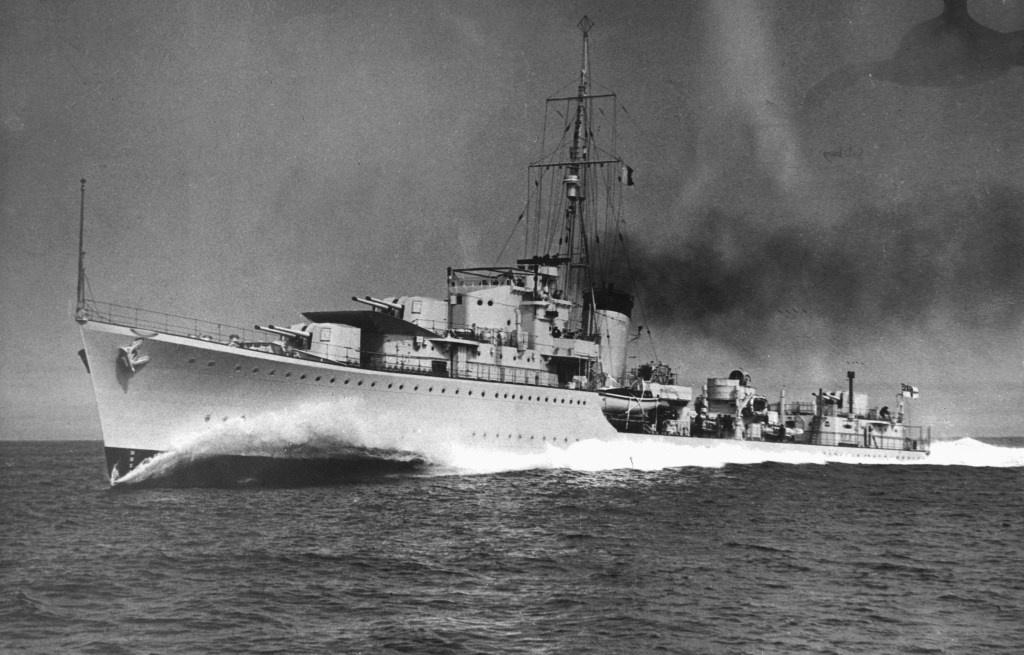
On the outbreak of the Second World War in September 1939, the Duke and Duchess of Windsor were brought from France, where they were living, back to Britain on board HMS Kelly.
On the afternoon of 14 December 1939, the tanker Atheltemplar struck a mine laid by German destroyers off the Tyne Estuary. Kelly and the Tribal-class destroyer HMS Mohawk were dispatched as escorts for the rescue tugs Great Emperor, Joffre and Langton. During the operation, Kelly also struck a mine and sustained damage to her hull. While Mohawk put a party aboard Atheltemplar, and Joffre and Langton took the tanker under tow, Kelly herself was taken in tow by Great Emperor and returned to the Tyne. Reaching the Tyne just before midnight, Kelly was assisted upriver by the tugs Robert Redhead and Washington. She was towed to Hawthorn Leslie’s yard for repairs, which took just a little over three months.
This was the second of Kelly’s misfortunes, having just returned to active service after a month in dry dock following storm damage. Repairs were completed on 28 February 1940, and Kelly returned to the fray. Astonishingly, she was involved in a collision with HMS Gurkha just two days later on 2 March, necessitating a further 8 weeks in dry dock, this time on the Thames. She was released on 27 April, in time to assist with the evacuation of allied forces from Namsos.
On the night 9 May/10 May 1940, during the Battle of Norway, Kelly was torpedoed amidships by the German E-boat S 31, under command of Oberleutnant zur See Hermann Opdenhoff (for which action Oblt.z.S. Opdenhoff was awarded the Knight’s Cross). Severely damaged, she was taken under tow by the tug Great Emperor and for four days she was attacked by E-boats and bombers as she struggled back to port at three knots. The Navy Controller wrote that she survived “not only by the good seamanship of the officers and men but also on account of the excellent workmanship which ensured the watertightness of the other compartments. A single defective rivet might have finished her.” She was repaired and returned to service.
On return to Hebburn shipyard, she was de-commissioned before undergoing extensive repairs; she was not fit for active service until December 1940. Her bad luck had seen her on active service for less than two weeks over the previous 14 months.
During this period her captain, Louis Mountbatten, as Captain (D), was forced to lead his flotilla from temporary placement in other ships of the flotilla; for a time he led from HMS Javelin, until she too succumbed to damage.
Kelly re-joined 5th Flotilla after re-commissioning in December 1940; after working-up trials and some service in the Channel, she and 5th Flotilla sailed for the Mediterranean, arriving at Malta in April 1941.
In April 1941 she joined HM ships Abdiel, Dido, Jackal, Jersey, Kashmir, Kelvin and Kipling at Gibraltar to form Force S, an escort for reinforcements to the Mediterranean Fleet (Operation Salient). She arrived in Malta on the 28th and was deployed with her flotilla to join Force K for attacks on Axis shipping to North Africa.
On 8 May, following the loss of HMS Jersey to a mine and the subsequent clearance of her wreck, the flotilla left Malta and joined Ajax, Dido, Orion and Perth to escort supply convoys to Egypt and Greece (Operation Tiger). On 10 May she led the destroyers to bombard Benghazi before returning to Malta. On 21 May she was despatched to Crete with Kashmir and Kipling and began patrols north of the island the next day.
Lost 23 May 1941.
On 23 May, during the evacuation of Crete, she was bombed and sunk, with half her crew killed. Kelly did succeed in shooting down three of the attacking Stukas, while another was badly damaged and crashed upon returning to base. Captain Lord Louis Mountbatten had been withdrawing at full speed since dawn. At 0755 hours, after surviving two air attacks without suffering damage, he was about 13 nautical miles to the southward of Gavdos Island when his ships were attacked by a force of 24 Ju.87 dive bombers. The Kashmir was hit and sunk in 2 minutes. A large bomb struck the Kelly while she was doing 30 knots under full starboard rudder. She turned turtle to port with considerable way on, and after floating upside down for about half an hour, finally sank. In accordance with earlier practice the dive bombers then machine-gunned the survivors in the water, killing and wounding several. The attack was witnessed by HMS Kipling, who was some 7 to 8 miles to the southward. She immediately closed and succeeded in picking up 281 officers and men from the water including the Commanding Officers of both destroyers.
The survivors were deeply affected by the loss of their ship; Mountbatten shared their loss and tried to console the ship’s company by reminding them all that “we didn’t leave the Kelly, the Kelly left us!”
Battle Honours: ATLANTIC 1939 – NORWAY 1940 – CRETE 1941 – MEDITERRANEAN 1941.
 History Diaries