10 days to war in Europe.
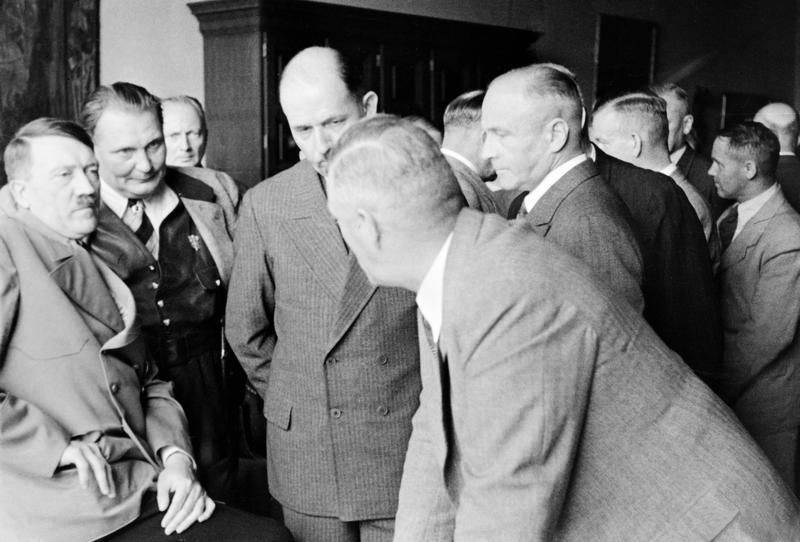
Hitler sets the date for the invasion of Poland as: Saturday, August 26, at 4:30am. Colonel-General Alfred Jodl is appointed Chief of staff of the armed forces supreme command (OKW).
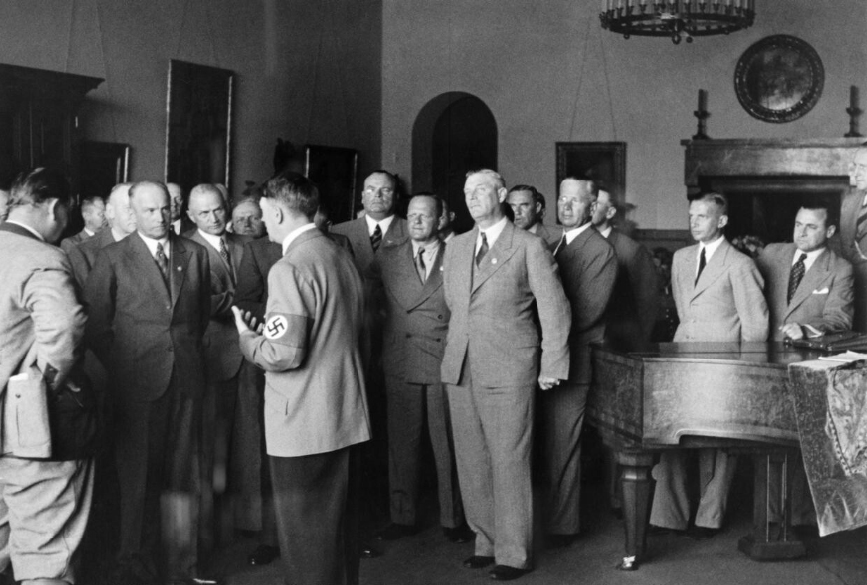
Hitler gave the Obersalzberg Speech to commanders of the Wehrmacht, detailing the pending invasion of Poland and plans for extermination of the Poles. At Obersalzburg, Hitler tells his generals that the destruction of Poland “starts on Saturday morning” (26 August), the aim of this war is the wholesale destruction of Poland. (Note: Hitler proclaims to the commanders of the armed services: “Our strength is in our quickness and our brutality. Genghis Khan had millions of women and children killed by his own will and with a gay heart. History sees him only as a great state builder… Thus for the time being I have sent to the East only my “Death’s Head Units” with the order to kill without pity or mercy all men, women, and children of Polish race or language. Only in such a way will we win the vital space that we need. Who still talks nowadays of the extermination of the Armenians?”)
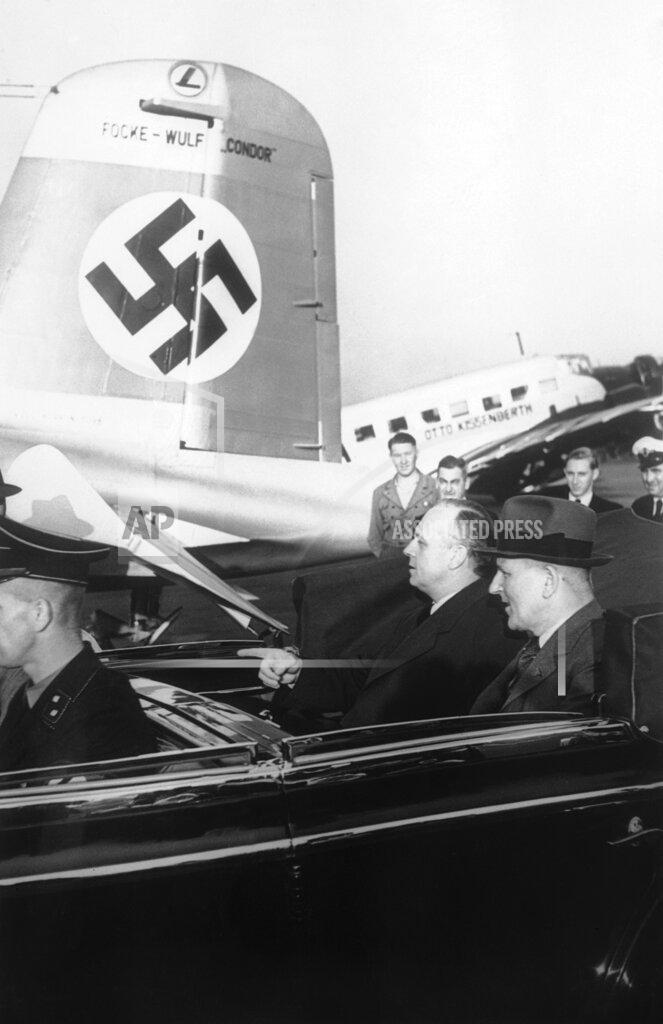
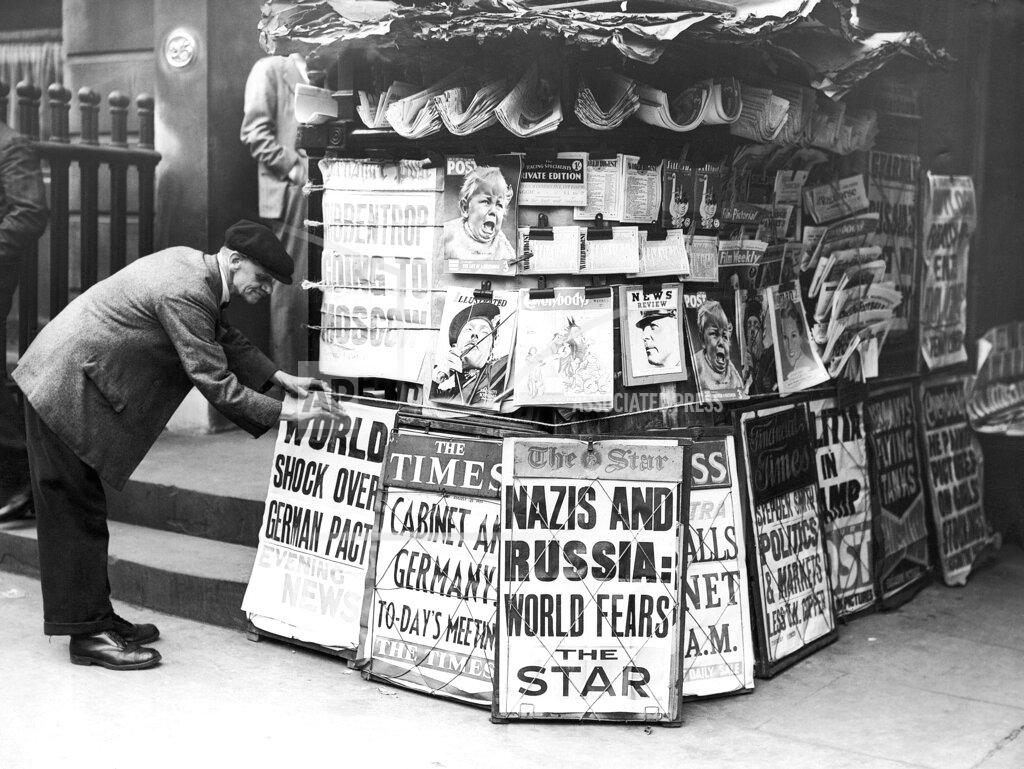
Joachim von Ribbentrop and the German delegation depart Berlin, Germany aboard two Condor aircraft for Königsberg, East Prussia, Germany, and then on to Moscow. The German press heaps ridicule on Paris and London for supposedly groveling in front of the Kremlin. With Germany jubilant and her army poised. to strike while the world is still stunned by Chancellor Hitler’s latest coup, Foreign Minister Jonchim von Ribbentrop and his staff left for Moscow at 9:40 o’clock tonight to “complete the negotiations” for the new German-Russian non-aggression pact, which is already hailed in German quarters An the beginning of “the fourth and final partition of Poland.” The word freely circulated in Berlin is still that Thursday will bring the zero hour and if Poland remains stubborn German troops will march into the Corridor either on that day or soon after. This assertion is supplemented tonight with another report that Germany is preparing a forty-eight-hour ultimatum to Poland to yield or face the consequences.
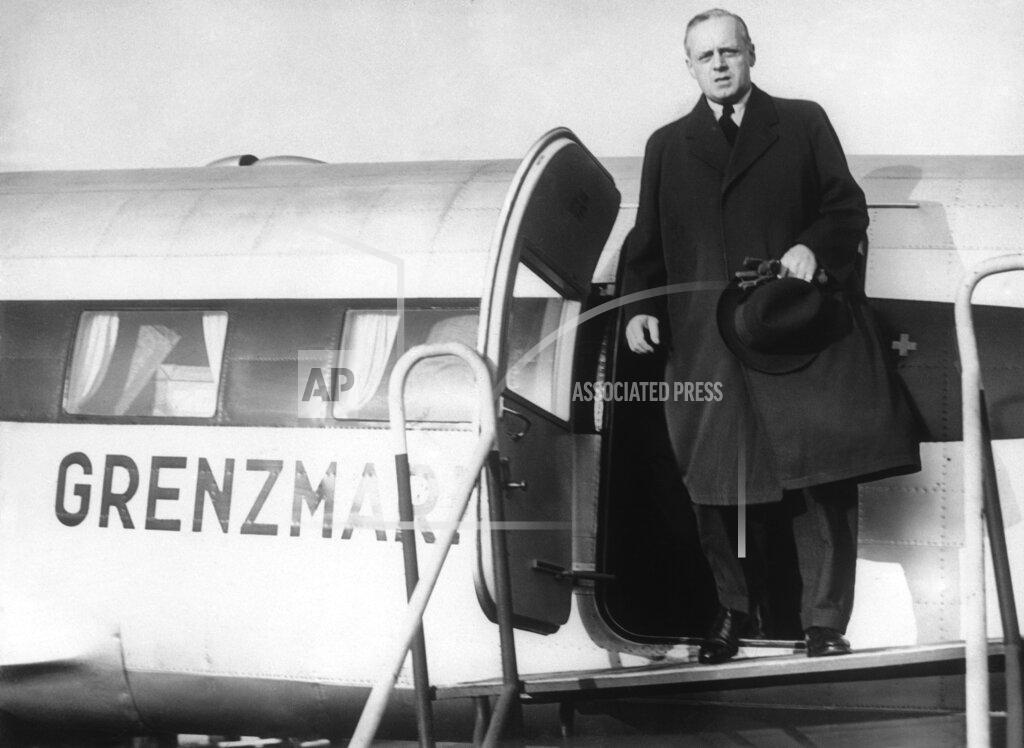
Leaving Salzburg on a plane bearing the significant name Grenzmark, or border province, the German Foreign Minister arrived in Berlin to pick up his staff, whereupon the party left in Herr Hitler’s personal and well-appointed Condor plane followed by another plane of the same type. Accompanying Herr von Ribbentrop are, besides clerical and other help, nine diplomats including Under-Secretary of State Friedrich Gauss, legal expert in the German Foreign Office; Baron Alexander von Doernberg, chief of protocol, who will undoubtedly have some delicate problems to solve on this first visit of a National Socialist Foreign Minister to the Bolshevik citadel, and Privy Councilor Schnurre, chief of the Foreign Office Eastern Department, who was in direct charge of the negotiations for both the non-aggression pact and the new trade agreement.
Avoiding the Polish Corridor the planes were scheduled to fly out over the Baltic and then to Königsberg and Moscow, where they are due tomorrow forenoon. The German planes carrying Herr von Ribbentrop and his retinue arrived at Königsberg at 11:30 PM and the journey will resume to Moscow tomorrow morning. According to present plans, Herr von Ribbentrop is scheduled to stay in Moscow only two days and the Germans already boast that he will give the world in general and the British in particular a lesson in diplomatic efficiency by completing negotiations and signing the pact within that time.
There was no doubt today that the announcement of this pact has shaken the Germans out of their almost fatalistic resignation of recent days and has given a lift to their morale and Herr Hitler’s prestige with it, which cannot be overestimated even though many confess they can no longer follow the gyrations of National Socialist policy. The German press, which pours ridicule on French and British diplomatic and military delegations for “groveling before the Kremlin,” extols the proposed pact as a historic victory that changes the whole world situation and blasts the British “encirclement policy” sky high but also directs German-Russian relations into centuries-old channels of friendship so highly prized by Bismarck and so lightly sacrificed by the former Kaiser.
Dr. Hans Frank, who, as Justice Commissioner, occupies the biggest legal position in Germany, told the German Lawyers Association today that the juridical clauses making Danzig a free city were null and void and the process whereby the city became autonomous was a fiction.
Orders are issued to confiscate all radios belonging to German Jews.
A Russo-German non-aggression pact will change nothing in Poland’s position toward Germany, was the first comment in Warsaw political circles early this morning when Members of British Parliament were summoned back to London for a special session on Thursday. The military aspects of the Russo-German non-aggression pact are being widely discussed in Warsaw, where the benefits to Germany are considered as doubtful. The Russians, it is pointed out in responsible circles, least of all intend to lend military aid to the Nazis in any form whatever. Any aggression against Danzig or elsewhere against Poland will be resisted forcibly, irrespective of the effect that such a pact might have on the Western powers, France and Britain. The Germans will soon discover their mistake, if they think they will be able to increase their pressure on Poland and force her submission in view of Soviet neutrality, was another reaction.
It is pointed out in Warsaw that the Polish-Soviet non-aggression pact remains in force and, furthermore, that Poland never counted on Soviet aid. Warsaw’s attitude of refusing a passage to Soviet troops through Polish territory in case of war is well known. As far as this pact or any other agreement tends to insure world peace, it is welcomed, but the circumstances under which it was negotiated would seem possibly to militate against peace. Moreover, circles close to the government point out that Poland, more than any other nation, knows the value of a pact signed by Nazi Germany.
Foreign Minister Beck agrees to allow passage of Soviet troops through Poland. It is too late; that ship has sailed.
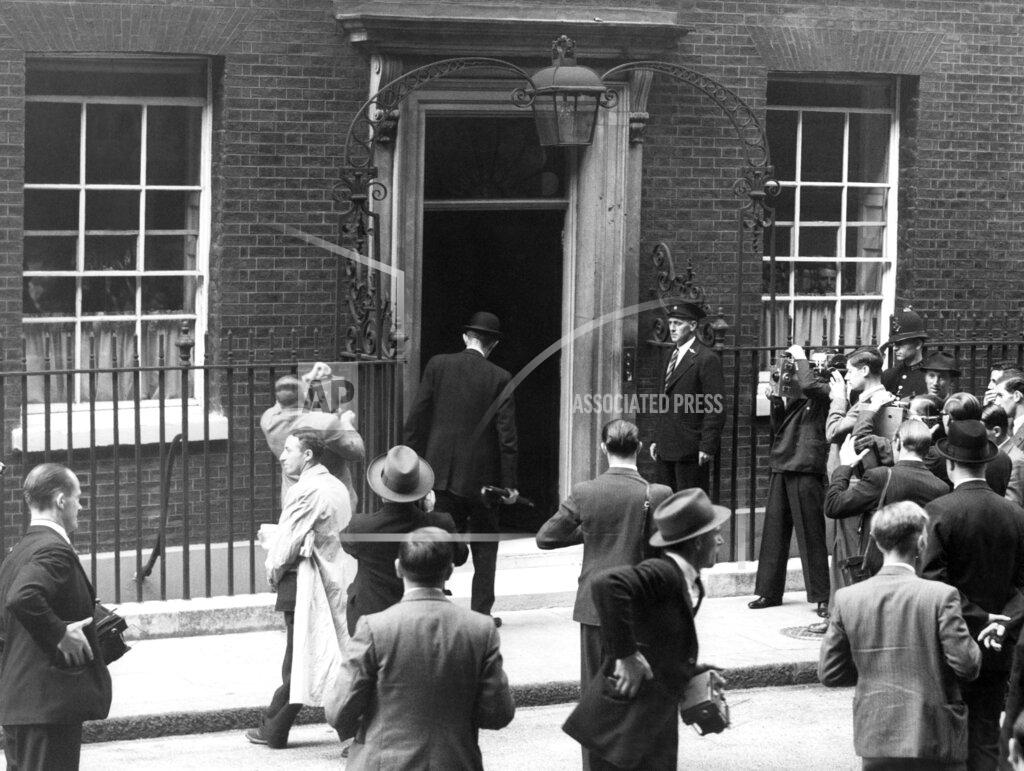
Britain and France stand by their pledge to the Poles. They rush plans for war and Poland stays calm. The British Cabinet asks the Commons for wartime powers. More troops mobilize. Britain responded swiftly tonight to the challenge of a German-Russian pact by reaffirming every word of her pledges to Poland and by speeding her preparations for immediate war if war should become necessary in the next few days. A three-and-a-half-hour Cabinet meeting was followed by an announcement that all the Ministers felt that the signature of a Nazi-Soviet treaty “would in no way affect their obligations to Poland, which they have repeatedly stated in public and which they are determined. to fulfill.” It was added that this decision had been made without hesitation and that, like all others. taken today, it was unanimous.
Moreover, it was announced that Parliament would be summoned for Thursday to hear a review of the situation by Prime Minister Chamberlain and to rush through all its stages a sweeping Emergency Powers Bill. This measure is expected to confer sweeping wartime powers on the government, not only to put the country on a war basis without delay but to prevent further shipments of copper, rubber and other essential war materials that have been going to Germany in large quantities in the past few days.
The government already has powers to mobilize its manpower without public proclamation. Nevertheless, it was announced after the Cabinet meeting that “further measures of a precautionary character” were being taken, including the calling up of additional men for all three fighting services and for civilian-defense organizations. Already so many men are under arms in the various services that any large-scale addition to their numbers would seem to make general mobilization complete. It is understood warning notices have already gone to some of the 48,000 naval reservists who have not yet. been called to the colors.
In all these measures and in the remaining passages of the Cabinet’s announcement there was no hint of weakening or of a “new appeasement” as a possible answer to the German-Russian bombshell of last night. The British communiqué repeated the belief, already expressed by Mr. Chamberlain, that “there is nothing in the difficulties that have arisen between Germany and Poland which would justify the use of force involving a European war with all its tragic consequences.”
British Prime Minister Neville Chamberlain cables German Chancellor Adolf Hitler informing him that a German-Soviet pact will not dissuade Britain from fulfilling its obligations to aid Poland: “It has been alleged that, if His Majesty’s Government had made their position more clear in 1914, the great catastrophe would have been avoided. Whether or not there is any force in that allegation, His Majesty’s Government are resolved that on this occasion there shall be no such tragic misunderstanding.”
Britain repeats its guarantees to Poland and pleads concurrently with Germany for a truce in Eastern Europe and for a conference on German territorial claims. Meanwhile, in late July the Poles had given the British two Enigma coding machines, based on German versions. They give a valuable start to the code-breaking effort that will assist Allied commanders during World War II.
Sir William Seeds, British Ambassador in Moscow, accuses Molotov of negotiating in bad faith.
France is said to be in complete accord with Great Britain and will declare war on Germany if Poland is attacked and resists German aggression.
Italy sees in the Russian-German non-aggression agreement the end of “encirclement,” alteration of the European balance of power in favor of the Axis and, indeed, a turning point in modern history. Italians feel that Poland now will have to yield and the war that has threatened Europe will not occur.
The Czechs decry the British on the Nazi-Soviet pact, blaming them for this new turn of relations. Munich is on everyone’s mind.
Belgium proclaims its neutrality and mobilizes its army for defense.
Americans in Europe start to rush home. The Normandie sails tomorrow from Havre with every available space filled, whereas the bookings a few days ago were described as only “fair,” and there is reasonable doubt that the North German Lloyd liner Bremen, scheduled to leave Cherbourg tomorrow for New York, will sail, although local agents today said they had received no advice from the home offices indicating a cancellation. The embassy and consulate in France, to whom Americans are turning in great numbers for advice as to whether they ought to return, are not offering advice one way or the other, leaving it up to each person to decide for himself. However, today they counseled Americans intending to go to Poland to refrain from the trip.
Greece is considered sure to support Britain. Despite its anti-democratic rule, Greece fears Italy and cites London’s naval strength and France’s power. Should war break out the Greek Government, despite its anti-Democratic ideology, would be forced to follow the lead of Britain and France, according to observers, who at the time of the Albanian crisis took more seriously than today Premier John Mextaxas’s repeated statements that Greece would follow a neutral course.
Dutch Premier De Geer recalls Dutch holidaymakers in Black Forest.
Dutch border guards take positions for German invasion.
The Panamanian passenger ship Parita was beached at Tel Aviv, Mandatory Palestine with 900 Jewish refugees on board.
The international situation took precedence over all other matters at the Zionist congress in Geneva today. Although committee meetings were held as usual it was found that more than 100 of the 600 delegates had already left for home. Most of them came. from Palestine or Eastern European countries. Several of the latter were women who had received word that their husbands had been mobilized. It was generally agreed today that in the event of war the congress would adjourn forthwith and turn over to its action committee, composed of 70 representatives of various parties, all unfinished business. The action committee would then arrange to meet in London.
President Roosevelt, heading for the Gulf Stream aboard the naval cruiser USS Tuscaloosa, paid close attention tonight to radio reports on the tense European situation, but made no comment on European affairs.
President Roosevelt on his return to the White House Friday will be confronted with appeals from all parts of the country that he intervene again to preserve the peace of Europe. The number of these telegraphic appeals has been mounting since German troops moved into Slovakia and the announcement of negotiations for a Russian-German non-aggression pact. But, unless all signs fail, Mr. Roosevelt will make no further representations to the rulers of European States in the interest of world peace unless and until Congress revises the existing neutrality law so as to remove the mandatory arms embargo that would apply automatically to belligerents if the President decided a state of war exists.
It was apparently in anticipation of the appeals that have been reaching the White House in the last few days that the President told. the group of Senators, who conferred with him at the White House a few days ago, before Congress adjourned without action on his neutrality program, that he had already fired two shots for the peace of Europe and wanted to be in a position to fire a third. But the President said emphatically then and repeated since that he could do nothing more to preserve peace in Europe if Congress. refused to revamp the Neutrality Law so as to permit arms shipments to belligerents and others on a cash-and-carry basis even in wartime.
Mr. Roosevelt’s two appeals to the German and Italian dictators were made in anticipation of favorable action on the Administration’s! neutrality program and, when that action was not forthcoming, he took the position that further peace proposals from the executive branch were impossible and that there was nothing left to do but pray there would not be a war. Whether the President would call a special session of Congress soon after his return to the capital appeared to be a question that depended entirely on the course of European developments. Without attempting to forecast the answer the White House said Mr. Roosevelt alone could decide it.
Although some observers thought the probabilities of such a special session call might be enhanced by the action of Prime Minister Chamberlain in summoning Parliament to meet Thursday, there was no official basis for such speculation. In fact, President Roosevelt described the only circumstances under which he would call Congress into session before leaving on his North Atlantic cruise a fortnight ago, and so far as could be learned today those circumstances have yet to materialize. The President said he would not call for a special session of Congress before January, unless and until it appeared reasonably certain that war was imminent in Europe or the Far East. If that time came, he said, he would not. hesitate to call on Congress to reconsider the question of Neutrality Act revision along the lines it refused to undertake last session.
The position of the United States in relation to rapidly shifting and threatening world events and the steps to be taken in case war develops in Europe were thoroughly discussed in a lengthy meeting of high officials of five government departments late this afternoon in the office of Sumner Welles, Acting Secretary of State.
That this government regards European developments and their influence upon events in the Far East as extremely serious was indicated by the fact that the Chief of Staff of the Army and the Chief of Naval Operations were among officials of the Departments of State, War, Navy, Treasury and Justice who attended the gathering.
Following the meeting Mr. Welles said that among the questions discussed were those of safeguarding the interests of American citizens, estimated to number 100,000, including tourists, in countries that might be affected by a European conflict, and of safeguarding the neutrality of the United States should war develop. It was presumed that the problem of cushioning financial markets against shock should war develop was also among the matters discussed.
Officials scouted the idea that any dramatic move, such as a peace plea by this country or a sudden summoning of Congress, was considered, and said that the Far Eastern situation, where Japan’s position has been weakened by Soviet-German non-aggression arrangements, was not a principal subject of discussion.
The German-American Bund, which its leader, Fritz Kuhn, last week pictured to the House Committee Investigating Un-American Activities as a 100 per cent American patriotic organization, was described today to the committee by an intimate associate of West Coast Bund leaders as an agency of the German Embassy and the German Government.
President Roosevelt is barely leading Vice President Garner for the Democratic nomination for President, while Thomas E. Dewey still leads in the Republican field in a poll made by the Columbia Survey of Washington among 3,193 weekly newspaper editors in farm States.
There has been a slight decline in the popularity of President Roosevelt since last month, according to the monthly Presidential index of the American Institute of Public Opinion, it was announced yesterday by Dr. George Gallup, director of the institute. Still, FDR’s support is at 56.6%.
The plan for settlement of the up-state New York milk strike announced by New York City Mayor La Guardia Monday night was put in the form of a final draft last night, and was taken immediately to Utica for submission to the representatives of the dairy farmers.
The American motorboat Estella was destroyed in a small cove immediately north of Wards Cove, Territory of Alaska (55°24′30″N 131°43′30″W) after her gasoline engine backfired, causing an explosion and igniting a fire that consumed her. The two men aboard were blown clear of her cabin by the explosion and survived.
The song “You Are My Sunshine” was recorded for the first time, by the Pine Ridge Boys for Bluebird Records.
At Comiskey Park in front of 50,000 fans, the New York Yankees win their first night game in franchise history, defeating the hometown Chicago White Sox, 14-5. The Bronx Bombers bang out 14 hits in the evening tilt, nine of which are for extra bases. Five are home runs, including Joe DiMaggio’s 19th of the season.
The Cleveland Indians drove Southpaw Kendall Chase from the hill in the midst of a six-run uprising in the sixth inning tonight and defeated the Washington Senators, 6–4, giving Bob Feller his eighteenth victory of the season.
Denny Galehouse had a three-hit shutout for the Boston Red Sox today until George McQuinn’s ninth-inning homer set off a rally for the St. Louis Browns to bring the final count to 10–3 in Boston’s favor.
Four Chicago Cubs pitchers, whose combined ages total 145 years, were unable to string along with Slim Melton, a mere child of 26, and the lanky left-hander hurled the New York Giants to a 4–2 triumph over the Cubs before 5,924 fans at the Polo Grounds yesterday. Charley Root, 40; Vance Page, 32; Earl Whitehill, 39, and Jack Russell, 34, formed the quartet that paraded before the Giants, who counted enough runs in the opening stanza to enable Melton to notch his ninth victory against eleven setbacks this season. Paced by successive first-inning home runs by Joe Moore and Frank Demaree, the New Yorkers routed Old Man Root after Harry Danning had doubled and Billy Jurges’s single made it 3–0. With Melton enjoying one of his good days the Giants moved leisurely to a nine-hit conquest that evened the series.
The Philadelphia Phillies today scored their second victory in eighteen games with the Cincinnati Reds this season, defeating the league leaders, 4–0, behind the brilliant five-hit pitching of Kirby Higbe at Shibe Park.
Showing some of their early 1938 style, the Pittsburgh Pirates hopped on the offerings of the Boston Bees’ Lou Fette in the first inning for four runs today and went on to win, 8–2.
The Japanese present new Shanghai demands: they want indemnity for killing two Chinese policemen, punishment for a Briton involved, and an apology. The Japanese sponsored Shanghai Municipal Government last night demanded indemnities from International Settlement authorities for the killing of two Japanese-controlled Chinese policemen and the wounding of six others by a British policeman last Saturday. The demands were accompanied by a threat that unless they were. carried out “in good faith,” the municipality would “take such measures as were deemed necessary and suitable.” Four specific measures were included in the communication handed to Cornell Franklin, American chairman of the International Settlement Council:
- Punishment of the individual who did the firing and any others connected with the affair.
- A report on the disciplinary measures to the Mayor of the Shanghai municipality.
- Payment of damages by the Settlement to the victims or their relatives.
- A Settlement apology and assurances that similar incidents would not occur in the future.
Settlement authorities were silent on the demands but were expected to reply shortly.
The government of the British Crown Colony of Hong Kong, in a broadcast last night, asked British women. to register themselves and children tomorrow and be prepared for evacuation if things get worse here. The opinion evidently is held that the European situation provides an opportunity for the Japanese, who are parading several thousand soldiers along the Hong Kong frontier. Although all is quiet today, their presence is aggravating unnecessarily the South China tension. The evacuation plans envisage Singapore and its hinterland in the first resort, though the Philippines are preferred by many and Britishers have not been unwelcome there. The radio announcement mentioned British Indians also as persons who would be evacuated.
Sham Sung, nephew and political agent of Wang Ching-wei, former Chinese Premier who turned pro-Japanese, was assassinated in Hong Kong last evening by three Chinese, who fired two shots and escaped.
A Japanese threat to “isolate” Hong Kong was reported from Canton Sunday and attributed to the Japanese Army press spokesman there. This threat was believed, however, to apply only to the twenty-two-mile mainland boundary with Kwangtung Province, China, in view of the fact that the statement came from the Japanese Army and that the navy recently assured that a blockade of Hong Kong was not intended.
China, torn by war, flood, famine and disease, bore still heavier burdens of distress tonight. There was no death estimate from the flooded area in and around. Tientsin, but the rampaging Hai River was known to have taken an enormous life toll, and officials, seeking outside aid, said 3,000,000 persons were affected. Both American and British authorities planned to evacuate their women and children if boats could be obtained. The American women and children, about 100, were to be sent to Chinwangtao, a beach resort northeast of Tientsin. United States Marines were offering food and inoculations to all Americans. The water in some places was from 10 to 15 feet deep and continued to rise. Disease spread rapidly and authorities were unable to obtain sufficient vaccines and medicines.
Japan bombs and burns Kiatang, a city in western China without any military objective. The United States calls the incident terrorism.
Dow Jones Industrial Average: 135.07 (+2.26).
Born:
Carl Yastrzemski, MLB outfielder (Hall of Fame, inducted 1989; MVP and Triple Crown, 1967; All-Star, 1963, 1965-1979, 1982, 1983; 7 Gold Gloves; Boston Red Sox), in Southampton, New York.
Valerie Harper, American actress (“Rhoda”), in Suffern, New York (d. 2019).
Naval Construction:
The Royal Navy Hunt-class (Type I) escort destroyers HMS Quorn (L 66) and HMS Southdown (L 25) are laid down by J.S. White & Co. (Cowes, U.K.).
The Marine Nationale (French Navy) Élan-class aviso dragueur de mines (minesweeping sloop) La Batailleuse is launched by Ateliers et Chantiers de Provence (Port-de-Bouc, France).
The Вое́нно-морско́й флот СССР (ВМФ) (Soviet Navy) Project 7-class (Gnevny-class) destroyer Besposhchadny (Беспощадный, “Merciless”) is completed.

 History Diaries