
Over 1,000 ARVN troops were deployed during the operation in the Việt Cộng jungle stronghold of Tây Ninh. Despite the guidance of United States Army helicopters and a staff of American officers 10 times more numerous than the Vietnamese commanders, one company of about 100 men lost contact completely with the other units for nearly a day. Troops staggered through jungle thickets of bamboo, palms and marshes. One soldier was critically hurt when a deer charged across a file of troops and butted him in the head. American advisers generally agreed that the troops would not be ready for more big operations of this kind until their level of training improved markedly. “We don’t know how many regiments the Việt Cộng have up here,” an American said, “but they may have roughly a full division in the area. If they happen to discover our units around, they could probably pick us off like flies.”
Patrolling troops discovered a site where a government unit was recently ambushed and nearly wiped out. There were 35 fresh graves of government soldiers. Contact with the enemy during the operation was negligible, but the Việt Cộng made their presence felt. A burst of machine‐gun fire ripped through a hut at the command post, and then was silent. There were no casualties. A United States Special Forces radio detachment at the top of the 3,000‐foot Black Virgin Mountain heard guerrillas within 20 yards one night. The troops poured machine‐gun and recoilless‐rifle fire at the sounds, and helicopters and fighters swept in for night strikes.
Black Virgin Mountain, 60 miles northwest of Saigon, is just outside the city of Tây Ninh, near the Cambodian frontier. Somewhere in the jungles north of the mountain is believed to be the central headquarters of the Việt Cộng. Helicopters and fighter planes beat off sizable Communist units yesterday at Suối Đá, a United States and Vietnamese Special Forces camp 60 miles northwest of Saigon, military sources reported today. There were no immediate reports of casualties.
A bomb explosion in a Saigon theater kills one Vietnamese civilian. The bomb exploded in the rear of the downtown movie theater tonight. Plaster and glass debris from the outside wall fatally injured a Vietnamese man on the sidewalk. The explosion was presumed to be the work of Việt Cộng terrorists. It occurred at the Eden Theater, where two French movies were playing to a small audience. Light damage was caused in the Ocean Bar next door, where several Americans were sitting. No American or other Vietnamese casualties were reported.
President Nguyễn Khánh replied point by point today to students’ charges that his Government was a dictatorship. He gave his replies in a threehour session during which he induced six student leaders to pour out their grievances. On two complaints he gave them some of the assurances they demanded. He said that the war cabinet he was now forming would have civilian ministers in the majority, with military men to carry only those portfolios connected with the fight against Communist insurgents. And he promised to find ways to relax the censorship of the press. On this score, he evoked some laughter from the students by charging that the censors were not doing a very good job. “They’ve even censored out some of my own statements,” he said.
For the most part, however, General Khánh argued quietly but firmly that his emergency powers, decreed on August 7, were necessary to defeat the Communist insurgency and to assure the eventual exercise of democratic institutions that would be denied if Communism won over South Vietnam. Students have emerged in the last few days as a spearhead of the opposition to the emergency decrees and the week‐old presidential constitution, under which he exercises sweeping powers. The charges are also made by Buddhist leaders and representatives of leading political parties. Both groups are said to be urging the students, many of them teen‐agers, to press their demands. Nearly a thousand students met today at the Faculty of Sciences to call for liberties that they say are denied by General Khánh’s newly strengthened regime.
President Johnson said today that Mrs. Harry A. Walling’s bravery “is no less than her husband’s.” Mrs. Walling of San Jose, California, wife of an Army sergeant killed in South Vietnam June 19, attended a White House ceremony in which the sergeant was awarded the Silver Star posthumously. The ceremony over, she kissed the President on the cheek. He took her by the arm and led her into his office, where she met some of her husband’s friends, sergeants of the Special Forces.
France’s proposals for neutralizing Southeast Asia face certain rejection by her Western allies, judging from the strong support for the opposing American policies that has been evoked by Henry Cabot Lodge during his current tour of European nations.
An official of the Central Intelligence Agency has suggested the possibility of “some kind of negotiated settlement” of the hostilities in South Vietnam. According to the proposal, which was made public but not endorsed by Administration sources, the negotiated settlement would be based upon neutralization of the area. Willard Matthias, a member of the agency’s Board of National Estimates, one of the highest units in the body, was the author of the suggestion in a 50‐page working paper dated June 8. Administration officials emphasized that it did not reflect official United States policy. It was apparently made available because a copy was said to have been obtained by The Chicago Tribune, which indicated it planned to print excerpts. Mr. Matthias said in his paper that there was “serious doubt that victory can be won.” He indicated that, at best, “a prolonged stalemate” might be achieved.
Prince Souphanouvong, leader of the leftist faction in Laos, left for Paris from Hanoi, North Vietnam, today for a meeting on the Laotian civil war, Hsinhua, the Chinese Communist press agency, reported. The Premier is scheduled to meet with Prince Souvanna Phouma, the neutralist Premier of Laos, and probably Prince Boun, Oum, leader of the rightist faction. Prince Souvanna Phouma arrived in Paris yesterday. Prince Boun Oum has been living in France. Prince Souvanna Phouma said in Paris yesterday that he hoped the meeting would lead to another 14‐nation conference in Geneva for a settlement of the Laotian crisis. Hsinhua also reported that a Pathet Lao spokesman had called for a halt in the Laotian fighting to create “a good atmosphere” for the peace talks.
Archbishop Makarios, the President of Cyprus, conferred with the Soviet Ambassador, Pavel K. Yermoshin, for more than two hours today. Their topic was reported to be the question of Soviet aid to the Greek Cypriots. The conference, held at the Presidential Palace, was also attended by Foreign Minister Spyros Kyprianou, who said later that he expected to depart soon for Moscow talks. The conference followed by several hours the departure of Peter Garoufalias, the Greek Minister of Defense, for Athens. Despite denials by both the Defense Minister and the Archbishop, it was widely believed that Mr. Garoufalias had devoted his two‐day stay to urging President Makarios to support the suggestions of Dean Acheson for a solution of the Cyprus crisis and to dissuading him from seeking Soviet military aid.
Mr. Kyprianou’s statement, as well as a remark by President Makarios that the Cyprus Government’s policies had not changed, indicated that the Greek minister’s efforts had not been successful. The formula proposed by Mr. Acheson, President Johnson’s special representative in Geneva, is reported to center on “enosis,” or a union of Cyprus with Greece, in return for a Turkish foothold on the island and special guarantees for the Turkish Cypriot minority. Archibishop Makarios first denounced the Acheson formula on July 30 in Athens after talks with the Greek Government. He has remained opposed to the plan ever since. Last night he asserted that the Acheson suggestions moved the Cyprus case “from its proper perspective” and therefore could not be a basis for discussions with his Government.
Informed observers suggested that the intransigence of the Archbishop was having the ironical effect of bringing Greece and Turkey closer together. Whatever agreement may be worked out between Greece and Turkey, it seems to have little chance of success with the President. Diplomats here voiced bafflement over how he could be brought around to accept any compromise solution that did not meet his demand for full independence and eventual self‐determination.
Meanwhile the United Nations, for a third consecutive day, mounted a show of military force in the Nicosia area. Thirty armored vehicles and jeeps mounted with machine guns and 106‐mm. recoilless rifles rumbled along the “green line,” or truce zone, that separates the hostile communities in the capital. After much delay and argument with United Nations officials about population figures and calorie requirements, the Greek Cypriots allowed a small shipment of food to reach the beleaguered Turkish Cypriot village of Kokkina in northwestern Cyprus. Although the Greek Cypriots have lifted the drastic economic blockade that was in effect against the Turkish Cypriots for a month, they have substituted a complicated food rationing system involving the International Red Cross and the United Nations. It has produced hours of frustrating negotiations.
Prime Minister Sir Alec Douglas‐Home called today for a new Greek‐Turkish agreement on Cyprus as a “barrier against the threat of Communism in the eastern Mediterranean.” Sir Alec warned that without such an accord there was a “real danger to the eastern flank of the NATO alliance.” Reviewing foreign policy in a weekend speech in his con stituancy, the Prime Minister said: “We are living in a most dangerous and turbulent world where Communism is still active and nationalism is rampant.” British policy was directed, he said, “to stop nuclear war and contain local conflicts so that they do not spread into wider wars.”
The United States has again counseled restraint and expressed to the Turkish Government a desire for a peaceful and quick solution of the Cyprus question. The United States Ambassador, Raymond A. Hare, conveyed the message today during a meeting he had requested with Premier İsmet İnönü. Foreign Minister Feridun C Erkin was also at the meeting, which lasted two and a quarter hours, an unusual amount of time even in a crisis. Neither Turkish nor American officials would say whether Soviet hints of aid to Cyprus or the question of American aid to Turkey had been discussed.
The United States Embassy announced today that three Americans reported missing during fighting in the eastern city of Bukavu had been found alive.
The United States has agreed in principle to evacuate its huge Wheelus Air Force base in Libya, Premier Mahmud Muntasser announced today.
Hurricane Cleo began a five-day path of destruction through the Caribbean Sea, destroying homes and killing 120 people in Haiti and Guadeloupe on its first day. It then swept northward to Florida, where it caused an additional $200 million in damage and killed 13 more people; the final death toll was 156 lives lost.
Guinea, Liberia, and Ivory Coast form a joint market.
President Johnson has told his closest associates that he has not yet chosen a Vice-Presidential running mate and probably will not do so before Tuesday or Wednesday. The 34th Democratic National Convention, which opens in Atlantic City Monday, will choose its nominees Wednesday night. Mr. Johnson’s nomination for President and that of his choice for Vice President are assured. The identity of the latter, however, furnishes virtually the only suspense at this convention. Democrats gathering here today kept their eyes on Washington, where the President met with a number of Democratic Governors. They hoped some sign might emerge that would guide the Vice-Presidential speculation that consumes this resort city. However, the President merely told the Governors that he was still considering several men and would make his selection known early next week.
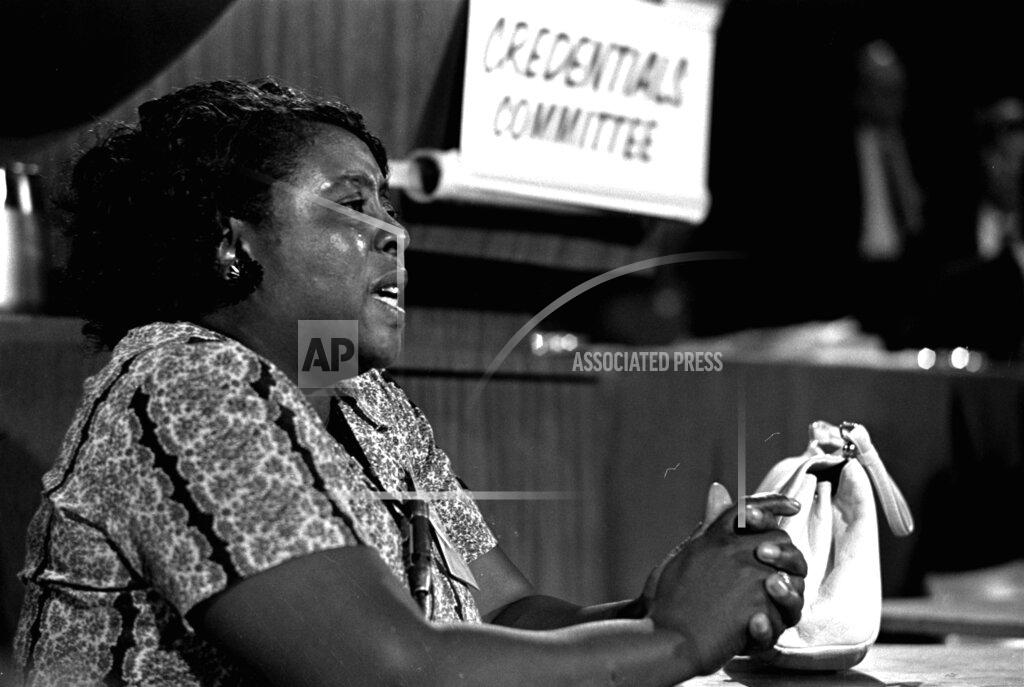
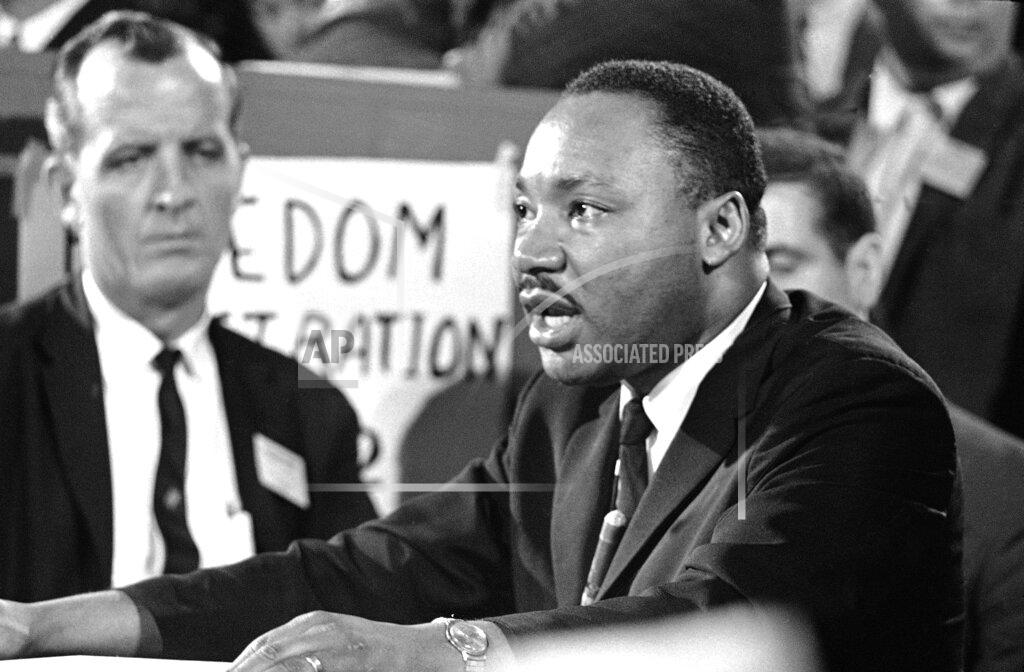
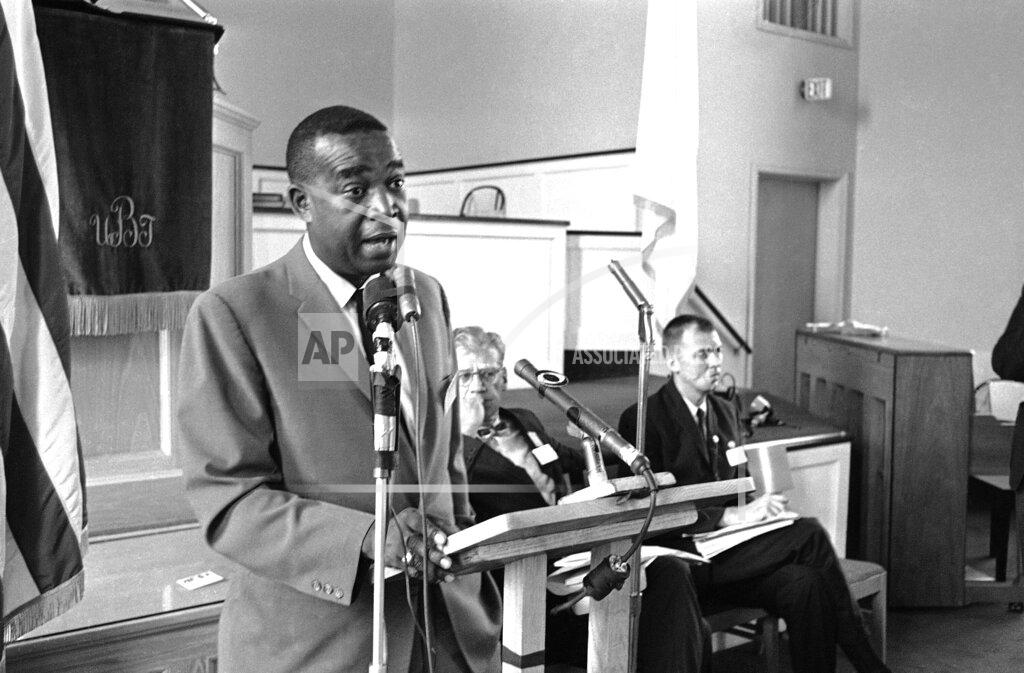
The Credentials Committee of the Democratic National Committee listened today with rapt attention to an emotion-laden confrontation between the regular delegation of the State of Mississippi and the challenging biracial delegation of the Freedom Democratic party. The committee postponed decisions on the Mississippi contest and a challenge to the Alabama delegation until tomorrow afternoon. A reason for the postponement was that David L. Lawrence, former Pennsylvania Governor, who is chairman of the committee, was trying to work out a formula to avoid a bruising floor battle in front of the television cameras. The chances for such a compromise were believed to be fairly good tonight. The Freedom party contests the right of the regular delegation to represent Mississippi Democrats on the ground that Blacks were systematically denied the right to take part in the process of selecting delegates from precinct meetings to the state convention. It was an emotional session. Witnesses for the Freedom party, led by its chairman, Aaron Henry of Clarksdale, told in quiet voices of the brutality and terror they said they had experienced while trying to register and vote.
Fannie Lou Hamer, civil rights activist and Vice Chair of the Mississippi Freedom Democratic Party, addressed the Credentials Committee of the Democratic National Convention, challenging the all-white Mississippi delegation. Hamer speaks at the U.S. Democratic National Convention about her terrifying experiences with voter registration as a Black woman in Mississippi.
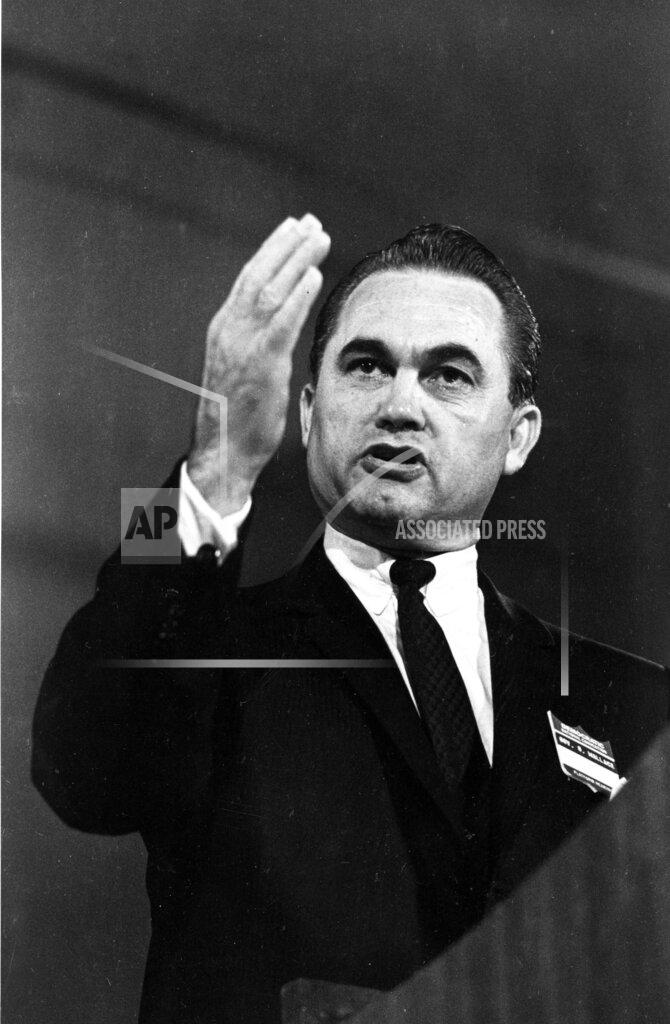
Four Southern Governors boycotted a meeting of Democratic Governors called here today by President Johnson. The four were George C. Wallace of Alabama, Orval E. Faubus of Arkansas, Paul B. Johnson Jr. of Mississippi and John J. McKeithen of Louisiana. Thirty responded to the President’s invitation for an afternoon conference and dinner at the White House 48 hours before the Democratic National Convention in Atlantic City. The agenda for the meeting this afternoon, according to the White House press secretary, George E. Reedy, consisted only of “national matters of mutual interest to the President and the Governors.” Members of the Cabinet spoke briefly, and the Governors were given kits of information on the status of various Government programs.
Party politics, however, and convention politics in particular, did play an unofficial part in the get-together. The Governors got an encouraging impression of the President’s optimism over the coming campaign, but many were disappointed that he falled to tip his hand on his choice of a running mate. One of the participants in the meeting told reporters afterward that he expected the President to make an announcement on this “early in the week, possibly Monday.”
The Democrats pointed with pride today to what they called “four years of unrelenting effort and unprecedented achievement-not by a political party but by a people.” That was the theme of the first section of the 1964 platform, which was released in draft form. Entitled “An Accounting of Stewardship,” the preamble was a lengthy recital of national accomplishments during the Kennedy and Johnson Administrations. National defense drew the heaviest emphasis; the platform pictured a sharp rise in nuclear capability and in flexible conventional forces. Also emphasized were the swift economic growth of the last four years and the steps taken on civil rights.
The Platform Committee labeled this section a draft because committee members have until tomorrow night to propose changes. Some said they would suggest literary improvements, but there was no sign of any fight on substance. Tomorrow the committee will publish a second part of the platform, the foreign policy planks. On Monday it will complete its work with release of the domestic pledges.
There is little prospect of any real struggle over the planks either. President Johnson’s harmony theme is just about the only motif being heard in the platform proceedings. Legislative apportionment has been the subject of some informal disagreement among committee members. But the general expectation is that President Johnson’s indicated wishes will be followed and that the whole question will be avoided. Civil rights is another possible area of controversy. Today, Governor Carl E. Sanders of Georgia warned that he might file a minority report if the committee rejected his proposal for a plank putting the emphasis on local implementation of the new Civil Rights Act.
Twenty-five percent of the male Black teenagers who are in the labor force are out of work, according to normally unpublished Government statistics obtained today.
In addition, the jobless rate among Black teenage boys, which was only slightly higher than that among their white counterparts 10 years ago, is now nearly twice as high, The jobless rate for both groups has grown, as was expected because of the teen-age population explosion, but the Black rate has grown far faster. The huge percentage of unemployment among Black boys is not new. The jobless rate for this group, according to the government figures, has ranged between 21 percent and 25 percent since 1958. The big growth in this group of jobless was in the years 1953 to 1958, and it has remained high ever since
The rate was 25.4 percent for all of last year and it was 26 percent last month, though the latter figure is not adjusted for seasonal variations. These facts, taken together, are regarded by many officials here as a major explanation for what has been taking place in Harlem, Rochester, Elizabeth, New Jersey, and elsewhere, where rioting has been led by youths. The jobless figures refer to male Blacks between the ages of 14 to 19, inclusive, who count themselves as in the labor force and looking for work. It is highly probable that a significant additional percentage of Black youths are out of school but are not even looking for work and thus are not counted in the labor force.
In 1953, a boom year in the economy until the last three months, the percentage of unemployment among the Black teen-agers was only 7.1 and that among white boys 6.3. There was, in effect, no problem. By 1957, a comparable year for economic conditions, the jobless rate among white boys had risen to 10.6 percent. But among Blacks it had soared to 17.7 percent. In 1958, a recession year, the jobless rate for white teen-age boys rose to 14 percent and for Blacks it rose to 24.3 percent. For the Blacks it has not dropped below 20.7 percent since. In 1959 the Black rate was 22.8 percent, in 1960 it was 22 percent, in 1961 it was 24.7 percent, in, 1962 it was 20.7 percent and last year it was 25.4 percent.
All over the Northern United States, local branches of the National Association for the Advancement of Colored People have been working for several weeks to convince one million adult Blacks that it is worthwhile to register and vote.
A master plan for remolding the city of Chicago economically and socially in the next 20 years was unveiled by Mayor Richard J. Daley this week before a gathering of 300 civic leaders.
Two cars carrying two vacationing families collided head-on in the fog in Sanford, North Carolina today, killing eight persons and leaving an eight-year-old boy as the only survivor of one family.
The Soviet Union today launched three unmanned earth satellites, the second time it has done this in four days.
“Match of the Day,” one of the longest-running shows on British television, premiered on BBC 2 with Kenneth Wolstenholme as its presenter. Each Saturday during the English soccer football season, the show would feature pre-recorded highlights of one of the day’s games. Wolstenholme introduced the first broadcast, featuring Liverpool hosting Arsenal at Anfield stadium, with the words, “Welcome to Match of the Day, the first of a weekly series on BBC2. This afternoon we are in Beatleville.” Liverpool won the match, 3-2.
The Beatles appeared in Canada for the first time, performing in Vancouver at Empire Stadium.
The New York Yankees lose the first game of a doubleheader to the Boston Red Sox, 5–3, extending their losing streak to 6 games. Boston scores 3 runs in the 8th inning to win it. Al Downing, carrying a 3–2 lead into the eighth inning, was beaten by a two‐run, two‐out homer by Lee Thomas. The winner was Dick Radatz, Boston’s relief “monster” who retired the Yankees in order in the last two innings. In the nightcap, New York wins, 8–0, as Mickey Mantle, Roger Maris and John Blanchard hit home runs off Jack Lamabe, Boston’s starter, and the attack totaled 13 hits, and Maris drives in 3 runs. Mel Stottlemyre wins his 3rd game in a row since being recalled from Richmond. The Yanks end the day 5½ games behind the Orioles, with the White Sox in 2nd place, 1½ games back.
The Baltimore Orioles beat the Chicago White Sox again, 4–2. Brooks Robinson’s three‐run home run into the right‐field seats in the ninth inning gave the Baltimore Orioles the victory today and a game‐and‐a‐half lead over the Chicago White Sox in the American League pennant race. Robinson’s homer, his 22nd, was hit off the Chicago starter, Joe Horlen, who had yielded just three hits in eight innings. Jerry Adair doubled in opening the ninth for the Orioles. The White Sox right fielder, Mike Hershberger, tried for a shoestring catch of the drive, but the ball bounded past him. Horlen then struck out Luis Aparicio, but he walked Norm Siebern. Then came Robinson. The count went to 3 and 1 before Robinson belted a curve ball into the upper deck in right. Horlen, who had won nine games, took his eighth loss.
Cleveland sweeps a pair from the visiting California Angels, winning 1–0 and 5–1. Sonny Siebert allows 5 hits and tosses the shutout in game 1, besting Dean Chance. Dick Donovan allows 4 hits in game 2 as the Indians win, 5–1. A three‐run uprising in the sixth inning of the second game was marked by a two‐run homer by Leon Wagner, his 28th. The other run in the inning came on a double steal, with catcher John Romano stealing home and Vic Davalillo going to second.
Five runs in the sixth inning by the Kansas City Athletics sent the Washington Senators to their fourth straight defeat today, 6–2. Dick Green led off the sixth with a single and Wayne Causey doubled. Rocky Colavito then hit a two‐run single. Jim Gentile was purposely passed and Doc Edwards clouted a three‐run homer. In the fourth, Causey hit a home run and Willie Kirkland hit one for the Senators in the same inning after Jim King had walked.
Larry Jackson beat the New York Mets for the ninth straight time as the Chicago Cubs won, 3–2, at Shea Stadium to stop the Mets’ winning streak at five. Jackson, in posting his third success of the season against the Mets, was virtually invincible for eight innings. He faced only 28 batters during this span. The only extra‐base hit up to the ninth was Joe Christopher’s three‐bagger that Doug Clemens lost in the sun. Lindy McDaniel came in to get the save after the Mets scored in the ninth on Ron Hunt’s triple and Christopher’s single.
The Pittsburgh Pirates scored five unearned runs in the seventh inning and Roberto Clemente cracked three doubles today as the Pirates downed the National League‐leading Philadelphia Phillies, 9–4. The Pirates snapped a losing streak at six games and broke the Phils’ winning string at four. Frank Bork, the winning pitcher, singled home two of the runs in the big seventh as 10 Pirates went to bat. Willie Stargell’s pinch double drove home the first run and Dick Schofield and Manny Mota singled in the other two. The runs followed a throwing error by Richie Allen on Gene Freese’s grounder.
The San Francisco Giants snapped a six‐game losing streak today when Bob Bolin pitched them to a 4–2 victory over the St. Louis Cardinals. Bolin, who has allowed only two earned runs in his last 26 innings, struck out 11 batters and brought his won‐lost record to 5–5. The Cards scored a run in the first inning on singles by Lou Brock, Bill White and Ken Boyer. The Giants came back with, two runs in the second on consecutive singles by Jim Hart, Jay Alou, Jimmy Davenport and Tom Haller. San Francisco made it 4–1 in the third on singles by Harvey Kuenn and Hal Lanier, Willie Mays’s sacrifice foul fly and Orlando Cepeda’s single. The final Cardinal run came in the eighth on a single by Boyer, a walk and Tim McCarver’s single.
[Ed: The loss leaves the Cardinals ten games behind Philadelphia with just over a month left in the season. To all appearances, out of pennant contention.
Appearances can deceive…]
Jerry Grote singled home Bob Aspromonte with two out in the seventh inning tonight to give the Houston Colts a 5–4 victory over the Milwaukee Braves. The game was delayed 2 hours 10 minutes by rain. Milwaukee took a 2–0 lead off Hal Brown in the fourth on Joe Torre’s single, Gene Oliver’s double and a single by Rico Carty. After being held to two hits through four innings by Denny Lemaster, Houston exploded for four runs in the fifth on five singles and two walks.
Born:
Trey Gowdy, American politician and political commentator (Rep.-R-South Carolina, 2011–2019), in Greenville, South Carolina.
Mats Wilander, Swedish tennis player (7-time Grand Slam winner) in Växjö, Sweden. In 1988, he won the Australian Open, the French Open, and the U.S. Open.
Dean Evason, Canadian NHL centre (Washington Capitals, Hartford Whalers, San Jose Sharks, Dallas Stars, Calgary Flames), in Flin Flon, Manitoba, Canada.
Aaron Pearson, NFL linebacker (Kansas City Chiefs), in Gadsden, Alabama.
Mike Norseth, NFL quarterback (Cincinnati Bengals), in Los Angeles, California.
Diane Setterfield, British novelist, in Englefield, Berkshire, England, United Kingdom.
Died:
Benjamin J. Davis Jr., 60, African-American politician and Communist who served on the elected to the New York City Council from 1943 to 1949. Smith, who was editor of the Communist Party USA newspaper, the Daily Worker, was jailed for three years in a federal penitentiary for violating the Smith Act by being a member of a subversive organization.
Bishop Symeon Lukach, 71, Soviet cleric jailed seven years for unauthorized evangelism in the Ukrainian Greek Catholic Church, died of tuberculosis shortly after his release from a labor camp


 History Diaries