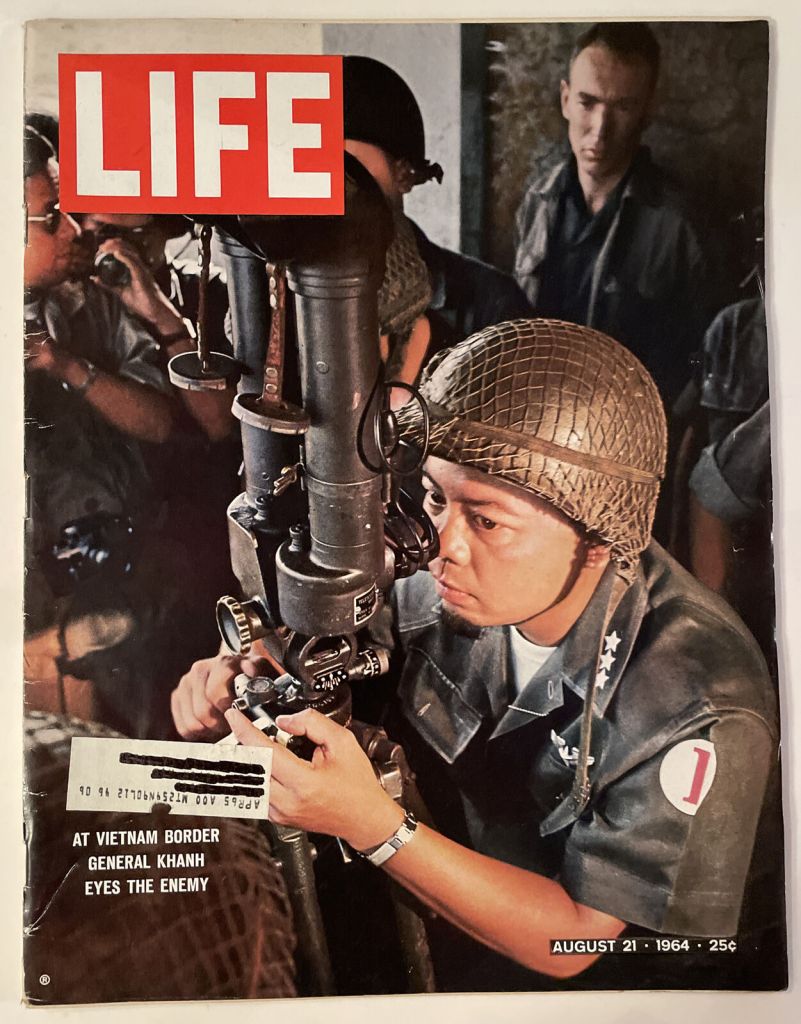
Several hundred students marched to President Nguyễn Khánh’s office today carrying banners denouncing “military dictatorship” and influences remaining in the Government from the deposed regime of the late Ngô Đình Diệm. The demonstration, noisy and undisciplined but peaceful, followed the pattern of Buddhist demonstrations yesterday asserting rights to a strong voice in the new Vietnamese regime being formed. The students leaders’ said that they represented two of of Vietnam’s amorphous political parties, the Đại Việt and Việt Nam Quốc Dân. The police tried at first to bar the students from entering the street where President Khánh’s office is situated, then moved aside so the demonstrators could approach the large stone building.
In the northern city of Huế, students staged a march after participating in predawn Buddhist ceremonies commemorating the first anniversary of attacks on pagodas by President Diệm’s armed forces. The attacks came at the height of the Buddhist crisis, which eventually led to the regime’s overthrow last November l. The Huế students stayed away from scheduled university entrance examinations, declaring that they were on strike.
As opposition to Khánh’s new South Vietnamese Government mounts, Saigon is plunged into virtual anarchy. The Buddhists charge the government with ‘anti-Buddhist’ holdovers from the Diệm era. Students mount widespread and violent demonstrations marching on Khánh’s office, storming the national radio station, stoning U.S. Army billets. Khánh meets with the student leaders and promises that the new government will have a majority of civilian ministers, but the students are not satisfied, and the anti-government violence begins to spread to other cities. The Revolutionary Council issues a proclamation that withdraws the constitution devised on 16 August and promises to elect a new head of state who will convene a national assembly to reform the government ‘consistent with the aspirations of the people.’
A battalion‐size South Vietnamese force that walked into a Việt Cộng ambush late yesterday had theoretically cleared the paddy‐land area of guerrillas “a few hours before,” military sources reported today. According to the latest reports, 60 of the government troops were killed, 65 wounded and 135 listed as missing in the engagement. Four Americans accompanying the Vietnamese force as advisers were killed. For the American and Vietnamese commands the ambush was one of the most disheartening examples in recent months of the Việt Cộng’s skill at surprise attacks. A military spokesman said Việt Cộng losses in the engagement were also heavy, but no official estimates of guerrilla casualties were given.
The ambush took place about 45 miles southwest of Saigon in the Mekong Delta province of Kiến Hòa, a center of mounting Việt Cộng strength. The spokesman estimated the size of the Việt Cộng force at two battalions, perhaps 800 men. The size of the government battalion could not be precisely determined since these vary from 250 to 350 men. The government unit included crack rangers alongside the regular infantry. The battalion had been helping two others pursue Việt Cộng who had attacked a nearby outpost. The Việt Cộng followed their traditional strategy cf making a small attack and then lying in wait with larger forces for government relief units.
The wife of a United States Navy pilot captured by the pro‐Communist Pathet Lao after he was shot down over Laos disclosed today that she had received eight letters telling of his solitary life in a closely guarded mud hut. She said she was satisfied that he was receiving “decent treatment.” “Just think of it as an extended tour,” Lieutenant Charles F. Klusmann, 30 years old, wrote to his wife almost two months ago. “I will be back.” Mrs. Klusmann, also 30, received the letters in a single packet Wednesday after a delay of more than a month.
U.S. Navy Lieutenant Charles F. Klusmann, who had been held captive by the communist Pathet Lao since June 6 after his RF-8A Crusader jet was shot down over Laos, managed to escape his captors this day after he and five Laotian and Thai prisoners of war were able to tunnel under the wall of the compound and sneak past sentries. He and one of the five POWs were able to reach safety at Bouam Long. Lt. Klusmann would be one of only two U.S. Navy aviators to escape prison during the Vietnam War.
Prince Souvanna Phouma, Premier of Laos, arrived today for the scheduled conference of the leaders of the three Laotian political factions. But diplomatic sources expressed uncertainty about whether the talks would take place. Their doubt is traced to the fact that only the Premier, head of the neutralist faction in Laos, is here and ready for the parley. It is scheduled to begin Monday. There is considerable uncertainty over the two other participants. Neither Laotian nor French officials were sure of the whereabouts and expected date of arrival of the leftist leader, Prince Souphanouvong, the Premier’s half‐brother. An official at the Laotian Embassy said no could give no assurance that Prince Souphanouvong was on his way here. The nominal leader of the rightist faction, General Phoumi Nosavan, is remaining in Laos as acting head of the Government in Prince Souvanna Phouma’s absence. The general is Deputy Premier.
Prince Norodom Sihanouk, Cambodia’s head of state, left by air today for Phnom Penh after a week’s state visit to Jakarta. He promised that Cambodia would support Indonesia whenever support was required.
A heavily armed United Nations force carried out maneuvers here today in the second major show of force in two days against Greek and Turkish Cypriot gun posts. The activation of a new, mobile battle force, comprising Canadian, Danish and Finnish soldiers, appeared to be a determined bid by the peaceforce commander, Gen, Kodendera S. Thimayya of India, to bring the tense situation under control. A week ago General Thimayya complained publicly that the United Nations had been unable to gain control in the Cypriot capital “despite my best efforts.” The repeated reinforcement of Greek and Turkish Cypriot gun emplacements along the “green line,” or neutral zone, was blamed. A new drive began yesterday when United Nations troops ripped down two Turkish Cypriot gun positions on the “green line” despite protests by the Turkish Cypriots.
Today the mobile force — including scout cars, armored cars and jeeps mounted with recoilless rifles — raced about the northern suburbs of the capital. Periodically its vehicles stopped and United Nations soldiers piled out, taking up battle positions in clear view of Turkish Cypriot gun posts. It was a clear demonstration that the United Nations was making its toughest force ready for instant action if new fighting broke out in the capital. For nearly two weeks the Greek and Turkish Cypriots have respected a cease‐fire imposed by the United Nations in the communal warring that had raged since last December.
The Greek Cypriots, despite an earlier promise, refused this morning to let emergency food supplies reach the isolated Turkish Cypriot village of Kokkina on the northwestern coast of the island. Kokkina is the last Turkish Cypriot stronghold on the coast. When it was attacked by Greek Cypriot forces two weeks ago, Turkey’s air force retaliated with a strafing‐and‐bombing assault that brought the Cyprus crisis nearer than ever to war between Turkey and Greece.
United Nations trucks were supposed to drive 10 tons of food to Kokkina this afternoon under Greek Cypriot escort. A spokesman for the United Nations said that the food was badly needed and that if it was not received, the Turkish Cyp‐ riotes were likely to be provoked into action. Greek Cypriot sources said later that the delivery would be permitted tomorrow. Since Tuesday, when the United Nations announced that the Greek Cypriots had agreed to ease their economic blockade of Turkish Cypriot areas, not a single food truck has entered the Turkish Cypriot quarters in Nicosia or most other areas.
Congolese Government forces were reported today to be in “full control” of Bukavu, the key eastern Congo city where fighting has been going on for the last three days. According to radio reports received in Leopoldville, the Communist-backed rebels were in full retreat on the road west of the city. The reports said at least 300 rebels were killed in an attack this morning that was spearheaded by 150 former gendarmes of Katanga Province flown into the city aboard a United States Air Force C‐130 transport.
Seven Europeans are believed to have died during the fighting. Among them was a Belgian television cameraman, Franz Ponchaux. He was first believed to have been shot, but later reports said he had suffered a heart attack. Four Belgian Army officers, who were serving with Congolese forces in the city, were also reported missing tonight. In addition, hopes were dimming for the three Americans who were reported missing yesterday. They are Colonel William A. Dodds and Lieutenant Colonel Donald V. Rattan, United States Army counter‐insurgency experts, and Louis R. Macfarlane, a vice consul.
Even though the gendarmes proved the decisive factor today, the regular army garrison in Bukavu under the command of Colonel Leonard Mulamba battled fiercely to save the city from being overrun Wednesday and Thursday. The successful defense of Bukavu was the first substantial victory the army had scored in months. After a series of stinging defeats by the rebels, it could serve as an important psychological boost for Premier Moise Tshombe’s Government. However, observers here were cautious. They noted that the tide had shifted with startling rapidity in the Bukavu area during the last few months. They warned that the rebels could launch a new attack any time.
U.S. Senator Mike Mansfield, the majority leader, warned today against unilateral American involvement in the Congo. Last week, Senator John Stennis, Democrat of Mississippi, charged that the sending of planes and personnel to the Congo might involve the United States in “another undeclared war such as that in Vietnam.” United States Government officials denied again tonight that the shipment to the Congo of American equipment to support the regime of Premier Moïse Tshombe against the rebels constituted intervention. “Any impression that we are intervening is a gross exaggeration,” one official said.
The Bolivian Government, after careful preparation to prevent possible violence, broke diplomatic and commercial relations with Cuba tonight. The order to comply with a resolution adopted in Washington on July 26 by the Organization of American States, which called for such action by all its members, was issued by President Victor Paz Estenssoro in a private talk with Foreign Minister Fernando Iturralde Chinel. Mr. Iturralde immediately summoned the Cuban Charge d’Affaires, Roberto Lasalle, and notified him of the action. The Bolivian Government’s decision had been expected since Chile severed relations with the Havana regime last week. President Paz had previously indicated that he wanted at least one of the other countries still maintaining relations with Cuba — Mexico, Chile and Uruguay — to act first.
The revolutionary court in Algeria tonight sentenced to death four of 12 men accused of terrorist attacks against government and army buildings in Algiers in May; of five men sentenced to prison, one was given a life sentence. Three men were acquitted.
Malta will become independent September 21 and will be a member of the British Commonwealth, the Colonial Office announced today. Britain and Malta agreed last month on a Constitution for the Mediterranean island. The Constitution included a defense agreement that would enable British forces to remain in Malta for 10 years. An announcement from Buckingham Palace said Queen Elizabeth would be represented by her husband, the Duke of Edinburgh, at the independence ceremonies.
Congress adjourned today for the Democratic National Convention, which opens at Atlantic City on Monday. It left behind a load of vital business for its return on August 31. The Senators who had not already left town had planned a quiet, clean‐up session today. But a fight broke out in midafternoon when Senator Strom Thurmond tried to force a vote on the legislature apportionment bill that the House passed, 218 to 175, on Wednesday. The bill, sponsored by Representative William M. Tuck, Democrat of Virginia, would deprive Federal courts of jurisdiction over cases involving the make‐up of a state legislature. During the hot Senate debate, Russell B. Long, Democrat of Louisiana, called “some” members of the Supreme Court “screwballs.”
Shortly after this interlude the Senate agreed to set aside temporarily the pending $3.3 billion foreign‐aid authorization bill. This measure is tied up by an apportionment rider that has prompted an incipient filibuster by the liberal bloc.
The Senate today approved and sent to the White House legislation to establish a National Council on the Arts. It is the first time that Congress has adopted legislation to help the arts, although bills were introduced as far back as 1877. Under terms of the bill, the council would study everything from music and drama to fashion design and television. The council, consisting of 25 persons chosen from the arts, would recommend ways to maintain and increase the cultural resources of the United States.
The Senate passed a bill today that proposes wider use and more flexible management of 467 million acres of public lands now administered by the Interior Department. The Senate action would direct the Secretary of Interior to classify the vast public lands holdings for disposal or retention. The House, which had passed a similar bill, now will consider Senate changes in the measure. Senator Frank E. Moss, Democrat of Utah, said the bill should result in increased use of the Western lands for commercial, industrial, agriculture and recreational purposes.
The Supreme Court’s decision that all citizens must be represented equally in state legislatures emerged today as the major issue before the Democratic Platform Committee. Rank‐and‐file members of the committee applauded when they were urged to write in a plank endorsing the decision. But behind the scenes, leaders indicated that they would try to avoid the subject of legislative apportionment altogether. The harmonious atmosphere of the committee’s hearings was shattered later by Governor George C. Wallace of Alabama.
Governor Wallace went before the Democratic Platform Committee today with a scorching attack on President Johnson and the national Democratic Party. “The prevailing leadership of our party has consciously and deliberately advocated, sponsored and sold an alien philosophy of government,” Mr. Wallace said. He said the people were “disgusted and repelled by the callousness, the duplicity, the underhanded mealy‐mouthed platitudes of politicians who would sell the birthright of our nation to be re‐elected.” His listeners took this as a reference to the President. The governor warned of an “uprising” by the south against the Democrats. He said he would lead a third party movement after the election if his views did not find expression in the established parties.
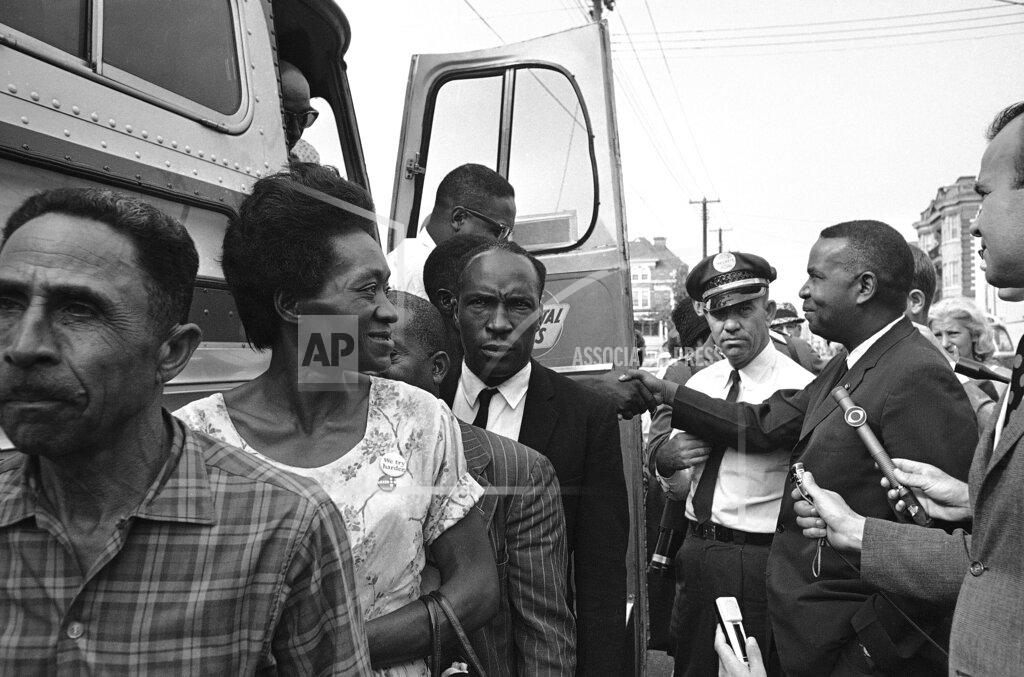
Governor Wallace’s appearance was one of two developments here today that disrupted what had been an atmosphere of calm, almost boring harmony in the pre‐convention period. The other was a sharpening conflict over southern seats in the convention. The bi‐racial delegation of the Mississippi Freedom Democratic Party arrived in town and began its fight to displace the all‐white regulars. It promised to take the issue to the floor if necessary—an outcome the party leaders devoutly wish to avoid. By all indications the Freedom Party was getting a cold shoulder from convention officials. They selected a small room in the convention hall for the credentials committee meeting tomorrow instead of the ballroom, where the press would have easier access. Aaron Henry, a Black pharmacist from Clarksdale, Mississippi, who heads the Freedom party delegation, warned that “Blacks all over this country — and white, too, who are concerned with freedom — will be watching Atlantic City.”
In his first public political speech since the Republican National Convention last month, Governor Rockefeller called three times today for the election of the Republican ticket “from top to bottom.” His speech appeared to set at rest doubts that he might bypass appeals for Senator Barry Goldwater, the Presidential candidate, in his campaigning within the state. These doubts were raised by the bitterness of the Governor’s attacks on Mr. Goldwater as ho fought for the Presidential nomination for himself.
Senator Barry Goldwater told the Senate today that he wanted to strengthen the Social Security system and would vote for a pending bill to increase benefits. Suggestions from Mr. Goldwater that the program be made voluntary have been criticized in some political quarters. He last made the suggestion in January. “I favor a sound Social Security system and I want to see it strengthened,” said Mr. Goldwater today. “I have voted for genuine improvements in the system since I have been in the Senate, and I plan to do so now.” Today’s statement was another in a long series of attempts by the Republican Presidential nominee to offset what he has called misrepresentations of his position on Social Security.
Goldwater also continued his running battle with the Pentagon over weapons policy by commenting — on reports of malfunctions in Minuteman intercontinental missiles — that the problem of missile reliability was “rather serious” and that he was “looking into it” further. He also issued a statement deploring anti‐Semitism in the Soviet Union and accusing the Administration of doing “business with Khrushchev, the butcher of the Ukraine, without compunction.”
Republican Senators asked in a campaign document today whether President Johnson was afraid to debate Senator Goldwater. The Senate Republican Memo commented on the 44‐41 Senate vote Tuesday that killed a bill to permit television and radio networks and stations to provide free time for debates or appearances of the Presidential and Vice‐Presidential candidates of the two major parties this fall.
Sources close to the White House said tonight that President Johnson had received several private polls showing that he leads Senator Barry Goldwater by a substantial margin in seven different states, including New York. The New York survey, just completed, shows the President with 60 percent of the vote, Mr. Goldwater with 22 percent and 18 percent undecided. The origin of the New York poll was not revealed, but it is known that still another poll in New York, conducted for the White House at a cost of $10,000 by Oliver Quayle, shows Mr. Johnson leading the Republican candidate by 69 to 31 percent.
Mr. Quayles is a former associate of Lou Harris, the poll taker. His poll is also understood to show that Attorney General Robert P. Kennedy is the only Democrat capable, at the present time, of defeating Senator Kenneth B. Keating of New York in November. One source described Mr. Kennedy’s margin in the poll as “substantially less than the President’s margin over Mr. Goldwater.” The sources said here that, in addition, polls had been taken in Hawaii, Maine, Indiana, Kansas, Maryland and Wisconsin.
Brooks Robinson and Sam Bowens, who hit successive homers in the fourth inning, lashed run‐scoring singles in the ninth tonight and carried the Baltimore Orioles to a 4–2 triumph over the Chicago White Sox. The victory put the Orioles back into first place in the American League. The White Sox, a half‐game ahead of Baltimore before the game, dropped a half‐game behind as their five‐game winning streak was snapped. Luis Aparicio started the winning rally with a one‐out single off Hoyt Wilhelm. Earl Robinson walked before Brooks Robinson belted a single to left scoring Aparicio. Bowens followed with a single to center that sent Earl Robinson home. The White Sox had tied the game, 2–2, in the eighth on Don Buford’s run‐scoring triple.
Behind Bob Heffner’s (6–4) second career shutout, the Red Sox down the visiting Yankees, 7–0. Batterymate Bob Tillman clouts a 7th-inning grand slam off reliever Stan Williams to put the game out of reach. Dick Stuart and Eddie Bressoud also homer for the Red Sox. Mickey Mantle and his balky knee return to action but he offers little help, as he goes 0-for-4 today. Struggling Ralph Terry (5–11) takes the loss.
Rocky Colavito hit his 30th home run of the year tonight to pace the Kansas City Athletics to a 3–2 victory over the Washington Senators. Moe Drabowsky gets the win in relief; Claude Osteen takes the loss for the Senators. Don Lock’s 22nd homer of the season gave the Senators a second‐inning run, but the A’s took a 3–1 lead in the fourth on a triple by Wayne Causey, a single by Ed Charles and Colavito’s two‐run clout.
The New York Mets continued their amazing antics at Shea Stadium last night. They blasted the offerings of four Chicago Cubs pitchers for 15 hits in gaining their fifth straight success with a 7–0 victory. Only once during the three-year major league sojourn of the Mets have they flown so high. Last May, when hopes were soaring that the Mets might see some daylight after a cellar monopoly, they won five straight. They never did emerge from their lowly berth. And the chances are that they will finish last again this season. But based on last night’s pertormance and on the four that preceded it, many in the crowd of 21,867 must have left the park envisioning a much brighter future for their favorites.
The National Leagueleading Philadelphia Phillies defeated the Pittsburgh Pirates, 2–0, tonight behind Chris Short’s seven‐hit pitching. With one out in the Phils’ second, Alex Johnson singled off the Pirates’ southpaw, Bob Veale, and took second on a balk. Gus Triandos line out before Tony Taylor came through with a single to left. Ruben Amaro’s infield hit, Short’s sacrifice bunt, and John Callison’s two‐out single produced the Phillies’ other run in the eighth. Short, scoring his 13th victory against six losses, stranded nine base runners.
The Houston Colts scored three runs in the seventh inning tonight for a 3–2 victory over the Milwaukee Braves. Tony Cloninger of the Braves pitched 5⅓ perfect innings before the game turned. First baseman Gene Oliver had three hits for Milwaukee including a solo homer.
In Los Angeles, Reds reliever Billy McCool pitches 6⅔ innings of stellar relief to beats the Dodgers, 3–2. McCool allows one hits and strikes out 9.
Dow Jones Industrial Average: 838.62 (-0.09).
Born:
Gary Elkerton, Australian surfer nicknamed “Kong”; three time world masters champion (2000, 2001, and 2003); in Ballina, New South Wales, Australia.
Shawn Hillegas, MLB pitcher (Los Angeles Dodgers, Chicago White Sox, Cleveland Indians, New York Yankees, Oakland A’s), in Dos Palos, California.
Trinity Loren [as Joyce Evelyn McPherson], American adult film actress and model, in La Jolla, California (d. 1998, due to an accidental drug overdose).
Died:
Palmiro Togliatti, 71, Italian politician and General Secretary of the Italian Communist party (PCI), died while vacationing in the Soviet Union at the Black Sea resort of Yalta. Togliatti, who had led the largest Communist Party in Western Europe since 1926, and been in poor health since being shot four times in a 1948 assassination attempt. Togliatti was succeeded as PCI secretary by Luigi Longo.
J. L. Wilkinson, American Baseball HOF executive (founder All Nations Baseball club 1912 & NgL Kansas City Monarchs 1920).

 History Diaries