12 days to war in Europe.
Nazi Germany and the Soviet Union shocked the world when a trade pact between the two countries was announced. The Reich and Soviet Union enter a seven year treaty. The pact is a blow to France and Britain, and Germany will get needed materials. A further widening of the gulf developing over the Anglo-French-Soviet alliance negotiations was suggested by two official Soviet announcements late tonight. The first declared that a trade agreement had been signed yesterday in Berlin between representatives of Russia and Germany. The agreement provides for a German credit to the Soviet Union of 200,000,000 marks over seven years at 5 per cent to permit the purchase of German goods ordered in the next two years. It further provides for the purchase of Soviet goods by Germany ordered in the next two years to the value of 180,000,000 marks.
The second message broadcast tonight begins by quoting a Paris message from a Danzig correspondent saying that “Prime Minister Chamberlain waited impatiently for the adjournment of Parliament in order to effect a second Munich” through the dispatch of an economic mission to Danzig headed by a Professor Riley. With great emphasis the Soviet broadcaster read a statement attributed to Professor Riley that his mission would exercise great influence on the future of Britain and Danzig.
The British Foreign Office, the Soviet broadcaster continued, has denied the semi-official nature of the mission, but he said it had not denied its existence. Polish newspapers were said to have expressed indignation at what they called a second Runciman mission, and Paris democratic circles were declared to be shocked at Mr. Chamberlain’s “hypocrisy” in having concealed the facts about the mission from Parliament, although they were known to him at the time.
Conclusion of a new Soviet-German trade agreement was almost foreshadowed in Premier Vyacheslav M. Molotov’s big speech at the most recent meeting of the Supreme Soviet, when he said the Soviet was ready to conclude normal trade agreements with any countries, irrespective of their political line. However, Moscow’s consent to sign the agreement now and the manner of its announcement tonight, together with the citation of hostile Polish and French newspaper comments on Mr. Chamberlain’s integrity, must be considered a further indication of the Soviet’s annoyance with Mr. Chamberlain’s tactics.
Soviet Foreign Minister Vyacheslav Molotov presented to Adolf Hitler’s Moscow ambassador a draft of a nonaggression pact between the two powers. The draft contained essentially everything the German serial aggressor could have wished for because it opened the gates for crushing neighboring Poland and solving the pesky problem of the “Polish Corridor,” the strip of land that separated East Prussia from the rest of Hitler’s Germany. For Soviet dictator Joseph Stalin, the proposed mutual diplomatic understanding was viewed as the stepping stone for restoring lost territories in the west (parts of Belarus and the Ukraine) that had been ceded to Poland in the Treaty of Riga (March 18, 1921), which ended the Polish-Soviet War.
Stalin’s “generosity” came at a price: the nonaggression pact could only come into force if the pact’s secret protocol on future spheres of influence between the two heretofore antagonistic nations was signed at the same time. The secret protocol divided Poland into spheres of influence: German (West Poland) and Soviet (the “lost territories” in Eastern Poland). Poland’s neighbor to the north, Lithuania, fell into the German sphere of influence because it was adjacent to East Prussia. Finland, the Baltic states of Latvia and Estonia, and Bessarabia (which was part of Romania), fell into the Soviet sphere. The initial vivisection of Central Europe had the potential for “territorial and political rearrangements” as the two foxes rearranged the hen house after the outbreak of war in Europe.
From the Berghof, Hitler sent a message to Joseph Stalin proposing that von Ribbentrop go to Moscow no later than August 23, “in view of the international situation.” Hitler, suspecting Molotov might cause delays in ratification of the nonaggression pact, sends a personal message to Stalin asking him to receive Ribbentrop in Moscow as soon as possible, telling Stalin “The tension between Germany and Poland has become intolerable… A crisis may arise any day. Germany is at any rate determined from now on to look after the interests of the Reich with all the means at her disposal.”
Frederick T. Birchall writes for the New York Times:
This week begins with war clouds hanging blacker and more threatening over Europe than they have since the days immediately preceding the opening of hostilities in 1914. The pending crisis is more alarming than the one last September, for then one side was openly anxious for peace — peace at any price — because it well knew it was unprepared for war.
It is different today, because the would-be peacemakers of last year are readier now than they were then. Moreover, that peace with justice that they then thought they had contrived has proved to be a swindle. There cannot be another Munich while the consequences of the last one are spread fresh before men’s eyes.
Sadly and with greatest reluctance the lesson has been taken to heart: There is no peace in surrender. The temporary respite thus gained serves merely as a period of preparation for new encroachments and farther reaching demands. Even the “appeasers” of last year have at last realized that appeasement has become futile. They have dwindled to a discouraged handful.
U-boats begin to take up positions in the North Atlantic shipping lanes.
Four Reich submarines are rumored to be en route to attacking Martinique. The daring German war plan is said to provide the establishment of a Caribbean base.
German warship Admiral Graf Spee and her tanker Altmark depart Germany on a raiding mission against British shipping once hostilities begin.
The German auxiliary sailing vessel Hans Voss collided with Bodegraven (Netherlands) off Hamburg and sank.
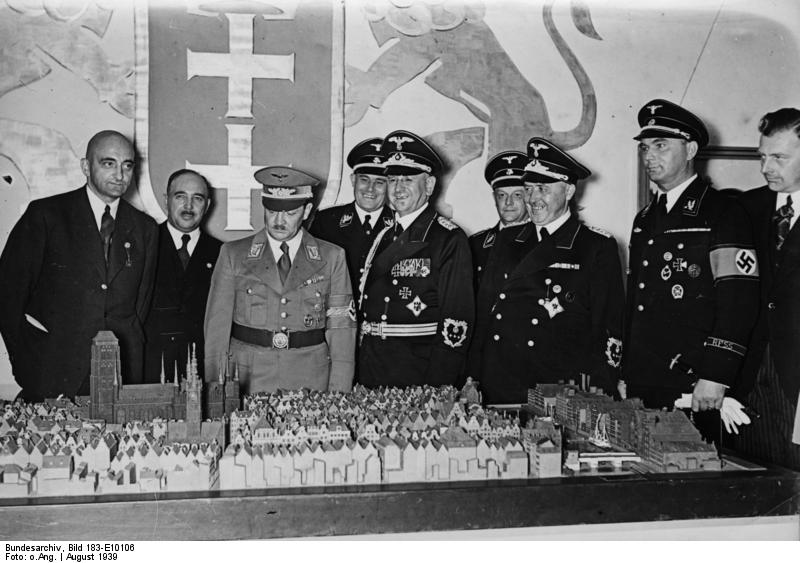
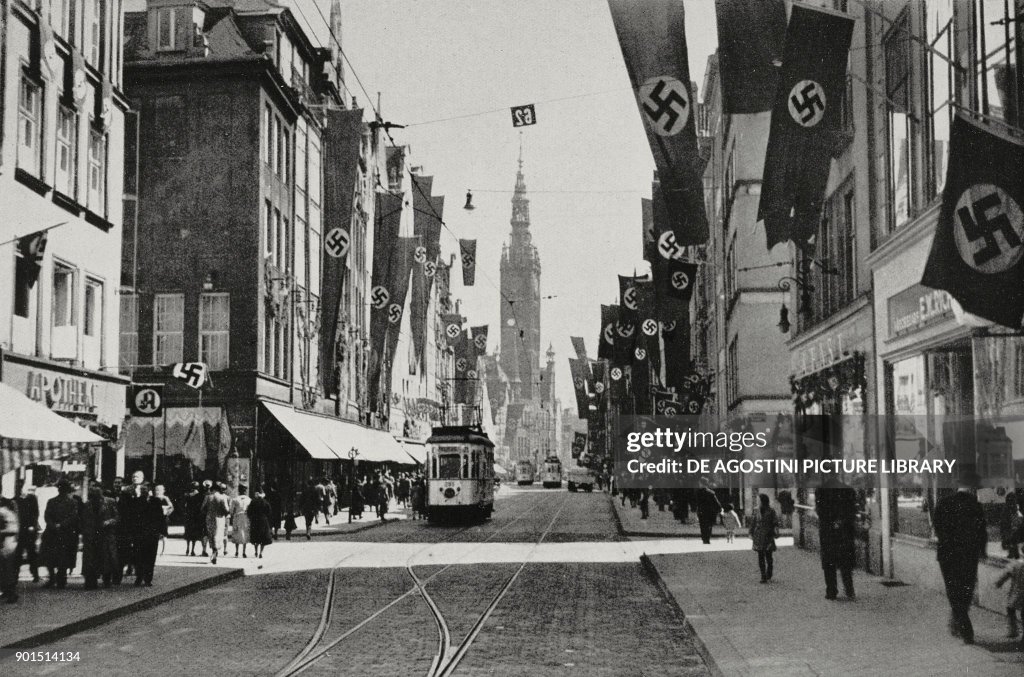
Albert Forster, Nazi district leader in Danzig, today told Danzigers: “There is a storm coming; but we are sure that when it has passed the Führer will march triumphantly into your city.” To Poland he issued a warning that “One day the measure of our patience will be exhausted, and then woe to those who have so sorely tried us!” Herr Forster’s speech was made in the Danzig suburb of Lagfuhr on the occasion of the district’s Nazi party congress. It was the Danzigers’ attitude rather than their leader’s solemn words of warning that was interesting to foreign obServers.
Although Herr Forster left no doubt that the “supreme sacrifice might be necessary,” his listeners. seemed to remain entirely unaware of the implication of his words. He warned Danzig mothers that “You women must know that your future is at stake, your homes and your children, and no sacrifice is too great to preserve them.” Yet the many women, young and old, who were present continued to play with their babies or to laugh at their leader’s gibes at Poland, apparently unconcerned about the possible fate of their husbands, sons and sweethearts standing at stiff attention on the sloping meadow before the speakers’ stand.
The Polish eastern border is cleared of troops. The Soviet frontier is the only one not manned as Warsaw sends reinforcements west. Large-scale troop movements in Southern and Southwestern Foland occurred over the weekend. The eastern Polish-Soviet frontier is now almost entirely cleared of Polish troops hurriedly shifted to the Moravian and Slovak frontiers, as well as to the new Hungarian border along the Carpathians to face German reinforcements in the Protectorate and Slovakia. Polish military authorities are not taking any chances; following the news of increased German pressure. on Hungary to join the Axis, military preparations are being extended even to that friendly frontier.
The Nazis who complain of the British “encirclement” policy are now trying to encircle Poland on all her frontiers except, of course, the eastern one, it is argued here. German troop movements in the former Czecho-Slovakia and attempts to use Hungary as a German military base, coupled with the new demand for the return to the Reich of all the Polish provinces that once formed a part of Imperial Prussia, are obviously intended to intimidate Poland and her allies and, force them to give up Danzig.
The Poles, however, are remaining calm. The press today repudiates all hints of a “compromise” over Danzig that would give the Nazis control of the Free City. The Hungarian situation is being watched in Warsaw with great attention. The Poles have good contacts in many influential Hungarian circles, and the opinion prevails here that the Hungarians will resist German pressure even without Italian assistance, which Count Stephen Csáky, the Hungarian Foreign Minister, sought in Rome. The Warsaw press cites many instances in Budapest of sympathy for Poland and distrust of the Axis powers. The peasant leader, Tibor Eckhardt, only yesterday declared that the Hungarians would never betray their Polish friends. In return traditional Hungaro-Polish friendship is hailed here in many editorials on the occasion of Hungary’s national holiday.
Military observers hold that Poland’s strategic position in the south is quite satisfactory. The entire length of the Slovak frontier — some 180 miles — is mountainous and of little value for large-scale military operations. The mountain chains, reaching 6,000 feet, are crossed by only a few passes — running mostly east and west. Observers hold that Germany’s position would be favorable only were Hungary won over to close military cooperation with Germany.
.
The Poles would regard German domination of Hungary in the form of a military alliance or a protectorate on the Slovak model or occupation on the Czech model, as “indirect aggression.” It is hoped here that this term will be included in the Anglo-Polish pact, replacing Britain’s oral guarantee to Poland, which is to be signed Thursday before Herr Hitler’s Tannenberg speech.
The Hungarian Nazi organ, Magyarsag, said today twenty-one executives of the Nazi youth group had been arrested for organizing secret military exercises in the hills outside Budapest.
Italo-Reich parleys may determine peace or war. Talks are stormy and Premier Mussolini assures King Vittorio Emmanuel III that no steps will be taken without his approval.
Europe’s most critical week since the end of the World War commences in Rome with a high prelate en route to Warsaw from Castel Gandolfo with a last plea from the Pope, with Count Ciano returning from Albania to face a battery of foreign diplomats asking Italy to save world peace and with two classes — 1920 and 1910 — starting their mobilization.
It is now universally admitted that Europe is on the brink of war, but before it goes over many desperate efforts are going to be made to save the situation, and since Rome holds one of the few keys to peace the “Eternal City” is going to see some important activities in the next few days.
This last week apparently has ended even worse than most people suspected because it only seems too likely now that Germany did make some drastic demands on Hungary and that Count Stephen Csáky, the Hungarian Foreign Minister, came here to see if he could get some help from Italy. He evidently bore no message, least of all a peace proposal about Danzig. If he returns to Rome tomorrow one may suppose that the Italian reply was not negative.
Prime Minister Neville Chamberlain left the trout streams of Scotland today and boarded a night train for London, twenty-four hours earlier than he had planned, to be ready for a meeting with his Cabinet colleagues on Tuesday.
British Intelligence suggests that Field Marshal Hermann Göring should come to London for discussions.
The Finnish cargo ship Aagot ran aground on Saltholm, Denmark. She was later refloated.
Soviet Marshal Voroshilov (knowing of Ribbentrop’s impending arrival) indefinitely postpones any continuation of Anglo-French-Soviet talks.
An energetic reminder in Moscow of the necessity of combating “religious superstitions” is conveyed to all Communist organizations in an editorial in today’s Pravda.
President Roosevelt cut short his vacation cruise in Newfoundland waters today and headed back from Bonne Bay to attend to pressing official work mailed from the White House to Halifax. The work was described as principally authorizations for many WPA projects requiring Presidential approval before operations could be started. Mail could not be sent by plane to the Presidential ship, the cruiser USS Tuscaloosa, because of fog. The President had planned to go through the Straits of Belle Isle, eighty miles from Bonne Bay, to look at a large grounded iceberg and sail around Newfoundland.
Instead, he decided to start back to Halifax, stopping briefly at Bird Rocks, famous sanctuary in the Gulf of St. Lawrence. If the weather was clear, the President planned to sail over in a whaleboat for a close-up view of the two rocky islands, inhabited only by lighthouse keepers, edged with precipitous cliffs, and covered with a snowlike blanket of thousands of seagulls and white-plumed gannets.
The party was expected to reach Halifax late tomorrow afternoon. According to tentative plans, the President will arrive back at Annapolis, Maryland, on Friday. His trip up to today, has totaled about 1,500 miles.
Representative Dies, chairman of the House Committee on Un-American Activities, said today that he expected the Department of Justice to file charges soon against the Communist party, the German-American bund and allied organizations, accusing them of failure to register as agents of foreign governments.
“I hope that the issue can be tried in the federal courts,” he added, “so that if the organizations are found guilty the leaders will be put in the penitentiary.” Mr. Dies said the Department of Justice had been investigating the organizations following a request made by him last November that they be prosecuted. Agents of foreign interests are required by law to file detailed information and register with the State Department. Violators are subject to criminal prosecution.
The Wage-Hour Administration issued today its first comprehensive summary of the Wages and Hours law’s application to agriculture.
Defiance of the American Federation of Labor on the issue involved in the suspension by its executive council of the International Typographical Union was urged yesterday at a membership meeting of Typographical Union 6, the largest single unit in the I.T.U., at Manhattan Center, Thirty-fourth Street and Eighth Avenue.
While making an appeal for “peace by cooperation,” Paul V. McNutt, Federal Security Administrator, declared here today that instead of having “the simple question of minding our own business, we have the question of whether we will keep quiet while other people mind and mold our business for us.”
It is costing upward of $3,000,000 to train 75,000 officers and men of the First Army in the two-week war games at Plattsburg, New York, and Manassas, Virginia.
The American motorboat Grace was severely damaged in a collision with the motorboat ARB 10 ( United States) between Sokolof Island (56.5011°N 132.5897°W) and Vank Island, Territory of Alaska (56.4708°N 132.6136°W). ARB 10 towed the partially submerged wreck of Grace to the beach and anchored it there, then picked up Grace’s crew of five. Grace was declared a total loss.
The American fishing vessel Kap Velaluka was destroyed by fire in Murder Cove at the southern tip of Admiralty Island in the Alexander Archipelago, Territory of Alaska. Her crew of five survived.
“Rebecca” actress Joan Fontaine (21) weds actor Brian Aherne (37); they divorce in 1945.
First black bowling league formed (National Bowling Association).
Eric McNair’s tenth-inning single gave the Chicago White Sox a 6–5 victory over the Cleveland Indians today and their seventh consecutive triumph. Clint Brown, making his 47th mound appearance of the season, got credit for the victory. He relieved Johnny Rigney in the ninth, when the Indians tied the score.
After handing the world champion New York Yankees a 5–4 beating in the first game of a doubleheader, the Philadelphia Athletics went out and beat themselves 5–1, providing a “dead heat” in the heat at the Stadium yesterday.
After being shut out, 2–0, by the veteran Dutch Leonard in the first game, the Boston Red Sox came back strongly in the second today to split a double-header with the Washington Senators by winning, 10–5. Boston took the series, three games to two.
Buck Newsom made his first appearance back in St. Louis since the Browns traded him to Detroit. The Browns shelled him, and beat the Tigers, 6–2.
After dropping the opener to the Chicago Cubs, 9–5, the Pittsburgh Pirates snap a twelve game losing streak with a 5–0 victory in the nightcap. Max Butcher goes the distance in the shortened six-inning game, limiting the visitors to just two hits in the Forbes Field contest.
The New York Giants take the opener of their doubleheader with the Philadelphia Phillies, 8–4, but the Phillies come back to win the second game, 3–2, beating Carl Hubbell.
The St. Louis Cardinals win both games of a doubleheader from Cincinnati, 7–1 and 7–5. The Reds crumbled before the Cardinals’ express in a double collision today and their lead was slashed to three and a half games. The doubleheader was watched by 28,432 fans.
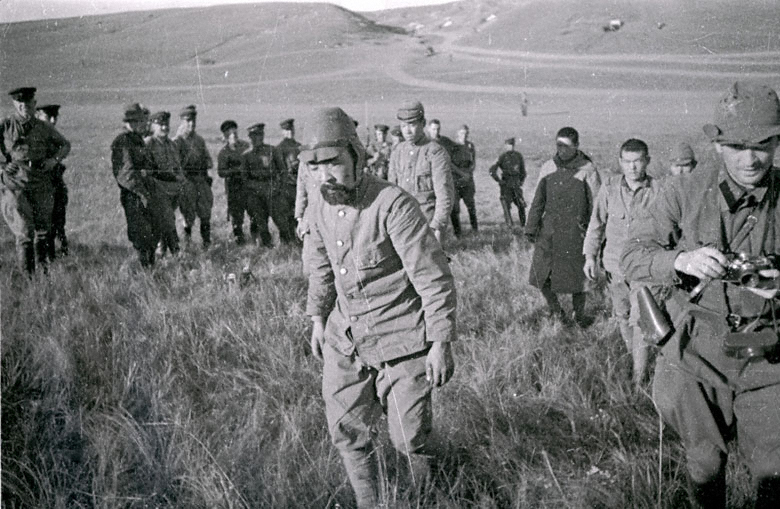
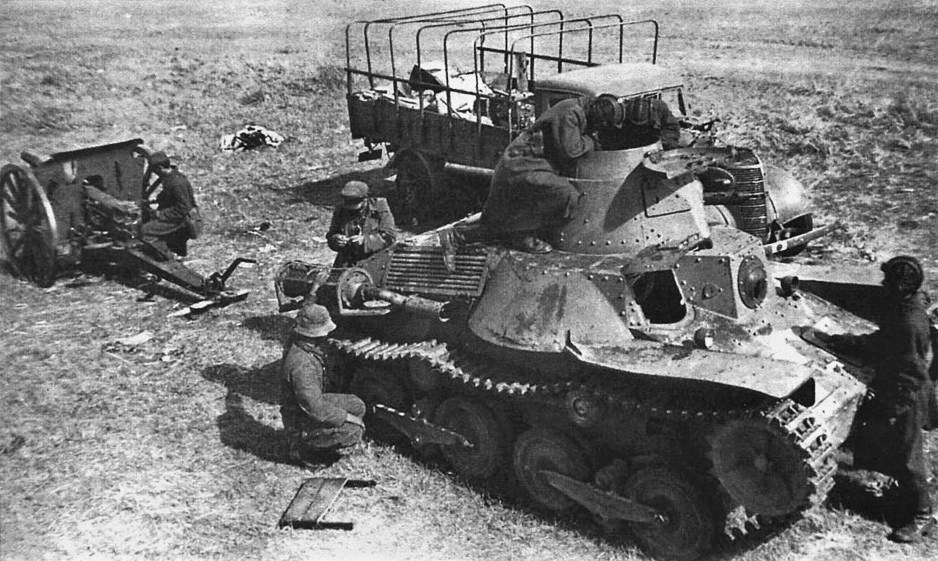
Battles of Khalkhin Gol: Soviet general Georgy Zhukov launched a new attack with over 200 aircraft and as many as 500 tanks. The Soviet Union far eastern forces under General Gregory Zhukov score a major victory over Japan in the border conflict along the Outer Mongolia-Manchukuo frontier and Japan will soon sue for peace. Zhukov crossed the river with a 57,000-strong force consisted of 498 tanks, motorized infantry, an air wing with 250 aircraft, and two Mongolian cavalry divisions. Opposing them, the Japanese only field two light armor divisions. As the overwhelming Soviet forces pin down Kwantung Army’s veteran forces near the river, Russian tanks break through and attack the Japanese in the rear, achieving envelopment by 25 August. By the end of the campaign Soviet losses will be 10,000 killed and wounded. Japanese losses: 52,000 to 55,000 killed and wounded.
While this engagement is little known in the West, it played an important part in subsequent Japanese conduct in World War II. The battle earned the Kwantung Army the displeasure of officials in Tokyo, not so much due to its defeat, but because it was initiated and escalated without direct authorization from the Japanese government. This defeat combined with the Chinese resistance in the Second Sino-Japanese War, together with the signing of the Nazi-Soviet non-aggression pact (which deprived the Army of the basis of its war policy against the USSR), moved the Imperial General Staff in Tokyo away from the policy of the North Strike Group favored by the Army, which wanted to seize Siberia for its resources as far as Lake Baikal.
Instead, support shifted to the South Strike Group, favored by the Navy, which wanted to seize the resources of Southeast Asia, especially the petroleum and mineral-rich Dutch East Indies. Masanobu Tsuji, the Japanese colonel who had helped instigate the Nomonhan incident, was one of the strongest proponents of the attack on Pearl Harbor. General Ryūkichi Tanaka, Chief of the Army Ministry’s Military Service Bureau in 1941, testified after the war that “the most determined single protagonist in favor of war with the United States was Tsuji Masanobu”. Tsuji later wrote that his experience of Soviet fire-power at Nomonhan convinced him not to attack the Soviet Union in 1941.
The killing of two Japanese-controlled Chinese policemen and the wounding of six others by a British policeman with a submachine gun yesterday threatened tonight to develop into another major incident aggravating British-Japanese relations in the Far East. “We take a grave view of this affair,” the Japanese Embassy announced after representatives of the Japanese Army and Navy held an emergency meeting aboard the cruiser Idzumo, flagship of the Japanese Fleet in China waters.
Japanese reports said that the conferees “reached important decisions regarding the shooting incident designed to meet whatever attitude International Settlement authorities may adopt concerning the affair.” Settlement authorities were expected to confer on the situation tomorrow.
The British policeman, W. L. Kinloch of Scotland, a sergeant of the Settlement Police, was placed under a heavy armed guard of British troops and Settlement Police in the British hospital. Foreign authorities were taking no chances of being caught unprepared in the event of attempts at reprisals. The Settlement Police version of the affair was that some of Sergeant Kinloch’s adversaries, members of the Japanese-controlled Chinese police squad, were “armed and in plainclothes” and that Sergeant Kinloch had no way of identifying them.
Three thousand Chinese in the United States pledge war aid, and cheer as a Chinese government reprentative, Chi-shan Hsiao, predicts the nation’s spirit will repel the Japanese.
The Japanese Foreign Office in a statement today insisted that economic questions at Tientsin were purely British-Japanese matters and rejected as beyond comprehension a British suggestion for the participation of third powers in the discussion.
Japan is considering a fundamental change in her policy toward the United States, the newspaper Asahi reports this morning.
Rapidly rising flood waters, increased by steady rain, today temporarily washed out Japan’s nine-week blockade of the British and French Concessions and brought one of the worst disasters in this region’s history.
Born:
Leighton W. Smith, Jr., U.S. Navy admiral (Commander in Chief of United States Naval Forces Europe and Allied Forces Southern Europe, 1994-1996), in Mobile, Alabama (d. 2023).
Fernando Poe Jr., Filipino actor and politician (2004 presidential candidate), in Manila, Commonwealth of the Philippines (d. 2004).
Don Allen, AFL fullback (Denver Broncos), in Leon County, Texas.

 History Diaries