13 days to war in Europe.
Vyacheslav Molotov outlines the Soviet requirements to the German Ambassador, Friedrich von Schulenburg. He insists that trade agreements be signed and that a special protocol be made defining the German and Soviet spheres of interest.
At 7:10 PM, a telegram is received in Berlin from the German ambassador in Moscow: “SECRET. MOST URGENT. THE SOVIET GOVERNMENT AGREE TO THE REICH FOREIGN MINISTER COMING TO MOSCOW ON AUGUST 26 OR 27. MOLOTOV HANDED ME A DRAFT OF A NON-AGRESSION PACT.”
Hitler received a message from his ambassador in Moscow reporting that the Russians were prepared to meet with Joachim von Ribbentrop on August 27 or 28 to negotiate and sign a non-aggression pact. Hitler welcomed the news but wanted the date of von Ribbentrop’s visit to be brought forward.
Stalin’s alleged speech of 19 August 1939: A secret meeting of the Politburo was allegedly held in which Joseph Stalin outlined the strategy of the Soviet Union in the upcoming war. Stalin supposedly said that the war among the Western powers should go on as long as possible so all belligerents would be weakened, creating an ideal opportunity for Soviet expansion.
After months of agitation and recrimination between the Polish and German governments, and a number of border incidents between the two countries, the long-expected crisis begins to come to a head when Albert Forster, the National Socialist leader in Danzig, proclaimed that the hour of deliverance was at hand.
Germany is adamant on the Polish question; the time for words is past, officials reiterate.
Poland held herself in readiness tonight for developments generally expected in Warsaw to bring a decisive turn soon — possibly within a week — in European affairs. Feeling grew that “pressure” by the Rome-Berlin Axis would be intensified in the dispute over Germany’s demands for the Free City of Danzig, which Poland holds to be a “lung” of her economic organism. “The forthcoming week,” read a headline in the evening Warsaw newspaper Czas, “will be a week of crisis-to decide peace or war.” The German propaganda campaign has already been described by the Polish press as “bordering on madness.” Official comment was lacking on military moves in Slovakia, German protectorate over which the Nazis have established “military possession.”
Polish circles said the Polish army had been aware since last March of possible German “attacks” on Slovakia. It was stated bluntly that “Poland is ready.” In general, the Polish view was that the forthcoming week would see the actual threat of war launched in a new bid for an appeasement policy and compromise. German propaganda, in this Polish view, was expected to continue “the effort to isolate Poland, provoke Poland and establish Poland as an aggressor nation.”
Gradual mobilization of Slovakia’s army, pledged to “cooperation” with Nazi Germany’s forces, was under way tonight throughout the little nation. Two divisions of Slovakia’s army of 30,000 and 300,000 reservists were reported authoritatively to have been dispatched to the High Tatra Mountains, which constitute Slovakia’s frontier with Poland.
These Slovak measures were described as “necessary for the defense of the country.” They were reported a few hours after Germany took “military possession” of her protectorate. Nearly 100,000 German troops were strung along the Slovak-Polish frontier, with their headquarters at the railway junction of Zilina.
Nazi “military possession” was accompanied by renewed expressions by Slovak leaders of territorial demands for their little country on Poland. Premier Josef Tiso, Propaganda Minister Alexander Mach, and Dr. Moses Kirschbaum, General Secretary of the Hlinka party, alleged in speeches at Trnava that Poland had “stolen” the Javorina region from Slovakia last September. “Slovakia had a legal right to this region now incorporated in Poland,” Premier Tiso declared. “Slovakia will persevere and accomplish its will in regaining this object of Polish robbery.” General Ferdinand Csatlos, Slovak Minister of War, was still in office today, having withdrawn his resignation, offered last week in protest against ordering two divisions to the Polish frontier. The divisions went today.
Members of Premier Tiso’s Cabinet refused to make any statement regarding Germany’s “military possession” of their country. Bratislava was quiet tonight, and, in contrast to the northern region, there were no German troops in sight. Reports that Nazi soldiers also were massed on the frontier between Slovakia and Carpatho-Ukraine, door to the Polish Ukraine, were denied in authoritative quarters. “If there are any German troops in the eastern part of Slovakia, it is only a coincidence,” these sources said.
Travelers returning from Northern Slovakia said that Zilina’s citizens were instructed to be ready to leave their homes at a minute’s notice. The town of Orava was reported to have been turned into a huge German troop encampment. Bratislava was swamped with disquieting reports. Townsfolk anxiously sought to learn if the German garrison would be transferred. across the Danube and military rule inaugurated.
Today’s German minority newspaper proclaimed Bratislava’s “Jewish problem is more than ripe.” Squads of police were sent to Bratislava’s ancient ghetto, which the German minority has invaded three times this month to beat Jews and destroy property.
The German minority newspaper Grenzbote said in a front-page editorial: “It is only right that the Jews be quickly and thoroughly punished this time for their evil provocations.” The last census gave 70,000 Jews in Bratislava.
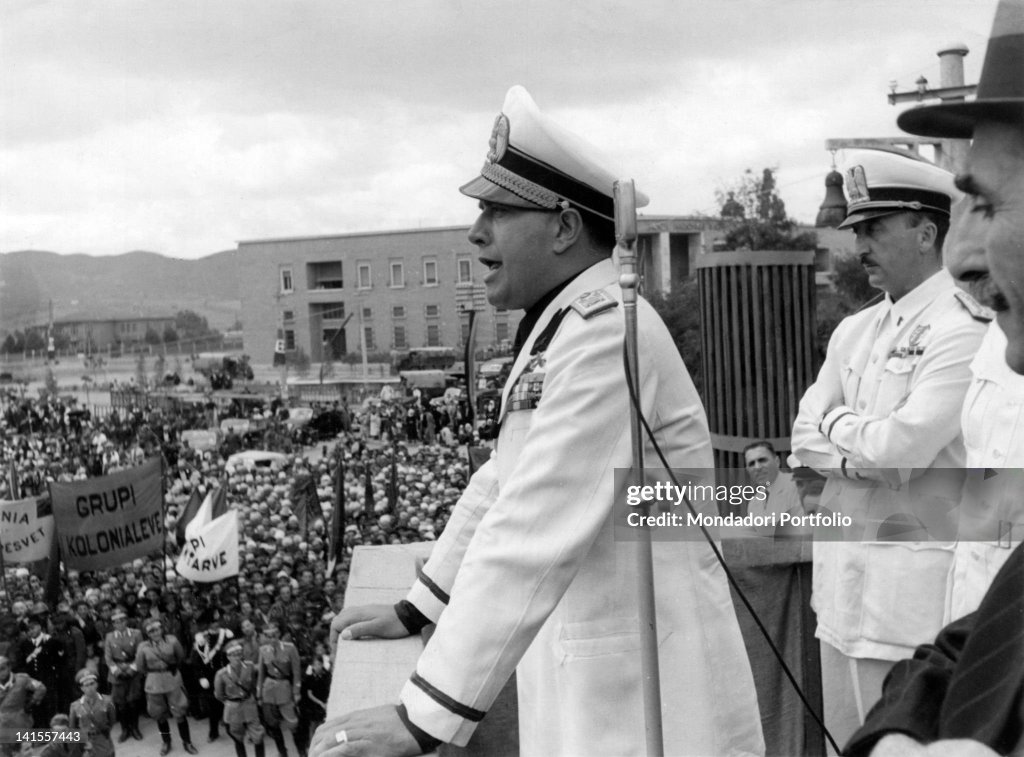
The Italian Foreign Minister Ciano is in Albania. His motive is puzzling; some think he is avoiding the British and French envoys who want to see him. Because Europe is in a state of crisis and it seemed a strange thing for the Italian Foreign Minister to leave Rome and dedicate public works in Albania at this moment, there has been much guessing at the possible motives behind Count Ciano’s voyage today.
The Czech language is barred in German talks; German must be spoken in all foreign negotiations.
An anti-Swiss propaganda campaign that has been going on in Southern Germany during the past few weeks and the presence of German troop concentrations near Basle have caused the Swiss authorities to order the strengthening of all garrisons along the German and Italian frontiers.
Italy barred entry to Jews from Germany, Poland, Hungary and Romania.
A moving plea for “peace in our time” was addressed by Pope Pius XII this morning to Europe and its rulers in a speech commemorating the twenty-fifth anniversary of the death of Pope Pius X, delivered at Castel Gandolfo to a large group of pilgrims from Venetia.
Ulster’s attitude toward the Irish Republican Army is one of uncompromising opposition, and the authorities are ready to strike in determined fashion at the least sign of any effort to revive the campaign of violence of the troubled days of 1922 and recent years.
Viscount Halifax, British Foreign Secretary, returned unexpectedly today from a vacation on the Yorkshire moors, and spent several hours at the Foreign Office during the afternoon and evening studying reports, obviously of a disturbing nature, that have been pouring in not only from an increasingly tense Europe but also from the Far East.
Lord Halifax and Prime Minister Chamberlain are the two men whose movements are being watched by the British public with even greater anxiety than those of the dictators, whose comings and goings cannot always be understood. But for Lord Halifax suddenly to come to London three days before he was scheduled to come is a clear indication to British minds that something is amiss — and there is plenty of evidence in the news dispatches from abroad to support that view.
Moreover, when Chancellor Hitler is “at large” — preparing some coup, the world knows not what — the weekend, by experience, has always been an uneasy time for the rulers of other States. The official explanation of Lord Halifax’s return is that he wished to “prepare material for his report on the international situation that will be discussed at a meeting of Ministers early next week.” It is emphasized in government circles that this meeting will not be a gathering of the “Inner Cabinet,” which reached the major decisions of government policy during the crisis last Autumn, but will be open to any member of the Cabinet who happens to be in London or who thinks the journey here is worth his while.
Today Lord Halifax had plenty of new material for the preparation of his report: the renewed anti-Polish “atrocities” campaign in the German press; the German militarization of Slovakia; the reported breakdown of the peace talks between. Professor Karl J.. Burckhardt, League of Nations High Commissioner for Danzig, Arthur Greiser, Danzig Senate leader, and Marian Chodaki, Poland’s High Commissioner in Danzig; the enlargement of Germany’s claim against Poland and her threats to Hungary.
All these bear a striking similarity in technique and “timing” to the events that preceded Munich. There is, however, this considerable difference: There is no question when the Ministers meet next week of any new decisions by the British Government. Britain has pledged herself to come to the aid of Poland should that country find it necessary to employ her national forces in defense of her integrity. British plans for doing so are now complete and could come into operation at the pressing of a button. The chief danger, as seen here, is that Germany may disregard this warning.
Signs of a serious setback to the attempt to get Russia into the peace pact front have to be recorded today. The first sign, a brief paragraph in the newspaper Pravda, should be considered little less important than Andrey A. Zhdanoff’s startling denunciation of the British for delaying tactics during the political negotiations.
Some 800 Jewish refugees from central Europe are apprehended while landing in northern Palestine. They are to be held in quarantine until a decision can be amde about returning them to Europe.
Growing pessimism throughout the United States regarding this country’s ability to remain neutral in the event of another European war is shown in a survey of the American Institute of Public Opinion, made public yesterday by Dr. George Gallup, director of the institute. 76% of all Americans now fear that America will be “drawn in” by any new war in Europe.
The Chamber of Commerce of the United States reported today that steady improvement had been noted in general business activity and it saw encouraging signs for the future in plans now being made for raising new capital.
The Wage-Hour Administration will open a school here Monday to train “hard-boiled diplomats,” some of them women, in how to detect violations and enforce the standards of the Wage Hour Law.
New England says no to a proposed Thanksgiving date change. They say the day is as immovable as Plymouth Rock.
Three persons were seriously injured and fourteen others slightly hurt when the five cars of the Blue Comet, deluxe Central Railroad of New Jersey express train operating between Atlantic City and Jersey City, jumped the track over a culvert three miles south of Chatsworth, New Jersey at 5:45 o’clock this afternoon. Heavy rains caused a wash out of track and led tot he derailment.
14.8 inches of rain falls at Tuckerton, New Jersey this day, setting a state record.
The International Typographical Union opened its eightythird annual convention here today, but took no action regarding its suspension by the American Federation of Labor.
A “favorite son” boom for Senator Nye of North Dakota for the Republican Presidential nomination was reported in the making today.
Governor John W. Bricker of Ohio and Owen J. Roberts, associate justice of the United States Supreme Court, are the leading “dark horse” possibilities for the Republican nomination for President in 1940, according to information received by party leaders here.
A group of Pennsylvania National Guardsmen, returning home from mimio warfare at Manassas, Virginia, were hailed today as heroes of a real life battle last night in which an attempted highway robbery in Harrisburg, Pennsylvania was thwarted and one of the bandits fatally wounded.
Ted Williams leads the Boston Red Sox to an 8–6 win over the Washington Senators by hitting his first Major League grand slam. He’ll hit his 2nd in 10 days. The Senators came abck to win the nitecap of the doubleheader, 2–1.
In St. Louis, the Detroit Tigers ride a 7-run 4th to school the Browns, 9–3. Hank Greenberg has a grand slam in the frame to back Schoolboy Rowe’s pitching.
The Brooklyn Dodgers, behind the seven-hit pitching of knuckleballer Tot Pressnell, beat the Boston Bees, 4–0.
Handcuffed by the six-hit pitching of big Bill Lee, the Pittsburgh Pirates tied the longest losing streak of the current National League season today by bowing to the Chicago Cubs, 5 to 0.
The Yankees and Giants in New York were idle because of rain. The Cincinnati Reds and St. Louis Cardinals, opening an important series, played a 3–3 nine-inning tie that was halted by rain.
Dispatches from Europe indicating that Great Britain may sooner or later be involved in a war with Germany, with aid to Poland as the immediate issue, are being followed by Canadians in a mood of fatalism. Canadian resolve to back Great Britain in any war in Europe is beyond doubt.
The Norwegian cargo ship Løvland came ashore at Cape North, Cape Breton Island, Nova Scotia, Canada and was wrecked.
The Norwegian tanker Herbrandran aground at Buenos Aires, Argentina. She was refloated undamaged on 22 August after discharging 7,000 tons of cargo.
A Tientsin flood lifts the blockade; refugees crowd the French and British zones. Two feet of water in some parts of the Concession have forced residents to leave their homes and some business firms to vacate their ground floors.
A British policeman armed with a submachine-gun tonight killed two members of a Japanese-controlled Chinese police squad and wounded six others before he dropped from a bullet in his back in a fight on the International Settlement border of Shanghai.
A Japanese air force made the westernmost raid in Szechwan (Today Sichuan) Province when it bombed Kiating, metropolis of an extensive silk-producing district 150 miles west of Chungking, yesterday. A local American missionary who was in a China National Aviation Corporation plane that circled over Kiating after the bombing, said that half the city was in flames. Kiating is an education and mission. center, but it was thought that the foreign mission properties were outside the bombed zone. The city is crowded with refugees from the lower Yangtze and is the site of Wuhan University, one of the “refugee” Chinese universities. Chikiang, south of Chungking, was also reported bombed. Chungking was paralyzed by raid alarms while the bombers were believed to be headed here, but they carried out their attacks elsewhere.
The British Ambassador to Tokyo, Sir Robert Leslie Craigie, will leave for the Summer Embassy on Lake Chuzenji today, going there for the first time this year. His departure indicates that the British do not expect to resume negotiations for a week or more. The police guards at the British Embassy were strengthened last night. The Japanese-British negotiations are not broken off but are officially regarded as in a state of temporary suspension. The Japanese Government will answer the British Government in a statement to be issued, probably tomorrow. It will undertake to show that it is legitimate to include economic issues in the discussions of security and, according to press forecasts, it will refute the British idea that the Nine-power and other old treaties still have any binding power.
The Tokyo press, on second thoughts this morning, is much calmer than its first thoughts were yesterday. The newspaper Asahi states that even if a breakdown becomes definite the Arita-Craigie formula will retain its legal force and the Japanese will take delivery of the four suspects in Tientsin. Japanese press reports from North China state that the military forces there will take no rash measures and will issue no statement pending the arrival of official information.
In their final conversation yesterday afternoon Sir Robert and Sotomasu Kato, Minister at Large to China, who has been a leading figure in the parley, agreed that the negotiations be discontinued for the time being. Whether this will prove a simple adjournment or a termination of the parleys depends upon how the Japanese Government regards the British refusal to accept Japan’s economic proposals without further consultation with the United States and other interested powers.
It is definitely learned that the Japanese Government does not object to those consultations, but considers that enough time for them has already been consumed. Japan would definitely reject, however, an international conference, as it is one of her primary principles that all questions concerning East Asia be settled by direct negotiations.
The immediate outlook depends on whether Japan values an agreement with Britain sufficiently to wait for the result of the British investigations and deliberations or whether the Japanese experts can devise fresh proposals that, in the British Government’s view, would not prejudice the rights of those other powers that Britain is consulting. The alternative course is to break off the conversations entirely.
The U.S. Navy plans to strengthen the Aslatic Fleet soon by displacing six World War submarines in service. in the Far East with six larger and more powerful craft. Officials who disclosed this today. asserted the move was routine and in no sense represented a general reinforcement of American strength in the Far East. Older submarines at Panama similarly have been displaced as newer vessels became available. The Asiatic Fleet change probably will be made next Spring. The six “S” class submarines of about 800 tons each, in service in the Far East, were started in the World War and completed shortly thereafter. The new vessels of the same type are more than 1,300 tons. Destroyers with the Asiatic Fleet similarly are World War types, but no plans have been disclosed to displace them.
Dow Jones Industrial Average: 135.11 (-0.43).
Born:
[Peter] “Ginger” Baker, English drummer (Cream – “Sunshine Of Your Love”; “Toad”; Blind Faith – “Do What You Like”); in Lewisham, South London, England, United Kingdom (d. 2019).
Ron Miller, NFL quarterback (Los Angeles Rams), in Lyons, Illinois (d. 2012).
Died:
Johannes Marinus Meulenhoff, 70, Dutch publisher.
Naval Construction:
The Royal Navy Tree-class minesweeping trawler HMS Deodar (T 124) is laid down by the Goole Shipbuilding & Repairing Co. Ltd. (Goole, U.K.); completed by Amos & Smith.
The U.S. Navy Folgal 58′ class motor torpedo boat USS PT-2 is laid down by the Fogal Boat Yard (Miami, Florida, U.S.A.).
The Royal Navy requisitioned dockyard tug HMS Guardsman is commissioned.


 History Diaries