A pro‐Communist Việt Cộng battalion smashed two government posts in the Mekong River delta late yesterday, ambushed a relief force and inflicted 117 casualties on government troops. Helicopters brought in troops to reinforce the battered relief units. Officials said these troops caught up with the Việt Cộng, near one of the posts and fought a pitched battle along a canal. The guerrillas retreated. United States officials said the Việt Cộng left 10 dead and carried off about 40 other casualties. Five government soldiers were killed and four wounded in the battle along the canal. From any standpoint, it was clear that government troops had suffered one of their bloodiest setbacks in weeks, with a heavy loss of weapons.
The Vietnam action began when about 400 Việt Cộng at tacked the hamlets of Hòa Mỹ and Hiệp Hưng, 90 miles southwest of here yesterday afternoon. Eight defenders were killed and 119 wounded. But the heavy losses came when a relief force was sent to the beleaguered hamlets last night and ran into a Việt Cộng ambush about two miles from one of the posts. Twenty‐two government soldiers were killed, 53 were wounded, 15 were missing and presumed captured by the Việt Cộng and 26 weapons; including two machine guns, were missing.
The ambush was typical of the Việt Cộng pattern that has operated successfully for several months—a fairly strong attack against a post followed by an overwhelming ambush of the relief force. United States advisers have repeatedly said Vietnamese Army units usually fail to put out flank guards and take other measures vital to avoiding, ambush. The remnants of the battered relief force kept going, however, and a helicopter unit was flown in today to reinforce it. Officials said the helicopter troops caught up with the Việt Cộng near one of the posts and battled along the canal. About 400 Communists attacked the hamlets. They killed eight of the defenders and wounded 19. Then the bulk of the battalion settled down in roadside hideouts about two miles away to spring the trap on the troops marching to the relief of the hamlets. They killed 22 of the soldiers and wounded 53. In addition, 15 were missing and presumed captured by the Việt Cộng.
In the capital, American officials reported that the death toll from the crash of a United States Army helicopter 60 miles northwest of Saigon Friday had risen to three. Two United States Army men were killed and seven injured when the helicopter plunged into Black Virgin Mountain. The third man died over the weekend. The cause of the crash has not been disclosed. A United States military spokesman later identified the latest fatality as First Lieutenant Alan B. Harriman, whose widow lives in Naha, Okinawa. The other dead were Specialist 4 James C. Caughey of Indianapolis, and Staff Sgt. William M. Dean of Fayetteville, North Carolina.
Pro‐Communist forces were reported today to have recaptured strategic Phou Kout ridge in the confusing see‐saw battle in central Laos. General Amkha Soukhavong, a leader of the Right‐wing faction in Laos, said Pathet Lao troops, supported by five companies of North Vietnamese troops, were firmly dug in atop the ridge. He said the Communist forces were in trenches up to 15 feet deep, invulnerable to both artillery bombardment and air attack. The general said forces of the Laotian neutralist faction held the Phou Kout foothills in a semi circle extending halfway around the slopes. He said they did not plan a counterattack soon.
Parts of the hill, just west of the Plaine des Jarres, have changed hands frequently in recent weeks. Military sources said the hill was sometimes reported to have‐changed hands when, only one of its many peaks was taken or retaken. Last week the neutralists occupied parts of the uppermost Phou Kout ridge before the Pathet Lao retook it. The neutralists now appear content to maintain their positions in the foothills without sacrificing men in an attempt to retake the ridge. Farther west in the area, where Routes 7 and 13 meet, Right‐wing forces were reported mopping up. The important junction was recently taken by Right‐wing forces that also captured all rebel‐held positions along Route 13. This route connects Vientiane and Luang Prabang, the royal capital.
Four top pro‐Communists, in a statement issued from their headquarters at Khang Khay, charged that the neutralist Premier, Prince Souvanna Phouma, was “completely under the control and manipulation of the United States and the Laotian rightists. “Prince Phouma has totally given up the line of peace and neutrality,” said the statement, broadcast by Hsinhua, the Chinese Communist press agency, and monitored in Tokyo. “All his words and deeds serve the interests of the United States and its lackeys, and are against those of the Laotian people and nation.”
The Burmese Government announced today that its troops killed 23 rebels in six clashes over the weekend. Bodies of four women slain by the rebels were recovered. The skirmishes are part of a 15‐year‐old war against Communist irregulars and Communist‐influenced jungle tribes. The ethnic rebels are fighting mainly to secede.
Greece decided tonight to withdraw certain army, navy and air force units from the North Atlantic Treaty Organization to “fulfill her commitments toward Cyprus, to support it against any Turkish attack.” The size of the forces to be withdrawn was not disclosed. Unconfirmed reports said the Greek Government, as a result of a Supreme Defense Council meeting today, intended to send some squadrons of the air force now stationed in Crete to Cyprus to “be ready for defensive action.”
An official statement recalled that Turkey, “invoking the need to use part of her armed forces for reasons deriving from her treaties,” withdrew such forces from the NATO command on August 8. Turkish planes from those withdrawn from the alliance were used for strafing attacks against Greek Cypriote positions on Cyprus. Greece protested against Turkey’s move to the Supreme Allied Commander in Europe, Gen. Lyman L. Lemnitzer, “but its protest has remained unanswered,” the statement said.
Greece said her decision to withdraw some of her forces from the Atlantic alliance had been duly reported to the NATO Supreme Commander and the Secretary General in Paris. Greece has also decided to recall her echelon serving with the alliance’s Southeastern Europe headquarters in Izmir. Turkey, and station is in Salonika, in northern Greece. Spyros Kyprianou, the Greek Cypriote Foreign Minister, who arrived in Athens early Saturday, flew back to Nicosia tonight after repeated conferences with Greek leaders. Shortly before his departure, he attended the Supreme Defense Council meeting, at which Premier George Papandreou presided. It was reported that during talks here, Premier Papandreou and his Foreign Minister, Stavros Kostopoulos, had assured Mr. Kyprianou that if Cyprus was again attacked Greece would give the full support of her armed forces.
The Greek Government’s reassurances are said to have been accompanied by a recommendation to President Makarios to be more “cautious” in his appeals for the Soviet Union’s support. Nevertheless, a spokesman for the Greek Foreign Ministry described as “an important contribution to world peace” the strongly wordsd warning of Premier Khrushchev to the “Turkish aggressors.” Mr. Khrushchev warned the Turkish Government yesterday it could not bomb Cyprus with impunity and that “the damage which you wanted to inflict on somebody may act as a boomerang.”
A NATO spokesman confirmed tonight that Greece had notified the Supreme Headquarters Allied Powers Europe that she wished to withdraw certain army, navy and air forces from command control. It is not clear how many or what forces are included and clarification has been asked, the spokesman said. It is understood, according to the spokesman, that notification was sent not only to the miiitary but also to the political headquarters of the alliance in Paris.
In Geneva, Sakari S. Tuomioja of Finland, the United Nations mediator for Cyprus who suffered a stroke Sunday, was operated on following a deterioration in his condition.
President Antonio Segni of Italy, stricken 10 days ago with a stroke, was being kept alive tonight by emergency measures after lapsing into a coma early Saturday.
Premier Moïse Tshombe has appealed to five African countries for troops to help put down the Congolese rebellion. The United States, in response to another Tshombe appeal, said it would provide a few B‐26 light bombers. Informed sources said today that Mr. Tshombe had asked Senegal, Liberia, Nigeria, Ethiopia and Malagasy to supply soldiers. It is understood that the Organization of African Unity will be informed of the move. The United States Embassy, in announcing that it would provide “a small number” of B‐26 planes, said the move was’ in response to a request from the Congolese Government.
Mr. Tshombe asked yesterday for several “long‐range reconnaissance planes” to allow surveys of rebel activity in farflung areas. However, the embassy spokesman’s statement did not limit the planes to reconnaissance missions. It said the planes “will be used to help assure Congolese internal security.” The spokesman said the Congo “will utilize contract pilots and maintenance personnel as needed for these aircraft.” He said no United States citizens would be called on as contract pilots. This immediately raised speculation that the Congo would call on South African and Southern Rhodesian pilots to fly the B‐26’s.
About six Rhodesians and South Africans, who flew for Mr. Tshombe while he was the leader of the Katanga secession, have been here for the last few weeks. Several of them are believed to be flying smaller planes against the rebels in the Kasai region. The use of South Africans to fly United States planes here would certainly draw protests from countries that bitterly oppose South Africa because of her policy of apartheid — complete racial separation. United States officials refused to comment on this matter. However, there were some indications that efforts would be made to find other “pilots for hire” — perhaps French — to fly the B‐26’s.
A year and a half after the Konfrontasi between Indonesia and Malaysia began on the island of Borneo, about 100 Indonesian Army troops landed on the Malaysian mainland, launching an amphibious invasion on the peninsula at Pontian. A historian notes that the troops (and a force of paratroopers) “expected to be welcomed by the people” but were immediately turned over to the national government by local militias.
The political truce sought by President Arturo Illia to give Argentina time to regain hex economic and social health appears to be disintegrating. An upsurge in terrorism, militant efforts to restore the influence of Perónism and former President Arturo Frondizi’s bitter attack on the Government have combined to sharpen political antagonisms. A high Government source said today that these developments, while producing new tensions, have not shaken Dr. Illia’s determination to pursue a conciliatory policy designed to eradicate “the old hatreds that have divided our society.” But some military figures who fear that moderation is no way to deal with extremism are pressing for a tougher stand.
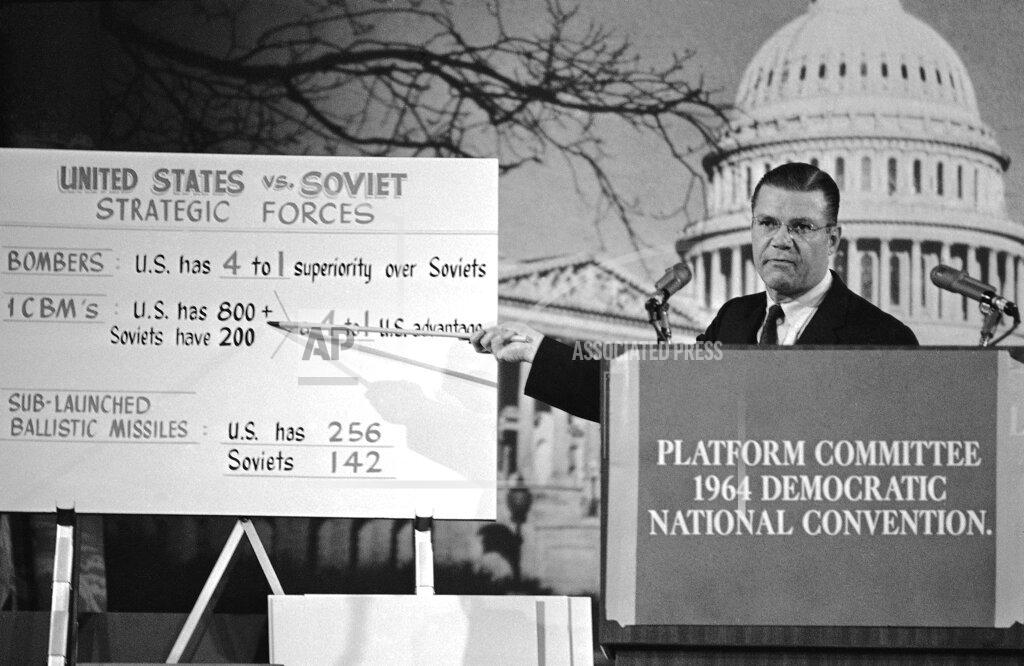
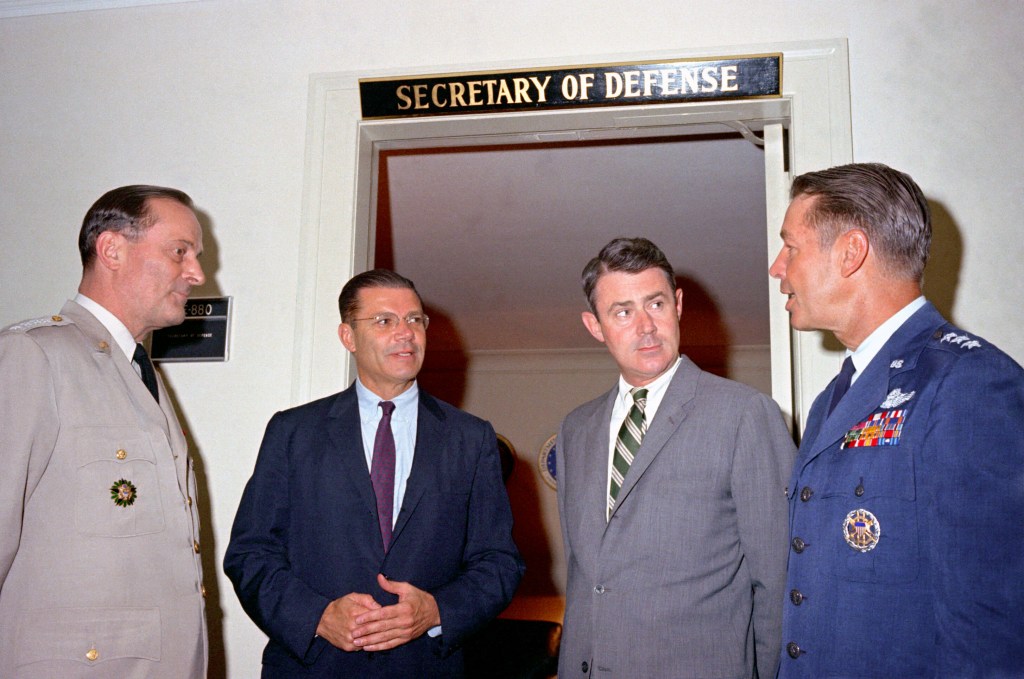
The Johnson Administration’s top officials dealing with international and security policy fired a broadside today at the views of Senator Barry Goldwater and the 1964 Republican platform. Secretary of Defense Robert S. McNamara, Secretary of State Dean Rusk, United Nations Delegate Adlai E. Stevenson and Disarmament Director William C. Foster joined in the attack. They spoke at the opening of hearings on the Democratic platform. The strongest words were Mr. McNamara’s. Without naming the Republican candidate, he coldly rejected Senator Goldwater’s charges that defense planning was inadequate.
“Let me assure you,” Secretary McNamara said, “that our strategic forces are and will remain in the 1960’s and the seventies sufficient to insure the destruction of both the Soviet Union and Communist China under the worst imaginable circumstances accompanying the outbreak of war. “There should be no doubt about this in the mind of any American. There is none in the minds of our enemies.” The Defense Secretary called on the Democrats to make their “first pledge” in the platform a reaffirmation of the President’s sole authority over nuclear weapons. Senator Goldwater’s forces rejected such a proposed plank at San Francisco last month. In less than an hour of fullscale nuclear war, Mr. McNamara said, almost 100 million Americans would be killed. He said he considered his personal duty to assure communications for Presidential command over nuclear weapons “my most solemn obligation as Secretary of Defense.”
“The awesome responsibility to unleash such force,” Mr. McNamara went on, “can rest only on the highest elected official in this country — the President of the United States.” In a question period later Mr. McNamara was asked whether Presidential control might be delegated for smaller tactical weapons, as Senator Goldwater has said should be done for the Supreme Commander of the North Atlantic Treaty Organization. The Secretary replied. “The average tactical weapon in Europe has a yield five times the bomb that was dropped on Hiroshima. I simply leave it to you to decide whether you think power of that kind should be placed at the disposal of anyone other than the President.”
In a 351‐to‐0 vote, the House urged President Johnson today to start action designed to deprive the Soviet Union and 14 other countries of their General Assembly votes unless they pay their United Nations debts. A House resolution with this purpose was sent to the Senate, where early concurrence was expected. The action, sponsored by Representative Edna F. Kelly, a Brooklyn Democrat and member of the Foreign Affairs Committee, has the support of SecreLary of State Dean Rusk. The Secretary wrote to the committee a week ago that he thought it would be “useful” for Congress to take a step to “strengthen the hands” of the President and of the representative of the United States at the United Nations in dealing with the problem of financing the world organization. “The resolution,” he said, “would serve as a clear indication of the united support of the Congress and the American people for the vigorous and impartial application of the [United Nations] Charter, and would demonstrate our determination that the obligations of the Charter be given effect.”
A Senate committee rejected efforts today to attach any form of medical insurance for the aged to a bill increasing Social Security benefits and taxes. The bill, minus the medical care provision, was then voted out of the Senate Finance Committee. The action was not unexpected. Backers of various medicalcare proposals had conceded in advance that they did not have the votes in committee. They will renew their fight, however, when the Social Security bill goes to the Senate floor this week. The bill will go to the floor minus one of its most controversial parts — a provision to bring self‐employed physicians under Social Security for the first time.
A number of state medical societies had indicated that their members desired to come under Social Security. The move was opposed, however, by the American Medical Association. Physicians would have been brought under Social Security under the bill as passed recently by the House. The committee also eliminated a provision that would have permitted tips to be considered as part of the wages on which Social Security taxes would be paid. In a series of votes, the committee rejected three medicalare plans, including a long-stalled Administration proposal, the King‐Anderson bill.
President Johnson said Saturday that he and other Administration leaders would “do everything we can” to get the King‐Anderson plan through Congress. He did not rule out a possible compromise. The King‐Anderson proposal — pending in Congress for several years—would provide extensive hospital and nursing home benefits through an increase in Social Security taxes. It would cover persons, 65 years of age and older, who are on Social Security rolls. Medical‐care coverage for those not on Social Security would be financed through general‐fund revenues.
The House approved by voice vote today legislation that would increase the terms of county agricultural committee members from one to three years. The legislation, which now goes to the Senate, also provides that committee members may not serve more than three consecutive terms. All present there is no limit. The bill also proposes that county committeemen be elected by all community committeemen instead of by the chairman of the community committees.
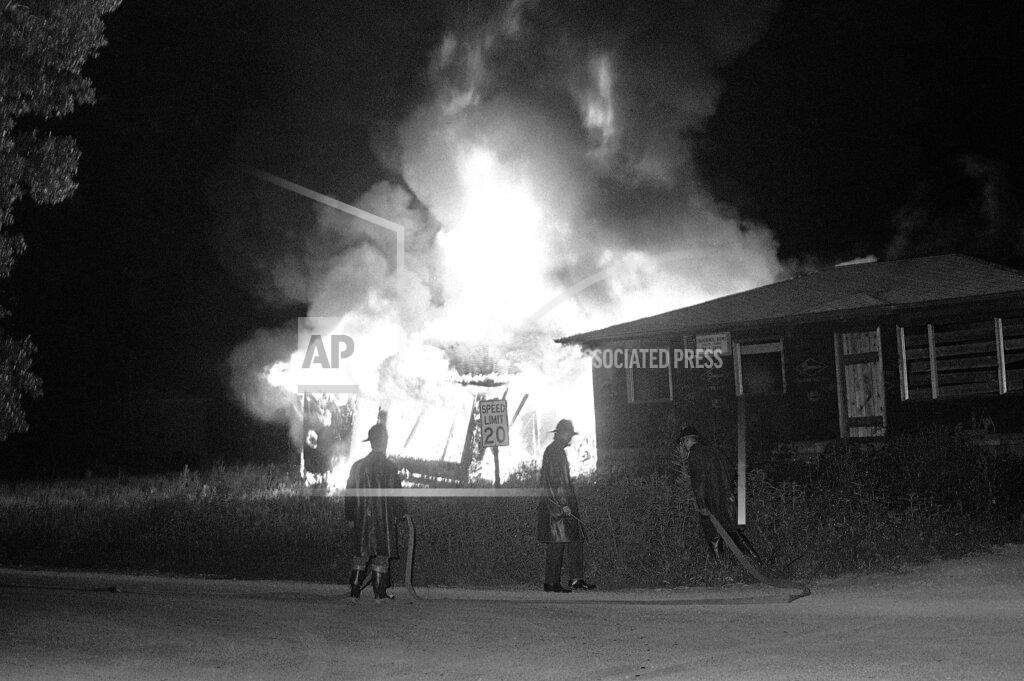
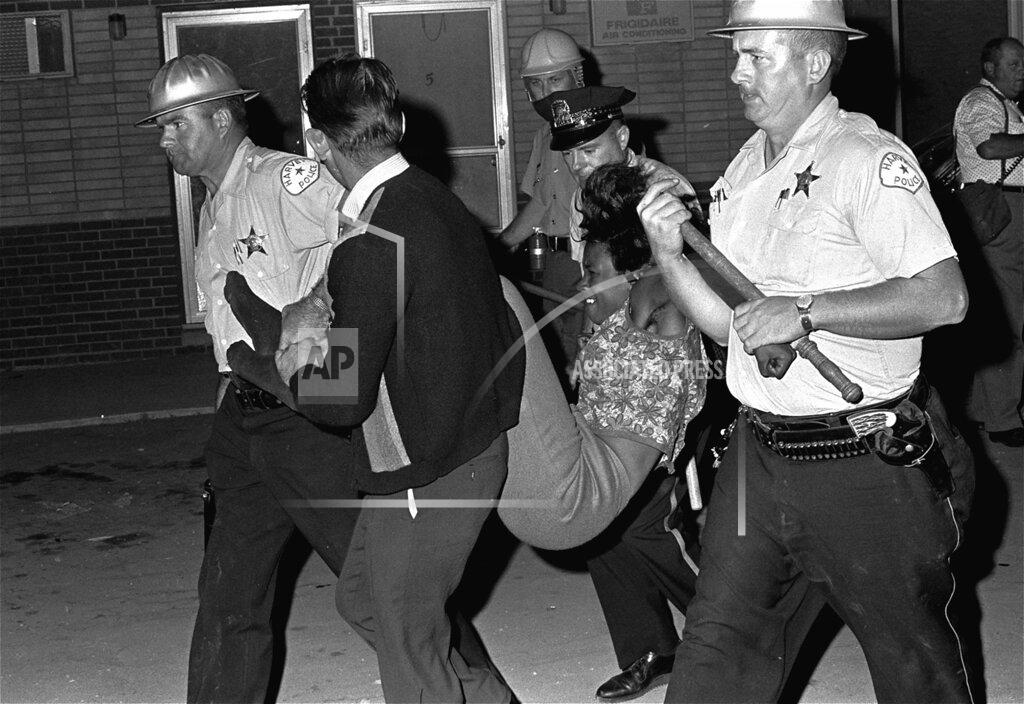
After 20 hours of an uneasy calm, violence broke out anew tonight at Dixmoor, a suburb south of Chicago, where earlier today Blacks and police clashed in riots that began Saturday. An exchange of gunfire, probably not more than a dozen shots, between the police and the Blacks came shortly after a Molotov cocktail was thrown into an already wrecked liquor store where the trouble started when a Black woman was accused of stealing a pint of gin. Despite the shooting and other violence, the only injury reported was to a Black woman who was struck by a flying brick thrown through a bus window.
The police made 34 arrests, bringing to 65 the number since the riots began. The fire in the liquor store was quickly extinguished, but the excitement attracted more than 100 persons, many of them teen‐agers, who refused to heed the orders of the police. They gathered in a parking lot opposite the smoldering shop and refused to budge until the police moved on them with dogs, axe handles, shotguns and tear gas. They reluctantly dispersed and disappeared into nearby apartment buildings as policemen took up posts along the way to prevent any further movement onto the streets. Meanwhile, civic leaders and church representatives who had circulated in the crowd earlier calling for order, renewed their pleas over loud speakers. At 11:30 PM, after more than two hours of rioting, a police official said the situation appeared under control. He added, “This may be just a lull, although I don’t think so.”
Dixmoor is an integrated community of 3,000 persons six miles southwest of Chicago. It is bordered by all‐Black communities such as Robbins and the integrated town of Harvey. Police and community officials, meeting at the office of Mayor Elmer C. Turgren in Harvey, decided to block the principal streets of Dixmoor to all except residents and police. At the same time it was announced that instead of a curfew, as had been suggested in some quarters, all shops would close at 6 P.M. Mayor Turgren, back from a shortened Colorado vacation, said all shopkeepers had agreed to the new plan.
James R. Hoffa, president of the International Brotherhood of Teamsters, was sentenced today to five years in Federal prison and fined $10,000 for defrauding his union’s §280 million pension fund. His six co‐defendants received sentences and fines ranging from the same as Hoffa’s down to one hour in custody. Federal District Judge Richard A. Austin imposed the sentences after having overruled defense motions to set aside the conviction and order a new trial. He also overruled a surprise defense move to upset the conviction with the testimony of an alternate juror. “This court,” the judge said, “is one that believes the sound of the clanging jailhouse door has a salutary effect on the defendant and the community. This may be an old fashioned idea, but it is one that I hold.”
Hoffa now faces a total of 13 years in prison. He was sentenced to an eight‐year term last March upon his conviction in Chattanooga, Tennessee, on Federal charges of tampering with a jury. In the present case he was sentenced to five‐year terms on each of four counts but the judge ordered that the terms run concurrently. Before imposing sentence upon the union leader, Judge Austin asked: “Has the defendant anything to say?” Hoffa, standing beside his chief defense counsel, Maurice Walsh, replied: “Not at all, your honor. The record speaks for itself.”
Construction was completed on the Capital Beltway, a 64 miles (103 km) multi-lane interstate highway that surrounds the District of Columbia and passes through Maryland and Virginia as I-495. The first section of the route, originally called the “Washington Circumferential Highway”, had been opened in Maryland in 1957 as one of the first projects in the American Interstate Highway System; the project cost an estimated $189,000,000 at the time.
Bruce Lee (23), Hong Kong and American martial artist and actor, weds Linda Emery (19), teacher.
Once again, the New York Yankees lost the opening game of a series tonight, a pattern they have followed all year. They dropped a 2–1 decision to the Chicago White Sox in the opener of a four‐game set that will complete the season’s business between the two teams. This was the 22d time the Yankees were beaten in a series opener out of 39 series played. On the road, this has happened 14 times out of 20.
General manager Bing Devine and business manager Art Routzong of the St. Louis Cardinals are fired by owner August Busch. The popular Devine, who was engineered the Brock trade, leaves with the Cardinals in 5th place. Bob Howsam is hired to take Devine’s place
The St. Louis Cardinals spoiled a masterly pitching: performance by 39‐year‐old Hal Brown tonight with a three‐run rally in the ninth inning that gave them a 3–1 victory over the Houston Colts. In the ninth Ken Boyer singled and moved to second on an error. Dick Groat singled to drive in the tying run and moved to third on another error. Singles by Mike Shannon and Tim McCarver and an infield out drove in two more runs. Brown had given up eight hits until the ninth.
Dennis Ribant, a 22‐year‐old right‐hander who has been performing in New York Met pinstripes for only 10 days, won his letter yesterday in his second time out. He knocked the Pittsburgh Pirates out of third place by pitching a 5–0 four‐hit victory at Shea Stadium. He allowed only four men to reach base, walked none, struck out 10 and retired the side in order six times.
The Philadelphia Phillies struck for five runs in the second inning and went on to defeat the Chicago Cubs, 8–1, tonight behind Chris Short’s five-hit pitching. The victory gave the Phillies their largest lead of the season — five games — over the second-place San Francisco Giants, who were not scheduled. The Phillies sent 10 men to the plate in the second inning against Ernie Broglio.
Dow Jones Industrial Average: 840.21 (+1.40).
Born:
John Offerdahl, NFL linebacker (Pro Bowl, 1986-1990; Miami Dolphins), in Wisconsin Rapids, Wisconsin.
Dallas Comegys, NBA power forward (New Jersey Nets, San Antonio Spurs), in Philadelphia, Pennsylvania.
Colin James, Canadian singer-songwriter, in Regina, Saskatchewan, Canada.
Died:
Keiji Sada, 37, Japanese actor, was killed in a car accident.




 History Diaries