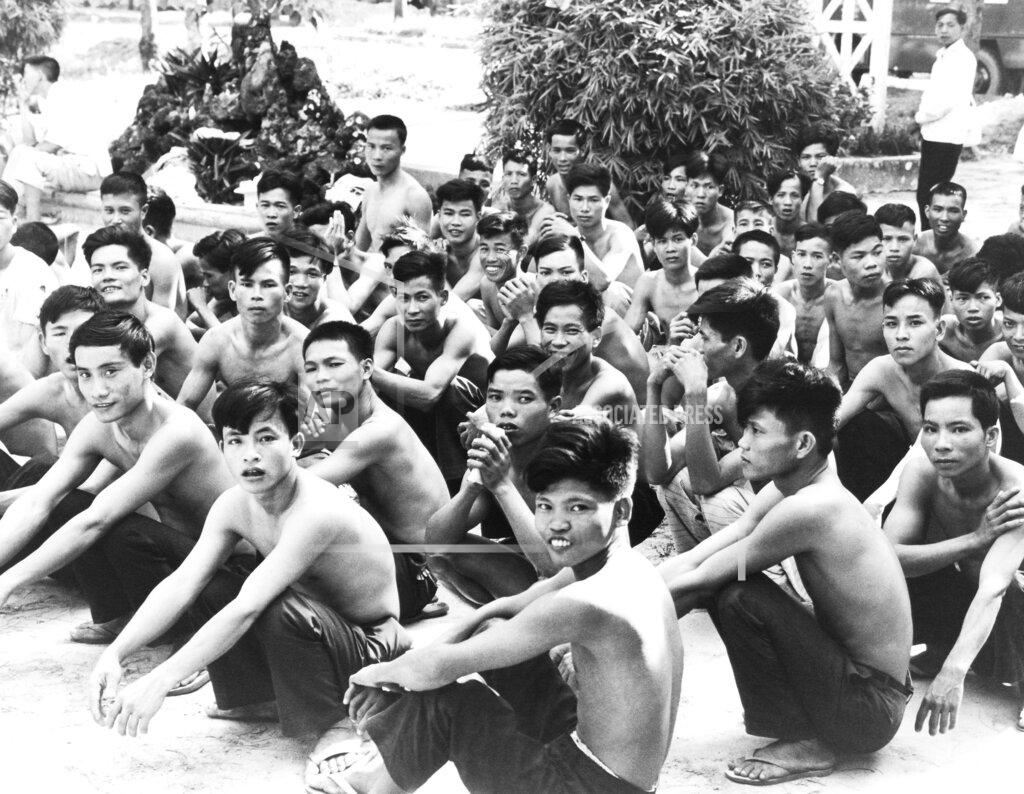
In a coup, South Vietnam’s Prime Minister, Major General Nguyễn Khánh, was named as the nation’s new President, replacing figurehead chief of state Dương Văn Minh as chief of state. Under a new constitution, drafted with the assistance of the U.S. Embassy, a 62-member revolutionary council had the right to veto Khánh’s decisions. Meeting in closed session, the South Vietnamese Military Revolutionary Council elects Nguyễn Khánh president of Vietnam and reduces Dương Văn Minh to adviser to the council (although Khánh says he stepped down on his own) under a new constitution — claimed to be based on that of the United States that consolidated power in the president. A 150-member advisory provisional National Assembly and a separate judicial branch are also to be established. Khánh rejects the suggestion he is becoming a military dictator but he clearly is now the chief power in the government. He would resign after only nine days, and be replaced by a three-man military junta. On September 30, he would be named prime minister by the new government, but would serve only 30 days.
The government reorganization was announced after a three‐day closed meeting of the Military Revolutionary Council, the nation’s supreme governing body set up by officers who overthrew the government of Ngô Đình Diệm last November 1. General Khánh, who seized power Jan. 30, arrested the council’s leader and had himself elected chairman of the body, a post he still retains with the Presidency. General Khánh said his new government, to be announced within a month, would be a “war cabinet.” Because of changes in the government structure after the coup d’état in November, the general becomes the first President of South Vietnam since Ngô Đình Diệm.
Henry Cabot Lodge, former ambassador to South Vietnam, tours the capitals of Western Europe over the next two weeks as a personal emissary of President Johnson, to explain U.S. policy in Vietnam and to obtain more support from these allies. In Paris, he argues that the struggle in Vietnam is just as vital to the West as is the freedom of Berlin. Although Lodge will return with pledges from countries such as West Germany, Holland, Belgium, Great Britain and Spain to provide non-military technical aid to South Vietnam, no Western European country will ever provide military support.
Twenty‐eight members of the Philippine armed forces left for Saigon today aboard a United States military transport plane to begin an aid program in South Vietnam. The group included civic action officers, doctors, nurses and enlisted technicians.
A North Vietnamese delegation left Peking for Bucharest today, after a stop‐over in the Chinese capital, Hsinhua, the Chinese Communist press agency, reported.
Pierre Millet, the French Ambassador to Laos, conferred today with Prince Souphanouvong, the leftist leader in Laos, on final preparations for Laotian peace talks in Paris. Mr. Millet flew to Khang Khay to see the Prince, who is the leader of the pro‐communist Neo Lao Hak Xat. The Paris meeting would be between the Neo Lao Hak Xat, the neutralist faction in Laos and the rightist bloc. Mr. Millet reported on his return here that antiaircraft guns of the Pathet Lao, the military arm of the leftist faction, had opened fire on five Laotian government T‐28 fighter‐bombers flying over Khang Khay. Apparently none of the high‐flying planes was hit.
Mr. Millet flew to Khang Khay this morning at the invitation of Prince Souphanouvong The Paris meeting is scheduled for August 24. Mr. Millet said that the practical arrangements for the meeting were not final but that he hoped they would be completed “sometime this week.” He said there were still “slight differences” between Prince Souphanouvong and Prince Souvanna Phouma, his half‐brother, on the agenda of the meeting, following a telegram from the Premier to the leftist leader sent this morning.
Prince Souphanouvong is considering an offer by the International Control Commission, which is made up of representatives of India, Canada and Poland, to handle facilities for the trip to Paris, according to Mr. Millet. He quoted the Prince as having said, “I am ready to go anytime.” Although the two leaders appear fairly confident about the coming meeting, observers here have little hope for a full agreement.
Premier Khrushchev warned the Turkish Government today that it could not drop bombs on Cyprus “with impunity.” He charged that the Turkish attack on Greek Cypriots last weekend had been part of an “imperialist plot,” led by the United States and Britain and directed against Nicosia. Turkey alone could not have embarked on the “dangerous military gamble” involved in the attack, he asserted. The Premier’s warning was made in a speech at Frunze, the capital of Kirghizia, a Central Asian republic of the Soviet Union. A brief summary of the speech was issued tonight by the official press agency Tass.
Mr. Khrushchev charged that the United States was assuming the role of “international gendarme” in many parts of the world. “Imperialist forces’’ in America are using this role as a cover for their “attacks” on North Vietnam and for “waging an undeclared war against the people of South Vietnam,” he said. In Laos, Mr. Khrushchev added, “American imperialism” is taking the side of reactionaries against the “democratic forces of the Laotian people.”
Sakari S. Tuomioja, United Nations mediator for Cyprus, who had been looking optimistically toward talks in Athens, Ankara and Nicosia, suffered a stroke in Geneva. His trip was put off indefinitely.
Premier Moïse Tshombe asked the United States today to provide the Congo with several “long‐range” reconnaissance planes to help detect rebel military activity. Mr. Tshombe made the request during a two‐hour meeting with G. Mennen Williams, Assistant Secretary of State for African Affairs, United States officials said the request had been forwarded to Washington. They saw no reason why it would not be granted. The officials emphasized that United States pilots would not fly the planes and that the Congo would be responsible for finding pilots.
Mr. Tshombe’s request for American planes came amid reports that two Soviet‐made IL-18 planes had landed at Stanleyville. The IL‐18 is a mediumrange turboprop airliner that carries 84 to 111 passengers. Diplomatic sources said they had heard about the IL‐18 landings, but they cautioned that there was no confirmation of them. Stanleyville has been virtually cut off from the rest of the world since it was seized by the rebel Popular Army of Liberation August 5. The lack of adequate air reconnaissance has been one of the Congolese Government’s major weaknesses in attempting to put down the Communist‐backed revolts sweeping the eastern provinces. The rebels have been moving with surprising speed in recent weeks, but the government has had to depend largely on rumors and unofficial reports as to their movements.
Some reconnaissance missions have been flown by American military pilots attached to the United States military mission to the Congo and the military attaché’s office. They have used C‐47’s and lighter planes belonging to these units. However, the Congolese Air Force has no planes capable of making the long, sustained flights necessary to trace rebel movements throughout this vast country. Stanleyville, the country’s third largest city, is 775 miles northeast of here. Bukavu, the capital of Central Kivu Province, which is being threatened by the rebels, is more than 1,000 miles away. “United States officials did not specify what kind of planes would be provided. Nor did they indicate how many would be given, but they noted that Mr. Tshombe had asked for “several planes.”
Sir Robert Menzies, Prime Minister of Australia, has strongly implied in a letter to President Johnson that Australia would cut off imports from the United States of six major products if a bill restricting beef imports to the U.S. becomes law. In a private letter to the President delivered late last week, Sir Robert said, “I should tell you directly and quite frankly the seriousness with which I view this matter before you decide whether or not the proposed legislation ought to be put into effect.” The substance of Sir Robert’s letter became known today. In it he noted that the loss to Australia from the bill cleared by the Senate would be “the equivalent” of the loss to this country if Australia cut off imports of American tobacco, cigarettes, cotton, tractors, harvesting machines and aircraft.
President Gamal Abdel Nasser and King Hussein of Jordan discussed Middle East politics today at Alexandria. The monarch arrived yesterday for a one‐week private visit. It is known that he wants to smooth the way for a demonstration of maximum unity at the meeting of Arab kings and heads of state scheduled to open September 5 in Alexandria. The principal problem is to bring together Egypt and Saudi Arabia on the issue of Yemen. Informed sources say a further rapprochement is needed to assure the presence at the meeting of Crown Prince Faisal, the Saudi Premier.
The American Central Intelligence Agency (CIA) cut all ties with Michael Goleniewski, a former intelligence officer for Poland’s spy agency, the Urząd Ochrony Państwa (UOP). Goleniewski, who had provided the CIA Polish and Soviet secrets since his defection in 1961, had told a New York Times interviewer that he was actually Prince Alexei Romanov, the former heir to the Russian throne. Prince Alexei had been killed along with his father, the former Tsar Nicholas II and the rest of the Romanov family in 1918. Goleniewski, who had been born four years after Alexei’s death at the age of 13, claimed also that he was the sole Romanov survivor and heir to the Romanov fortune.
Fourteen children from the Arras region of northern France, and three adults, were killed when the bus they were on plunged into a ravine near Bourg St. Maurice. The dead were part of an excursion of 55 children who were attending a summer camp in the French Alps, and the bus was on a narrow road near the Little St. Bernard mountain pass. An oncoming car forced the bus to the side of the road, which then crumbled under the bus’s weight, causing the accident.
A state‐by‐state survey conducted with White House encouragement shows that Senator Hubert H. Humphrey of Minnesota is preferred for the Democratic Vice‐Presidential nomination by most ranking party officials in every region except the Deep South. Southerners were reported to favor Senator Eugene J. McCarthy, Mr. Humphrey’s colleague from Minnesota, or Senator Mike Mansfield of Montana, the Senate majority leader. Both Mr. Mansfield and Mr. McCarthy are regarded in Washington as distinguished liberals. But neither is identified with civil rights legislation, while Mr. Humphrey has been in the forefront of the civil rights cause since 1948. In essence, the survey reported Mr. Humphrey to have the backing of nearly all significant party figures in 26 states and the District of Columbia, and a clear majority in six additional states, including New York.
All told, the pro‐Humphrey leaders represent state delegations with more than the 1,159 votes required for nomination at the four‐day Democratic National Convention, which opens in Atlantic City next Monday. Almost every party leader expressing or indicating a personal choice for Vice President in the survey was careful to stress that he would, of course, accept whomever President Johnson chooses for his running mate. The survey was started by a group of Democratic figures in Washington after President Johnson had said on July 30 that Attorney General Robert F. Kennedy and other Cabinetrank members of the Administration would not be included inj the list of prospective nominees.
The Senate may come to grips this week with two of the thorniest issues of the session — whether to delay reapportionment of state legislatures and whether to provide some form of medical care for the aged. Action on these proposals could make it possible for Congress to adjourn on Saturday, in time for the opening of the Democratic National Convention Aug. 24 in Atlantic City, but legislative leaders were uniformly doubtful. Mike Mansfield of Montana, the Senate Democratic leader, acknowledged today there was “a long outside chance” of finishing work this week. But yesterday he let it be known that he had abandoned any hope of it and was planning to recommend that the Senate return on Aug. 31.
Representative John W. McCormack, Speaker of the House, said today that “it looks as though we will have to come back,” and the House assistant Democratic leader, Representative Hale Boggs of Louisiana, agreed. Senate leaders believe that the reapportionment issue could come to a vote by the middle of the week. The proposal seeks to delay the reapportionment of state legislatures on the basis of population, as ordered last June by the Supreme Court. It is being offered as a rider to the $3.3 billion foreign aid authorization bill.
A small‐scale filibuster, begun last week by a group of liberals opposing the proposal is expected to falter and halt soon for lack of speeches. “Then we can come to grips with this thing,” Senator Mansfield said. The proposed amendment is sponsored by Senator Everett McKinley Dirksen of Illinois, the Republican leader, with the concurrence of Senator Mansfield. It would require federal courts, except in “highly unusual circumstances,” to stay all reapportionment proceedings until January 1, 1965. It would also require the courts to give the state legislatures a “reasonable” opportunity to reapportion themselves according to the Supreme Court’s one‐man, one‐vote standard.
Night riders shot and wounded two Blacks, burned crosses, clubbed a white civil rights worker and fired into an automobile during a Saturday night of racial violence in Mississippi. Silas McGhee, a 21‐year‐old Greenwood Black, was reported in fair condition today after a small‐caliber bullet was removed from his head. He was shot from a passing automobile as he sat in his car in front of a restaurant in a Black neighborhood here. Last month Mr. McGhee was severly beaten twice and his home was fired into after he attended a movie theater that had been integrated. The beating he received on July 16 led to the arrest of three white men.
In Jackson, where the rest of last night’s violence occurred, Willie Guynes, 17, was hospitalized with a leg wound. He was struck by a 22‐caliber bullet when he stepped into the street from a dance hall. The police said two white men, Markus Perkins and J. D. Hawkins, both in their 20’s, were being held on charges of shooting with intent to kill.
A young white man wearing Bermuda shorts stepped from a car in front of the office of the Council of Federal Organizations, sponsor of the summer civil rights drive in Mississippi, and hit a volunteer, Philip Hocker of Corning, New York, with a baseball bat. Mr. Hocker, a Princeton University student, was taken to a hospital, where doctors took 12 stitches in his head. Another white volunteer, Steve Smith of Iowa State University, said the car in which he was carrying four Blacks had been struck by bullets fired from an automobile in which two white men were riding. The police said they found three bullet holes in the car.
Shortly after the shootings at least six crosses were burned in the city, two in downtown Jackson. One cross was burned near the C.O.F.O. office, another in front of a downtown motel that recently had been integrated.
The weekend of violence, the worst since the civil rights drive opened in mid‐June, began before dawn Saturday in southwestern Mississippi. In Natchez a grocery next door to a Freedom House was destroyed by an explosion and fire. In McComb, a bomb exploded outside a Black supermarket across the street from a church were a Freedom School had been held. The Student Nonviolent Coordinating Committee, which maintains the Freedom House in McComb, said five carloads of state, county and city policemen raided the house at 1 AM today. The officers said they were looking for illegal liquor and left after finding none, a spokesman for the committee said.
Some 50 persons were injured in five hours of racial rioting tonight and early Monday as Blacks stoned passing cars and white residents in the predominantly Black suburb of Dixmoor, south of Chicago. Most of those injured were white. Two persons were shot. The police said one was a Black hit in the arm by a civilian sniper and the other was a white man who accidentally shot himself in the hand. Hundreds of policemen cordoned off the area, holding off crowds of white men with police dogs. Inside the area, the noters roamed freely for a time.
Then, led by Sheriff Richard Ogilvie of Cook County, 40 policemen walking with rifles and six squad cars of policemen restored order by marching into the heart of the riot area. Before the police moved in, Sheriff Ogilvie instructed them: “If anyone shoots, we’re shooting back.” The squad marched from east to west and back again through the area without any shots fired. “It was tense, real tense,” said Lieutenant Mervin Horsmann of the sheriff’s police. Lieutenant Horsmann said Blacks in what he called the middle‐class neighborhood lined the streets and jeered: “Gestapo, Gestapo.”
Earlier, the crackle of small arms fire was heard in the area. The only looting was in a liquor store where the rioting was touched off. Rioters also set fire to an abandoned building. The riot reportedly began at a liquor store at 147th Street and Western Avenue. A Black woman fought there Saturday with the owner, who accused her of having stolen a bottle of liquor. Late yesterday Blacks began picketing the liquor store.
The secretary‐treasurer of the Southern Christian Leadership Conference charged yesterday that “too many voices have been silent” in “these moments that are filled with tears and tension.” Speaking at Mount Olivet Baptist Church, Lenox Avenue and 120th Street, the Rev. Dr. Ralph D. Abernathy called the silence of the churches “the tragedy of our age.” Dr. Abernathy recalled how, when the Pharisees demanded that Jesus rebuke his disciples for their utterances, he answered, “If these should hold their peace, the stones would immediately cry out.”
“The Pharisees are found today on the streets of New York, Atlanta and St. Augustine,” Dr. Abernathy declared, and the figurative stones in the Bible have become literal ones today. “Now people are throwing bricks and bottles as well as rocks,” the minister said, “bricks and bottles that say we want to be free.” In an interview after the service, Dr. Abernathy defined the role of churches to be “to cry out for justice, freedom and human dignity, to feed the hungry and care for the sick.”
Churches haven’t cried out as yet because of fear, he continued, “fear perhaps that the offerings will be cut off.” Even the Black church has not been as active as it should be,” he asserted. In his message to the near-capacity congregation of 1,000, the 38‐year old aide to the Rev. Dr. Martin Luther King Jr. told of the time he was saying goodby to his son Ralph 3rd before leaving on a trip into segregated areas. “My own son had to ask me, ‘Why doesn’t President Johnson give us our freedom?’” he said.
Black women were honored yesterday at the World’s Fair in messages from Governor Rockefeller, Mayor Wagner and the World’s Fair Corporation. Eight metropolitan area chapters of the first Black sorority in the country, Alpha Kappa Alpha, sponsored a luncheon for more than 1,000 of its 40,000 members at the fair, as part of Alpha Kappa Alpha Day. The sorority was founded at Howard University in 1908. Special tributes were paid to Marian Anderson, the singer; Dr. Mildred Mitchell‐Bateman, doctor and psychiatrist; Mrs. Yolande H. Chambers, lawyer and business executive; Inge Hardison, sculptor, and State Senator Constance B. Motley of Manhattan.
The drive to assure Robert Kennedy the Democratic nomination for Senator from New York State moved towards fulfillment yesterday as 12 prominent Democrats and a key county leader endorsed him. But as the Kennedy drive gained backing his principal rival moved to stop it. Representative Samuel S. Stratton of Amsterdam formally announced his candidacy and attacked the Kennedy campaign as a “newspaper blitzkrieg” to force delegates into line.
Mayor Wagner passed up another chance to endorse Mr. Kennedy. On NBC’s “Meet the Press” program the Mayor said he wanted “to hear it directly” from the Attorney General that he wanted to enter the race. Mr. Wagner emphasized that he was also disturbed that the earliest principal backers of Mr. Kennedy for the nomination were “political bosses’’ such as Charles A. Buckley of the Bronx. He said he wanted to make sure that the Kennedy candidacy would not open the door for their return to power. The Mayor said he had talked to the Attorney General and would meet with him again in a day or two. The 12 top Democrats, several of them leading fund‐raisers for the party, released a statement saying that the 38‐year‐old Attorney General could “best serve the interests and future” of New York as its Senator.
More than 1,000 men were mobilized today to battle massive fires that blackened 175,000 acres of range and forest land in northern and central Nevada. A pilot flying firefighters to the scene of the worst blazes was killed when his single engine plane crashed 20 miles north of Elko, in. northeast Nevada. The pilot, Clay Farnsworth, was returning to Boise, Idaho, when his Cessna 182 went down and burned. Two ranchers were seriously burned trying to halt one of the fires. Four hundred Indian firefighters from New Mexico were flown to Elko to join 500 men battling the four largest blazes. Three of the fires, northwest of Elko, were still out of control tonight. Most of the fourth fire, southwest of Elko, was controlled at 20,000 acres this afternoon, but one side flared up this evening.
The New York Times published “Visit to the World’s Fair of 2014”, by American author and scientist Isaac Asimov, his forecast of the world of fifty years in the future. Fifty years later, a writer would note, “Depending on which parts are emphasized, Asimov’s predictions range from off-the-wall (underwater cities and solar power plants in space) to eerily prescient (miniaturized computers, self-driving cars and automated kitchen appliances). He estimated the U.S. population at 350 million (it’s just under 319 million), and the world population at 6.5 billion (it’s 7.2 billion) — not bad, considering in 1964 they were 192 million and 3.3 billion, respectively.”
Billie Jean Moffitt (later King), the top‐seeded player, beat Mrs. Karen Hantze Susman today in the final of the Essex County Club’s invitation tennis tournament. The hard‐fought match, which took two hours, went to the 20‐year‐old star from Long Beach, California, 6–4, 4–6, 11–9. Mrs. Susman, from San Diego, saved three match points in the third set and came within three strokes of victory. It was the longest final in the 37 years of the tournament.
Mildred Sampson of New Zealand runs a female world record marathon in 3:19:33 in Auckland, New Zealand.
Harmon Killebrew clouted his 42nd homer of the season today and Jim Grant pitched a six‐hitter as the Minnesota Twins routed the Cleveland Indians, 13–2, and swept a three‐game series. Killebrew’s homer was a 410‐foot shot to left with Tony Oliva on base in the fourth inning. Zoilo Versalles hit his 14th homer in the third inning for the Twins. Grant notched his 10th victory and his first in three starts against his former teammates since being obtained in a trade on June 15.
Dave Wickersham gained his 14th victory today, pitching his first complete game since June 13 as the Detroit Tigers slammed 15 hits and took advantage of five Kansas City errors in an 11–5 rout of the Athletics. Don Wert and George Thomas hit homers for the Tigers and Wert drove in four runs. The Athletics also had three homers, with Rocky Colavito hitting his 29th and Jim Gentile his 19th and 20th.
The Chicago White Sox parlayed a pair of misplayed triples and a wild pitch by Ed Connolly into a 2–1 victory over the Boston Red Sox today. Joel Horlen yielded four Red Sox hits until he tired in the seventh and surrendered a second straight double to Frank Malzone. Jim Landis of Chicago got a triple to the right‐field corner in the third inning when Lee Thomas stumbled and fell while retrieving the ball. Landis then scored on a wild pitch by Connolly. Although no errors were charged, Carl Yastrzemski, the Boston center fielder, misjudged triples by Floyd Robinson in the first inning and Bill Skowron in the sixth. Robinson scored on a single by Skowron.
The New York Mets, indignant at their rough treatment by the Philadelphia Phillies this season, turned loose a 17‐hit attack on their tormentors yesterday at Shea Stadium and scored a 12–4 victory. The triumph halted a four-game losing streak (one defeat was to Pittsburgh and three were to the National League leaders). The Phillies, however, finished with a 15–3 margin in the season series.
Frank Robinson slugged his 22nd homer and drove in three runs to support the six‐hit pitching of Joey Jay as the Cincinnati Reds trimmed the Houston Colts, 8–3, tonight. In salvaging the last of a three‐game series, the Reds scored four runs in the first three innings, routing Ken Johnson, the Colts’ starting pitcher. Jay, winning his ninth game against eight losses, had a twohitter until the seventh, when the Colts scored their only run.
Jimmy Stewart’s pinch‐single with two out in the ninth inning, off Al McBean gave the Chicago Cubs a 5–4 victory today, but the Pittsburgh Pirates won the second game of the doubleheader, 7–4. A three‐run rally in the ninth inning of the opener had pulled the Pirates into a 4–4 tie, but McBean, who hadn’t lost a game in 60 appearances dating to July 27, 1963, couldn’t hold the Cubs. McBean retired the first two batters and then yielded singles to Dick Bertell, Andre Rodgers and Stewart. He suffered his first loss after 11 straight victories, including seven this season. The Pirates slammed 14 hits in the finale, including two‐run homers by Donn Clendenon in the first inning and Bill Mazeroski in the fourth.
Three‐run homers by Eddie Mathews in the first game and Gene Oliver in the second powered the Milwaukee Braves to a double‐header sweep today over the San Francisco Giants, 5–4 and 10–2. The double defeat dropped the second‐place Giants 4½ games behind the National Leagueleading Philadelphia Phillies, who lost a single game to New York, 12–4. The Giants hit five homers in the double‐header, all with the bases empty. Willie Mays hit his 36th and 37th in the opener, giving him eight homers in the last 11 games. Mathews hit his 18th homer in the seventh inning of the first game, putting the Braves ahead, 5–3. Orlando Cepeda’s 23rd homer in the eighth — his third in the last three games — was the last Giant run and the only one scored off the reliever, Bob Tiefenauer, in his two innings in the opener. Willie McCovey hit his 18th homer in the second inning off the winner, Frank Lary.
Sandy Koufax (19–5) pitches a 3–0 win against St. Louis, but he will miss the rest of the season because of a elbow injury suffered when he slid back into second base against Milwaukee on August 8. In the nightcap, Curt Simmons matches Koufax with a 4–0 shutout of the Dodgers. Cardinal centerfielder Curt Flood has 8 straight hits in the doubleheader split. Flood got eight consecutive hits before striking out in the ninth with a chance to become the first player in 70 years to get nine consecutive hits in a double‐header. He hit a triple, two doubles and five singles before Ron Perranoski fanned him.
Born:
Rick Reed, MLB pitcher (All-Star, 1998, 2001; Pittsburgh Pirates, Kansas City Royals, Texas Rangers, Cincinnati Reds, New York Mets, Minnesota Twins), in Huntington, West Virginia.
Jimmy Arias, American tennis player (French Open mixed doubles 1981 [Andrea Jaeger]) and broadcaster (ESPN, Tennis Channel, NBC, Rogers Sportsnet, CBC), in Buffalo, New York.
Craig Birdsong, NFL defensive back (Houston Oilers), in Kaufman, Texas.
Died:
Jack Pennick, 68, American actor (Lady From Louisiana).



 History Diaries