Premier Nguyễn Khánh is consulting his senior aides and top American officials this weekend about a reorganization of his government and possibly a greater United States role in managing the war effort against Communist guerrillas. General Khánh’s office reported today that he would announce the results of the conference tomorrow. The meetings are taking place at Cap Saint-Jacques, a seaside resort about 40 miles southeast of the capital. Changes are expected in some top Government posts.
Ambassador Maxwell D. Taylor of the United States went to Cap Saint‐Jacques yesterday for what American officials described only as “one of his routine conferences with General Khánh.” The Ambassador was accompanied by Deputy Ambassador U. Alexis Johnson, Gen. William C. Westmoreland, commander of the militaryassistance program, and other senior American officials. Recent contacts between high Vietnamese and American officials, according to informed sources, have been building toward more extensive sharing of responsibility for tactical military decisions. These sources emphasize that any such changes would not put American officers in command of Vietnamese troops. American servicemen are here as advisers to the Vietnamese Army and, though they assist in operational planning, they are not entitled to give orders. The plans now evolving apparently envisage a higher command level that would be consulted in case of differences of opinion between Vietnamese field commanders and the United States officers. At present, Vietnamese officers are free to accept or reject the Americans’ advice.
Ultimately, under the proposed plans, decisions might reach Premier Khánh, and he would be in constant consultation with Ambassador Taylor. It is not yet clear how formal or institutional this new sharing of responsibilities would become. No immediate announcement or specific change is expected after the weekend meeting since details are far from firm agreement. General Taylor has long opposed placing American field officers in direct command of Vietnamese units, maintaining that such an arrangement would fail militarily and politically. Such reservations, however, might not apply to a sort of joint operational center, which is reported to be under consideration. Such a center would be established outside Saigon, possibly at Cap St.‐Jacques.
The United States is prepared to intervene forcefully if Communist‐led Pathet Lao troops in Laos make a major move toward the Mekong River along the border of Thailand, informed sources here said today. An advance toward the river region, which the Pathet Lao has been avoiding, is regarded as a possible response the Communists might consider to the air assault President Johnson ordered against North Vietnam this month following torpedo‐boat attacks on United States destroyers. The Pathet Lao movement is heavily dependent upon the Communist regime in North Vietnam, which provides the leftist forces in Laos with essential military supplies, coupled with decisive political pressure.
State Department officials, asked today what form intervention might take, said only that any such decisions would depend on the nature of the aggression by Pathet Lao troops and the seriousness of the situation. It could, they said, involve anything from bolstering the existing defensive capabilities of Laos with T‐28 airplanes to the dispatch of troops to Thailand. In 1962, when Pathet Lao troops threatened to overrun northern Laos, President Kennedy sent American forces into Thailand, which is allied with the United States, in the Southeast Asia Treaty Organization. Although the Pathet Lao forces could move toward the Mekong, it is considered more likely that they will consolidate the gains they made last spring in the Plaine des Jarres area, continue to nibble at Government positions or possibly launch a new. offensive in the area.
The sources in Washington also made it plain that if the Pathet Lao troops made a dramatic move toward the Mekong River, their probable objective would be to win larger areas of Laotian territory and not to cross the river into Thailand. Government forces made progress this week in securing Routes 7 and 13, running from the Plaine des Jarres and connecting the administrative capital of Vietiane with the royal capital of Luang Prabang. The United States is awaiting a conference of Laotian leaders to determine whether the Communists are prepared to accept some form of stability in Laos.
Fifty‐three Greek Cypriots — 25 soldiers and 28 civilians — were killed during the recent six days of violence in the island, according to the Cyprus Government’s first official casualty list issued today. They died in the fighting between Greek and Turkish Cypriots in the Mansoura area and in Turkish air attacks. A total of 125 Greek Cypriots were wounded.
The Turkish military intervention in Cyprus after the Greek Cypriot attack on the Turkish Cypriot enclave on the island’s northwestern coast, marked a critical turning point in the long, simmering crisis. Among its immediate after‐effects was a deepening of the split between Athens and Nicosia, a widening of the already apparent divisions in the Greek Cypriot Government and the emergence of a new and dangerously cocky spirit to offset the desperation of the Turkish Cypriots. The fighting last week in the Kokkina-Mansoura region was a repetition with far more disastrous consequences of the attack by the Greek Cypriots at the end of April against Turkish Cypriot positions in the Kyrenia Pass area.
What these two operations demonstrated so unhappily was the failure of the close coordination and cooperation between Archbishop Malarlos, the President of Cyprus, and Premier George Papandreou of Greece that had been first publicly set as the policy of the two governments following the Archbishop’s visit to Athens in mid‐April. It is in military matters that the split has been most evident in recent months. There also is believed to be a sharp political divergence between the views held by the Archbishop and the Premier.
Mr. Papandreou is said here to be perfectly prepared to accept enosis — the union of Cyprus with Greece — or some variation of it as a solution to the problem if some way could be found to get Turkey to agree to such a formula. The Archbishop, however, is as lukewarm about enosis as is Turkey, although for different reasons. What Makarios and his associates say they want is full independence and self‐determination. Self-determination could, of course, mean enosis, which continues to have a powerful emotional pull for the ordinary Greek Cypriots, particularly in times of trouble. But the Archbishop’s advisers, or at least those who see eye to eye with him on political matters, have frequently indicated privately that they are prepared to fight for independence without strings and an eventual referendum that would only confirm independence as the popular choice.
Fazil Kutchuk, Vice President of Cyprus and leader of the Turkish Cypriot community, appealed to world governments and humanitarian organizations today to take “drastic measures” against the Greek Cypriot economic blockade of Turkish Cypriots. But even as he spoke at a news conference in the beleaguered Turkish quarter here, there were signs that the Greek Cypriot authorities were preparing to relax the month‐long blockade. An official of the Esso company reported that the Ministry of the Interior had informed oil concerns that beginning Monday full deliveries of gasoline, oil and kerosene could be resumed to all Turkish Cypriot communities except the one in Nicosia.
After excited debates in the United Nations Security Council, an uneasy peace has returned to Cyprus. In response to the Council’s admonitions, Turkey not only has stopped her air strikes but has discontinued the reconnaissance flights begun immediately after the cease‐fire to determine whether the Greek Cypriots were observing the truce. To even the balance, the Council requested the commander of the United Nations Cyprus force, General Kodendera S. Thimayya, to increase the strength of his contingents in the‐Mansoura‐Kokkina area, where a Greek Cypriot attack on the outnumbered Turkish Cypriots opened the current phase of the crisis 10 days ago. Barring another outbreak of fighting, time has been gained for further efforts by the United Nations mediator, Sakari S. Tuomioja, to achieve a permanent settlement. Mr. Tuomioja is, in fact, starting another round of visits to Athens, Ankara and Nicosia today.
The outlook for such a settlement remains unpromising, however. The immediate problem is to prevent Archbishop Makarios, the President of Cyprus, from ordering a new attack on the Turkish Cypriots in the northwestern part of the island, thus reviving the possibility of full‐scale Turkish intervention under the 1960 treaties establishing and guaranteeing the republic.
Whether the United Nations force will be able to prevent another Greek Cypriot attack is more than doubtful in view of its do‐little record. Although it was expected to interpose itself between the two communities to forestall fighting, in practice is has confined itself to actions haying the consent of both sides. To put it bluntly, the Cyprus force has not taken any action unacceptable to Archbishop Makarios, and there are no signs that any change is in the making.
Eighteen young men and three girls of Greek and Cypriote origin, some of them United States citizens and others visiting students, began a two‐day hunger strike at the UN today as a protest against failure to achieve a settlement in Cyprus. They sat quietly all day on a bench in the lobby of the General Assembly building, wearing lapel buttons with a picture of Archbishop Makarios and strips of black crepe on their sleeves. Security guards made them put away placards they were carrying when they arrived. One or two continued to wear large buttons saying “Self-determination to Cyprus.” They said they represented the Hellenic‐American Central Committee for Cyprus, the Association of Greek Students and the Greek Cypriote Youth of America. George Gianaris of 49 West 76th Street, a Hunter College student, said their aim was to bring peace to the island and to protest recent Turkish air “atrocities.”
Communist China’s press tojday switched the emphasis of its current campaign against the United States from Vietnam to the Congo after 10 days of almost exclusive concentration on the clashes in the Gulf of Tonkin. A front‐page editorial in Jenmin Jih Pao, the main Communist newspaper, accused President Johnson’s administration of “seeking to turn the Congo into a second Vietnam.” It was commenting on the dispatch of American transport aircraft and military guards to Leopoldville to help the Government of Prime Minister Moise Tshombe in his battle against left‐wing rebels. “This is an important military move taken by United States imperialism toward unleashing sanguinary war and intervention against the Congo, and a grave‐provocation against the” Congolese and other African peoples,” the editorial said.
Aloysius Schwartz, a Roman Catholic priest from the United States, founded the Sisters of Mary of Banneux to provide education to impoverished children in Amnam-dong, a poor section of Pusan in South Korea. Over the 50 years that followed, it would establish programs in the Philippines, the Honduras, Mexico, Guatemala, and Brazil.
The first rebellion of the Tuareg minority against the government of Mali was declared suppressed by the Malian Army. A new rebellion would not occur until 1990.
Construction of the Mount Fuji Radar System, Japan’s first early-warning weather radar network, was completed. The project had been commissioned after Isewan Typhoon had killed 5,000 people in September, 1959.
Senator Barry Goldwater told a luncheon meeting of Republican leaders today that under recent. Democratic Administrations “the national symbol is slowly changing from an eagle to an ostrich.” The Johnson Administration, he said, “has not produced a single new strategic weapons system, and about the only bomb it’s produced has been [Secretary of Defense Robert S.] McNamara.” The Republican Presidential nominee’s speech to nearly 200 Republican state chairmen and finance chairmen was brief but full of sharp thrusts at the Democrats. The chairmen also met with Dean Burch, chairman of the Republican National Committee, who told newsmen that his 1964 campaign budget would be about $13 million.
Senator Goldwater devoted much of his speech to alleged dishonesty in government and said that “the American people are anxious to have leadership that stresses morality and honesty.” He cited the case of Robert G. Baker, former secretary to the Senate Democratic majority, who has been accused of using his office to amass a personal fortune. The Republican party, Senator Goldwater said, might consider putting out a book of “Bobby Baker nursery rhymes.” He suggested that the book be called “The Butcher, The Baker and the Stereo Taker.” The allusion was to the purchase of a stereo set for President Johnson by Don B. Reynolds, an insurance agent who wrote a large policy on Mr. Johnson. Mr. Johnson has said that the set was presented to him as a gift from Mr. Baker, with whom he had exchanged presents often.
President Johnson directed a blistering attack at Senator Barry Goldwater today for what the President called “loose charges” concerning atomic weapons. Mr. Johnson said at a news conference: “Loose charges on nuclear weapons without any shadow of justification by any candidate for any office, let alone the Presidency, are a disservice to our national security, a disservice to peace and, as for that matter, a great disservice to the entire free world.” Mr. Johnson chose a news conference in the White House Rose Garden to deliver his first broadside of the campaign, and one of the first attacks he has made on any individual since entering the White House.
He was referring to statements Senator Goldwater, the Republican Presidential nominee, made at Hershey, Pa., Wednesday. The Senator suggested that Mr. Johnson had given implied permission for nuclear weapons to be used by American forces in retaliatory attacks on North Vietnam. Reads Statement Reading a long statement to rebut this suggestion, the President called it “preposterous.” He said that similar remarks by Representative William E. Miller, the Republican VicePresidential nominee, were “equally false and reckless.” Senator Goldwater’s headquarters issued a statement that raised another charge. This concerned the President’s speech on radio and television, made before the attacking American planes reached North Vietnam in the United States retaliation. The Goldwater “statement implied that this speech had given the North Vietnamese warning of the attack and enabled them to shoot down two American planes.
Three Southern Democratic Governors have disclosed that they now plan to support Senator Barry Goldwater, the Republican candidate, in the coming Presidential race. The Governors, all of whom have defied the Federal Courts on the school desegregation, issue, are Orval E. Faubus of Arkansas, George C. Wallace of Alabama, and Paul B. Johnson Jr. of Mississippi. They made their intentions known, according to highly reliable sources, at a closed meeting yesterday in New Orleans with Govs. John J. McKeithen of Louisiana and Farris Bryant of Florida. Governor Bryant and the Florida Congressional delegation have long since pledged their support to President Johnson, who will receive the Democratic nomination at that party’s national convention in Atlantic City the week after next. Mr. Bryant left the meeting early.
Senator J. W. Fulbright said today that the major problem facing the American electorate was to save itself not from Senator Barry Goldwater’s “conservative disposition” but from his “ungovernable conscience.” In a Senate speech, the Arkansas Democrat used wit, irony and frequently elaborate sarcasm in offering what he called his contribution to the discussion of Mr. Goldwater’s “qualifications for the most powerful office in our land.” Quoting heavily from Mr. Goldwater’s books — ”The Conscience of a Conservative” and “Why Not Victory?” — and from speeches and other texts, Mr. Fulbright criticized the Presidential nominee’s foreign and domestic policy. He said Mr. Goldwater had devised a “conservative” policy that was not conservative in the true sense but was, rather, a program that “combined daring adventures abroad with dynamic and deliberate nonaction at home.”
Mr. Fulbright is chairman of the Senate Foreign Relations Committee and a ranking Administration foreign policy spokesman in the Senate. He and Mr. Goldwater have disagreed sharply on foreign affairs, especially over Mr. Goldwater’s advocacy of “total victory” in the struggle with the Communist world, and the role of the military in policy‐making. For his part, Mr. Goldwater has accused Mr. Fulbright as one who would “make the principle of nonintervention under any circumstances a national policy.”
The Senator from Arkansas warmed to his subject slowly. He began by describing Mr. Goldwater as an “honorable man,” a man of “proven integrity.” He said Mr. Goldwater was, by his own definition, a “conservative.” According to Noah Webster’s dictionary, Mr. Fulbright said, a conservative is one “who favors the conservation of existing institutions and forms of government, is opposed to change or innovation, and adheres to principles believed to involve little risk.” He added, however, that a “peculiar problem arises from the fact that while Senator Goldwater is himself of conservative disposition his conscience clearly, is not.” “It is,” he continued, “an unruly conscience, demanding intermittently that we break off diplomatic relations with the Soviet Union, or that we impose a Western protectorate on the newly independent peoples of Africa, or that we balance the budget while at the same time abolishing the graduated income tax …”
The automobile industry — a major prop for the nation’s economic expansion — expects sales in 1965 to equal this year’s record pace. That is the forecast from auto company economists, who for the last two years have been notably conservative in their predictions. This forecast comes at a critical time for the industry. Auto makers next week will begin unveiling their 1965 models, upon which they are spending approximately $1 billion for tooling. And the industry is only two weeks away from the expiration of labor contracts with the United Automobile Workers, which is seeking a larger share of this prosperity. A prolonged automobile strike or a poor public response to the 1965 models could upset the rosy forecast. But barring that, or an unexpected international crisis, auto economists express confidence that next year will be at least as good as 1964.
This is promising news for the entire economy. The automobile industry, as a large employer and consumer of goods, significantly influences economic trends. Most makers expect sales this year to pass 8.1 million units, which would easily surpass record sales of 7.7 million last year. When sales of imported cars are deducted, they say, retail sales of domestically built autos this year are likely to approach 7.7 million. That would be the highest since a record 7.4 million domestic cars were sold in 1955.
Communist China has begun a propaganda campaign against the Communist party of the United States for its alleged lack of militancy in refusing to support Black violence. The attack on this country’s Communists was initiated in a Peking speech last week by a white American, Frank Coe, a former high official of the. Treasury Department and of the International Monetary Fund who has lived in China in recent years. He spoke at a mass meeting celebrating the first anniversary of Mao Tse-tung’s 1963 statement on the American Blacks.
Mr. Coe linked the American Communist leaders with Premier Khrushchev’s forces as united in trying to get American Blacks to halt their demonstrations until after the Presidential election. The American Communists, Mr. Coe charged, “not only played no part in the recent demonstrations in New York and elsewhere, but are proud of it.” “When the bourgeois press asserted that Communists were involved,” he added, “Gus Hall and the other leaders immediately issued a statement of denial. They said they vigorously condemn any resort to acts, of violence.”
Mr. Coe called the Progressive Labor Movement in this country a true Marxist Labor movement. He said that when William Epton, leader of the movement in New York, was arrested, “Gus Hall and the others rushed in to say that these people are not Communists and that their ranting and irresponsible actions have nothing in common with Communism. From.this you can see how frightened the revisionists are of the U. S. imperialists, how anxious they are to serve and please the oppressors of. the Black people.”
The Progressive Labor Movement is a left wing group headed by persons who have been expelled from the Communist party of the United States. It is generally considered sympathetic to the Chinese point of view in the Sino‐Soviet dispute. Mr. Coe hailed the American Blacks as “today the most militant and politically advanced portion of the United States population.” He asserted that the American Blacks’ struggle supports the struggle of every people fighting “American imperialism,” since the former are “battering. down the walls of U. S. imperialism from within.” He predicted that there soon will be no American Blacks “willing to serve as cannon fodder for the wars of U. S imperialism in Asia.”
Mr. Coe, who born in Richmond, Virginia, and graduated from the University of Chicago, is an economist who served as monetary research director of the Treasury Department and served as Secretary of the International Monetary Fund — at a salary of $20,000 a year — for seven years after World War II. In 1948 Mr. Coe was accused by the late Elizabeth T. Bentley, former courier for a Soviet espionage group, of having aided Soviet spying in this country. He denied the charge under oath and asserted also that he had never been a member of the Communist party. In 1952, he pleaded the Fifth Amendment against self‐incrimination when he appeared before a Senate subcommittee and shortly thereafter resigned when requested to do so by the fund.
A race riot in Dixmoor, Illinois, a suburb of Chicago, begins. Blondella Woods, a black woman and Chicago resident, was accused of stealing a bottle of gin from Foremost Liquors at 2240 West 147th Street in Dixmoor. When she tried to leave the store, owner Michael “Big Mike” LaPota and his employees wrestled Woods to the floor, reportedly to prevent her from fleeing or smashing liquor bottles. African-American witnesses recounted that LaPota and his employees beat Woods before she was arrested; she was taken to a hospital by police. The next day, a demonstration will escalate intoa riot.
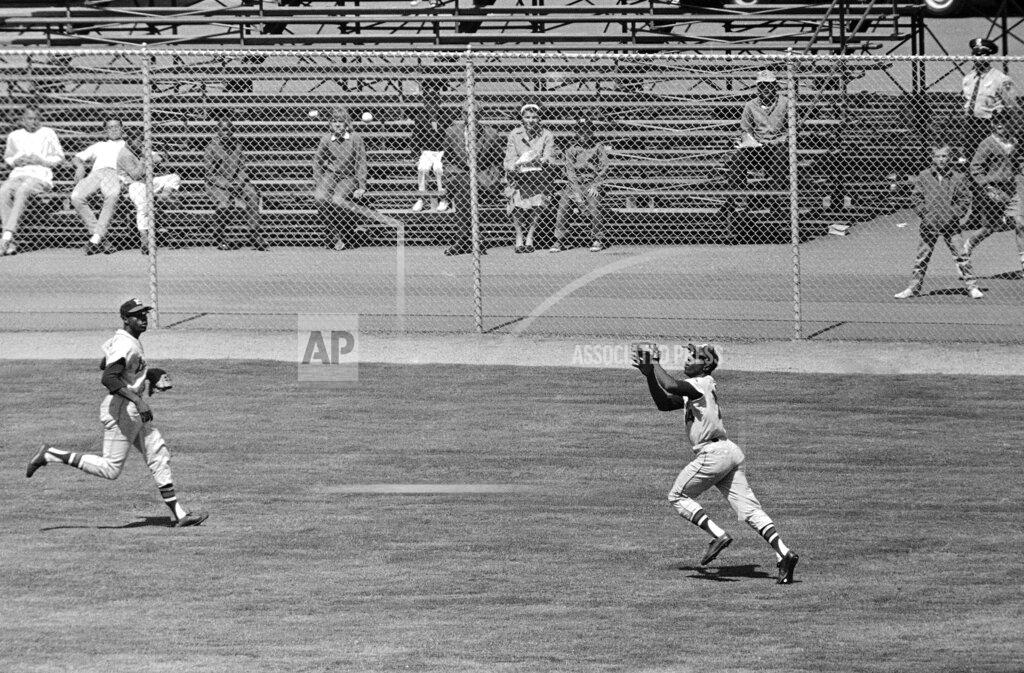
Denny McLain, a 20‐year-old right-hander, limited the Kansas City Athletics to three hits tonight as the Detroit Tigers downed Kansas City, 5–1. McLain, the son‐in‐law of Lou Boudreau, gave a home run to Rocky Colavito, his 28th, in the second inning. McLain fanned eight batters. Detroit scored three runs off Diego Segui in the first and added two more off Ken Sanders in the seventh. Singles by Jerry Lumpe, Gates Brown and Bill Freehan and Al Kaline’s doule accounted for first‐inning runs. A double by Don Wert, a walk to Bill Bruton, an error by Sanders and Kaline’s sacrifice fly produced the runs in the seventh.
Dave Morehead and Dick Radatz combined to check the second‐place White Sox on five hits today for a 5–2 victory. The Boston Red Sox triumph, only its fourth in 17 games with Chicago, snapped a five‐game Red Sox losing string and cost the White Sox valuable ground in their three-way struggle with Baltimore and New York in the American League. Morehead gained credit for his seventh victory though he had to be lifted in the seventh inning whin he broke a blister on his pitching hand.
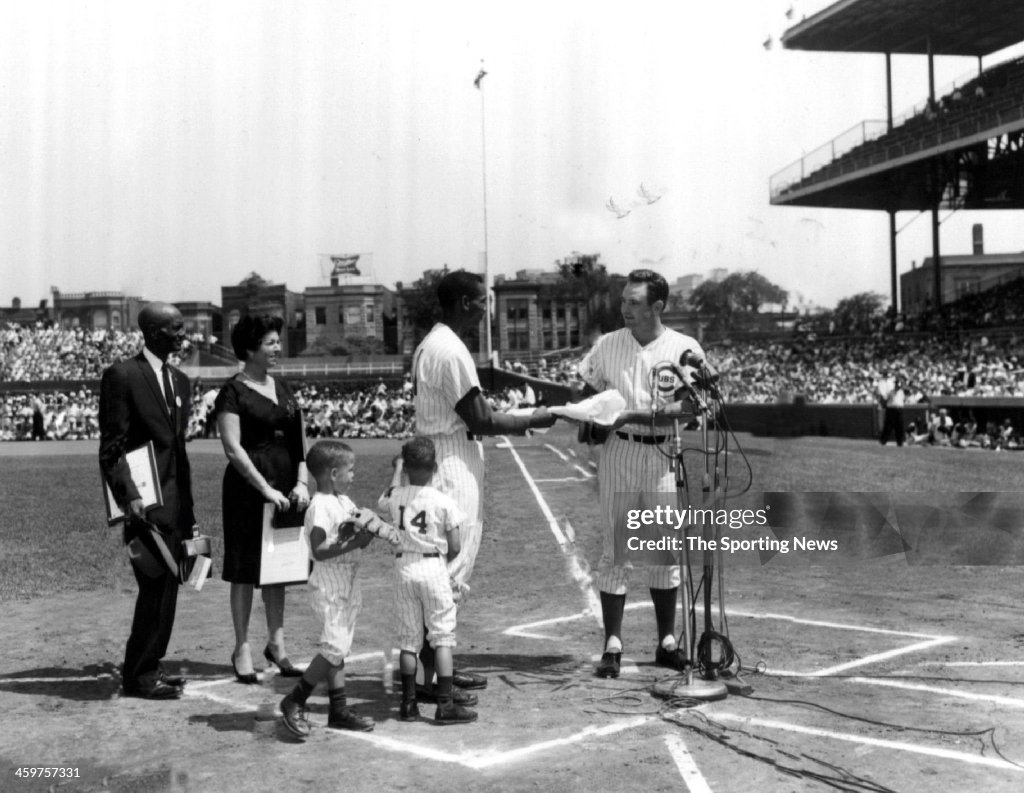
Mayor Daley declares “Ernie Banks Day” in Chicago and 26,000 fans cheer the Cubs’ slugger. Banks then goes hitless as Pittsburgh wins 5–4. Donn Clendenon’s infield single with two out in the ninth inning scored Bob Bailey today to give the Pittsburgh Pirates the victory. The Cubs scored all their runs in the fourth when Billy Williams and Billy Cowan each slugged two‐run homers. It was the 26th homer of the year for Williams. Bailey and Roberto Clemente hit homers for Pittsburgh, both coming off Dick Ellsworth in the first.
The Philadelphia Phillies turn a second-inning triple-play in their 8-1 win over the New York Mets at Shea Stadium. The Phillies sent 10 men to bat in the first inning. Five of them hit safely and six of them scored. The New York Mets contributed two glaring errors in the inning.
Timely hitting by Bob Aspromonte and clutch pitching by Don Nottebart and Hal Woodeshick pushed the Houston Colts to a 7–4 victory over the Cincinnati Reds tonight. Aspromonte led Houston’s 13hit attack and drove in four of the Colts’ runs with four singles in five times at bat. Two of his hits came after intentional walks to Walt Bond. Vada Pinson put on a oneman show for the Redlegs, hitting his 16th and 17th home runs of the season and driving in three of the Reds’ runs.
Duke Snider’s pinchsingle in the eighth inning sent in the winning run today as the San Francisco Giants edged the Milwaukee Braves, 8–7. Snider’s single, a soft, liner to center, followed a 410‐foot triple by Jim Hart that greeted Bob Sadowski, the fourth Milwaukee pitcher. The Braves had erased a Giant lead and moved ahead, 7–6, on two‐run homers by Ed Mathews and Henry Aaron in a five‐run fourth inning.
American long jumper Ralph Boston sets a world record, jumping 27′ 3½” (8.31m) at Kingston, Jamaica.
Born:
Melinda Gates [as Melinda Ann French], American philanthropist, wife of Bill Gates and co-founder of the charitable organization, the Bill & Melinda Gates Foundation; in Dallas, Texas.
Jeff Huson, MLB shortstop, second baseman, and third baseman (Montreal Expos, Texas Rangers, Baltimore Orioles, Milwaukee Brewers, Seattle Mariners, Anaheim Angels, Chicago Cubs), in Scottsdale, Arizona.
Robert Moore, NFL safety (Atlanta Falcons), in Shreveport, Louisiana.
Joe Peterson, NFL defensive back (New England Patriots), in San Francisco, California.

 History Diaries