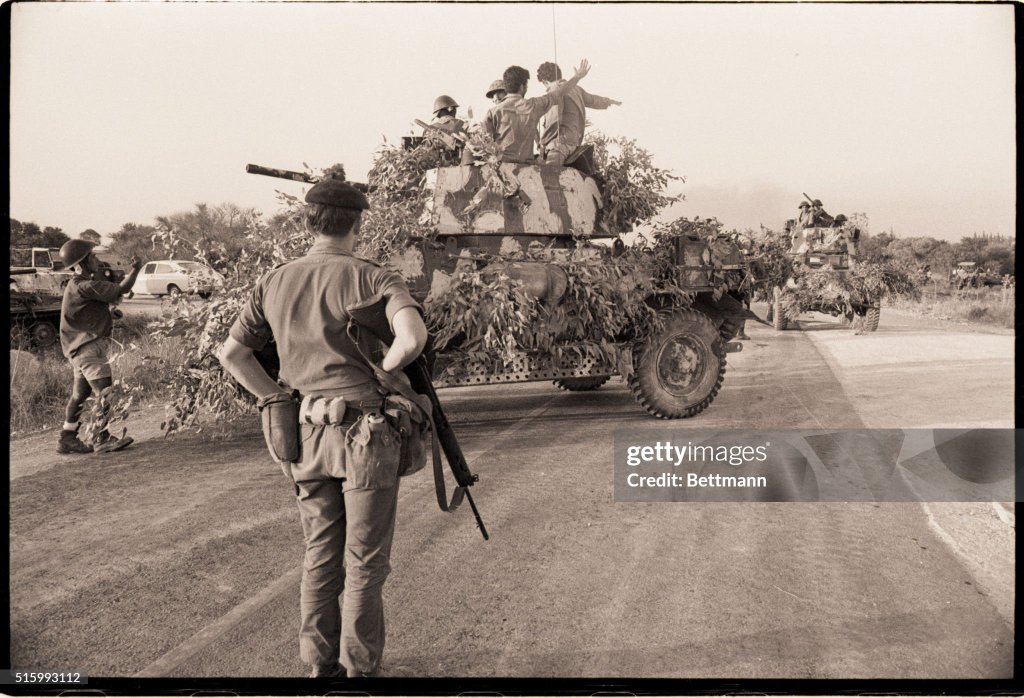
Premier Konstantinos Karamanlis of Greece told his country that the government would not go to war over Cyprus. He said that Greece could not land troops on the island because it was too far away, and that Turkey already had an overwhelming military advantage. An invasion, the Premier said, could not be attempted without the risk of weakening the defense of Greece.
The Turkish forces moved east and west across northern Cyprus in an attempt to cut the island in two. In the east, armored columns entered the port city of Famagusta, and in the west other forces appeared headed toward Morphou Bay. Greek Cypriots could not match the Turkish military force and as their resistance dwindled, thousands of Greek Cypriot civilians fled their overrun villages and towns to the safety of the south. Early this morning, there were believed to be still some pockets of Greek resistance in Famagusta, but the Turkish forces had made a junction in at least the Turkish Cypriot quarter of the city. In northern Cyprus, meanwhile, it was believed the Greek Cypriot National‐Guard had received orders to withdraw without a fight and leave the area to the Turkish Army.
Military sources said today that the Turkish objective on Cyprus was to gain central of a line stretching across the island from Famagusta on the east to the Bay of Morphou on the west before accepting a cease fire ordered by the United Nations Security Council. This area, including the Turkish, or northern, sector of Nicosia, would then be the basis for any negotiation with Greece and the Greek Cypriot community on the geographical division of areas under Greek and Turkish Cypriote administration, the sources said. They said the Turkish drive for Famagusta was designed to cut off Greek Cypriot forces, numbering several thousand men, that had taken up positions between Kythrea and the northern coast. This was the main remaining Greek‐led defending force on the island. The military sources said during the day that advance groups of a Turkish armored column had made contact with Turkish Cypriots within the walled city of Famagusta.
Turan Güneş, the Turkish Foreign Minister, and Rauf Denktash, leader of the Turkish Cypriots, said today that the Turkish com munity of Cyprus must have its own area on the island. Mr. Güneş and Mr. Denktash, the last of the participants in the Cyprus peace talks to leave Geneva, departed late this afternoon for Ankara. Taking to newmen at the airport, Mr. Güneş said that the 110,000 Turkish Cypriots who live scattered in Cyprus “must have an area that is economically administratively and demographically viable.” Mr. Güneş defended the resumption of hostilities after the collapse of peace talks by accusing the Greek Cypriots of, continuing their policy of seeking to exterminate the Turkish Cypriot population. “War is bad,” he said, “but genocide, more or less hidden and being carried out in stages, is just as bad.”
The United States has informed Greece, Turkey and Cyprus of its willingness to take an active mediating role in ending the Cyprus crisis and asked for suggestions on how to resume peace talks.
At least 20 persons were killed and many more injured when a passenger train jumped the tracks and crashed on a bridge at Luttre, Belgium. One car of the eight-coach train jammed the bridge and teetered perilously over the water of the Charleroi Canal while another plunged upside down on the bank of the canal, hurling some of the victims into the water. Two coaches caught fire. Most of the passengers, on the domestic run from Charleroi to Antwerp, were believed to be Belgians. Police said 97-degree temperatures may have buckled the tracks. and caused the accident.
A tip in May by an underworld informant to a French detective led to the seizure in New York of 165 pounds of heroin smuggled into the country inside copies of Louis XIII furniture. Five persons, four of them French, were arrested.in New York, while French police followed up the New York arrests by detaining for questioning five more alleged drug traffickers in Nice and Marseilles. The heroin is worth $2.25 million in New York’s illicit wholesale market.
Rabbi Meir Kahane, former leader of the militant Jewish Defense League, said in New York that Secretary of State Henry A. Kissinger would be the target of a series of demonstrations because of Kissinger’s handling of the Mideast crisis and his alleged failure to aid Soviet Jews. “It’s about time the myths of Kissinger as savior of Israel and the Free World are punctured,” Kahane said upon his arrival at Kennedy Airport from Tel Aviv.
Princess Anne on her 24th birthday was honored by Queen Elizabeth II for bravery during the attempt to kidnap the princess near Buckingham Palace last March. Anne was appointed a dame grand cross of the Royal Victorian Order. Her husband, Captain Mark Phillips, was named a commander. Rowena Brassey, the princess’ lady in waiting who also was in the royal car, was also made a member of the order, fourth class.
The British travel operator Court Line, and its subsidiaries Court Line Aviation, Clarksons Travel Group and Clarksons Travel Group, ceased operations as the Court Line Group went bankrupt. More than 49,000 tourists were left stranded with no means of returning home from vacation, but would be rescued by Court Line’s competitors who organized an airlift, at no additional cost to the tourists, through the Tour Operators’ Study Group.
The Israeli government defeated an opposition attempt in the Knesset (parliament) to call an immediate national referendum on the future of the occupied West Bank of Jordan. The center-right opposition Likud, which opposes the return of the territories taken during the 1967 war, suggested that a national poll be held now “to prevent the government from surrendering any area during its negotiations with the Americans and Arabs.”
Hurricane and floods ravage Bangladesh, 4,000 are killed. A tidal wave slammed into the southern coastline of Bangladesh in the wake of disastrous floods. The tidal wave, whipped up by a storm with 40 m.p.h. winds, submerged the port town of Chalna and inundated part of the town of Khulna. No loss of life was reported. The Bangladesh Planning Commission estimated a loss of 1.1 million tons of food grain in the floods. Affected by the floods are about 36 million people and 20,000 square miles of land.
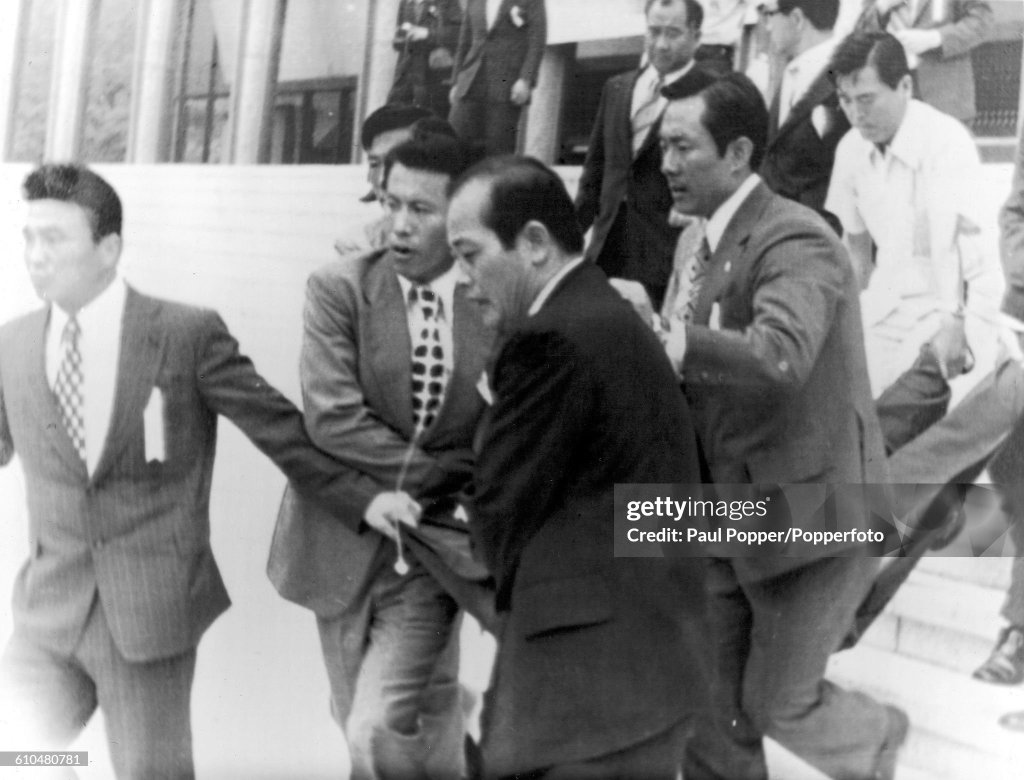
President Park Chung Hee of South Korea escaped unhurt this morning when a man shot at him while he was speaking at national day ceremonies in Seoul. The man was immediately shot and seized by security men. The President’s wife was struck in the head and least one other person, a high school choir singer, was wounded by return fire. Mr. Park continued his speech afterward.
The 48-year-old wife of President Park Chung Hee of Korea died today from an assassin’s bullet evidently intended for her husband. Yuk Young-soo, 48, the wife of South Korea’s President Park Chung Hee, was fatally wounded during an attempt by a Japanese-born North Korean sympathizer, Mun Se-gwang, to assassinate President Park. The event occurred as the President was giving a speech at the National Theater of Korea in Seoul for National Liberation Day. During the gun battle that followed, a bullet fired by one of the president’s guards ricocheted and killed Jang Bong-hwa, a member of a high school choir performing at the event. Mrs. Park had two daughters and a son. After the shooting and Mun’s arrest, President Park resumed his address. President Park would be assassinated in 1979.
South Vietnamese troops battled Communist forces 20 miles north of Saigon today in what the government military command said was the closest major fighting had come to the capital in more than two years. Another battle was reported 25 miles farther north. A communiqué from the South Vietnamese command said government forces had repulsed both attacks. A command spokesman said Saigon had not been threatened by the fighting. The communiqué estimated that 400 North Vietnamese troops had been killed, most of them by air and artillery strikes, but independent sources said the estimate appeared to be high. The Saigon command said 15 government soldiers had been killed and 52 wounded. The command said North Vietnamese troops, supported by tanks, moved in behind an artillery barrage shortly before dawn and attacked positions near Phú Cường, 20 miles north of the capital.
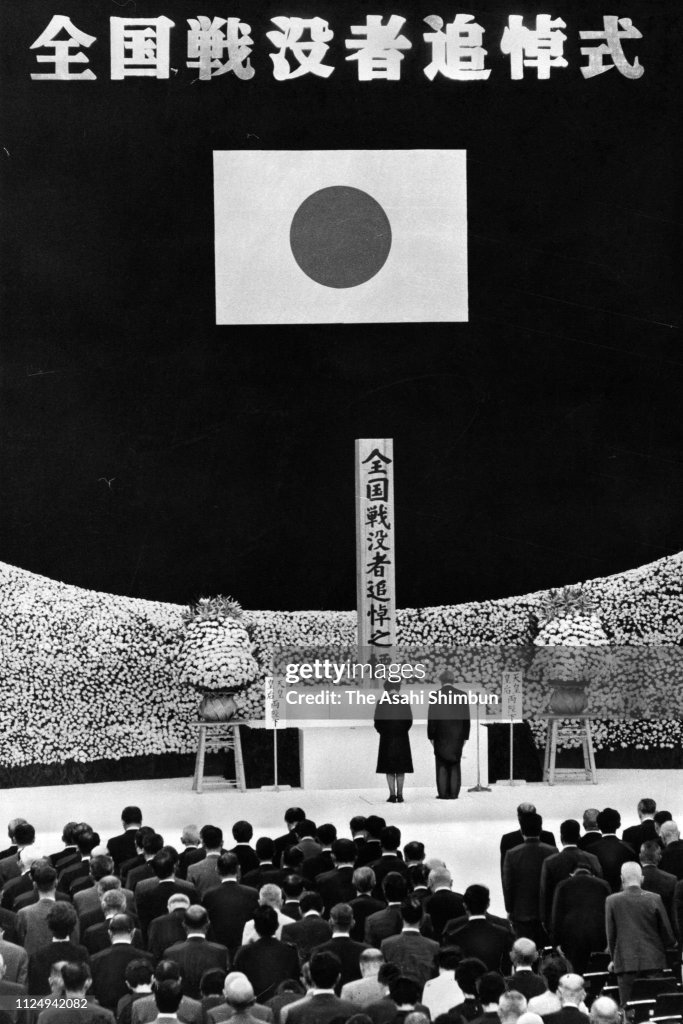
Emperor Hirohito led his people in paying tribute to the 3.1 million Japanese dead of World War II in ceremonies in Tokyo marking the 29th anniversary of the nation’s surrender.
The Toronto Zoo, with an area of 287 hectares (710 acres) and the largest in Canada, opened to the public.
A ship’s captain and a crewman, both from New York were sentenced in Nassau, Bahamas, to four years in prison for the smuggling of what officials say is a record 3,700 pounds of hashish with a reported value of $15.5 million. Terry Daniels, 36, captain of the freighter Sea Trader, and engineer Louis Tomiselli, 24, were also ordered to pay $5,000 fines or serve an additional 18 months in Fox Hill prison.
Fifty-eight Ecuadorian stowaways, who arrived in New York hidden in the hold of a cargo ship, have been given a free ride back to Guayaquil, Ecuador, aboard a chartered Braniff Airlines DC-8 and guarded by 15 private security guards. The men were discovered 36 hours earlier as the ship Santa Elena docked in Brooklyn. Prudential Lines, owners of the Santa Elena, spent nearly $60,000 for the jet and other expenses.
France performs a nuclear test at Mururoa Atoll in the Pacific Ocean.
Former President Nixon was subpoenaed to testify in the forthcoming Watergate cover-up trial as a defense witness for John Ehrlichman, who had been Mr. Nixon’s chief domestic affairs adviser. The effectiveness of the subpoena was uncertain, however, because Mr. Nixon faces possible prosecution on charges in the Watergate case. In response to delay motions by several indicted Watergate defendants, Leon Jaworski, the special Watergate prosecutor, told Federal District Court Judge John Sirica that “reasonable” delay in the cover-up trial was warranted. The trial had been scheduled to start Sept. 9.
Members of the American Bar Association at their convention in Honolulu unanimously approved a resolution intended to discourage a grant of immunity from criminal prosecution to Mr. Nixon. The resolution, unopposed by the association’s 340-member House of Delegates, proposes that laws should be enforced impartially, regardless of the “position or status” of any alleged violator.
President Ford today chose Philip W. Buchen, his former law partner, as his counsel in charge of all legal matters. Mr. Buchen’s appointment came as the White House announced the resignation of J. Fred Buzhardt Jr., the last of former President Nixon’s Watergate attorneys, from the Presidential legal staff. Mr. Nixon’s other chief Watergate attorney, James D. St. Clair, left the White House staff yesterday to return to private practice in Boston.
The possibility that someone was sneaking false statements into the Congressional Record under the names of lawmakers set off an investigation by House leaders. False statements attributed to two Republican members of the U.S. House of Representatives appeared in the Congressional Record, the official record of U.S. Congress proceedings and debates. In today’s Record, Representative Earl Landgrebe of Indiana, who had supported President Nixon during the Watergate scandal, was represented as recommending that President Ford appoint Nixon as Vice President and then resign. Representative John M. Ashbrook of Ohio supposedly praised the military dictatorship of Chile. Both men denied making the statements and asked for them to be expunged from the permanent bound version of the Congressional Record.
The House, voting 202 to 197, barely sustained the concept of federal mass-transit subsidies, and then voted to require municipalities to put up $2 for every federal subsidy dollar. Both votes reflected wide disinclination by Congressmen to be responsible for saving New York City’s 35-cent fare. Debate on the $20.4 billion bill, which the House is expected to trim sharply, was carried over to Monday.
The House of Representatives gave final Congressional approval today, 377 to 21, to a compromise $11.2‐billion housing bill, the first major housing measure to pass Congress since 1968. Representative William B. Widnall of New Jersey, the ranking Republican on the Banking and Currency Committee, told the House that he expected President Ford to sign the bill. Before the housing bill was sent to the White House, Democratic leaders of the House and Senate agreed at a closed meeting to push for final adjournment of the 93d Congress in early October.
The housing bill, which was worked out last week by Senate‐House conferees and passed the Senate, 84 to 0, on Tuesday, would continue for two more years programs for home ownership and rent subsidies for low‐income families that the Nixon. Administration had sought to replace. However, the measure also contained a major feature sought by the Nixon Administration to give localities more flexibility in the spending of Federal housing funds.
The Senate approved and sent to the White House three appropriations bills totaling $13.3 billion. And the Senate Appropriations Committee approved another money measure of $21.2 billion, of which about $14 billion is for the Veterans Administration. One of the approved bills, of nearly $3.3 billion, includes funds for the Transportation Department. A second measure includes $1.74 billion for the Atomic Energy Commission and $2.24 billion for public works projects. The third bill would fund the Treasury Department at $2.27 billion and the U.S. Postal Service at $1.5 billion. With the bills passed, Senate Majority Leader Mike Mansfield of Montana said he and House Speaker Carl Albert of Oklahoma were shooting for adjournment between October 1 and October 15.
Seeking to restrict the long expansion of Presidential power, a special Senate committee is expected to introduce next week legislation to repeal wideranging Presidential emergency authority and establish new standards of public accountability by the President. Under emergency proclamations dating as far back as 1933 and still in force, the President has the legal power to Censor the air waves, institute martial law, take over office buildings, seize commodities and control ships, planes and trains. Under existing law, the President is not required to inform Congress or otherwise publish his decisions and orders unless he alone designates these decisions as either “Executive orders” or “Presidential proclamations.” In the words of the report of the Senate Special Committee on National Emergencies and Delegated Emergency Powers: “There is no formal accountability for the most crucial executive decisions affecting the lives of citizens and the freedom of individuals and institutions.”
Acting with unusual speed, both the Senate and the House moved closer today toward creating the cost of living panel that president Ford requested to help fight inflation. By voice vote, the Senate Banking Committee approved a bill creating the agency. Earlier in the day, the House Banking Committee voted 27 to 7 for virtually the same bill. Both House and Senate are to take up the bill Monday, and it should go to Mr. Ford for his signature early next week. Senator John Sparkman, Democrat of Alabama who is chairman of the Senate Banking Committee, said he hoped to win speedy approval by the full Senate.
A group of doctors from the Food and Drug Administration told a congressional panel they were frequently harassed and disciplined by superiors when reporting adversely on new drugs. Six of the 11 said they were transferred away from their field of expertise after speaking out against certain drugs and other substances under review. Several said their unfavorable reports were later changed without their consent. The testimony came before a joint meeting of Senate, labor and welfare and judiciary subcommittees investigating the pharmaceutical industry. The FDA had no immediate comment on the accusations.
Citing a growing consumer interest, the Treasury Department has asked Congress to legalize the home brewing of beer. Under a proposal sent to the Senate Finance Committee, anyone 18 years or older would be allowed to brew 100 gallons of beer each year for personal consumption. In homes with more than one adult, the limit would be 200 gallons. At no time, however, could a household have more than 20 gallons on hand, including what was brewing. It is legal to make wine at home but the law has no provision for beer.
The four months of December through March would be exempted from daylight saving time in an amendment to an energy research. bill adopted by the Senate. By voice vote, the Senate acted to end the permanent, year-long daylight saving time enacted at the height of the energy crisis last winter: The Senate then passed by voice vote the Energy Reorganization Act of 1974 after adding, 78 to 0, an amendment by Senator Henry M. Jackson (D-Washington) to provide a 10-year, $20 billion program of non-nuclear energy research and development.
The decommissioned U.S. Navy aircraft carrier USS Yorktown (CV-10/CVA-10/CVS-10) is donated as a museum ship, to be maintained at Patriots’ Point, South Carolina.
Gaylord Perry, with relief help from Tom Buskey, snapped his six‐game losing streak tonight as the Cleveland Indians beat the Minnesota Twins, 4–2. Frank Duffy’s bases‐loaded single drove in two runs in the sixth inning to help Perry to his 16th victory against seven defeats. Perry, who had not won since July 3, when he had stretched his consecutive winning streak to 15 games, struck out two, walked two and allowed five hits before giving way to Buskey in the eighth. The Indians staked their star pitcher to a 1–0 lead in the third, Tom McCraw opened the inning with a double down the left‐field line, took third on Duffy’s sacrifice and scored on Jack Brohamer’s grounder, beating the throw to the plate. Tony Oliva 11th homer of the season and the 16th served up by Perry this year tied the score in the fourth. But a double, by John Ellis and a pair of walks off Bert Blyleven, the Minnesota starter, set the stage for Duffy’s single in the sixth.
Earl Williams and Paul Blair hit home runs in support of Mike Cuellar’s six-hit pitching as the Baltimore Orioles’ left‐hander beat the Chicago White Sox, 2–1, tonight for his first victory since July 20. The Orioles failed to score in the third inning, despite loading the bases with one out, but Williams connected an inning later for his ninth homer of the season and Blair slammed his 13th in the fifth, off Jim Kaat. Cuellar, now 14–9, ended a three‐game losing streak and struck out a personal seasonhigh of 10, including Dick Allen three times. He yielded a run in the seventh on two walks and a single by Buddy Bradford. In addition to his homer, Blair prevented two Chicago runs with a sparkling fifth-inning catch. With runners on first and third, Blair raced back to make an over-the‐shoulder grab of Jorge Orta’s drive.
Larry Milbourne, second baseman for the Houston Astros, dropped Steve Swisher’s bases‐loaded popup for a two‐run error in the eighth inning that gave the Chicago Cubs a 5–3 victory today. Billy Williams started the winning rally with a single — the 2,500th hit of his career. Andy Thornton walked and Jerry Morales singled, tying the score. Jim York replaced Ken Forsch as the Houston pitcher and walked Bill Madlock intentionally to load the bases. He struck out George Mitterwald before Milbourne dropped Swisher’s routine popup, allowing Thornton and Morales to score.
Dow Jones Industrial Average: 737.88 (-2.66, -0.36%).
Born:
Natasha Henstridge, Canadian film and TV actress (“Species”, “Maximum Risk”, “She Spies”), in Springdale, Newfoundland and Labrador, Canada.
Ramón Morel, Dominican MLB pitcher (Pittsburgh Pirates, Chicago Cubs), in Villa Gonzalez, Dominican Republic.
Cao Yu, award-winning Chinese cinematographer (“Kekexili: Mountain Patrol”, “Legend of the Demon Cat”), in Beijing, Peoples’ Republic of China.
Died:
Yuk Young-soo, 48, wife of South Korean president Park Chung-Hee, murdered in an assassination attempt on her husband
Otto Braun (aka “Li De”), 73, German communist journalist, Comintern agent and military adviser to the Chinese Communist Party during the Chinese Civil War.
Clay Shaw, 61, American businessman and CIA contact, the only person brought to trial for involvement in the assassination of John F. Kennedy, died of metastatic lung cancer. Shaw had been indicted and arrested in 1967 on the prosecution of New Orleans District Attorney Jim Garrison on charges of conspiracy, but acquitted by a jury.
Edmund Cobb, 82, American actor who appeared in 620 films during his 50-year career, primarily in westerns as a villain’s henchman (“A Final Reckoning”, “Motorcycle Gang”, “Comanche Territory”), of a heart attack.
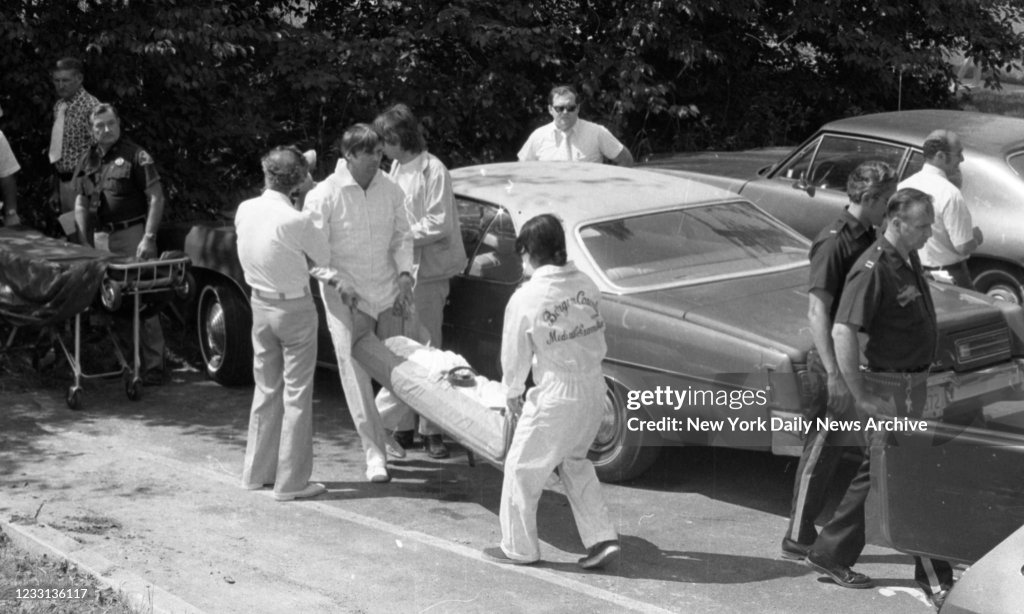
[Ed: The case remained unsolved for decades. In 2021, notorious serial killer Richard Cottingham, 74, sat in a wheelchair in beige prison scrubs as he pleaded guilty to kidnapping the teenage girls and raping them for days before he drowned them in a motel room bathtub.]
 History Diaries