Ninety U.S. and 12 South Vietnamese helicopters airlift about 1,000 ARVN troops close to a Việt Cộng base near Ấp Bo Cang, while other ARVN ground troops converge on the area. Every available helicopter in lower South Vietnam was called on for one of the largest airborne assaults in the war against the Việt Cộng. First reports indicated little contact with the Việt Cộng, but a battle of several days was expected. A United States Army first lieutenant was shot and killed as he piloted his helicopter on a strafing pass over Communist positions. Two other American crewmen were reported wounded in the assault. Captain Robert Estes of Anson, Maine, a friend of the lieutenant, said he “was the seventh pilot in our class of 50 to be killed in Vietnam.” Major Ralph Irvin of Redding, California, commander of the lieutenant’s company, piloted another helicopter, which was hit by Communist ground fire.
The operation had been delayed by ground fog but when the fog lifted, the helicopters and some propeller‐driven fighter planes moved in on the jungle objective, about 48 miles northwest of Saigon, near the Cambodian border. The unarmed troop‐transport helicopters dropped smoke grenades wherever they drew ground‐fire, pinpointing targets for the armed helicopters. In the jungle, scores of smoke bursts erupted, and tracer bullets arched toward the helicopters. Machine guns in the fast‐moving helicopters chattered, and rockets roared from their pods. Troop‐carrying helicopters touched down for six seconds, just long enough to unload their men. Only a few troops reported enemy contact. “In this mess of jungle, there could be 2,000 or 20,000 Việt Cộng hiding, and we’d never see them,” an American paratroop adviser said. Việt Cộng antiaircraft batteries continued to hammer under their canopy of foliage.
But the 2,000-man guerrilla force slips away, and only four Việt Cộng are killed, while one U.S. helicopter is downed.
Presidential candidate Barry Goldwater charges that President Johnson’s ‘admonition’ to U.S. naval commanders during the crisis authorized them ‘to use any weapon necessary,’ which he claims includes nuclear weapons. Goldwater claims that this, plus Johnson’s ‘impulsive action’ in Vietnam takes the sting out of charges that he is the impulsive individual who might resort to nuclear warfare. Rusk and McNamara immediately deny that Johnson authorized the use of nuclear weapons and label Goldwater’s charge ‘both unjustified and irresponsible.’
In an attempt to neutralize resistance, the Việt Cộng distribute leaflets claiming they will fire only on South Vietnamese units accompanied by U.S. advisers; this promise is soon broken.
General Maxwell D. Taylor, reporting on his first month as United States Ambassador to South Vietnam said today that further measures would be necessary to cut off Communist North Vietnam’s support for the Việt Cộng insurgents. “We must do better in restraining the capability to reinforce the Việt Cộng from the outside,” he told an auditorium full of Vietnamese and foreign correspondents. He declared that “only time will tell” whether insurgency can be crushed as long as the North Vietnamese supply base remains available to the Việt Cộng. “If we are more successful in closing the frontier, which has been the case in other areas threatened by subversive insurgency, then it will be possible,” he asserted. “But I think it is an open question at the moment,” he added.
General Taylor spoke rapidly and frankly, avoiding any sweeping phrases of optimism and pointing rather to the problems continuing to face the United States and South Vietnamese war effort here. “Until we have a government that lasts for a year or two and proves itself, I think it is very difficult to make a forecast about whether we can control the in‐country problem,” he said.
The Ambassador declared that over‐all reports for July seemed to indicate “an upward turn” in the general war effort, although he said earlier in a prepared statement that the status of the pacification program — the principal strategy for defeating the insurgents in the hamlets and provinces of South Vietnam — was uneven. “It has barely begun in some provinces long under heavy Việt Cộng influence,” he said. ”It is virtually complete in a few provinces where the Vietcong threat has never been great” General Taylor said that Premier Nguyễn Khánh’s leadership after two coups d’état was an encouraging sign. “Under his leadership we see the beginning of unity in government and increased effectiveness in the conduct of military operations,” the Ambassador said.
Marshal Chen Yi, Foreign Minister of Communist China, voiced support today of North Vietnam’s stand in opposing United Nations investigation of the Gulf of Tonkin incidents. In a letter to Xuân Thủy, the North Vietnam Foreign Minister, Marshal Chen implied that the Soviet Union should have opposed the Security Council discussion of the incidents.
The Security Council has before it a complaint by the United States that North Vietnam committed “deliberate aggression” last week in attacking American destroyers in the Gulf of Tonkin. Marshal Chen’s letter was in reply to recent letters and statements issued by Hanoi including statement made public earlier this week in which North Vietnam rejected a Security Council request to take part in discussion or to submit information about the torpedo boat attcks and a retaliatory United States air strike. Both the United States and the Soviet Union were party to the request.
In rejecting the Security Council’s overtures, North Vietnam followed Peking’s lead. The Chinese Communists declared over the weekend that the United Nations had “no right whatsoever to interfere in Indochina.” Asserting that the United States was making active preparations for extending the war in South Vietnam, Marshal Chen said the situation was ”still of utmost gravity.”
“While making a surprise attack on the Democratic Republic of Vietnam, it had the audacity to bring before the United Nations Security Council, a so‐called complaint against the latter,” he said. The United States, he said, aimed to “use the United Nations to legalize a fait accompli of its aggression” against North Vietnam. The Foreign Minister continued: “Naturally, the Democratic Republic of Vietnam cannot possibly agree with this nor should any Socialist country agree with it.” This was regarded as a rebuke aimed at Moscow.
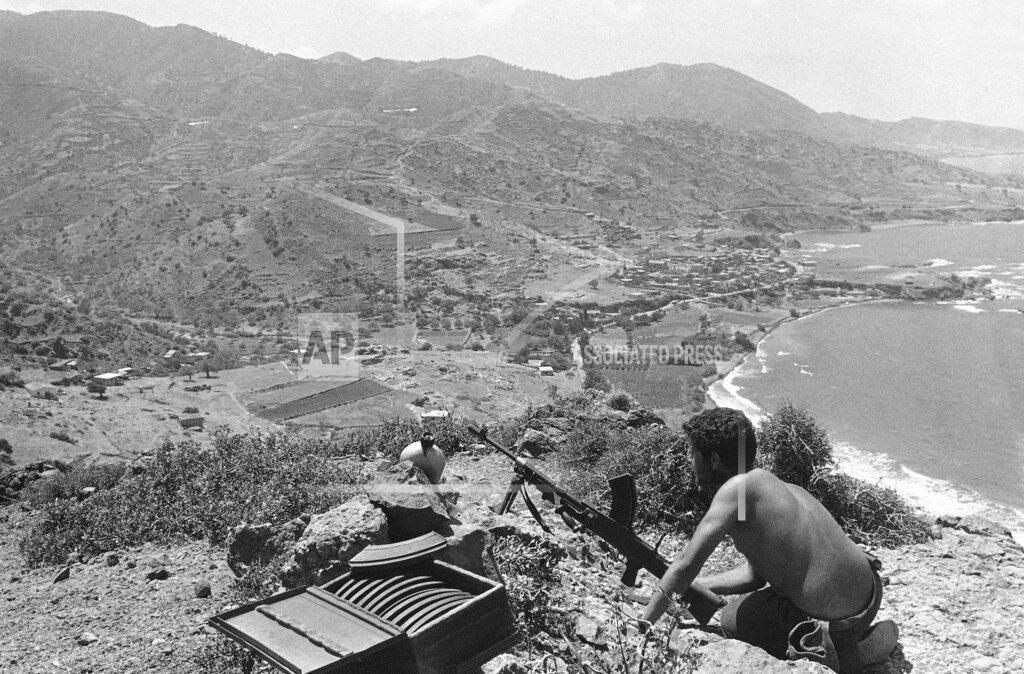
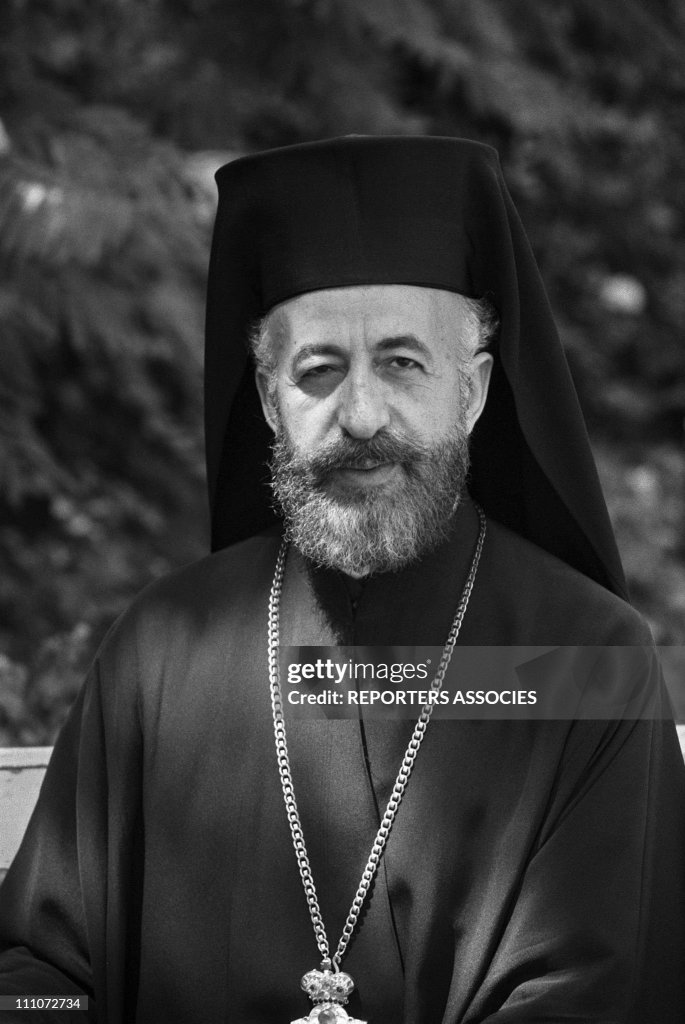
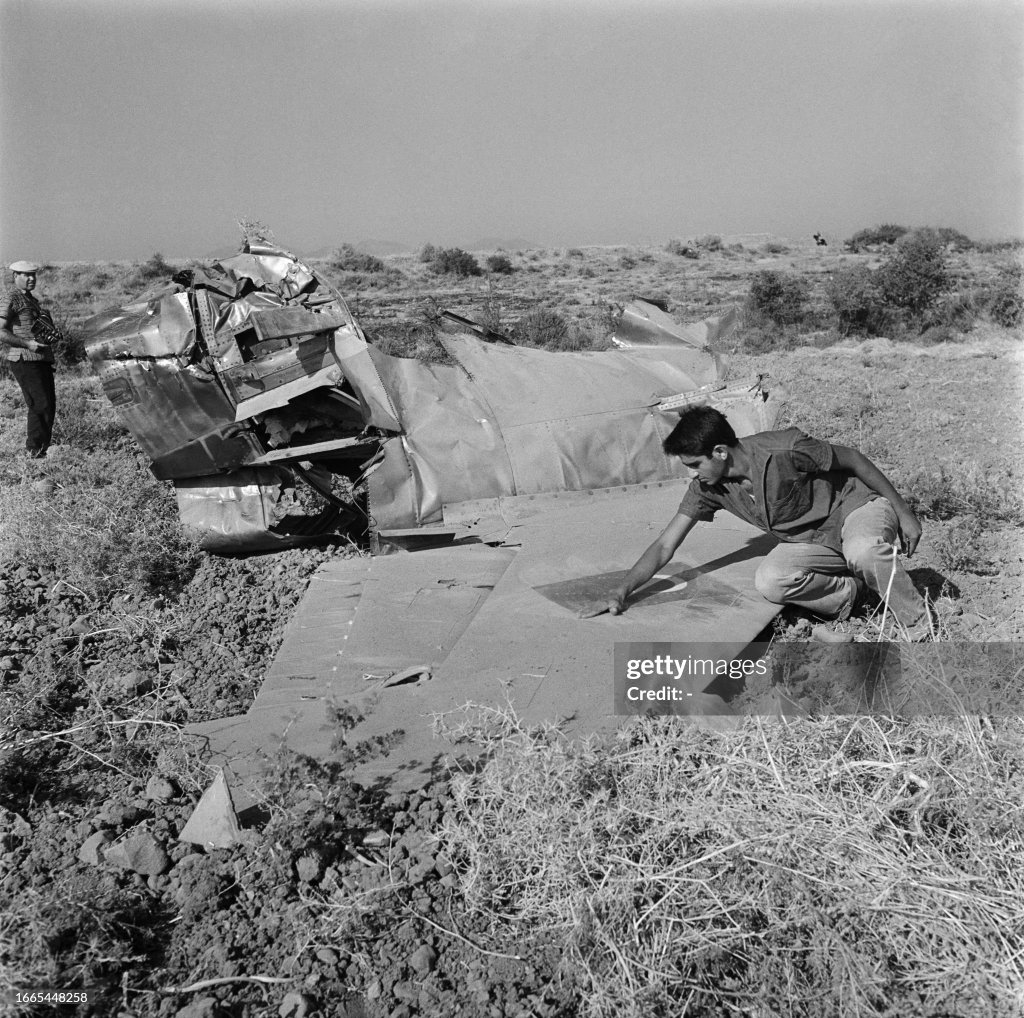
The Turkish Government agreed tonight to a request by the United Nations Security Council to cease aerial reconnaissance over Cyprus. There was one flight over Cyprus today, made before the United Nations statement was received, the Foreign Ministry said. The Foreign Minister, Feridun C. Erkin, said Turkey was halting the flights to make the task of the United Nations force in Cyprus easier. Archbishop Makarios, President of Cyprus, had bitterly attacked the Turkish reconnaissance missions as an infringement upon Cyprus’s sovereignty. An assault on Turkish Cypriot villages in the northwestern part of the island a week ago led to Turkish air strikes Friday, Saturday, and Sunday on Greek Cypriot positions.
A cease‐fire was arranged Sunday night. Turkey had agreed to stop the air strikes but reserved the right to make surveillance flights. Today’s decision set into high gear diplomatic machinery for the settlement of the Cyprus dispute. It was hoped here that the Turkish decision would lead to a withdrawal by Greek Cypriot forces from three Turkish villages they had captured in their assault. The Turkish Cypriots retreated to the northwestern coastal village of Kokkina. A Foreign Ministry spokesman said a withdrawal was the only way a “real” cease‐fire could be obtained. The Turkish decision, announced in a broadcast to the nation by Mr. Erkin, came less than 12 hours after receipt here of the Security Council request.
Reliable sources said today that the United Nations was sending reinforcements to the Mansoura‐Kokkina area in northwestern Cyprus in accordance with a Security Council decision last night. These sources said that a general redeployment of the United Nations force was being put into effect by General Kodendera S. Thimayya, the force commander, for the more efficient use of its 6,000 officers and men. It became known today that Adlai E. Stevenson and Sir Patrick Dean, the United States and British representatives, met with the Secretary General, U Thant, before the Council session last night and urged him to instruct General Thimayya to increase the number of United Nations soldiers in the area.
Premier George Papandreou had a sharp disagreement with President Makarios of Cyprus last week over his handling of the crisis and the repercussions are continuing, according to authoritative sources. Following is part of the story that could be pieced together today: Two weeks ago the Greek Premier met with Archbishop Makarios and with George Grivas, the Greek general who commanded the guerrilla forces on Cyprus in the nineteen‐fifteen in their struggle against Britain. The three men agreed that no military operations should be undertaken against the Turkish Cypriots without prior consultation with and consent of the Athens Government.
General Grivas went to Cyprus as an unofficial representative of the Papandreou Government to act as a kind of watchdog. He was also to have command of the Greek soldiers on the island. It has been estimated that there are about 12,000 mainland Greeks under arms on Cyprus. Apparently Athens wanted General Grivas and these soldiers to act not only as a potential reinforcement of the Greek Cypriots in the event of a Turkish invasion but also as a brake on the Greek Cypriots. Fighting between the Greek and Turkish Cypriots started last December after the Greek Cypriots had attempted to amend provisions of the 1960 Constitution granting the Turkish Cypriote minority a veto power over legislation and other safeguards. The move involving General Grivas and the Greek soldiers was welcomed by some Western diplomats, who saw in it a sensible step toward easing the military tensions on the island. In fact, the Greek forces were never committed to battle.
In the meantime, President Makarios had become convinced that the Turkish Cypriotes and the mainland Turks were unable to offer serious resistance to his drive for control of the whole island. Some time last month, according to reliable sources, he and the men around him determined to launch a new push against the most strategic Turkish Cypriot stronghold, the area known as Mansoura, on the northwest coast. This area would be the only practical beachhead for an invading Turkish army. A Greek source declared last night that President Makarios’s forces launched their attack on the Mansoura positions Thursday without having consulted Athens, as had been prescribed in the agreement with Mr. Papandreou. The Greek Premier was infuriated. He sent a message to Archbishop Makarios asking why he had not been informed and urging that the operations be halted.
Greek Cypriot authorities refused today to accept a United States shipment of 2,000 pints of blood plasma flown here at President Makarios request Sunday. Some Nicosia newspapers that have been conducting an anti‐America campaign charged that the plasma was so old its use could be fatal. A United States Embassy spokesman said the plasma was the same as that used by the American armed forces. Each pint has the standard warning label that if it becomes cloudy after shaking it should not be used. The Greek Cypriot authorities said that the first three of 23 bottles handed over to them were bad. They then refused the whole shipment.
The Cypriot Government expelled today a British correspondent, Jack Williams of the British Broadcasting Corporation. A statement said his “absolutely groundless” report that heavy fighting was still under way yesterday could have endangered the peace.
The United States has sent four large C‐130 turboprop transport planes to the Congo to help Premier Moise Tshombe fight the rebellion in his country. The planes are due tomorrow in Leopoldville, the Congolese capital. The C‐130’s apparently will be used to haul Government troops and cargo to combat areas. A brief announcement by the Pentagon said that the planes, with American crews, would be on “temporary assignment for transport functions.” In addition, about 100 United States Army and Air Force men, including 40 paratroopers, are being sent along to maintain and guard the planes at their temporary base near Leopoldville, qualified sources said. The Pentagon announcement said only that the planes would be “carrying their own maintenance and guard personnel with them.”
A Soviet press dispatch listed the Congo today along with Vietnam, Cuba and Cyprus, as an area where American “machinations’ were adding to world tension. Tass, the official press agency, said in a dispatch datelined New York that the United States was bringing pressure on Belgium to intervene directly in military operations conducted by the Congolese Government against rebel forces in the eastern part of the country.
Alice Lenshina, leader of the Lumpa cult whose rampage has cost 500 lives in three weeks, has surrendered to the Northern Rhodesian Government. She is in jail with her husband and two of her five children. Prime Minister Kenneth Kaunda reported to Parliament today that Alice Lenshina had appealed to her followers to end their battle with Northern Rhodesian security forces. Dr. Kaunda said he could not disclose how the cult leader had come into Government hands or where she was at the moment. Reliable sources in Northern Rhodesia said, however, that the family was being held at the Bwana Mkubwa jail, near the Congo border.
Charlie Wilson, who was serving a 30-year sentence for his role in the Great Train Robbery of 1963, escaped from Britain’s Winson Green Prison in Birmingham, apparently with the aid of three accomplices. Wilson, who was only four months into his 30-year sentence, was aided by three men believed to have used a rope ladder to scale a 20 foot high prison wall, tying up a guard, somehow obtaining a key to his cell, and helping him get out. Wilson would be recaptured in Canada in 1968 and would serve 10 years of his sentence. After his release in 1978, he would move to Spain and be murdered in his home in 1990.
Race riots flare in New Jersey. Sporadic violence broke out in Paterson’s Black neighborhood tonight in the face of a warning by Mayor Frank X. Graves Jr. that he would “meet force with force.” It was the second successive night that bottle and rock throwing disrupted this industrial city.
In Elizabeth, 20 miles to the south, racial violence also erupted for the second night. About 700 Blacks were in the streets tonight, some throwing Molotov cocktails and pushing the police. At least 18 persons were arrested. By 3 AM Thuirsday both cities were relatively quiet.
At least 16 persons were arrested in Paterson as small groups of teenagers lobbed wine bottles and rocks at passing cars. In addition, five juveniles were detained by the police. By 1:30 Thursday morning, the police said, four civilians had been injured. Mayor Graves was almost struck by a bottle as he inspected the troubled area. He ordered all taverns in the Black section of town closed by midnight. There was no looting reported. John Kinney, a photographer for The Call, a Paterson newspaper, was struck on the head by a bottle. His yellow helmet was knocked off, but he was not seriously injured.
In one incident, firemen used a ladder to climb to an apartment on the third floor of a building at Governor Avenue and Paterson Street from which a shower of bottles had been hurled at the police. The firemen used pikes to break the windows and then joined the police inside in herding the occupants downstairs to radio cars. Three policemen armed with riot guns guarded Paterson police headquarters, some distance from the Black section. Mayor Graves said at a press conference early this morning the guards were there because “we have reason to believe somebody… would like to seize our communication setup.”
The violence broke out shortly after 9 o’clock last night. The first, bottle thrown shattered against an automobile driven by a Black. Within a few minutes, 50 policemen, part of a force of 200 called into duty to handle the anticipated violence, moved into the neighborhood. They had been cruising in squad cars. The bottles came from a crowd of about 25 Black men who appeared to be in their early 20’s. They had been standing on a street corner for some time, drinking wine. When the bottle smashed against the car, residents of nearby tenements applauded from their windows. About 25 minutes later the window of a nearby grocery was broken, and again there was applause. At least one person was injured seriously enough to be taken to the hospital — a woman who was struck in the eye by a shard of glass.
Black clergymen and civil rights leaders patroled the streets in cars equipped with loudspeakers, urging Black youths to go home. Policemen were firm with Black residents and at one point almost arrested Arthur L. Jones, a 31‐year‐old Black who is a Republican candidate for Alderman from the Fourth Ward, the Black section. Mr. Jones, who had just left a meeting between Mayor Graves and civil rights leaders, was in the area at the request of Mr. Graves in an attempt to halt the disturbances. When he walked up to a group of Black youths, his way was barred by a policeman who said: “Go home or I’ll put you in jail. Get the hell off the street.” Mr. Jones tried to identify himself, but the policeman insisted. Finally, an executive of the National Association for the Advancement of Colored People convinced the patrolman that Mr. Jones was there at the Mayor’s request.
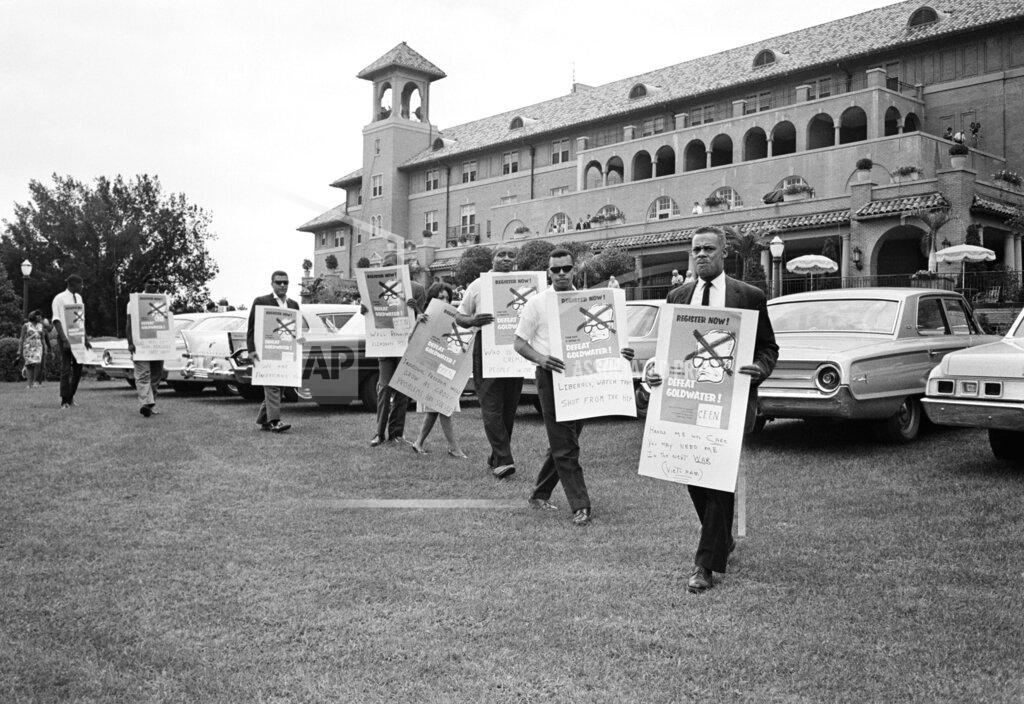
Senator Barry Goldwater offered to Republican leaders today a sweeping set of political reassurances including a promise to consult former President Dwight D. Eisenhower on the appointments of Secretaries of State and Defense. In a speech to a unity conference of party leaders, Mr. Goldwater made what observers considered to be a distinct shift toward the middle of the road. The Republican Presidential candidate repudiated extremist groups and “character assassins.” He expressed support of the United Nations, which he has often criticized, and of the Social Security program. Ha promised not to shirk Federal responsibility in the field of civil rights.
Mr. Goldwater’s speech grew out of a meeting last week at Gettysburg, Pennsylvania, with General Eisenhower and former Vice President Richard M. Nixon, and it embodied “clarifications” of Mr. Goldwater’s controversial opinions, which General Eisenhower had requested. In a news conference after the unity meeting, General Eisenhower said that he had had reservations about Senator Goldwater’s candidacy, that he had asked for clarifications, and was now “satisfied.” Mr. Goldwater, at the joint press conference with General Eisenhower at which Mr. Nixon, the Vice‐Presidential candidate, William E. Miller, and Pennsylvania’s Gov. William W. Scranton also appeared, declined to call his speech “conciliatory,” or to agree that he had made ”concessions.”
In the speech, Mr. Goldwater declared: “I seek the support of no extremist — of the left or the Right.” He said of himself and Mr. Miller: “We repudiate character assassins, vigilantes, Communists and any other group such as the Ku Klux Klan that see kto impose its views through terror of threat or violence.”
Mr. Goldwater also said that President Johnson, in his “admonition” to naval commanders during last week’s Vietnam crisis, had told “subordinate commanders to use any weapons necessary.” When asked if he was saying that it was his impression that Mr. Johnson had authorized military commanders to make the decision as to whether or not to use nuclear weapons, he said his information came from the newspapers, but that “in my book” Mr. Johnson had indicated naval commanders could use “the whole inventory” of weapons if needed.
President Johnson said in New York that this country must follow the path of restraint and law in both foreign affairs and the racial crisis at home. “I am convinced,” he said, “that the same dedication to legal order which will keep the peace in this land will bring us nearer to peace among all lands.” Mr. Johnson spoke to the American Bar Association, which is holding its 87th annual meeting this week. More than 3,000 lawyers and their guests jammed into the Grand Ballroom of the Waldorf‐Astoria to hear him, and thousands more watched on television sets in adjoining rooms. The 21‐minute speech was interrupted by applause 16 times. The loudest response was to Mr. Johnson’s pledge that he would match firmness with restraint in the use of America’s nuclear might.
Some of the President’s words seemed to be aimed at his opponent for the Presidency, Senator Barry Goldwater, but he did not name him. Speaking of the fighting in Vietnam, Mr. Johnson said that some persons “are eager to enlarge the conflict.” He called that view reckless and said it might “risk the lives of millions.” On the racial situation, the President said that law and order can be maintained only if we continue to work “toward racial justice.” Then, in what many took as a shaft at Senator Goldwater, he said: “Those who would hold back progress toward equality, and at the same time promise racial peace, are deluding themselves and the people.”
The strongest emphasis in the speech to the lawyers was on the racial situation. The President condemned by implication both the murders of civil rights workers in the South and the recent Black riots in Northern cities. “No person,” he said, “whatever his grievance, can be allowed to attack the right of every American to be secure in his home, his shop and in his streets. “We will not permit any part of America to become a jungle, where the weak are the prey of the strong and the many. Such acts must be stopped and punished — whether they occur in Mississippi, or in the State of New York.”
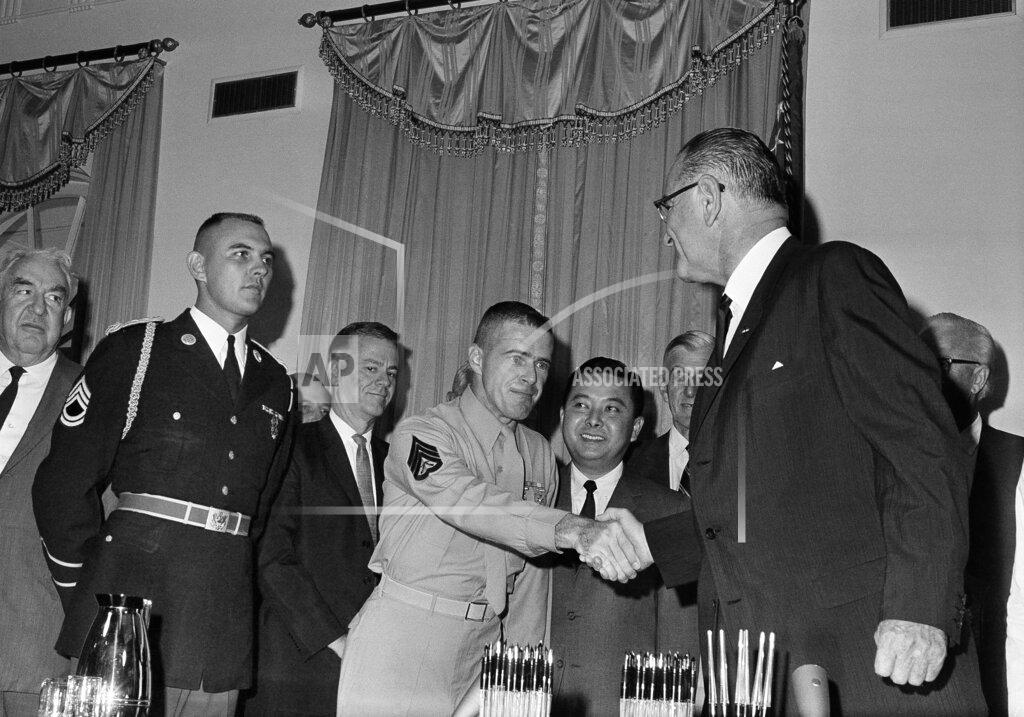
President Johnson today signed the second military pay increase in less than a year. He said the move would give the nation’s service men “the respect they have earned” and help make the military a stable profession. The $207 million increase for more than 1.8 million men and women in the armed forces goes into effect September 1. Mr. Johnson said the nation could not promise comfort to the military, but, he said, “we want them to be able to know their service to America’s defense will not be a disservice to their families’ dignity.” The increase does not apply to lower‐ranking enlisted men with less than two years’ service.
The Senate approved today one of the most important conservation measures in recent years. The vote was 92 to 1. The legislation, a companion piece to the wilderness bill passed by both houses of Congress, would create a largely pay‐as‐you‐go fund to provide outdoor recreation areas and facilities for all Americans.
The “Big Three” American automakers (General Motors, Ford and Chrysler) announced through the Automobile Manufacturers Association that they would introduce vehicle emissions control devices voluntarily in time for the 1966 model year. The move came less than two months after California’s Motor Vehicle Pollution Control Board had forced the issue by licensing devices by four independent vendors for catalytic converters.
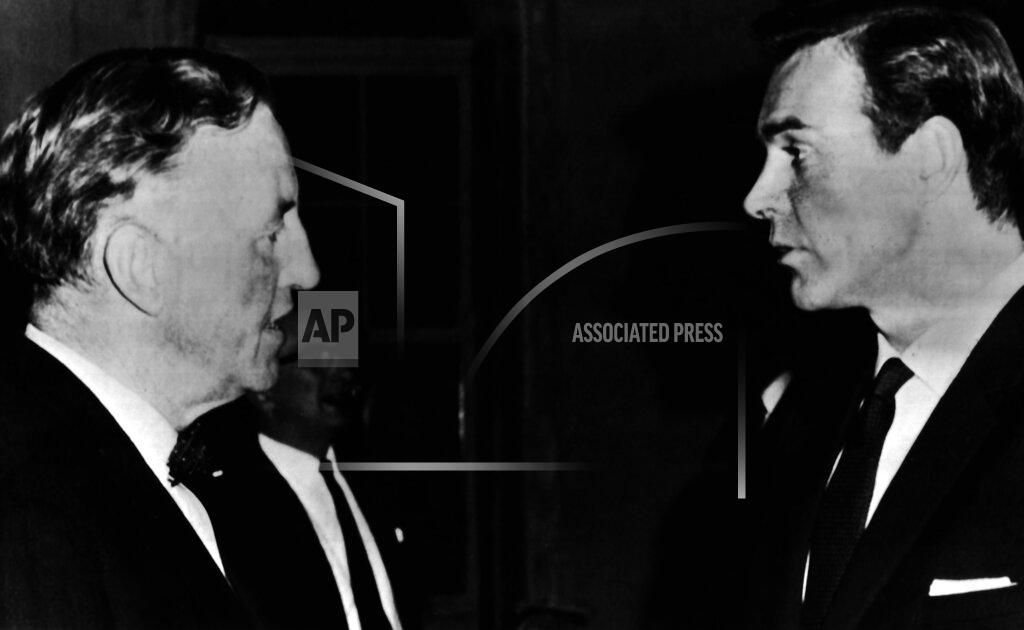
Ian Fleming, the creator of James Bond, Agent 007 of the British Secret Service, died early today in a hospital at Canterbury after suffering a heart attack. He was 56 years old. Mr. Fleming was stricken last night at his hotel in Sandwich, where he was spending a golfing vacation with his wife, Anne Geraldine Fleming, and their son, Caspar, who became 12 years old today.
Sinfonia Sacra, Sir Andrzej Panufnik’s Third Symphony, was given its world premiere performance by the Monte Carlo Philharmonic Orchestra in Monaco, conducted by Louis Frémaux. The symphony “gained immense recognition among audiences and critics” and would be performed in concerts worldwide.
Mickey Mantle homers from each side of the plate in the same game for the 10th and final time, a Major League record, and the New York Yankees beat the Chicago White Sox, 7–3 at Yankee Stadium. Mel Stottlemyre, in his major league debut, is the winner, scattering 7 hits.
Sam Bowens belted his 15th and 16th homers and Milt Pappas limited the Boston Red Sox to five hits tonight for a 7–0 victory that increased the Baltimore Orioles’ American League lead to two games. The victory was the Orioles’ fifth in their last six games and their eighth over Boston this year. Pappas earned his 11th victory of the season. He did not allow a Boston runner past second base.
Bill Freehan’s threerun homer lifted the Detroit Tigers to a 6–2 victory over Minnesota tonight despite Harmon Killebrew’s 40th home run for the Twins. Killebrew’s drive came in the sixth with Tony Oliva, who had walked, on base. Mickey Lolich checked the Twins for the third straight time this season on a fourhitter. He struck out five in a, row in the seventh and eighth innings and 10 in all.
Fred Newman continued his mastery over Cleveland tonight by pitching the Los Angeles Angels to a 4–2 victory. It was his fourth straight triumph against the Indians. Jim Piersall and Lou Clinton led the 10‐hit Los Angeles attack with three hits each.
The Philadelphia Phillies scored five runs in the last two innings today for a 6‐5 victory over the Chicago Cubs. The triumph was the fifth straight for the National League leaders and the 11th in their last 14 games. The Cubs staged a battle, though. They scored three times in the ninth and had the tying run on second base. Wes Covington put the Phils ahead by 4–1 in the eighth with a three‐run homer off Larry Jackson after a pinchsingle by John Briggs and a walk to Richie Allen.
Sandy Koufax pitched a fivehitter for his 18th victory of the season as the Los Angeles Dodgers defeated Cincinnati, 4–1, tonight. The victory also ruined a 45th birthday celebration held for the Reds’ manager, Fred Hutchinson. Koufax, who has lost five games, had a shutout going until Deron Johnson led off the seventh inning with his 17th home run.
Successive singles by Bill White, Ken Boyer, and Dick Groat plus a wild pitch by Billy O’Dell gave the St. Louis Cardinals two runs in the seventh inning tonight and led to a 6–4 victory over the San Francisco Giants. The defeat put the Giants four games behind the Philadelphia Phillies. Willie Mays sparked a four-run Giant seventh with a three-run homer, his 34th of the year. The Giants scored another run when Hal Lanier’s single drove in Matty Alou.
Dow Jones Industrial Average: 834.08 (+6.00).
Born:
Mark Garalczyk, NFL defensive tackle and defensive end (St. Louis-Phoenix Cardinals, New York Jets), in Roseville, Michigan.
Mike Simmonds, NFL guard (Tampa Bay Buccaneers), in Belleville, Illinois.
Xavier Warren, NFL defensive end (Pittsburgh Steelers), in Cleburne, Texas.
Died:
Ian Fleming, 56, former British intelligence officer and novelist who created the “James Bond” series of spy novels, of a heart attack.
Dmitry Maksutov, 68, Soviet optical engineer who invented the Maksutov telescope.
Ernst Kühnel, 81, German art historian.
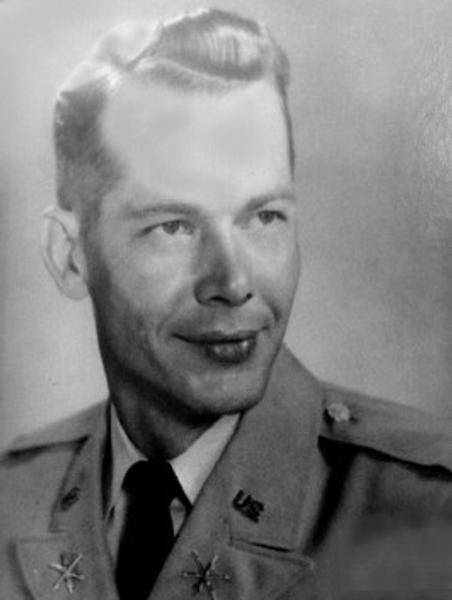
On August 12, 1964, 1LT McNeil was piloting a HU-1B helicopter approximately 10 miles east of Mỹ Tho, Định Tường Province, South Vietnam on a reconnaissance mission into an assault zone in support of a military operation conducted by the armed forces of the Republic of Vietnam. When the lead aircraft of the reconnaissance team was struck by hostile ground fire, 1LT McNeil bravely flew his helicopter into the combat zone to provide cover for the stricken aircraft. As he skillfully rolled the nose of his helicopter into firing attitude, an enemy missile penetrated the windshield of the aircraft and lodged in his body. Although the physical reaction caused him to release the controls of the aircraft, he quickly resumed them, completely ignoring his own serious injury. He then instructed the co-pilot to take control of the aircraft while he defended the crew and the friendly forces by firing a pair of rockets which silenced a hostile machine gun. His courage, determination, and valiant efforts prevented the destruction of two aircraft and saved the lives of seven men at the sacrifice of his own. He was posthumously awarded the Distinguished Service Cross for his heroic conduct and conspicuous gallantry in the service to his country.
1LT McNeil had over 8 years of military service and was a graduate of the Texas Army National Guard Academy. He was 30 years old and the married father of two children at the time of his death. Harold is buried at Forest Lawn Memorial Park, Mount Pleasant, Titus County, Texas. He is remembered on the Wall at Panel 1E, line 61.
 History Diaries