Hanoi reports that Lieutenant (j.g.) Everett Alvarez Jr., the U.S. Navy pilot shot down in the raid on 5 August, is paraded through the streets of Hòn Gai (now part of Hạ Long). Hanoi radio announced tonight that Alvarez, “pale, weary and awe‐stricken, staggered along the streets of Hòn Gai in his dirty United States uniform under the escort of proud Vietnamese People’s Army men.” A picture published by the North Vietnamese showing Lieutenant Alvarez’s heavily damaged plane indicated he had parachuted from the craft. The radio, quoting a report made public in the official newspaper Nhân Dân, did not report on Lieutenant Alvarez’s condition. But from the Communist account it seems that the 26‐year‐old pilot had suffered no serious injury when his plane went down over the coastal city, about 80 miles east of Hanoi. Lieutenant Alvarez is from San Jose, California. The other pilot missing in the air strike is Lieutenant Richard C. Sather, of Pomona, California.
Nhân Dân called the captured pilot a “U.S. pirate, one of McNamara’s ‘strong men’ who had been trained for years at the Pensacola airfield in Florida.” It continued: “This professional American officer, whom a Western paper has for the past few days not ceased to praise as a ‘symbol of the fighters bringing civilization to the new world’ dared not raise his eyes to look at the fresh evidence of the crimes he had committed in the Hongay town. Neither dared he look at the towering cranes at the port which had immediately returned to their normal job of shifting coal onto the fueling vessels.”
In Washington, State Department officials said efforts to free Lieutenant Alvarez are being made through the International Red Cross.
[Alvarez will come home — in about eight-and-a-half years.]
William Bundy, Assistant Secretary of State for East Asia and Pacific Affairs, draws up a memorandum that calls for a ‘short holding phase’ of ‘military silence’ during August but a phase of ‘limited pressures’ from September through December to be followed by ‘more serious pressures’ against North Vietnam after 1 January 1965 — including systematic bombing raids and the mining of Haiphong Harbor (Hải Phòng). This memo will circulate among the high-level U.S. civilian and military officials.
The Defense Department announces that Communist China has moved MiGs into North Vietnam; it also insists that the USS Maddox, despite claims to the contrary, never went closer than 12 miles to North Vietnamese territory. The aircraft were identified as MIG‐15’s and MIG‐17’s, combat jets of an early type whose speed is less than that of sound, 1,088 feet per minute at sea level. Officials made clear, however, that only a few MIG’s had been spotted at airfields near Hanoi, the North Vietnamese capital. One source said only 12 to 15 planes were involved.
In addition, it was emphasized that the MIG‐15’s and MIG‐17’s were older types, first used in the Korean war. The Soviet Union, which designed them, reduced its shipments of aircraft supplies to the Peking regime at least two years ago. The Chinese Communists manufacture MIG‐17’s and possibly MIG‐19’s under license, it was said. There is no indication that they have any more advanced jet planes. United States aircraft in the area include many supersonic jets.
Assistant Secretary of Defense Arthur Sylvester, who made today’s announcement, called attention to the prediction made last week by Secretary of Defense Robert S. McNamara that the Chinese would send warplanes to North Vietnam. The Defense Secretary made his prediction at a news conference shortly after the United States had carried out reprisal raids against North Vietnamese bases. Mr. McNamara noted at the time that no planes had opposed the United States raids, in retaliation for North Vietnamese patrol boat attacks against American destroyers in the Gulf of Tonkin.
At the Pentagon today a spokesman said in answer to an inquiry that the destroyer Maddox was not closer than 12 miles from the North Vietnamese shore at the time of the first incident in the Gulf of Tonkin on August 2. The inquiry was based on a dispatch to The New York Times from Saigon that said Admiral Moore indicated the Maddox was two or three miles inside the 12‐mile territorial waters limit claimed by Hanoi. The Pentagon spokesman said that while the Maddox and other patrol warships occasionally went inside the 12 mile limit set by Communist countries, because the United States recognized only a 3‐mile territorial waters limit, this was not the case on the day of the patrol boat attack.
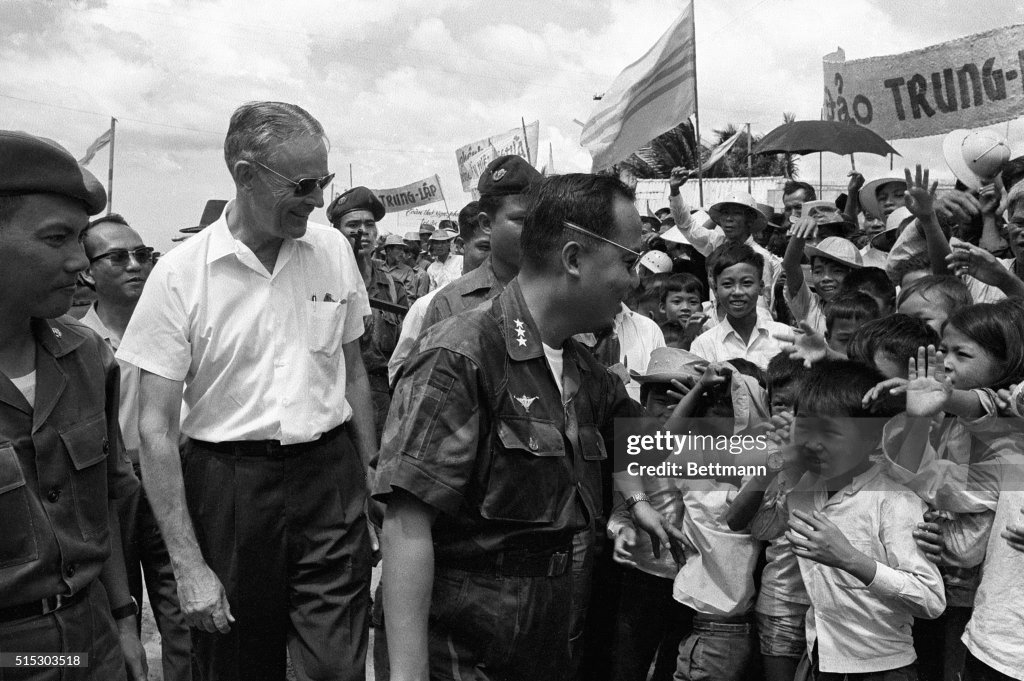
The Communists handed out leaflets today saying Vietcong guerrillas would fire only on Government units accompanied by United States military advisers. South Vietnamese officials scoffed at the leaflets, distributed in hamlets northwest of Saigon. The Government pulled an apparent propaganda move of its own in a well‐announced shopping stroll by South Vietnam’s Chief of State, Major General Dương Văn Minh, and his family. Newsmen were notified by that the general, his wife and four children would be walking along Saigon’s main shopping street. The stroll was regarded as an attempt to squelch rumors that General Minh had been placed under house arrest. He was asked about the rumors, but refused comment and asked for questions to be addressed to him in writing, a practice followed by ranking Vietnamese officials.
The Laotian Government requested today an international investigation to disprove charges that the United States has used Laos as a base for air attacks against North Vietnam. In a letter to the North Vietnamese, the Government included a formal denial that recent bombings in North Vietnam involved American flights from Laos. The Communist regime in North Vietnam protested last week that bombing raids on Năm Căn and Noọng Dẻ had been made by aircraft based in Laos and Thailand.
The neutralist Premier of Laos, Prince Souvanna Phouma, denied the charge last Thursday, but he did not suggest at that time an investigation by the International Control Commission. The three‐member commission, composed of representatives of India, Canada, and Poland, was created in 1954 to supervise the Geneva agreement that ended the French Indochina war. It became inactive and was revived in 1962 to police a cease‐fire between the rival Laotian factions.
In recent months, the Laotian coalition of neutralists and rightists, headed by Prince Souvanna Phouma, has supported moves to release the Control Commission from restrictions the Polish member and the pro-Communist Pathet Lao faction have imposed on it. Prince Souvanna Phouma left yesterday for Luang Prabang, the royal capital. There was speculation that the publication of the letter, which was prepared late last week, had been delayed until his departure so that he might avoid issuing a rejoinder at a time when he was negotiating with the Pathet Lao faction peace for a meeting in Paris.
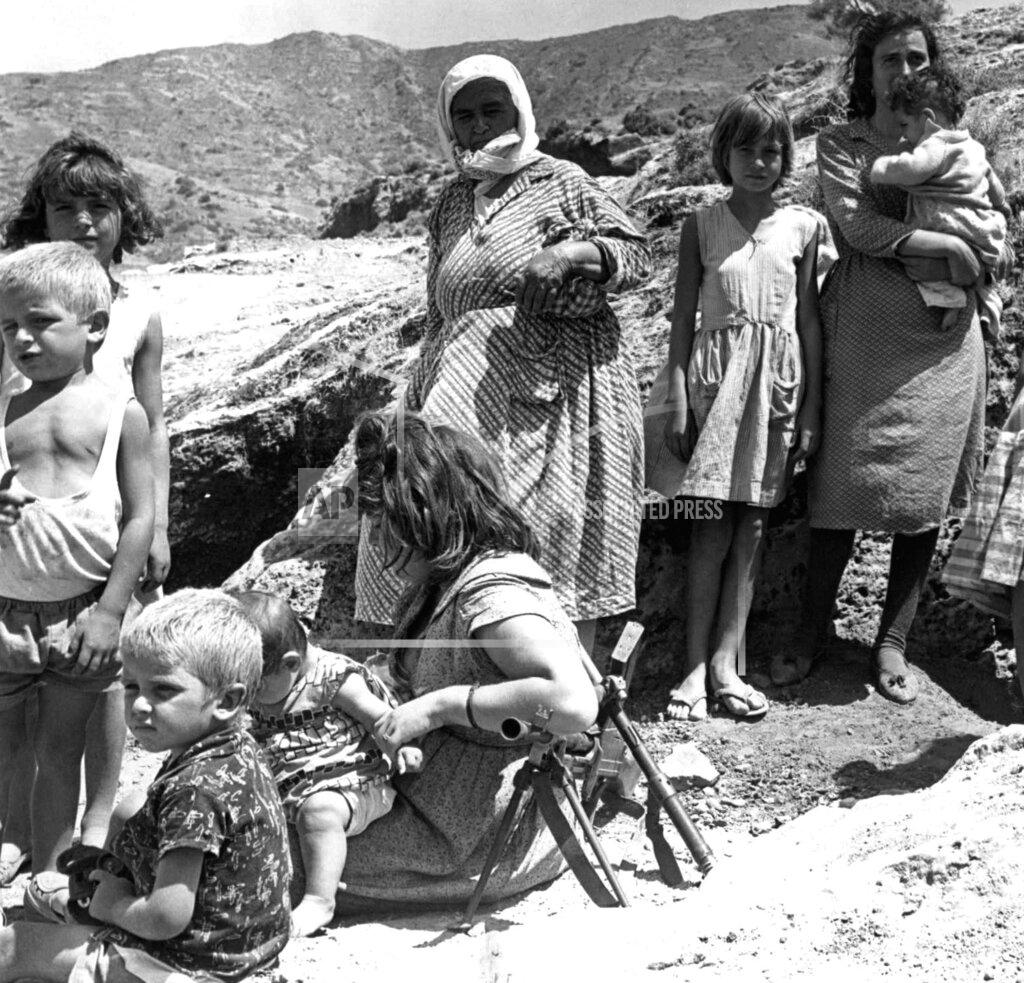
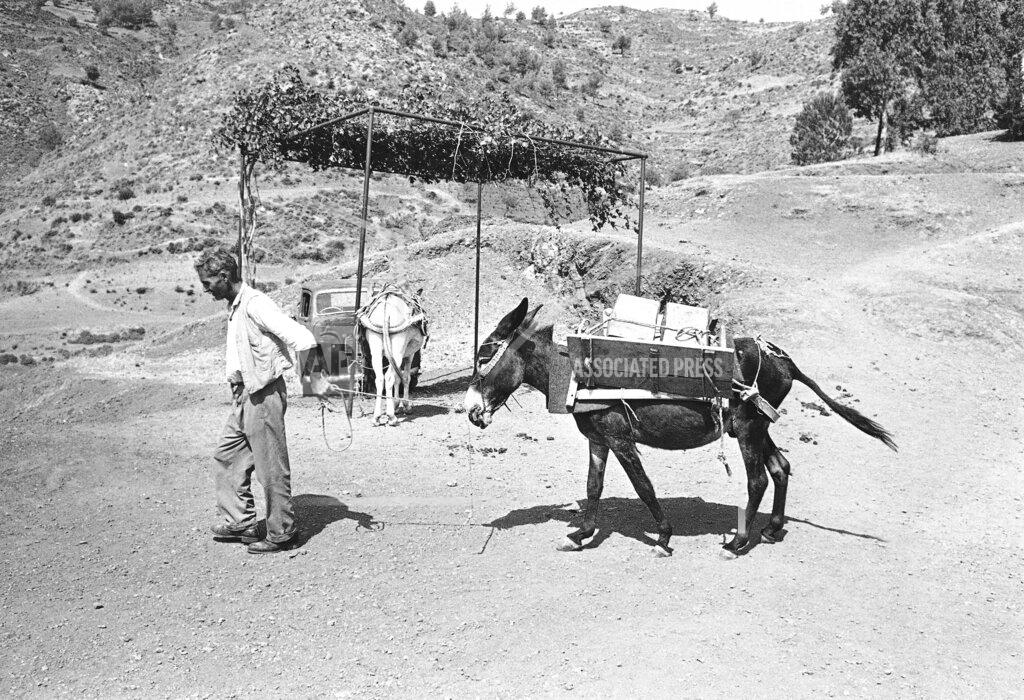
The U.N. Security Council requested all governments tonight to stop all flights over Cypriot territory in violation of the sovereignty of Cyprus. At the same time, the Council asked Generals Kodendera S. Thimayya, commander of the United Nations force in Cyprus, to strengthen his contingent in the Mansoura‐Kokkina area, where outnumbered Turkish Cypriots have been under attack from Greek Cypriot forces, “so as to insure the safety of the inhabitants.” These recommendations, embodied in a statement issued by Sivert A. Nielsen, this month’s President of the Security Council, were accepted by other members after a bitter threehour debate. The meeting was called, on an hour and a half’s notice, in response to Cyprus’s demand that the Council meet to “deplore” a Turkish reconnaissance flight over Cyprus today.
Turkish Premier İsmet İnönü made a friendly personal appeal to Premier George Papandreou of Greece today to join him in carrying the Cyprus crisis beyond a cease‐fire to a “quick” settlement of the long dispute. He predicted that such a settlement might he possible “within a month,” but he did not say how it could be obtained. Although Greece and Turkey are allies in the North Atlantic Treaty Organization, their relations have been hostile since last December, when fighting broke out between the Greek and Turkish Cypriot communities.
Archbishop Makarios, the President of Cyprus, declared tonight, “We shall not give in, we shall not be broken, we shall not surrender.” “We declare to the whole world,” the Archbishop asserted in a radio address to the Greek Cypriot people, “that we shall not surrender to crude violence.” The President spoke as the island entered the second day of a precarious cease‐fire following the Turkish air raids against northwestern Cyprus over the weekend. United Nations officials again reported the island was “tense but quiet.”
One-hundred and six U.S. Army and U.S. Air Force troops were dispatched to the Democratic Republic of Congo to intervene in the Congolese government’s fight against the rebels who had taken control of Stanleyville. The group, sent from Fort Bragg, North Carolina included 40 paratroopers from the Army’s 82nd Airborne Division, 56 men from the Air Force maintenance group, and ten Army support personnel, went along with four C-130 transports to be used by the Congo government to airlift its soldiers.
In Northern Rhodesia (now Zambia), Alice Lenshina surrendered voluntarily to Zambian authorities “in exchange for a guarantee of her personal safety” but without any promises that she would avoid criminal prosecution. Thousands of Lenshina’s followers would be imprisoned or killed during the two months that followed, and another 20,000 would flee to the Democratic Republic of the Congo. Although Lenshina would not be prosecuted, she would remain in detention until her death on December 7, 1979.
The Chilean Government broke diplomatic relations with Cuba tonight in response to last month’s call by the Organization of American States for political and economic sanctions against Havana.
The U.S. Senate approved the Economic Opportunity Act of 1964, as amended by the House of Representatives, and sent it to the White House for the approval of President Johnson. At the same time as it was approving domestic aid to fight poverty among Americans, the Senate voted 50-35 to cut foreign aid by $216.7 million. On Saturday, the House of Representatives had voted 226 to 185 to amend the Economic Opportunity bill that had passed the Senate on July 23. President Johnson’s $947.5 million antipoverty bill smoothly cleared its final Congressional hurdle today and was sent to the White House. It was a strangely quiet climax to what had been one of the most partisan political battles waged in Congress in recent years. Only a dozen of the 100 Senators were present for the final action and the galleries were sparsely filled.
House amendments to the Senate‐passed bill were approved by voice vote, marking the end of nearly a five‐month legislative journey for the measure that President Johnson had called the opening gun in his “total war on poverty.” The bill will reach the President’s desk sometime tomorrow, after the usual clerical processing on Capitol Hill. President Johnson is expected to sign it into law immediately, clearing the way for the program to go into operation and show results before the fall election. The bill calls for job training, basic education, aid to needy college students, community antipoverty projects, loans to low‐income farmers and businessmen and a domestic Peace Corps. Race riot in Paterson, New Jersey.
The Senate dealt President Johnson’s foreign aid bill two harsh blows today. First, it accepted by a vote of 50 to 35 an amendment by Senator Wayne Morse, Democrat of Oregon, to cut the authorization bill to $3.25 billion. This is $216,700,000 less than the amount the Foreign Relation Committee approved and $266,700,000 less than the President requested. Second, the Senate approved, 49 to 38, an amendment by Senator Karl E. Mundt, Republican of South Dakota, to increase the interest charged on development loans. The effect would be to make many of the loans as “hard” as those by the International Bank for Reconstruction and Development (World Bank) and the United States Export-Import Bank.
Both of these actions came late in the afternoon and took the Democratic leadership by surprise. Only a few hours earlier the leadership had been able to turn back by a vote of 52 to 37 an amendment by Mr. Morse that would have cut the authorization to $3 billion. And it had defeated, 48 to 44, an interest-increase amendment by Senator Ernest Gruening. Democrat of Alaska, which was similar to that offered by Mr. Mundt. In an authorization bill, the House or Senate sets a ceiling for the actual appropriations of money. Rarely does an appropriation bill supply all the money authorized. President Johnson, requested $3,516,700,000 for the program for the fiscal year that began July 1.
The Senate Commerce Committee postponed today a vote on a controversial bill to regulate the mail‐order gun business. An official committee announcement treated the bill as still a live issue on which it could act later. But Senator Thomas J. Dodd, Democrat of Connecticut, the measure’s chief sponsor, told a reporter that the postponed action just about eliminated his last hope that Congress would have time to enact the bill before adjourning. “This was just an avoidance of the issue,” Mr. Dodd said.
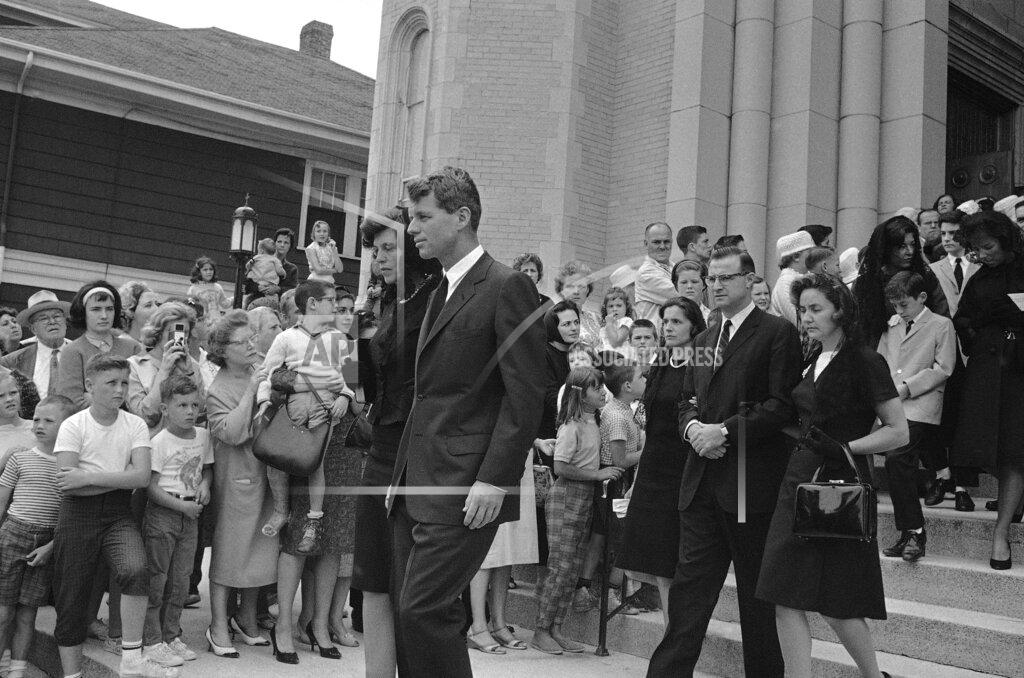
Attorney General Robert P. Kennedy has decided to enter the race for the United States Senate in New York, it was learned last night. Mr. Kennedy has confided his decision to relatives and a few close friends. He expects to make a formal declaration of his candidacy next week and, in all probability, to announce at the same time his resignation as Attorney General. The Kennedy camp anticipates an endorsement from Mayor Wagner in the next few days, an authoritative source disclosed. Mr. Wagner, the state’s most influential Democrat, is to talk with the Attorney General late this week.
Mr. Kennedy’s intentions became known after a day in which the campaign to nominate him for the seat now held by Senator Kenneth B. Keating, a Republican, gathered momentum in all sections of the state. One of Mr. Wagner’s closest political associates had said that it was “as sure as Ivory Soap” that the Mayor would endorse Mr. Kennedy, probably within two weeks.
The Mayor avoided a number of opportunities to come out for the Attorney General yesterday. He was asked 14 times at a City Hall press conference whether he was ready to issue an endorsement; each time he parried the question with a quip or expressed admiration for Mr. Kennedy’s abilities. Asked whether he felt that Mr. Kennedy, who lives in Virginia and votes in Massachusetts, would be vulnerable to charges of carpetbagging, the Mayor replied: “I’ll be frank and say that he would. But he would also bring many assets to a campaign in this state.”
The House, on a roll‐call vote of 388 to 0, passed a bill today that would increase pension payments to veterans by a total of $44 million next year. The bill, which now goes to the Senate, has escalator clauses that add $111 million to pension costs five years from now. Congress would then review the program. Most of the increases would go to veterans over 65 years old under the bill’s provisions concerning the amount of income a veteran can receive and still collect his pension. The bill would liberalize the amount and kinds of income that the veteran may exclude for that purpose.
The Department of Defense labeled today as being “without foundation,” “contrary to the facts” and “totally false” an allegation by Senator ‘Barry Goldwater that the United States’ nuclear‐weapons power was being drastically diminished in this Administration. The Republican Presidential nominee made the following as‐ sertion yesterday in a speech to the National Association of Counties: “Under our present defense leadership, with its utter disregard for new weapons, our deliverable nuclear capacity may be cut down by 90 percent in the next decade.” The Pentagon statement, issued through Arthur Sylvester, Assistant Secretary of Defense for Public Affairs, termed this allegation “not only without foundation but contrary to the facts.”
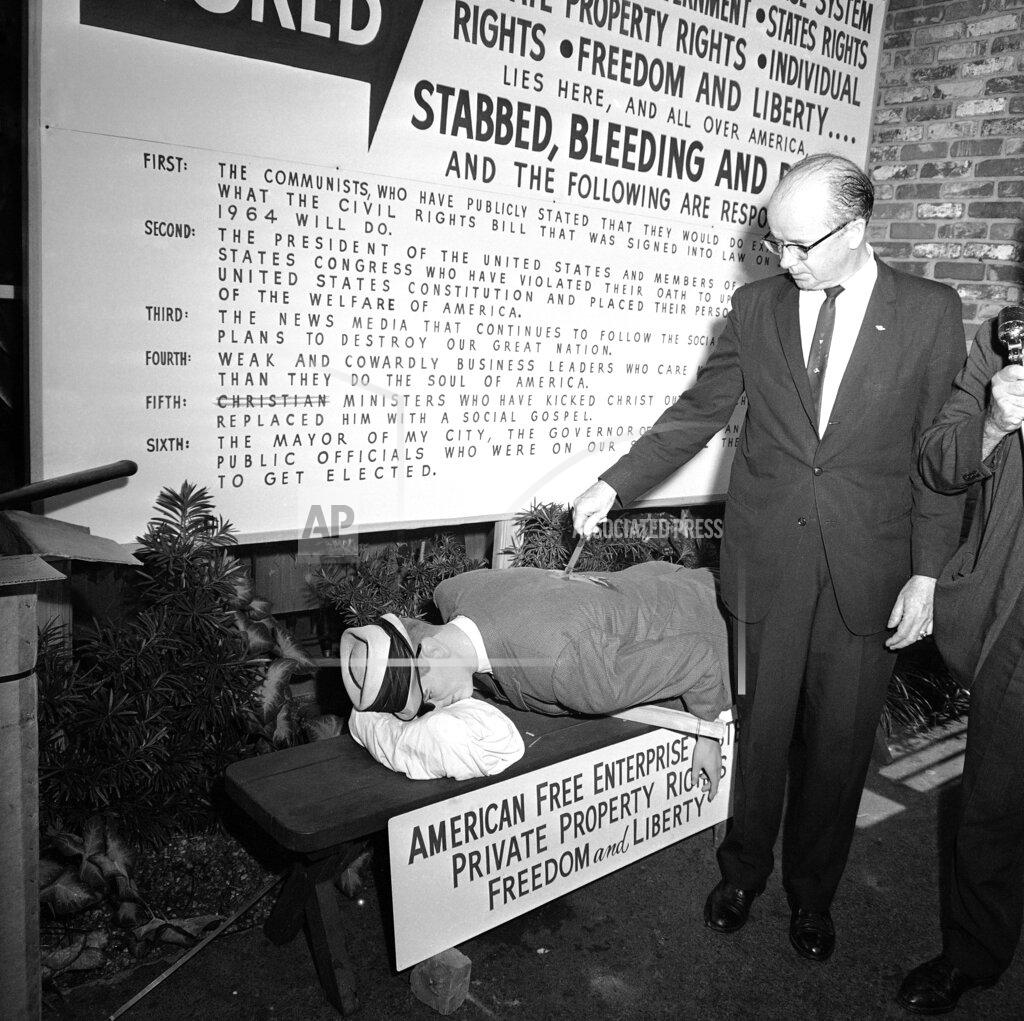
In Atlanta, Lester Maddox, armed with a pistol and backed by 200 cheering whites, defied the nation’s new Civil Rights Law again today by turning three Blacks away from his restaurant. “You’re dirty Communists and you’ll never get a piece of fried chicken here,” Mr. Maddox shouted, waving his arms but keeping the pistol in its holster at his side. He first defied the Civil Rights Act hours after President Johnson signed it into law last month by ushering three Blacks from his restaurant, the Pickrick, at pistol point after having armed his white customers with ax handles. Boxes of ax handles stood inside the doorway to the restaurant today with, a sign advertising them for $2 each.
After the first defiance, a three‐judge Federal court specifically ordered Mr. Maddox to desegregate his restaurant, but he appealed to the United States Supreme Court, asking that the order be stayed. The court rejected the request yesterday. During today’s confrontation, one white spectator swung at one of the Blacks but missed. The police quickly stepped between the two.
The three Blacks who sought service were Albert Sampson, executive vice president of the Atlanta chapter of the National Association for the Advancement of Colored People, and the Revs. Albert Dunn and Charles Wells. Mr. Maddox intercepted the three at the restaurant door and stood arguing with them as a heavy rain fell. “You’re not here to eat,” he shouted. “You’re here to run us out of business.”
“The government has told you to integrate,” Mr. Sampson said. “We would like to enter.” “You’re not about to enter,” Mr. Maddox snapped back. “If you live 100 years you’ll never get a piece of fried chicken here.” Blacks filed suit in United States District Court today calling for full integration of Dallas schools when classes begin next month. The suit challenged the gradea‐year plan used by the Dallas School Board, terming it unconstitutional, and charged that the board was “not acting in good faith.” W. J. Durham and Fred Finch filed suit on behalf of 12 Black students and their parents who were plaintiffs in the original integration suit filed here in 1955. The lawyers filed a court order that would prohibit Dallas schools from opening next month with only the first four grades integrated.
They accused school officials of trying to perpetuate a policy of segregation in violation of the Constitution. They said Black students living near white schools had been transferred to Black schools and that Blacks had been denied vocational and technical training of “the same quality” as that given white students. A hearing date was not set immediately. School officials withheld comment. They said earlier that they intended to comply with decisions of the courts.
The Beatles’ first film, “A Hard Day’s Night,” was released in the United States and Canada by United Artists in 700 movie theaters.
John (Boog) Powell’s 30th homer of the season, a two‐run opposite‐field drive to left in the seventh inning, broke a 6–6 tie tonight and led the Baltimore Orioles to an 8–7 victory over the Boston Red Sox. The triumph enabled the American League‐leading Orioles to maintain a one‐game edge over the Chicago White Sox, who swept a day‐night card from the Yankees. Powell’s homer, on a two‐out, 1–2 pitch off Boston’s ace reliever, Dick Radatz, was the third two‐run homer of the game for the Orioles. Sam Bowens connected in the fourth to put Baltimore ahead, 3–2, and Brooks Robinson hit one in the sixth to tie the score 6–6.
Tony Oliva slammed his 26th homer in the seventh inning tonight to help the Minnesota Twins gain a 5–3 victory over the Detroit Tigers. The victory snapped a sevengame winning streak by the Tigers. Hank Aguirre, who had checked the Twins on five hits until Oliva’s homer, suffered the loss.
Jim King and Don Lock smashed home runs and Claude Osteen posted his 11th victory tonight as the Washington Senators handed the Kansas City Athletics’ their sixth straight loss, 5–2. King hit a homer in the first against Diego Segui. The Senators then clinched the victory with a four‐run assault against Segui in the fourth. King walked and Lock hit his 20th homer. Ed Brinkman doubled in the final two runs.
At Crosley Field, Joey Jay (8–8) strikes out 13 Los Angeles Dodgers as the Cincinnati Reds win, 4–2. Frank Robinson slammed a homer, triple and double and Deron Johnson clouted a homer.
Johnny Callison collects two doubles and a grand slam and scores 4 runs as the Philadelphia Phillies roll over the host Chicago Cubs, 13–5. Callison’s grand slam, the first for the Phillies this year, capped a five‐run rally that was touched off by Gus Triandos’s fourth homer and overcame a 5–4 Chicago lead.
Two‐run homers by Orlando Cepeda, his 20th, and Willie Mays, his 33rd, carried the San Francisco Giants to a 6–3 victory over the St. Louis Cardinals tonight. The victory kept the second‐ place Giants three games behind the National League lead‐ ing Philadelphia Phillies. Bob Hendley won his 10th game against seven defeats with ninth inning help from Bob Bolin and Billy Pierce, who came on after Mike Shannon tagged a two‐run homer. Bill White, who singled in front of Shannon’s homer, stretched his hitting streak to 19 games.
Hank Aaron passes Joe DiMaggio with his 362nd career home run. Aaron drove in five runs with his 19th and 20th home runs in leading the Milwaukee Braves to a 9–6 victory over the Houston Colt .45s tonight. Warren Spahn, making his first start since July 26, was lifted after Walt Bond’s tworun homer in the fifth had given the Colts a 5–3 lead. It was the 14th time in 15 starts the Braves’ southpaw had been knocked out of the box. His earned‐run average has risen to 5.50. Aaron hit a two‐run homer off the loser, Ken Johnson, in the third and a three‐run shot off Hal Woodeshick that capped a six‐run sixth.
Dow Jones Industrial Average: 828.08 (-1.27).
Born:
Roger Vick, NFL fullback (New York Jets, Philadelphia Eagles), in Conroe, Texas.
Rogers Alexander, NFL linebacker (New York Jets, New England Patriots), in Washington, District of Columbia.
Jim Lee, Korean-American comics artist, in Seoul, South Korea.



 History Diaries