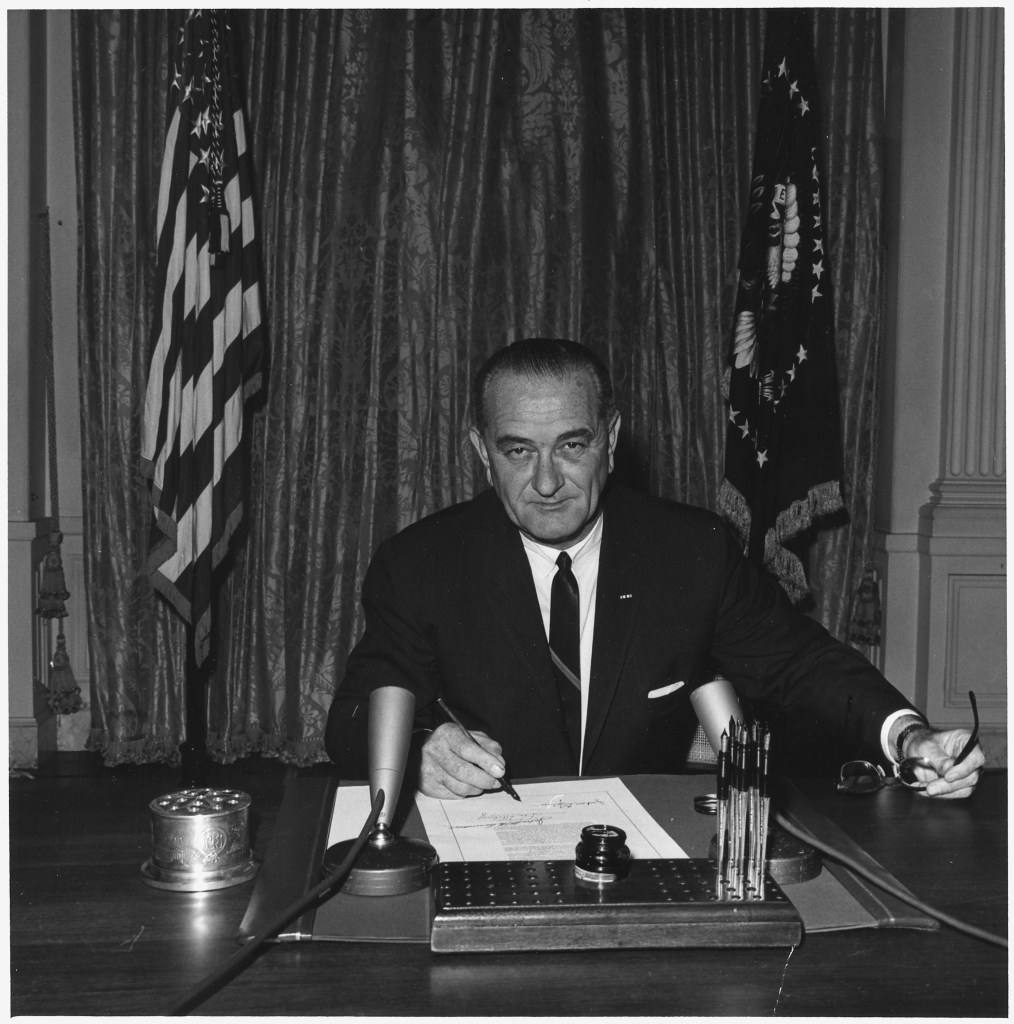
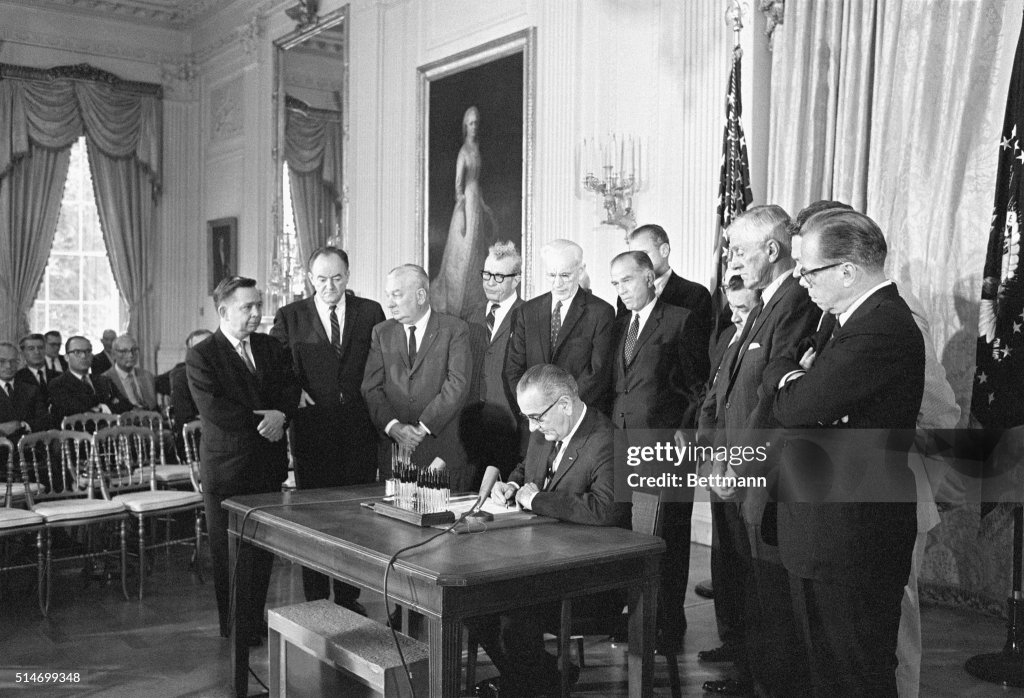
President Johnson signed the Gulf of Tonkin Resolution, which took effect as U.S. Public Law 88-408. Johnson formally signed a joint Congressional resolution today approving “all necessary measures” he might take to repel attack and prevent aggression in Southeast Asia. Surrounded by the Cabinet and the Joint Chiefs of Staff and Congressional leaders, the President emphasized that United States policy in Southeast Asia was now clearly known throughout the world. “The position of the United States is stated plainly,” he said. “To any armed attack upon our forces, we shall reply. To any in Southeast Asia who ask our help in defending their freedom, we shall give it.”
The President had requested the Congressional resolution to strengthen his hand in dealing with Communist aggression after the North Vietnamese torpedo boat attacks last week on two United States destroyers which resulted in retaliatory air assaults on North Vietnamese boats and bases. The resolution was approved 416 to 0 in the House and 88 to 2 in the Senate last Friday, after what the President described as free and serious debate. “Thus, today, our course is clearly known in every land,” the President said at the signing ceremony. “There can be no mistake — no miscalculation — of where American stands or what this generation of Americans stands for. The unanimity of the Congress reflects the unanimity of the country.” The only members to oppose the resolution were Senators Wayne L. Morse, Democrat of Oregon, and Ernest Gruening Democrat of Alaska.
Ambassador Maxwell Taylor in Saigon cables President Johnson a report in which he claims that the Khánh regime has only “a 50-50 chance of lasting out the year”; therefore Taylor advocates that the United States “be prepared to implement contingency plans against North Vietnam with optimum readiness by January 1, 1965.”
Communist guerrilla activities in South Vietnam were sharply reduced in the three days immediately after the United States air attacks against North Vietnam last week but increased again, a government military spokesman said today. He reported that 32 guerrillas were killed and weapons were captured when two Việt Cộng companies attacked a government unit in Quảng Tín Province, 350 miles north of Saigon, early yesterday. Government forces reported five dead. In Vĩnh Long Province, 75 miles southwest of Saigon, about 200 Việt Cộng attacked and destroyed a government watchtower.
United States naval forces in Far Eastern seas have orders to “pursue, attack and destroy” any Chinese Communist unit that commits a “hostile act” against Americans in international waters, a key officer in a Seventh Fleet task force off the South Vietnamese coast declared today. Such action by the Chinese would be a “parallel situation” to the torpedo‐boat assault on two United States destroyers last week, Captain James Daniels, Chief of Staff of the carrier force that hit back at North Vietnam, said. “The pattern is established” for a United States response to a Chinese attack, he said, alluding to air strikes at North Vietnam’s torpedo‐boat fleet and its shore bases by planes from the Seventh Fleet carriers USS Constellation and USS Ticonderoga. “If they come at us with broomsticks, we will break their broomsticks and destroy their capacity to make any more broomsticks,” he asserted.
Officers interviewed aboard the carriers stressed that the engagement in the Gulf of Tonkin was purely a North Vietnamese action. However, Rear Admiral Robert B. Moore, commander of the task force, said a Chinese Communist air unit on Hainan Island adopted a “certain status of alert” when the United States naval vessels were sighted. Premier Nguyễn Khánh said today that about 15 MIG 17 jet fighters from Communist China were stationed in Hanoi, North Vietnam’s capital last Friday. He said he could not identify the nationality of the pilots.
Former Ambassador Henry Cabot Lodge said today that Chinese Communist advisers had been “seen and heard” in South Vietnam. “But we have never taken one prisoner,” Mr. Lodge added. He made the comments after a closed briefing with the House Foreign Affairs Far East subcommittee. Mr. Lodge, who plans to leave this weekend to brief allied leaders in Europe on the situation in Southeast Asia, said the Chinese “have been seen by agents and heard on the radio.” They apparently are serving “as advisers and that sort of thing,” he said. Mr. Lodge said he would meet with the North Atlantic Council in Paris next week. He plans to leave the United States Saturday or Sunday.
South Vietnam denounced North Vietnam today for having refused the Security Council’s invitation to testify on the recent clash with United States naval forces in the Gulf of Tonkin. A Saigon spokeman, in a statement circulated here, accused the Hanoi regime of having shown contempt for international law. The statement also charged that Hanoi had provoked the clash with its “piratical” attack on the American vessels in “reckless aggressiveness.” The same statement also said that the Republic of South, Vietnam, for its part, stood ready to cooperate with United Nations efforts to secure peace in Southeast Asia. The policy statement was received here as a forerunner of a more formal response from Saigon to the action taken Friday by the 11-member Council.
South Vietnam severed diplomatic relations with Indonesia today. The Foreign Ministry said in a note to the Indonesian Government that the decision was made as a result of reports that Indonesia and Communist North Vietnam had decided to raise the level of their respective diplomatic missions to embassies. Calling the Indonesian decision a “serious breach” in friendship, Saigon said it had decided to close its consulate general office in Jakarta from today, and asked Indonesia to recall its mission in Saigon with the “shortest delay possible.”
Saigon officials announced today a plan to build 500 air‐raid shelters. Brigadier General Dương Ngọc Lắm, prefect of the capital, said the public shelters would accommodate 400,000 of Saigon’s nearly 1.5 million people. He asked landpwners to donate property, called for volunteers to help construct the shelters and urged citizens to build their own. General Lắm said that during an hour‐long air‐raid drill yesterday, the first in Saigon since World War II, persons crowded around civil defense trucks “as if it were all a play.”
Prostitutes in a Saigon Government rehabilitation center rioted today against alleged maltreatment and won their freedom after a two‐hour battle with the police. The police used high‐pressure water hoses to control the 109 women when they stormed watchtowers along the 13‐foot wall topped with barbed wire and splintered glass. A guard was injured. Trần Quang Thuận, South Vietnam’s Minister of Social Welfare, intervened and agreed to release the women after a hastily arranged conference with the leader of the revolt. The women marched out of the center behind the minister, shouting insults at the guards.
In the last 10 days, Europe appears to have erased the question mark that stood beside the name of President Johnson and replaced it with a plus sign. The President’s handling of the short, sharp crisis in the Gulf of Tonkin has had a deep impact upon Europeans. The employment of great power with restraint, they say, is true statesmanship. These comments have been offered freely in embassies and in international organizations such as the North Atlantic Alliance, the Organization for European Economic Cooperation and Development and the United Nations Educational. Scientific and Cultural Organization.
Until this week Europeans had been rather chary in their attitude toward the President. To them he was a new and enigmatic character, less sympathetic than his predecessor, whom they thought they understood, and less popular than President Dwight D. Eisenhower, whom they liked without understanding. The change in attitude on President Johnson does not seem to have much to do with the hostility of most European politicians, officials and diplomats toward Senator Barry Goldwater’s candidacy. Rather, it is a belief on their part that Mr. Johnson acted in a critical hour as they believe a president of the United States should act. He was firm, they say, but he was calm.
[Ed: Sigh. Yeah. They will not be saying this in four years.]
Senator Barry Goldwater indicated today that he believed President Johnson had not gone far enough in last week’s air attacks on North Vietnam. Mr. Goldwater said that the nation must “prosecute the war in Vietnam with the object of ending it” and that “taking strong action simply to return to the status quo is not worthy of our sacrifices” or the national ideals. The Republican Presidential candidate said he believed he must point out that the President’s action had been no more than “a response, an incident, not a program or a new policy; a tactical reaction, not a new winning strategy.” Mr. Goldwater also asserted that the guerrilla war in South Vietnam “would never have occurred had the enemy really believed that we would have moved in.”
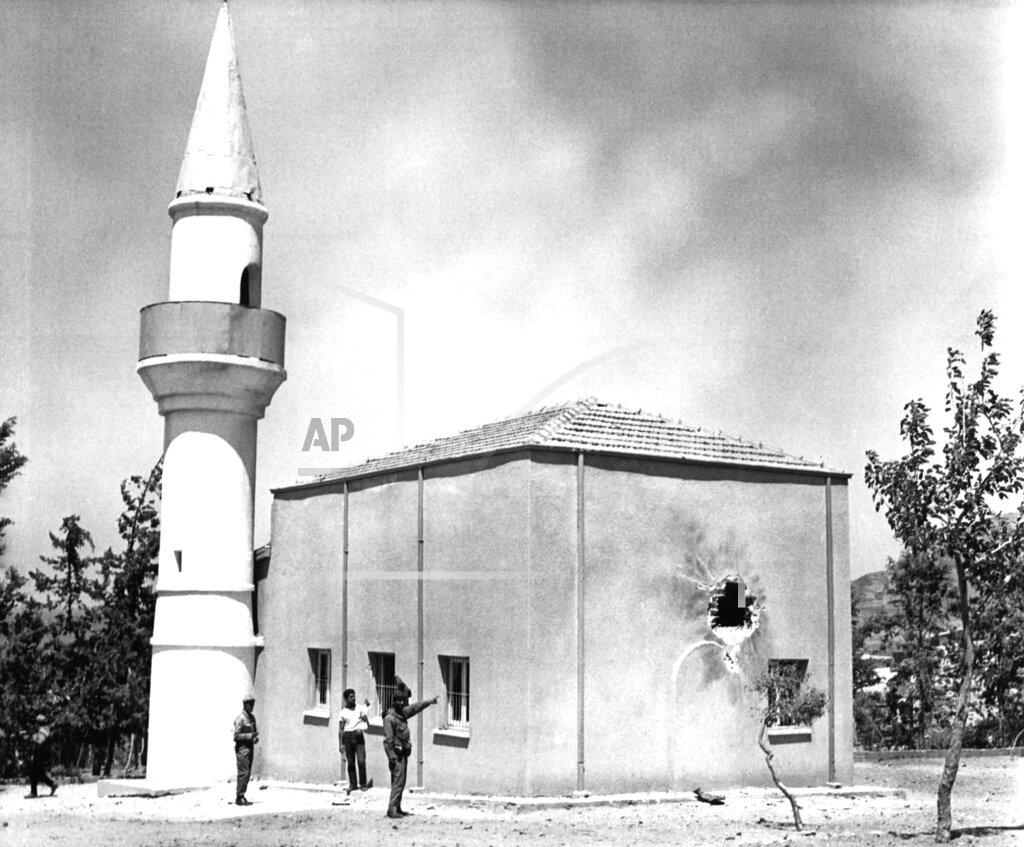
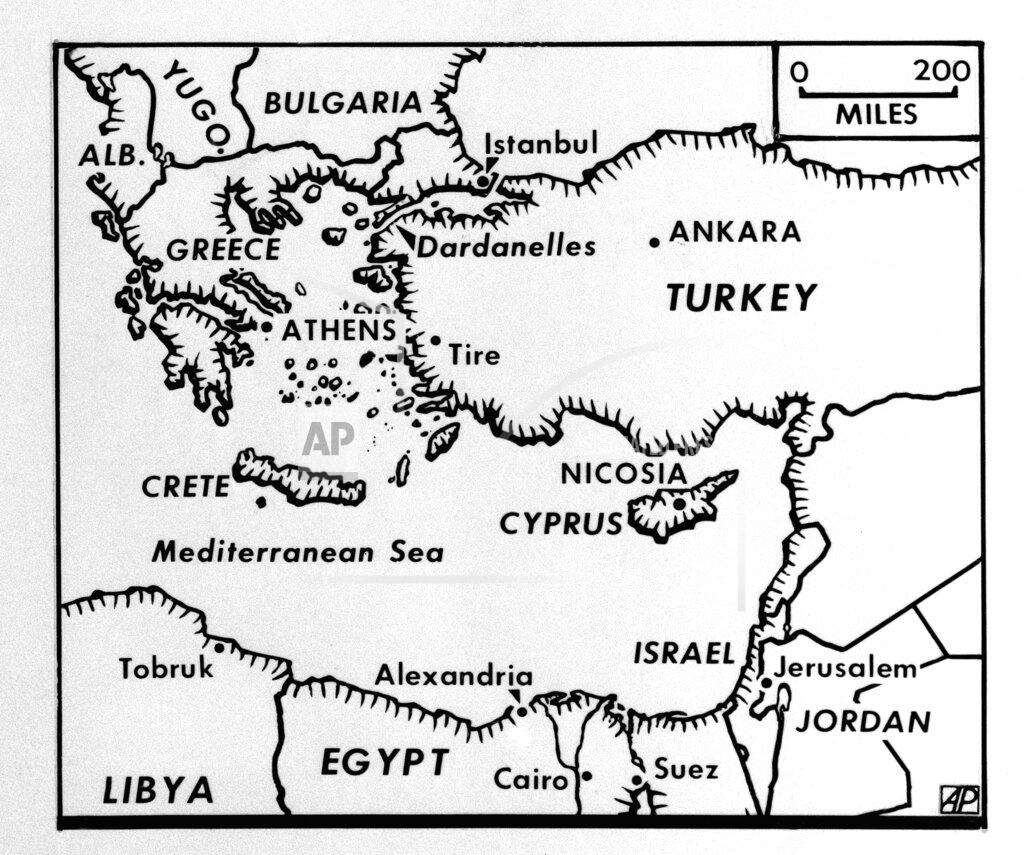
Turkey and Cyprus agreed to the unconditional ceasefire demanded by the United Nations. Turkey and Cyprus notified the United Nations Security Council today that they had accepted the Council’s call for an immediate cease‐fire in Cyprus. The Secretary General, U Thant, issued a statement tonight declaring that it was “gratifying and encouraging that both governments have responded positively and without conditions” to the ceasefire appeal. Mr. Thant added that the Turkish and Cypriot acceptance afforded “an opportunity for definitively ending fighting and relaxing tension in Cyprus, and it will be my purpose to take fullest possible advantage of this opportunity by exerting every effort toward constructive peacekeeping arrangements in all areas of the island.”
Premier İsmet İnönü of Turkey and President Makarios of Cyprus informed Sivert A. Nielsen of Norway, this month’s president of the Security Council, of their acceptance. Neither leader imposed any conditions. However, Mr. Inonu’s message declared, “I am sure you will realize that this decision of the Government will only make sense if the Greek Cypriot attacks are stopped forthwith and if your appeal for an immediate cease‐fire is heeded by the Greek Cypriots.” Mr. İnönü’s message said that Turkey, in response to the Council’s appeal of yesterday, “has decided to stop immediately the action of the Turkish aircraft over the Mansoura‐Kokkina region, where the recent large‐scale aggression of the Greek Cypriot forces is endangering the lives of the whole Turkish population in this area, including children, women and old men.”
The Turkish Government agreed today to accept conditionally the United Nations resolution calling for a ceasefire in Cyprus. The condition was that Turkey would not put an end to ”reconnaissance and warning flights” over Cyprus by her aircraft until Archbishop Makarios, President of Cyprus, recalled Greek Cypriot forces in the island’s northwest area back to positions they occupied August 5. The Turkish decision to accept the United Nations resolution was made at a meeting this morning attended by Mr. Inonu, his military chiefs of staff and members of the Council of Ministers.
It took place three hours after the government received reports of new Greek Cypriot attacks in Kokkina. Turkish aircraft immediately took off on what was called an observation flight. The government spokesman said Turkish planes had fired no shots and dropped no bombs because “they observed no fighting below.” According to Turkish reports, the entire area remained quiet after brief early morning attacks by Greek Cypriots. Mr. Soysal said Ankara was convinced President Makarios had called off the fighting this morning only “because Turkish planes quickly appeared overhead.”
Cyprus took a step back from the brink of war today. The island was quiet, solemn and grieving as a cease‐fire requested by the United Nations went into effect. Small‐arms fire continued in northwestern Cyprus and in Nicosia but the tension was easing, other dispatches reported. Hospitals were filled with casualties from three days of Turkish air strikes against Greek Cypriot villages and military positions in the mountainous northwest sector of the island. There were unofficial estimates of 100 dead and between 500 and 600 wounded in the fighting. Previous reports put the death toll at more than 300.
Soviet mass media declared today that yesterday’s United Nations Security Council resolution calling for an immediate cease‐fire on Cyprus was inadequate. They expressed suspicion that Turkey had continued bombing raids today because she had been given the green light by her NATO partners. And they likened the Turkish air attacks to the American air strikes against North Vietnamese torpedo‐boat bases last week. These were the principal themes expressed in the first commentary on the Cyprus crisis published by Tass, the official press agency, and in a dispatch from New York carried by the Government newspaper, Izvestia. The Izvestia correspondent wrote that yesterday’s Security Council resolution had been dictated by NATO and was inadequate.
Turkey took as her example the “pirate acts” of her older partner in NATO and even the official justification for the two actions sounded alike, he said. Washington described its move as “limited and considered,” he continued, while Ankara called its action “precautionary and preventive.” The Tass commentator suggested that Turkey had sent bombers to Cyprus today because she felt she had not been condemned in the Security Council by her NATO allies. Turkey said her planes made an observation flight Monday, after a report of Greek Cyproite attacks, but had fired no shots and dropped no bombs.
Soviet leaders committed themselves publicly today for the first time to a timetable for the controversial world conference of Communist parties. They announced that invitations had recently been issued to 25 foreign parties to convene here December 15 for a preliminary meeting that would make arrangements for a fullscale conference of all parties next summer. The announcement, in the form of an editorial in Pravda, the Soviet party newspaper, was regarded as the most important event in the dispute between Moscow and Peking in many months. It meant that the Soviet party leadership, after about a year of continuous consultation, had decided to call a world conference in spite of opposition by a number of parties, most notably Peking.
In the Soviet Union, the number of years of required secondary education was reduced from three years to two years, effectively returning Soviet students to the ten-year school program that had existed prior to 1958. The decree was issued jointly by the Council of Ministers and by the Communist Party’s Central Committee prior to the beginning of the 1964-1965 school year.
Pope Paul VI published his first encyclical, Ecclesiam suam, identifying the Catholic Church with the Body of Christ. Completed on August 6, the papal letter expressed an intent for the church to begin a “dialogue with the other religions of the world”, and with anti-religious governments within the Communist nations.
Associate Justice Hugo L. Black of the United States Supreme Court rejected requests by the Heart of Atlanta Motel and by the Pickrick Restaurant (owned by Lester Maddox in Atlanta) for a temporary stay of enforcement of the Civil Rights Act of 1964 provisions prohibiting racial discrimination in public accommodations. Both the motel and the restaurant had urged that they would suffer irreparable injury (in the form of lost revenues) if they had to serve African-American customers while litigation on the constitutionality of the new law was pending before the Supreme Court, which would not begin its new term until October. In a three-page memorandum, Justice Black wrote that a restraint on enforcement would be unjustifiable, but urged his fellow justices to expedite the cases “in the hope that they could be made ready for final argument the first week we meet in October.”
The petitioners had sought an order staying the effectiveness of a ruling July 22 by a special three‐judge United States Court in Atlanta that the public accommodations section of the Civil Rights Act was within the Federal Government’s constitutional right to regulate interstate commerce. It issued orders requiring the motel and restaurant to admit Blacks, but delayed the effective date until Aug. 11 to enable the two companies to petition the Supreme Court. Mr. Rolleston and Mr. Maddox brought their initial suit 2 hours and 10 minutes after President Johnson signed the Civil Rights Act. The Justice Department said at the time it was the first major test of the act. In their suit, Mr. Rolleston and Mr. Maddox requested the District Court to enjoin Attorney General Robert F. Kennedy from enforcing the public accommodations section of the law.
In their petition to Justice Black, they said they would be irreparably damaged if they were not granted a stay pending final action by the full Supreme Court on appeals to be filed later. Justice Black observed that “a judicial restraint of enforcement of one of the most important sections of the Civil Rights Act would, in my judgement, be unjustifiable.” He agreed, however, with the motel and restaurant operators and also with the United States Solicitor General Archibald Cox “as to the wisdom of having the specific constitution issues here involved decided at as early a date as orderly procedure will permit.” “For that reason, I would welcome motions to the Court to expedite both cases in the hope that they could be made ready for final argument the first week we meet in October,” Justice Black wrote.
In Philadelphia, Mississippi, Sheriff Lawrence Rainey told Federal Bureau of Investigation agents today to get a warrant if they wanted to question him any further, about the slaying of three civil rights workers. The sheriff refused to talk to two agents at his office after one of them, Art Murtaugh, approached and asked, “May we have five minutes with you?” Mr. Rainey, who had just emerged from his inner office with a newsman, asked, “you got a warrant?”
Informed that they did not, the sheriff told the two to “come see me when you got one and I’ll be glad to talk to you. When Mr. Murtaugh asked if he was going to refuse cooperation with the F.B.I., Mr. Rainey replied that he would cooperate with the F.B.I. “as much as it cooperates with me.” The F.B.I. office in Jackson had no comment on the incident. There is no evidence that Michael H. Schwerner was beaten or mutilated before or after he was shot to death in Mississippl, a medical examination of his body showed yesterday.
A report by Dr. David M. Spain, the former medical examiner of Westchester County, said that the 24‐year‐old civil rights iworker apparently died of a bullet wound in the thorax. The private autopsy was carried out in about half an hour yesterday at a Brooklyn funeral home. Dr. Spain had been asked to perform the examination by William M. Kunstler, a lawyer who represents the slain man’s parents, Mr. and Mrs. Nathan Schwerner of Pelham. The bodies of Mr. Schwerner and two companions in the Mississippi civil rights campaign, Andrew Goodman and James H. Chaney, were discovered last Tuesday near Philadelphia, buried deep in an earthen dam. An autopsy has shown that Mr. Chaney, a Black, was severely beaten. All three of the victims had been shot. In his report, Dr. Spain said: “As far as could be determined there were no obvious defects or injuries to the skin. One must therefore assume that the cause of death was due to a bullet wound. There was no evidence of any other injury or body mutilation.”
[Ed: Rainey was ultimately charged in January 1965 with violating the victims’ civil rights alongside one of his deputies, Cecil Price, but Rainey was acquitted in 1967. Despite his acquittal, Rainey was stigmatized by his role in the events. His law enforcement career ended in 1968 when he was not re-elected as Sheriff of Neshoba County. As a result of the trial, his wife became an alcoholic, and they divorced. She subsequently died of a brain tumor. Rainey died of cancer in 2002.]
A split federal appeals court in Richmond, Virginia warned a group of civil rights demonstrators today that the rights of free speech and free assembly were “not a license to trample on the rights of others… They must be exercised responsibly and without depriving others of their rights, the enjoyment of which are equally as precious,” the Court of Appeals for the Fourth Circuit said in ruling on a case arising from racial violence last year at Danville, Virginia. The court, in a 3‐2 decision did the following:
- Refused to rule on the constitutionality of a Danville ordinance restricting parades and picketing.
2.Sent 105 cases of arrests under the ordinance back to the state courts for trial.
- Refused to take up the question of whether five persons arrested under the ordinance could collect unemployment benefits.
- Dissolved its own temporary injunction that had ordered the city to stop prosecuting persons arrested under the ordinance.
The two dissenting judges said, however, that they would send the cases back to a Federal District Court for a preliminary hearing to determine if a fair trial could be held in the city.
Attorney General Robert F. Kennedy announced yesterday the creation of an Office of Criminal Justice to take a broadly critical look at the fairness and effectiveness of Federal law enforcement. The new office, Mr. Kennedy said, will help “insure that the department over which I preside is more than a Department of Prosecution and is in fact the Department of Justice.” As its first head he named Professor James Vorenberg of the Harvard Law School. No attempt was made by Mr. Kennedy to define precisely the duties of Professor Vorenberg and his staff. They will have a free‐ranging assignment to improve handling of such matters as Federal arrests, the provision of counsel to the poor and psychiatric examination of prisoners.
The state’s Democratic state chairman said yesterday that he planned to encourage Attorney General Robert F. Kennedy to run for the United States Senate from New York this fall “because he would be a great candidate.” The Attorney General, in New York to speak at the convention of the American Bar Association, had made it clear earlier yesterday that he would not be a candidate unless he had the support of Mayor Wagner. A few minutes later, in a brief sidewalk news conference, Mr. Wagner told reporters: “If he is available, he is the type of person who would make an exceptionally fine candidate. I’m sure that he would win.”
President Johnson entertained 190 business leaders at luncheon today and told them his principal interest as the occupant of the White House was the unity of the American people. The President also emphasized that businessmen had never enjowed the success they were enjoying now. All the Cabinet members, except Attorney General Robert V. Kennedy, were there. Mr. Kennedy was out of the city. Also present were Kermit Gordon, Director of the Bureau of the Budget, and Gardner Ackley of the Council of Economic Advisers.
Former President Dwight D. Eisenhower will speak to a luncheon gathering of Republican leaders in Hershey, Pennsylvania at the meeting Wednesday called by Barry Goldwater, the party’s Presidential nominee. The Republican National Committee announced the schedule in Washington today. The committee said 38 party leaders — among them 14 Republican governors — would attend a closed business session Wednesday morning.
An agreement to lease more than 56,000 square feet of space in the World Trade Center to be built in lower Manhattan has been made by the Manufacturers Hanover Trust Company. The Port of New York Authority said yesterday that the lease agreement represented the largest single tenancy yet contracted for in the huge project planned for the area west of the financial district.
Logan Martin Lake, a reservoir on the Coosa River, Alabama, was completed.
Taking advantage of an off-day in the Pirates’ schedule, the Associated Press collars Roberto Clemente for a brief profile/interview of the National League’s leading hitter, with a particular focus on the peculiarities of his batting style. One genuine scoop emerges, Clemente’s own explanation for his distinctive and dramatic step away from the plate or, as they say, “into the bucket.” While his early tendency to bail out had been corrected in Puerto Rico in 1952 by Santurce’s player/manager Buster Clarkson [“He put a bat behind my left foot and made sure I didn’t drag my foot”], the subsequent seeming resurrection of this habit occurs in response to the damage to Clemente’s spine sustained in a December 1954 automobile accident and aggravated almost exactly two years later by a violent swing and miss during winter ball. “In 1956 I was doing good until I hurt my back,” Clemente recalls. “Since then I step to the side with my left foot faster so I don’t have to twist my body so much.”
The St. Louis Cardinals made two early runs stand up for a 2–1 victory over the San Francisco Giants tonight. Bob Gibson, although he needed help, picked up his 10th victory against nine defeats. The loser was Ron Herbel,who is 8–7. The loss dropped the secondplace Giants three games hehind the Philadelphia Phillies, who were idle. The Phils now hold the biggest lead of the season in the National League. Jim Hart spoiled Gibson’s shutout when he led off the seventh with a tremendous blow that cleared the scoreboard atop the left‐field bleachers. It was the 19th home run for Hart, who hit only three in the season’s first two months.
The Cincinnati Reds, scoring four runs in the first inning, breezed to a 7–2 victory over the Los Angeles Dodgers tonight behind the four‐hit pitching of Bob Purkey. Steve Boros singled, doubled and drove home three runs and Mel Queen had three singles to pace a 10‐hit attack. The Reds beat the Dodgers for the 11th time in 13 games. Singles by Queen and Vada Pinson, sandwiched between doubles by Pete Rose and Frank Robinson, drove Joe Moeller to the showers in the four‐run first inning before he retired a batter.
Dow Jones Industrial Average: 829.35 (+0.19).
Born:
Andy Stankiewicz, MLB second baseman, shortstop, and pinch hitter (New York Yankees, Houuston Astros, Montreal Expos, Arizona Diamondbacks), in Inglewood, California.
Bill Wilkinson, MLB pitcher (Seattle Mariners), in Greybull, Wyoming.
Lawrence Jackson, NFL guard (Atlanta Falcons), in Jacksonville, Florida.
Aaron Hall, Caribbean-American singer and songwriter (“Guy”), in The Bronx, New York, New York.


 History Diaries