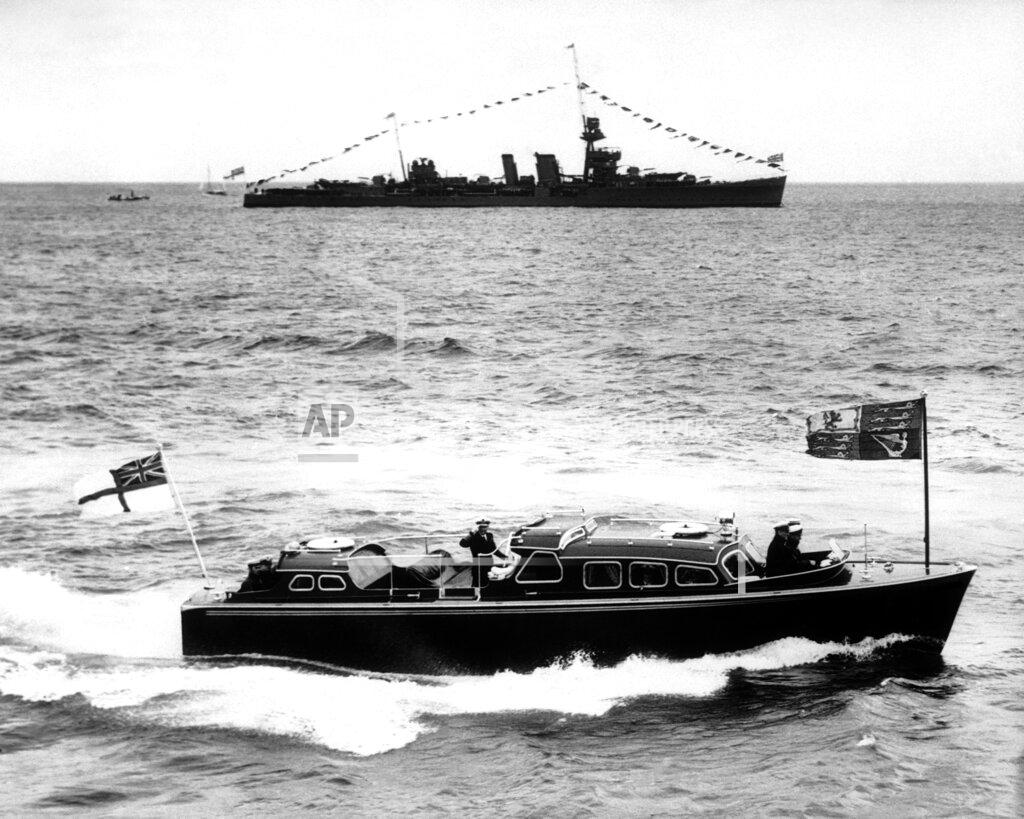
George VI conducted a fleet review of 133 ships at Weymouth Bay. At Weymouth, on the south coast of England, King George VI inspects the 133 warships of the Reserve Fleet immediately prior to its mobilization. During the inspection, as a courtesy to the French, Admiral de la Flotte Jean Darlan, Chief of the French Naval Staff is presented to the King. In a continuous drizzle and mist that hid the spectacle from the crowds on shore, King George today reviewed 133 warships of the reserve fleet, drawn up in long gray columns in Weymouth Bay. The bad weather caused postponement of the vast blackout in the air force’s test. The assembling of the mighty reserve fleet and the war games in the air, which began yesterday, were two of Britain’s trump cards in the effort to prove that this country is ready for any challenge. The existence of the reserve ships had been forgotten by those who imagined the home fleet and the Mediterranean fleet were the only large aggregations of British seapower.
Until ten days ago the ships had lain at dockyards, manned only by maintenance crews. There were rusty patches on their steel sides. and they had the look of long disuse. Yet today the King saw hundreds of thousands of tons of fighting power, ready for instant action, with the crews quietly called up from civilian life or from shore stations. Many of these ships had served in the World War, but although they were old they still could give a good account of themselves in case of trouble.
Among them was the cruiser HMS Cardiff, which led the German High Seas Fleet into the Firth of Forth, when it surrendered after the armistice. Another was the destroyer HMS Warwick, which flew the flag of Admiral Sir Roger Keyes during the raid on Zeebrugge in 1918. Others were still older, like the pre-war battleship HMS Iron Duke, which led the fleet into action at Jutland but which has been used as a gunnery training ship for a few years. With these veterans were scores of newer vessels, still serviceable. All were ready to join the home fleet at battle stations off Scotland at the end of this week for maneuvers on an unprecedented scale in the North Sea.
The King had a soaking today but as a naval officer and a veteran of Jutland he took no notice of the weather. “It’s the same everywhere,” was his philosophic remark to the Mayor of Weymouth, who had commiserated with him when the royal train arrived from Scotland in the morning. Later the King stood in the open on the cruiser HMS Effingham to receive sixty of the reserve fleet’s commanding officers. When this ceremony had ended the King walked to the admiral’s cabin with his uniform sodden and with water streaming from the gold braid on the visor of his admiral’s cap.
Italy published a law introducing fines for anyone moving from the country to a city of 25,000 people or more unless they already had work there. Mussolini had recently advised moving out of the cities if possible to avoid potential bombing in event of war.
Reichsmarschall and head of the Luftwaffe Hermann W. Goering boasts “The Ruhr will not be subjected to a single bomb. If an enemy bomber reaches the Ruhr, my name is not Hermann Goering: you can call me Meier!”
Following his conference at Berchtesgaden with Chancellor Adolf Hitler, Albert Förster, Danzig Nazi leader, returned to the Free City this morning and immediately ordered a monster mass meeting of “the entire Danzig populace” for tomorrow night at which, in the words of an official announcement, “against the Polish threat to raze Danzig with cannon he will give expression to the will of the German city of Danzig before all the world.”
According to all indications, this rally promises to become something of a town meeting plebiscite for Danzig’s return to the Reich, determined not by ballots but by acclamation. For there can be no doubt that aside from protests against Polish “chauvinism” the main burden of Herr Förster’s speech will be a demand for Danzig’s Anschluss with the Reich, and, like all National Socialist speeches, it is certain of loud and unanimous approval from all those present. Nevertheless, coming fresh from Berchtesgaden, Herr Förster will also presumably echo Herr Hitler’s own will, which today determines. the issue of war and peace, and though Herr Hitler has already committed himself by his public demand for Danzig he has thus far left the question of time and method open for further consideration.
German Ambassador von Dirksen, preparing to depart on leave to Germany, visits British Foreign Secretary Lord Halifax. Halifax questions von Dirksen over the “sharp tone of the German press concerning Danzig.” Dirksen replies that it is the fault of the Polish newspaper Czas which has published a statement that if there were any attempt to incorporate Danzig into the Reich, Polish troops would open fire on the Free City.
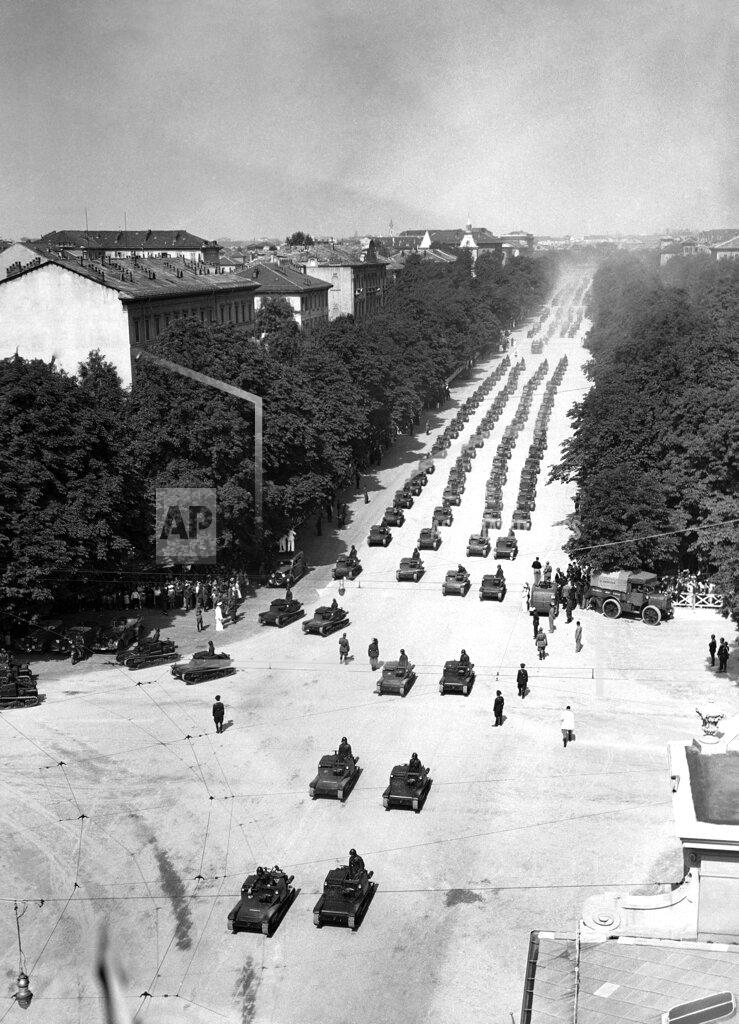
For three hours this morning the streets of Turin resounded to the roar and clatter of the great mechanized Army of the Po concluding its exercises with a triumphal parade. In the reviewing stand were King Victor Emmanuel, Crown Prince Humbert, marshals and generals, high Fascist officials and representatives of foreign nations, including the United States. But Premier Mussolini was not there nor was Marshal Pietro Badoglio. The Premier paid a brief visit at the beginning of the maneuvers but never returned, while the supreme commander of the armed forces does not appear to have paid even one visit.
The Italian cargo ship Povvidenza ran aground at Cuxhaven, Germany. She is refloated the next day.
Only a miracle can provide a peaceful solution to Europe’s troubles, Count Jerzy Potocki, the Polish Ambassador, said in Washington today on his return from Warsaw.
Yugoslavia bars the Axis plan to use its materials in case of war. Yugoslavia’s premier flies to Italy to reject Axis demands. Italo-Reich proposals include taking over railroads and the nation’s foodstuffs. Yugoslavia has refused German and Italian demands for her “benevolent” neutrality involving use of her railroads and Axis supervision of her economic and military centers in the event of European war, it was learned tonight on the highest authority. With the full support of Britain and France, Premier Dragisha Cvetkovitch will fly to Italy tomorrow in a Yugoslav Army bomber, it was said, to tell Italy’s leaders bluntly that Yugoslavia is determined to maintain strict neutrality, even if it is necessary to use her arms to do so.
The government issued orders to speed up construction of fortifications on the German frontier. Germany and Italy were said to have described their proposals as a form of “benevolent” neutrality. Besides use of Yugoslavia’s railroads and supervision of her economic and military centers in wartime, it was said the German-Italian demands would give them complete access to all Yugoslavia’s war materials and foodstuffs in case of war.
Use of her railroads, besides giving them rail connections through the Yugoslav province of Slovenia, in addition to those they already have through Brenner Pass, would give them troop transportation in any advance toward Rumania and the East. The Premier’s sudden decision to fly to Venice and Rome came after “indefinite” suspension of negotiations with Dr. Vladimir Matchek, Croat peasant leader, over demands of 5,000,000 Croats for home rule. Premier Cvetkovitch’s plans were understood to call for direct talks. with Italy’s Foreign Minister, Count Galeazzo Ciano, and possibly with Premier Mussolini.
Prince Paul, senior regent of Yugoslavia, was said to have explained the Axis demands to the British and French Governments on his recent trip to London and Paris. Authoritative sources said Britain and France had told the regent that they would back Yugoslavia in case she came into conflict with the Rome-Berlin Axis, for her surrender would mean a staggering blow to Rumania, Greece, and Turkey, which have joined the French-British front or have been included in it by British-French guarantees of their independence. The government of Premier Cvetkovitch and Prince Paul was understood to have agreed that the slightest compliance with any demands, such as those made in the Axis, would be incompatible with the sovereignty of Yugoslavia. Whether Dr. Matchek, the Croat leader, had agreed to suspension of home rule negotiations, in view of what the government considered a threat to the existence of the whole nation, was not known.
Members of all Hungarian parties in parliament denounce the Nazis.
Slovaks arrest 27 Jews; the group is accused of attacking Germans and of being Communists.
The joint British-French military mission arrives in Leningrad tonight.
The British cargo ship Dalblair ran aground south of Gothenburg, Sweden. She was refloated the next day after offloading 400 tons of cargo.
Jews from several Hagana units use a time-bomb to sink the British police boat Sinbad II in Palestine off Wadi Falik, south of Nathanya. One British policeman is killed. Four Jews are killed when their truck hits a lndmine on the Rehovoth-Gaza Road. An Arab police constable is murdered in Jaffa.
The War and Navy Departments announced today the formation of a civilian advisory committee to the Army and Navy Munitions Board to be known as the War Resources Board. Its duties will be to cooperate in the mobilization of the economic resources of the country and in perfecting plans already made or in the making to put the United States on a war footing and ready to meet any emergency involving war. Edward R. Stettinius Jr., chairman of the board of the United States Steel Corporation, is the chairman of the new board.
The mission of the board is similar to that of the old War Industries Board which functioned during the World War under the chairmanship of Bernard M. Baruch. The Assistant Secretaries of War and of the Navy, Louis Johnson :and Charles Edison, who are acting heads of their respective departments, announced that President Roosevelt had approved the formation of the agency. They added that, along with the Army and Navy Munitions Board, of which Johnson and Edison are joint chairmen, the new body will function directly under the President and will report to him instead of to the Secretaries of War and Navy, as formerly was the case with the Army and Navy Munitions Board.
Besides Mr. Stettinius, the members of the Resources Board, all of whom have agreed to serve, are Dr. Hail T. Compton, president of the Massachusetts Institute of Technology; Walter S. Gifford, president of the American Telephone and Telegraph Company; John Lee Pratt, a director of General Motors Corporation; General Robert E. Wood, chairman of Sears, Roebuck & Co., and Harold G. Moulton, president of the Brookings Institution. Colonel Harry K. Rutherford, Ordnance Department, U.S. Army, was named secretary of the board. A number of other board members will be added at a subsequent date, said Secretary Johnson. In the event of an international emergency the board will lose its semi-official status as an advisory organization and immediately when hostilities are declared it would become an executive agency of the government with broad powers in many ways similar to those exercised by the War Industries Board of World War days.
President Franklin Roosevelt orders a drive to cut costs. All government agencies are to survey operations for possible economies. President Roosevelt has asked all heads of departments, independent establishments and other agencies of the government to seek administrative and operating economies during the current fiscal year, in a letter made public today by Harold D. Smith, Director of the Budget.
President Roosevelt lapsed today into his favorite role of Hyde Park squire, signed and vetoed a number of unimportant bills and drove about his estate in his small open car, inspecting his new crop of trees while awaiting an country’s reaction to his charge that anti-New Deal blocs in Congress had gambled with the nation’s security and economic welfare. The President saw none except local political leaders and a few friends and neighbors during the day, devoting almost all his time and attention to the sheaf of bills which he brought from Washington. He signed twenty-eight of the measures and vetoed nine, but a larger number were disposed of which were not mentioned in the temporary White House statement.
There were no further developments here in the situation which prompted his charge yesterday that “self-willed” Congressional groups had subordinated the national good to their own political purposes in scrapping the neutrality amendments and the lending and housing measures. However, there was good authority for the statement that Mr. Roosevelt, at the next session of Congress, would return to his former method of dealing with both legislative branches and name a “must” list of bills at the outset and then take the issue to the country if he failed to get his way.
It is known that the President Is completely dissatisfied with the results of the recently adjourned session and that he attributes the out-come to some extent to “crack-down” as formerly. Mr. Roosevelt has told friends since the adjournment that he had refrained deliberately to “must list” ideas this session in the hope of overcoming the charge that Congress had become a “rubber stamp” for the administration. Now that the strategy proved ineffective, he is thinking seriously of using his former tactics, according to informed White House’ sources. Among bills approved by the President was one exempting from the provisions of the Fair Labor Standards Act telephone operators employed at exchanges having fewer than five hundred subscribers.
Employees of the District of Columbia, controlled by the federal government, are being asked to contribute to a fund of $350,000 being raised to provide for the equipment of the library at Hyde Park which is to house President Roosevelt’s state documents and papers. This was revealed today following the disclosure yesterday that a form letter had been sent to 10,000 Department of Agriculture employees asking them to contribute for the same purpose. Elwood H. Seal, Corporation Counsel of the District of Columbia, recently called forty or fifty heads of departments of the department together and suggested that they arrange for contributions from employees.
“This is a strictly voluntary proposition,” Mr. Seal asserted. “I purposely refrained from writing any memorandum to the heads of the departments, since it might look as if we wanted people to contribute whether they wanted to or not.” A check of officials and employees of the WPA, PWA, SEC, and the Departments of Interior, Commerce, and Justice, as well as of high officials of the government, showed that so far these agencies of the federal government have not been “solicited.”
The nation’s organized Young Democrats made ready today for their convention, opening tomorrow, to the accompaniment of forecasts of “a solid front” againest the Hatch Political Practices Act and amid charges and denials that the presidency of the organization was being “bought.”
French diplomatic officials, officers of the French Line and the French Government Tourist Bureau were accused by a U.S. federal grand jury yesterday of using diplomatic customs privileges to smuggle in commercial motion pictures.
The American cargo vessel Pipestone County was afire 1,000 miles at sea tonight, but the captain sent a radio message to New York at 10 PM saying the blaze was under control in lower hold 4 and that the ship would proceed eastward this morning.
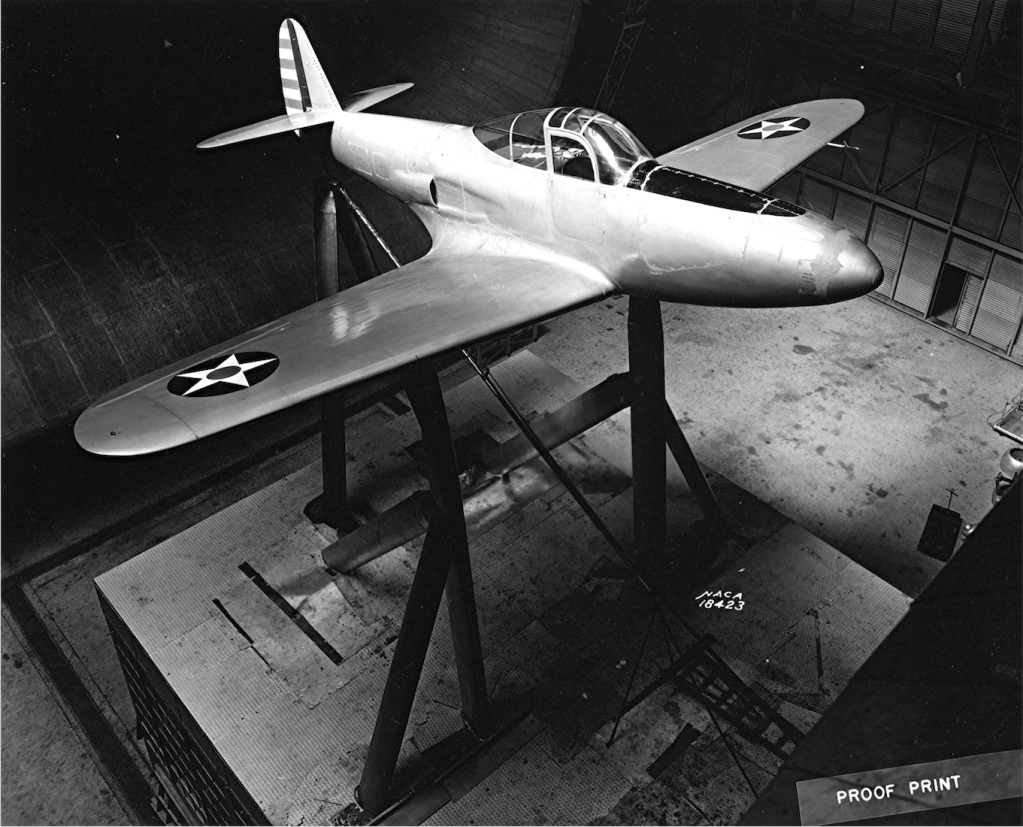
After General Henry H. Arnold had ordered that the prototype Bell Aircraft Corporation XP-39 Airacobra be evaluated in the National Advisory Committee for Aeronautics (NACA) Full-Scale Tunnel at the Langley Memorial Aeronautics Laboratory, Langley Field, Virginia, it was flown there from Wright Field. It was hoped that aerodynamic improvements would allow the prototype to exceed 400 miles per hour (644 kilometers per hour). NACA engineers placed the full-size airplane inside the large wind tunnel for testing. A number of specific areas for aerodynamic improvement were found. After those changes were made by Bell, the XP-39’s top speed had improved by 16%. NACA wrote, “it is imperative to enclose the supercharger within the airplane with an efficient duct system for cooling the rotor and discharging the cooling air and exhaust gases.” In the very tightly planned XP-39, though, there was no internal space left over for the turbo. Using a drag-buildup scheme, a number of potential areas of drag reduction were found. NACA concluded that a top speed of 429 mph (690 km/h) could be realized with the aerodynamic improvements they had developed and an uprated V-1710 with only a single-stage, single-speed supercharger.
The P-39, however, after the engine change mandated by the army, turned out to have disappointing high-altitude performance. The production P-39 retained a single-stage, single-speed supercharger with a critical altitude (above which performance declined) of about 12,000 ft (3,700 m). As a result, the aircraft was simpler to produce and maintain. However, the removal of the turbo destroyed any chance that the P-39 could serve as a high-altitude front-line fighter. When deficiencies were noticed in 1940 and 1941, the lack of a turbo made it nearly impossible to improve upon the Airacobra’s performance. The removal of the turbocharger and its drag-inducing inlet cured the drag problem but reduced performance overall.
The P-39 went on to acquit itself quite well in Soviet service, where much aerial combat took place at low and medium altitude. It was not, as many have erroneously thought, primarily used for ground attack. The P-39 was used by the Soviet Air Force, and enabled individual Soviet pilots to score the highest number of kills attributed to any U.S. fighter type flown by any air force in any conflict. Other major users of the type included the Free French, the Royal Air Force, and the Italian Co-Belligerent Air Force.
Congress authorized construction of second NACA research station at Moffett Field, California, which became the Ames Aeronautical Laboratory, named after Joseph S. Ames, president emeritus of Johns Hopkins University, member of the NACA from its beginning in 1915 to 1939, and Chairman of NACA from 1927 until 1939.
New York Yankees’ third baseman Red Rolfe begins an eighteen-game scoring streak. The Penacook, New Hampshire native will score thirty runs during this period of time.
Japanese military authorities at Tientsin, China, yesterday issued a statement warning Britain that unless she showed sincerity “she must prepare for possible happenings that will make Prime Minister Neville Chamberlain’s blood boil for such things as he terms ‘high-handed and intolerably insulting treatment of British subjects.’ ” That statement is published and translated by Domei, Japanese news agency. The statement declares the British Government has wasted more than a week and that London is trying to hold over the Far Eastern issues until the Danzig question has been disposed of and while it make efforts to conclude a military alliance with the Soviet Union. The statement asserts Japan will never overlook “such tricks” and will find it unnecessary to continue the discussions if Britain maintains “her faithless attitude.” The Tokyo press today declares that Japanese military representatives have made up their minds to return to Tientsin in a few days unless the talks are reopened. The explanation offered is that those officers hold important executive posts in China, to which they are anxious to return. It is likely that the talks will be resumed before next week, and so far as Tokyo is concerned there is little fear of an immediate rupture.
The Japanese Cabinet shuns an Axis tie. The Japanese Army’s effort to have Japan’s European policy reopened met a discouraging reception from the “Inner Cabinet” yesterday, it became known today. The war minister will present his views to the Emperor today, but a deep rift is reported.
Wang Ching-wei, former Chinese premier, urges south China to revolt. He asserts the Japanese are ready to make peace.
Marking the first anniversary of their arrival to establish the United States Embassy in Chungking, members of the embassy staff of one year’s service yesterday were “treated” by Ambassador Nelson T. Johnson to an informal luncheon.
Dow Jones Industrial Average: 139.75 (-1.35).
Born:.
Claude Osteen, MLB pitcher (World Series Champions-Dodgers, 1965; All-Star, 1967, 1970, 1973Cincinnati Reds, Washington Senators, Los Angeles Dodgers, Houston Astros, St. Louis Cardinals, Chicago White Sox), in Caney Spring, Tennessee.
Dick Lage, NFL tight end (St. Louis Cardinals), in Omaha, Nebraska (d. 1987).
Billy Henderson, American pop and R&B singer (The Spinners, 1954-2004 – “The Rubberband Man”), in Indianapolis, Indiana (d. 2007)
Max Neuhaus, American classical musician and experimental percussionist (sound sculptures), in Beaumont, Texas (d. 2009).
The Mighty Hannibal, American singer, songwriter and record producer; in Atlanta, Georgia (d. 2014).
Bulle Ogier, French actress; in Boulogne-Billancourt, France.
Naval Construction:
The U.S. Navy prototype submarine chaser USS SC-450 is laid down by American Car & Foundry (Wilmington, Delaware, U.S.A.).



 History Diaries