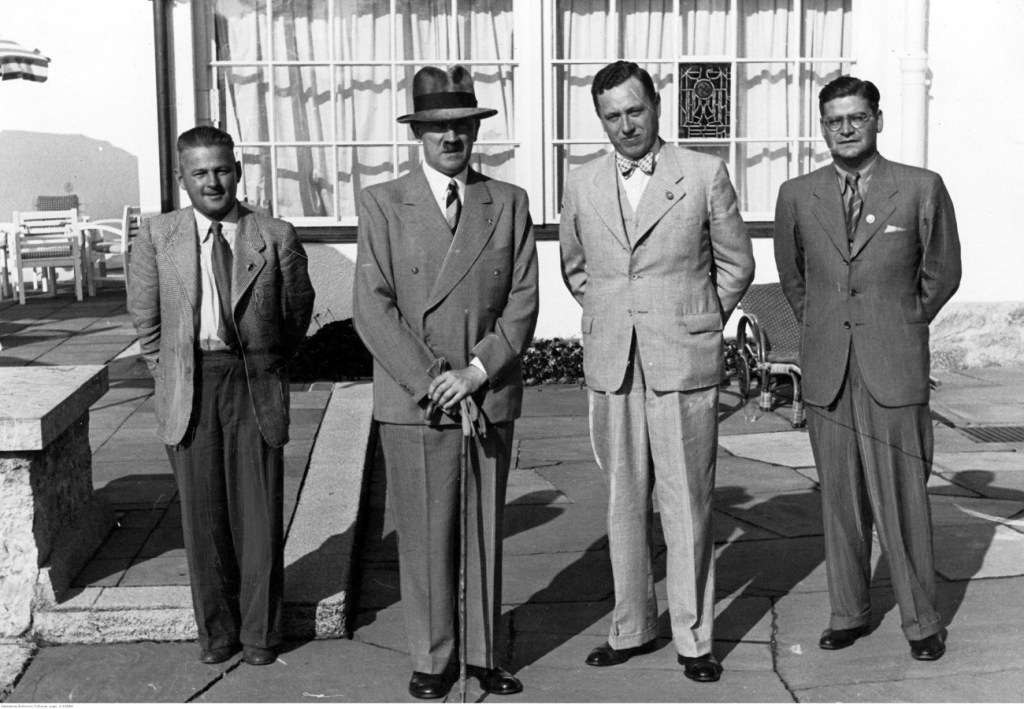
Swedish businessman Birger Dahlerus arranged a meeting at his house in Schleswig-Holstein between his friend Hermann Göring and seven important British businessmen in an effort to avoid war. The meeting was friendly and Dahlerus believed that an informal agreement was in place to hold a peace conference. A group of British businessmen meets with Hermann Göring in Schleswig-Holstein, Germany, warning him that British public sentiment will not allow another act of appeasement, and that the public will push the British government to declare war on Germany.
Danzig proposes talks with Poland over the customs dispute. The Nazi Senate’s overture is said to evoke positive reaction in Warsaw. The Nazi-controlled Danzig Senate agreed today to open negotiations on the critical dispute over Polish customs administration of the Free City. Poland likewise was represented as ready to enter the negotiations, provided her treaty rights to control customs were not violated. Political informants said they saw Berlin’s guiding hand in the Senato action. Poles interpreted it as a victory for the firm attitude attributed to Warsaw in the Polish-Danzig “margarine and herring war.”
The dispute revolves around the allegation of Danzig Germans that Poland increased the number of customs supervisors unnecessarily in Danzig. The Polish action in banning export of margarine and curtailing herring shipments to Poland, a big user of these two important Danzig products, also figured largely in the differences. The Germans charged that some of the customs supervisors were engaged in espionage. The seriousness of the situation was intensified by the long campaign by the Nazis for the return of Danzig to her pre-war status as a part of German territory.
The Free City Senate sent a note today to Polish Commissioner Marian Chodacki, whose offices are across the street from the building occupied by the governing body of the Free City. The strictly controlled Danzig press did not carry the contents of the note, but the official Danziger Vorposten said the Senate would enter into negotiations with M. Chodacki. Polish customs officials halted the export of margarine to Poland last week, declaring her customs control rights had been violated because Danzig manufacturers had refused to permit inspection of their plants.
The export of some herring was stopped when Poland charged the fishery involved was not a real Danzig firm but one with Netherlands hacking and therefore outside the duty-free classification of Danzig products moving into Poland. The Free City Senate’s recent decision simply to refrain from recognizing the Polish customs officials it regards as superfluous has not gone into effect. Nor has the unofficial threat to open the East Prussian [German] frontier and trade directly with Germany advanced beyond that stage.
Contradictory versions of the official Danzig reply to Polish Commissioner Marian Chodacki were current all day. An official Polish statement late tonight said that in today’s note Danzig promised to cease discriminatory measures against Polish customs officials in the future, but at the same time made it clear that measures against them in the past, which led to Saturday’s Polish “ultimatum,” had been introduced “without the knowledge of the Danzig Senate authorities.” The note suggests that Arthur Greiser, Danzig Senate president, was unaware of this discrimination.
Italy’s war games end abruptly. Premier Benito Mussolini is strangely absent. The great Italian Army maneuvers ended suddenly and unexpectedly this morning, twenty-four hours before schedule. No reasons were advanced, the newspapers writing their stories as If the conclusion today had been expected. The exercises ended, moreover, without the presence of Premier Benito Mussolini, who merely paid a brief visit by plane on the first day and did not return afterward. In previous years, as head of the National Defense Ministries and Commander in Chief, he stayed with the maneuvers constantly.
The whole business is all the more confusing because the Army of the Po was just about to demonstrate the reason for its formation — how to smash through an opposing force and exploit the breach. Yesterday it halted the invading “Red” forces and took the initiative this morning at 7. At 11:30 it was announced that it had broken through in three places and that all its objectives could be regarded as reached. That gave the army no real opportunity to test its striking power and ability to follow through. The exercises, therefore, proved to have been merely an experiment in speed, logistics, and maneuverability.
Count Ciano requests a meeting with Joachim von Ribbentrop.
Loyal Tyrolese may stay in Italy; those who embrace fascism will not be ousted.
In Austria, Salzburg’s Catholic center is seized, and more nuns are ousted.
A Serb-Croat agreement is said to be signed.
Netherlands royalty names the new Princess Irene Emma Elizabeth. Irene means “peace.”
President Roosevelt claims victory on courts despite Congress; he says his “liberal ideas” prevail in the Supreme Court. President Roosevelt declared today that the objectives of his 1937 battle with the Senate over his Court Reorganization Bill had been won despite the defeat of that program at the time. Although his proposal for enlargement of the Supreme Court was rejected, today the “liberal ideas” of the Administration prevail, he said, pointing to recent attacks on the Supreme Court by “ultra-conservative members of the bar.” Frank J. Hogan, president of the American Bar Association, has said that recent court decisions had brought most activities of the nation “within the ambit of Federal control” and that now “the American people must look to the Legislature rather than the judiciary for the preservation of liberty.”
Since the President’s controversy with the Senate over his enlargement plan he has appointed four of the nine Supreme Court justices. Mr. Roosevelt made his claims of complete if belated victory in a prepared statement on signing the so-called Court Proctor Bill, passed by the session just ended. “The country is naturally concerned,” he said, “with the attainment of proper objectives rather than any one of many possible methods proposed for the accomplishment of the end.”
The President’s statement was prepared after a visit to the White House by Attorney General Frank Murphy and Homer S. Cummings, his predecessor in that office. It preceded, by a few hours, Mr. Roosevelt’s departure for his Hyde Park, New York, family home, where he plans to pass the coming week, signing bills and clearing his desk of other official routine before embarking on a ten-day cruise in the North Atlantic. The statement followed close on the heels of authentic White House indications that Mr. Roosevelt has no intention of accepting the House defeat of his latest pump-priming recovery program and is now considering ways and means of laying the issue before the constituents of those who voted against the housing and lending measures in the last days of the session.
In his statement on signing the measure authorizing the proctor or fiscal officer for all Federal courts he recalled his 2-year-old attack on “the unwarranted attitude” of the Supreme Court with reference to its exercise of constitutional powers and the “narrow interpretations” which he said had impeded or defeated his program of economic reform. He called it a fight against the Supreme Court’s assumption of legislative powers that reside in Congress alone. Then he said: “It is true that the precise method which I recommended was not adopted, but the objective, as every person in the United States knows today, was achieved. The results are not even open to dispute.” One after another, the President cited the objectives of his judiciary. reorganization program and their achievement. He waited until the last line of the statement to dispose of the chief recommendation of his plan — the enlargement of the membership of the Supreme Court itself. And of this he said that it “has been accomplished through the opinions of the Supreme Court. itself.”
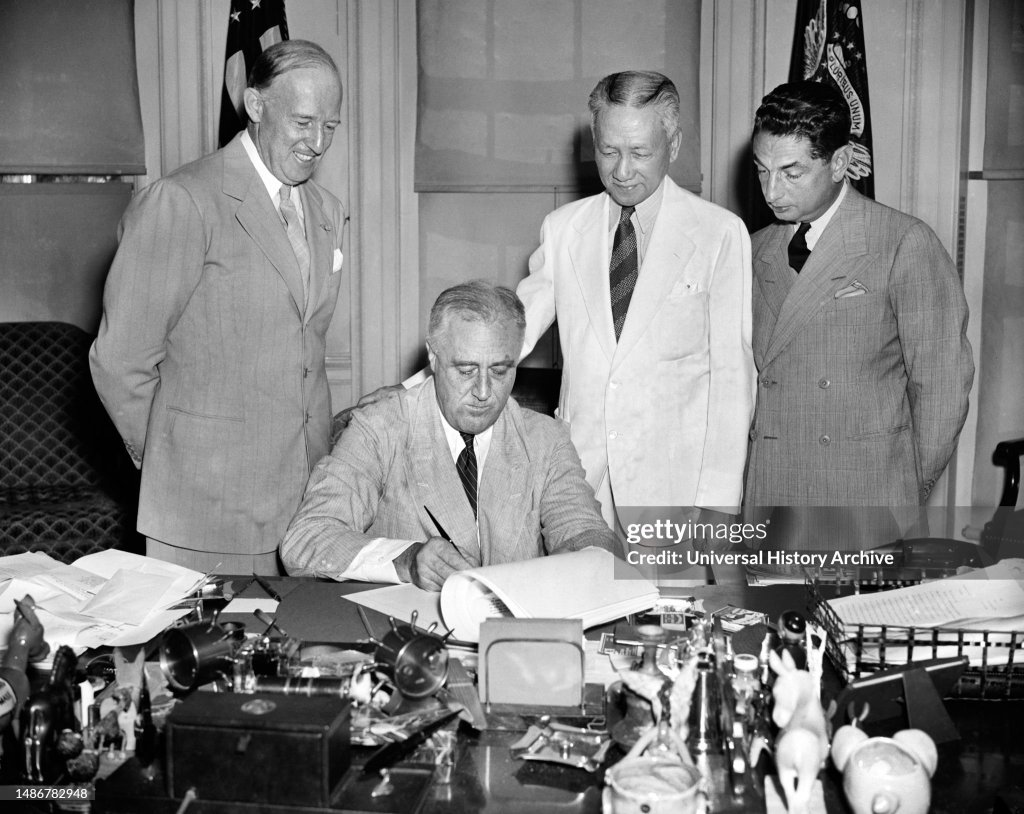
President Franklin Roosevelt signs 100 bills. Patent laws are among the policies altered. President Roosevelt today signed legislation canceling export taxes scheduled to be applied to certain Philippines products and imposing graduated quotas instead. This measure was among about 100 approved by the President. With the aim of conditioning Philippine export industries gradually to the situation to be encountered after independence removes free access to the American markets, the Tydings-McDuffie Independence Act imposed export taxes amounting to 5 percent of the American duty for 1941 and increasing 5 percent each year to a maximum of 25 percent in 1945.
The new amendments remove this tax on cigars with their by-products, coconut oil, pearl buttons and embroidered garments, industries which represent a considerable investment and are even more important from the viewpoint of labor employed. The export quotas which are substituted decline 5 percent each year from 1941 to 1946, when independence is to be granted. The measure provides for a conference to be held at least two years. before independence to formulate recommendations as to future trade relations.
The President signed a series of amendments broadening the act requiring the registration of persons who act as agents for foreign principals. Three bills designed to simplify patent procedure also were approved. One shortens and simplifies the contests in the Patent Office by eliminating one of the two or more appeals previously permitted. Inventors are required by the second to file their application for patent within one year, instead of two as previously, after they make. their invention known to the public. The third requires that any person who believes himself a prior inventor must file an application within one year and start a contest within one year after a patent is granted. Previously two years were allowed.
A judge rejects a Connecticut ban on birth control. He clears two doctors and a nurse in the test case of the statute.
The tax burden of the United States has increased almost six and one-half times since 1913, as compared to a rise of only four and one-third times in the United Kingdom, the National Association of Manufacturers asserted today.
The WPA cuts rolls but a labor shortage is seen. Some say work projects will be undermanned for a short time only.
An oil concession covering the entire kingdom of Saudi Arabia has been granted to the Standard Oil Company of California by King Ibn Saud.
One of the developments for both the comfort and safety of passengers which will be found in the 1940 models of General Motors cars was disclosed today in demonstration of a joint development of the Fisher Body division of the automobile corporation and the Libby-Owens-Ford Glass Company. This is the use of safety plate glass, rather than safety sheet glass in windows and rear lights of closed passenger bodies which constitute about 99 percent of the total output of body types.
Explained at a morning meeting by Dr. Andrew H. Ryan of Chicago, who has been conducting tests for many months, and characterized in a luncheon talk by Charles F. Kettering, vice president of General Motors in charge of research, as an important advance in the application of science to motor-car production, the plate safety glass has been shown by test to reduce eye fatigue, distortion of vision and errors of depth perception. It also resists impacts more effectively without shattering.
Millionaire Howard Hughes is presented with a Congressional Gold Medal.
Outfielder Roy Weatherly’s pinch single in the eighth inning gave the Cleveland Indians a 6–5 victory over the St. Louis Browns tonight in a contest marked by the sterling play of Lou Boudreau, Cleveland shortstop, in his first full game in a major league uniform.
The Brooklyn Dodgers edged the Boston Bees, 7–6, in ten innings. Dixie Walker singled home Jimmy Hudson with the winning run with two outs.
The Canadian schooner Fahe was destroyed by fire 8 nautical miles (15 km) off Coffin Island, Nova Scotia.
The British hold a big stake in Japanese trade, as they supply many products vital to Japan. The Empire’s sale of raw materials is a factor in treaty discussions.
The British see intent in the Ichang bombing. A naval report says the Japanese also tried to hit a gunboat, and the French are also menaced. British official circles tonight took an increasingly grave view of two Japanese air raids on British property near Ichang as more detailed reports. came from the British gunboat. HMS Gannet, which passed unscathed through the Sunday attack. Commander A. F. St. G. Orpen of the Gannet sent word that the gunboat herself narrowly escaped destruction from one bomb, which, he asserted, seemed to be aimed at the British vessel and landed only 100 yards away.
Reports from the Gannet said that the raiders, twelve planes in all, appeared not to be concerned with any objective but the anchorage of British ships just below Ichang and near-by waterfront property of the Asiatic Petroleum Company, a British firm. These reports said that the planes dived at the oil plant and the anchored ships, which included eighteen lighters, a floating dock and two tugs, “with seemingly undeniable intent to destroy this foreign property.” Two British Yangtze River steamers were destroyed in the raids that killed four Chinese and injured a Canadian, H. G. Denyer, and four Chinese, near Ichang, more than 1.000 miles up the Yangtze from Shanghai.
“We have no information,” said a Japanese army spokesman. “If it happened, it is a regrettable mistake.” All of the damaged property was said by the British to have been marked plainly with British ensigns. Commander Orpen reported to Rear Admiral Reginald Vesey Holt, commander of Britain’s Yangtze River patrol, that the Gannet was a half mile below the petroleum company property while it was being bombed. One Japanese plane then detached itself from the attackers and flew over the gunboat, releasing a single bomb that passed over the Gannet. The missile and fire that followed destroyed the two river steamers.
Britain yesterday lodged a protest with the Japanese against the attack on British property, but no action has been taken in the light of further official reports from Commander Orpen. Foreign missionaries reported to Chungking that casualties probably would total more than 500 in Ichang as a result of Japanese air raids carried out at the same time.
The Japanese Emperor opposes any war attempt with Britain.
Japanese leaders weigh an Axis tie.
Dow Jones Industrial Average: 140.76 (-1.35).
Born:
Anjanette Comer, American actress (“The Guns of San Sebastian”, “The Baby”, “Lepke”), in Dawson, Texas.
Verna Bloom, American actress (“After Hours”, “Badge 373”), in Lynn, Massachusetts (d. 2019).
Naval Construction:
The Kriegsmarine (German Navy) Type IXC U-boats U-66, U-67, U-68; and U-125, U-126, U-127, U-128, U-129, U-130, and U-131 are ordered from AG Weser, Bremen (werk 985-987 and 988-994).
The Kriegsmarine (German Navy) Type XB U-boat U-119 is ordered from F. Krupp Germaniawerft AG, Kiel (werk 624).
The Kriegsmarine (German Navy) Type VIIC U-boats U-132, U-133, U-134, U-135 and U-136 are ordered from Bremer Vulkan-Vegesacker Werft, Bremen-Vegesack (werk 11-15).
The U.S. Navy Cimarron-class oiler USS Neosho (AO-23) is commissioned. Her first commanding officer is Cdr. William Evans Anthony Mullan, USN.
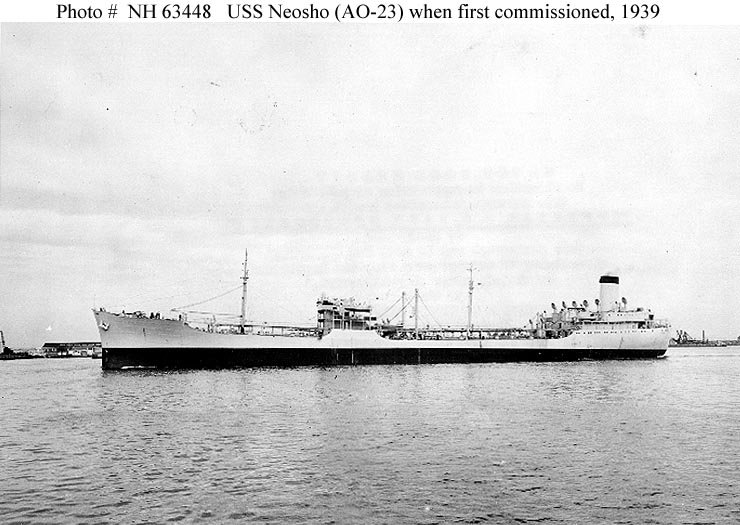
Conversion at Puget Sound Naval Shipyard was completed on 7 July 1941, USS Neosho immediately began the vital task of ferrying aviation fuel from west coast ports to Pearl Harbor. On such a mission she arrived in Pearl Harbor on 6 December, discharged a full cargo to Naval Air Station Ford Island, and prepared for the return passage.
Next morning, the surprise attack on Pearl Harbor found Neosho alert to danger; her captain — Commander John S. Phillips — got her underway and maneuvered safely through the Japanese fire, concentrated on the battleships moored at Ford Island, to a safer area of the harbor. Her guns fired throughout the attack, shooting down one enemy plane and driving off others. Three of her men were wounded by a strafing attacker.
For the next five months, Neosho sailed with the aircraft carriers or independently, since escort ships—now few and far between—could not always be spared to guard even so precious a ship and cargo. Late in April, as the Japanese threatened a southward move against Australia and New Zealand by attempting to advance their bases in the Southwest Pacific, Neosho joined Task Force 17 (TF 17). At all costs, the sea lanes to the dominions had to be kept open, and they had to be protected against attack and possible invasion.
As the American and Japanese fleets sought each other out in the opening maneuvers of the climactic Battle of the Coral Sea on 6 May 1942, Neosho refueled the carrier Yorktown and the heavy cruiser Astoria, then retired from the carrier force with a lone escort, the destroyer Sims.
The next day at 1000, Japanese search planes spotted the two ships and misidentified them as a carrier and her escort. 78 aircraft from Shōkaku and Zuikaku soon arrived and began searching in vain for the “carrier” force. Eventually, they gave up and returned to sink Sims and leave Neosho — victim of seven direct hits and a suicide dive by one of the bombers — ablaze aft and in danger of breaking in two. She had shot down at least three of the attackers. One of her crewmen, Oscar V. Peterson, was posthumously awarded the Medal of Honor for his efforts to save the ship in spite of his severe injuries suffered in the attack.
Sound seamanship and skilled damage control work kept Neosho afloat for the next four days. The stricken ship was first located by a RAAF aircraft, then an American PBY Catalina flying boat. At 13:00 on 11 May, the destroyer Henley arrived, rescued the 123 survivors and sank by gunfire the ship they had kept afloat. With Henley came word that the American fleet had succeeded in turning the Japanese back.
Neosho received two battle stars for her service.
 History Diaries