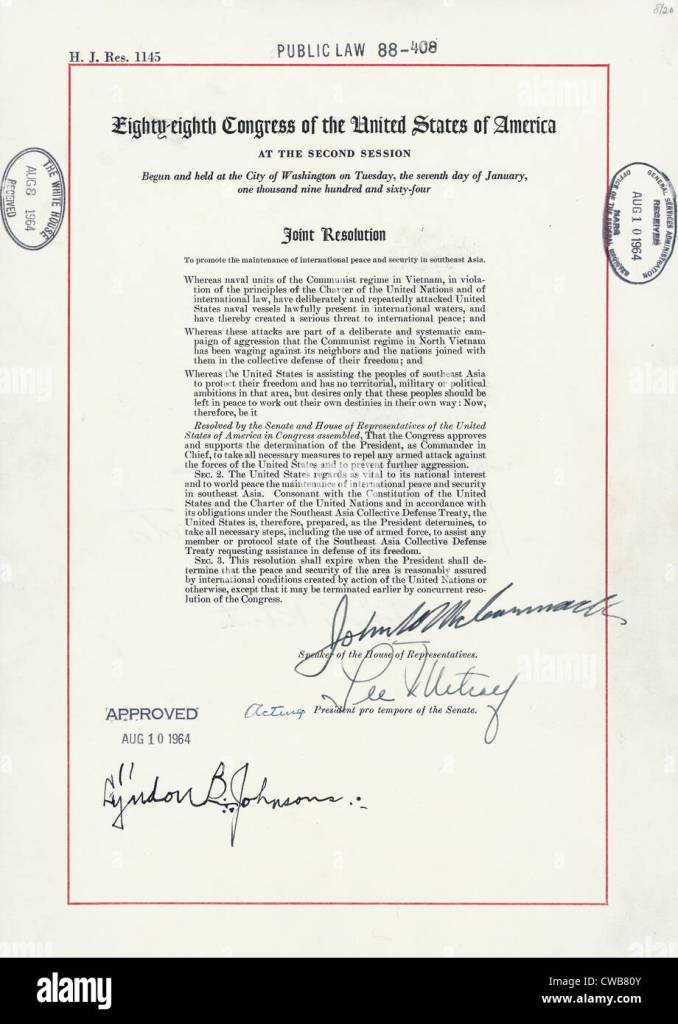
By a unanimous (416 to 0) vote in the House of Representatives and an 88 to 2 vote in the Senate, the United States Congress approved the Gulf of Tonkin Resolution, endorsing President Lyndon B. Johnson’s broad use of war powers to combat North Vietnamese and local Communist attacks in Vietnam. The approval would clear the way for a massive American commitment to the Vietnam War. The only two votes against the resolution came from Senator Wayne Morse of Oregon and Senator Ernest Gruening of Alaska. U.S. Representative Adam Clayton Powell Jr. of New York did not vote for or against the resolution, and chose to vote “present” during the roll call. The resolution authorized the president to “take all necessary measures to repel any armed attack against the forces of the United States” and “to assist any member” of the Southeast Asia Treaty Organization, but fell short of a declaration of war. The resolution would be repealed by both houses of Congress on June 24, 1970, although American combat operations would continue into 1973.
The U.S. Senate, by a vote of 82-2, and the House of Representatives, 416-0, overwhelmingly approve Public Law 88408 which becomes known as The Tonkin Gulf Resolution.’ President Johnson will sign it on 10 August. It will become increasingly controversial as Johnson employs it to enlarge the U.S. commitment to the war in Vietnam. Only two Senators vote against it, but eventually many Senators and Representatives will have strong doubts about the resolution, which will be repealed in May 1970.
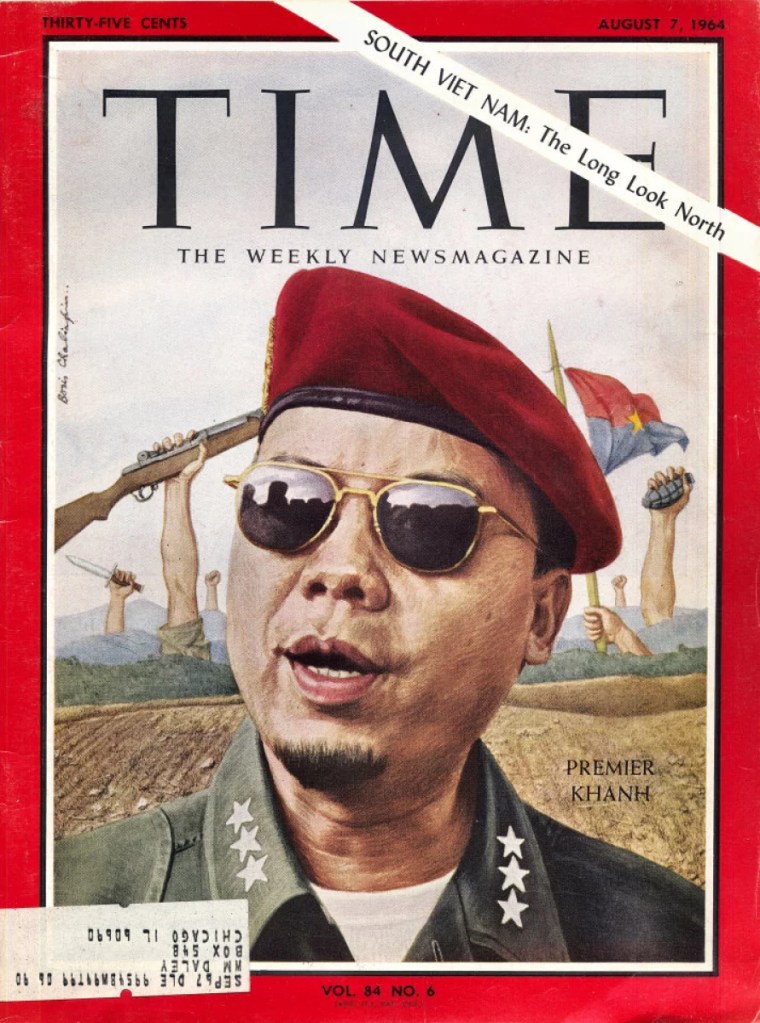
To exploit the mood of crisis surrounding the events in the Gulf of Tonkin, General Khánh declares a state of emergency in South Vietnam, reimposes censorship, and announces other controls, the justification being that the nation is threatened by large-scale Communist aggression. Premier Nguyễn Khánh decreed a state of emergency throughout South Vietnam today and urged the people of North Vietnam to “stand up and overthrow the dictatorial party rule” of their Communist Government.
The Premier also ordered stringent measures to tighten his Government’s control over the population and to safeguard the country against the threat of large‐scale Communist attacks. “The coming weeks will decide the destiny of our entire people,” General Khánh said. “We will not accept becoming a minor province of Red China.” According to intelligence reports, General Khánh said, Chinese Communist troops are massed along China’s southern frontier and are “stationed—not infiltrated but stationed — in North Vietnam itself.”
Emergency measures, to be put into effect immediately, include controls on travel and food distribution, regional curfews where dictated by security requirements, enlarged authority for detention and house arrest, unlimited search rights in private homes and a ban on strikes and meetings “considered harmful to public order.” The press and all public‐information media are to be censored. This apparently will not extend to foreign news dispatches and other communications leaving the country, The Associated Press said.
For anyone taking part in terrorist activities, the death penalty will be authorized after an urgent trial before a military court. During the evening the Government announced a curfew in Saigon from 11 PM to 4 AM, starting tonight. The Military Revolutionary Council, the army’s governing body, which overthrew the Government of President Ngô Đình Diệm last November, ordered a temporary suspension of “all laws and regulations” as necessary.
Henry Cabot Lodge, only a few months ago a leading Republican Presidential possibility, will tour allied capitals for President Johnson to explain the situation in South Vietnam. Speaking in front of the White House today, Mr. Lodge said he had General Dwight D. Eisenhower’s approval for the mission. He will leave within a week. Mr. Lodge was the United States Ambassador to South Vietnam for 10 months until he resigned in late June to return and work against the nomination of Senator Barry Goldwater by the Republicans. He did not elaborate on what he would tell officials he would talk with during his trip, except to say that it would be “in support of our national policy.” Presumably a large part of his mission will be to explain the reasons for and the intent of the retaliatory action taken this week against North Vietnam for attacks on American naval vessels.
The Hanoi Government charges that U.S. airplanes ‘again intrude repeatedly’ into North Vietnam air space, but the Pentagon categorically denies this.
The Security Council invited North Vietnam today to appear before it to testify on the recent armed clashes with United States naval forces in the Gulf of Tonkin. The Council also asked South Vietnam to appear or to present pertinent information on the situation. The Council adjourned without further action. It was agreed that the members would set the date for the next meeting, which presumably depends on the replies to the invitations.
Adlai E. Stevenson, the United States representative, rejected an assertion by Czechoslovakia’s delegate, Jiri Hajek, that United States ships violated North Vietnamese territorial waters on July 30, three days before the first Vietnamese attack on the USS Maddox, and had fired on Vietnamese territory. Mr. Stevenson said there had been no attack on North Vietnam and no incursion into its territorial waters before the retaliatory attack of August 5. United States ships were attacked on the high seas 65 miles from Vietnamese territory, he said.
Release of the official summary of the U.S. air strikes against North Vietnam prompts Defense Secretary McNamara to admit that President Johnson was announcing the raids about one hour before the first target was actually hit, but he defends this on grounds that this warned China that only North Vietnam was to be the target.
The world continues to react. Foreign Minister Gromyko of the Soviet Union promises his nation’s full support for North Vietnam. In Peking, thousands of demonstrators march to support North Vietnam; in London, Lord Russell condemns the U.S. action, while in Calcutta, 1000 leftist students demonstrate against the United States. But Premier Souvanna Phouma of Laos supports the U.S. action, as does the Inter-American Naval Conference, meeting in Rio de Janeiro, and Britain announces its Far East fleet is ready for any emergency action to support the United States.
On the same day, the People’s Republic of China warned that it would “without hesitation… resolutely support the Vietnamese people’s just war against U.S. aggressors”, though not committing to direct military intervention. American strategy during the war would be set when the Beijing government “informed Washington privately that it would not go beyond material aid provided that the United States did not invade North Vietnam with ground forces”, which would be considered a threat to China’s frontier.
On August 6, Greek Cypriot government forces had launched an attack supported by mortars from the Greek Cypriot village of Ayios Georgios against Turkish Cypriot positions in the north. On August 7, they resumed the attack in the afternoon by opening heavy fire on Ayios Theodoros and began to advance on Kokkina. The same evening a government patrol boat shelled Mansoura and Kokkina. Some 70 shells were fired. The Unficyp commander sent a strong written protest to the government and asked that the operation be stopped. At about the same time, four Turkish F100 aircraft flew over Polis in a demonstration of force and fired their weapons out to sea.
After an emergency Cabinet meeting, Deputy. Premier Kemal Satir also warned that the island could be bombed if American conciliation efforts failed to ease the tension between Greek and Turkish Cypriots. Mr. Satir denied, however, a Greek Cypriot charge that four Turkish Air Force Sabrejets had already strafed the northwestern coastal town of Polis and had hit an Italian cargo vessel in the harbor. In denying Cypriot charges of strafing and machine‐gun fire by Turkish jets, Mr. Satir said, “They must have mistaken the planes’ noise for machinegun fire.”
After the Cabinet meeting, Turkey’s Minister of Information Ali Hassan Gogush issued this statement: “The government is closely watching the latest developments in. Cyprus. The Greek Cypriot Administration has increased its aggression against the Turkish Cypriot community. The Turkish Government is taking defensive precautions and making political contacts.”
Turkey now prepares to use air power to actively intervene, defending the Turkish Cypriot population.
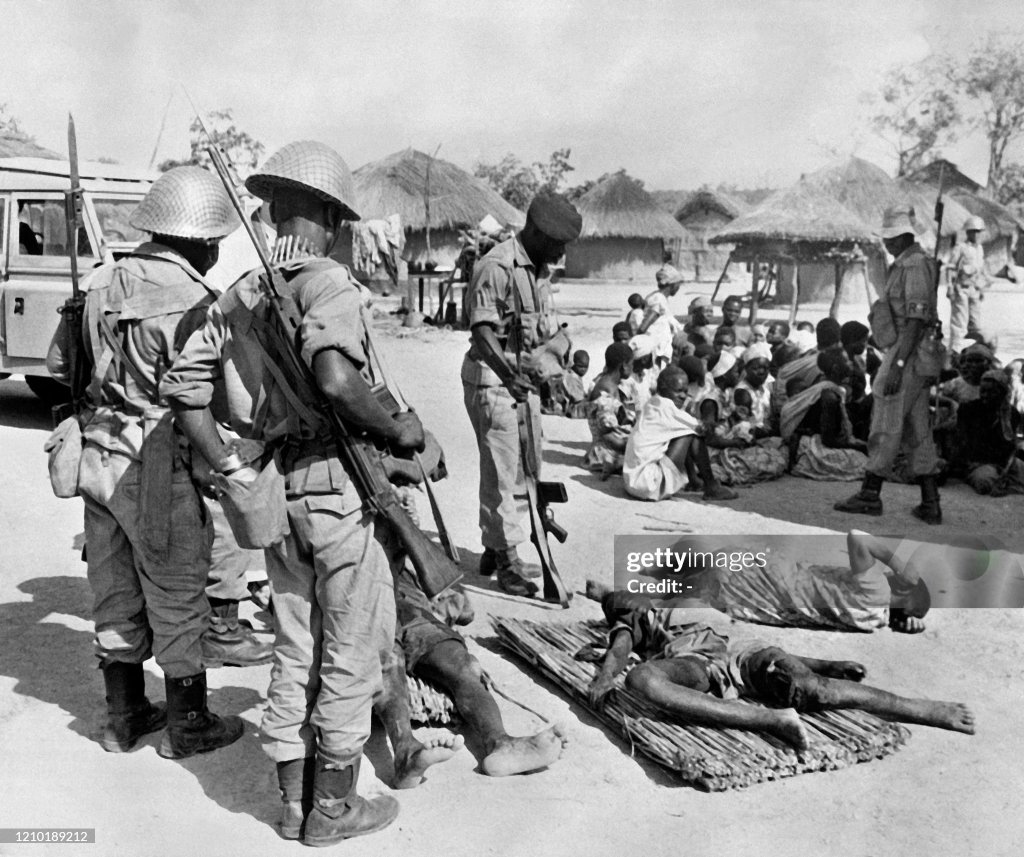
Belgium and the United States are ready to increase technical aid to shore up Premier Moise Tshombe’s Government in the Congo, but neither country will provide military personnel for combat, informed sources indicated here tonight. W. Averell Harriman, United States Under Secretary of State for Political Affairs, arrived here from Washington today and conferred for five hours with Belgium’s Foreign Minister, Paul‐Henri Spaak. They refused to comment later on their discussions beyond saying that they had had a “useful exchange of views.”
President Johnson’s antipoverty bill won an all‐but‐final victory in the House tonight by a surprisingly wide margin of 38 votes. However, opponents succeeded in delaying final action until tomorrow. Tentative approval came on adoption of the Administrationsponsored substitute bill, embodying all the changes made by both the Senate and the House. The vote was 228 to 190. Even sponsors of the bill were surprised at the wide margin of support. They had expected to get the votes of only six to ten Republicans.
Twenty Republicans joined 208 Democrats in voting for the measure. Voting against it were 153 Republicans and 37 Democrats, most of them conservative Southerners. Thus, after a day of bitter wrangling and one close brush with defeat, the $947.5‐million antipoverty program was on the verge of passage. But opponents delayed a final vote by demanding an engrossed bill — a printed copy of the measure and all its amendments. This demand automatically put off final action until the printers could prepare the document. The delaying maneuver was viewed as a temporary setback for the Administration, which had pressed for quick passage while the votes were in hand.
Many members usually go home for the weekend. It could prove difficult to keep the supporters, particularly those who reluctantly backed the Administration, in town for the final vote scheduled for tomorrow. The House will meet at noon. However, the tentative approval represented a major victory for President Johnson. The antipoverty bill, one of the most controversial measures to come before Congress in recent years, is the only major domestic legislation proposed by Mr. Johnson. Other major bills approved this year, including civil rights and tax reform, were originated by President Kennedy. The bill calls for the following:
- A job corps in which 30,000 young men and women will be given job‐training and remedial education in camps and residential schools. The corps is primarily designed to attract school dropouts between the ages of 18 and 22 years.
- A work‐training programto prevent up to 200,000 teenagers, living at home, from dropping out of school. The recruits would earn money by working in hospitals, playgrounds and other community projects.
- A work‐study program to aid needy college students by helping to finance part‐time jobs for them, either on or off campus.
- A Federal fund of $340 million to be allocated to communities to help them finance local attacks on poverty.
- Loans to small farmers and to small‐business men.
- A domestic Peace Corps, to be known as Vista (Volunteers in Service to America). The volunteers would work on Indian reservations, mental hospitals and in various areas of intensive poverty.
Attorney General Robert F. Kennedy is once again seriously considering running for Senator from New York State this fall. Authoritative sources disclosed yesterday that relatives and political allies of the Attorney General had begun tentative discussions with a number of important Democrats in the state, seeking a broad base of support for his candidacy. Stephen Smith, Mr. Kennedy’s brother‐in‐law, has told people eager to work for the Attorney General to expect a go‐ahead signal by this weekend, barring unforeseen developments. However, other intimates of Mr. Kennedy, while confirming that he has expressed a definite interest in a Senate campaign, said they expected no final decision for two weeks.
Mr. Kennedy was in New York yesterday for a meeting with Mayor Wagner, the state’s most powerful Democrat. They had breakfast together at Gracie Mansion and discussed the Senate situation as well as the recent racial riots in Harlem. After studying the idea of making a race for the Senate for several weeks, Mr. Kennedy said on June 23 that he would not be a candidate. At that time he was hopeful that President Johnson would choose him as his running mate. When Mr. Johnson eliminated the Attorney General and other Cabinet members from the list of potential Vice‐Presidential candidates on July 30, Mr. Kennedy was immediately urged by influential New York Democrats to reconsider. He has now done so.
Mr. Kennedy is known to have the support of a powerful group of Democratic leaders, including Peter Crotty of Erie County (Buffalo), Stanley Steingut of Brooklyn, Charles A. Buckley of the Bronx and John F. English of Nassau County. With the exception of Mr. English, each of these men is a political opponent of the Mayor. They will control close to 400 votes at the state Democratic convention on September 1, with a total of 573 votes needed to win nomination. While it is conceivable that Mr. Kennedy could win the nomination without the open endorsement of Mr. Wagner, it is not thought likely that he would attempt to do so.
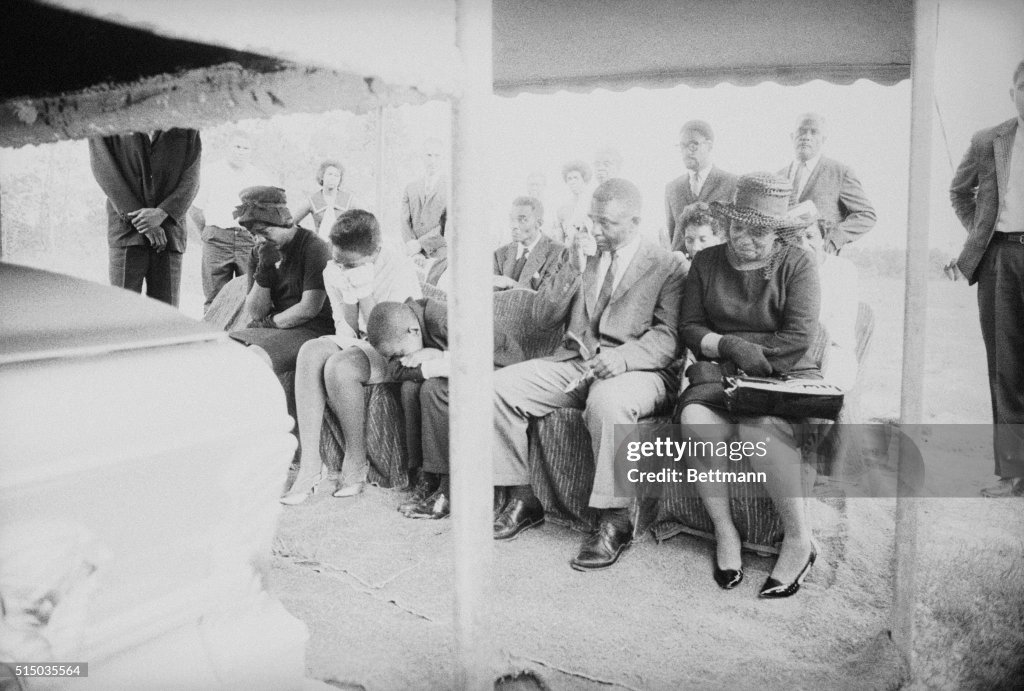
The funeral for James Chaney, the first for the three victims of the murder in Neshoba County, Mississippi, was held before African-American mourners at the First Union Baptist Church in Meridian, and one of the eulogies was given by a white preacher, Ed King, the chaplain at Tougaloo College. “I come before you to try to say that my brothers have killed my brothers,” he told the gathering. “My white brothers have killed my black brothers.” Pastor King, a native of Vicksburg, had fought for civil rights since 1960 and had been frequently jailed and beaten for his activities.
A second medical examination, performed today, showed that Chaney had been beaten brutally before his death. The examination was conducted following release of his body. The results contradicted a partial unofficial report of the findings made Wednesday by a local pathologist, who conducted the initial examination for law enforcement officials. John. M. Pratt, a New York lawyer, said the re‐examination had been requested by the victim’s mother, Mrs. Fannie Lee Chaney. He said it had been made by Dr. David M. Spain, former medical examiner of Westchester County, New York whom he described as “a nationally recognized pathologist.” Mr. Pratt quoted Mrs. Chaney as having said, “I want to know,” when she asked that the step be taken.
While Mr. Pratt declined to comment on the results until he had consulted her, an unimpeachable source said Dr. Spain’s report would show that the Negro youth had been subjected to an “inhuman beating” before three bullets were fired into his body. “Mrs. Chaney wanted to be absolutely certain that all the information which could be gained from an examination of the body of her son had, in fact, been learned, and to reassure herself that no information was being withheld from her,” Mr. Pratt said. Two other New York physicians, Dr. Charles Goodrich and Dr. Aaron Wells, stood by during the second examination at the University of Mississippi Medical Center.
Senator Barry Goldwater has told Republican Congressmen that he could assure his election by carrying California, Texas, Illinois, Indiana and Ohio. The Republican Presidential nominee was reported to have told the Congressmen that if he could win the 130 electoral votes of those major states and add them to the “states that are already for me” it would be possible to defeat President Johnson. His reference to states already for him was understood to cover many smaller Western, Midwestern and Southern states he believes he will carry. Mr. Goldwater expressed these views, and others on several important subjects, in two closed breakfast meetings with about 200 Republican members of the Senate and House. The meetings were held yesterday and today.
The U.S. Government announced today arrangements for evacuating residents in an area 28 miles southwest of Hattiesburg, Mississippi, next September 22 when it touches off an underground nuclear detonation. The blast will be the first of three in a series known as Project Dribble. The project is part of the Department of Defense’s Vela program, which is designed to develop techniques for detecting and locating underground nuclear explosions. Earlier investigations in the Vela series contributed to the United States decision to press for the exclusion of underground tests in the treaty with the Soviet Union that prohibited nuclear explosions in the atmosphere, outer space and under water.
A Pentagon expert said that the site near Hattiesburg was chosen because of its huge natural salt deposits. The project calls for explosions in various types of subsurface conditions. He said there were relatively few people residing in the area who would be affected. The Atomic Energy Commission and the Department of Defense said that structural damage was possible to buildings near the explosion point. “Because of the possible effects of ground shock, residents living within about one-and-one-half miles of the explosion point will be asked to leave their homes for a few hours,” an announcement said.
31st NFL Chicago College All-Star Game: Chicago 28, All-Stars 17 – 65,000 at Soldier Field.
Steve Barber and Harvey Haddix beat the New York Yankees 2–0 to boost the Baltimore Orioles back into first place. Brooks Robinson drove in a run with a solid single off Jim Bouton in the first inning. That was enough to make Bouton, who actually pitched better than the other three pitchers last night, the loser. Jerry Adair hit a home run off Bill Stafford in the eighth, and the extra run was a great comfort when the Yankees threatened for the last time in the ninth.
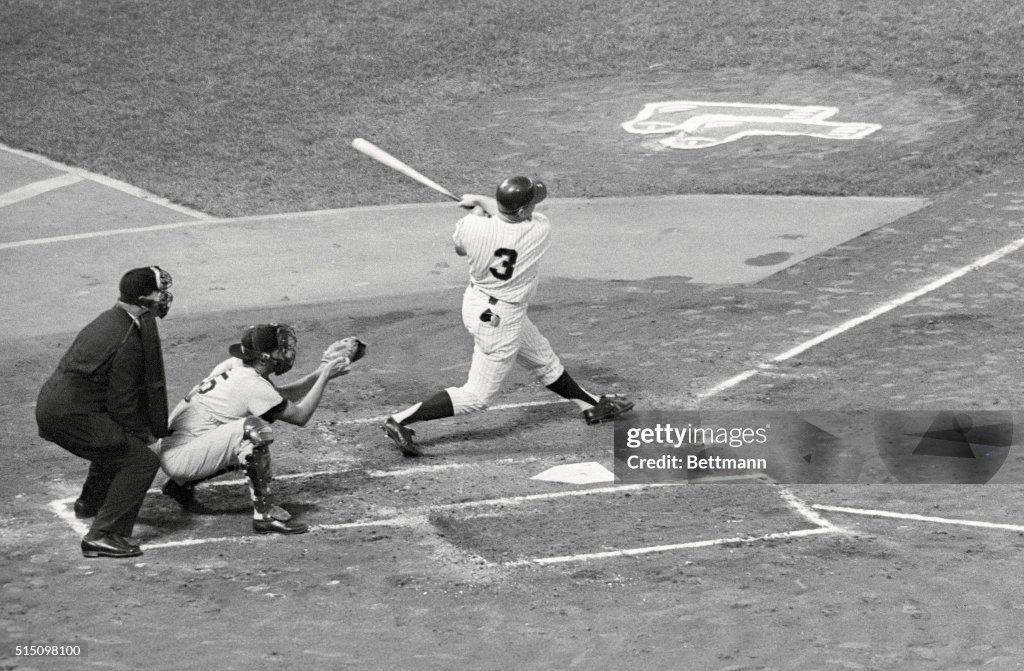
The Cleveland Indians swept a double‐header tonight from the Minnesota Twins, 10–4 and 8–2, although the Twins hit three home runs. The second game was delayed 45 minutes in the fourth inning by a rainstorm. Tony Oliva and Earl Battey hit homers in: the first game, but the rest of the Twins were helpless against. Luis Tiant, who lifted his won‐lost record to 4–1. Jimmy Hall hit his 19th homer of the season in the second game, but the Twins could do little else against three Cleveland pitchers. Tiant allowed five hits and struck out 10 in the opener, permitting only one hit after the first inning.
Ray Herbert blanked the Boston Red Sox, 2–0, on five hits and drove in both of the game’s runs today in helping the Chicago White Sox snap a three‐game losing streak. The seasoned right‐hander, who lost a month this year while on the disabled list, registered his fifth victory against three defeats. Ed Connolly suffered the loss, his eighth against two victories and his fourth to Chicago. Herbert’s decisive blow came in the sixth. Ron Hansen opened with a single and, after two were out, Jerry McNertney singled Hansen to second. Herbert then lined a single to left, scoring Hansen.
The 10th-place New York Mets send first baseman Frank Thomas to the National League-leading Philadelphia Phillies (1½ games ahead of the San Francisco Giants) for pitcher Gary Kroll, outfielder Wayne Graham, and cash. Thomas, seemingly the answer to the Phillies’ first base problem, rode the Mets’ team bus to Philadelphia, then found out he was traded. He then drives in 2 runs as the Phils top the Mets 9–4. The Phillies will take the next two games with Thomas collecting 5 RBIs in the sweep.
Phil Ortega of the Los Angeles Dodgers, staked to a fiverun lead in the first inning, scored his first victory in three months tonight. However, he needed relief help in the ninth to beat the Milwaukee Braves, 5–1.
The Chicago Cubs swept a doubleheader tonight from the Pittsburgh Pirates, 7–3 and 4–3. Ernie Broglio got the victory in the second game, his sixth against nine defeats, although Bobby Shantz came on and got the last out. Larry Jackson scattered 11 hits in the opener and won his 14th of the year. He has lost eight.
Curt Simmons scattered five hits tonight to lead the St. Louis Cardinals to a 4–1 victory over the Houston Colts. It was his 12th victory of the season against eight losses.
Jim Maloney of Cincinnati struck out 12 men in six innings and drove in a run before his right arm stiffened, but the Reds went on to gain a 5–3 victory over the San Francisco Giants. The loss dropped the Giants 2½ games behind the National League‐leading Phillies, who whipped the New York Mets, 9–4. Third‐place Cincinnati remained four games back. Maloney was approaching the strike‐out record when he fanned the 12th of the 24 batters who faced him in six innings, but he had to leave at that point. The record is 18 for a nine‐inning game. Maloney has struck out 16 in his career.
Dow Jones Industrial Average: 829.16 (+5.76).
Born:
John Birmingham, Australian author (“Axis of Time” trilogy), in Liverpool, England, United Kingdom.
Tim McGee, NFL wide receiver (Cincinnati Bengals, Washington Redskins), in Cleveland, Ohio.
Roger Remo, NFL linebacker (Indianapolis Colts), in Suffern, New York.
Michael Weishan, American TV host, in Milwaukee, Wisconsin.
Died:
Aleksander Zawadzki, 65, President of Poland since 1952
Salima Machamba, 89, former Queen of the island of Mohéli in the Comoro Islands until she was deposed in 1909




 History Diaries