The first North Vietnamese Air Force jet fighter unit, Fighter Regiment No. 921 (the “Red Star Squadron”), arrived in North Vietnam after training at the Mengzi airfield in the neighboring Yunnan province in the People’s Republic of China, bringing 36 MiG-17 and MiG-19 fighters to Phúc Yên Air Base near Hanoi.
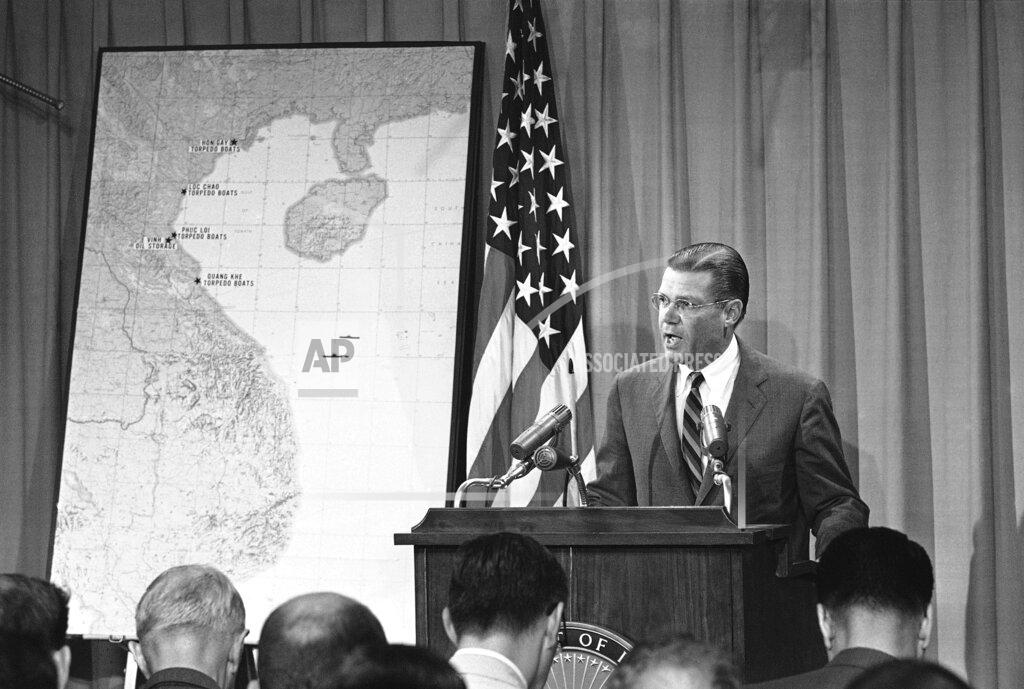
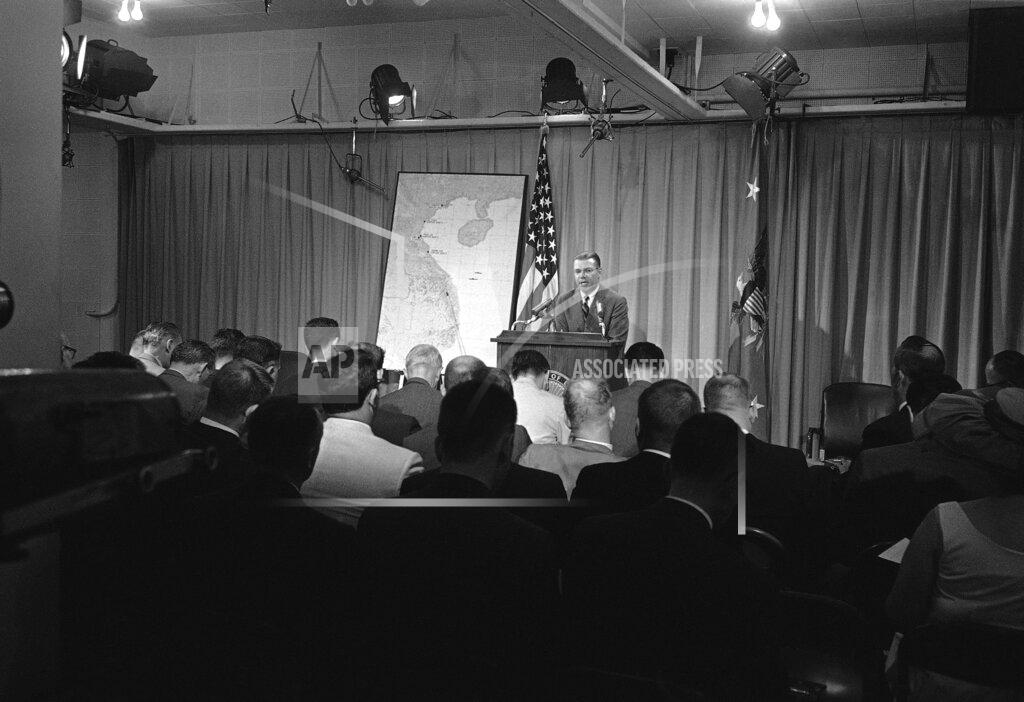
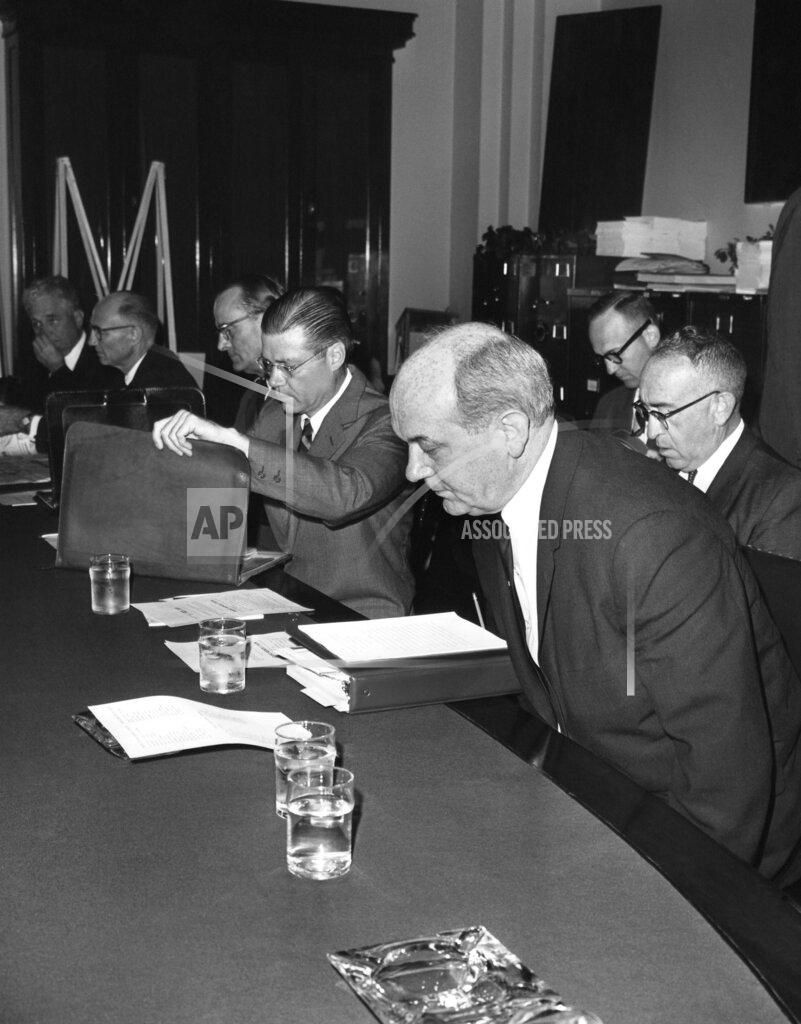
Defense Secretary McNamara and Secretary of State Rusk appear before a joint Congressional committee on foreign affairs and present the Johnson Administration’s arguments for a resolution authorizing the president ‘to take all necessary measures.’ Senator Wayne Morse (D-Oregon) has received a tip from an officer in the Pentagon that the Maddox had been engaged in certain covert actions against North Vietnam, but when Morse asks if there was any link between the U.S. ship and the South Vietnamese raids, McNamara replies flatly, ‘Our Navy played absolutely no part in, was not associated with, was not aware of, any South Vietnamese actions, if there were any. Morse is unable to win over any of his colleagues. When the Senate begins to debate on the resolution, only Senator Ernest Gruening (D-Alaska) joins Morse in opposing it. McNamara gives a news conference at which he denies U.S. naval involvement in any South Vietnamese raids. He admits that China may now provide fighter planes to North Vietnam but he sees no sign of a general Chinese or Communist military response to the U.S. raids.
President Johnson rules out any further air raids against North Vietnam. But one U.S. bomber is reported as crashing and three are damaged in the first day of the U.S. military buildup in Thailand and South Vietnam.
The New York stock market reacts to the news of the crisis in Vietnam with the sharpest decline since the death of President Kennedy. Various rallies and peace vigils are held to protest the U.S. bombing raids. Republican presidential candidate Barry Goldwater says the he supports President Johnson’s ordering the air raids on North Vietnam but that he intends to make the whole question of Vietnam a campaign issue.
North Vietnam appealed today to the signatories of the 1954 Geneva agreements on Indochina to take timely measures to check what it described as United States preparations to invade its territory. Diplomatic observers here said the statement by the Hanoi Government indicated that it intended to resort to diplomatic rather than overt military means to cope with its encounter with the United States in the Gulf of Tonkin.
The Hanoi statement, repeating an earlier denial, said no attack was made Tuesday by North Vietnamese gunboats on the United States destroyers Maddox and C. Turner Joy in the Gulf of Tonkin. It was this attack, which followed a similar attack Sunday on the destroyer Maddox, that led President Johnson to order retaliatory air strikes against North Vietnamese bases. Hanoi’s statement, broadcast by the Government radio, described the strafing and bombing by United States planes as ”premeditated warlike acts.” It added that the attack “exposes even more clearly the design to invade North Vietnam and extend the war here as declared many times by the U.S. Government.” Hanoi appealed to world opinion, other Communist countries and the signatories of the Geneva agreements that terminated the struggle against the French in Indochina to express their “particular concern for the excessively serious situation created by U.S. imperialists in Vietnam.”
The U.S. State Department instructs J Blair Seaborn, of the ICC who had made the contacts with the North Vietnamese on 18 June, to tell Hanoi that the United States does not understand the motives behind the North Vietnamese attacks on U.S. ships but that the U.S. response ‘for the moment will be limited and fitting,’ although additional air power is being deployed to South Vietnam and Thailand. When Seaborn gets to see Premier Phạm Văn Đồng on the 13th, the latter is furious, indicates that North Vietnam is quite prepared to fight, but also states he wants to keep open channels of communication with the United States. Seaborn’s report of this mission indicates he feels that Hanoi is convinced there ‘was no need to compromise.’
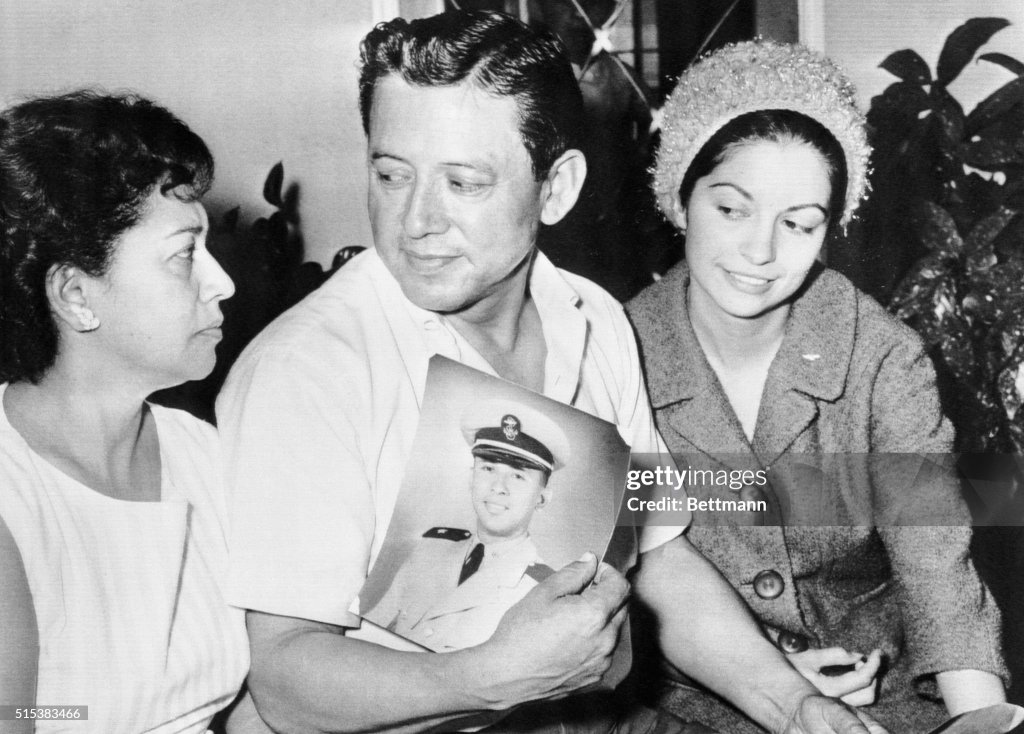
The Hanoi radio today identified the United States airman taken prisoner by North Vietnam as Lieutenant (j.g.) Everett Alvarez Jr. The Defense Department in Washington said yesterday in reporting Lieutenant Alvarez missing that he was from San Jose, California. He is 26 years old. Another pilot, Lieutenant (j.g.) Richard G. Sather, 26, was reported missing also. His parents live in Santa Clara, California.
The Cyprus radio reported tonight that four Greek Cypriots had been killed and one wounded in a battle that raged all day near Mansoura and other Turkish Cypriote villages on the island’s northwest coast. The radio, which is controlled by the Greek Cypriots, asserted that Turkish Cypriots had attacked Greek positions but had been repulsed with serious losses. No figures were given. The broadcast charged that the Turks held a beachhead in the area on which they had been landing men, arms and ammunition. The radio asserted that “many” Turkish Cypriot positions had been captured in the fighting.
Earlier, a United Nations spokesman said there had been serious fighting in the Mansoura area thoughout the afternoon, but he was unable to give any casualty figures. Nicosia, where there was a gun battle last night, was quiet but tense. The streets were almost empty of traffic after dark.
This afternoon, General George Grivas, the former Greek Cypriot guerrilla commander returned to Nicosia from Athens, where he had held talks with Greek Government officials on the Cyprus situation. The Cyprus radio declared that an “authoritative spokesman” had said General Grivas was satisfied there was a complete identity of views between the Greek and Cypriote Governments on the Cyprus question. He was also satisfied with “measures taken for the defense of Cyprus and measures to repulse an invasion,” the broadcast added.
A statement made tonight by the Cypriot Government, headed by Archbishop Makarios, said it was unshakable in its decision to take all necessary steps to safeguard its sovereignty and Cyprus’s territorial integrity, and was determined “not to allow the Turkish rebels to improve their military positions.” The statement declared that “any further attempt of the Turks to gain military advantages will be met by the use of arms.”
Archbishop Makarios, President of Cyprus, reiterated to the United Nations today his stand that United Nations troops would have to obtain advance permission to enter security areas in Cyprus. The status agreement for the United Nations Force provides for freedom of movement. Countries providing contingents have complained that the troops had been threatened by Greek Cypriot forces when they tried to enter the dock areas while ships were loading or unloading. Although it did not drop the restrictions the new message was interpreted by some United Nations sources as a softening in the Archbishop’s attitude. The July 28 message had said the force’s commander could make arrangements to visit any place “with the Minister of the Interior.” Today’s message was interpreted as meaning that after consultations with the government, the commander, now General K. S. Thimayya of India, could arrange also for visits by his subordinates.
Of all the newly independent African nations, the Congo has been the most tragic and troublesome. It is living up to its reputation now, with its third largest city, Stanleyville, and about one‐sixth of the country in the hands of rebels, while the Chinese Communists pull strings from neighboring Burundi and the Congo Republic. The problems of the Congo have been beyond solution ever since the Belgians, who had done a poor job of preparing the Congolese for independence, suddenly pulled out four years ago.
President Johnson sent W. Averell Harriman to Brussels tonight for talks on the deteriorating situation in the Congo. Mr. Harriman, the Undersecretary of State for Political Affairs, will confer with the Belgian Government and with business circles interested in the Congo, the State Department disclosed. He flew to New York, where he boarded a flight scheduled to land in Brussels tomorrow morning. While it was said that Mr. Harriman would have no specific United States proposals, the basic aim of American policy in the Congo is to restore order and national unity through a strengthening of the national army.
It is no secret here that the United States would like to see Belgium offer help for the army, including a return of Belgian officers. The Belgians, the former colonizers of the Congo, could not reinforce the Congolese Army unless the Government of Premier Moïse Tshombe asked for help. The State Department disclosed today that the United States was considering a Congolese request for additional military equipment. Such military aid now amounts to less than $7 million a year.
The United States had hoped that other African nations might supply forces to reinforce the Congolese Army. However, this has not worked out. One reason is the dislike of most African governments for Mr. Tshombe, who at one time was believed to be a tool of the Europeans. United Nations troops were sent to the Congo to quell disorder in 1960, after the country had gained independence from Belgium. Congolese soldiers had mutinied. The United Nations force, which once numbered more than 20,000 men, was used to end the secession of Katanga Province, then led by Mr. Tshombe. Last June the United Nations withdrew the last of its troops, thus removing a major stabilizing influence.
Syria accused Israel today of mounting a night raid on the Syrian border and said the attack was repulsed after a 6½‐hour battle with machine guns and hand grenades. Syria lodged a complaint with the United Nations truce observance staff. A Syrian Army communique said two Israeli soldiers were killed and an undetermined number wounded. One Syrian soldier was reported injured. The communique said the clash, the fifth since Israel began tapping the Jordan river waters in Sea of Galilee area to irrigate the Negev desert region, began at 11:57 PM and continued until 6:30 AM.
Before a background of placards denouncing war and the Government’s policies in Vietnam, 1,000 persons demonstrated yesterday at Washington Square in New York City.
Eight of 20 former staff members of the Auschwitz concentration camp, on trial in Frankfurt since last December, refused today to accompany the court if it visited the site of the former camp at Oswiecim in southern Poland.
The outgoing Bolivian Vice President, Juan Lechtin Oquendo, was severely beaten by the political police today as Victor Paz Estenssoro took office for a new four-year term as President.
Ethiopian cattle rustlers massacred 120 persons in Kenya’s Northern Frontier Province, the police here reported today.
The Government of Kenya is reliably understood to be planning still more expulsions of Britons. Yesterday four men were deported.
Pope Paul VI publishes encyclical Ecclesiam Suam.
The Federal Bureau of Investigation today arrested four men identified as Ku Klux Klansmen in connection with the shotgun slaying of a Black educator, Lemuel A. Penn, last month. United States Commissioner Girard Hawkins said one of the men had confessed and implicated the three others. Mr. Penn, a lieutenant colonel in the Army Reserve, was driving home to Washington after summer training at Fort Benning, Georgia, when he was shot by occupants of a passing car on July 11. The FBI, in its formal charge against the four suspects, said they killed him. But there is no federal law against murder on non‐federal property. The four men were charged with violating Mr. Penn’s rights under the new civil rights law. The suspects were identified as Cecil William Myers, a 25-year‐old yarn plucker; Joseph Howard Sims, 41, a machinist; James Lackey, 29, a service station attendant; and Herbert Guest, 37, who operates the garage where, the FBI said, the men plotted the killing. All four live in Athens, Georgia.
A recognizable if incomplete picture of the circumstances surrounding the slaying of three civil rights workers in Mississippi began to emerge today. There was no definite indication when the Federal Bureau of Investigation would supply the missing links in the chain of events that ended with the discovery of the two whites and one Black in a crude grave in a cattle‐pond dam. A Washington source said completion of the investigation, perhaps tomorrow, might bring an announcement. But inquiries brought no comment from Federal officials.
Most Mississippians waited with an unusual air of calm expectancy for the arrests they feel certain would follow recovery of the badly decomposed bodies from beneath tons of clay in the new dam near Philadelphia in east central Mississippi. Nevertheless, guarded statements by officials, partial disclosure of a medical examiner’s findings and comments from a variety of sources here, in Washington, Philadelphia, Mississippi, and elsewhere suggest how the three men died and who killed them.
Apparently death was swift for the three: Michael Schwerner, 24 years old, a New Yorker and a member of the Congress of Racial Equality; James E. Chaney, 21, a Meridian, Mississippi, Black and also a CORE member, and Andrew Goodman, 20, a Queens College student who left his New York home to become a volunteer in the summer civil rights project in Mississippi. The known evidence indicates that the three men were executed by one or more gunmen among a group that took them from their 1964 Ford station wagon on the moonlit night of Sunday, June 21. The vehicle was subsequently found burned.
They had been arrested that afternoon by Cecil Price, the Neshoba County Deputy Sheriff, and were accompanied by two State Highway Patrolmen when they arrived at the jail in Philadelphia with the deputy. Mr. Price, by his account, booked Mr. Chaney for speeding and held the two whites for investigation. He has said he released them at approximately 10:30 PM, Central Standard Time, after Mr. Chaney had posted a $20 bond. Reports that the three had been held past that time were brushed aside the next day by Mrs. Minnie Herring, the husky wife of the county jailer. She has since suffered emotional difficulties that preclude further questioning, according to Philadelphia sources.
There is considerable evidence that FBI agents have determined who was involved in the slayings. At least six men appear to have been implicated directly, according to several reports. One is an official who has been questioned repeatedly by FBI agents. The others, also visited frequently by the agents, include a bootlegger, a fundamentalist minister, a radio and television supply store operator, a used‐car dealer and a fifth man with semiofficial status. Some, but not all, of these men work in Philadelphia or Neshoba County.
Senator Barry Goldwater and his Vice‐Presidential running mate, Representative William E. Miller, met in Gettysburg, Pennsylvania today with former President Dwight D. Eisenhower and Richard M. Nixon and solicited their advice on the coming campaign. In an informal conference after the meeting, Mr. Goldwater firmly repudiated the Ku Klux Klan and said he did not want the support of organizations bearing that name. The Klan was one of three groups cited at the Republican National Convention in a debate whether to name extremist groups in the party’s platform. The two others were the Communist party and the John Birch Society. In rejecting support of the Klan, Mr. Goldwater seemed to have overruled both Mr. Miller and the new Republican National Chairman, Dean Burch. In recent days both of them have said that the Republicans would not reject the support of Klansmen. Mr. Miller, standing at the Senator’s elbow, expressed agreement. He said the Republicans “didn’t seek or want” the support of the Klan.
In an unusually active day, Mr. Goldwater also conferred in Washington with Governor George Romney of Michigan and spoke to a breakfast meeting there of about 100 Republican members of the Senate and House. The meetings were designed to promote party unity. At a morning news conference after the breakfast, Senator Goldwater commented on the Vietnam crisis. Although the nation, he said, is united behind President Johnson and his actions in Vietnam, the Democrats do not understand the threat of international Communism and are “like the pacifists after World War I who wanted to have neace at any price.” Mr. Goldwater defended his now celebrated remark that “extremism in the defense of liberty is no vice.” He said he felt about it as Lincoln felt about his controversial “house divided” speech on slavery.
The unemployment rate dropped below 5 percent in July for the first time in more than four years. Every group of workers — men, women and teenagers — shared in the improvement, the Labor Department’s monthly unemployment survey showed. The total number of persons at work during the month exceeded 72 million for the first time in history, with 72.4 million persons employed. This was of a total civilian labor force that reached 76.2 million workers in July.
The decline in the unemployment rate from 5.3 percent of the work force in June to 4.9 percent in July was seen by Labor Department experts as part of a trend toward lower levels of unemployment that began in February of this year. Before that, and despite rising employment, the unemployment rate had remained fixed for more than two years between 5½ and 6 percent. Labor Department experts conceded that slight increases in the unemployment rate were possible in the months ahead — increases that might bring the rate back up to 5 or 5.1 percent. But they indicated their belief that any such rise in the rate would be temporary. The attainment of an unemployment rate of less than 5 percent in July put the Administration far ahead of its announced timetable for reduction of joblessness. The most optimistic forecast made publicly by any Administration official has been that unemployment would fall below 5 percent by the end of this year.
A 5 per cent unemployment rate is still considered much too higff by Administration officials and most economists. Both the Johnson Administration and the Kennedy Administration have said a 4 percent unemployment rate is the highest that can be considered tolerable. Secretary of Labor W. Willard Wirtz emphasized the Administration’s dissatisfaction with even the present reduced rate of unemployment in a statement issued today. The drop in the unemployment rate to 4.9 percent, he said, “means that 3,800,000 people are still out of work. That is an awful lot of people to be left out of a record high prosperity.”
President Johnson faces one of the most crucial tests of his political career as his antipoverty bill heads for a show‐down on the House floor tomorrow. The outcome, still in doubt tonight, could have a far‐reaching effect on the Presidential campaign this fall, for the antipoverty program has already become a highly partisan issue. While a handful of Democrats and Republicans angrily exchanged words on the House floor today, there was feverish activity behind the scenes as both sides sought to line up votes. “If I live through this without getting two ulcers, I’ll be lucky,” Representative Phil M. Landrum of Georgia, floor leader for the bill, said good‐naturedly as he hurried from one off‐floor caucus to another. Attention centered on a small number of uncommitted Southern Democrats, whose votes could either defeat or pass the bill.
Legislation designed to make sure the ordinary investor can get reliable information about stocks sold in the over‐the counter market was given final approval by Congress today. The bill, the first major securities legislation in 24 years, is also aimed at driving the remaining incompetent, dishonest and inadequately financed operators out of the se curities industry. The Senate voted its approval of the measure today, without dissent, following similarly unanimous action in the House of Representatives yesterday. The bill has the backing of President Johnson, who is expected to sign it into law promptly.
Robert F. Kennedy backed President Johnson for election today, but—with a more or less humorous smile—he rued his own recently discovered ineligibility for the Vice‐Presidency. Addressing a school for Democratic Congressional candidates, the Attorney General said: “I must confess I stand in awe of you. You are not members of the Cabinet, and you don’t meet regularly with the Cabinet, and therefore you are eligible for Vice President.” Amid laughter, Mr. Kennedy went on to fall in with the line taken by some Washington wags, which is this: That President Johnson’s pronouncement of last week — ruling out as his running mate all Cabinet members and all who regularly attend the Cabinet sessions — was aimed at Secretary of State Dean Rusk.
Prometheus, the world’s oldest tree aged at least 4,862 years old, is cut down on Wheeler Peak in Nevada. The tree is cut down by a graduate student at the University of North Carolina at Chapel Hill, studying climate dynamics of the Little Ice Age using dendrochronology techniques. It has been argued that the cutting down of Prometheus was an important factor in the movement to protect bristlecones in general, and the Wheeler Peak groves in particular. There had been a movement to protect the mountain and contiguous areas as a national park before the incident, and 22 years later the area gained national park status.
Rich Rollins’s seventhinning fly ball, which was lost in the sun by Les Thomas, dropped for a triple and drove home the winning run today as the Minnesota Twins scored a 6–5 victory over the Boston Red Sox. When the ball fell behind Thomas, the right fielder, Zoilo Versalles scored the run that broke a 5–5 tie. Harmon Killebrew’s 39th homer of the season, a two‐run shot in the third, gave the Twins a 5–4 lead that held until the seventh. Then a walk to Carl Yastrzemski and singles by Dick Stuart and Bob Tillman tied the score.
The New York Yankees headed East tonight for 15 games with the Baltimore Orioles and the Chicago White Sox, but not until they had exacted a measure of revenge from the ninth‐place Kansas City Athletics. Most of the exacting was done by Ralph Terry, who defeated the Athletics, 5–3, for his third straight victory since completing a six‐week term in the Yankee bullpen. He needed help in the last two innings from Hal Reniff, but by that time the Athletics’ starting pitcher, Diego Segui, had left the game and the Yankees were finding the range on his three successors.
Bill White and Dick Groat drove in two runs each and powered the St. Louis Cardinals to a 5‐3 victory over the Chicago Cubs today. Bob Gibson worked put of numerous early jams and posted his ninth victory against nine losses. It was his first triumph since July 19. The Cardinals collected only four hits off Dick Ellsworth, but they bunched them in two scoring innings.
Dick Farrell gained his 11th victory on the 12th attempt tonight as the Houston Colts defeated the National League‐leading Philadelphia Phillies, 2–1. The loss trimmed the Phillies’ lead to 1½ games over the idle San Francisco Giants. Farrell, who had lost six straight since becoming the first 10‐game winner in the majors on June 14, was aided by Jim Owens, who relieved in the ninth and put down the Phillies’ final threat.
Dow Jones Industrial Average: 823.40 (-9.65).
Born:
(Gary) “Moosie” Drier, American actor (“Laugh-in”; “The Bob Newhart Show”; “American Hot Wax”), and theatre director, in Chicago, Illinois.
Lisa Boyle, American actress (“Showgirls”), in Chicago, Illinois.
John Mooney, American kayaker (World Championship gold K-2 200m, 1995), in Seattle, Washington.
Willie Smith, NFL tight end (Miami Dolphins), in Jacksonville, Florida.
Jonathan Shelley, NFL defensive back (San Francisco 49ers), in Vicksburg, Mississippi.
Gary Valenciano, Filpino pop musician and singer; in Santa Mesa, Manila
Died:
Cedric Hardwicke, 71, English stage, film, radio and television actor (“Rope”; “Suspicion”; “Peter Pan”; “Richard III”).



 History Diaries