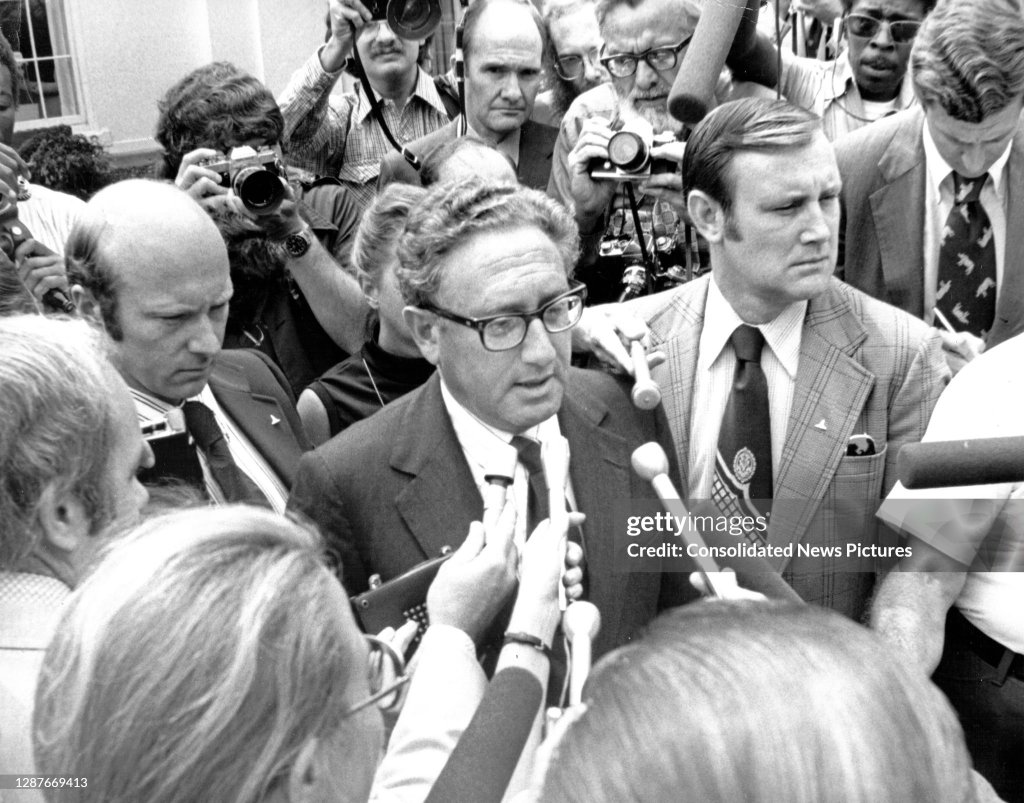
Israel is now prepared to open talks with Jordan involving some military withdrawal from the Jordan River and some Jordanian civilian administration in the occupied West Bank area, according to senior officials in Jerusalem. According to government sources, preliminary contacts began in late May when Secretary of State Kissinger arranged a secret desert meeting between King Hussein of Jordan and Premier Golda Meir and Defense Minister Moshe Dayan before they left office. The United States has urged Israel to try to negotiate at least an interim agreement with Jordan before the next phase of the Geneva peace talks.
The Israeli Government issued a denial after the first accounts of the meeting were published. The denial was regarded as pro forma by most observers here. Mr. Rabin repeated it during a speech in Parliament today, but he made it clear at the same time that Israeli Government officials were prepared to meet secretly with the Jordanians if this proved necessary. “Israel has not and will not neglect any opportunity to achieve contacts as openly as possible and as directly as possible with every neighboring country,” he said. “Nor shall we reject even opportunities to conduct dialogues without publicity should the opposite side so desire for reason of its own.”
Discussing the possible elements of an Israeli‐Jordanian agreement, Israeli officials stressed in interviews that Israel was not prepared to grant King Hussein’s demand for an Israeli withdrawal of six to eight miles along the entire length of the Jordan River. But the officials said that more limited withdrawals at various points along the river — perhaps at the key Damiya and Allenby Bridges and in the Jericho area — would be “conceivable.” “I think the Rabin Government is prepared to consider limited withdrawals as part of an agreement,” one official said. Israel would insist, however, on maintaining military positions along most of the length of the Jordan River as protection against any Arab attack from the east.
Israel reported today that her planes had attacked southeast Lebanon after infiltrators from the area abducted four Syrian Druze workers erecting an Israeli security fence on the frontier. The raid on the heavily Palestinian area took place at 1 AM, 11 hours after the reported abduction. Earlier the military command said that an Israeli Army unit that crossed the border in search of the workers had come under mortar fire from Lebanese Army position. The Israeli soldiers had been alerted by a fifth worker, who said he had escaped from the kidnappers. The workers, who lived in the Israeli‐occupied Golan Heights, had been erecting the fence on the border between Lebanon and occupied Syrian territory. The site was a desolate spot of the Lebanese village of Majdia near the Israeli‐built road to Har Dov, a strategic height dominating Lebanese territory controlled by the Palestinian guerrillas. The Israeli search party returned without the missing men but with six suspects taken for interrogation.
President Anwar elSadat has accused the Libyan leader, Col. Muammar el‐Qaddafi, of having conspired to blow up a presidential retreat in Egypt, it was reported here early today. In a scathing attack on Colonel Qaddafi, President Sadat further charged that the Libyan leader’s secret agents had attempted to kill a prominent Egyptian journalist, Ihsan Abdel‐Kuddus. President Sadat also said that Libya had demanded the return of Mirage jets based in Egypt. The charges were contained in a sharply worded message addressed to the Libyan leader and other members of Libya’s ruling Revolutionary Command Council.
President Sadat said some members of a tribe living along the Egyptian‐Libyan border had confessed that they had been recruited by Colonel Qaddafi’s secret police to blow up the Egyptian Presidential retreat in Mersa Matruh, on the Mediterranean. “The coordination between the Libyan intelligence machinery, belonging to Colonel Qaddafi personally, and the Libyan information media was striking,” President Sadat said.
Ethiopian Prime Minister Lij Michael Imru announced a new draft constitution that would strip Emperor Haile Selassie of the absolute powers the nation’s emperors have held for 3,000 years. The proposal would make Selassie, 82, a constitutional monarch with much of his power going to an elected parliament. He would continue to reign as a symbol of national unity.
The Việt Cộng’s Provisional Revolutionary Government of South Vietnam charged again today that American pilots were still flying combat missions over Communist‐controlled areas north of Saigon. A spokesman for the Việt Cộng delegation here, Dương Đình Thảo, said at a press conference that he had witnessed American air strikes in South Vietnam. He went on to charge that American military personnel, disguised as civilians, were still playing advisory roles to the South Vietnamese Army and that the United States was still supplying South Vietnam with vast shipments of military equipment. The American Consul General in Đà Nẵng, Frederick Brown, and the military attachés at the consulate, Mr. Thảo said, were supervising military field operations. In the first six months of this year, Mr. Thảo said, the United States sent Saigon 190 aircraft of all types, including a dozen F‐5 fighter‐bombers, 500 tanks and armored cars, 200 pieces of heavy artillery and 400,000 tons of ammunition.
Communist soldiers have penetrated the district capital of Thượng Ðức, and fighting was reported today inside the town 25 miles southwest of Đà Nẵng, according to the South Vietnamese command. There were no immediate details on the fighting, but the communist ground forces appeared to have pierced the last defense line of the town after more than 400 shells were fired into Thượng Ðức last night. Pressure on the town has increased since Communist forces mounted a drive about three weeks ago in Quảng Nam Province, which is situated on the coast 280 miles northeast of Saigon.
Cambodian Khmer Rouge rebels last night fired four rockets into Phnom Penh, killing 7 people and injuring 10, the Cambodian command said today.
Prime Minister Souvanna Phouma of Laos named a Communist, Foreign Minister Phoumi Vongvichit, to serve as acting prime minister while he is in France recuperating from a heart attack, government sources in Vietiane said. Non-Communist cabinet members reportedly were shocked by Souvanna’s action but withheld protest out of concern for the ailing prime minister’s health. Souvanna, 72, suffered a heart attack July 12, and told his cabinet he expected to be out of the country one or two months. Prince Souvanna Phouma, who suffered the attack July 12, designated Phoumi Vongvichit, one of two deputy Premiers who also serves as Foreign Minister. Government sources said the 72‐year‐old prince apparently made the appointment because of the influence of his half‐brother, Prince Souphanouvong, titular head of the Pathet Lao.
More than 10,000 lighted paper lanterns were floated down Hiroshima’s three rivers in memory of those who died in the atomic blast 29 years ago. Hundreds of Japanese jumped into the same rivers to escape the heat of the blast that leveled the city on August 6, 1945. Speaking at ceremonies in memory of the victims of the bomb, Mayor Setuo Yamada called on the world to scrap its nuclear arsenals and free mankind of “the awesome threat of suicidal ruin.”
Military delegates from Turkey and Greece met in Nicosia to discuss Cyprus cease-fire lines while fighting continued elsewhere on the island. Turkish armored infantry drove Greek Cypriot defenders out of two more northern villages. Osman Orek, defense minister of the Turkish Cypriot community, said at a news conference there could be no cease-fire while Turkish Cypriots were in areas controlled by the Greek Cypriot National Guard. Turkish armored infantry occupied the heavily bombarded villages of Lapithos and Karavas today while negotiations continued between Turkish and Greek military representatives on a cease‐fire line.
The Turkish advance into the abandoned villages drove the Greek Cypriot defenders toward Myrtou to the southwest. The Greek Cypriots have been increasingly unable to hold lines that they have defended for two weeks. In a lemon grove where Turkish mortar shells landed every few minutes, Lieutenant Colonel Andreas Zagoritis, a Greek Army officer from Athens, said: “Greece must intervene actively if she wants to stop Turkey from taking over the whole island.” “How am I expected to hold this road with 150 men, no armor and no antitank guns?” he said.
More than 35,000 Turks in 80 villages on Cyprus are being held hostage by the Greeks, the Turkish Information Minister, Orhan Birgit, said at a news conference today. According to his figures, more than 26,000 Turks in 60 villages are surrounded and threatened by Greek Cypriot forces while more than 21,000 others have been forced to flee their villages. A communiqué from the Turkish General Staff said today that Greek Cypriot National Guard battalions had suddenly shelled Turkish positions in Lapithos and Karavas, west of Kyrenia. The Greek Cypriot attack was halted and fighting continued, the communiqué said.
Gunmen cut the main rail link between Belfast and Dublin for more than 12 hours by hijacking a train just inside the Irish Republic. Police said the train was allowed to block the tracks for hours because they feared it might contain a bomb. A subsequent search revealed nothing, and service was resumed. Meanwhile, in Belfast, police said that a stray bullet from a gunfight between ambushed British troops and gunmen killed a Roman Catholic woman who was watching television in her son’s home.
The U.S. House of Representatives called for suspending aid to Turkey if it does not. halt its planned resumption of opium production. The resolution, which requires Senate concurrence, does not have the force of law. However, legislation is pending which could be used to cut off aid to Turkey. Thus, the ease with which the resolution passed the House is significant.
For the first, and only, time in Australian history, the two houses of the Parliament of Australia convened as a combined 187-member body. All 127 members of the House of Representatives and all 60 Australian Senators participated in a two-day session inside the chambers of the House to debate and vote on six bills. The first legislation passed was the “one vote, one value” reform (96 for, 91 against) followed by an act to give representation in the Senate for the Australian Capital Territory and for the Northern Territory (97 for, 90 against).
Two U.S. senators indicated in Caracas that unless international rules on fisheries are adopted soon, the United States might take unilateral action to protect American fishermen from foreign competition. Senators Edmund S. Muskie (D-Maine) and Ted Stevens (R-Alaska) are among a group of U.S. senators observing the 10-week U.N. Law of the Sea Conference which opened June 20. “There are disturbing possibilities that the conference may not produce a treaty at all,” Muskie said.
John M. Haydon resigned after five years as governor of American Samoa. In a cable to Interior Secretary Rogers C.B. Morton, Haydon asked that his resignation take effect October 15, saying he hoped to serve as “American Samoa’s last appointed governor, but this possibility has been negated by the people’s rejection” of the election of their own governor in a June referendum.
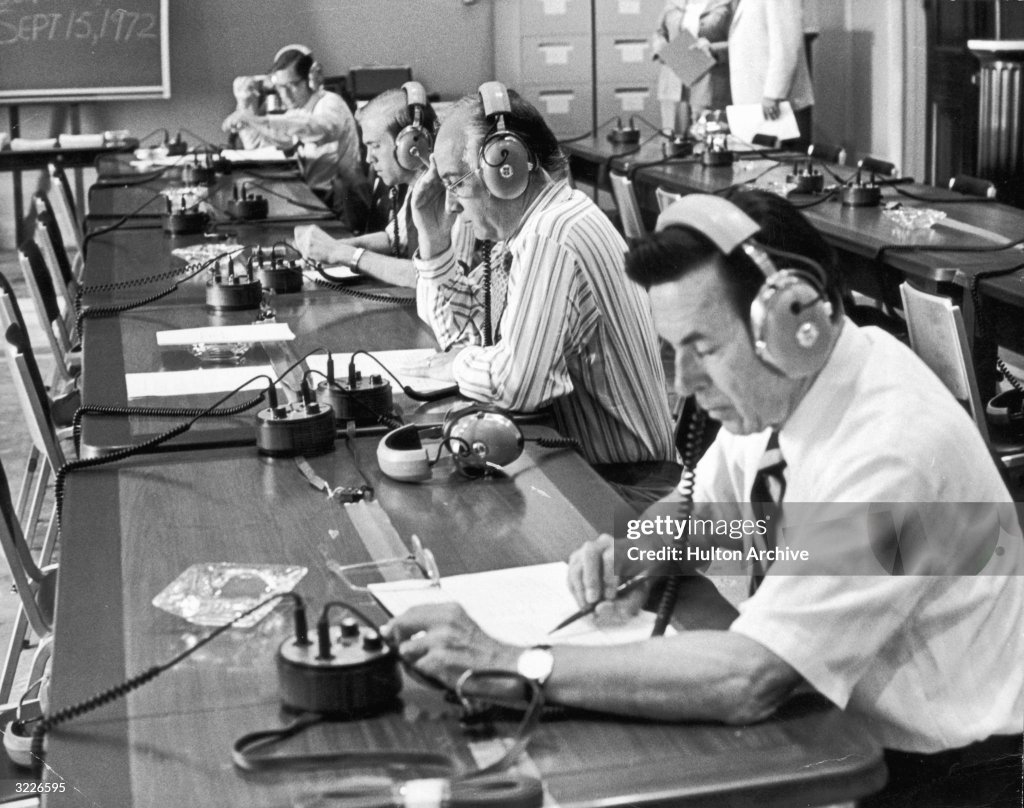
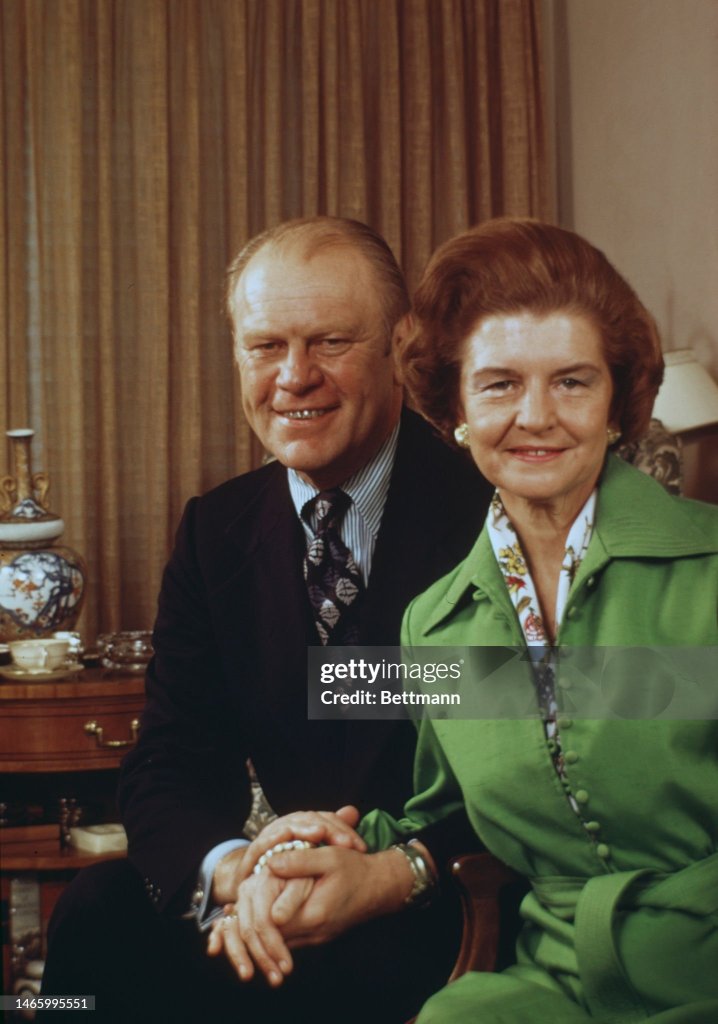
President Nixon told his cabinet he would not resign but remain in office while the constitutional impeachment process ran its course. Vice President Ford, top White House aides and Republican National Chairman George Bush attended the meeting. In statements later, none suggested Mr. Nixon thought he would win, simply that he would stick it out in the belief he had committed no impeachable offense.
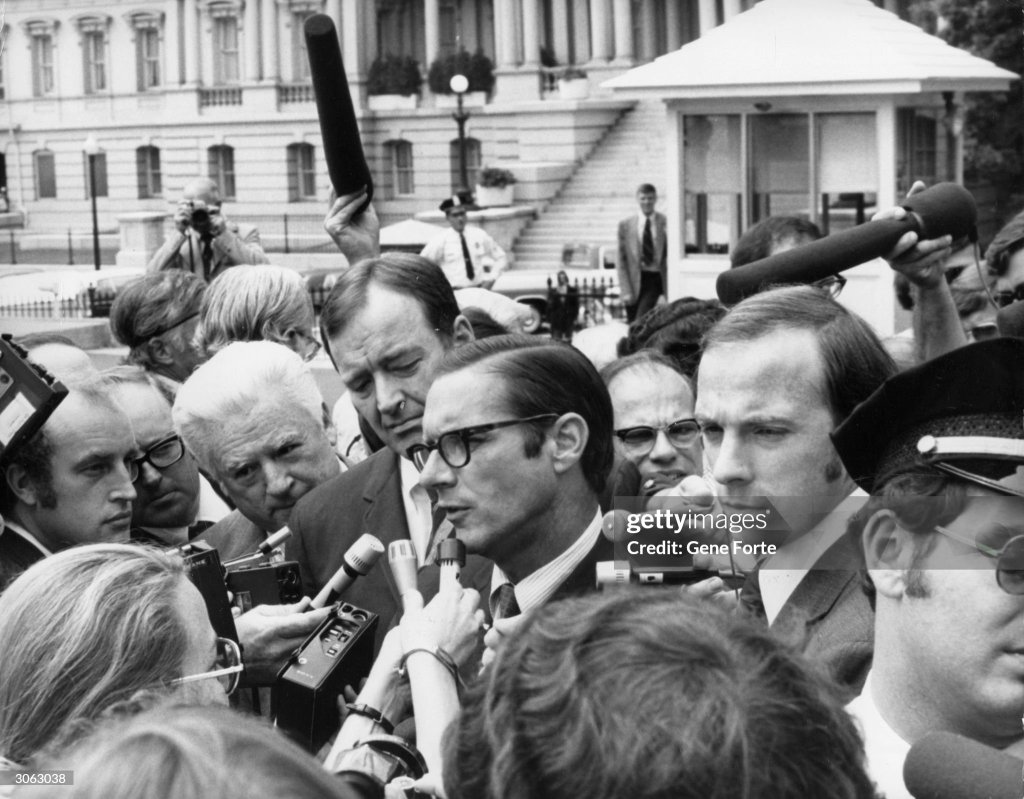
Gerald L. Warren, the deputy Presidential press secretary, seemed to be trying his best to pull a cloak of blandness over the whole thing. But there was no way to escape the sense of gloom and shock at the White House today. President Nixon’s revelation yesterday of his role in the Watergate cover‐up had crumpled his support in Congress where the distasteful business of impeachment has begun. Today Mr. Nixon called in his Cabinet. The members discussed “the difficulties of the times.” Mr. Warren said. They also talked of “constitutional process,” as Mr. Warren insisted on calling impeachment. Pressed against the White House fence outside, about 100 persons peered in across the green grass and black asphalt drives to the cluster of limousines and reporters standing outside the West Wing.
President Nixon’s support in the Senate crumbled — and with it, apparently, the prospect of long survival for his presidency. Senator Robert Dole, a conservative Kansas Republican, said that if the President had 40 votes a week ago, it had fallen to 20 at most — not even close to the 34 he would need to survive a Senate trial. Another Republican Senator, unwilling to be quoted, guessed that 10 members would stand by him on the basis of current evidence.
President Nixon’s political friends in the House of Representatives joined one by one in a march toward impeachment. The House minority leader, John Rhodes of Arizona, announced he would vote for it because “cover-up of criminal activity and misuse of federal agencies can neither be condoned nor tolerated.” The impeachment tide rose to the point that Democratic and Republican leadership decided one week of floor debate rather than two would be enough.
The Senate Foreign Relations Committee unanimously cleared Secretary of State Kissinger of allegations that he had misled it on his role in the wiretapping of 17 officials and newsmen from 1969 to 1971. It acted after six closed-door hearings. Senator Hubert Humphrey, Democrat of Minnesota, called the study “very exhaustive” and described the Secretary as “a tremendous national asset.”
Dr. Arthur Burns, the chairman of the Federal Reserve Board, proposed a $4 billion program of public service employment if the nation’s unemployment rate should rise above 6 percent of the labor force. This would create some 800,000 jobs in state and local government. He told a receptive Joint Economic Committee of the House and Senate that this would ease the pain of budgetary and monetary restraint on the economy to curb inflation.
Two persons were killed and 66 injured in an explosion at a railroad yard in Wenatchee, Washington. Firemen said the blast occurred as a tank car containing liquid ammonium nitrate, an explosive chemical used in making fertilizer, was being hooked to a freight train in the Burlington Northern Railroad yard. The blast and resulting fire destroyed more than 75 freight cars and left a hole 50 feet deep where the tank car had been. More than a dozen houses were destroyed in the blast, which tossed many of the cars on their sides and crumpled others. Flying glass and debris accounted for many of the injuries.
Rescue workers finished the grisly job of recovering bodies from the collapsed southeast headquarters of the Federal Drug Enforcement Administration in Miami and proceeded with the task of salvaging records and evidence from vaults buried under tons of debris. Seven persons — two male narcotics agents and five women clerical workers — were crushed to death and 15 were injured Monday morning when a rooftop parking lot with 57 cars caved in. A spokesman said the number of parked cars was “within (safety) limitations” but the matter is under investigation by local and federal agencies.
Investigators were checking today a possibility that the guns and ammunition used by three Huntsville, Texas state prison inmates last Saturday night in a deadly escape attempt may have been mailed into the institution or may have been delivered under the guise of “library supplies.” The authorities have said that Fred Gomez Carrasco and two accomplices used the weapons to murder two women hostages and seriously wound a Roman Catholic priest during the escape attempt. Mr. Carrasco, a convicted drug dealer, who was 34 years old, and one of the other convicts, Rudolfo Dominguez, who was 27, also died during the escape attempt. A justice of the peace has said that they committed suicide when they saw that their escape plan had been foiled. The third convict, Ignacio Cuevas, 42, was captured unhurt.
Dissatisfaction with terms of a tentative national contract for telephone workers sparked several wildcat walkouts and led to charges of a sellout against the union’s national leadership. Members of the Communications Workers of America locals in the District of Columbia, New Jersey, Ohio and Missouri walked off their jobs to protest the tentative pact reached Sunday night. In New York, a spokesman for American Telephone & Telegraph Co. said the walkouts had not affected service and supervisors filled in. Chief CWA spokesman Lee White in Washington said, “This is a tentative agreement and every member will vote on it. They can vote it up or down.”
The House of Representatives eliminated funds today for the production of a new type of nerve gas and reduced military aid to South Vietnam by $300‐million, as it approved an $84‐billion Department of Defense appropriations bill. The full production of the binary system for the delivery of nerve gas, plus the destruction of existing stocks of gas, had been expected to cost as much as $2‐billion. The 214‐to‐186 vote on this issue was significant in two respects. The House Appropriations Committee had recommended the nerve gas program, and it is unusual for the House to vote against this committee. Also, the Pentagon had argued that the nerve gas program was needed to bargain effectively with the Soviet Union on its gas program. The House vote marked the first time that either the Senate or the House had voted against this type of approach to negotiations.
The House passed by voice vote and sent to the Senate a compromise bill to limit the number of highly paid White House assistants to the President. Backers contended that White House staffs have grown enormously over the years and that such personnel wield much of the power in government without being responsible to Congress. The bill would not require President Nixon to make cuts in his staff. The President now has 14 top level men, each earning $42,500 a year. This number would be cut to eight by Jan. 20, 1977. Lesser grades would be similarly reduced.
U.S. Post Office inspectors arrested Ricky A. Young, 22, on a complaint accusing him of mailing the pipe bomb that killed Superior Court Judge James Lawless in his office in Pasco, Washington, last June 3. Young, a laborer from Prosser, was arrested in Richland and brought to Yakima for an appearance. He was held without bail. Lawless had sentenced Young to five years probation and to one year in the Benton County Jail in 1971 on a charge of second-degree burglary.
The bombing of a terminal at Los Angeles International Airport killed three people and injured 36. The time bomb had been placed in a locker by Yugoslavian-born American terrorist Muharem Kurbegovic and exploded at 8:10 in the morning.
Robert C. Berger died at the age of 46 during an attempt to make the first crossing of the Atlantic Ocean in a balloon. An hour after Berger took off from Lakehurst Naval Air Station, his helium balloon disintegrated over Barnegat Bay in the U.S. state of New Jersey. Berger had reportedly never flown in a balloon before.
Ferguson Jenkins of the Texas Rangers, the 1971 Cy Young Award winner, gained his 15th victory of the year, beating the world champion Oakland A’s the hard way, 1–0. Jenkins shut out the hardhitting A’s on two hits, struck out eight, walked three and went the distance for the 20th time to lift his record to 15‐10. It was Jenkins’s eighth victory in his last 10 starts, his third victory against Oakland, and it lowered his earned‐run average to 0.50 against the A’s. In 27 innings against them, he has allowed only two earned runs. Toby Harrah drove in the only run of the game in the fourth with a bloop double that fell between Reggie Jackson in right and Dick Green at second base. Harrah’s hit scored Lenny Randle, who had doubled.
The Kansas City Royals crushed the Minnesota Twins, 17–3. Amos Otis sparked a six‐run first inning with a two‐run double and also hit a two‐run homer in the third as the Royals routed the Twins with a 19‐hit attack while Bruce Dal Canton breezed to his seventh victory in 12 decisions with a five‐hit, seven‐inning effort. Orlando Cepeda, making his debut with Kansas City, drilled a two‐run single in the fifth, one of his two hits.
Wilbur Wood breezed to his 17th victory and Ken Henderson capped a seven‐run second inning with a bases‐loaded triple in an 18‐hit assault, as the Chicago White Sox routed the California Angels, 12–2. Henderson also doubled twice in the game. The Sox sent 10 men to the plate in the second, with Henderson starting the rally by drawing a walk. Wood, who has lost 13 games, scattered nine hits, struck out seven and did not walk a man. The Sox helped him with three double plays.
In Los Angeles, Johnny Bench snaps a 3–3 tie with a 2–run homer in the 10th to lead the Cincinnati Reds to a 6–3 win over the Los Angeles Dodgers. It is Bench’s 200th career home run.
Jay Johnstone hits a pair of homers and Willie Montanez connects for a grand slam as the host Philadelphia Phillies beat the Chicago Cubs, 8–3. Montanez’s homer, his fifth of the season, helped make Steve Carlton the National League’s first 14‐game winner. Carlton scattered nine hits and struck out seven to lift his league-leading total of strikeouts to 175, in the seven innings he worked.
Bob Watson homers, triples and drives in four to pace a 13–4 Houston Astros rout of the San Francisco Giants. Besides Watson, Greg Gross, Milt May and Doug Rader notch three hits apiece. Mike Cosgrove pitches 4⅓ innings of relief for the win.
Dow Jones Industrial Average: 773.78 (+13.38, +1.76%).
Born:
Nelson Vargas, American soccer forward (Olympic gold medal, 1996), in Holoyoke Massachusetts.
Luis Vizcaíno, MLB pitcher (World Series Champions-White Sox, 2005; Oakland A’s, Milwaukee Brewers, Chicago White Sox, Arizona Diamondbacks, New York Yankees, Colorado Rockies, Chicago Cubs, Cleveland Indians), in Bani, Dominican Republic.
Chris Heintz, MLB catcher (Minnesota Twins), in Syosset, New York.
Alvin Williams, NBA point guard and shooting guard (Portland Trailblazers, Toronto Raptors, Los Angeles Clippers), in in Philadelphia, Pennsylvania.
Olivier Dubois, French journalist on Malian affairs, known for being held hostage from 2021 to 2023; in Créteil, Val-de-Marne département, France.
Ever Carradine, American TV actress (“Once and Again”, “Commander in Chief”); in Los Angeles, California.
Died:
Gene Ammons, 49, American jazz tenor saxophonist, of bone cancer.
Henry Jacques Gaisman, 104, American philanthropist and inventor.
Emma Fordyce MacRae, 87, American representational painter and one of the Philadelphia Ten.
Robert Rounseville, 60, American stage actor and tenor, of a heart attack while teaching a class.



 History Diaries