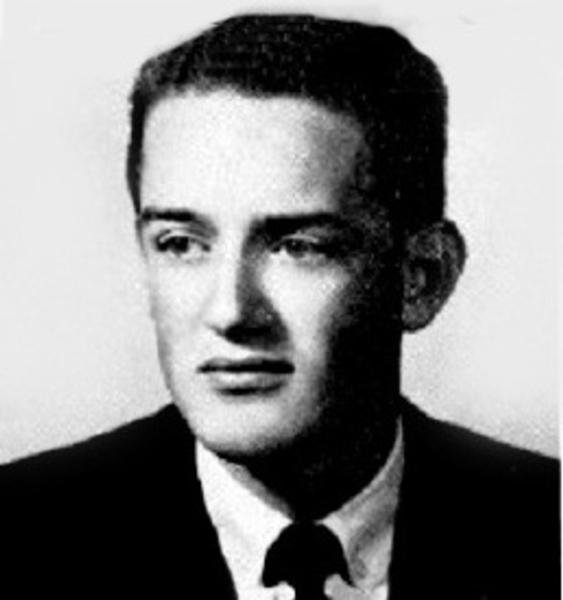
LTJG Sather’s flight of four aircraft and others were conducting retaliatory strikes against North Vietnamese vessels and installations ordered by President Lynden B. Johnson in response to the supposed attacks on the U.S. Navy destroyers USS Maddox and USS Turner Joy. These attacks precluded the passing of the Gulf of Tonkin Resolution by only two days. This joint resolution of the United States Congress allowed President Johnson to wage war as he deemed necessary to defend South Vietnam.
LTJG Sather graduated in 1961 from the University of California Riverside with a degree in zoology. In November of that same year, he enlisted in the U.S. Navy. LTJG Sather was single and 26 years old when he died. He was posthumously awarded the Distinguished Flying Cross. Richard is buried at National Memorial Cemetery of the Pacific in Honolulu, Hawaii. He is remembered on the Wall at Panel 1E, line 60.
(photo from vvmf Wall of Faces web site)
The Vietnam Era began for purposes of federal law pertaining to members of the United States Armed Forces, which defines the period of American involvement in the Vietnam War as “the period beginning on August 5, 1964, and ending on March 27, 1973”.
The United States bombed North Vietnam for the first time as it launched Operation PIERCE ARROW from the aircraft carriers USS Ticonderoga and USS Constellation. The raid, conducted on the North Vietnamese PT boat bases and coastal installations, destroyed 90 percent of the oil storage facilities in the port of Vinh.
F-8 Crusaders, A-1 Skyraiders and A-4 Skyhawks, flying from the carriers USS Ticonderoga and USS Constellation, fly 64 sorties over a 100-mile area of North Vietnam along the Gulf of Tonkin. They destroy or damage an estimated 25 North Vietnamese PT boats (claimed by the United States to comprise about one-half of the North Vietnamese Navy) in attacking bases at Hòn Gai (now part of Hạ Long), Lộc Gạo, Phúc Lợi, and Quảng Khê; they practically destroy an oil storage depot at Phúc Lợi (estimated to be about 10 percent of North Vietnam’s oil storage facilities); and destroy seven anti-aircraft installations at the base at Vinh.
Two U.S. planes are damaged and two others shot down by anti-aircraft fire. The pilot of one, Lieutenant (j.g.) Everett Alvarez, Jr, parachutes to safety although he fractures his back when landing in shallow water and is taken prisoner by the North Vietnamese; the first of some 600 U.S. airmen who will be captured by the Communist forces during the war, Alvarez will not be released until the cease-fire agreement is signed in 1973. U.S. Navy Lieutenant Everett Alvarez, Jr. became the first American serviceman to be taken prisoner in North Vietnam, when his A-4 Skyhawk was hit by ground-fire and he parachuted to safety over Hòn Gai. Members of the local militia pulled him on to their boat after he landed in the water, and he would be held as a prisoner of war for eight and a half years until February 12, 1973. Alvarez’s captivity would be second only to that of U.S. Army Captain Floyd “Jim” Thompson, who had been captured in South Vietnam four months earlier, on March 26.
President Johnson has his aides present the resolution drafted earlier by William Bundy, to the two Congressional leaders who are to sponsor its passage: Senator J William Fulbright (D-Arkansas), chairman of the Senate Foreign Relations Committee, and Representative Thomas E. Morgan (D-Pennsylvania), chairman of the House Foreign Affairs Committee. The resolution would give the President authority to ‘take all necessary measures to repel any armed attack against the forces of the United States and to prevent further aggression . . . including the use of armed force, to assist any member or protocol state of the Southeast Asia Collective Defense Treaty.’
At a news conference, Defense Secretary McNamara announces the results of the U.S. air strikes, and that moves are underway to reinforce U.S. forces in Vietnam: interceptor and fighter-bomber aircraft have been moved from the Philippines to South Vietnam and Thailand and transferred from the United States to advance bases in the Pacific; an attack carrier group has been transferred from the First Fleet off the U.S. Pacific coast to the western Pacific; an antisubmarine task force group has been moved into the South China Sea; and ‘selected Army and Marine forces have been alerted and readied for movement.’ McNamara admits that these actions are being taken in case there is some form of military reaction from Communist nations, but he does not reveal that these actions are part of the Operation Plan 37-64 and other operations that the Johnson administration and the JCS have been planning for several months.
There are reactions from governments and leaders throughout the world to the recent incidents in Vietnam, with the Communist nations inevitably supporting North Vietnam and attacking the United States, while America’s allies, although generally supportive, tend to qualify their statements. British Prime Minister Douglas-Home defends the U.S. action as ‘in accordance with the inherent right of self-defense,’ while France simply observed that the crisis shows the need to accept De Gaulle’s proposal for an international conference on Southeast Asia. China warns that it will ‘not sit idly by’ while the U.S. commits deliberate armed aggression’ against North Vietnam.
The Security Council holds an emergency session to consider the U.S. charges that the North Vietnamese attacked U.S. destroyers in international waters in the Gulf of Tonkin. The Soviet delegate condemns the United States for ‘acts of aggression’ against North Vietnam, but U.S. delegate Adlai Stevenson defends the air attacks as a ‘defensive measure.’ A resolution is passed asking both North and South Vietnam to participate in the Security Council debate.
After taking off from the Constellation, U.S. Navy Lieutenant (jg) Richard C. Sather became the first American serviceman to be killed in North Vietnam (though many had died in South Vietnam), when his A-1 Skyraider was hit by anti-aircraft fire, and he crashed into the water off the shore of Thanh Hóa.
The United States told the U.N. Security Council today that despite “acts of deliberate aggression” by North Vietnam it was determined to maintain the “assured and guaranteed independence” of Southeast Asia. “We are in Southeast Asia,” Adlai E. Stevenson, the chief United States delegate, declared, “to help our friends preserve their own opportunity to be free of imported terror, or alien assassination managed by the North Vietnam Communists based in Hanoi and backed by the Chinese Communists from Peking.”
Mr. Stevenson insisted that the United States bombing of North Vietnamese torpedo boats “and their facilities” was an act of self‐defense against attacks on United States destroyers on the high seas and was authorized by international law and the United Nations Charter. He said: “This is a single action designed to make unmistakably clear that the United States cannot be diverted by military attack from its obligations to help its friends establish and protect their independence.”
R. W. Jackling, the British representative, supported the United States, holding that the bombing was authorized by Article 51 of the Charter, which recognizes the right of selfdefense against an armed attack pending action by the Security Council to maintain international peace and security. However, Platon D. Morozov, the Soviet representative, asserted that in the view of his Government the United States, had committed an “act of agigression.” He added that if such actions were repeated the United States “will have to bear a heavy responsibility.”
Communist China accused the United States today of “deliberate armed aggression” against North Vietnam and said the Chinese people would not “sit idly by.” In an official statement distributed by the Hsinhua press agency, Peking Government said Washington had taken the first step toward extending the war in Indochina. Referring to the American raids en North Vietnamese installations as a “surprise attack,” the Peking statement said Washington had thus gone “over the brink of war.” As Peking’s strongest statement on the situation so far, it appeared to commit China to some concrete move. It spoke of “lending a helping hand” and added that “the debt of blood incurred by the United States to the Vietnamese people must be repaid.”
President Johnson warned the nations of the Communist world today not to support or widen aggression in Southeast Asia or to assume that in this election year the United States was divided. In grave, measured tones, the President said: “To any who may be tempted to support or to widen the present aggression, I say this: There is no threat to any peaceful power from the United States of America. But there can be no peace by aggression, and no immunity from reply. And that is what is meant by the actions that we took yesterday.”
The United States rushed fighting men, planes, and ships to Southeast Asia today. Secretary of Defense Robert S. McNamara, announcing the reinforcements at a news conference this morning, disclosed among these the assignment of an antisubmarine task force to the South China Sea. This clearly was intended to thwart any possible intervention by the Chinese Communists. The North Vietnamese are not known to have any submarines. In a television interview tonight, Mr. McNamara was asked to comment on the possibility of Soviet or Chinese Communist intervention. “We are prepared for any action they may take,” he replied.
French officials said tonight that the crisis in Southeast Asia emphasized the wisdom of President de Gaulle’s call for an international conference on the future of the area. Qualified sources said they expected that the general, who is on holiday at his home at Colombey-les-deux-Eglises, would make a new appeal for a big‐power parley to establish the independence and neutrality of the states of Indochina. The absence of firm and immediate French support for the United States air strikes against North Vietnam was in marked contrast with General de Gaulle’s stand during the Cuban missile crisis in 1962. Then he assured President Kennedy’s Administration of full French support. The French attitude also contrasted sharply with that of a majority of the members of the North Atlantic Treaty Organization.
The dusty Laotian capital of Vientiane was tensely expectant tonight as rumors of an impending coup d’état circulated among military men and civilians. In the wake of a military alert, last night, the Ministry of the Interior issued a communiqué asking the local and foreign population to remain calm and to have confidence in the authorities. Since last April 19, when rightists staged a military takeover under General Kouprasith Abhay and Siho Lamphoutha‐ coul, rumors of another coup have abounded. Speculation has centered on the rightist faction that backs Deputy Premier Phoumi Nosavan, who lost power in the April 19 coup. Reliable sources attributed last night’s alert to reports that such a move was imminent. Armed policemen guarded all barracks, the major crossroads and the radio station.
Fighting flared tonight between Greek and Turkish Cypriots along Ledra Street, which marks the zone between the communities in the Cypriot capital of Nicosia. Four Greek Cypriots were wounded. There were no reports of the wounding of any Turkish Cypriot. A 15‐man Danish patrol of the United Nations peace‐keeping force, stationed along the Ledra Street line, was pinned down during the firing. Outside the city, Greek Cypriot policemen warned drivers against entering Nicosia.
Stanleyville, the third largest city in the Democratic Republic of the Congo, was captured by the Simbas, the participants in the Simba rebellion, led by Christopher Gbenye and Pierre Mulele, who took several hundred Western hostages. Belgian paratroopers, airlifted into Stanleyville by the U.S. Air Force, would retake the city on November 24. During the siege, at least 120 hostages were killed. Congolese Government troops, who pushed the rebels from the heart of the city last night, were reported late this afternoon to have fled.
The victory is the most important yet scored by the rebels, who already control much of the eastern Congo. It would also be a severe blow to the Government of Premier Moïse Tshombe. When he came to power last month he pledged to end the revolts by negotiation. A radio message from the Stanleyville control tower was picked up by the Leopoldville airport after the tower had been off the air for about two hours. The Stanleyville operator was reported to have said: “All services at the Stanleyville airport are now functioning normally under the control of the Popular Army of Liberation. The entire city is now in rebel hands.”
President Johnson requests a joint resolution of Congress that will become known as the Tonkin Gulf Resolution, enabling the U.S. to become fully involved in the war in Vietnam.
President Johnson asked Congress today to pass a joint resolution assuring him of full support “for all necessary action” he might have to take to protect the armed forces of the United States in Southeast Asia. The President also asked that the resolution give prior sanction for any necessary steps, including the use of armed force, to assist nations covered by the Southeast Asia Treaty Organization that requested help in defense of their freedom. As soon as the clerk had finished reading the special message from the White House, identical resolutions were offered by Senator J. W. Fulbright of Arkansas, chairman of the Senate Foreign Relations Committee, and Representative Thomas E. Morgan of Pennsylvania, chairman of the House Foreign Affairs Committee. Hearings on the proposed resolution will begin tomorrow.
The President made his request for Congressional support a day after he told the nation over television of a second attack within three days on United States destroyers by North Vietnamese PT boats. In his message the President emphasized, as he did in his broadcast, that “the United States intends no rashness and seeks no wider war.” He went on to make clear that the United States would not tolerate such attacks as have taken place this week. Then he said: “We must make it clear to all that the United States is united in its determination to bring about the end of Communist subversion and aggression in the area. We seek the full and effective restoration of the international agreements signed in Geneva in 1954, with respect to South Vietnam, and against at Geneva with respect to Laos.”
Experts working from dental charts and other evidence identified today the three bodies found buried deep inside a cattle‐pond dam as those of three missing civil rights workers. Federal Bureau of Investigation agents declined to say how the two white men and one Black were killed six weeks ago after their release from the Neshoba County jail at Philadelphia, Mississippi. There were persistent reports that an informer who received $25,000 to $30,000 had led FBI agents to the crude graves five miles southwest of Philadelphia in the rolling hills of east-central Mississippi. These reports and other circumstances surrounding the finding of the bodies early last night indicated that investigators knew some details of the slaying and had some idea of who was involved. However, it was learned that no arrests were imminent.
In Honolulu, Dick Gregory, the Black entertainer, said tonight that three weeks ago he had turned over a letter to the FBI naming five persons as responsible for the deaths and pinpointing the location of the bodies, according to United Press International.
County Coroner Fulton Jackson, Sheriff L.A. Rainey, Deputy Sheriff Cecil Price and a six-man coroner’s jury visited the site last night and again this morning. No finding was announced immediately. “We are not certain what was the cause of death,” Mr. Jackson said. He drove an ambulance bearing the bodies to Jackson last night. The bodies were encased in three black plastic bags, tagged X‐1, X‐2 and X‐3.
A waiting team of pathologists and FBI, identification experts at the University of Mississippi Medical Center began examination of the bodies after the ambulance arrived at 12:30 AM. Mr. Jackson was asked today if it were true the autopsies had shown that the three men had been shot to death and that bullets had been removed from all the bodies. Such a report was published by The Jackson Daily News. “I’m just not going to make any statement at this time,” the coroner answered. “The matter is still pending.”
J. Edgar Hoover, director of the FBI, announced this morning in Washington that the two white men had been definitely identified as Michael H. Schwerner, a 24‐year‐old field worker for the Congress of Racial Equality from New York, and Andrew Goodman, 20, a Queens College student from New York, who was a volunteer in the summer civil lights campaign in Mississippi. Further tests were being made to confirm the tentative identification of the body of James E. Chaney, 21, a Black plasterer from Meridian, Mississippi, who also was a CORE field worker. It was indicated that FBI agents were certain the body was that of Mr. Chaney but that the identification could not be announced as positive until further tests were completed, to satisfy the legal requirements for establishing identification.
The New York Times opines:
“The discovery of the bodies of the three civil rights workers confirms the awful fears that arose when they first disappeared in Mississippi six weeks ago. Triple murder, by foul and violent means, has been committed. It is the most futile of all responses to the fight for equal rights, as well as the most monstrous. For terrorism is sure to strengthen the resolve to implement and enforce the law, not spur resistance to it.
“The triple murder is creating this reaction. Mississippi’s Governor, Paul B. Johnson Jr., has pledged to “exert every effort to apprehend those who may have been responsible.” Unfortunately, there is little in the state’s record to warrant optimism that any massive response will come from its law‐enforcement agencies. The champions of white supremacy and the defenders of states’ rights in Mississippi have shown much less resolve than Northern officials in making clear that they do not condone resort to violence or terror by either side in the civil rights conflict. If they now fail to honor the Governor’s pledge, the Federal Government will have no choice but to do the job.
“Mississippi and other Southern states look upon civil rights workers as alien intruders, sowing strife and fomenting dissension. But the civil rights workers who are taking part in the Mississippi summer project, a campaign that started before the new law was enacted, are not engaged in any subversive or illegal activity. If there were no obstacles to Negro voting in that state, there would be no “invasion.”
“Mississippi cannot declare itself off limits to the rest of the nation, nor can the rest of the nation regard Mississippi as something separate and apart. The murders of Michael Henry Schwerner, Andrew Goodman and James Earl Chaney are a horrendous example of an unthinking and inhuman reaction that might happen wherever mobs make themselves custodians or nullifiers of the law.
“These murders will serve to remind decent and responsible people everywhere that lawlessness or mob rule cannot be tolerated. They can be responsible for a new determination to bring the murderers to justice and to affirm the need for law and order. The horror stirred by their murder must also bring a firmer resolution that the nation’s effort to end discrimination be accomplished without violence or bloodshed. This is no help for the victims and scant solace for their families, but they will gain a noble and deserved epitaph if their death helps to lead to a peaceful victory for the cause in which they enlisted so hopefully.”
The Administration, as a concession to the South, agreed today that Governors would be allowed to veto antipoverty projects in their states. The move, designed to attract badly needed Southern votes, was announced as the House opened a partisan debate over President Johnson’s antipoverty bill. The states’ rights amendment will be offered by supporters of the legislation tomorrow or Friday. The final vote on the bill is scheduled Friday. Administration sponsorship of the veto proposal represmis a reversal of the stand taken in the Senate just two weeks ago. There, Administration leaders fought off adoption of a similar proposal. Instead, the Senate adopted an amendment allowing Governors to veto only those projects originated by private organizations, such as the church groups or civic clubs.
Today’s debate was marked by frequent clashes between Democrats and Republicans. The Republicans charged, as they had done previously, that they had been locked out from attempts to write a bipartisan bill. There were strong racial overtones, too. Representative Howard W. Smith of Virginia, a leader of the conservative Southern bloc that has joined Republicans in opposing the bill, told the House: “I want to say to any Southerners who plan to vote for this bill, you are implementing the civil rights bill that you opposed.” The Job Corps training camps that would be set up under the bill would be “integrated camps,” Mr. Smith said printedly. “They aren’t going to be very popular south of the Potomac.”
Pierre Salinger survived a near filibuster over fine points of constitutional law and Senate rules today before being sworn in as a Democratic Senator from California. His appointment was confirmed, 59 to 29, on a roll‐call vote. While it was the Republican minority that raised the only serious obstacle to his confirmation, the most profound plea in his behalf came from his California Republican colleague, Senator Thomas H. Kuchel. Mr. Salinger, who has been campaigning for the seat of the late Senator Clair Engel since last March, received an interim appointment to the post yesterday from Governor Edmund G. Brown. The opposition to seating him today was led by the Senate minority leader, Everett McKinley Dirksen of Illinois. Senator Dirksen’s objection was based on the same question that had plagued Mr. Salinger’s nomination and subsequent campaign — his status as a legal resident of California.
Senator Barry Goldwater begins a week of work tomorrow aimed at marshaling the support of dissident or indifferent Republican leaders behind his Presidential candidacy. Mr. Goldwater spent today at his apartment, canceling a tentative plan to visit the offices of the Republican National Committee for conferences, a press aide said. Tomorrow at 8 AM, Mr. Goldwater will hold a breakfast meeting with about 100 Republican members of the Senate and House at the Congressional Hotel. Friday morning he will meet with a similar group at the same place. There are 211 Republican members of the House and Senate. A Republican official said that “only a bare dozen or so have said they cannot attend” either of the breakfasts. The breakfast conferences are a preliminary to a so‐called “Republican summit conference’ to be held a week from today at Hershey, Pennsylvania, which will be attended by Republican Governors, former President Dwight D. Eisenhower, former Vice President Richard M. Nixon and other major party figures.
American screenwriter and future film maker Mel Brooks (38) weds American actress Anne Bancroft (32) at the Manhattan Marriage Bureau; second marriage for both, until her death in 2005.
Beatles record a cover of Little Willie John’s “Leave My Kitten Alone”; not released until 1995’s “Anthology 1”.
After weeks of negotiating, Ford Frick tells the league presidents and club owners he will not run for another term as commissioner.
The Minnesota Twins hit three home runs tonight, including successive clouts by Tony Oliva and Harmon Killebrew, and beat the Boston Red Sox, 6–1. Oliva and Killebrew connected in the first inning to help Camilo Pascual gain his 11th victory. Killebrew’s homer was his 38th and gave him a tie for the American League lead in runs batted in with Dick Stuart of the Red Sox, who went hitless. Both have 86.
At Kansas City, the A’s touch up the Yankees’ Al Downing for 8 runs in 5 innings en route to a 10–1 victory. Rocky Colavito has a single, 2 doubles and a homer, scoring 3 runs and driving in 3, while Nelson Mathews clouts a grand slam. Joe Pepitone’s homer off Orlando Pena is New York’s lone tally. To make the evening a total flop for Yogi Berra, his boys committed three more errors on defense, making a total of five in two games here. This was two more than the Yankees had made in their 12 previous games in the West, and one of them led to the Athletics’ first run tonight while another gave Mathews a two‐out shot at his grand slam.
The Cleveland Indians cracked 12 hits, including successive home runs by Chico Salmon and Leon Wagner, and routed the Washington Senators, 9–0, tonight. The Indians’ third baseman, Max Alvis, returned to the lineup, for the first time since he was stricken with spinal meningitis on June 26.
“Roberto Clemente scores 2 knockouts: Drysdale in 8, Dodgers in 9.” The Pittsburgh Pirates edge the Los Angeles Dodgers, 4–3. Clemente’s 9th-inning liner over the head of second baseman Nate Oliver, his third hit of the game, brings home Gene Alley with the winning run. Visiting beat writer Frank Finch reports: “The crowd of 11,071 figured L.A. had won another one when the Californians reeled off six straight hits with two out in the 6th to take a 3–1 lead, but starter Don Drysdale and reliever Ron Perranoski failed to contain the battling Buccos down the stretch. After pitching his way out of several earlier jams, Drysdale was yanked in the 8th when Bill Virdon singled and reached third on Clemente’s double. Perranoski (4–6) came in to whiff the dangerous Jerry Lynch, then wild-pitched Virdon across the plate… Perranoski gave up a score-tying home run to Jim Pagliaroni in the last of the 9th and a single to Ducky Schofield to set the stage for Roberto Clemente’s game-winning single.”
Bill White hit a three‐run homer and a single to lead the St. Louis Cardinals to a 4–2 victory over the Chicago Cubs tonight. White extended a hitting streak to 13 games and lifted his percentage to .300 for the first time since May 1. During his streak, the Cardinal first baseman has batted .473 (26 hits in 55 trips).
Dow Jones Industrial Average: 833.05 (+0.28).
Born:
Adam “MCA” Yauch, American hip hop musician and founder of the Beastie Boys; in Brooklyn, New York, New York (d. 2012, from parotid cancer).
Eric Dorsey, NFL defensive end (NFL Champions, Super Bowl XXI and XXV, 1986, 1990; New York Giants), in Washington, District of Columbia.
Michael Ball, NFL safety (Indianapolis Colts), in New Orleans, Louisiana.
Died:
Art Ross, 79, Canadian-American hockey player (Montreal Wanderers), coach (Boston Bruins, 1924-1945), and namesake of NHL’s scoring champion trophy.
Moa Martinson, 73, Swedish writer (My Mother Gets Married).
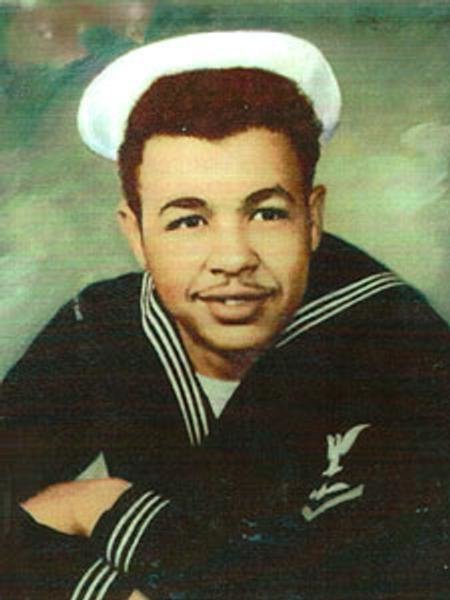
Those who do not know, do not know. Working on a carrier flight deck is one of the most hazardous, gruelling jobs in the world. These guys work punishing hours, amid all sorts of dangers. Fatigue is seductive and can easily kill you, especially since you have to wear hearing protection. The manner of his death is, tragically, far from uncommon.
(photo from vvmf Wall of Faces web site)
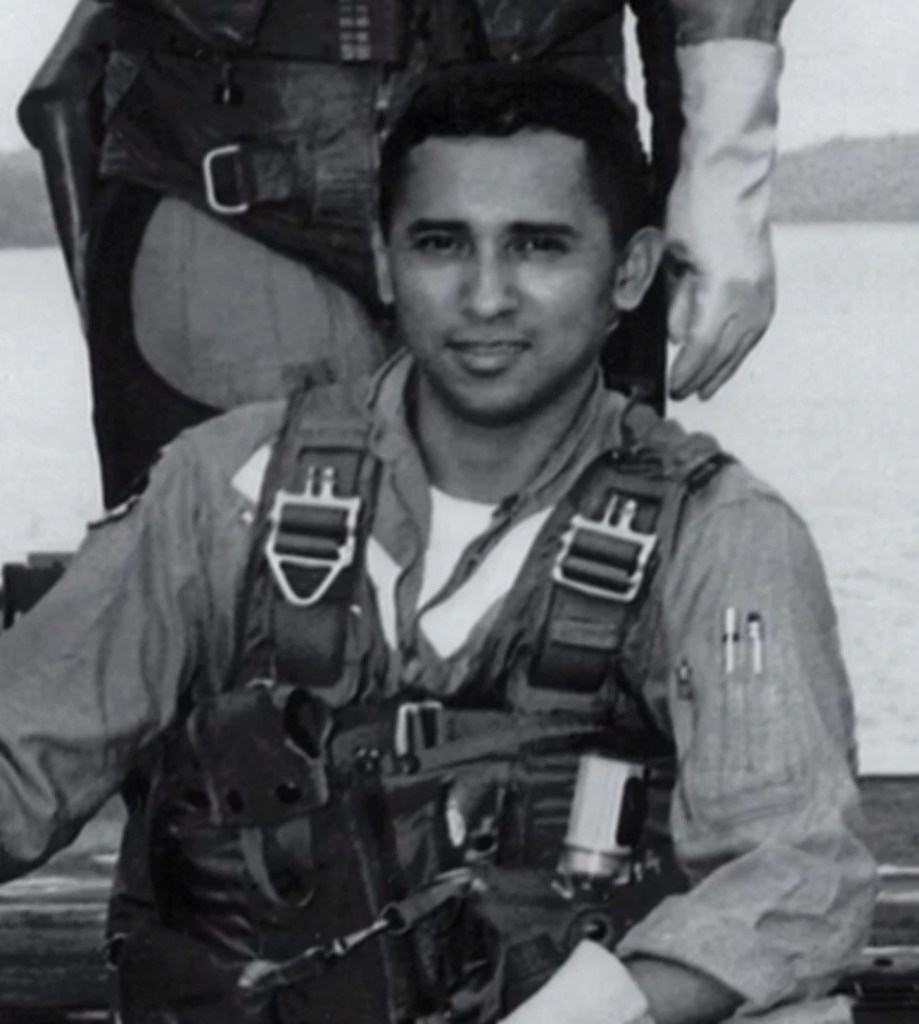
Alvarez has said that he survived imprisonment thanks to primarily his faith in God, and the mutual support of the other prisoners who communicated with each other by tapping on the prison walls. “We had a philosophy that you didn’t ever let your fellows down,” he said in the interview. “If they couldn’t take care of themselves, you took care of them because you knew darned well they would do the same. And we had a goal. We were determined to come home with our personal integrity, our reputation and with our honor.” He has co-authored two books: “Chained Eagle,” with Anthony S. Pitch, about his captivity; and “Code of Conduct / An Inspirational Story of Self-Healing by the Famed Ex-POW and War Hero,” with Samuel Schreiner, about his return and life afterward. He holds numerous military decorations including the Silver Star, two Legions of Merit, the Distinguished Flying Cross, two Bronzes Stars, and two Purple Hearts.
After he returned from Vietnam, Alvarez received a Master Degree in Operations Research and Systems Analyst at the Naval Post Graduate School where he has ben installed into the Alumni Hall of Fame. He also has Juris Doctorate degree from George Washington School of Law where he is a distinguished Alumnus. He is a member of the Washington DC Bar. He went on to serve as Deputy Director of the Peace Corps, Deputy Administrator of the Veterans Administration (now known as Department of Veterans Affairs) and vice president for government services with the Hospital Corporation of America. After retiring from government service, he founded and is presently Chief Executive Officer of the consulting firm Alvarez LLC. Alvarez and his wife, Tammy, serve on various projects involving wounded warriors, including the Green Road Project at Walter Reed that provides a natural healing environment for wounded service members and their families. He also served for 21 years on the Board of Regents of the Uniformed Services University.
Everett and Tammy have made Rockville, Maryland their home since 1976. They have two sons who grew up in Rockville. Marc is an attorney, and President of Alvarez LLC. Bryan is a medical doctor and served as a battalion surgeon in Iraq, and is a Commander in the Navy Reserves.
 History Diaries