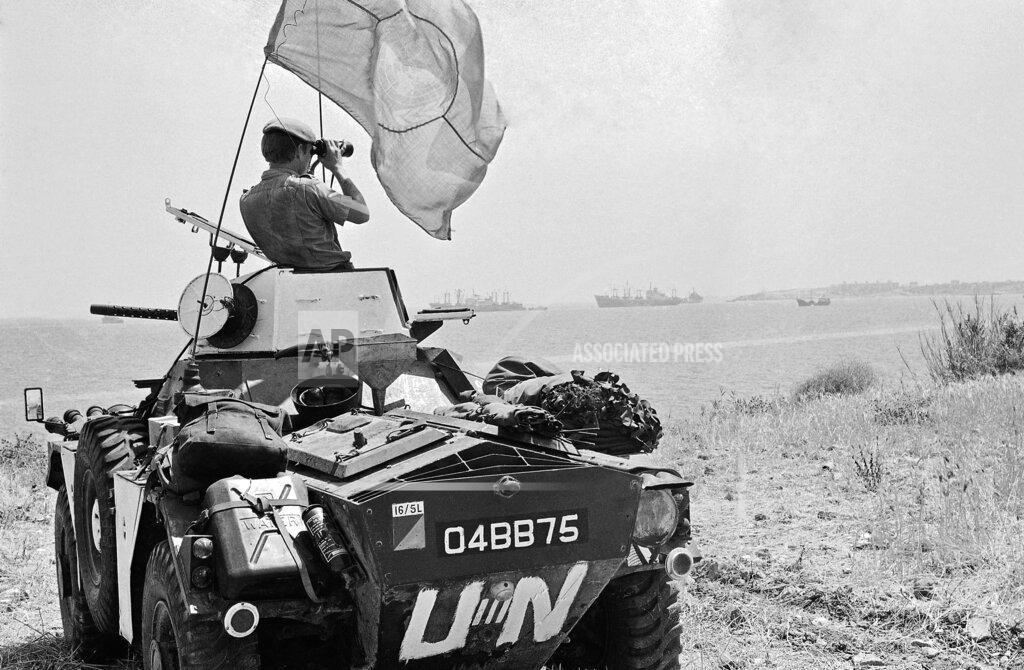
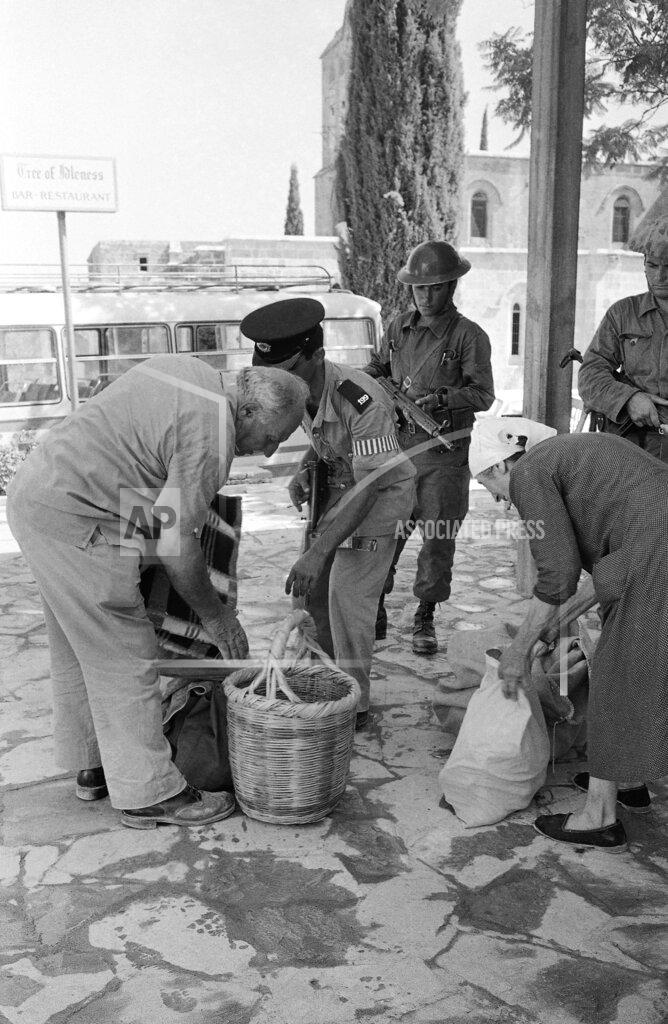
Turkish troops arrested the able-bodied men and expelled the women and children from the last Greek Cypriot havens in the Turkish-occupied area of northern Cyprus. Before leaving for Athens to consult with the Greek government, Glafkos Clerides, President of the Greek Cypriot administration, sent a message to Secretary General Waldheim and members of the United Nations Security Council complaining that 20,000 Greek Cypriots had been expelled from the Turkish sector between Nicosia, the capital, and Kyrenia, the coastal city 12 miles to the north.
Greek leaders conferred with the President of Cyprus, Glafkos Clerides, and it was assumed that they were planning the strategy for the second round of Geneva talks on Cyprus, which begin Thursday. Some Greek soldiers were reported recalled from leave when an unidentified Turkish ship was sighted off the Aegean island of Chios. The Turks have previously made geological surveys in the area and have threatened to do more, to back their claims on oil exploration rights in the Aegean Sea.
At the end of a two-day conference in Lisbon, Secretary General Waldheim announced that Portugal was ready to recognize the territory of Portuguese Guinea as an independent state and to support its entry into the United Nations. Portugal had announced last June that it would go along with U.N. resolutions on the independence of its African colonies. Thus ended Portugal’s long estrangement from the United Nations. Mozambique and Angola are expected to follow Portuguese Guinea into independence from Portugal and representation in the United Nations.
Portugal’s military leaders, acting after other newspapers and radio stations threatened to shut down in protest, lifted an order suspending publication of three Lisbon newspapers for printing reports of a Maoist rally that criticized the regime. Suspension of the papers-A Capital, Diario de Lisboa and Republicacreated a split within the military’s ranks because the 10-member press commission, which is made up of young officers, had not been informed of the move.
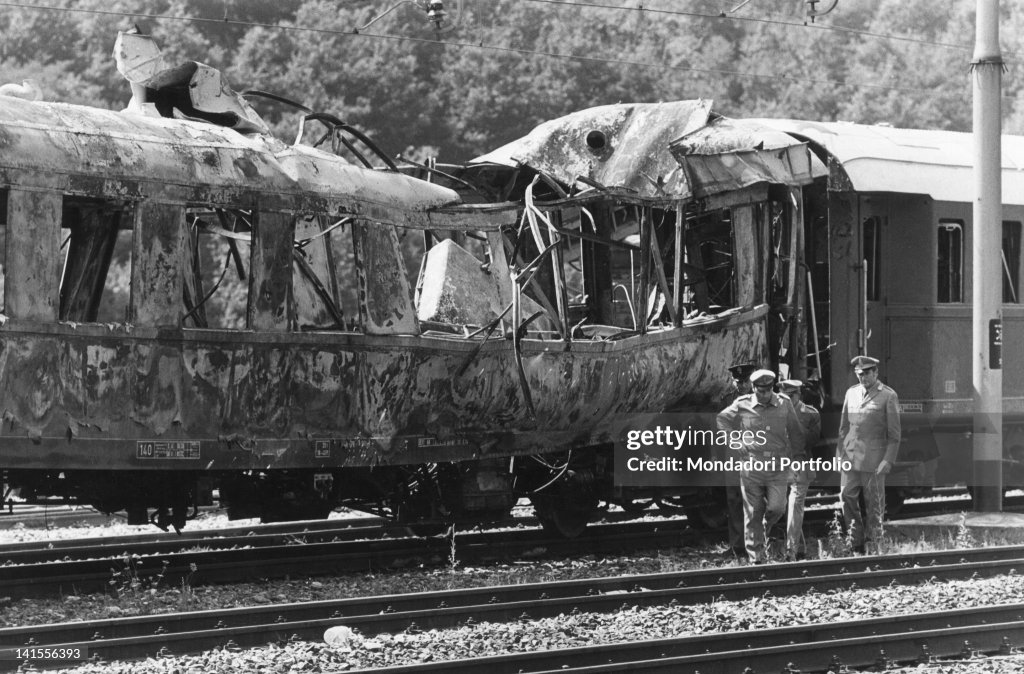
A bomb exploded on the Italicus Express train between Italy and West Germany, killing 12 people and injuring 48. Italian neo-fascists claimed responsibility. Italian police said two Americans were among 48 persons injured when a terrorist time bomb exploded aboard the speeding Rome-Munich express train, killing 12 persons. A special police squad took over the investigation and said the bomb, left in the lavatory of a second-class compartment, may have been timed to explode when the train stopped in Bologna station. But the train was 30 minutes behind schedule, preventing what could have been a major disaster in Bologna.
Northern Irish terrorists fired five mortar rounds into a British army post in Belfast but only two rounds exploded and damage was light with no reported injuries, authorities said. They blamed the outlawed Irish Republican Army for the attack, which came after the British had rounded up 28 alleged IRA men and women in a sweep of Belfast.
The Paris police responded to eight more bomb threats last night, but found no booby‐trapped cars of the type that exploded in front of the offices of the Jewish Social Fund and at the offices of two anti‐Arab newspapers Friday night. The threats were all directed against journalistic organizations: four newspapers and four radio‐television studios. Since yesterday morning, hundreds of policemen have been on duty guarding the offices of most newspapers and Jewish organizations, the two types of targets that have been bombed or threatened. No group has yet claimed responsibility for the actions, but the police say they are on the trail of a suspect. He is described as a man 35 to 40 years old, with a dark complexion. Elegantly dressed and speaking with a foreign accent, he presented himself as Bernard Leon to a car rental agency, where he picked up the three vehicles used to house the bombs that exploded Friday night.
The derailment of an express train in Dol-de-Bretagne, France, killed nine people and injured 30.
Soviet author Viktor P. Nekrasov, who fell from official grace after winning a Stalin Prize and popular praise for his wartime novels, has been granted an exit visa to live in Switzerland for two years. Friends of the 63-year-old writer said they feared he would be forbidden to return. Nekrasov’s “In the Trenches of Stalingrad” won official recognition, but a 1960 book, “On Both Sides of the Ocean,” in which he praised the United States, marked his fall from favor.
Turkish Prime Minister Bulent Ecevit told a news conference in Ankara that his country had arranged for “tight control” of opium fields when poppy cultivation resumes in seven provinces this fall. “We will concentrate on controls in the fields and not at the borders,” Ecevit said, adding that several thousand officers, mostly Americantrained, will enforce the controls. Turkey lifted its ban on poppy growing last month.
French Army Commandant Pierre Galopin, posted in Chad, was captured by Chadian rebels in the Sahara desert, after traveling to the rebel-held portion of the African nation to negotiate the release of hostages. Galopin would be sentenced to death by his captors and executed by hanging on April 4, 1975.
The flood crisis in Bangladesh worsened, claiming the lives of 119 more people — most of them victims of a flood-related outbreak of cholera, officials said in Dacca. A total of 517 have died so far in 49 consecutive days of flooding, and the waters have submerged 250 miles of roads. The latest survey showed that 20,000 of the country’s 52,000 square miles of land were under water, and official damage estimates ranged above $600 million.
North Vietnamese and South Vietnamese forces suffered more than 350 casualties in a dawn‐to‐dusk battle yesterday on the outskirts of the besieged district town of Duc Duc 20 miles south of Đà Nẵng, the Saigon command announced today. A communiqué also reported continued heavy North Vietnamese shelling against a cluster of district towns 20 to 30 miles below Đà Nẵng, the country’s second largest city. However, the command denied earlier reports from the field that North Vietnamese and Việt Cộng troops had overrun 10 South Vietnamese Government positions around Đức Dục and 50 miles farther south in Quảng Ngãi province.
The command said that North Vietnamese troops shelled Saigon Government rangers defending Đức Dục, then launched a ground attack. But the rangers, with air and artillery support, drove off the attackers, leaving 208 North Vietnamese dead, the communiqué asserted. As only 31 weapons were captured, it appeared that the government figure was probably inflated. South Vietnamese casualties in the battle were put at 25 dead and 63 wounded. North Vietnamese infantrymen carried out a similar attack on the nearby district town of Đại Lộc, the command said, but this was also repulsed, with 8 North Vietnamese and 5 government troops killed and 22 government soldiers wounded.
Rebel forces overran five small Cambodian Government outposts and abducted several hundred villagers only three to five miles from the capital of Phnom Penh, according to field reports. The reports said that at least 40 militiamen from a 200‐man force were missing, and that 15 villagers were slain after they resisted. The villages lie in the swampy area adjacent to the east bank of the Mekong river.
The West African nation of Ghana began requiring its 80,000 motorists, as well as other vehicle operators, to drive on the right-hand side of the road after decades of left-hand side driving that dated from Ghana’s days as a British colony. On the day before, the government banned the sale of alcohol for nine hours in order to ensure sobriety of vehicle operators after midnight.
An estimated 30,000 people demonstrated in Lourenco Marques (now Maputo) today to acclaim the Portuguese Government’s pledge earlier today of early independence for Mozambique. Assembled in the bullring here, the crowd waved Mozambique Liberation Front (Frelimo) flags and shouted pro‐Frelimo slogans. The crowd listened in the hot sun to four speakers for two hours while students distributed Frelimo flags.
President Nixon summoned his principal defense lawyer, James St. Clair, other aides and speechwriters to Camp David, indicating that some new move was contemplated in the congressional impeachment drive.
Secretary of the Treasury William Simon suggested that the Nixon administration would continue its present economic policy of budget and monetary restraint even if unemployment level, now at 5.3 percent, went above 6 percent — the rate that in the past has been considered recessionary. Mr. Simon and Kenneth Rush, the President’s counselor for economic policy, in separate television appearances, each rejected forecasts that the rate would go over 6 percent in the coming months.
Herbert Kalmbach, President Nixon’s former personal lawyer, has told the House Judiciary Committee that John Ehrlichman was trying to leak a story that the Democratic party chairman, Lawrence O’Brien, was in trouble with the Internal Revenue Service weeks after Mr. Ehrlichman knew that the I.R.S. had found no basis for auditing Mr. O’Brien’s tax returns. Mr. Kalmbach said that Mr. Ehrlichman had told him that “I am being pressured” to get the story defaming Mr. O’Brien.
President Nixon should immediately turn over his official duties to Vice President Ford until impeachment proceedings are settled, said Senator William Proxmire (D-Wisconsin), chairman of the congressional Joint Economic Committee. Such a temporary move is “absolutely essential” to enable the government to draw up an effective program for fighting inflation, Proxmire said. At the same time, Proxmire said it would be “just plain wrong” for Mr. Nixon to resign before the impeachment process had fully run its course.
Senator Charles H. Percy said today he had asked for an accounting of all the intelligence, police and investigative agents hidden within the Federal Government so Congress can bring them under its control. If he succeeds, it will be the first such comprehensive survey of the Federal police and intelligence community ever conducted and reported to Congress. The Illinois Republican said that his request was part of a renewed Congressional interest, promoted by the revelations of Watergate, in passing legislation to protect privacy rights against government encroachment.
The courtyard at Huntsville State Prison was quiet today. After ten and one‐half days of tense negotiations between prison officials and three armed inmates who had seized 15 hostages in an escape attempt, a 252‐hour siege ended at 9:58 o’clock last night following a 20‐minute shootout. Two of the convicts were killed. Two of the 12 hostages they still held, both women, were, killed. Two male hostages were wounded.
“The results of this under the circumstances are the very best, I’m convinced, that we could have hoped for, considering the people that held our people hostage,” said W. J. Estelle Jr., director of the Texas Department of Corrections. Mr. Estelle had headed the negotiations with Fred Gomez Carrasco, a convicted murderer and narcotics dealer, who led the escape attempt and was one of those killed. Although it had appeared at times that prison officials might allow the escape to be carried out, Mr. Estelle said: “At no time was any thought given to the granting of any illegal freedom of any captor. In good conscience, we could never turn this kind of violence loose on the community of Texas.”
During the prolonged negotiations, three of the original 15 hostages were freed, another escaped, and a Roman Catholic priest, one of those wounded yesterday, volunteered to become a hostage. The talks, conducted by telephone and; written messages, reached a critical stage yesterday. The inmates had requested an armored truck for their getaway. They planned to walk one at a time, surrounded by hostages as shields, down a 40‐yard angular ramp and into the truck.
William A. H. Williams, accused kidnaper of Atlanta Constitution Editor Reg Murphy, was found guilty of extortion by a federal jury in Atlanta. Sentencing was set for Aug. 30. Convicted on three counts, Williams could receive a maximum 50-year prison term. He was convicted on charges of extorting $700,000, from the newspaper, using a firearm in a federal felony and using the mails for a ransom note. The 34-year-old subcontractor had based his defense on alleged insanity at the time of the kidnapping, which he freely admitted in two days of testimony.
The American economic situation is so uncertain “that one shouldn’t discard the possibility of a panic,” said Chase Manhattan Bank President David Rockefeller. He was quoted in a newspaper economic survey, which observed, “Some of the most powerful leaders of the world’s major financial centers are openly fearful that strains in the money market could result in at least a few bank and industrial failures in the next six months.” With inflation soaring unabated, the stock market depressed and Washington undergoing the agony of impeachment, financial leaders are feeling genuine anxiety about the future of the economy, the account concluded.
Government employees responsible for determining pay increases have weighted the figures to give civil servants an extra $1 billion a year, the General Accounting Office said. The GAO report charged that surveys of private industry salaries conducted by the Department of Labor’s Bureau of Labor Statistics gave disproportionate weight to the highest paying jobs. Under federal law, pay raises for civil servants are based on the survey’s findings. The GAO said a possibly unwarranted increase last October gave each employee more than $250 extra annually and would cost at least $1 billion every year.
Actor-comedian Shelley Berman, 47, in New York for a summer stock revival of the play “Room Service,” was robbed at gunpoint by a masked man who burst into his hotel room. The gunman tied and gagged Berman and escaped with $60 in cash and a watch. Berman, treated for bruises around his mouth from the gag, said he was sitting in bed watching television around 3 am, when “suddenly, before I knew it, there was a man in the room.” BerIman said the door had been locked but the chain latch wasn’t hooked up. “All I could see was that damn gun coming at me,” Berman said. Because of his hood, the assailant was “completely unrecognizable.”
Two Dallas computer executives may owe a sizable gift tax on the $100,000 donation they gave secretly to the Wilbur Mills’ 1972 presidential campaign. Both men, Milledge A. Hart III and Mervin L. Stauffer, have stated the money came from their personal funds. They could each owe more than $4,000 in gift taxes, according to Internal Revenue Service standards. An IRS spokesman refused to give an opinion on whether Hart and Stauffer owed taxes.
The Crawford-Butler Act allows Puerto Ricans to elect own governor.
A nationwide strike by the Bell Telephone System’s employees was averted tonight as union and management negotiators tentatively agreed on terms of a new three-year contract about two hours before the midnight strike deadline.
Steve Cirillo, 31 years old, believed to be a member of the Joey Gallo Mafia group, was shot and killed while attending a fundraising “Las Vegas Nite” at the synagogue of the Congregation B’nai Israel at Ocean and Jerome Avenues in Sheepshead Bay, Brooklyn. His death may have been connected with a struggle for control of the Gallo group. Since July 1, one other member of the group has been killed and three others have been wounded.
Bob Pleso, a stunt motorcyclist attempting to break the distance record of 171 feet (52 m) (set by Bob Gill rather than Evel Knievel) in jumping over parked automobiles, was fatally injured in front of 3,000 spectators while trying to jump over 30 cars at the Phenix Dragway in Phenix City, Alabama. Pleso’s motorcycle cleared the first 27 cars before coming down on the windshield of the 28th, and he died in a hospital two hours later.
Swiss driver Clay Regazzoni won the 1974 German Grand Prix at the Nürburgring.
The New York Yankees, one‐day revolt against the Boston Red Sox subsided yesterday when Luis Tiant pitched Boston to a 7–3 victory and became the major leagues’ first 17‐game winner of the season. The game was supposed to be the first half of a doubleheader that drew 41,888 persons into Shea Stadium, making a two‐day total of more than 92,000 who paid to watch the teams. But the second game was delayed at the start by 1 hour and 20 minutes by a rainstorm and was finally postponed.
In San Diego, the Reds and the Padres split a pair with the Reds winning, 7–2, in the opener. Randy Jones loses his 15th. In the nightcap, Dave Freisleben pitches 13 scoreless innings for the Padres before giving way to Rusty Gearhart, who wins in the 14th when the Padres push across a run against Pedro Bourbon to beat the Cincinnati Reds, 1–0. Starter Clay Kirby pitches 9 innings for the Reds.
At Dodger Stadium, Geoff Zahn pitches 8 innings for a 2–1 win over the Houston Astros. Davey Lopes has 3 hits and 4 stolen bases, the most in the National League in 12 years.
Born:
Muqtada al-Sadr, Iraqi politician and militia leader (Sadrist Movement), in Najaf, Ba’athist Iraq.
Canute Curtis, NFL linebacker (Cincinnati Bengals), in Amityville, New York.
Tyrell Peters, NFL linebacker (Baltimore Ravens), in Oklahoma City, Oklahoma.



 History Diaries