Two more clandestine attacks under Oplan 34A are carried out: PT boats manned by South Vietnamese attack the radar installations at Cape Vinh Sơn and an installation at the Cửa Ron estuary. The two U.S. destroyer commanders are aware of this operation and try to avoid becoming associated with the South Vietnamese operation, but Admiral U.S. Grant Sharp orders the U.S. ships to stay close by ‘to assert our legitimate rights’ and even to serve as decoys for the South Vietnamese boats.
President Johnson has directed the Navy to shoot to destroy attackers in any future incident in the Gulf of Tonkin off North Vietnam. In orders issued yesterday and announced today, the President also added a second destroyer to the patrol in the gulf and instructed the Navy to provide an air patrol over the destroyers. The orders followed the unsuccessful attack yesterday on the destroyer USS Maddox by three North Vietnamese torpedo boats. The Maddox drove off the attackers and damaged them, but did not follow up to sink them. One of the boats, the Navy said, was left dead in the water. An air search today failed to produce any trace of it, leaving authorities uncertain whether it sank or was towed away.
The State Department announced that a formal protest would be made over the incident. It was understood that the protest would be directed to North Vietnam, probably through the three‐nation International Control Commission for Indochina. The United States does not have diplomatic relations with North Vietnam. President Johnson disclosed this morning his orders to the Navy. He called newsmen into his office, read a brief statement and refused to answer questions. He said the orders were issued yesterday. The statement said:
“I have instructed the Navy:
“1. To continue the patrols in the Gulf of Tonkin off the coast of North Vietnam,
“2. To double the force by adding an additional destroyer to the one already on patrol,
“3. To provide a combat air patrol over the destroyers, and
“4. To issue orders to the commanders of the combat aircraft and the two destroyers, (a) to attack any force which attacks them in international waters, and (b) To attack with the objective not only of driving off the force but of destroying it.”
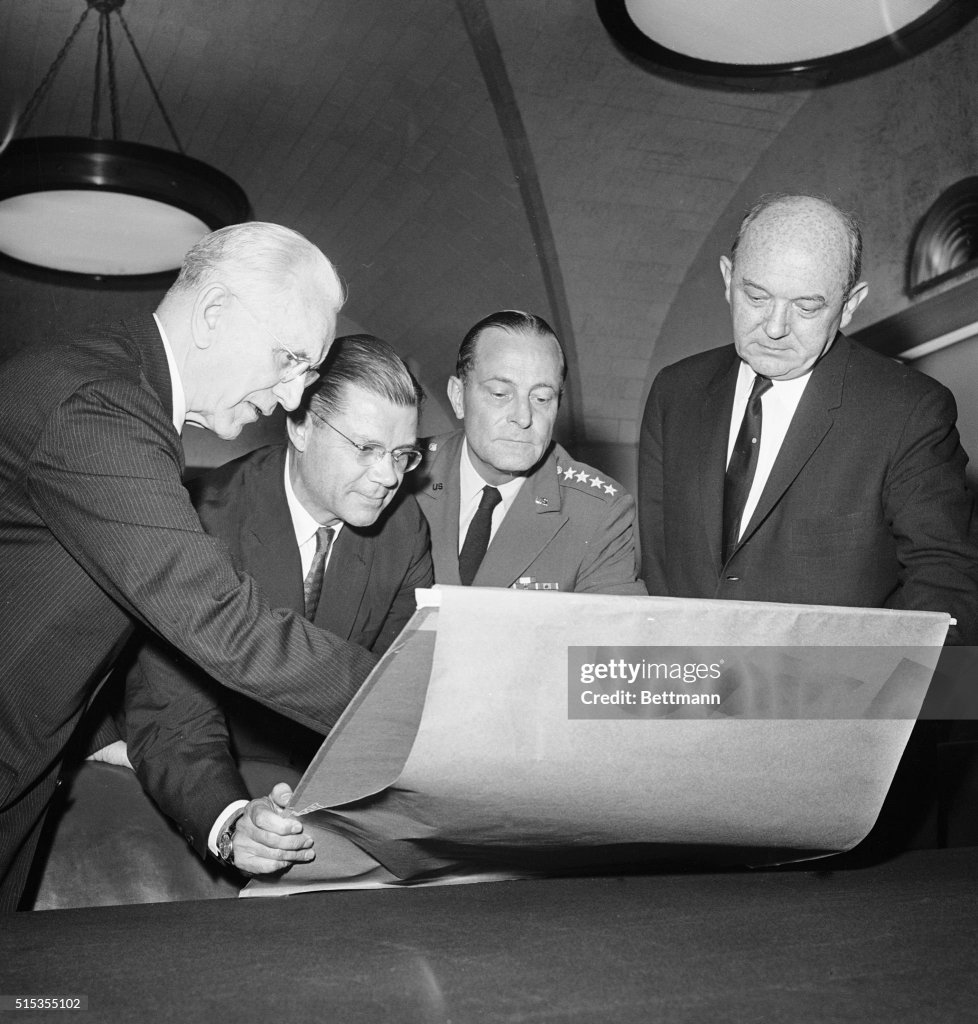
In another development affecting North Vietnam, the State Department denied as “without foundation” Hanoi’s (charge of two separate United States attacks on North Vietnamese territory. Hanoi said yesterday that United States planes based in Laos had attacked a North Vietnamese village near the Laotian frontier, and that American warships had shelled two North Vietnamese islands in the Gulf of Tonkin. Secretary of State Dean Rusk, Secretary of Defense Robert S. McNamara and Gen. Earle G. Wheeler, Chairman of the Joint Chiefs of Staff, briefed the combined Senate Foreign Relations and Armed Services Committees on the Maddox incident this afternoon. In addition to the committee members, those present included the Democratic and Republican leaders, Senators Mike Mansfield of Montana and Everett McKinley Dirksen of Illinois. The meeting was held at Mr. Rusk’s request. After the closed session, Mr. Rusk said, “We are determined to make full use of international waters and to take care of ourselves.” He said “it remains to be seen” whether this was just an isolated incident.
[Ed: This is, of course, false and misleading.]
Premier Nguyễn Khánh urged the United States tonight to take a firmer stand toward Asian Communists as a consequence of a North Vietnamese attack on the United States destroyer Maddox. The South Vietnamese Premier asserted that the United States must save face in Asia and demonstrate that it is not a “paper tiger,” as represented by the Communists. Major General Khánh said it was a. matter for the United States to decide what measures should be taken. The Premier made his remarks at a reception where he was questioned by newsmen about his views on a United States Navy announcement that three torpedo boats had made an unsuccessful attack yesterday on the Maddox in interna- tional waters of the Gulf of Tonkin off the North Vietnamese coast.
“You know President Johnson warned the Communists as a whole, including the North Vietnamese Communists, that they must leave other countries alone,” General Khánh said. “What is their answer? Look at the facts.” The Premier asserted that the incident showed the Communists were determined to dominate Southeast Asia. In declarations made in the latter part of July, General Khánh and his deputies advocated a “march to the North” as a response to North Vietnamese assistance to the Việt Cộng insurgents in South Vietnam.
Although Washington had warned Hanoi and . Peking of serious consequences if they did not desist from covert aggression in South Vietnam, General Maxwell D. Taylor, United States Ambassador in Saigon, told General Khánh privately July 23 that his demands for an expansion of war to include North Vietnam were contrary to present United States policy. The response of the Communist regime in Hanoi to Premier Khánh’s talk of a “march to the North,” and the earlier warnings by the United States, has been a propaganda campaign to rally the North Vietnamese population, for a more intensive effort in support of the pro‐Communist Việt Cộng rebels. Appeals are being made to rouse patriotic fervor and there has been a closer identification between the need to back the Việt Cộng and the defense of North Vietnam against possible United States attack.
Senator Barry Goldwater suggested today that the presence of a United States destroyer off North Vietnam might signify a change in the nation’s foreign policy along the lines of the stepped‐up military effort he has advocated. The Republican Presidential nominee, gave his views when asked for his reaction to the attack Sunday by North Vietnamese torpedo boats on the U.S.S. Maddox. Mr. Goldwater, who is vacationing in Newport Beach, California, replied: “I think the American people are entitled to ask some questions of their own in regard to this event: Does the presence of American destroyers in the area signify the possible landing of larger American ground forces? Does it mean medium bombers are going to be used to interdict supply lines? Does it mean a change is taking place in foreign policy at White House and State Department levels?” The Arizona Senator has repeatedly called for a more decisive military effort against the Communist forces of North Vietnam, including “interdiction” of supply lines by bombers.
Soviet Premier Khrushchev called today for an “early German peace settlement” as a major step toward elimination of tension between East and West. In a statement commemorating the first anniversary of the signing of the treaty forbidding some forms of nuclear tests, he said that without a German settlement it would be “difficult to approach” an agreement on general and complete disarmament. He called for a policy of “mutual example” as well as formal agreements and pledged that the Soviet Union would not fail the “noble cause” of bringing about a world peace that would benefit “all states, big and small.”
The Premier’s statement was in the form of an interview with the editorial boards of Pravda and Izvestia, the official newspapers of the Communist party and the Soviet Government respectively. The statement was made public tonight by Tass, the official press agency. The Premier declared that the treaty restricting nuclear tests had “enriched international life” and had built up a certain store of trust between nations. It is important “to keep this store” and to guard against letting it allow to run out, he said.
This was not the first time that Premier Khrushchev had placed a German peace settlement at the top of a list of measures that should be taken by the major powers to reduce tension. But today’s declaration, observers felt, took on special significance in view of the announcement in Bonn last week that agreement in principle had been reached on a meeting, at an as yet unspecified time, between Premier Khrushchev and the West German Chancellor, Ludwig Erhard.
Congolese rebel forces advanced to within 30 miles of Stanleyville today as the revolt in the eastern Congo continued to gain momentum. Reports reaching Leopoldville said rebels moving north from Maniema Province had attacked Congolese troops at Wanie Rukula, a town on the main road to Stanleyville. Wanie Rukula is the army’s last position south of Stanleyville, the Congo’s third‐largest city. It is manned by a company of the 15th Commando Battalion.
Meanwhile, there were unconfirmed reports that four more Europeans had been killed in Maniema. According to one version, the rebels who seized the town of Kalima last week killed two Belgian mining company officials, a Catholic priest and a fourth man who was unidentified. If true, this would bring to eight the number of Europeans killed in Maniema since the revolt broke out there last month. A Belgian contractor, his two sons and a priest were killed in Kindu about 10 days ago. The situation has also worsened in Kivu Province. Reports from Bukavu, capital of the province, said it was feared that the city might be attacked within days.
Followers of Alice Lenshina and the Lumpa sect attacked the town of Lundazi in Zambia and indiscriminately murdered residents they found on the streets, using hatchets, spears, arrows and gunfire. They then marched northward from Lundzi and attacked seven villages. At least 150 people were killed in the attack. Zambian troops and riot police counterattacked at the Lumpa village of Chipoma and killed 74 of the rebels, and Zambian President Kenneth Kaunda outlawed the Lumpa church. Lenshina would be captured, alive, on August 11.
The Central Committee of Soviet Communist Party issued decree number 655-268, directing Vladimir Chelomey of the OKB-52 bureau to proceed on building rockets for a manned landing on the Moon. The decree slowed the progress of the OKB-1 rocket design program headed by Sergei Korolev for a Soyuz lunar mission.
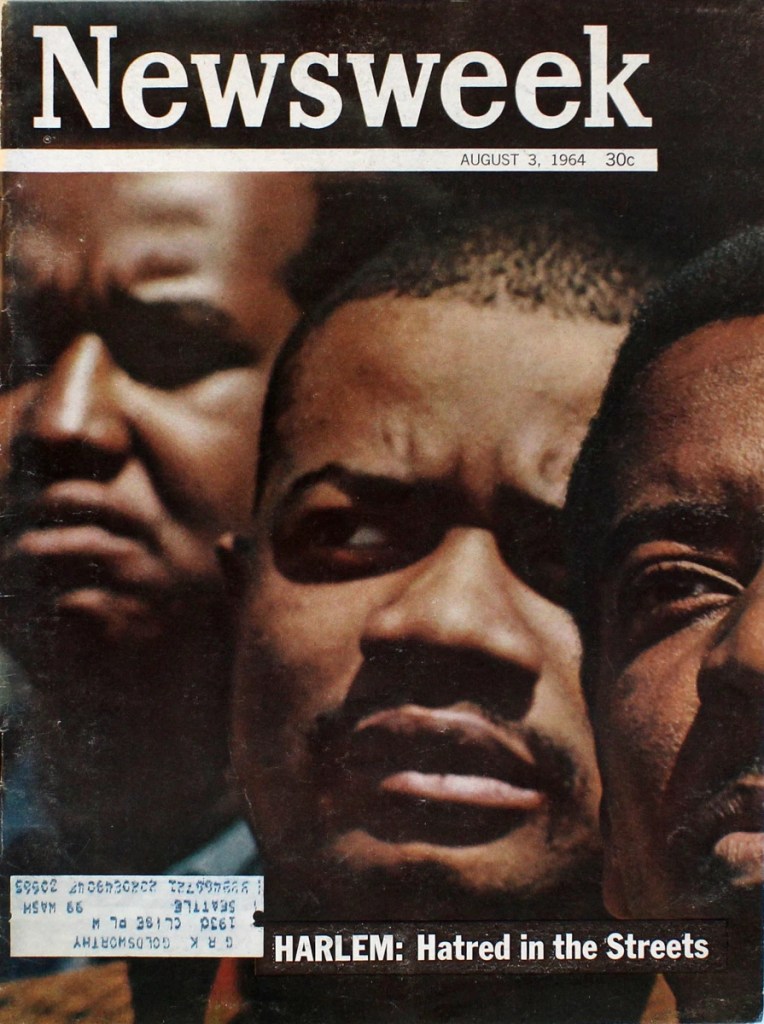
Blacks surged into the streets of Jersey City tonight for the second night in a row, hurling gasoline bombs, bricks and rocks in a running fight with the police. About 300 persons were involved. One homemade bomb destroyed a panel delivery truck; j the driver was not in it. Other bombs were tossed into streets. One band of youths tried to overturn a police car. Helmeted policemen, pouring into the city’s Black section, fired several hundred shots into the air. At 11 PM, Chief of Police Joseph L. Smith said marauding bands of Blacks were rioting “all over the city.” He said gangs had penetrated into white neighborhoods and the business districts. About 400 policemen, including men from Jersey City and from surrounding communties, were on riot duty.
Three buses were stoned at the intersection of Grand Street and Pacific Avenue. One driver, “ Ismael Romas, 36 years old, was dragged out of his bus and beaten, and a passenger, Frank Zelinski, 50, was hospitalized after rioters beat him. The police said two Blacks had been treated for gunshot wounds. One was a 17-year‐old youth shot in the left shoulder, the other a 24-year‐old man, shot in the left forearm. Half a dozen other persons, including a policeman with a fractured left ankle, were treated for injuries. At 1:30 Tuesday morning, Grand Street — the axis of the riot — was quiet. By 3 AM, 16 persons had been arrested.
The rioting broke out at about 8:30, just as Black leaders, clergymen and city officials met at City Hall to discuss Black grievances and ways to avert a repetition of Sunday’s rioting, in which 32 persons were injured. That meeting lasted only 26 minutes. As it broke up, Mayor Thomas J. Whelan said: “As far as I am concerned they [the Blacks] presented us no formal demands.” Later he said: “I will not permit a small group of agitators to intimidate us. One per cent of this city will not rule 99 per cent.”
Raymond Brown, president of the Jersey City branch of the National Association for the Advancement of Colored People,] said “nothing of value happened at the meeting.” And James Bell, head of the local Congress of Racial Equality chapter, said the Mayor was “going to solve the problem with a nightstick.” A white clergyman said merely, “I’m heartbroken.” Earlier, plans for a mass meeting were canceled and clergymen and Black leaders went through the area talking to teenagers in an attempt to reduce tensions.
Mayor Whelan, meanwhile, said the problem was not simple. He said that Jersey City, across the Hudson River from New York City, had been suffering in recent years from a shrinking of industry, a scattering of middle‐class residents to the suburbs and in influx of lower-income people into the city proper. The once‐affluent railroads used to provide, in taxes, onethird of the revenue needed to provide city services, the Mayor said; they now contribute 14 percent. A result, he said, is that the city cannot hope to renew and redevelop itself without Federal aid. And its ability to match 50-50 Federal grants is impaired because it now has a statutory borrowing capacity of only $9 million.
The first sign of trouble was in Ward F, the Black section. About 8:15 PM, the police began to receive reports that teenagers were throwing rocks at cars driven by white persons at Grand and Prior Streets there, scene of Sunday night’s riot. At about 8:30, a band of teenagers tried to overturn a police car passing the Lafayette Gardens housing project. Policemen armed with shotguns and pistols stood their ground at the intersection of Grand Street and Woodward Street as Blacks threw rocks and bombs at them. Several hundred shots were fired into the air and the crowds retreated into back alleys of the project. However, the youths regrouped and attacked the police again and again, coming out of the shadows in waves.
Later, the rioters split into smaller bands and spread out from Grand Street, which is on the east side of the area. At the Duncan housing project, for example, on the west side of the Black section, there was scattered looting of small shops and much window‐breaking and other vandalism. Street lights were shot out by the police so that the Blacks would have trouble spotting their targets. In portions of the city that were untouched by Sunday night’s rioting, groups of whites gathered on corners and in front of taverns to listen to sirens and to news on transistor radios. But late last night, they found that they, too, were in the riot zones. One car containing marauders who were throwing rocks at other cars was stopped a block from Police Headquarters. Sunday night’s riot included much looting of stores; last night’s resembled more a small military battle.
Representatives of a dozen civil rights groups meeting in Boston organized a committee today aimed at defeating Senator Barry Goldwater, the Republican candidate for President. Canon James P. Breeden, Episcopal adviser on civil rights, is chairman of the new committee. Speaking for the group, he accused “the men who have seized control of the Republican Party” of having “Contemptuously slapped the face of all citizens who have recently turned America toward the goal of equality for all.”
Democrats on Capitol Hill acknowledged privately today that the news from the South was grim and that Senator Barry Goldwater had a good chance of carrying several Southern states. Surveys published in the last two days have confirmed reports reaching the White House, of a deep and spreading disaffection in large areas of the South. One source said that LeRoy Collins, former Governor of Florida and now head of the Community Relations Service under the Civil Rights Act of 1964, had warned President Johnson that he was in danger of losing several Southern states because of resentment against the act. This was after Mr. Collins’s recent visit to several states in the South to talk with Governors about the new service.
A survey published by The Washington Post yesterday, based on reports from political correspondents in 11 Southern states, indicated that the Republican Presidential nominee had an excellent chance of carrying Mississippi, Alabama, Louisiana, and Florida. The survey listed Texas as “a toss‐up,” Virginia, South Carolina, and Tennessee as “leaning” toward Mr. Goldwater, and Arkansas, Georgia, and North Carolina as “most likely” to stick by President Johnson.
The American Federation of Labor and Congress of Industrial Organizations began an effort today to defeat Senator Barry Goldvvater of Arizona in November. The organization declared that the Republican platform merited “not mere rejection hut outright disdain” from the American labor movement. The attack on the Republican platform was made by the 27-member A.F.L.-C.I.O. Executive Council at the start of its quarterly meeting here. The vigor of the statement, which characterized the platform as “an insult to the intelligence of the voters,” indicated that the federation intends to make its most energetic foray into politics yet this fall in an effort to defeat Mr. Goldwater and elect President Johnson.
Lyman Frain, Sr., aged 80, became the oldest person to complete a transcontinental bicycle ride across the United States, arriving at the Golden Gate Bridge in San Francisco after a journey of 86 days and 3,244 miles. Frain had taken up the sport at the age of 72.
Milt Pappas shut out the Los Angeles Angels for the third time this season as the Baltimore Orioles pulled to within one percentage point of the American League lead by defeating the Angels, 7–0, tonight. The Orioles got to Bo Belinsky and his four successors for 13 hits and picked up their eighth victory in 10 meetings with the Angels this year. Brooks Robinson and Sam Bowens drove in two runs apiece. The victory put the Orioles one‐half game ahead of the idle New York Yankees but the Yanks retained first place by percentage, .624 to .623. Pappas pitched an eight-hitter, struck out five batters and walked one. He didn’t allow an Angel runner past second base. Belinsky allowed seven hits and four runs in five innings and suffered his seventh loss in 16 decisions.
Dick Howser and Vic Davalillo slammed three hits each in Cleveland’s 14-hit attack tonight and led the Indians to a 4–2 triumph over the Washington Senators. Dick Donovan gained his sixth victory with relief help: from Luis Tiant in the ninth. Cleveland broke a 2–2 tie in the fourth on Chico Salmon’s double, Davalillo’s infield single and Billy Moran’s sacrifice fly. Another run scored in the fifth on Howser’s single, a passed ball, an infield out and Joe Azcue’s single.
Bob Bailey slapped a run-producing single up the middle in the ninth inning to give the Pittsburgh Pirates a 3–2 victory over the San Francisco Giants tonight. The loss dropped the second-place Giants two games behind the league‐leading Philadelphia Phillies, who were rained out. Bill Mazeroski got the winning rally under way with one out in the ninth when he singled off Billy O’Dell. Dick Schofield followed with another single that moved Mazeroski to second. John Pregenzer replaced O’Dell on the mound. Pregenzer got Manny Mota to hit into a force out before Bailey delivered the deciding hit. Bailey had collected a key triple in the eighth inning when the Pirates, shut out on five singles for seven innings by Bob Bolin, struck for two runs and tied the score.
Dow Jones Industrial Average: 840.35 (-0.75).
Born:
Abhisit Vejjajiva [as Mark Abhisit Vejjajiva], English-born Prime Minister of Thailand (2008-2011), in Wallsend, Northumberland, England, United Kingdom.
Joan E. Higginbotham, American engineer and NASA astronaut (STS-116, Discovery, 2006), in Chicago, Illinois.
Kevin Elster, MLB shortstop (World Series Champions-Mets, 1986; New York Mets, New York Yankees, Philadelphia Phillies, Texas Rangers, Pittsburgh Pirates, Los Angeles Dodgers), in San Pedro, California.
Nate McMillan, NBA point guard and shooting guard (Seattle SuperSonics; NBA steals leader 1994) and head coach (Seattle SuperSonics, Portland Trailblazers, Indiana Pacers, Atlanta Hawks), in Raleigh, North Carolina.
Mark Lamb, NHL centre (NHL Champions, Stanley Cup-Oilers, 1990; Calgary Flames, Detroit Pistons, Edmonton Oilers, Ottawa Senators, Philadelphia Flyers, Montreal Canadiens), in Ponteix, Saskatchewan, Canada.
Johnny Thomas, NFL cornerback (Washington Redskins, San Diego Chargers, Cleveland Browns, Phildelphia Eagles), in Houston, Texas.
Lucky Dube, South African reggae musician, as Philip Lucky Dube in Ermelo (died 2007).
Zeljko Mejakic, convicted Bosnian Serb war criminal who operated the Omarska detention camp; in Prijedor, Yugoslavia.
Died:
Flannery O’Connor, 39, American novelist (“Good Man is Hard to Find”), of lupus.



 History Diaries