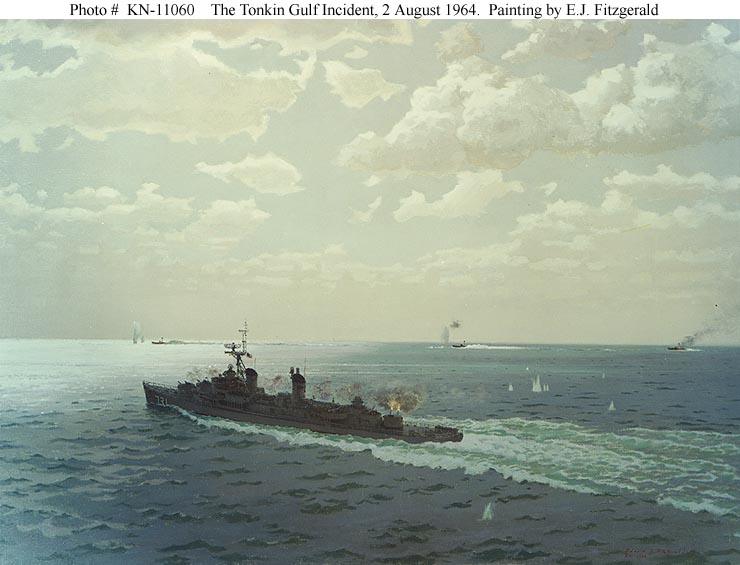
The Tonkin Gulf Incident begins, ultimately triggering massive U.S. escalation of the war in Vietnam.
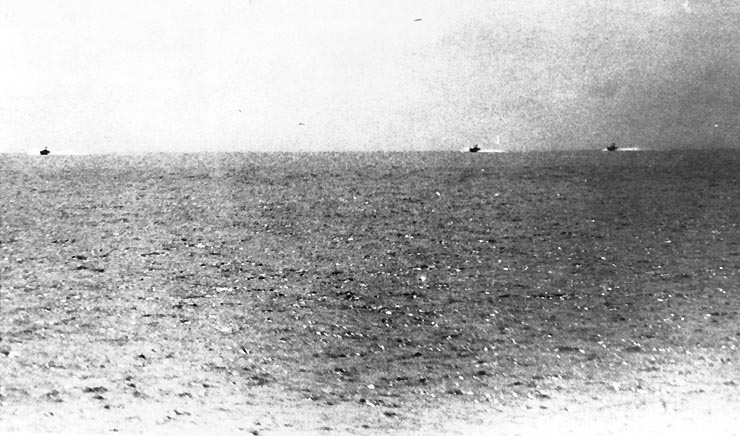
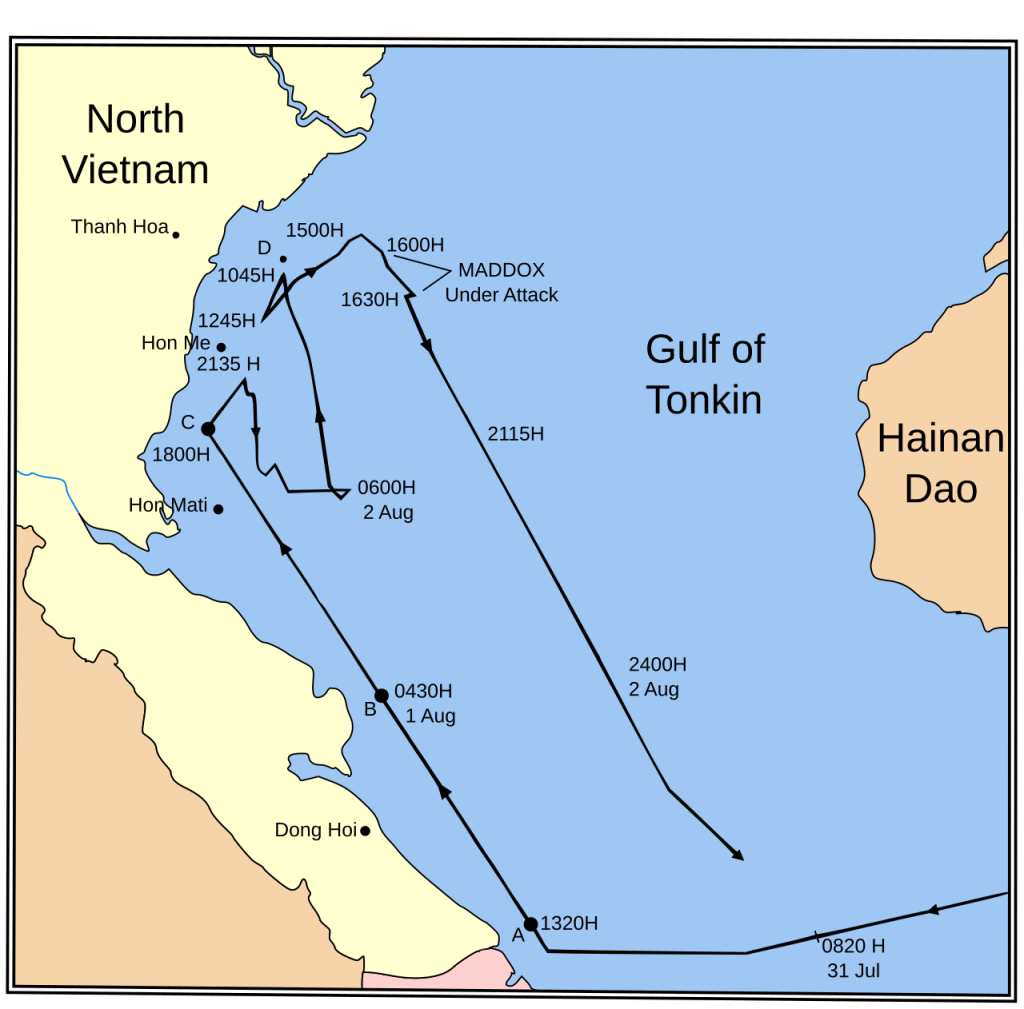
The USS Maddox (DD-731) has been cruising around the Tonkin Gulf monitoring the radio and radar signals following the attack by the South Vietnamese. U.S. crews interpret one North Vietnamese message as indicating they are preparing “military operations,’ which the Maddox’s Captain John Herrick assumes means some retaliatory attack; his superiors instruct him to remain in the area. Early in the afternoon, three North Vietnamese patrol boats begin to chase the Maddox. About 1500 hours, Captain Herrick orders his crew to commence firing as the craft come within 10,000 yards and he radios the U.S. aircraft carrier USS Ticonderoga for air support.
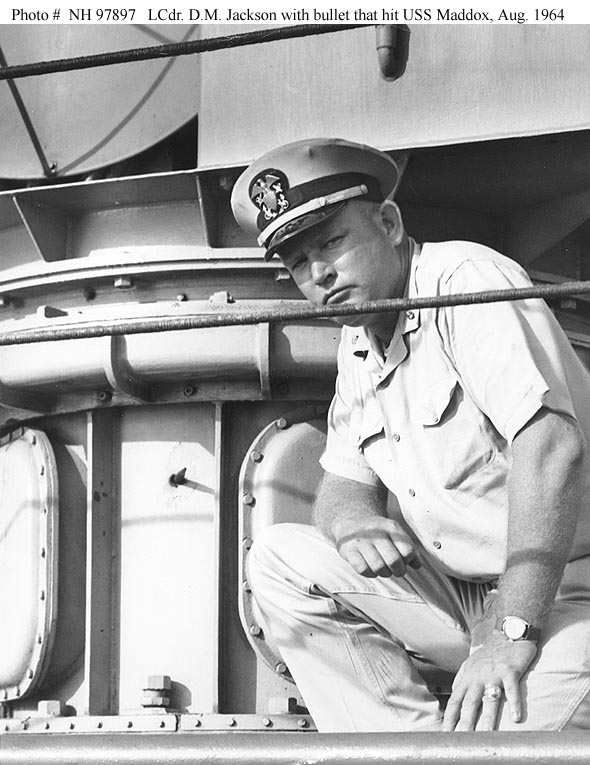
The Gulf of Tonkin incident took place when the destroyer USS Maddox engaged three North Vietnamese Navy torpedo boats of the 135th Torpedo Squadron, while performing a signals intelligence patrol as part of DESOTO operations. Accounts from both sides agreed that the North Vietnamese fired first, with Commander Nguyễn Văn Tú of T-336 giving the order to launch the first torpedo, followed by the T-339 and the T-333. According to the U.S. Navy, the Maddox evaded two torpedoes at 4:08 in the afternoon local time, and at 4:21 the Maddox and a third Viet boat exchanged gunfire. During the battle, the Maddox spent over 280 three-inch and five-inch shells, and in which four U. S. Navy F-8 Crusader jet fighter bombers strafed the torpedo boats. One American aircraft was damaged, one 14.5 mm round hit the destroyer, four North Vietnamese torpedo boats were damaged, and four North Vietnamese sailors were killed and six wounded.
The North Vietnamese boats each fire one torpedo at the Maddox but two miss and the third fails to explode. U.S. gunfire hits one of the craft, and then three U.S. Navy Crusader jets proceed to strafe them. After about 20 minutes, Maddox gunners have sunk one of the boats, and two are crippled; only one bullet has hit the Maddox and there are no U.S. casualties. The Maddox is ordered to withdraw and await further instructions.
Because of the time difference. President Johnson is informed of the incident in the morning of the 2nd. With a presidential campaign underway, he must appear firm yet restrained. He rejects any reprisals against North Vietnam and the Pentagon’s first press release doesn’t even refer to the North Vietnamese. In his first use of the ‘hot line’ to Russia, he tells Khrushchev that he has no need to extend the conflict; and in the first U.S. diplomatic note ever sent to Hanoi, he warns that ‘grave consequences would inevitably result from any further unprovoked offensive military action’ against U.S. ships ‘on the high seas.’
Despite President Johnson’s measured response, the U.S. military command takes several more critical actions. U.S. combat troops are placed on alert and additional fighter-bombers are sent to South Vietnam and Thailand; the carrier USS Constellation is ordered to the South China Sea to join the Ticonderoga; finally. Admiral Sharp, CINCPAC, orders a second destroyer, the USS Turner Joy to join the Maddox and to make daylight approaches to within eight miles of North Vietnam’s coast and four miles of its islands to ‘assert the right of freedom of the seas.’
Government officials said later that the attack was not regarded as a major crisis. They said the United States Seventh Fleet had been patrolling the area for some time would continue its patrols and had sufficient strength on hand. Admiral U. S. Grant Sharp Jr., Commander in Chief in the Pacific, was advised of the incident by radio as he flew back to his Pearl Harbor headquarters from a visit to South. Vietnam. The Defense Department statement on the attack, issued also by the Pacific Command, said that the boats were damaged by gunfire from the Maddox and the four carrier‐based jet aircraft. The statement said.
Senator Barry Goldwater received today a summary of the news of the attack on the destroyer Maddox off Vietnam. The briefing was given by Edward K. Nellor, the Republican Presidential candidate’s press secretary. Pending a more detailed report on the incident, there was no statement on Mr. Goldwater’s reaction.
Communist North Vietnam charged today that four United States fighter‐bombers flew in from Laos and attacked a border post and village with bombs and rockets. Hanoi said the attack yesterday wounded a villager and destroyed homes and property. A protest from the North Vitenamese Foreign Ministry accused the United States of a provocative act and said the Laotian Government “must bear heavy responsibility” for having allowed the United States to use its territory for the attack. The United States has sent T-28 fighter‐bombers to the Government of Prince Souvanna Phouma, the neutralist Premier of Laos, in its struggle against the pro‐Communist Pathet Lao. The propeller‐driven planes, piloted by Laotians, have been striking at Pathet Lao forces around the Plaine des Jarres in central Laos. The Hanoi protest, broadcast by the North Vietnamese press agency, did not describe the attacking planes other than to say they were United States fighter-bombers. United States Navy jets have been flying reconnaissance in the central Laos area. The United States says they are unarmed.
The area in which the Vietnamese say the fighter‐bombers struck is about 50 miles northeast of the Plaine des Jarres. The statement said the planes flew across the border from the direction of the Laotian village of Nong Het and attacked the border post of Nậm Cắn and a village it identified as Noọng Dẻ. The statement said the flag of North Vietnam was flying at the border post. It was the second North Vietnamese protest against the United States in two days. Yesterday the Vietnamese protested what they called an attack by United States and South Vietnamese warships on North Vietnamese islands last Thursday. The statement today said the village that came under attack was 12 miles inside North Vietnam.
“This constitutes a provocative act on the part of the United States Government and its henchmen that crudely violates the sovereignty and territory of the Democratic Republic of [North] Vietnam,” the statement said. “The Government of the Kingdom of Laos, which had solemnly declared to observe the policy of peace and neutrality, must bear heavy responsibility for having allowed the United States to use Laotian territory to encroach on the Democratic Republic of [North] Vietnam.” The statement demanded that Laos immediately cease “letting the United States Government and its lackeys use Laotion territory as a springboard” to provoke North Vietnam.
Communist China made it clear today that it did not want the Soviet Union to carry out its threat to withdraw as co-chairman of the 1962 conference on Laos. In a note to Moscow, Peking expressed support for the Soviet Union’s renewed call for another 14-nation meeting on Laos. Peking said that any Soviet decision on the 1962 co-chairmanship should await discussion at a new conference. The Soviet Union shared the 1962 chairmanship with Britain. The two countries have maintained special responsibilities under the agreements reached in Geneva to neutralize and assure the Government ot Laos. The Chinese note, quoted by Hsinhua, the Chinese Communist press agency, was in reply to the Soviet proposal of July 25.
In its proposal for a new meeting, the Soviet Union warned that it would have to re‐examine its role as co‐chairman if the United States and other Western powers continued to block the convening of the conference. Last week, after a visit to Moscow by R. A. Butler, the British Foreign Secretary, the Soviet Union was reported to have agreed to defer a final decision on withdrawing as co-chairman. The Peking statement said the Soviet Government had “rightly condemned the United States imperialists’ violations of the Geneva agreements and their acts of interference in the internal affairs of Laos.” The statement went on to say that Peking “expresses its approval of and support for” the Soviet bid for a new conference this month.
Gunfire crackled again this morning in region of the Kyrenia Mountain, north of Nicosia, the scene yesterday of what a United Nations spokesman called the biggest exchange of shooting in months. The spokesman said there had been a “considerable increase in shooting incidents throughout the island in the last few days.” He said a Turkish Cypriot, wounded in the firing in the Kyrenia Mountains last night, was reported to have died. St. Hilarion Castle, a ruin above the water from Nicosia north to the port of Kyrenia, was again the scene of shooting, as were the Temblos and Krini areas. The United Nations spokesman said a “rather heavy convoy movement” was observed leaving the Limassol area last night but he had no details because United Nations patrols have been withdrawn from the Limassol dock area.
Michel Struelens, former director of the Katanga Information Service in New York, will serve as the personal representative for Premier Moïse Tshombe of the Congo in his dealings with the United States Government. Informed sources said today that Mr. Struelens, a Belgian who now lives in Canada, had been named as adviser to the Congolese Embassy in Washington and to the Congolese delegation to the United Nations. However, he is expected to be more than an adviser. He will hold the title of Special Assistant on Foreign Affairs to Mr. Tshombe and observers here believe he will perform some of the functions normally performed by an ambassador.
Dutch government gives Indonesia export guarantees.
A race riot occurs in Jersey City, New Jersey. Scores of Blacks rioted tonight and early Monday, hurling debris, looting stores and shouting at the police. At least 30 persons, including 10 policemen, were injured. Three of those hurt were white persons whose car was stopped by a mob. All of the city’s 150 available policemen were sent to the scene, in the predominantly Black Lafayette section. The police said that about 500 Blacks were concentrated in several spots in the area at the height of the rioting but that many of them were only onlookers. Observers said 200 people, most of them young toughs, made up the core of the rioters. The trouble, which started shortly after 8 PM, was generally under control at 1 o’clock Monday morning.
The trouble began when Miss Dolores Shannon, 26 years old, a Black, was arrested on a disorderly conduct charge. The police said she was drunk and had been shouting and screaming. As they took her into custody, a man identified as Walker Mays was said to have interfered. He, too, was arrested on a disorderly conduct charge. Both were taken to the Fourth Precinct station house at Communipaw Avenue. Soon afterward, about 40 Blacks marched on the station house, chanting charges of police brutality.
The crowd left about a half an hour later. But at about 10 PM, the crowd re‐formed, its numbers swelled, at the scene of the arrests, Priore and Grand Streets, at the Lafayette Gardens city housing project. One hundred policemen were sent to the corner. The policemen, wearing helmets, faced the Blacks, who were shouting epithets and curses. “We”re ready for you,” the crowd shouted. “Come on! Come on!” Garbage can covers, bricks and bottles began to shower down on the police, who moved in to disperse the crowd with their nightsticks.
The police succeeded in clear- ing the intersection, but not before an angry mob of 50 Blacks had swarmed around a passing car driven by a white woman, stopped it, broken its windows and beaten its three occupants. Mrs. Dorothy Hudak of 43 Monitor Street was returning home with her daughter Dorothy, 13, and her son John, 22, when their car was intercepted. They were rescued by the police and sent to Jersey City Medical Center. Soon after the crowd was dispersed, sporadic looting began. Gangs of youths started ransacking stores throughout the 10-block Black district, which is adjacent to downtown Jersey City.
A sound truck manned by members of the National Association for the Advancement of Colored People cruised the streets with its loudspeaker blaring, “Please Go Home, Please Go Home.” On the sidewalks, groups of Blacks chanted back, “No, you go.” At least once, policemen fired several shots into the air. Five demonstrators were taken to the hospital for treatment of Uralses from police clubs. The police said those taken to the hospital would be arrested.
New York Governor Nelson Rockefeller tonight ordered the withdrawal of all National Guard units from Rochester, and convoys of guardsmen slowly began winding their way home. More than 1,200 officers and men had been on standby duty for a week to prevent new outbreaks of racial violence, which erupted here 10 days ago and resulted in four deaths. The guardsmen learned of Governor Rockefeller’s decision shortly after 9 o’clock tonight, and immediately began dismantling pup tents and assembling their gear. Though the troops’ morale was generally high, they cheered. Many headed for telephones to notify their families. The governor’s statement, issued in Albany, noted that there had been seven consecutive days of law and order here. It said that the move had been made “with the consent of local and county authorities.”
It added that the governor had acted “after reviewing the steps being taken by local authorities to protect the citizens of Rochester after state forces are withdrawn.” Local officials said that the 300 state policemen on duty here would remain available. It was understood that state and local officials would meet today to discuss how long the troopers might be needed. Beginning at tommorow morning at 4 AM, the city’s police force will resume its regular eight‐hour shifts and regular days off. However, leaves and furloughs remain canceled. The guardsmen, who came here from eight neighboring communities, were never called into action. But their presence and their shows of force — touring the city with fixed bayonets — helped to bring relative quiet to the troubled city.
President Johnson’s key foreign and domestic programs face crucial tests this week as Congress pushes toward adjournment. Foreign aid will be debated in the Senate. The antipoverty bill is scheduled for House action. Both bills face strong opposition. The fate of other Administration bills will be on the line this week. A decision is expected on whether to push for a program of medical care for the aged under Social Security. Clearance will be sought for the House to debate extending the area redevelopment program, which was once given up for dead.
The House debate over the Administration’s $962.5 million antipoverty bill is expected to be one of the major legislative battles of the year. The Senate passed an almost identical bill by nearly 2 to 1 last month after cutting out $15 million in funds and eliminating several farm programs. In the House, however, the antipoverty bill has become caught up in far more partisan politics. Republicans, almost solidly opposed to the bill, have charged that it is nothing more than an election‐year bid for votes by the President. The Administration’s one hope of pushing the measure through the House now. rests on adequate support from Southern Democrats, most of whom normally are fiscal conservatives.
“We’re going to pass the bill,” Representative Hale Boggs of Lousiana, the assistant Democratic leader, said today. “We’ve got the votes.” But some Administration sources were less certain of victory. They said it would be necessary to recruit 65 to 70 votes from the ranks of either the 94 Southern Democrats or the 178 Republicans. Administration efforts to round up support from Southern Democrats and Liberal Republicans is reminiscent of the close contest over expanding the House Rules Committee membership in January, 1961, just after President Kennedy took office. The Administration won that fight, 217 to 212, but the outcome was in doubt until the vote was counted.
Eight clergymen who came to Tallahassee, Florida in 1961 on a bus to protest racial segregation flew back tonight to start serving 60-day jail terms imposed as a result of that earlier visit. The eight were among 10 convicted in 1961 of unlawful assembly after they had been arrested during a sit‐in at a restaurant at the municipal airport. Appeals of their sentences of $500 fines or six months in jail were taken to the Supreme Court but failed. They said they would serve the jail terms instead of paying the fines as a “moral obligation to all of those involved in the civil rights struggle.” They were ordered back to Tallahassee by officials who said their appeals had run out and it was time for them to either pay their fines or start serving their jail terms.
They said they had returned out of respect for the law and to honor the commitment of their bail bondsman, so as not to jeopardize the chance of others to obtain bonds. The clergymen said they hoped the city would comply with the new Civil Rights Law. “We hope the attention focused by our re‐imprisonment will find creative ways of completing successfully the civil rights struggle,” they declared. Howard Dixon of Miami, attorney for the clergymen, said he would go to United States District Court Judge G. Harrold Carswell tomorrow to seek a release of the ministers. He said he would seek a hearing date immediately. “Meanwhile,” he said, “they will be in jail.”
The success of Ranger 7 will lead to concentration on the Project Surveyor “soft” lunar landing, a space agency official said today. The official said a number of top‐grade engineers would be transferred from the Ranger to the Surveyor program to capitalize on their experience. He indicated that other measures were also in the offing to assure that the late 1965 date for the first test flight would not have to be put off, as it has been several times already. A landing is not a primary goal of the first launching. But the unmanned spacecraft will be fully equipped to try it if everything works in the initial stages of flight.
Preparations are going ahead full tilt for vital tests early this fall in which the difficult soft lunar landing will be simulated in a 1,500-foot drop from a balloon over the White Sands, New Mexico, proving area. The eventual landing on the moon will have to be as gentle as a parachute landing on earth. But since the moon has no appreciable atmosphere, the landing cannot be made with parachutes. It will have to be done with reverse‐thrust braking rockets automatically receiving precise instructions from sensitive radar on board. Such a trick has never been performed on earth. It will be enormously more difficult 240,000 miles away.
The wreckage of a plane piloted by popular singer Jim Reeves was found near Brentwood, Tennessee, 42 hours after it crashed. Reeves’ body had been thrown from the aircraft, while the body of his manager, Dean Manuel, was found inside the plane.
Two world swimming records were broken on the final day of the Amateur Athletic Union’s national championships in Los Altos, California, in a meet where 10 new world bests had been set. Murray Rose of Australia swam the men’s 1,500-meter freestyle in 17 minutes, 1.8 seconds, and 15-year old Shaon Stouder set a new mark for the women’s 200-meter butterfly at 2 minutes, 26.4 seconds.
The 1964 German Grand Prix was won by John Surtees.
Detroit pitcher Larry Sherry suffers a fractured left foot when struck by a liner off the bat of Leon Wagner in Cleveland’s doubleheader sweep, 6–1 and 2–1. Sherry is out for rest of the year. The Cleveland Indians completed a sweep of a double‐header today with the Detroit Tigers by scoring a 2–1 victory in 11 innings. The game was won when Larry Brown pinch‐hit a “single” that wound up as a force play at second base. The Indians won the opener, 6–1, as Sam McDowell pitched a four‐hitter.
Jim Bouton limited the Minnesota Twins’ power game to two singles and a double and pitched his second straight shutout today as the New York Yankees defeated the Twins, 3–0. It was the third time since the Yankees left home 10 days ago that the 25-year‐old New Jerseyan had pitched a complete game, the third time he had won and the third time he had kept the other team from hitting any home runs. The Yankees and Twins had totaled 259 home runs this season, but only one was hit today — a 410-foot shot over the centerfield fence by Hector Lopez in the seventh inning.
Jim Landis’s two‐run single in the sixth inning gave the Chicago White Sox a 3–1 victory over the Washington Senators today to complete a sweep of a double‐header and a four-game series. The White Sox won the opener, 2–1, on bloop singles by Gerry McNertney and Moose Skowron. Joel Horlen and two successors checked the Senators on four hits. The victories moved the White Sox within a half‐game of the league‐leading New York Yankees.
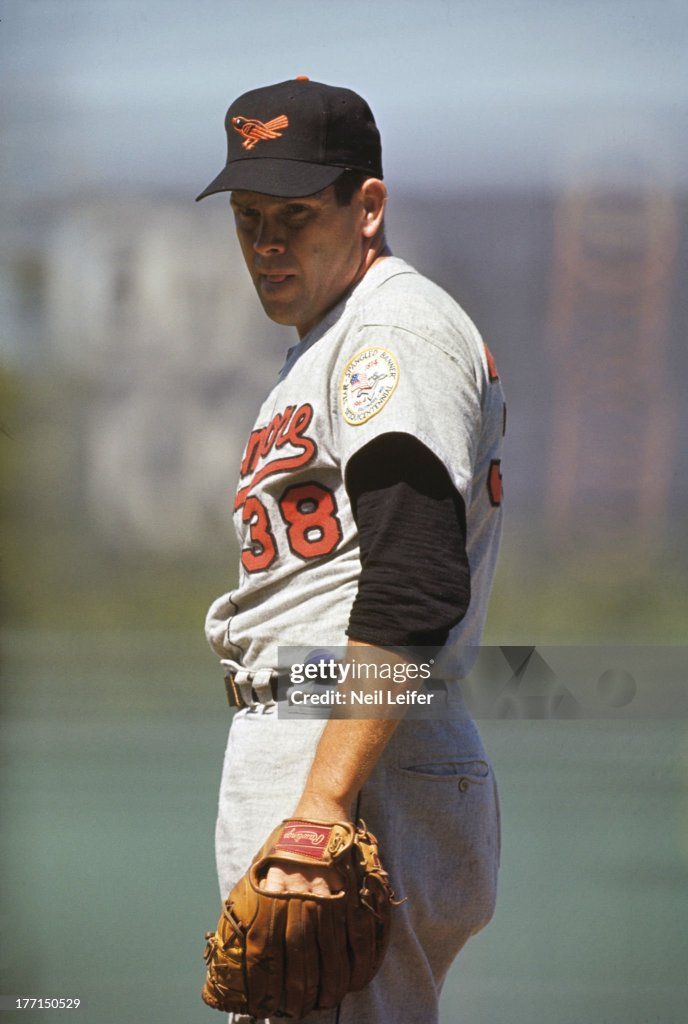
In Baltimore’s 8–7 win over Kansas City, Brooks Robinson hits a ball that strikes the left field pole at Kansas City and it is ruled in play by John Rice. Brooks is thrown out at third base. Later Rice admits he made a mistake.
Bob Rodgers’s run‐producing single in the ninth inning off Dick Radatz gave the Los Angeles Angels a 2-1 victory today over the Boston Red Sox. Radatz, making his 55th appearance, took over in the eighth. He got into trouble in the ninth when Jim Fregosi walked with one out. Willie Smith flied out but Joe Adcock singled and Rodgers followed with his deciding hit.
Duke Snider singled to drive in Chuck Hiller with the tie-breaking run in the eighth inning and gave the San Francisco Giants a 2–1 victory over the Pittsburgh Pirates today. The victory moved the Giants to within 1½ games of the firstplace Philadelphia Phillies, who lost, 6–1, to the Los Angeles Dodgers. Snider got his hit off Bob Friend with two out after Hiller, batting for John Pregenzer, had reached first on a fielder’s choice and advanced to second on an infield out.
Maury Wills hit a double and single, stole two bases and started two double plays today to lead the Los Angeles Dodgers to a 6–1 victory over the National League leading Philadelphia Phillies. Wills, who extended his consecutive game hitting streak to 12, has made eight hits in 13 trips to the plate in the first three games of the four‐game series. Larry Miller, a left‐hander, checked the Phillies on seven hits and raised his won‐lost record to 2–2.
Born:
Mary-Louise Parker, American stage, television and film actress (“Fried Green Tomatoes”, “Weeds”); in Fort Jackson, South Carolina.
John Cullen, Canadian NHL centre (NHL All-Star, 1991, 1992; Pittsburgh Penguins, Hartford Whalers, Toronto Mapple Leafs, Tampa Bay Lightning), in Puslinch, Ontario, Canada.
Cliff Young, MLB pitcher (California Angels, Cleveland Indians), in Willis, Texas (d. 1993, in a single-vehicle highway crash).
Sebron Spivey, NFL wide receiver (Dallas Cowboys), in Youngstown, Ohio.
Died:
Jack Kirkwood, 69, Scottish actor (“Fibber McGee & Molly”).
José María Castro, 71, Argentine composer.

 History Diaries