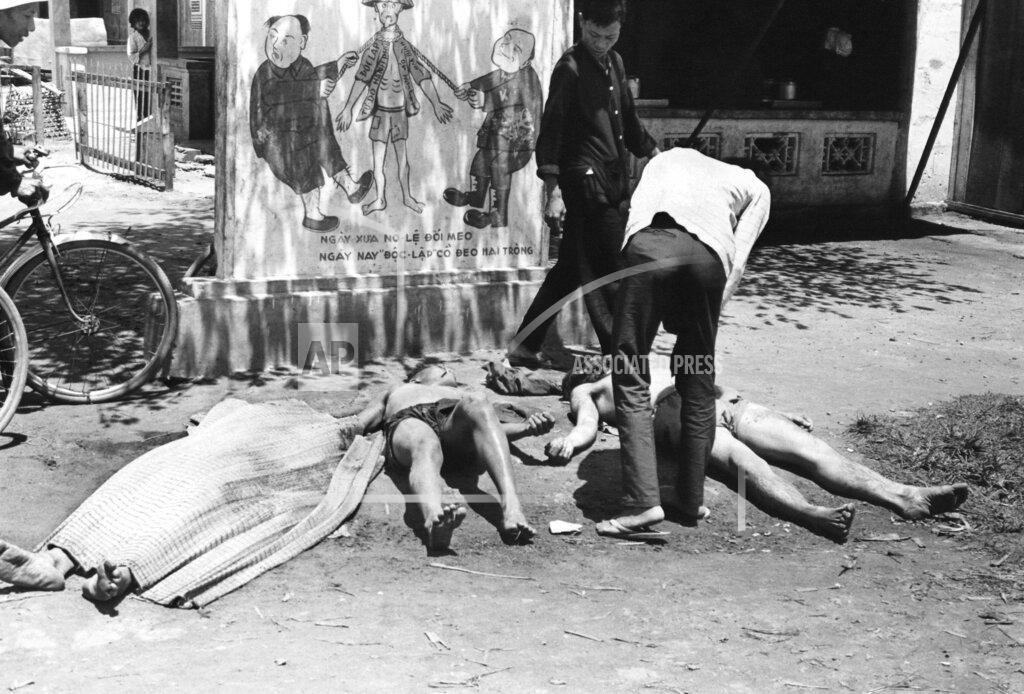
A Communist battalion struck today at the village of Vĩnh Lộc, only four miles west of Saigon. The Việt Cộng’s assault on Vĩnh Lộc followed several days in which the insurgents distributed leaflets warning that they would strike. Casualties were light, and the Việt Cộng abandoned the fight at daybreak. But the attack was considered significant because of its proximity to the capital. Only ricefields separate the village from Saigon’s busy airport. The insurgents were as close to Saigon as they could have come without entering the suburbs. At the airport American servicemen said that buildings had shaken under a Communist mortar barrage and that tracer bullets had streaked through the sky. As Saigon listened to the roar, residents feared an attempt was being made to overthrow Premier Nguyễn Khánh.
Việt Cộng units struck from the west and the south. Their mortar shells and recoillessrifle fire smashed a small Civil Guard outpost, and one Civil Guardsman was killed and three were wounded. Bullets flying around civilian houses wounded three other persons. Three Việt Cộng bodies were seen in the village marketplace. A Việt Cộng battalion usually numbers about 500 men.
The North Vietnamese government accuses the United States and South Vietnam of having authorized the raids on the two islands in the Tonkin Gulf.
A bomb explodes in a Saigon bar, wounding 5 U.S. servicemen and 18 South Vietnamese. In the terrorist bombing, at Saigon’s Shadows Bar, one of the Americans and three Vietnamese were critically wounded. Fifteen other Vietnamese were injured. Demolition men estimated that the bomb had been filled with about 25 pounds of a high explosive. The police said they had captured one of two men believed to have thrown it into the rear of the bar. Both were described as Việt Cộng agents. The bar is on the main road leading to the airport.
The United States let South Vietnam reveal this week — and then quietly confirmed — that more American troops would soon be sent to help manage the antiguerrilla war. “More” was eventually defined as about 5,000 men to augment a force of more than 16,000. “Soon” was explained to mean three to six months. Most important, the move was officially described where as “more of the same” — that is to say, the troops will lead, guide and advise the South Vietnamese inside the borders of South Vietnam; they will not themselves be formally committed to combat or be used to mount a direct attack against Communist North Vietnam.
From all sides there immediately came the question, why the sudden need for a build‐up. Taking account of the Administration’s explanations, the question might well be rephrased to ask, why the sudden announcement of a gradual build‐up? The answer is complicated, and includes both military reasons — the lack of progress in the war, for one — and political ones, both in Washington, and in Saigon.
Thai pilots, flying U.S. T-28s from their base in Laos, bomb and strafe North Vietnamese villages near the Laotian border today and tomorrow. Souvanna Phouma will deny this on the 7th as part of the policy to deny any aspect of the covert operations.
The British Government has asked members of the International Control Commission on Laos to try to arrange a conference of the three Laotian factions on neutral territory. The British request was made by Foreign Secretary R. A. Butler after he had failed in talks with Premier Khrushchev and Foreign Minister Andrei A. Gromyko to budge the Soviet Government from, its insistence on an immediate, unconditional 14,-power conference on the Laotian problem. Mr. Butler ended a five‐day visit today and flew back to London.
Before his departure he said at a news conference that he had asked the Governments of India and Canada for help in arranging a conference of the three Laotian factions, the neutralists, rightists and pro‐Communists. It was not clear whether a similar request had gone to Poland, the third member of the Control Commission. Mr. Gromyko rejected yesterday a suggestion from Mr. Butler that Britain and the Soviet Union help the three Laotian factions in arranging a meeting on neutral ground. The suggestion was made after the Foreign Secretary had received a message from Premier Souvanna Phouma asking the two Governments to help in arranging such a conference.
The Russians also rejected Mr. Butler’s position that a 14power conference should be called only after the situation in Laos had been stabilized by the restoration of an effective coalition regime, a cease‐fire and the withdrawal of the proCommunist forces to the positions they held before their spring offensive. When this proved “unacceptable” to the Soviet leaders, Mr. Butler decided to “make one more effort” and turn to the members of the International Control Commission. He said he had expressed to Mr. Khrushchev and Mr. Gromyko the hope that the Soviet Union would not carry out the threat it made a week ago to give up its role as co‐chairman, with Britain, of the 1954 Geneva conference on Indochina and the 1962 conference on Laos. The two chairmen have maintained special responsibilities under the agreements.
Greek and Turkish Cypriots waged a sporadic daylong gunbattle today in the mountains of northwestern Cyprus near Kyrenia, the United Nations force reported. The battle broke out after the commander of the peace‐keeping force sent a protest to the United Nation Secretary General, U Thant, charging the Greek Cypriots with raising obstacles to the peace‐keeping efforts and asking a Security Council crackdown on them. Reports from the battle scene east of the strategic highway linking Kyrenia to Nicosia said a large amount of fire was exchanged. United Nation spokes- man said there were no reports of casualties. A British helicopter was endangered by ground fire. The spokesman said Greek Cypriots fired warning shots close to the craft when it flew, over the battle area and sent a radio message warning the pilot to leave. It withdrew.
In another incident, the United Nation force said Greek Cypriots stopped a unit of Canadian vehicles and demanded that they submit to a search. The Canadians refused, an argument followed and they were allowed to pass unsearched. The Greek Cypriot‐dominated Government published an official statement accusing Turkish Cypriots of opening fire with automatic weapons and hand grenades yesterday in a major communal clash. There was no United Nations confirmation of the battle reported by the Greek Cypriots. They said it began near Mansoura when four armed Turkish Cypriots were intercepted by Greek Cypriot security forces at Livadhi, in northwestern Cyprus. The Greek Cypriots have repeatedly charged that Mansoura is used by the Turkish community to smuggle arms onto the island. A Canadian soldier in the United Nations force was killed and another injured when their armored car hit a soft shoulder and overturned close to Kyrenia.
The United Nations Secretary General, U Thant, indicated today that the Soviet Union would walk out of the General Assembly in November if it was deprived of its vote for refusal to pay assessments for peace‐keeping operations. Mr. Thant, who returned last night from a tour that included talks in Paris and Moscow on this question, called the situation “very critical” for the United Nations. Asked by reporters whether: he was referring to the political or the financial situation, he said the remark applied to both. On the political side, he said that neither France nor the Soviet Union had given any indication of possible willingness to relax their contention that they were not liable to pay for operations of which they had not approved.
According to reliable sources, Mr. Thant was told in Moscow that loss of the vote would result in a walkout from the Assembly, and possibly from the world organization. The United States has been maintaining pressure for application of Article 19 of the Charter, which would require the withdrawal of the votes of France and the Soviet Union.
When Mr. Thant conferred with President de Gaulle July 21, he was told that France still felt that the peace‐keeping forces were beyond the powers conferred by the Charter. General de Gaulle indicated, however, that his Government wanted to participate more fully in United Nation’s activities. On Mr. Thant’s arrival last night at Kennedy International Airport after a 17-day trip, he said he had not atempted to infunence the French and Soviet leaders to change their views because he did not consider that to be proper. He said he had presented the case as he saw it — “that the financial situation of the world organization is critical.”
With the acceptance by voters of a new constitution, the former Belgian Congo officially changed its name from the “Republic of the Congo” to the “Democratic Republic of the Congo”. Since 1960, both the former French Congo and the former Belgian Congo had referred to themselves as “Republic of the Congo”, and had been distinguished as “Congo-Brazzaville” and “Congo-Léopoldville”, respectively.
Democratic Republic of the Congo Premier Moïse Tshombe presented today what he called “incontrovertible proof” of Communist and African support for the spreading revolts in the Congo. He showed newsmen and diplomats weapons, training manuals and propaganda that he said were seized yesterday by the Congolese Army when it retook the village of Bolobo, 180 miles north of Léopoldville. The alleged haul also included many personal effects and documents apparently belonging to Colonel Vital Pakassa, chief of staff of the “revolutionary forces.” Colonel Pakassa is reported to have led the rebel group which crossed the Congo River last week from the Congo Republic, the former French Congo, and seized Bolobo. He is now believed to have fled back across the river.
With Soviet and Egyptian help, socialist Algeria’s National People’s Army is slowly transforming itself from a heterogenous guerrilla force into one of Africa’s stronger armies. The army’s Political Commissariat, in a brochure published today, emphasized that the army must “achieve, cost what it may, its own modernization.” This is the prime concern of Colonel Houari Boumedienne, Algeria’s controversial Vice President and Defense Minister. He views the future of Algeria’s “socialist revolution” and her influence in Africa as linked to a strong army and a domestic arms industry. According to Algerian sources, part of the current push for a bigger, better army arose from the shock of its mauling by the better staffed, better equipped and better trained Royal Moroccan Army during last October’s border conflict. In April an Algerian‐Moroccan prisoner‐of-war exchange provided a clue: 375 Algerians were exchanged for 52 Moroccans. Colonel Boumedienne wants no repeat of such a performance.
Emancipation Day was first celebrated in Barbados, Bermuda, Guyana, St. Vincent and the Grenadines, Trinidad and Tobago, Turks and Caicos Islands, and Jamaica — as a celebration of the end of slavery during the British colonial era in the Caribbean.
Senator J. W. Fulbright, chairman of the Senate Foreign Relations Committee, warned the Senate today that reductions in the Administration’s $3.5 billion foreign aid bill would undermine the program as an instrument of policy. Senator Fulbright’s speech today opened what is expected to be a week of debate on the foreign aid authorization bill. Earlier this year the House of Representatives passed an authorization bill that precisely followed the recommendations made by President Johnson. Later, however, it cut that figure by $200 million in appropriating the funds to finance the program. “In proportion to the nation’s growing resources, this year’s request is the smallest burden since foreign aid began,” Senator Fulbright said.
The request for funds for the program, which the Foreign Relations Committee reduced by only $50 million from the original White House request, represents only 4 percent of the Federal budget and six‐tenths of 1 percent of the nation’s total output, the Senator said. In 1949 the comparable figures were 11½ percent and 2 percent. The foreign aid program has become “a normal instrument of American foreign policy,” like diplomacy or military power, Senator Fulbright said. He argued that foreign aid must, therefore, “be judged by the political criterion of whether it does or does not contribute to the security of the United States.”
“I think it is clear beyond any doubt that it has contributed to our national security,” the Senator said, continuing: “In the context of the cold war, the objective of our aid programs is not to help build stable and viable nations which will be profusely grateful to the United States, never annoy or displease us and follow us loyally on all international questions. If these were our objectives, a more effective program would be training and equipment of mass armies of occupation. Ingratitude is disagreeable but not dangerous, and slavish compliance is a characteristic for which a free society has no use, either in itself or in its associates.”
Senator Fulbright said that he simply did not understand “why it is that our fears of extravagance and waste are so overwhelmingly focused on foreign aid rather than on other, more costly programs.” He noted that last year the Senate spent three weeks in “rancorous debate” on a $3.6 billion foreign aid bill “and immediately thereafter approved a space budget of over $5 billion with only perfunctory debate.”
“There is relatively little to be wasted in the foreign aid program,” he said. “American economic and military assistance, once quite diffuse, has become highly concentrated. Seventeen nations which once received economic assistance from the United States no longer receive it and another 14 countries are approaching the point where they will no longer need” grants or special easyterm loans, the Senator said.
Space scientists told President Johnson today that photographs sent by Ranger 7 demonstrated that selected lunar areas were suitable for manned landings. The pictures of an area designated for a future landing showed most of the terrain to be hard and free of any thick layer of dust, the scientists said. Mr. Johnson, obviously elated over the success of the moon rocket and its photographic gear, received this information this morning at a public briefing in the Cabinet Room, He turned the occasion into a resounding endorsement of the moon‐landing project and a justification of the American space effort.
“Are you satisfied with the return on that investment?” Mr. Johnson asked Dr. Homer Newell Jr., an assistant administrator of the National Aeronautics and Space Administration. Dr. Newell said he was “delighted.” “Elated?” Mr. Johnson prompted. “Elated,” Dr. Newell said. Did the Ranger 7 “adventure,” the President wanted to know, leave doubt about the desirability of going to the moon? “Not in my mind, not at all,” Dr. Newell replied. “I would feel that we were backing down from a real challenge, the kind we’ve never backed down from before.”
Mr. Johnson’s leading questions and the answers to them appeared doubly satisfactory to him. They not only provided a counterweight to critics of the program, but they also provided some justification of Mr. Johnson’s role in it. Before becoming Vice President, he was chairman of the Senate Space Committee. As Vice President, he was chairman of the National Aeronautics and Space Council. In both posts, he was one of the architects of the present space program and in private conversations has asserted that he was responsible for persuading President Kennedy to start Project Apollo.
Officials of Project Apollo are due in Pasadena, California Monday for a firsthand briefing from astronomers, on the historic Ranger 7 pictures. The lunar pictures, taken yesterday, have removed much doubt about the adequacy of; the Apollo Project plans for a manned landing on the moon. The directors of the space program were elated by strong evidence that the lunar seas, or maria, were generally level enough for a safe landing by the two‐man craft now being built for the mission. Initial indications that the lunar surface was strong enough to support the 15,000-pound landing craft also elated them.
There had been fear in some quarters that the layer of dust or other material on the moon’s surface might be so thick that the landing craft, as now designed, would sink out of sight. Ranger 7’s photographs, made just before the craft crashed on the moon, have not completely resolved the issue. They will require much more study and eventual positive confirmation by unmanned Surveyor craft, which are to make controlled lunar landings. But the photographs have encouraged officials who previously rejected the thick‐dust theory. Had the officials been wrong, the expensive craft they authorized would have had to be radically redesigned. “We can now sleep a little better,” Dr. Joseph F. Shea, Apollo director at the manned Spacecraft Center in Houston, said in a telephone interview today.
Two civil rights workers, one a minister, were beaten in a Mississippi physician’s office where they were seeking medical care, it was reported today. The Rev. Edward K. Heininger of Des Moines, Iowa, 45 years old, was said to have been injured severely by a gang of whites who attacked him in the presence of Dr. A. L. Thaggard Sr., who operates a private clinic in the Madden community near Carthage. John Polacheck of Milwaukee, a Harvard student, suffered cuts and bruises.
The minister and student were both charged with disturbing the peace and released on $100 bonds pending a hearing on August 27. Mr. Heininger left today for Des Moines, where he is a pastor in the United Church of Christ. A. R. Wright, the Leake County prosecuting attorney, said he had only scant information about the incident, which occurred yesterday. Mr. Wright said he understood that Dr. Thaggard and “one of the two men got into a pretty vicious conversation as the doctor was about to go into surgery. As to who did the beating I don’t know.”
Mr. Heininger and Mr. Polacheck were working with Blacks in the Harmony community, a rural area of Leake County. It is the home of former Governor Ross R. Barnett and one of the four areas scheduled for school integration in Mississippi this fall. The Council of Federated Organizations, sponsor of the civil rights drive, said that Mr. Heininger had made an appointment at the clinic for Mr. Polacheck, who was in need of medical attention. When they arrived, Dr. Thaggard met them in the waiting room and began berating the minister and telling him he needed “forgiveness for what you are doing.” While speaking with the doctor, Mr. Heininger said in a statement, “I was suddenly hit from behind.” “At the time they were hitting me with their fists the doctor was pushing me from the front,” he asserted.
Mr. Polacheck said he was knocked to the floor and kicked and beaten by several men. He said Mr. Heininger was knocked unconscious. A deputy sheriff arrived, handcuffed the two men together and took them to jail, according to Mr. Polacheck. They were later taken to the Leake County Hospital in Carthage for treatment.
Dr. Robert Cole, a staff physician at Harvard and one of the doctors with the civil rights drive, examined the two later. “The medical condition of this minister from Iowa showed evidence of severe beating,” Dr. Cole said. “He sustained injury to the left eye and ear, severe lacerations to the scalp and injuries to his ribs, as well as possible internal eye injuries.” Dr. Cole continued: “I shall gather all the facts available in this case with the view of presenting it to the proper authorities in the American Medical Association.”
Dr. Thaggard, reached by telephone, said, “I don’t have anything to say about it.” Asked about Dr. Cole’s statement that the matter may be reported to the American Medical Association, Dr. Thaggard said: “You can tell him he can complain all he wants to. I’m a member of the American Medical Association and I never had one thing to do with the boy.”
An unauthorized radio hobby that has mushroomed into a multimillion‐dollar branch of the electronics industry is the target of a crackdown by the Federal Communications Commission. An order, which will become effective on November 1, is designed to stop 700,000 licensees from coast to coast who own citizen’s band transmitters and receivers from using their equipment for diversion rather than for necessary communication. If the new rules do not halt idle chattering over the airwaves by adults and youngsters, the commission warned it would consider shutting down the citizen’s band radio service. The order was issued on July 23. The radio service was instituted by the F.C.C. in 1958 to enable people without technical knowledge to use radio for personal or business communication over short distance.
[Ed: Without government, who wil save us from idle chit-chat? shakes my head]
The final Looney Tune cartoon, “Señorella and the Glass Huarache”, was released. The Warner Bros. Cartoon Division would subsequently be shut down by Jack L. Warner.
Dan ‘Big Daddy’ Garlits becomes first drag racer to run the 1/4 mile at over 200mph (201.34mph at Island Dragway, New Jersey)
Tenth‐inning singles by Pete Ward and Dave Nicholson, followed by Ron Hansen’s sacrifice fly, gave the Chicago White Sox a 9–8 victory over the Washington Senators today. Dick Phillips’s homer with two out in the ninth had tied the score for the Senators. Nicholson’s pinch‐homer in the eight had put the White Sox ahead. Don Lock of the Senators drove in five runs with his 18th homer, two sacrifice flies and a bases‐filled single.
Dean Chance, given an edge on consecutive fourth‐inning homers by Willie Smith and Joe Adcock, ran his winning streak to six games tonight as the Los Angeles Angels defated the Boston Red Sox, 4–1. Chance, picking up his 11th victory in 16 decisions, allowed eight hits and reduced his earned‐run average to 1.69, best in the American League. Chance struck out seven, walked one and let only two Boston runners past first base over the last seven innings. Chance has allowed only four earned runs in his last 54 innings—the equivalent of six compiete games.
Ralph Terry completed phase 2 of his comeback from the New York Yankee bullpen today by defeating the Minnesota Twins, 6–4. He required help from a former mate in the bull pen, though, when the tough Twins filled the bases with one out in a fairly nightmarish ninth inning and then sent the power segment of their batting order to the plate. One run scored but three runners were left on base when Hal Reniff retired two pinchhitters, weathering a storm identical to one that submerged the Yankees last night. Until the ninth, Terry had allowed the Twins only two hits — both home runs — as he pitched toward his second victory in six days after a six‐week exile in the Yankee bullpen.
The Baltimore Orioles rallied in the ninth inning for four runs and beat the Kansas City Athletics, 5–2, tonight. Three of the runs scored on Dick Brown’s double with the bases filled. The victory kept the Orioles within 4 points of the first‐place New York Yankees. Until the ninth, Orlando Pena had permitted the Orioles only two hits and held a 2–1 lead on Ed Charles’s fifth‐inning home run.
Mel Queen, a .171 hitter, smashed a three‐run pinch home run during a seventh‐inning five‐run rally today to that gave the Cincinnati Reds a 6-5 victory over the St. Louis Cardinals. The Cards were stopped in the same inning by Sam Ellis, a relief pitcher with two runs scored and the bases filled. Ken Boyer struck out and Bill White flied out after Ellis had forced in one run with a walk. Ellis preserved the victory for the starter, Joey Jay. It was Jay’s sixth triumph against eight defeats.
Hank Aaron’s home run in the eighth inning broke a 4–4 tie today and the Milwaukee Braves went on to an 8–4 victory over the Chicago Cubs. Milwaukee scored its fourth straight victory and sixth in the last seven. The loss was the Cubs’ fifth in a row. Aaron’s homer his 17th, was hit off Lew Burdette. The Braves added a run in the eighth on Rico Carty’s double, an error and a sacrifice fly, and two more in the ninth. Wade Blasingame got the victory. The Cubs had pulled even with three runs in the seventh off Denny Lemaster and Warren Spahn. Eddie Mathews hit a homer for the Braves in the first inning.
Bob Bailey scored three runs and slammed a two‐run homer today as the Pittsburgh Pirates defeated the San Francisco Giants, 6–1. Joe Gibbon scored hs eighth victory against four defeiats with an eight‐hitter. The Pirates got an unearned run in the third when Bailey reached base on an error, went to second on an infield out and scored on a double by Roberto Clemente. Then Bailey sparked a fourrun fourth with a homer after a walk to Dick Schofield. Bill Virdon and Clemente followed with singles that chased the Giant starter, Ron Herbel. Billy Pierce relieved and gave a two‐run triple to Jerry Lynch.
Tony Gonzalez and John Herrnstein led Philadelphia’s 15-hit attack against Don Drysdale and three successors tonight as the National League-leading Phillies downed the Los Angeles Dodgers, 10–6. The victory lifted the Phils 2½ games in front of the San Francisco Giants, who lost to Pittsburgh, 6–1. Gonzalez singled twice and doubled, scored two runs and drove in another. Herrnstein hit two singles and his fifth home run, driving in two runs. The Dodgers staked Drysdale to a 3–0 lead in the first with the aid of Cookie Rojas’s tworun throwing error. But the Phils snapped hack with five runs off Drysdale in the second before knocking him out in a four‐run fourth. Herrnstein’s homer in the sixth completed the Phils’ scoring.
Born:
Adam Duritz, American rock singer-songwriter, and keyboardist (Counting Crows – “Mr. Jones”; “Accidentally in Love”), in Baltimore, Maryland.
Nick Christian Sayer, British rock guitarist (Transvision Vamp – “Velveteen”; “Baby I Don’t Care”), in England, United Kingdom.
Rob Camilletti, American actor (“Born on the Fourth of July”), in Queens, New York, New York.
Ilia Jarostchuk, NFL linebacker (St. Louis-Phoenix Cardinals, Miami Dolphins, New England Patriots), in Utica, New York.
Andrew Wilson, Australian canoeist (Olympics, 1992, 1996), in Sydney, New South Wales, Australia.


 History Diaries