Neville Chamberlain speaks before the House of Commons of the British Parliament, noting that he was engaging in talks with the Soviet Union as a means to contain German aggression. On the twenty-fifth anniversary of the day that Russia entered the World War against Germany Prime Minister Neville Chamberlain quietly announced to the House of Commons today the immediate start of military staff consultations in Moscow by strategists of the three great 1914 Allies.
The Prime Minister did not mention the significance of the date, but many of his listeners felt that something historic had also taken place today. The announcement was accepted as one more demonstration-perhaps the most impressive of all-that Britain really “means business” now.
The staff talks, Mr. Chamberlain said, will begin before the Anglo-French-Soviet political accord has been completed, the reason being that the Russians have preferred not to initial any part of the proposed alliance before the full agreement is ready for signature.
But Mr. Chamberlain also spoke of a belief in Moscow that the beginning of staff talks would bring the political agreement nearer. And he added that Britain’s willingness to start such consultations was a sign of her trust and her sincerity in wanting the three-power alliance without delay.
The leader of the British mission that will leave for Moscow this week will be Admiral Sir Reginald Plunkett-Ernle-Erle-Drax, a strategist with a brilliant record and with much of the quick, imaginative mind of his brother, Lord Dunsany, Irish poet and playwright. Other members of the mission will be Air Marshal Sir Charles Burnett, Inspector General of the Royal Air Force, and Major Gen. T. G. Heywood, Russian-speaking artillery commander who served four years as British military attaché in Paris.
Government quarters in London expect the staff discussions in Moscow to be long and difficult and possibly as “tricky” as the political negotiations, which are now in their fourth month. Nevertheless, it is felt that these talks in themselves will have a sobering effect upon the Nazi leaders and will also contribute toward the defeat of aggression if war should come.
Mr. Chamberlain did not minimize the dangers of the present situation in his speech. As to Danzig, he stood squarely on his declaration of July 10, which said the British guarantee to Poland covered any direct attack or “surreptitious” aggression against the Free City. As for the Far East, he insisted that the Anglo-Japanese formula signed in Tokyo “does not denote recognition of any belligerent rights on the part of Japan, it does not betray any British interests in China and it does not purport or intend to surrender any rights belonging to third parties.”
Above all, Mr. Chamberlain resisted any temptation on the eve of Parliament’s adjournment for a long recess to say that the outlook of Europe was brighter. Just a year ago, when the Czech crisis was boiling up, Mr. Chamberlain prefaced the adjournment by suggesting that the tension had lightened and that the members could disperse for their holidays with happier hearts; last March, shortly before the invasion of Czecho-Slovakia, he talked in the same strain. Today, however, he spoke in somber tones.
“One must admit,” he said, “that a situation in which the accumulation of weapons of war is going on on so many sides and at such a pace is one which cannot but be regarded with anxiety. Indeed, it is difficult to see what the resolution of this problem can be unless it is to be resolved by war itself.”
[Ed: Too little, Too late. Hitler and Stalin are moving towards a new arrangement in Europe.]
Dudley Pound was made Britain’s Admiral of the Fleet.
Exceptional powers enabling ordinary crimes committed by Nazis and Nazi agents in Poland to be tried by court-martial and punished severely were placed in the hands of the War Minister today by a Presidential decree. Under it the Cabinet, acting on the request of the War Minister, can place certain crimes, now tried by ordinary courts, under the “jurisdiction of a court-martial.” The measure is aimed primarily against Nazis in Poland, whose activities are becoming a dangerous menace to the State. It is applicable, first, in Western Poland, where Nazi activity is rapidly spreading. The courts there are simply flooded with charges against Nazis.
Germans in the Polish district of Wabrzezno, Pomerania Province, have been ordered to surrender all arms, including hunting guns, a reliable informant reported today. Fines or imprisonment were said to have been provided for those failing to obey the order. Two German societies in the district, forty miles south of the East Prussia frontier, were reportedly ordered disbanded following the discovery of meetings being held in a secluded forest. Several members of the societies were arrested.
Dr. L. N. Deckers, a Catholic member of the Lower House of Parliament, was the first party leader summoned today by Queen Wilhelmina in an endeavor to solve the political crisis developing out of Premier Hendryk Colijn’s resignation. Doubtless the Queen intends to adhere to precedent — first consulting political leaders and then asking some Catholic to try to form a Cabinet, since it was mainly that party that overthrew Premier Colijn. However, the majority that caused the fall of the short-lived Ministry was comprised also of Socialists and Liberal Democrats who, with the Catholics, hold divergent views on essential questions, and the Socialists fiercely combated Catholic Ministers belonging to previous Cabinets. It is feared, therefore, that a constructive program will have difficulty in being realized by this coalition, and some observers foresee a period of political confusion.
Czechs defy the Reich on the language law, as officials refuse to sponsor the use of German.
Italian fascists put a curb on Catholic activities: the Fascist Party wins the right to limit Italian Catholic Action to religious activities only.
Nazis are said to be holding an American woman. U.S. officials ask German secret police to investigate.
President Roosevelt returned to the White House shortly before noon from a weekend cruise off the Maryland coast and held only a few appointments, one of them with Attorney General Murphy, presumably on the Hatch bill, which awaits his decision.
The Senate passed the Lending Bill by a vote of 52 to 28, after further whittling amounts requested by President Roosevelt, and adjourned at 6:17 PM until noon tomorrow.
The House passed 244 bills, most of them of a “private” character, and adjourned at 5:48 PM until noon tomorrow.
A Works Financing Bill containing little more than one-half of the amount originally recommended by the President, or a, total of $1,15,000,000, was passed today by the Senate, 52 to 28, at the end of the sixth day of consideration. As a culmination of emasculating amendments, prior to adoption, the Senate voted, 44 to 37, to remove tax-exemption accorded to other government bonds from the securities to be issued by the Reconstruction Finance Corporation to finance this venture. It then went on to approve the bill, with seventeen Republicans and eleven Democrats making up the opposition.
House leaders coincidentally arranged to have a companion measure taken up at noon tomorrow, under a rule permitting six hours of debate. The conditions of House consideration indicated to some informed members, however, that the solid Republican opposition, combined with a tight little group of Democrats seriously threatened passage of the bill in the House and at best promised amendment of it as drastic if not worse than the treatment meted to the measure by the Senate.
The Democratic-Republican coalition planned to make a direct fight on the bill, by means of a motion to strike out the enacting clause, the first paragraph of the bill to be considered at the end of six hours of debate allowed by the Rules Committee. The House plan for expediting this bill automatically placed in the background the separate pending bill providing $800,000,000 for additional slum-clearance housing, already passed by the Senate, and created a distinct possibility that that bill might die by default in this session.
The adjournment situation found the titular leadership of Congress in as much of a quandary as the rank and file members, since all normal authority apparently had ceased to exist. However, it was generally accepted that an end to the hectic session, marked by many serious revolts against the Administration, would come by the end of this week. The large majority for the lending bill in the final vote by the Senate was considered to have been due in some part to the expectation that the House would disapprove the measure or throw it into such confusion by amendment as to make agreement on it impossible. The Senate bill finally evolved largely into another farm-aid bill.
The House had a field day today, passing 244 measures, including one extending the life of the Civilian Conservation Corps to July 1, 1943, and another to help adjust Philippine industry to the coming independence status, which will be reached in 1946.
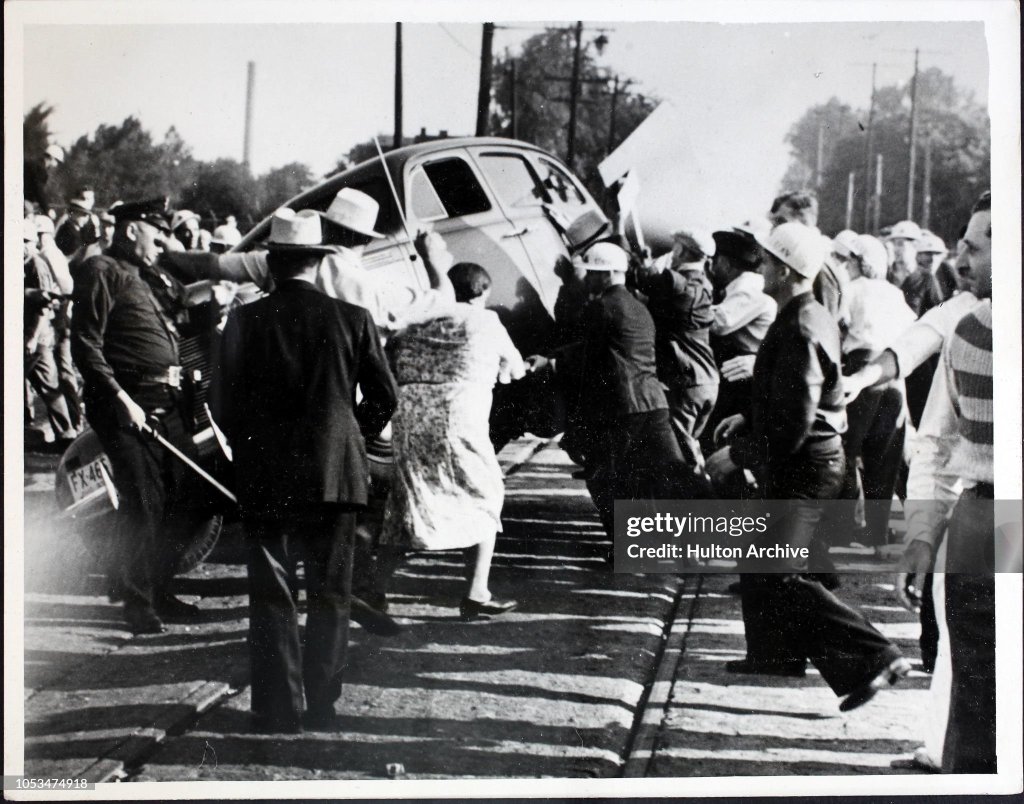
Automobile strikers and their sympathizers fought police in the vicinity of the Fisher Body plant here today, tear gas, clubs and rocks being used by both sides, and at the end of the day the official reports) listed forty-six persons as having been injured. Thirteen arrests were made. In what was described as the worst rioting since the “little steel” strike of 1937, the police and pickets clashed intermittently between 6 and 8 o’clock this morning at the company gates as the CIO’s United Automobile Workers sought to close the plant, against which it called a strike three weeks ago. There was another clash this afternoon.
Tonight 8,000 pickets and their sympathizers besieged in the plant 453 workers whose entrance this morning had precipitated the fighting. These employees decided, on advice of the authorities, to remain. in the plant until the early morning hours in the hope that the crowd would melt away. A force of 150 policemen stood guard. The clashes of the morning, in which 5,000 sympathizers encouraged pickets as they fought 100 police, ended in a truce arranged by Police Chief George J. Matowitz.
The truce broke down in the afternoon, however, when a company employee began to drive through a gate, which was blocked by a picket sitting on a stool. The car pushed the picket along slowly. A policeman seized the picket. Another picket with a club smashed a headlamp of the car. Thirty mounted police galloped out of the gates swinging their clubs right and left.
Mayor Harold Burton, who had assumed command at the strike scene in person and who witnessed this encounter, announced that “in Cleveland the public interest comes first and will be protected fully.” “The city will maintain law and order and the streets will be kept open,” he declared. “No rioting or inciting to riot will be permitted.” He called to strike duty every available officer, even rushing police from traffic duty downtown to the plant which is seven miles east of City Hall.
World Fair officials in New York reduce ticket prices to 50 cents on the weekends today as rain cuts throngs.
A tipsy soldier leaps off the Brooklyn Bridge, swims to shore, and heads to a saloon. His only injury is a minor leg laceration.
The Pirates buy baseball’s tallest player, 6′ 9″ P Johnny Gee, from Syracuse (International League).
The Chinese report that in the last two weeks they recaptured seven important cities in Southeastern Shansi which had been occupied by Japanese during the big clean-up drive begun early in July. These are Yangcheng, Tsinhui, Liaohsien, Yusheh, Wuhsiang, Chungtsun and Tungfentsen. Guerrillas reported they had cut Japanese communications throughout the war zone and were steadily closing in on Japanese garrisons in the burned, deserted cities the invaders still hold.
The three-way Japanese offensive westward from the Peiping-Hankow Railway in Southern Honan, designed as a diversion to assist the Southeast Shansi operations, was said by the Chinese to have been halted after a thirty-mile advance without the gaining of an important objective.
Two squadrons, each of nine Japanese planes, bombed Chungking and its vicinity by moonlight tonight. Explosives were unloaded in the Yangtze waterfront district of the main city and in the village of Haitangchi on the south bank of the Yangtze. The damage and casualties were small.
Japanese planes bombed Shumchun, less than a mile from the border from the Hong Kong territorial border.
Britain and Japan moved a step closer to agreement on their respective Chinese interests at Tientsin today as the police took steps to curb anti-British demonstrations. Authoritative sources said the conferees had agreed on measures for policing Tientsin, but had yet to settle the question of British support of Chinese currency, the thorniest question on the British-Japanese conference agenda.
Details of the agreement remained unsettled, but the general formula, it was understood, embraced a British agreement strictly “to control with the cooperation of Japanese military authorities any Chinese suspected of terrorism and sabotage behind Japanese lines” at Tientsin. The British were said to have agreed to surrender to Japanese authorities four alleged Chinese terrorists who, the Japanese charge, killed a Chinese bank official. It was the dispute over the custody of these four that led to Japan’s blockade since June 14 of the French and British concessions and the present conference in Tokyo.
It was said the British also had agreed to a joint British-Japanese search for other terrorists in the Concession. Authorities tonight also began removing anti-British posters which had plastered Tokyo for several days, and declined to permit the putting up of others. An even stronger control was exerted to prevent the anti-British campaign from developing into anti-American channels. The police refused to permit the printing of anti-American slogans, and none was posted anywhere in Tokyo.
Dow Jones Industrial Average: 143.26 (-0.74).
Born:
France Nuyen [as France Nguyễn Vân Nga], French-American actress (“South Pacific”, “The Joy Luck Club”, “Star Trek” episode “Elaan of Troyius”), in Marseille, Bouches-du-Rhône, France.
Susan Flannery, soap opera actress (“Days of Our Lives”), in Jersey City, New Jersey.
Norm Snead, NFL quarterback (Pro Bowl, 1962, 1963, 1965, 1972; Washington Redskins, Philadelphia Eagles, Minnesota Vikings, New York Giants, San Francisco 49ers), in Halifax County, Virginia (d. 2024)
John R. West, American rock guitarist (Gary Lewis & Playboys – “This Diamond Ring”), in Uhrichsville, Ohio.
Naval Construction:
The Royal Navy Tree-class minesweeping trawler HMS Ash (T 39) is laid down by Cochrane & Sons Shipbuilders Ltd. (Selby, U.K.); completed by Amos & Smith.
The Nihon Kaigun (Imperial Japanese Navy) repair ship HIJMS Akashi (明石), sole ship of her class to be completed, is completed.

 History Diaries