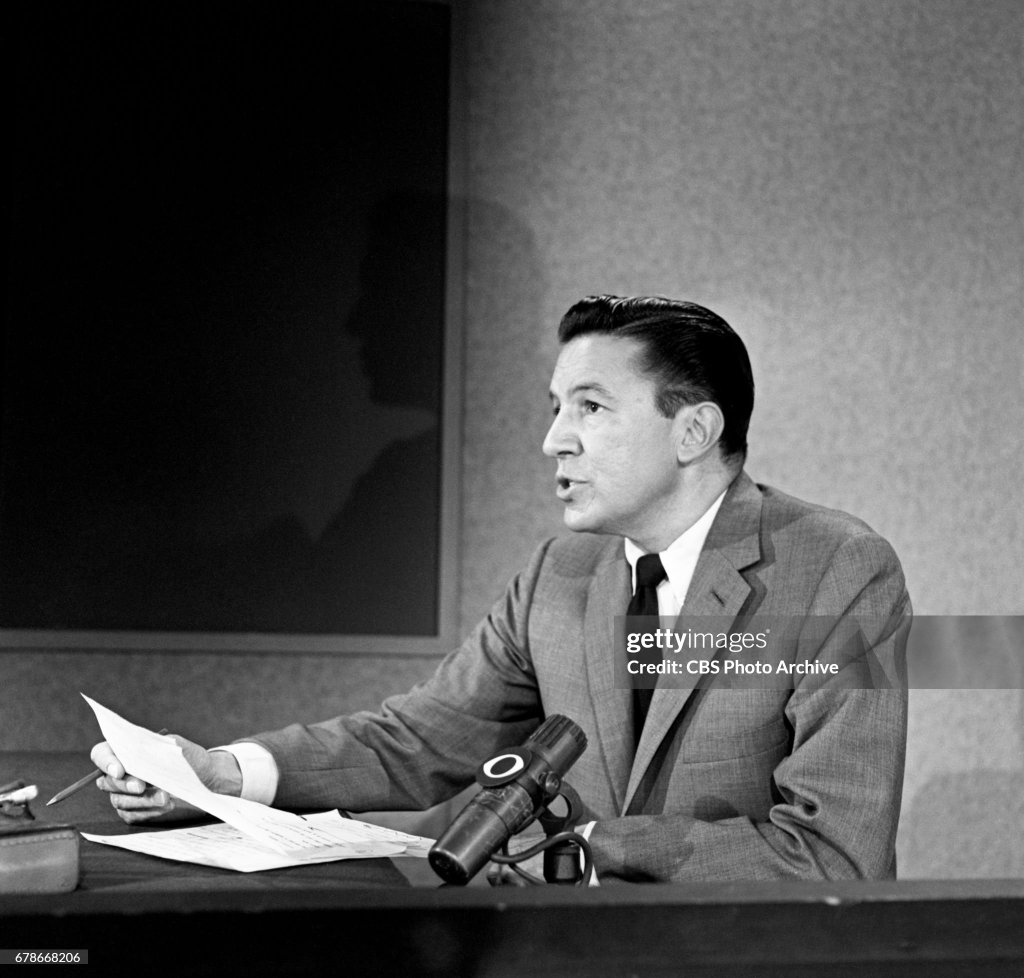
Secretary of State Rusk, in a news conference, admits there are differences between the United States and South Vietnam on the issue of extending the war into North Vietnam, yet he insists there is agreement on the general conduct of the war and that U.S. warnings to Communist China and North Vietnam indicate total U.S. commitment.
United States Air Force officers estimated today that 150 Việt Cộng guerrillas were killed yesterday in the third consecutive day of fighting around the district capital of Bến Cát. No additional American casualties were reported as battles raged east, west, north and south of the town, 30 miles north of Saigon. In Saigon, six United States servicemen escaped unhurt in a bomb attack. A Vietnamese cyclist hurled a grenade at the soldiers who were waiting for the American community’s special bus, but he missed. The grenade exploded near the door of a shop, seriously wounding two children and an adult.
The Air Force spokesmen stressed that the Việt Cộng casualty figure was preliminary. Ten fighter bombers strafed and bombed the guerrillas from early yesterday until late afternoon, breaking up at least one reinforced Việt Cộng battalion of about 900 men. The Vietnamese Defense Ministry had placed the Việt Cộng casualties near 300.
The South Korean National Assembly approves aid to South Vietnam. The National Assembly unanimously approved today a Government plan to send a 130‐man mobile hospital and 10 instructors of karate, the art of barehanded combat, to South Vietnam. The instructors and medical team are scheduled to leave here about. the middle of next month for a year’s tour of duty. They will receive transport and logistical support from the United States while helping in the struggle against the Việt Cộng. The Assembly’s National Defense Committee has voted an appropriation to pay officers in both groups up to the equivalent of $180 monthly and $30 for enlisted men. This is the first time that South Korea will send assistance to a foreign country.
A 40‐year‐old Air Force officer who was killed when his plane was shot down in Vietnam will receive the Air Force’s Cheney Award for “extraordinary heroism.” The officer was Major James R. O’Neill. The award will be presented Tuesday by the Air Force chief of staff, General Curtis E. LeMay, to the pilot’s mother, Mrs. Caroline V. O’Neill of Huntington Station, Long Island, New York. Major O’Neill was on a combat mission on Febraury 6, 1963, when his B-26 light bomber was struck by ground fire. The engines failed at low altitude and he remained at the controls while his crew bailed out.
South Vietnam rejected today a strong French protest over the desecration of the French War Memorial by demonstrating students in Saigon. The steady deterioration of relations between Saigon and Paris has aroused serious apprehension among the 15,000 French citizens living in this former French colony. In a note delivered to the French Embassy, the Foreign Ministry attributed the destruction of the memorial to emotion evoked by President de Gaulle’s renewed proposal, on July 23, for the neutralization of Vietnam. This proposal, the note said, “is considered by the mass of the Vietnamese people to be contrary to the higher interests of the country.”
About 300 students, shouting, “Down with de Gaulle!” ripped the statues from the memorial in central Saigon on Tuesday night. The statues honored French and Vietnamese who died fighting for France in the two World Wars. The police did not interfere as the students attacked the memorial with pickaxes and toppled it. Government troops later removed the wrecked statues and cemented over the names of the war dead inscribed on the pedestal. Twice before in the last two weeks France has filed protests, citing an attack on the memorial and student demonstrations during which an effigy of General de Gaulle was burned and the French Embassy raided.
In the newest note, the embassy expressed concern for the safety of French citizens and their property in view of the failure of the police to protect the memorial. Vietnam replied that there was no question of protecting French nationals. It said that the memorial had been erected on municipal property and that the authorities were free to modify or transform it. United States officials are understood to have cautioned the Vietnamese Government informally about the poor impression made abroad by student demonstrations and about the possible effect on relations between Saigon and Paris.
The Government of Premier Nguyễn Khánh charged today that Chinese Communist advisers directed the Communist force that killed 40 women and children in an attack July 20 on the Mekong River town of Cái Bè. In a communique, Saigon also asserted that the enemy units involved — the 261st and 514th battalions — were regular troops of the North Vietnamese Army rather than South Vietnamese insurgents. But United States sources said they doubted this. General Khanh and officials of his Government, with the vociferous backing of Saigon University students, have been campaigning for an expansion of the anti‐Vietcong war into North Vietnam to choke off the flow of recruits and supplies to the guerrillas. President Johnson’s Administration opposes such an expansion of the conflict, at least at this time.
Secretary of State Dean Rusk, in an oblique jab at Senator Barry Goldwater, said today that it was “unrealistic” to think the Soviet Union would “roll over and play dead” if its vital interests were threatened by the United States. In answering several political questions at a news conference, Mr. Rusk said the Administration had “eminently demonstrated” that it was “just as tough and just as stubborn as is necessary” to protect Its vital interests and those of the Western allies.
But he cautioned that the Soviet Union, too, would be stubborn in defending its interests. Therefore, he said, conflicts of interest must be approached with care and persistence to find ways in which the Communist and Western parts of the world can live together. Mr. Rusk did not refer diectly to Mr. Goldwater, the Republican candidate for President, or his views, but the Secretary’s questioners did, leaving no doubt about the meaning of their inquiries.
Secretary Rusk said he thought the main lines of United States foreign policy had been remarkably consistent since the end of World War II with “very strong support throughout the country and on a bipartisan basis.” He did not specify whether he thought Mr. Goldwater opposed these policy lines but said in reference to the coming campaign: “I think that if we were to bend those policies in any significant way, the American people would bend them back in the course of our discussion.”
United Nations officials in Cyprus, indignant over the way the international peacekeeping force is being treated, believe that a special Security Council meeting will be necessary to clear up the situation. The Secretary General, U Thant, has said he will submit a new report on Cyprus to the Council. He has asked the nations supplying peacekeeping troops to comment on the extent to which their task is being impeded by the Cypriot Government under Archbishop Makarios, the President. The Archbishop, who speaks for the Greek Cypriots in the factional strife here, has told Mr. Thant that he will not admit the force to “sensitive areas” where the government’s security is involved.
Last night a jeepborne patrol of the British Life Guards was halted at gunpoint by Greek Cypriots when it tried to investigate reports that a ship had entered Limassol harbor without lights. After an hour the patrol was rescued by a scout car of Life Guards. Mr. Thant has not replied to President Makarios’s rejection of his request that United Nations forces be allowed full freedom of movement to prevent outbreaks between the Greek and Turkish communities. He is expected to reply only after he has had a full report from the nations supplying troops — Britain, Canada, Sweden, Finland, Denmark and Ireland.
Pakistan announced today that she would accept a “generous offer” by Communist China of a $60 million long term, interest‐free loan. It is the first loan offered by Peking to Pakistan, which is allied with the West in the Central Treaty Organization and the Southeast Asia Treaty Organization, both aimed at preventing Communist aggression.
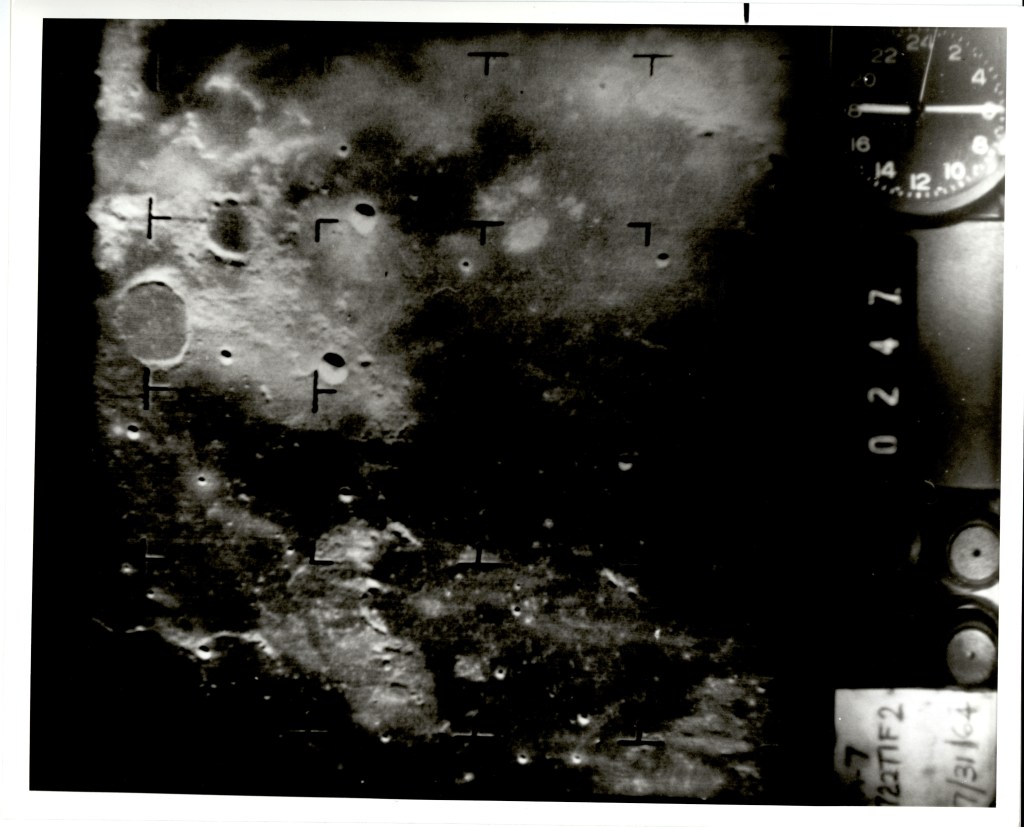
The U.S. lunar orbiter Ranger 7 sent back “history’s first close-up photographs of the moon”, with images 1000 times more clear than anything ever seen from Earth-bound telescopes. In all, the orbiter transmitted 4,316 photographs to the Jet Propulsion Laboratory in Pasadena, California before impacting at the Mare Nubium at 1325:49 UTC At 1308:36 UTC (5:08 a.m. at the JPL in California), the camera began transmitting its first images, with the final one 3/10ths of a second before it became the first American spacecraft to “land” on the Moon.
Ranger 7 radioed to earth today the first close‐up pictures of the moon — a historic collection of 4,000 pictures one thousand times as clear as anything ever seen through earth‐bound telescopes. Scientists at JPL in Pasadena, California were hailing the achievement, which exceeded all expectations, as by far the greatest advance in lunar astronomy since Galileo. They said the pictures not only represented a great leap in man’s knowledge of the moon, but also, on a more practical level, lent encouragement that the lunar surface was suitable for Project Apollo’s manned lunar landings. The still pictures were snapped and transmitted in the last 17 minutes before the spacecraft crashed into an area northwest of the Sea of Clouds.
They meant in effect that the 240,000 mile distance to the moon had been shrunk by man’s ingenuity to a mere half‐mile in terms of what he could see of its topography. They showed craters three feet in diameter and a foot to a foot and a half deep. The best earthbound telescopes, handicapped by the shimmering mantle of the atmosphere, can shrink the lunar distance only to 500 miles and reveal features no smaller than about one‐mile across. The startling disclosures of what Ranger 7 had wrought were made at a packed news conference here by a team of scientists headed by Dr. Gerard P. Kuiper of the University of Arizona.
President Johnson congratulated today the scientists and technicians responsible for the successful flight of Ranger 7 to the moon. The President was in the White House living quarters when Dr. William H, Pickering, director of the Jet Propulsion Laboratory at Pasadena, California, telephoned to inform him that the shot was a success. The President felicitated Dr. Pickering and Dr. Homer E. Newell, assistant administrator for space science and application of the space agency, then had the White House issue a statement praising those who participated in the flight.
Mr. Johnson called the flight “a basic step forward in our orderly program to assemble the scientific knowledge necessary for man’s trip to the moon. The pictures obtained of the lunar surface should prove extremely useful,” the President said, continuing: “They will be a guide in constructing the lunar excursion module and in planning the trip. We shall now be able to better map out our descent route. We’ll be able to build our lunar landing equipment with greater certainty and knowledge of the conditions which our astronauts will encounter on the moon. I recognize that this great success has come only after a number of failures and partial failures in our efforts to send probes to the moon. This success should spur us on to added effort in the future. The fact that our Soviet competitors have had many unpublicized failures to the moon and the planets also confirms the complexity of today’s success. On behalf of a grateful nation, let me again congratulate you on this. magnificent achievement. All of you today have helped further the peaceful exploration of space.”
The Senate passed today a $1.2 billion housing bill providing funds for urban renewal, low‐rent public housing and other programs. The measure was sent by voice vote to the House, where a subcommittee yesterday approved a similar measure. Housing legislation is on President Johnson’s must list for the year. The key sections of the Senate bill would provide $850 million for urban renewal grants to help clear slums and rehabilitate rundown sections of cities, and authority for 45,000 more public housing units. The measure also would make dozens of changes in present housing law. Senator John J. Sparkman, Democrat of Alabama, floor manager of the bill, said that it was designed to keep existing programs going to September 30, 1965, and to correct many inequities so as to make these programs work better.
The Senate rejected, 64 to 19, a substitute bill offered by Senator John G. Tower, Republican of Texas, which would have eliminated many of the provisions in the version worked out in Senator Sparkman’s Housing subcommittee. Senator Kenneth B. Keating, Republican of New. York, won adoption of an amendment permitting urban planning grants to be made in an area where there has occurred a substantial job reduction because of the closing of a Federal installation or a decline in Government orders to plants there.
The Senate passed a bill by 58 to 27 to implement the 1963 International Coffee Agreement after a sharp argument over whether it meant increased consumer prices. The bill, on the President’s must list, goes back to the House for consideration of a Senate amendment sponsored by Senate Republican leader Everett M. Dirksen of Illinois, which authorizes Congress to pass a withdrawal resolution if it finds an unwarranted coffee price jump attributable to the pact. The President would have, to withdraw the United States if the remedial action were not taken within 30 days. During the debate on the bill, Senator Frank Carlson, Republican of Kansas, charged the pact already was costing United States consumers $600 million a year.
Farm product prices increased by 1 percent between md‐June and mid‐July, the Agriculture Department said today. Price gains for cattle, hogs and milk contributed most to the increase. Partly offsetting were price declines for apples, wheat and oranges. Despite the increase, prices were 4 percent below July, 1963, and the lowest for the month since 1955.
Prices paid by farmers for goods and services and farm wages declined by one‐third of 1 percent during the month, and a like amount below a year earlier. The department said farm prices in mid‐July averaged 75 per cent of the parity price goal of Federal farm programs. This compared with 74 percent in mid‐June and 78 percent in July last year.
Another Black church burned to the ground in Mississippi last night, bringing to at least 15 the number damaged or destroyed by lire since the statewide civil rights drive opened in mid‐June. The Pleasant Grove Missionary Baptist Church in Rankin County, 15 miles east of Jackson, burned shortly before midnight. A deacon, Benjamin Jones, noticed the flames from his home, one mile away. When he arrived on the scene, Rankin County authorities told him the Brandon Fire Department had been there but decided the church was too far gone to save. Authorities who investigated said origin of the fire was unknown and there was no immediate sign of arson.
The Mount Moriah Baptist Church near Meridian was leveled by fire the night before under similar circumstances. A Lauderdale County deputy sheriff, Alton Allen, said there was no reason to suspect arson. Arson has been established in most of the church burnings, however, and civil rights workers point out that the two recent fires occurred, as all the others had, between 11 PM and 3 AM and in rural areas where white terrorist groups have been active.
No arrests have been made.
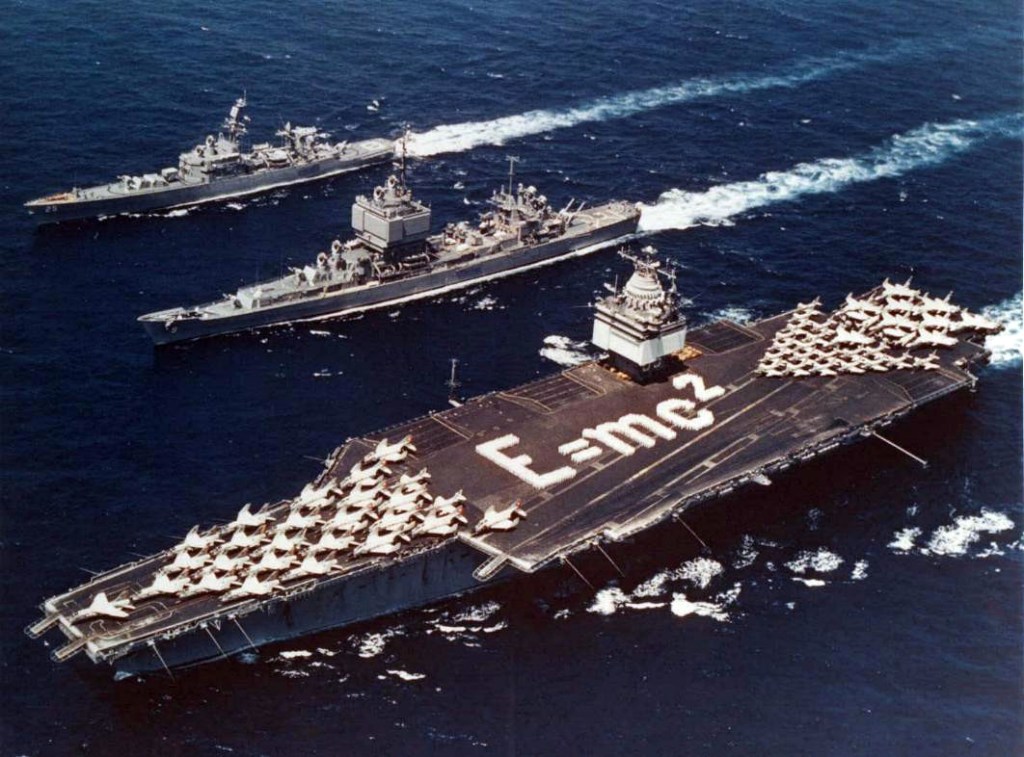
The first “all-nuclear task force” began Operation Sea Orbit, departing from Gibraltar on a voyage around the world without refueling. The U.S. Navy aircraft carrier USS Enterprise, and the guided missile cruisers USS Long Beach, and USS Bainbridge were powered solely by nuclear reactors, and would travel 30,565 nautical miles in 65 days before completing their mission on October 1.
American glider pilot Al Parker glides 644 miles without a motor.
In an event at Los Altos, California, swimmer Dick Roth broke the world record in the 400-meter individual medley.
Harmon Killebrew hit his 36th home run of the season for the Minnesota Twins tonight with two out in the ninth inning to defeat the New York Yankees, 4–3. The Twins’ slugger belted a 375‐foot shot off Al Downing with Rich Rollins on first base after three earlier Minnesota threats had failed with the tying run on base. His homer interrupted a three‐week slide by the Twins into seventh place and ended; Downing’s six‐game winning; streak after the Yankee lefthander had bested Camilo Pascual for eight innings. Al Worthington, who relieved Pascual in the ninth, received credit for the victory, which was only the fourth for the Twins in their last 20 games.
Ed Charles’s ninth-nning homer off Steve Barber led Kansas City to a 7–6 victory over the Baltimore Orioles tonight and enabled the Athletics to split a double ‐ header. Wally Bunker’s three-hitter brought the Orioles a 6–1 victory in the opener.
A brilliant relief stint by Gary Bell in the opener and tight pitching by Pedro Ramos in the second game helped the Cleveland Indians sweep a double‐header tonight from the Detroit Tigers, 12–3, and 4–2. Bell replaced Jack Kralick in the third inning of the first game and set down 18 men in a row. He didn’t allow a hit. Ramos struck out eight in the finale before giving way to Don McMahon in the eighth inning.
The San Francisco Giants take advantage of 3 errors by Bill Mazeroski and 2 by Bob Bailey to tip the bumbling Pittsburgh Pirates, 8–6. Maz’s last error, on a potential double play ball in the 9th, helps the Giants score 3 runs. Willie Mays has 3 singles and 3 runs to lead the attack. The Giants remain 1½ games in back of the Phillies, but learn that Juan Marichal has back spasms and will not pitch again until August 25th.
At Philadelphia, 24,197 see Chris Short, with help from Jack Baldschun, stop the Los Angeles Dodgers, 6–1. John Callison starts the Phillies scoring with a 2-run homer in the 1st, off Ron Moeller. Tommy Davis hits an 8th inning double that caroms off second baseman Tony Taylor’s mouth, kayoing both Taylor and Chris Short. Maury Wills has 4 singles and drives in the lone run.
Vada Pinson’s two‐run single in the fifth inning provided the decisive runs tonight as the Cincinnati Reds beat the St. Louis Cardinals, 7–6, and ended the Cardinals’ six‐game, winning streak. The Reds scored five unearned runs in the second inning with the aid of errors by Julian Javier and Bill White.
The St. Louis Cardinals send down Glen Hobbie and bring up knuckleballer Barney Schultz.
Dow Jones Industrial Average: 841.10 (+1.73).
Born:
Jim Corr, Irish singer and musician (The Corrs – “What Can I Do”), in Dundalk, County Louth, Ireland.
John Shasky, NBA center (Miami Heat, Golden State Warriors, Dallas Mavericks), in Birmingham, Michigan.
Died:
Jim Reeves, 40, American country singer (“He’ll Have To Go”; “Distant Drums”), was killed when the small plane he was piloting encountered a violent thunderstorm while flying over Brentwood, Tennessee. Reeves and a friend, piano player Dean Manuel, were returning to Nashville from Batesville, Arkansas. After a two-day search, the light plane would be found in a thickly wooded area.







 History Diaries