
The Boulton Paul Defiant was a British interceptor aircraft that served with the Royal Air Force (RAF) during World War II. The Defiant was designed and built by Boulton Paul Aircraft as a “turret fighter” to meet the RAF requirement for day and night fighters that could concentrate their firepower on enemy bombers which were not expected to have fighter escorts due to the distance from Germany to the United Kingdom. The Defiant had all its armament in a dorsal turret offering the ability to fire in most directions. The same principle was used in the Royal Navy’s Blackburn Roc which was also built by Boulton Paul.
In combat, the Defiant was found to be effective at destroying bombers, the role it was designed for, but was vulnerable to the Luftwaffe’s more maneuverable, single-seat Messerschmitt Bf 109 fighters operating from bases in Northern France. The Defiant had been designed to destroy unescorted bombers by means of beam or ventral attacks and therefore lacked forward-firing armament, which proved to be a great weakness in daylight combat with fighters. It was withdrawn from daytime operations for use as a night fighter and found success in combination with the use of aircraft interception radar (A.I.) to locate the enemy. It eventually equipped thirteen squadrons in this role, compared to just two squadrons as a day-fighter, though this was mainly due to slow initial production. In mid-1942 it was replaced by better performing night-fighters, the Bristol Beaufighter and de Havilland Mosquito. The Defiant continued to find use in gunnery training, target towing, electronic countermeasures and air-sea rescue. Among RAF pilots it had the nickname “Daffy”.
British Prime Minister Chamberlain writes in regards to the German oppression of Jews “[n]o doubt Jews aren’t a lovable people; I don’t care about them myself. But that is not sufficient to explain the pogrom.”
Prime Minister Neville Chamberlain is expected to make a statement on foreign affairs in the debate in the House of Commons tomorrow. His position has become more vexed because of the Japanese demand, in the Tokyo conference, that Britain surrender the Chinese silver reserves now in the Tientsin Concession, and support the Japanese currency to the detriment of the Chinese.
As responsible observers in London see it, there is only one course open to Mr. Chamberlain in dealing with these new Japanese demands — to resist them. Mr. Chamberlain has repeatedly declared that the British will not change their foreign policy at the behest of another power. Moreover, the British entered the Tokyo negotiations on the clear understanding that they were concerned solely with the Tientsin blockade and associated problems. To present such international questions to the conference as the dropping of support for the Chinese currency, which would directly affect the trade of the United States and France, and the surrender of the Tientsin silver, half of which is held in the vaults of French banks in Tientsin, in the British view is not “cricket.”
Britain will not depart from her policy loyally to stand by the Tokyo formula that established facts be faced in the occupied areas, but it is clear in informed quarters tonight that no instructions will be sent to Sir Robert Leslie Craigie, the Ambassador to Tokyo, to countenance a withdrawal of support from the Chinese dollar as long as it is worth a cent. Word of renewed Japanese threats against isolated British communities in Japanese-controlled areas was received in official quarters tonight. This still further hardened opinion in London against any new Japanese demands.
The extreme delicacy of the British negotiations, not only in Tokyo, but also in Moscow, where some old suspicions, it seems, have not been entirely removed, was emphasized in London tonight. It became known that Mr. Chamberlain’s statement tomorrow may, after all, be limited to an announcement that the British are joining the French in the dispatch of a military mission to Russia.
The world need not worry about war for the month of August, everybody is saying here now, because it has just been learned that Virginio Gayda is going on his vacation. Certainly, no Italian could conceive of war or even a serious crisis, without Signor Gayda present to write editorials about it. Even “Camicia Nera” (Blackshirt), well known commentator in Bologna’s Resto del Carlino and credited with being very close to Achille Starace, secretary general of the party, today tells all his readers to go on vacation and not to worry. “The reclamation of the large Sicilian estates,” he writes, “the Universal Exposition of 1942 and many other works on a vast scale are demanding all our enthusiasm. Our ally, Germany, is preparing for the September Congress at Nuremberg. The fascist states have a program of work, while the plutocracies have nothing but exasperating fear.”
Italian denials that German troops are being moved to Libya through Trieste and reports by visiting correspondents that they can find no trace of such movements there have failed to impress foreign military specialists responsible for the original reports.
Rumanian frontier guards at Tecso were accused today of firing last night at Hungarian rafts that were drifting down the Tisza River. Sixty shots were fired, several striking the Hungarian customs building. Count Stephen Csáky, Hungarian Foreign Minister, today opened the university summer school at Szoprod. In his speech he stressed that Hungary adhered to the Rome-Berlin Axis policy. “This is a peace-loving nation,” he said, “but on no account will she surrender her rightful claims. Hungary would be only too willing to live peacefully with all her neighbors; unfortunately, this does not depend on her alone.”
Francisco Franco decreed that to help rebuild Spain, every able-bodied citizen must either perform 15 days of unpaid work for the state each year, or pay a cash sum equivalent to 15 days of work at their own job. Demanding that the nation work harder to speed the national reconstruction and stop idling, General Franco ordered all able-bodied men to register for assignments to municipal, provincial and State works projects on August 31. Failure to work for the State or to pay the equivalent in wages is punishable by fines of 100 to 2,000 pesetas and imprisonment of thirty-one days to three months.
General Franco’s decree described free work for the State as necessary for security of the country, and said that failure to so comply would be prosecuted with all vigor. In effect, General Franco has adopted the law prevailing in some European countries in the Middle Ages when peasants were required to labor a specified number of days each year for the State without pay.
Nationalist Spain was reliably reported today to have agreed to take back 50,000 former Republican militiamen from French concentration camps at the rate of 2,000 daily, beginning this week. While the agreement was not confirmed immediately by officials, Generalissimo Francisco Franco was said in these reports to have consented to the return of these refugees as a result of France’s action last week in handing over the Spanish gold deposited in French banks by the former Republican regime. About 300,000 refugees have remained in France since the Catalonian defeat early this year and have been fed and housed in concentration camps. They have been returning to Spain at an average of only about 500 a week.
France’s new spy code, the strictest anti-espionage measure the Third Republic has ever had in peacetime, became law today with its publication in the Official Journal.
Finland’s Premier Aimo Cajander, speaking at a big public meeting at Savonlinna about the grave dangers threatening small nations from the present rivalry between great powers, drew especial attention to the German and Russian policies in the Baltic region and Russia’s apparent intention to control the neutrality and integrity of her small western neighbors.
These aspirations, he said, had gained new impetus after Britain and France, revising their foreign policy, had started negotiations for an alliance with Russia that had not yet led to definite results. Stressing this fact, the Premier made the following statement: “Leading British statesmen have already repeatedly given assurances that they will refuse to accept any agreement whereby Finland’s integrity or neutrality is violated. We are not entitled to doubt these assurances, which have been given in full cognizance of the Finnish Government’s attitude and the unanimous opinion of the whole Finnish nation.”
The Premier added that Finland found it difficult to believe that the Western powers, whose relations with Finland are the best, could without her acquiescence make an agreement that encroached on her status as an independent State and prejudiced her declared neutrality. If necessary, he exclaimed, Finland would rise in arms against anyone menacing her neutrality.
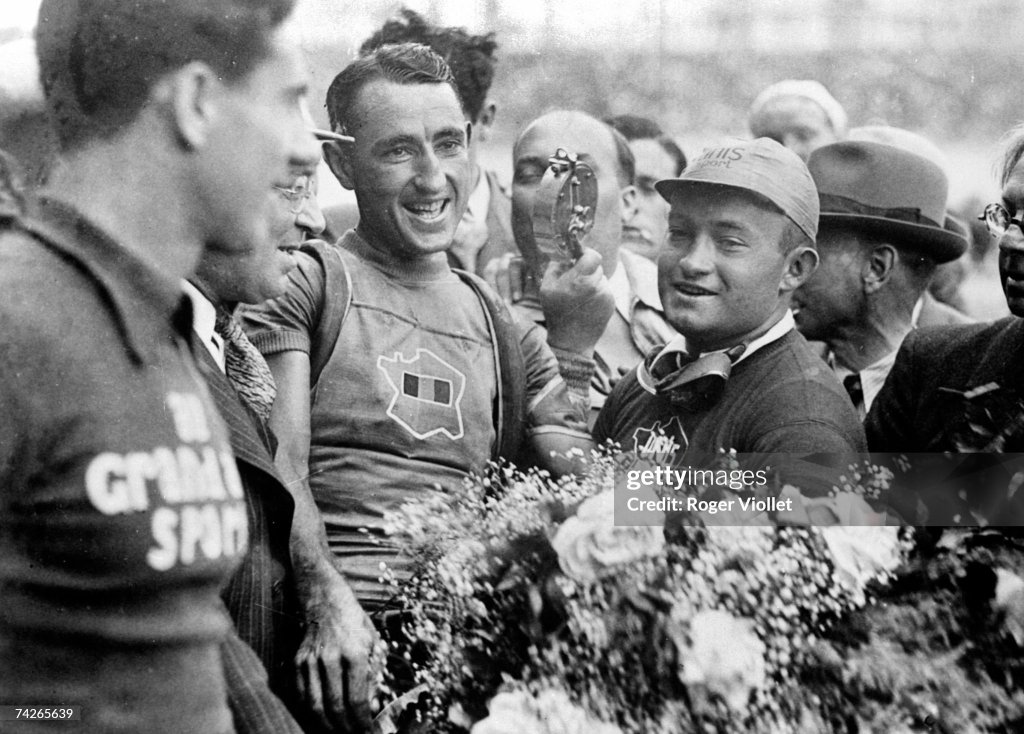
Sylvère Maes of Belgium won the Tour de France. It was the last Tour until 1947.
Administration leaders tonight were considering jettisoning parts of the Works Financing Bill in the hope of stemming the revolt they fear may wreck the program and bring about an abrupt end this week to the seven-months-old session. The situation, as Congress prepared to resume its sitting tomorrow, had the leaders worried. They stated privately they could only hope for passage of the Works Financing Bill and $800,000,000 housing measure in greatly reduced amounts.
The House, whose Banking and Currency Committee joined the Senate yesterday in slashing $550,000,000 from the Works Financing Bill, holds the key to the situation. Particular attention was being paid to making the two major administration bills palatable enough to a conservative Democratic-Republican coalition to save something from what appeared to be developing into a major rout. Usually, the legislative program for the House is planned and announced a week in advance. But tonight, Speaker Bankhead said he did not know for certain what legislation would be advanced for consideration in the House after tomorrow.
At least two reasons could be advanced for failure to detail the House program for the week. One is that House leaders are awaiting Senate action on the Works Financing Bill, which may come tomorrow night under a debate-limitation agreement that Senator Barkley engineered. The other reason was the absence of President Roosevelt who is fishing in Chesapeake Bay. Leaders want his advice before carrying out what was privately reported to be their decision to compromise on the works financing and housing bills in order to get them through.
It was not expected that the Works Financing Bill would encounter trouble in the House Rules Committee, since this group is overwhelmingly for early adjournment and because its members do not fear the results when the measures reach the House floor. A new source of trouble for the leaders is the deadlock over amendments to the Social Security Act. The Senate and House conferees were reported to be at an impasse over the Connally Senate amendment requiring that the Federal Government contribute two-thirds of the old-age assistance grants for pensions up to $15 per person per month.
Paul V. McNutt today backed Secretary of State Hull’s policy of cooperation with “like-minded nations” by warning that a policy of isolation would require a trebled navy and wreck the nation’s economic life for a generation.
The FBI seizes an ex-banker in a wide bond plot. The former vice president is linked to $250,000 in thefts.
New York Mayor La Guardia told the quarterly convention of the Association of Law Enforcement Officers of the Carolinas today that the South was “committing suicide” when subnormal wages and child labor were offered to attract industrial plants from the North.
The New York City WPA Teachers Union, Local 463, A.F. of L., has called upon all teachers dismissed from WPA education and recreation projects to disregard their pink slips and report for work, it was announced yesterday by William Levner, president of the union.
Compulsory unions lose favor in the U.S., as seen from polls taken of the general public and plant workers.
At age 50, Charlie Chaplin begins to talk on screen.
The Rev. Charles E. Coughlin, Royal Oak priest, intimated in his weekly broadcast today that his life had been threatened.
President Roosevelt caught a 70-pound marlin today and later radio reports to his shore guide said he had boated a second one, the weight of which was not given.
1939 American Karakoram expedition to K2 ended in tragedy when Dudley Wolfe and three Sherpa people sent to rescue him died high on the mountain.
In the event the United States is forced into war with a major naval power, the American naval policy must be an offensive one, Admiral William D. Leahy, the retiring Chief of Naval Operations, declares in his last report to the Secretary of the Navy, which was made public today. Admiral Leahy, who will soon assume the Governorship of Puerto Rico, urges the earliest possible completion of the naval vessels now under construction or authorized, and action by Congress to increase the enlisted personnel to a size to make possible the complete manning of the ships in commission and under construction. The fleet, including units under construction, will, in Admiral Leahy’s opinion, make impossible an attack in force against the United States by any navy in the world, this being based on the supposition that in the event of hostilities involving a first-class naval power the American fleet takes the offensive and by so doing seeks the enemy fleet wherever it may be and sinks it before it can come within striking distance of American shores.
Major Caleb Vance Haynes, Air Corps, United States Army, with Captain William D. Old, Master Sergeant Adolph Cattarius and Staff Sergeant William J. Heldt, flew the Boeing XB-15 experimental long range heavy bomber to a Fédération Aéronautique Internationale (FAI) World Record for Greatest Payload Carried to a Height of 2,000 meters. The XB-15 carried 14,135 kilograms (31,162 pounds) to an altitude of 2,000 meters (6,562 feet) over Fairfield, Ohio. The flight set a second record by carrying 10,000 kilograms (22,046 pounds) to an altitude of 8,228 feet (2,508 meters). Both records were certified by the National Aeronautic Association, the American organization representing the FAI.
The Boston Red Sox’ slugging first baseman. Jimmy Foxx, focused his batting eye on center field after going hitless for two days, slammed out his twenty-fifth homer and two other blows today, accounting for four runs as Boston rode to a 6–4 triumph over the St. Louis Browns.
Jumping on Al Milnar for four runs in the fourth inning today, the Washington Senators went on to a 5–2 victory over the Cleveland Indians before 10,000 fans and took a two-to-one edge in the series. Joe Krakauskas held the Clevelanders to eight scattered hits, the Indians getting one run on a bad throw to first by Cecil Travis in the second inning.
In Cincinnati, the Reds extend their win streak to 10 games by sweeping the Philadelphia Phillies, 9–2 and 5–1. In game 2, Billy Myers hits a walk-off grand slam in the 9th inning, off Boom-Boom Beck and the first-place Reds lead the Cardinals by 12 games.
The New York Giants tonight are enjoying the strange sensation of a two-game winning streak. At Wrigley Field this afternoon before a gathering of 26,626 fans they tamed Gabby Hartnett’s Chicago Cubs for the second straight day to win their first series in eight. The score was 3–1.
The St. Louis Cardinals, partial to MacPhail’s yellow-dyed baseballs, use them at Sportsman’s Park to beat the Brooklyn Dodgers twice by 5–2 scores.
The Boston Bees were in Pittsburgh for a Sunday doubleheader and beat the Pirates in the first game, 7–5. That game had a 1:25 rain delay in the ninth inning, causing the second game to start later than planned. In the bottom of the third of game two, Johnny Rizzo hit a solo homer off Joe Sullivan. In the top of the fifth frame, the game was called due to the Pennsylvania curfew law with the Bees leading 6–3.
A move to drive Britons out of North China has been extended while British-Japanese differences in Shanghai smoldered today. The anti-British campaign brought these developments today:
- Britons reaching Tientsin from Tsinan in Shantung Province said a committee had written all British nationals there a warning that their lives would not be safe after August 10.
- The Japanese press in Tientsin reported that the anti-British committee in Tsangchow, Hopeh Province city fifty miles south of Tientsin, had ordered all British missionaries to leave.
- In Peiping, policemen visited all Chinese shops and warned them to remove British goods from their shelves, and thousands of new posters appeared with denunciations of British influence.
British officials in Shanghai were reported preparing a protest to the Japanese against their alleged encroachment Saturday on British territory in erecting barbed-wire barricades in North Kiangsi Road, boundary between the British and Japanese defense sectors here. It was understood the protest would include a demand that the barricades, extending a mile and a half, be withdrawn.
Quiet was restored to the area. after the Japanese had opened gaps in the wires at street intersections, thus allowing Chinese free passage between the two sectors. Thousands of Chinese had fled in terror with their possessions Saturday into the British one and camped in the street alongside the barrier. Domei, Japanese news agency, meanwhile reported that Japanese military authorities in Peiping and Tientsin were “bluntly accusing Britons of practicing flagrant double diplomacy” in the Far East. It said the military was determined to insist on British surrender on the currency questions being discussed in the British-Japanese negotiations in Tokyo.
The military, Domei continued, asserted it was impossible to reconcile the British-Japanese agreement of a week ago with statements by Prime Minister Neville Chamberlain and his Foreign Secretary, Viscount Halifax, that Britain had not changed her policy in China. Under the agreement the British Government recognized that the Japanese forces in China had “special requirements.” Mr. Chamberlain declared it “did not connote any change in British policy in regard to China.”
British commercial circles in Tsingtao. Shantung port, said the anti-British boycott movement in Shantung Province had brought business to a virtual standstill. They said Chinese were afraid to buy British goods. Trade restrictions in Tsingtao and elsewhere in Shantung also are curtailing American business.
Britons who reported in Tientsin on the Tsinan drive said the anti-British committee charged British nationals with “obstructing the new order in East Asia for many years.” “If you wish to continue assisting Chiang Kai-shek,” it advised them, “proceed immediately to West China.” There are fewer than fifty Britons in Tsinan now. They were said to be undecided on what action to take, but it was believed they probably would withdraw as their countrymen who were in Kaifeng already have done under similar circumstances.
As policemen visited Chinese shops today, warning them to remove British goods from their shelves, Japanese shops continued to serve Britons — but purchases were always wrapped in paper clearly inscribed: “Down with Britain.” The thousands of new posters that appeared in public places, even on trees and posts on Legation Quarter territory, denounced the “banefully encroaching influence of Britain.” They proclaimed that “the spirited people of the yellow race will not be the slaves of England.”
Reports reaching Tsingtao, Shantung Province port, from Tsimo, forty miles to the north, said 4,000 Chinese who had been fighting with the Japanese had mutinied, killed six Japanese officers, captured four others and then joined Chinese national troops 100 miles away. The Tsingtao-Tsinan Railway was severed by guerrillas twice in the past week, once within forty miles of Tsingtao. Increased activity by the Chinese irregulars was ascribed to the withdrawal of many Japanese troops from Shantung Province for transportation to Manchukuo.
The Japanese destroy an American hospital in China. It is hit in a bomber raid.
Born:
Eleanor Smeal, American activist (NOW), in Ashtabula, Ohio.
Peter Bogdanovich, American film director and producer (“The Last Picture Show”, “Paper Moon”), in Kingston, New York.
Vic Davalillo, Venezuelan MLB outfielder and pinch hitter (World Series Champions, 1971-Pirates, 1973-A’s; All-Star, 1965; Cleveland Indians, California Angels, St. Louis Cardinals, Pittsburgh Pirates, Oakland A’s, Los Angeles Dodgers), in Cabimas, Venezuela (d. 2023).
Tom Wilkes, American photographer, Grammy Award-winning art director, poster and album cover designer (George Harrison; Rolling Stones; Carpenters, Sir Doug; Janis Joplin; Sandpipers), in Long Beach, California (d. 2009).
Naval Construction:
The Вое́нно-морско́й флот СССР (ВМФ) (Soviet Navy) “K” (Katjusa)-class submarine K-51 is launched by A. Marti (Leningrad, U.S.S.R.) / Yard 194.
The Royal Navy British Power Boat 60-foot motor anti-submarine boat HMS MA/SB 4 is commissioned.

 History Diaries