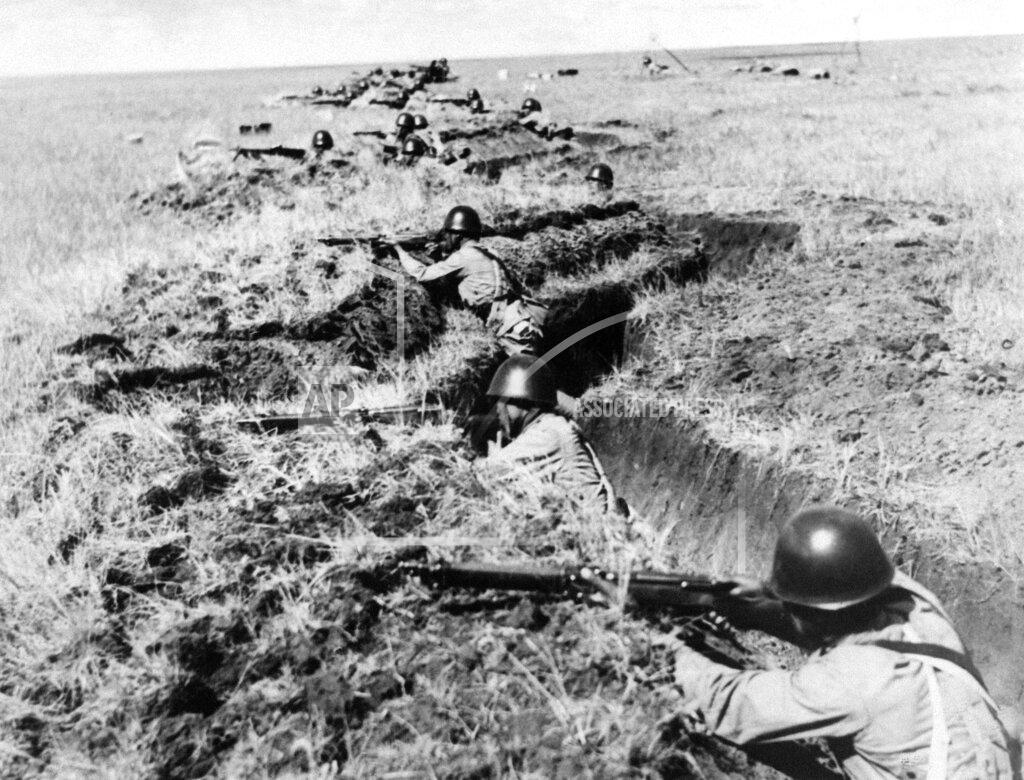
[Ed: LOL. Original caption. Actually, the Japanese offensive has failed, and their future is going to be bleak.]
Prime Minister Neville Chamberlain hopes to be able to make a statement on the progress of the Anglo-Russian negotiations early next week, he told the House of Commons today, thereby arousing new reports that an agreement was in sight. However, Mr. Chamberlain refused to discuss the matter beyond. saying that fresh instructions had been sent to Moscow and that it was necessary to await the Russian reply to them. It is understood, however, that these instructions. concern the Anglo-French military mission that will go to Russia. There is some reason to believe that the Russians actually asked for the mission, and it is therefore expected to go very soon. Mr. Chamberlain refused today to say whether the French were sending delegates, but he did say that the two nations were working very closely together.
It is reported in London that the British share of the mission will be largely in naval and air force men, with the French supplying high ranking army officers. This fits in with the war plans; the French would command on land and the British at sea. There is much for British and Soviet naval officers to talk about, because joint operations of the two navies in the Baltic are regarded as probable in a war. Formal announcement of the staff talks is expected to be made in Moscow, London and Paris within a few days. Unless a general agreement is reached before then, it is believed, the announcement will declare that some points must be settled before a full defensive-offensive agreement can be reached. But at any rate the British feel that the very fact that staff talks will be started will have some effect on Germany.
Low level German and Soviet diplomats have a friendly dinner together in Berlin, Germany, their discussions lasting a little after midnight. They conclude that a treaty between Germany and Soviet would mean peace in Eastern Europe, and that the Soviet Union should be aware of the United Kingdom, whose aggressiveness would undoubtedly drag the Soviet Union into a war, should the two countries sign any military agreement with each other.
Berlin today staged its first blackout and mock air raid in two years, and within two minutes after the alarm sirens had sounded the streets in this metropolis were completely deserted.
Germany lays plans to push television. One station is ready to function and others are being built.
Adolf Eichmann is placed in charge of the Prague branch office of the German National Central Office in the Protectorate of Bohemia and Moravia, responsible for deportation of Jews.
The Minister of Justice in Bratislava, Slovakia has prepared a bill declaring a partial moratorium on debts to Jews. These must not be settled in lump sums but in small installments. According to an interview with Premier Joseph Tiso, published in the newspaper Greszbote, Slovakia’s “Jewish problem” will be solved, step by step. All Jews have been dismissed from the army. In the schools their number has been limited to 4 percent. The “Aryanization” of industry and commerce, however, has made little progress, chiefly because of a shortage of competent substitutes. Lawyers’ and pharmacists’ associations have expelled all Jewish members.
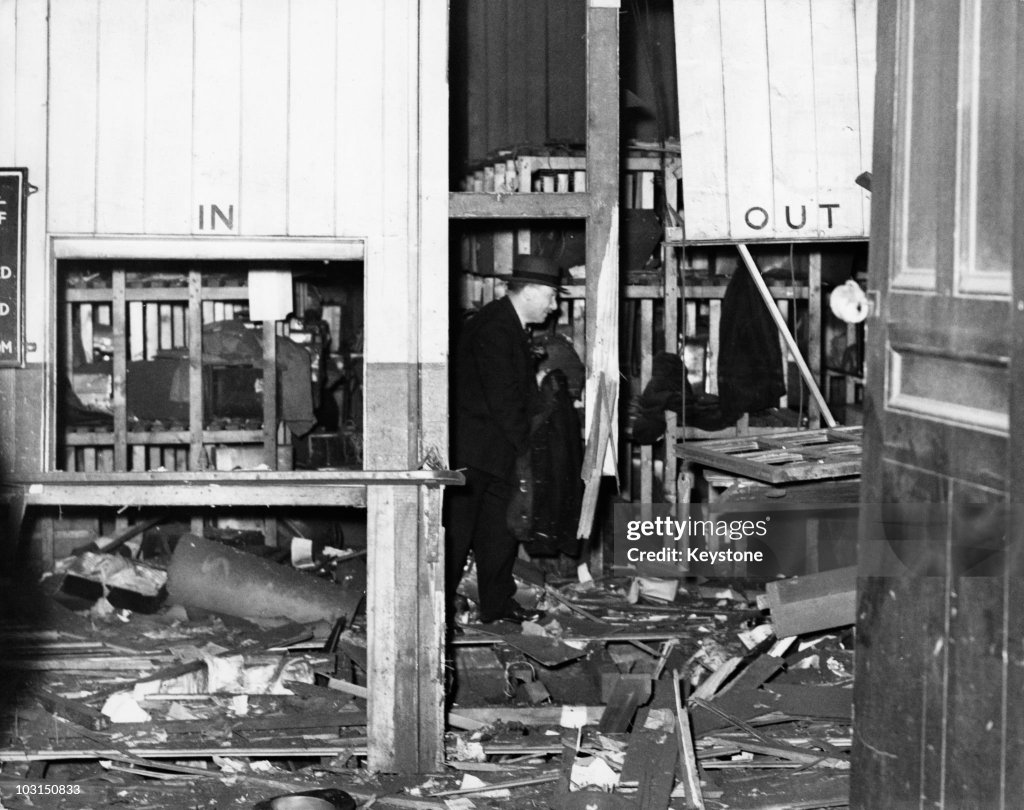
Five more bomb explosions occurred in England – two in London and three in Liverpool. One person was killed and twenty injured. Explosions in two of London’s largest railroad stations, killing a young college professor and injuring eighteen other persons, gave a violent answer today to the government’s new drive to run the Irish Republican Army. out of England. Late tonight Scotland Yard was busy rounding up suspected I.R.A. members throughout the United Kingdom.
A bomb that exploded under the counter of the checkroom at King’s Cross Station at 1:40 this afternoon fatally injured Donald Campbell, Latin lecturer at Edinburgh University, both of whose legs were blown off, and injured fifteen other persons, several seriously. Shortly before the House of Commons gave final passage to the bill equipping the government with drastic powers to expel bombing suspects from the country another bomb exploded in the checkroom of Victoria Station, injuring three persons.
A wooden swing bridge across the Leeds-Liverpool Canal, five miles from Liverpool, was wrecked by a bomb late tonight. The canal was completely blocked and windows of near-by houses were shattered. Later another bomb blew out the front of the Mount Pleasant Post Office in Liverpool, which had been under police observation, and a few moments later flames burst from a street mailbox twenty-five yards away. Nobody was injured in these explosions.
The explosion at King’s Cross was the second to take life since the long series of bombings — 132 since January — began, and heretofore care apparently had been taken to avoid injuries. Station checkrooms have been the favorite places for attack, and most of the attendants have been requiring travelers to open up suitcases before acceptance.
The bomb was left at the King’s Cross checkroom five minutes before the explosion by a man who is thought to have rushed aboard a train bound for the North of England. Mr. Campbell and his wife, who were returning from a honeymoon on the Continent, were inquiring about their baggage when the bomb went off. Checkroom attendants escaped with severe injuries, although the counter that they were serving was completely destroyed. The station was crowded, and women and children were trampled in the rush to get away. Bicycles and motor cars in an adjacent driveway were badly damaged.
For the first time since the Irish Republican Army extremists began their bombing campaign in Britain, Premier Eamon de Valera broke his silence on the subject tonight and declared the opposition of himself and his government to the radicals’ activities. The occasion was debate in the Senate on a motion made by Senators Frank MacDermott and Professor Michael Tierney declaring that the “country is entitled to an explicit statement by the government as to the justifiability and expediency of the bombing activities in Britain by Irish citizens.”
Mr. de Valera answered and declared emphatically that he neither approved nor sympathized with the I.R.A. campaign in England. “If,” declared the Premier, “force is to be used for the furtherance of national objectives there is only one authority with the right to do that. It is the government and Parliament of this State.
“Last Spring, we created a favorable attitude in Britain toward ending partition, but this campaign in England has put us back. The government can only have one attitude in this matter, and I took it everyone knew what it was. It comes as a surprise to me that anyone could suggest the government secretly or otherwise supported a campaign of this sort. If we could remove the excuse for the present acts of violence, we would do it.”
In another part of his speech Mr. de Valera pleaded: “I would like to appeal to those people who think they are furthering Irish interests by this campaign to ask themselves how they hope to get a favorable outcome. The only decision possible is an adverse one. I do believe a number of people engaged in these activities are influenced by high ideals, but I think they are completely misreading history and taking no account of changed circumstances with a legitimate government here. If these activities continue, they are going to have their reaction on this State.”
Spain sees Franco yielding on having his brother-in-law, Suñer, serve as premier.
Yusuf Abu Durra, one of the four chief leaders of the Arab rebels in the British Mandate of Palestine, who was active last year, was captured Sunday night in an ambush in Trans-Jordan. With the death of Abdul Rahim and the flight to Syria of Abu Ibrahim and Abdul Razzik his capture eliminates the four rebel commanders for whom rewards of £5,000 were offered last year. Durra, who comes from a family that was prominent in Galilee in Napoleonic times, is a middle-aged peasant. He is fanatically religious and patriotic and his courage and military prowess made him a leader of the rebels in Galilee. Like Razzik he was ruthless in eliminating Arab opposition. Durra narrowly escaped capture in August and again in March, when his clothes and documents were seized. He went to Syria when the other leaders fled last Spring, but recently he had been raising men and money for a new campaign.
President Roosevelt signed the bill amending the Tennessee Valley Authority Act to permit purchase of certain private utility properties, and issued a proclamation fixing August 16 of each year, the birthday of Orville Wright, as Aviation Day.
The Senate continued debate, at a night session, on the Administration’s $2,490,000,000 lending bill.
The House passed the Lea Transportation Bill and adjourned at 5:25 PM until noon tomorrow. Its Rules Committee deferred until tomorrow action on bringing the Wages and Hours Act amendments to the floor.
The District Supreme Court dismissed the government’s action against the American Medical Association for alleged violation of the Sherman Anti-trust Law.
The Treasury Department established a procedure to be used by revenue authorities in examining corporation tax returns with a view to determining accumulations in excess in excess of reasonable needs.
Out of a confused situation centering around the Rules Committee in the House of Representatives came today arrangements for a conference tomorrow between both factions of organized labor and representatives of American business to see if a compromise could not be reached on amendments to the Wages and Hours Act.
This conference was called as a by-product of the attempts of Representative Rayburn, majority leader, to clear the decks in the House for consideration of the $800,000,000 Housing Expansion Bill and the $2,490,000,000 lending bill measures which hold the key to adjournment. Pending the results of this labor-business conference, the Rules Committee took no action today on the Barden wages and hours amendments. Plans proceeded, nevertheless, for a caucus of House Democrats Friday night in accordance. with a petition of fifty-one New Dealers who are seeking to bind the party to favorable action this session on the housing and lending bills and the proposed restoration of the WPA prevailing wage.
The situation in the Rules Committee and in the House had developed today into one of the most peculiar witnessed in the last few years. It was, substantially, as follows: The key figure in the situation. was Representative Cox, Democrat, of Georgia, ranking member of the Rules Committee, to whom a personal appeal had been made by his friend Mr. Rayburn to use his influence to permit a rule by which the housing and lending bills could be brought to the floor.
Mr. Cox, however, wants above all else to get the Barden wages and hours amendments considered this session. In using his influence at the behest of Mr. Rayburn to push the housing and lending measures through the Rules Committee, he was reported to have met with opposition from Republican members of the coalition, of which he is an important member. It was said that the Republicans on the Rules Committee had threatened to withhold their necessary votes to report out the wages and hours amendments unless Mr. Cox ceased his efforts to get the two Administration-desired measures to the floor.
The outcome of all three measures is in doubt tonight and the conference tomorrow over the wages and hours amendments was considered only an effort on the part of the Rules Committee to play for time, since few observers, if any, expect a compromise on highly controversial wages and hours legislation from groups represented by John L. Lewis, president of the Congress of Industrial Organizations; William Green, president of the American Federation of Labor; the National Association of Manufacturers and the Chamber of Commerce of the United States.
In opening a broadside attack today on the Administration’s $2,490,000,000 works financing bill, Senator Byrd, leader of the economy group, stated in debate that this program would increase greatly a federal debt which already exceeded in fact the statutory limit. He challenged the assertion that all the money to be lent would be recoverable, and went on to state that, while the statutory debt limit of the Treasury is $45,000,000,000, passage of this bill, combined with authorized direct and indirect obligations of the Treasury, would create “a potential debt in this country of approximately $63,000,000,000.”
“I wish to say here and now,” the Virginian added, “that this scheme is nothing more than a spending scheme masquerading under the name of a lending scheme. It is just as much of a spending scheme as the direct appropriations which have been made by Congress. For eight long years we have tried the experiment of spending ourselves into prosperity on borrowed money. This is the fourth great spending program that has been presented to the Congress by the President. In my judgment the purpose of the devious way of increasing the public debt was to evade the statutory debt limitation which was set by the Congress, which limitation, according to testimony by the Secretary of the Treasury, will be reached on July 1, 1940.”
Francis B. Sayre, Assistant Secretary of State and son-in-law of President Wilson, was appointed by President Roosevelt today to be High Commissioner to the Philippines, succeeding Paul V. McNutt. The nomination was sent to the Senate.
A large majority of American voters, including many WPA workers themselves, approve the action of WPA officials in removing strikers from the relief rolls, it is indicated by complete returns in a survey made by the American Institute of Public Opinion, of which Dr. George Gallup is director. Dismissal after five days of absence was approved by 74% of those responding.
A U.S. judge bars the racial issue in a hearing against Communist labor leader Harry Bridges. He strikes testimony that the accused had white girls dance with Blacks.
Sidney Hillman, vice president of the Congress of Industrial Organizations and president of the Amalgamated Clothing Workers of America, told the Senate Committee on Education and Labor today that proposed amendments to the Wagner act, if enacted, would introduce a renewal of industrial conflict.
Seven of twenty-two Federal prisoners on their way from Atlanta to Pennsylvania escaped from a Department of Justice bus near this place today after overpowering four guards, taking their weapons and commandeering an automobile.
Unable to offer any hope for a general rain sufficient to break the East Coast drought in the near future, Dr. James H. Kimball, head of the New York Weather Bureau, announced yesterday that the present dry spell was the longest since the bureau began keeping its records.
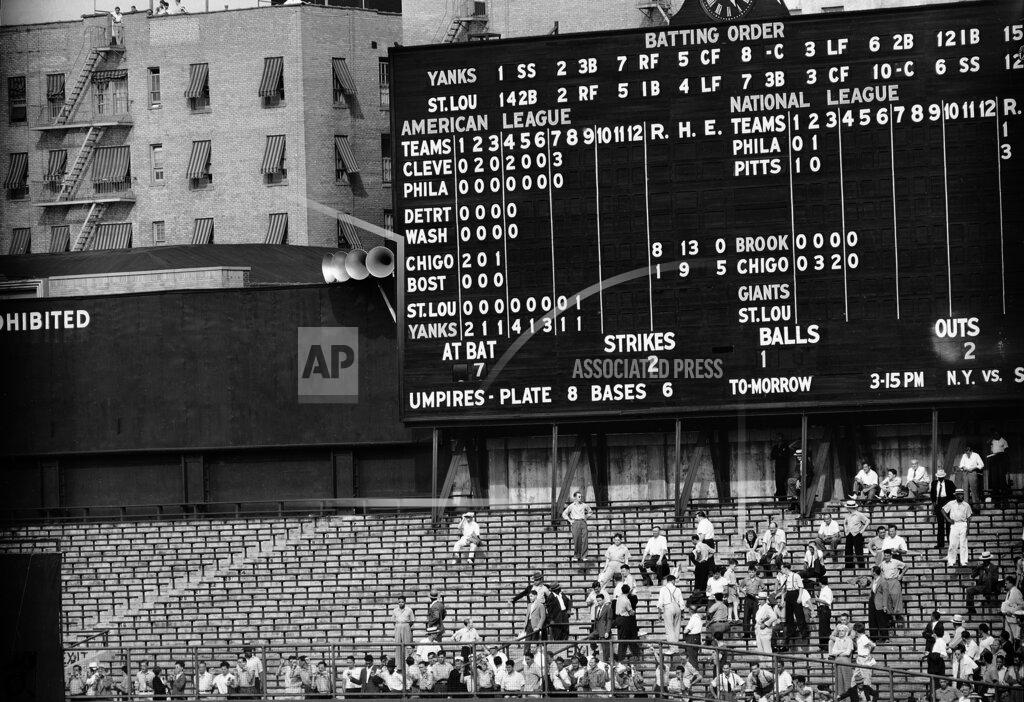
At Yankee Stadium, the Yankees score in all 8 innings to beat the Browns, 14–1. Bill Dickey leads the 20-hit attack by slamming three straight homers. Red Ruffing coasts to the win, allowing 3 Brownie safeties.
After piling up nine errors, the Red Sox settled down today and split a doubleheader with the White Sox by coming from behind for a 6–5 victory in the nightcap. Chicago won the opener, 8–1.
Dizzy Dean recaptures his old form for one day, and pitches the Chicago Cubs to a 10–2 drubbing of the Brooklyn Dodgers.
The New York Giants are held to two hits by rookie southpaw Tom Sunkel, and the St. Louis Cardinals win in a 10–0 rout.
The determined Pittsburgh Pirates strengthened their hold on second place in the National League by taking both ends of a doubleheader from the last-place Philadelphia Phillies today, 3–1 and 5–3.
The Cuban Baseball Hall of Fame was inaugurated, six weeks after its American counterpart.
In a sudden and dramatic move expressive of displeasure over Japan’s course in China, the United States gave formal notice tonight of denunciation of her commercial treaty of 1911 with that country. The Roosevelt administration withdrew from the trade pact of 1911 with Japan in an effort to maintain the status quo in the Far East. Trade between the two countries would be conducted on a day-to-day basis and the Roosevelt administration wanted to apply economic pressure on the Japanese to modify Japanese policies in China. The action is unique in U.S. history since the French Revolution. Japan says the U.S. denunciation move is “unthinkable.”
Termination of the 1911 commerce and navigation treaty between the United States and Japan is “unthinkable,” a Japanese Foreign Office spokesman declared today. He made this comment on the basis of press reports of Washington’s notice of termination, saying that the official notification had not been received. The spokesman added his government had asked its Washington Embassy to expedite details of the United States decision. The spokesman said that for the present he could offer no reason for the Washington move. Aside from making the “unthinkable” characterization he declined to comment.
Officially the Foreign Office in Tokyo professed to know nothing this morning about the action of the United States in denouncing the 1911 trade treaty with this country. It was understood, nevertheless, that a statement was being prepared for issuance this afternoon.
President Roosevelt’s dramatic move in denouncing the 1911 commercial treaty with Japan became. known in London shortly after 4 o’clock this morning, by which time, it is understood, he had assured himself that the negotiations now proceeding in Tokyo between. the British and Japanese Governments would not be prejudiced thereby. The extent of the President’s action was fully emphasized by confirmation of reports that the whole treaty and not merely the most favored-nation clause was denounced. Observers here had noted, in dispatches from China that United States citizens there had been subjected to something of the same kind of treatment that British subjects lately have been enduring. These observers were looking toward Mr. Roosevelt for some reaction to this news when it became known that he and Secretary of State Cordell Hull were in consultation on this point and in communication with London.
Japan and Britain come to an agreement on the first items regarding China. Britain is seen to have given in on vital matters at the expense of defenders. A communiqué on the British-Japanese negotiations was issued today as follows: “Consideration was given to the report of the committee which met yesterday and progress was made in examination of the various questions relating to the efficient maintenance of future peace and order in Tientsin.”
This understates the amount of progress made. The conference’s business concerned methods of cooperation and liaison between the local British authorities in Tientsin and the Japanese Army regarding public order. The conference will meet again tomorrow. The problems are not especially intricate but the existence of a foreign municipality in a war area is itself anomalous and the conference has to devise means of meeting the Japanese Army’s requirements without impairing the Concession’s legal rights. The committee submitted fact finding reports, from which the full conference had to evolve practical measures. The presence of Japanese officers familiar with the actual problems was of great assistance because they could explain the precise object sought by each Japanese proposal.
Their demands were, in general, closely confined to practical requirements, and the proceedings quickly developed a businesslike tone. On several points the two delegates, Foreign Minister Hachiro Arita and Sir Robert Craigie, British Ambassador, reached agreement, but this must be confirmed by their governments.
The principal result of today’s meeting, which for the first time grappled with concrete proposals, was the mutual impression of good faith. Britain did not receive any demands that were not related to local conditions, and Japan found that the British did not oppose proposals where the necessity of them in relation to the maintenance of order and security could be shown. There was a striking contrast between the moderation prevailing at the conference and the ideas each side had formed of the other’s intentions.
China is angry over Britain’s stand and the pact with Japan is condemned.
Japan and the Soviet Union continue to trade conflicting claims in the Khalkhin Gol (Nomonhan) fighting.
In connection with continued fighting on the Mongol border, the Manchukuoan Government today ordered that certain provisions of the Defense of the Realm Act be enforced. These include general air-defense measures, general police measures in accordance with military requirements, restrictions on freedom of speech and publication, prohibition of the possession of rifles or explosives, and restrictions on air, land and water communications. Air battles continue to be reported daily from the frontier in which Soviet-Mongol fliers are always declared hopelessly outclassed. Russian bombers did not appear in the air yesterday, but fifty-nine fighters were reported shot down in two engagements.
The Japanese assert that since the fighting began, they have destroyed 691 Soviet planes, including 103 in the past three days. The third day of ground fighting opened yesterday, according to press dispatches, with a terrific. bombardment of Soviet-Mongol positions in which the superiority of Japanese guns was demonstrated. The Japanese destroyed one of the enemy’s bridges over the Khalka River.
A report of further fighting along the Mongolian-Manchukuoan border in which Soviet-Mongolian ground and air forces are said to have defeated Japanese-Manchurian forces on the Khalkhin Gol River was broadcast here tonight by the Soviet official radio. It was asserted that in three days’ fighting seventy-four Japanese planes and four observation balloons were shot down, while the Soviet forces lost twenty planes. The commander of a Japanese air squadron, Colonel Kovara, was reportedly captured.
Dow Jones Industrial Average: 143.82 (+0.72).
Born:
John Howard, 25th Prime Minister of Australia (1996-2007), in Earlwood, New South Wales, Australia.
Bob Lilly, College and NFL defensive tackle and defensive end (Pro Football Hall of Fame, inducted 1980; NFL Champions, Super Bowl VI, 1971; Pro Bowl 1962, 1964-1973; Dallas Cowboys), in Olney, Texas.
Died:
Billy Murphy, 75, New Zealand boxer (world featherweight champion 1890; first world champion in any class from New Zealand).
Naval Construction:
The Royal Navy Hunt-class (Type I) escort destroyer HMS Pytchley (L 92) is laid down by Scotts Shipbuilding & Engineering Co. (Greenock, Scotland)
The Royal Navy “K”-class destroyer HMS Nerissa (G 65) is laid down by the John Brown Shipbuilding & Engineering Company Ltd. (Clydebank, Scotland). She will later be transferred to the Polish Navy as the ORP Piorun.
The Royal Navy “K”-class destroyers HMAS Napier (G 97) and HMAS Nestor (G 02) are laid down by the Fairfield Shipbuilding & Engineering Co. (Govan, Scotland).
The Royal Navy Hunt-class (Type I) escort destroyer HMS Quantock (L 58) is laid down by the Scotts Shipbuilding & Engineering Co. (Greenock, Scotland).
The Marine Nationale (French Navy) coastal submarine Aurore (Q 192), lead boat of her class of 15 (7 ultimately completed), is launched by Arsenal de Toulon (Toulon, France).
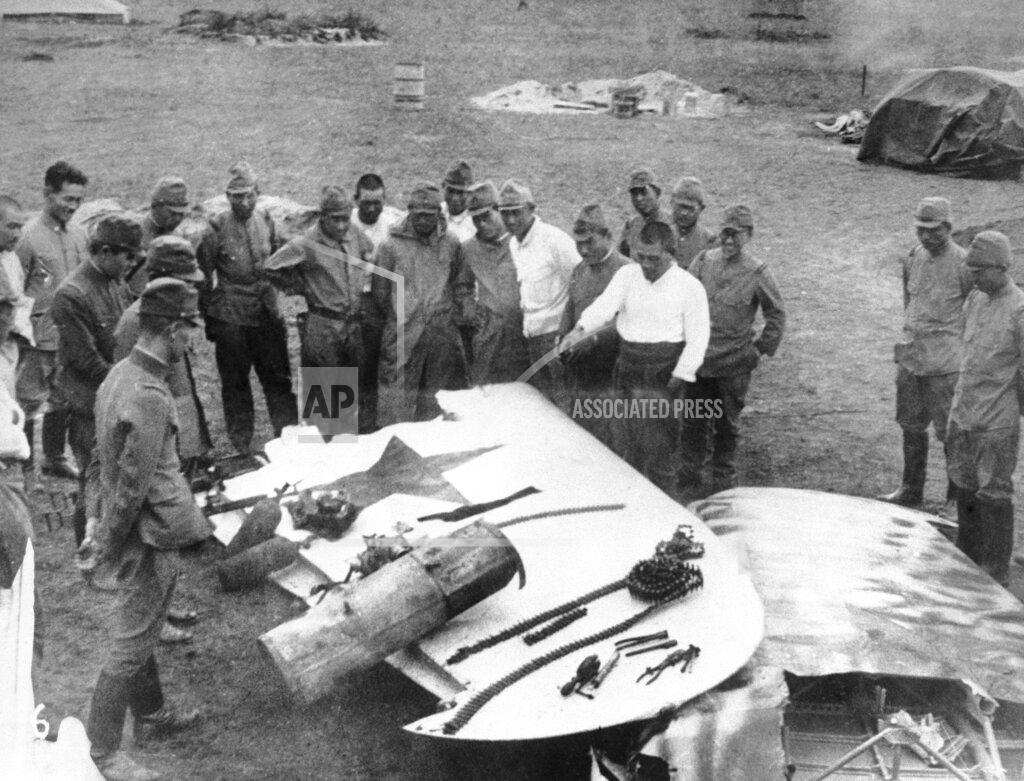
[Ed: Contrary to Japanese (and Soviet) claims, air losses show rough parity in the conflict.]



 History Diaries