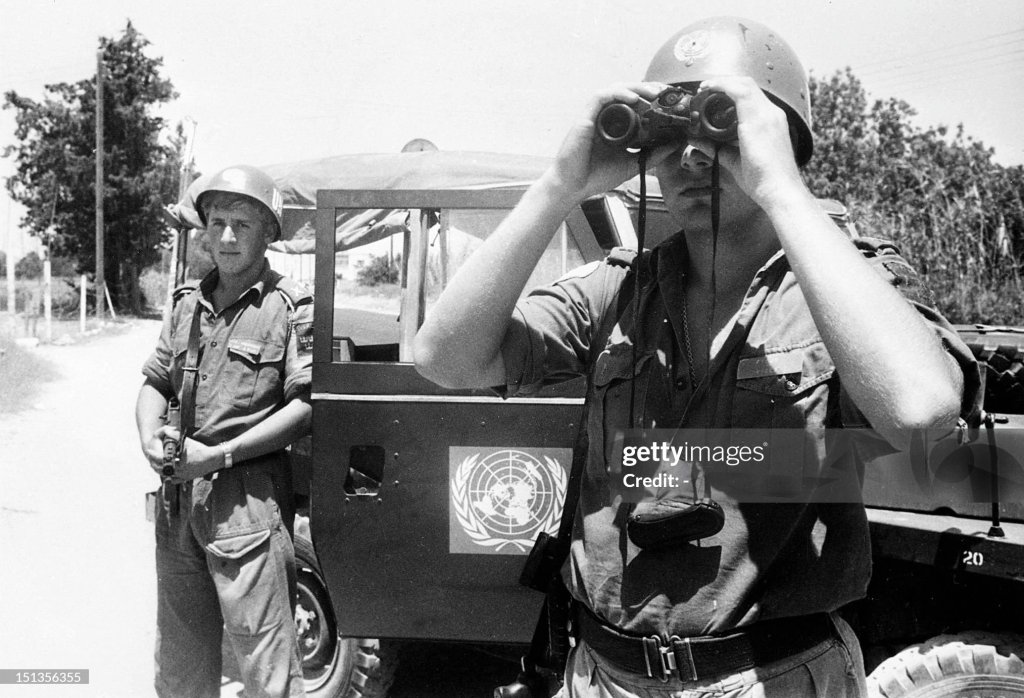
A breakdown in the three-power conference on Cyprus was averted in Geneva tonight. At the urging of Britain’s Foreign Secretary, James Callaghan, Turkey came up with a package proposal that Greece agreed to discuss with the Turkish Foreign Minister, Turan Gunes, tomorrow. Late this afternoon, the Greek Foreign Minister, George Mavros, had said that he could no longer participate in the conference without Turkish assurances that the fighting would be ended.
Scattered fighting in Cyprus broke out between Greek Cypriot and Turkish forces shortly after President Glafkos Clerides charged that Turkey was using the cease-fire as a pretext to expand the territory under her control. He warned that full-scale war could erupt unless the Turks stopped what he called cease-fire violations.
Although Mr. Clerides clearly meant his warning seriously, it was hard to see how the modestly equipped National Guard, which is the Greek Cypriot army, could restrain the Turkish Army if it wanted to continue its advances. The Turks enjoy complete mastery of the air over Cyprus and their land forces are equipped with modern American‐made heavy tanks, mobile howitzers and armored personnel carriers. The National Guard, by contrast, has no air force and only limited amounts of equipment. Given this disparity, Mr. Clerides’s remarks seemed designed primarily to bring additional diplomatic pressure on Turkey to observe the cease fire.
Turkish tanks were seen moving west from Kyrenia along the northern coastal road and in the plain northwest of Nicosia itself. In most cases the Turkish advances were unopposed. But isolated small engagements apparently were fought late this morning and early this afternoon. A. United Nations spokesman confirmed this evening that Turkish tanks had pushed westward from their beachhead near Kyrenia and were advancing on the key Greek Cypriot village of Myrtou, which controls the road between Nicosia and Lapithos. Greek Cypriot National Guard sources reported that a Turkish force with tanks had seized two other Cypriot villages in the mountains south of Lapithos.
Cyprus asked today for an emergency meeting of the Security Council on what she described as violations by Turkish forces of the ceasefire on the island, but the council put the session off. It was decided instead to wait for developments in the peace negotiations begun yesterday in Geneva by Greece, Turkey and Britain. The 15 council members were summoned at 3 PM to take up the Cypriot charges of “continuing and flagrant violations” of the United Nations truce by the Turks. For three hours, the members met behind closed doors, deciding finally to hold off an open meeting until tomorrow. After two more hours of discussion, the members fixed the time for tomorrow’s meeting at 3 PM.
Royal Air Force transport planes have evacuated 7,929 tourists of 48 nationalities from embattled Cyprus to bases in, Britain, an R.A.F. spokesman said today. The transport planes began arriving in England on Sunday. A spokesman said about 200 tourists, remained, awaiting evacuation.
In establishing his civilian cabinet, Premier Konstantine Karamanlis of Greece included several men who were imprisoned during the seven years of military rule. The appointments were followed by an order to the military police forbidding any further arrests of civilians. The new cabinet appointments included several men who are left of center politically and thus eased some complaints over the absence of the non-Communist left in earlier appointments to the cabinet.
In the Soviet Union, the 1,517 delegates of the Presidium of the Supreme Soviet voted unanimously to re-elect Nikolai V. Podgorny as the official head of state (the Chairman of the Presidium), and Alexei Kosygin as Chairman of the Council of Ministers, equivalent to Prime Minister. Podgorny and Kosygin had been nominated by Communist Party First Secretary Leonid Brezhnev, de facto leader of the Communist nation as well as a voting member of the lower house of the Supreme Soviet, the 767-member Soviet of the Union.
The United States is preparing to take up diplomatic relations with East Germany at the embassy level soon, probably next week, according to well‐placed Administration sources. Preliminary talks on diplomatic relations between Washington and East Berlin began 11 months ago. Full‐scale negotiations began July 15 between East Germany’s Herbert Siiss and Arthur A. Hartman, Assistant Secretary of State for European Affairs.
France performs a nuclear test at Mururoa atoll.
Defense Minister Shimon Peres of Israel said today that “we have information that the Arabs are preparing to attack the state of Israel in a matter of months —six, nine or 12 months.” Mr. Peres told a state television interviewer that Israel’s fears of a new attack were founded on “information collected during the past weeks, based mainly on Syria.” He accused Syria of being “extremist, impatient and overflowing with armaments.” He added that Syria’s air force was already stronger than Egypt’s, “while its patience is far shorter.”
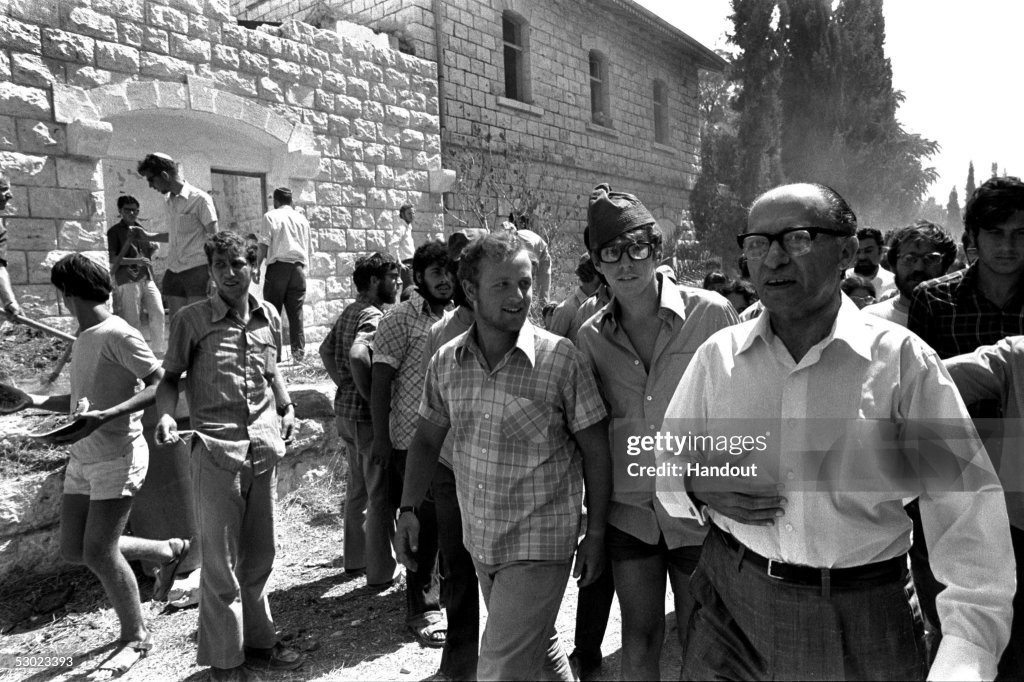
The Israeli Cabinet resolved today to prevent Israeli Jews from setting up a settlement in Israeli‐occupied Jordanian territory in defiance of government policy. However, no action was taken today to break up the encampment established yesterday by squatters eight miles northwest of Nablus, the largest Arab city in the West Bank area. It was clear tonight that the squatters would not be moved during the sabbath, which ends at sundown tomorrow, nor during the 24 hours following, a fast day commemorating the destruction of the temple in Jerusalem 2,000 years ago. Meanwhile, efforts were being made to avert a confrontation between Israeli military forces and the 150 squatters supported by some 2,000 sympathizers, including members of Parliament from opposition parties.
South Vietnamese military sources said yesterday that the North Vietnamese had massed 10,000 to 12,000 troops in an apparent effort to take the district town of Đức Dục, which is within artillery range of Da Nang, the country’s second largest city. Some of the heaviest fighting since the 1973 cease‐fire has raged among the hills around Đức Dục in recent days, with the South Vietnamese claiming to have killed over 1,000 Communist soldiers in intensive air strikes and artillery barrages.
Sources in the Saigon military command said that the battle erupted Wednesday after a three‐pronged South Vietnamese force traveling northwest from Quế Sơn encountered North Vietnamese troops a few miles southeast of Đức Dục. According to the Saigon sources, the North Vietnamese had broken a tacit understanding on which areas were under whose control and had crossed to the east of a line behind which they had remained in relative peace since the ceasefire. The Việt Cộng’s version of the events did not differ greatly from the government’s. A Việt Cộng spokesman in Saigon said that the fighting began July 18 “after the Liberation Army wiped out two positions.” A South Vietnamese Government source identified one of them, saying that rangers had fled from it to Đức Dục.
The Việt Cộng spokesman confirmed that Communist troops had intercepted government reinforcements, but he had no information on his side’s casualties. Saigon’s claims of enemy killed have been treated skeptically in the past. The Việt Cộng said they had shot down two government aircraft, killed or wounded about 500 government soldiers and destroyed six tanks and armored cars. The spokesman also said government gun positions were subjected to heavy shelling.
Communist troops attacked a district capital in the Central Highlands early today, the Saigon command reported. There was no immediate word on the outcome of the pre‐dawn ground attack on the town of Măng Buk, which followed two days of shelling.
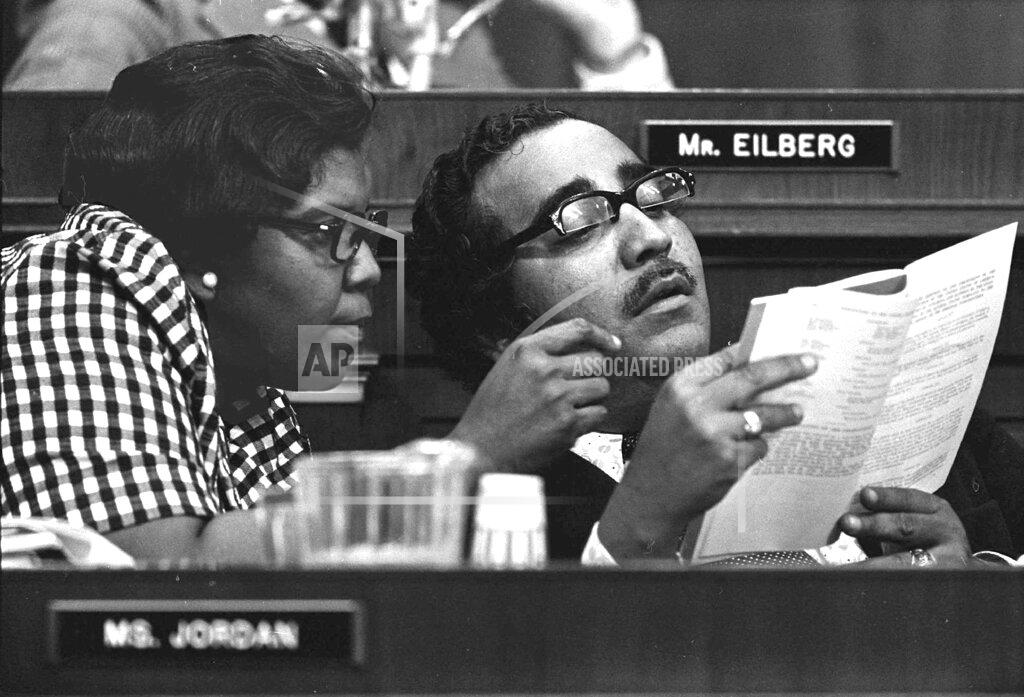
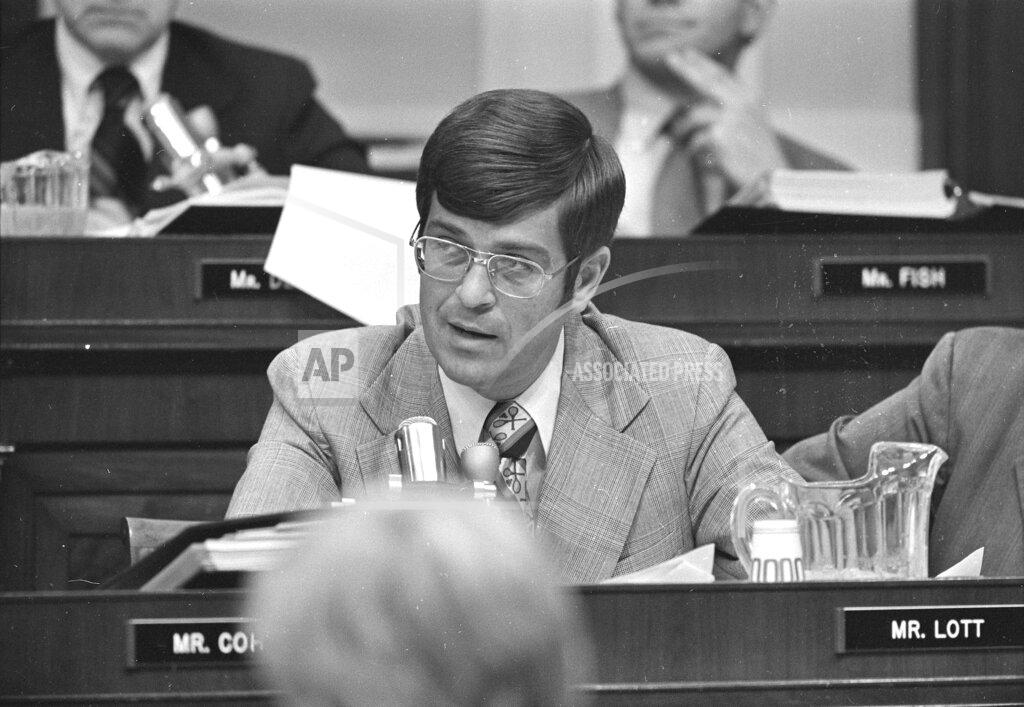
The House Judiciary Committee, 27 to 11, rejected a motion calling for suspension of deliberations until President Nixon could pledge to surrender White House tape recordings as impeachment evidence. But its members then became involved in an argument over the style, rather than the substance, of the first proposed article of impeachment. This put off at least until tomorrow any action on the charge that President Nixon obstructed justice.
U.S. Representative Paul Sarbanes of Maryland, a member of the House Judiciary Committee, introduced the first proposed article of impeachment against U.S. President Richard Nixon on charges of the crime of obstruction of justice.
Under pressure from federal Judge John Sirica, James St. Clair, President Nixon’s chief defense lawyer, tentatively agreed to begin turning over to Judge Sirica the subpoenaed records of 64 White House conversations Tuesday afternoon. This afternoon, at the Western White House in San Clemente, a senior official said that he saw ‘no problems in the arrangement” worked out by the lawyer. Gerald L. Warren, the deputy White House press secretary, said in San Clemente that a draft of a court order embody in the agreement was being sent to the Western White House by Telecopier. Under procedures worked out in District Court here today, Judge Sirica will sign the order once Mr. Nixon signals his agreement.
President Nixon is confident that he will be vindicated when the full House of Representatives considers the articles of impeachment the Judiciary Committee has written against him, a White House spokesman said today. “Our belief is that the House will not vote out a bill of impeachment,” the deputy press secretary, Gerald L. Warren, said. He made it clear that Mr. Nixon was virtually resigned to the likelihood that the panel would recommend impeachment with the support of perhaps as many as six or seven Republican members. Mr. Warren indicated that the President was devoting as little time as necessary to the impeachment matter and relying on aides, particularly his chief of staff, General Alexander M. Haig Jr„ to keep him posted on developments in Washington while he worked at his residence and nearby office in San Clemente, California.
The Commissioner of Internal Revenue has conceded that he handled tax penalties against President Nixon differently from the way the agency normally would for other taxpayers. The disclosure emerged from the 10th volume of the House Judiciary committee’s statements of information on Mr. Nixon’s conduct, which, was made public by the committee in connection with its impeachment proceedings.
Sidney Jones, deputy to Kenneth Rush, the White House economic counselor, said that he hoped consumers would not take President Nixon literally and save an additional 1.5 percent of their income. The President made the suggestion in an economic address Thursday. It was pointed out to Mr. Jones at a news conference that the additional saving would reduce the rate of consumer spending by more than $12 billion a year. Asked if that were what the administration wanted, he replied, “I don’t want to see it. We don’t want a consumer boycott.” Relatively sluggish consumer spending has been a cause of the economy’s slowdown this year.
New York City Controller Harrison Goldin charged that “misleading” information from the staff of his predecessor, Mayor Beame, had led him to believe that long-standing discrepancies in the city’s bank balances had been resolved before he took office. “They knew about the discrepancy, but we didn’t know about it,” he said. This brought a prompt denial from a City Hall spokesman.
Arthur Watson, who built the IBM World Trade Corporation from a new subsidiary, formed in 1949, of the International Business Machine Corporation into a world enterprise, died in the Norwalk (Connecticut) Hospital of injuries suffered in a fall at his New Canaan. home. He was 55 years old. In 1970, he was appointed Ambassador to France, a post he held two years.
Serial killer Paul John Knowles picked the lock of a jail cell in Jacksonville, Florida, where he was being held for assault, broke into a house, and strangled a 65-year-old woman, the first of 18 murders he would commit over the next four months. Three murders followed in August, five in September, three in October and six more in November. The day after shooting a Florida state trooper and a motorist, Knowles would be caught on November 17, 1974, by a civilian in Georgia. Knowles himself would be shot to death on December 18 after attempting to disarm a sheriff.
Gunshots erupted inside the Huntsville State Prison in Texas tonight. A prison spokesman said the leader of three armed inmates holding 11 hostages had refused an offer of transportation out of the prison and refused to surrender. The inmates fired seven shots between 7:45 and 8 PM, according to Ron Taylor, the prison spokesman. None of the hostages were hurt by the gunfire, he said, adding that the prison officials had talked to them by telephone. Fire trucks and ambulances were rushed to a side entrance of the prison. Off‐duty prison guards said the officials were planning to assault the third-story prison library where the three convicts have been holding the hostages and four other inmates since 1 PM on Wednesday. However, Mr. Taylor insisted, “there is no plan on the part of the Texas Department of Corrections to make any aggressive move into that, building.”
Ralph Nader, the consumer advocate, told Congress today that it would be simple for the nation to achieve a zero-growth rate in energy demand. There are all kinds of solutions to the problem of curbing energy demand, Mr. Nader said in testimony before a House Interior subcommittee. He cited the success of the Federal Government’s conservation program which he said had cut energy consumption by 25 percent “largely by walking to switch off switches.”
A teenage girl discovered the body of an unidentified woman at Race Point Dunes, Provincetown, Massachusetts. The identity of “The Lady of the Dunes” would remain unsolved for almost 48 years until 2022, when genetic testing confirmed that she was Ruth Marie Terry (1936–1974), who had been murdered by her husband. Her husband, Guy Muldavin, was officially named as her killer on August 28, 2023. Muldavin had died in 2002.
Three children and a teenager were killed and six persons injured today when a fire swept through a North Philadelphia row house. The police identified the four dead as Adrian Rew, 10 years old; Otis Bradley Jr., 3; Omar Bradley, 18 months, and Clarissa Gardner, 15, a baby sitter.
Two black lung clinics in Pennsylvania’s anthracite region will receive $257,400 from a $5‐million Federal grant made to help men affected with the miners’ disease, a United Mine Workers of America official said Thursday. He said the clinic at the Wilkes‐Barre General Hospital was to get $130,000 and the Vastine Foundation at Shamokin, $127,000.
The Detroit Tigers manage just three hits in 11 innings — but that is just enough, as Jim Northrup singles home Gary Sutherland with the only run of the game, and the Tigers down the Cleveland Indians, 1–0. Joe Coleman pitched the whole game for Detroit, allowing only four hits and striking out seven.
The ascending New York Yankees kept the pressure on their pitching staff and defense last night until they broke open their bats in the late innings for a 5–1 victory over the Milwaukee Brewers. Pat Dobson, the hard‐luck hurler on New York’s mound crew, made the most of a slim lead before leaving in the seventh and won his eighth game against 12 losses to help sweep the two‐game series at Shea Stadium.
The Texas Rangers blasted Chicago pitching for 16 hits, including a pair of doubles by Cesar Tovar, and ended Jim Kaat’s personal seven‐game winning streak with a 10–6 win over the White Sox. Jim Bibby, with late-inning relief from Steve Foucault, earned his 14th victory against 12 losses. Bibby allowed eight hits, including a pair of two‐run homers by Carlos May. Kaat gave up six runs and seven hits in three innings. The White Sox committed five errors.
Billy Williams clubs a 6th inning grand slam to pace the Chicago Cubs to 10–7 victory over the visiting Philadelphia Phillies. Jim Lonborg (12–10) was the loser, giving up 10 hits in 5⅔ innings. Rick Reuschel worked six innings for the Cubs to pick up his 10th triumph in 17 decisions.
That strong performance from Tom Seaver for which the New York Mets have yearned for weeks materialized in Busch Stadium tonight in the form of a 3–0 victory over the St. Louis Cardinals, and it sent the New Yorkers flying home in a positive frame of mind. Seaver gave up just four hits and struck out five. It was his first appearance in three weeks and his first complete game in almost two months.
Larry Milbourne scores in the 11th on a fielder’s choice to give the Houston Astros an 8–7 triumph over the Los Angeles Dodgers. Roger Metzger has three hits and raps into the game-winner when the throw home by Davey Lopes is late. Cesar Cedeno socks two home runs and drives in four. His 79 RBIs lead the league while his 21 home runs are just one shy of ex-teammate Jim Wynn for the top spot in that category.
The San Francisco Giants edged the Cincinnati Reds, 5–4. The Giants scored five runs in the third inning with Steve Ontiveros and Ken Rudolph contributing two‐run singles. Jim Barr, with help from Elias Sosa, posted his eighth victory against five defeats. The Giants got four hits and took advantage of three walks in their big inning to snap Don Gullett’s five‐game winning streak.
Dow Jones Industrial Average: 784.57 (-11.11, -1.40%).
Born:
Moe Williams, NFL running back and kick returner (Minnesota Vikings, Baltimore Ravens), in Columbus, Georgia.
Tim Terry, NFL linebacker (Cincinnati Bengals, Seattle Seahawks), in Hempstead, New York.
John Williams, NFL defensive back (Baltimore Ravens), in Hammond, Louisiana.
Bubba Wells, NBA shooting guard (Dallas Mavericks), in Russellville, Kentucky.
Peter Nordström, Swedish NHL centre (Boston Bruins), in Munkfors, Sweden.
Died:
Arthur K. Watson, 55, President of IBM World Trade Corporation and former U.S. Ambassador to France, died eight days after being fatally injured from a fall at his home in Connecticut.
George Barr, 82, American Major League Baseball umpire.
Floyd H. Nolta, 74, American airplane pilot and inventor who developed (in 1955) the first successful method of dropping water from an airplane for fighting forest fires.
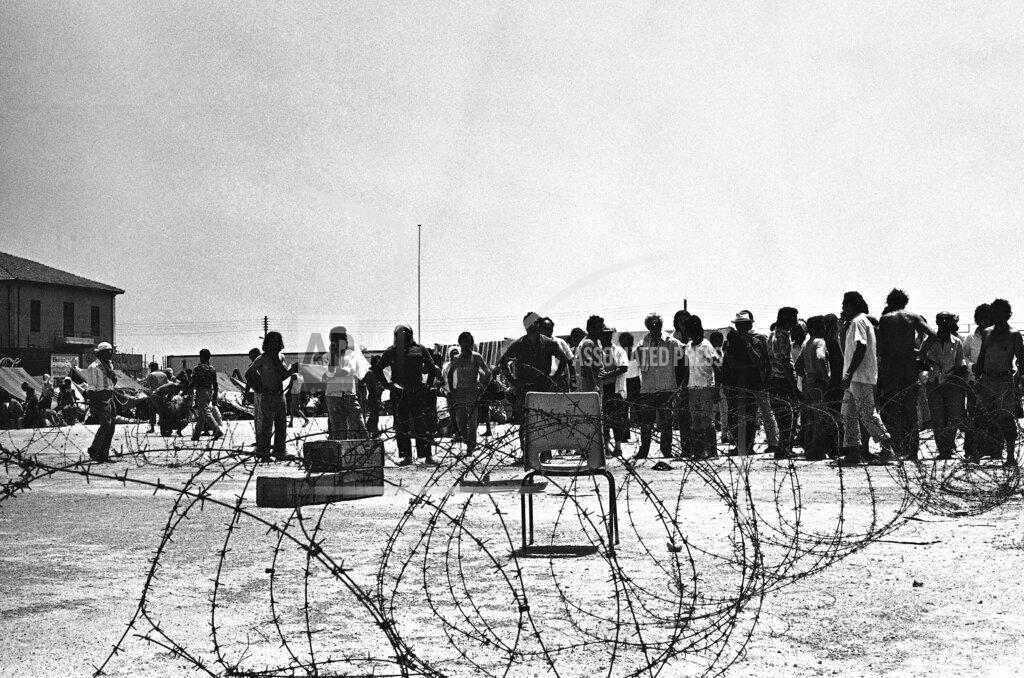





 History Diaries