Premier Nguyen Khanh has appealed to the leaders of 34 countries for material support in the war against Communist guerrillas. His request, conveyed in personal letters, followed the establishment of a committee to coordinate foreign aid. “The whole population and the Government of Vietnam are at this moment facing a crucial test,” General Khanh wrote. Additional aid is required, he said, because “of a considerable expansion of the means and forces brought into play by the aggressors.” “This guerrilla war has now become a real war,” the Premier added.
The letter went to the premiers of Argentina, Australia, Austria, Belgium, Brazil, Britain, Canada, Nationalist China, Ceylon, Denmark, West Germany, Greece, India, Iran, Ireland, Israel, Italy, Japan, Jordan, South Korea, Luxembourg, New Zealand, Norway, Pakistan, Panama, the Netherlands, the Philippines, Portugal, Spain, Sweden, Switzerland, Thailand, Turkey and Venezuela. Many of the countries General Khanh addressed already supply economic and specialized assistance such as medical teams, engineers and other technicians. Two of the countries — Australia and New Zealand — have sent small military contingents to serve alongside American advisers.
Hanoi Radio charged in a broadcast that American ships had fired upon North Vietnamese fishing craft, making the first assertion of United States aggression against North Vietnam.
The honeymoon is over for Major General Nguyễn Khánh and South Vietnam. It was a shotgun marriage to begin with, though none of the guns actually had to be fired that day in January when General Khánh seized power in Saigon. This week, after six months in power, some of the accumulated strains of the Khánh regime plainly showed. They are not so much strains in the actual Vietnamese and American war effort in the countryside — pacification programs that might have been stillborn are now incubating with occasional outbursts of liveliness. They are rather strains in Saigon in the Government itself. They are great enough to make the hitherto confident Premier Khánh wonder whether he is capable of carrying on — and his own doubts are shared by many around him. The sequence of the week’s events is important. On Sunday, General Khánh went before a mass meeting in downtown Saigon and placed his government on the side of those who favor an extension of the anti‐Communist war into North Vietnam. This policy is known here (and it can be taken only in a figurative sense) as the “March to the North.”
Wednesday, the commander of the Vietnamese Air Force, Air Commodore Nguyễn Cao Kỳ, stood before a news conference and put an open secret into the official record: South Vietnamese commando teams have already been sent on intelligence and sabotage missions inside North Vietnam. This has been true for years as Commodore Kỳ stated and for years it has met with virtually unqualified failure, as he did not state.
With this acknowledgement, American diplomats who had been trying to play down the earlier statements decided enough was enough. Thursday morning Ambassador Maxwell D. Taylor, flanked by Deputy Ambassador U. Alexis Johnson and other high American officials, went into a joint staff conference with Premier Khánh and some of his chief lieutenants. What was the meaning of the South Vietnamese Government statements, General Taylor inquired politely. As General Khánh knows and the Ambassador hardly needs to point out American policy is opposed to an extension of the war, and the United States certainly questions the wisdom of acknowledging the intelligence operations publicly. Premier Khánh’s reply startled the assembled Americans with its bluntness: the March to the North may not be American policy, but it is now South Vietnamese policy. A cautious “clarification” of Commodore Kỳ’s remarks made public after the Thursday meeting did not change that point.
What is Premier Khánh’s real problem? It is not the indiscretion of an air commodore nor is it a profound feeling that the Vietnamese brothers under Hanoi’s Communist rule must be liberated. The cry for a March to the North is only that — a cry — until the United States offers active support. No one seriously expects the students who shouted so loudly in the Saigon square to actually stir from their coffee houses to face the army of North Vietnam.
After six months in the post, Premier Khánh’s problem is that he is fed up. He says it in so many words to officials, both foreign and Vietnamese, and to friends, all within the last week. He feels utterly isolated and let down by all around him, people from whom he thinks he should have had support and cooperation—the civilian politicians and officials who he wishes would help him govern, the Army officers, and now the United States, which does not bolster him in the dramatic new policy line he launched. The politicians and officers do not deny that they are withholding their wholehearted support—their attitude is that the 37‐year‐old field commander was presumptuous in expecting he could command a whole nation as he did an army corps. The politicians including — indeed especially — Premier Khánh’s own Deputy Premier Nguyễn Tôn Hoàn, are openly demanding that the general step down and allow a civilian government to take over.
The meaning of last week for American policy is that the goal of internal stability in South Vietnam looks more remote now. The first spat does not end the marriage, but when the ties were so tenuous to begin with a little misunderstanding is a dangerous thing.
The South Vietnamese Government handed France today a coldly worded note of regret for a student raid on the French Embassy Monday. The ministry expressed regret for the damage to a French War memorial by students on Sunday, and for the invasion of the embassy by about 50 students Monday night. The government also offered to pay damages, although it said it was not responsible for either incident. “These incidents,” the note said, “came about under special circumstances, at a time when the French chief of state had shown sympathy for the neutralization of Vietnam — a policy that Vietnamese public opinion has not ceased to judge incompatible with the higher interests of the nation.”
The Saigon Government announced tonight that it had repealed the Family Law enacted under President Ngô Đình Diệm, who was ousted last November. The law’s provisions included a ban on divorce. It prohibited polygamy and gave wives property rights with their husbands. A decree regulating marriage will remain in force until a new civil code is enacted by the government. No details were given, but divorce laws will presumably be liberalized.
A Laotian neutralist source said that Communist‐led forces crossed the rain‐swollen Nam Ngum River today south of Phou Kout, about 11 miles east of Muong Soui on the Plaine des Jarres. Muong Soui is the neutralists’ last stronghold on the plain. They have been under attack by Pathet Lao forces. The Nam Ngum is part of the neutralist defense line. Communist‐led reinforcements were said to estimated at three battalions, with some North Vietnamese and “shock troops” moving in from the east. A military communiqué said these reinforcements suffered losses in an attack by Government fighter‐bomber planes.
Indian Prime Minister Lal Bahadur Shastri went back to work today after a month’s illness to face a critical food shortage that has reached starvation proportions in some regions. The Prime Minister, who suffered a mild heart attack June 26, is returning amid reports of hoarding, black marketeering, long food lines and protests over spiraling food prices. The leader’s illness came 17 days after he had taken office. The country’s battle against the ever‐present threat of starvation is entering a new and critical phase.
The immediate problem is that last season’s supplies of wheat, rice and other food grains have been nearly used up. It will be at least late October or early November before the next harvest begins to reach the market. Foreign countries, principally the United States, have been rushing grain to India. But Indian ports have all but broken down under the increased traffic. Once ashore, the imported grain strains the facilities of the railroads, motor transportation and the entire flimsy fabric of the Indian distribution system.
The conference of American foreign ministers early today ordered sanctions against Cuba by a vote of 15 to 4. Mexico, Chile, Uruguay and Bolivia voted against measures to punish Havana for its aggression against Venezuela last year. However, Bolivia, which switched her vote from an abstention in a preliminary test last night to the negative vote this morning, announced at the same time, that she would abide by the conference orders. The sanctions call for mandatory severance of diplomatic and consular relations between the American states and the regime of Premier Fidel Castro, although the only countries that now have such ties are those that voted against the sanctions resolution.
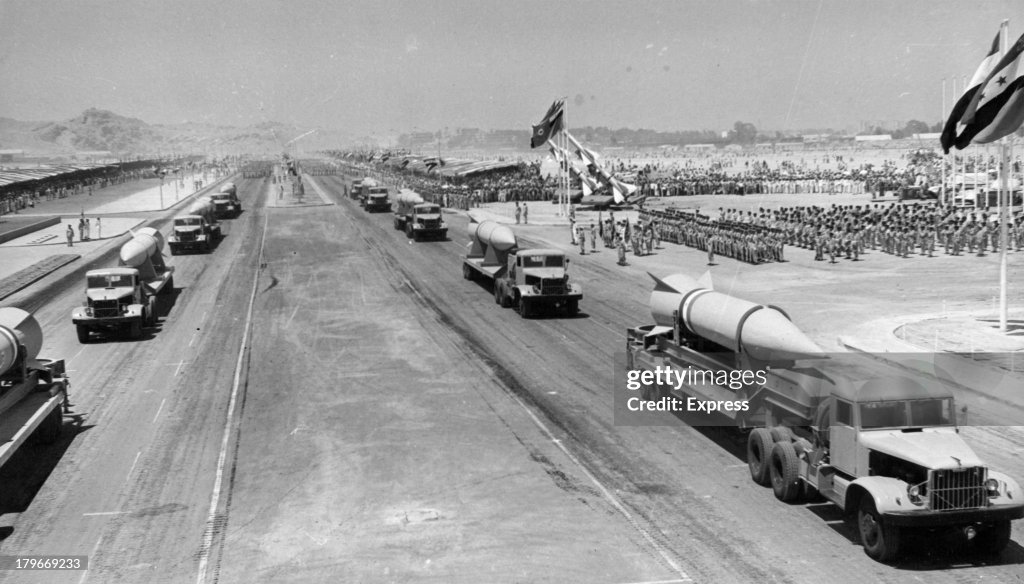
France is planning the construction of a super Mirage bomber with longer range and greater low-level flight performance. Prototypes of this aircraft have already been ordered. It would be an improvement on the Mirage‐4, now reaching the French Air Force in sufficient numbers to give France a credible nuclear military capacity. By the end of 1966, it is expected that France will have at least 75 Mirage‐4’s, all equipped with atomic bombs. Military sources concede that Soviet nuclear missiles are probably zeroed in on the Mirage airfields, each of which has a runway at least 6,000 feet long.
Despite the Government’s satisfaction with the performance of the Mirage‐4 and its atom bomb, France is pushing the production of other means of delivery and of hydrogen bombs. A single basic missile, called the SSBS, for firing from submarines and from land sites is being developed. This missile will have a range of 2,000 to 2,500 miles and will be armed with a hydrogen‐device warhead.
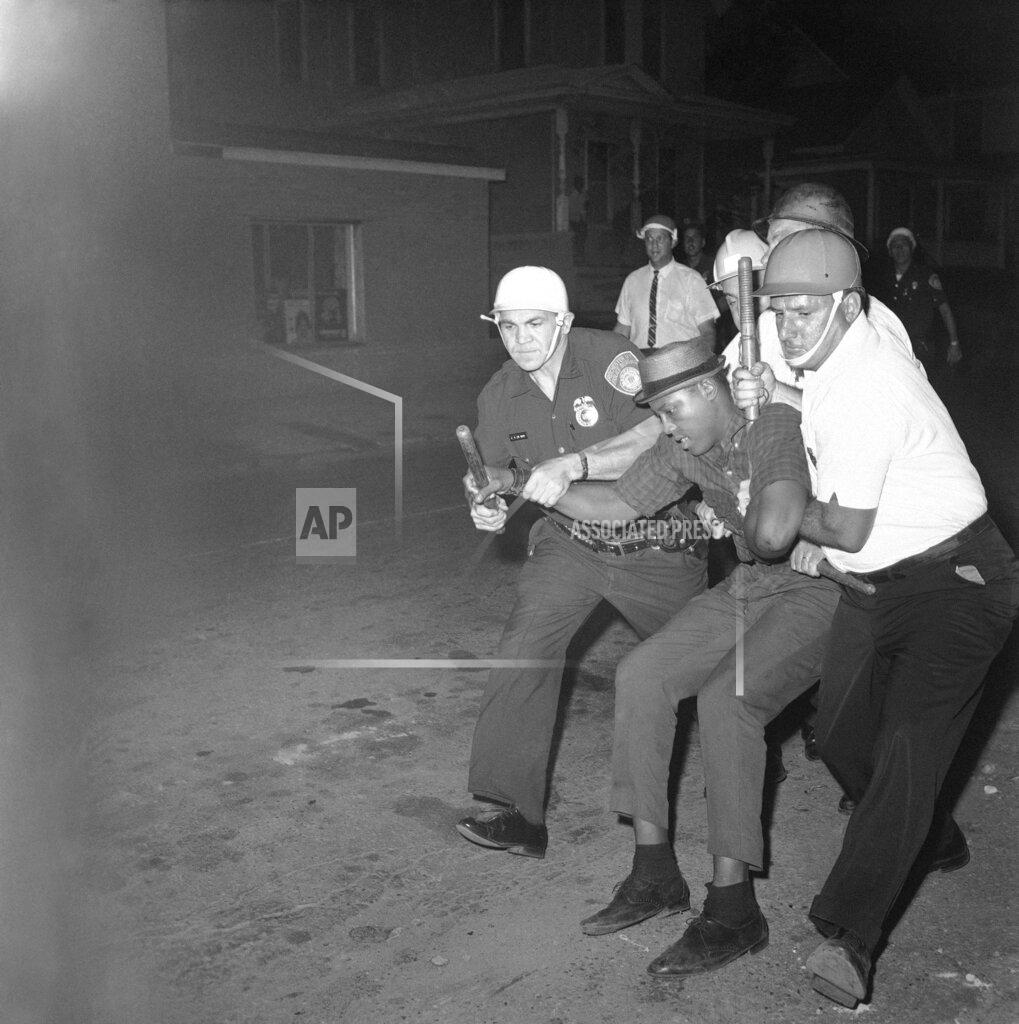
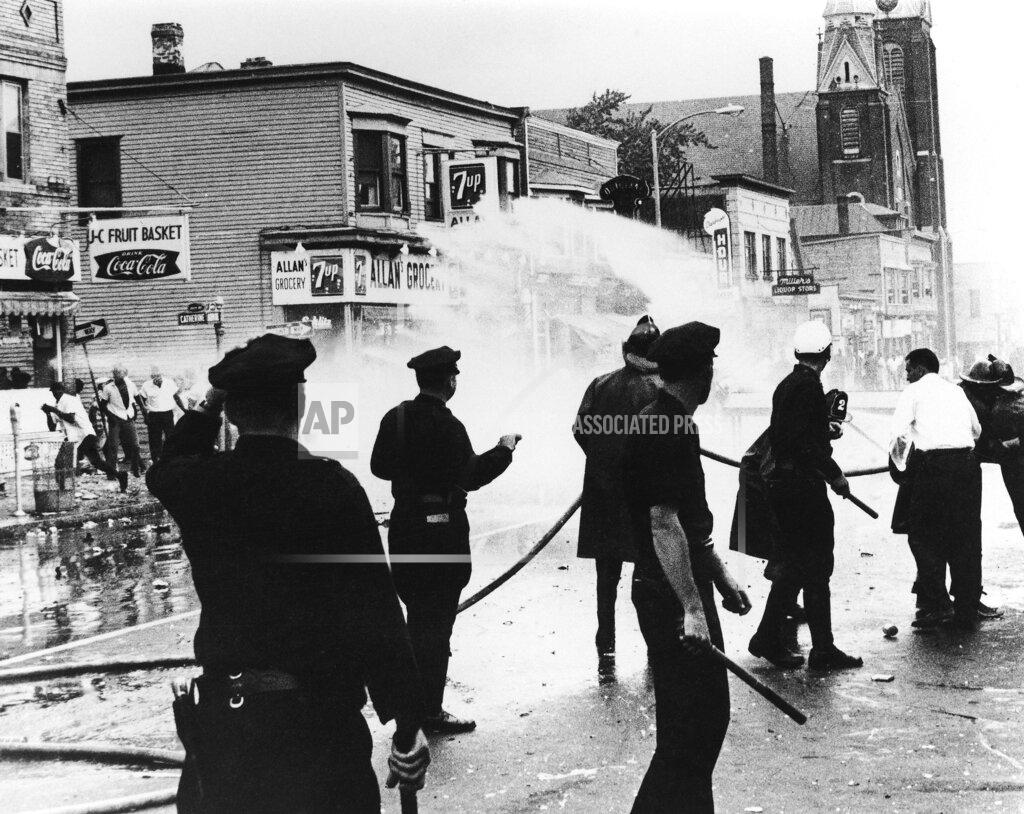
Widespread rioting and looting by Blacks broke out in Rochester, New York last night for the second time in 24 hours. An elderly white man was killed and a number of people were injured. The fighting erupted shortly after an 8 PM citywide curfew ordered by city officials went into effect. Seven hundred steel‐helmeted policemen, including 100 state troopers, joined in trying to quell the violence. At least four policemen were reported to have been injured. By 3 o’clock this morning, the fighting was still going on and was moving rapidly toward the main business district from the integrated residential area on the southwest side where it began. A steady stream of prisoners arrived at police headquarters in radio cars. At least 100 were arrested.
Shortly before midnight, in the midst of the rioting, Mayor Frank Lamb said in a television broadcast that he would name a committee to study five Black demands “as soon as order is restored in our community.” As the Mayor spoke, the police were using tear gas and firing shots into the air to try to halt the violence. Small demonstrations erupted constantly in different sections of the city. There were reports that Blacks were firing shotguns and pistols into the air. Looting spread into white and other integrated neighborhoods. Merchandise was taken away in cars. Objects too heavy to carry were destroyed. Some merchants used guns to defend their stores. In the Central Park section, a white jeweler fired five shots at looters. He did not know if they had been struck. Generally, however, white residents were not fighting Blacks.
The scene of the new rioting was along Jefferson Avenue, Bronson Avenue and Cady Street, a white residential area that has recently seen an influx of Blacks. The Joseph Avenue Black section, where the rioting took place Friday night and early yesterday, is more than a mile to the northeast. It was quiet last night, but early this morning about 25 Black youths threw bottles at the police. The state troopers, who were requested by the city earlier, rushed to the southwest side in buses when the rioting began last night. Fire trucks were also sent to the scene. Showers of bricks thrown from roofs by Blacks greeted the fire and policemen. Front yards were filled with jeering people throwing stones and bottles.
Tonight’s outbreak was centered on the intersection of Jefferson and Bartlett Streets, a neighborhood of well‐kept homes. Black residents, some holding cans of beer, hooted and jeered at the police as they moved in military formation down the streets. Groups of Blacks were reported speeding from one part of the city to another in autos, smashing windows and looting shops. Two white men in an auto were arrested for carrying guns. The police found a shotgun and a rifle in the car. Another rifle was found strapped under the car. Police investigated reports of looting in the Central Park section, west of the new outbreak. On Jefferson Avenue, boulders were placed across the street to keep out the police. One patrolman was struck on the ankle by a brick and limped out of formation. The interiors of a restaurant and grocery nearby were virtually destroyed by looters. All the windows were shattered and furniture and merchandise were hurled into the street.
While virtually the entire white community of Rochester professed astonishment at the rioting, Black leaders pointed out that racial antagonism had been smoldering here for more than a year. Issues producing the greatest interracial friction have been allegations of police brutality, a protracted lawsuit involving Black Muslims, and an effort to effect racial balance in the public schools. Charges of police brutality reached a peak in February, 1963, when a Black, A. C. White, was hospitalized after his arrest for a traffic violation. Mr. White said he had been beaten by four policemen.
A month earlier, 15 members of the Black Muslims had been arrested at a meeting. The policemen said they were attacked when they broke into the meeting to investigate a report that a man was illegally carrying a gun. The Muslims contended that the policemen had intruded without cause into a closed religious meeting. After protracted litigation, including a mistrial, the 15 were placed on probation last April following the suspension of four‐year prison sentences. These cases led the City Council, on March 26, 1963, to create a Police Advisory Board, with the function of investigating charges of police brutality.
The police blocked a proposed protest march in Harlem yesterday by arresting two of the leftists who had organized it. Leaders of the anti‐police demonstration had insisted on proceeding with it despite a ban by Police Commissioner Michael J. Murphy, a Supreme Court injunction obtained by the city and the opposition of nearly all Harlem organizations. The march had been planned by the Harlem Defense Council, an offshoot of the Communist-controlled Progressive Labor Movement. City officials had feared that the demonstration would precipitate renewed violence in Harlem. Those arrested were William Epton, 32 years old, the council’s leader and a self‐described disciple of the Chinese Communists, and his lawyer, Conrad J. Lynn, 55, who has a long record of associations with left‐wing movements.
As Mr. Epton and Mr. Lynn attempted to rally a small band of followers at the comer of Lenox Avenue and 116th Street at about 4:20 PM, patrolmen wearing helmets and brandishing nightsticks pushed their way through the crowd. A Black policeman said to the two men, who are also Blacks, “You’re under arrest,” and led them to a squad car. They were taken to the West 126th Street police station and charged with disorderly conduct. Later they were arraigned in Night Court before Judge Bert Koehler Jr., who released both men, Mr. Lynn without bail and Mr. Epton in $1,000 bail. They were ordered to appear at a Criminal Court hearing on August 7.
Harlem and the Bedford-Stuyvesant section of Brooklyn, which were torn by rioting last week, were quiet early today. Reinforced police patrols were on duty in the area between 116th and 135th Streets in central Harlem. Yesterday afternoon, Governor Rockefeller issued through his office in Albany a statement deploring the racial unrest in New York and Rochester. He promised to use “every legal means” to maintain order in the state. Mayor Wagner met for about two and a half hours with a delegation of 30 civil rights leaders at Gracie Mansion. Later he left for his summer home in East Islip, Long Island, without issuing a statement.
The Federal Bureau of Investigation and the special services squad of the New York Police Department have big dossiers on the Harlem Defense Council and its sponsors, the Progressive Labor Movement. The files show the movement, which organized yesterday’s abortive march, is a hardline, Left Communist group that has instigated half a dozen disorderly demonstrations in the few years it has been operating. The so‐called council is a paper organization, a catch‐all front set up by the Progressive Labor Movement, which operates out of the Harlem center of the movement, called the Harlem Progressive Labor Club.
About half the Republican liberals and moderates in Congress are now planning to give at least nominal support to Senator Barry Goldwater in his campaign for the Presidency. Four Republican Senators and two Representatives have publicly disassociated themselves from the party’s national ticket. Several others may do so before the campaign gets formally under way. Ultimately, however, it appears that the Arizona conservative will win endorsements, though reluctant or cool for the most part, from a sizable majority of his Congressional colleagues who are identified with the party’s more liberal wing. In most cases, party loyalty and an aversion to aiding the Democratic Presidential ticket seem to be outweighing the antipathy of moderates and liberals to Senator Goldwater and his running mate, Representative William E. Miller of upstate New York.
People seldom are neutral about Milton Friedman, Paul Russell Snowden Professor of Economics at the University of Chicago. Like Senator Barry Goldwater, who reads and admires his work, Professor Friedman collects disciples, not mere followers. And like the Republican Presidential nominee, the economist is an eloquent rhetorician. He supports the Senator and corresponds with him, Professor Friedman said last week. But he minimizes his role as an adviser to the candidate. “My connection is rather casual,” he said in a telephone interview.
Because of this friendship, the Brooklyn‐born educator — a small bald man who will celebrate his 52nd birthday next Friday — seems certain to become better known between now and November. So does his “fixed-throttle” theory of money. That is the characterization one monetary student gives to Professor Friedman’s notion that the money supply should be increased by a fixed percentage each year, close to the 4 percent by which the money supply has grown in the last century. As the apparent high priest of economic liberalism in the 19th‐century meaning of the term, Professor Friedman would do away with Government business regulations, subsidies and controls, which he regards as impediments to the operation of a free‐market society.
He takes no offense at suggestions that he would return to the world of Adam Smith. “That was a world that never existed, an intellectual world of free markets, of free trade and individual liberty,” he said. “I think it is preferable to the previous world — the mercantilist world—to which many present-day economists wish us to return.” In the field of money, to which he attaches great importance, he would remove all discretion from the Federal Reserve. Eventually, he would eliminate the central banking system. Its itchy foot on the gas pedal, he contends, has added substantially to ups and downs in the economy. On the international front, Mr. Friedman would do away with fixed exchange rates, the Treasury’s guarantee to buy and sell gold at the fixed price of $35 an ounce, and the prohibition against purchases and sales of gold by individuals.
A Federal jury resumed today its deliberations in the fraud and conspiracy trial of James R. Hoffa, president of the International Brotherhood of Teamsters, and six associates. After 7 hours 20 minutes, the jurors quit for the day without reaching a decision. They will return tomorrow at 9:30 AM to continue. Hoffa, who is free on bond, left the Federal Building soon afterward in a jaunty mood, whistling a tune.
A 10‐year‐old Bethlehem, Pennsylvania girl was praised today by President Johnson for “a job well done.” The girl, Kim Shortell, started a neighborhood campaign last April 7 to collect funds for the victims of the Good Friday earthquake in Alaska. She collected $1,300.
The Ranger 7 spacecraft was reported in top working condition today for a scheduled Monday launching on a picture‐taking mission to the moon. Its cameras are designed to snap and transmit 4,000 closeup photos of the lunar surface before the spacecraft crashes on the moon. Scientists need the pictures in planning for manned lunar landings before 1970. The launching is scheduled between 12:32 and 2:40 PM, Eastern daylight time, but scientists have six days to try the shot before the moon moves out of position. If the Ranger is fired Monday, it should hit the moon at midmorning Thursday.
Meredith Wilson’s musical “Here’s Love”, based on the film “Miracle on 34th Street”. closes at Shubert Theater, New York, after 338 performances.
Beatles’ album “A Hard Day’s Night” goes #1, stays #1 for 14 weeks.
The Minnesota Twins tie an American League record by using 9 pitchers in a 13-inning game they lose 6–5 to the Chicago White Sox. Mike Hershberger singled across two runs in the 13th inning today to give the White Sox the triumph over the Twins. Hershberger’s single off Dick Stigman came after the White Sox had filled the bases on three walks. Gerry Fosnow walked J. C. Martin and Tom McCraw, and Stigman walked Floyd Robinson. The rally overcame a one‐run lead the Twins had taken in their half of the 13th on Jerry Zimmerman’s single. Zoilo Versalles hit a homer off Hoyt Wilhelm in the Twins’ 12th, but the White Sox tied the score in their half when Bill Skowron singled in Pete Ward from second. Fosnow (0–1) is the loser; Don Mossi (2–1) — the 5th Chicago pitcher — is the winner.
The New York Yankees, who were the victims of an eight‐run inning by the Detroit Tigers last night, came out swinging today with an eight‐run second inning of their own as they rolled to a 14–2 victory. The Bombers raked three Tiger pitchers for 13 hits and 12 runs in the first two innings before 21,077 startled fans in Tiger Stadium. Before the game was over, they had scored their biggest total of runs for the year on 20 hits, the most in one game by an American League team this year. About the only thing that matched the Yankees in fury was a violent thunderstorm that struck during the second inning and threatened to wash away the 12–0 lead the Yankees had built. Play was halted for 48 minutes before the storm abated and the game was resumed.
Jerry Adair’s run‐scoring single capped a four‐run rally in the eighth inning that gave the Baltimore Orioles a 5–4 victory over the Washington Senators tonight. The triumph kept the firstplace Orioles one game ahead of New York in the American League race. Sam Bowens delivered a key single in the uprising, driving in two runs with two out and the bases filled. His hit came off Ron Kline, who had just relieved Bennie Daniels. The Orioles filled the bases on singles by Earl Robinson, Boog Powell and Brooks Robinson.
At Connie Mack Stadium, Ken Boyer hits two homers, including his second grand slam of the week, as the Cardinals take a comfortable 10–2 lead into the bottom of the 9th. The Phillies then plate 7 runs, ending the game when John Herrnstein hits a sac fly that turns into a double play with an out at second base. Alex Johnson debuts for the Phils with 3 hits.
Tracy Stallard acted for all the world yesterday as if he were a Bob Feller or a Lefty Grove and Met hitters swung like Joe DiMaggio, Johnny Mize, Hank Greenberg and other old‐time slugging heroes. Casey Stengel’s New York Mets forces, who may have got a tip or two before the game, trounced the Milwaukee Braves, 10–0.
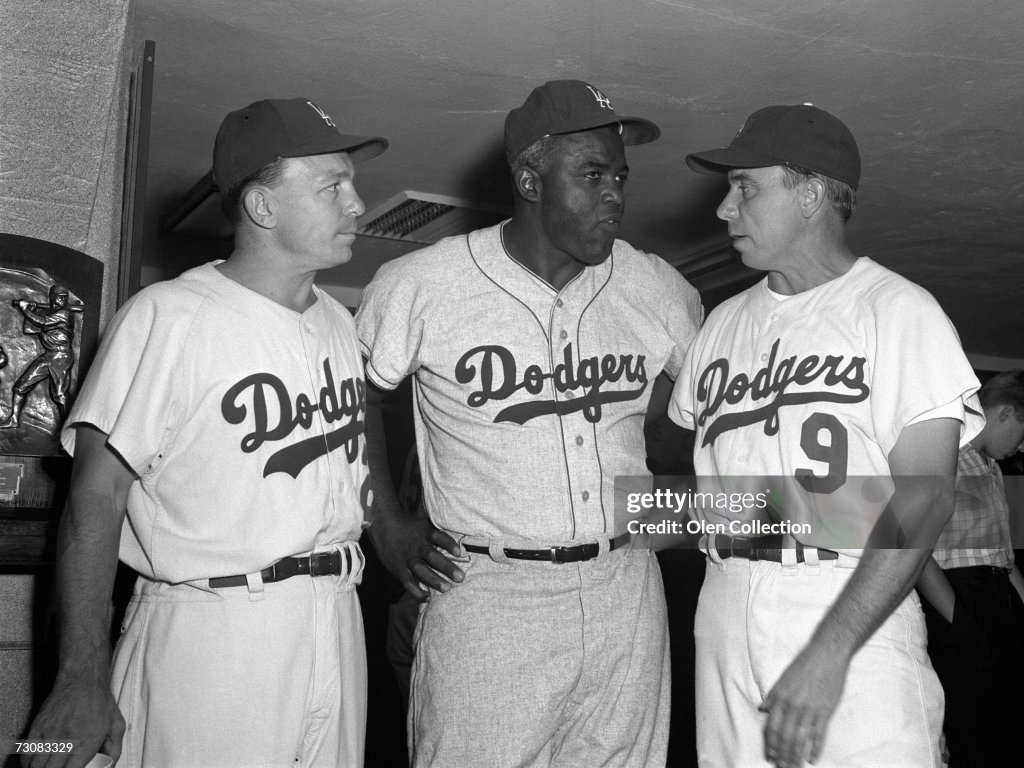
Bob Miller, making only his second start of the season, beat San Francisco for the first time in his career tonight as the Los Angeles Dodgers defeated the Giants, 7–4. Miller pitched a three‐hitter through eight innings, but needed relief help from Ron Perranoski and Phil Ortega in the ninth when the Giants rallied for all their runs. Frank Howard drove in three runs for the Dodgers with his 20th homer and fifth against San Francisco this year. Willie Davis knocked in two runs with a pair of singles.
Eddie Kasko rifled a double in the eighth inning tonight that drove in two runs and gave Houston a 5–3 triumph over the Chicago Cubs. Kasko’s double off Bob Buhl with two out knocked in Joe Gaines, who had started the inning with a single, and Walt Bond, who had sacrificed but reached first on a fielder’s choice. The Colts scored three runs in the fourth when Mike White doubled in two runs and then came home on Kasko’s single. The Cubs tied the game at 3–3 in the sixth on doubles by Billy Cowan and Ron Santo and Ernie Banks’s single. Santo hit a homer in the second for the Cubs’ first run.
Born:
Tony Granato, Team USA and NHL left wing (Olympics, 1988; NHL All-Star, 1997; New York Rangers, Los Angeles Kings, San Jose Sharks), in Downers Grove, Illinois.
Doug Marrone, NFL guard, center, and tackle (Miami Dolphins, New Orleans Saints), in New York, New York.
Eric Jeffries, NFL defensive back (Chicago Bears), in Springfield, Missouri.
Lisa LaFlamme, Canadian news anchor for CTV National News; in Kitchener, Ontario, Canada.
 History Diaries