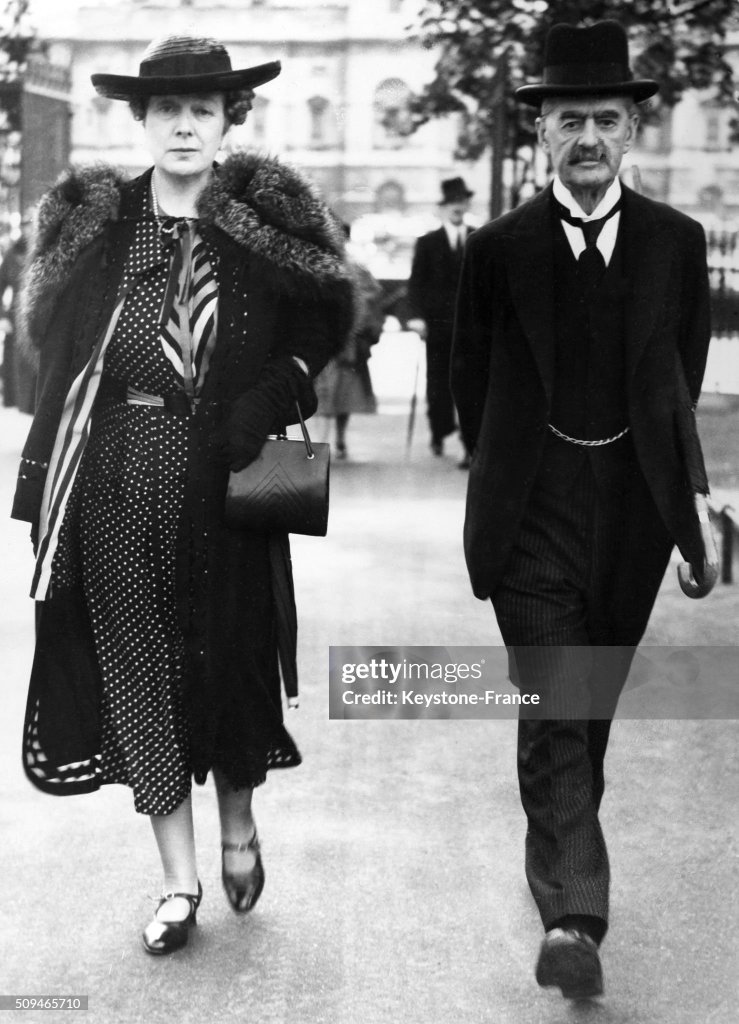
The British House of Commons hears the Tokyo plan; little opposition is expected. British Prime Minister Neville Chamberlain informed the House of Commons that the government had reached an agreement with Japan that “the Japanese forces in China have special requirements for the purpose of safeguarding their own security and maintaining public order in regions under their control and that they have to suppress or remove any such acts or causes as will obstruct them or benefit their enemy.” The British government, Chamberlain explained, had “no intention of countenancing any act or measures prejudicial to the attainment of the above-mentioned objects by Japanese forces.” Chamberlain denied opposition suggestions that Britain was now on the side of Japan in its war against China.
During the reading of a bill designed to crush IRA activities, Home Secretary Samuel Hoare announced the police discovery of a document known as S-Plan. Hoare read excerpts from the document that included plans to sabotage airplane and munitions factories and damage supplies of water and electricity. The Irish Republican Army campaign of bombings throughout Britain is being “closely watched and actively stimulated by foreign organizations,” Sir Samuel Hoare, Home Secretary, told the House of Commons tonight, appealing successfully for passage of a bill giving the government wider powers to deal with terrorists.
“I would ask the House not to press me for details,” the Home Secretary said. “It would not be in the public interest to divulge them, but the House must accept my assurance that these are not unchecked suspicions founded on gossip, but definite conclusions reached. on reliable facts.” Sir Samuel could not mention the name of any country but most of his listeners assumed he was talking about Germany. Especially did they think so when he went on to remind the House that if “we are faced with war or an emergency of some kind” in August or September terrorist outrages would immeasurably increase the danger of sabotage.
Terrorists came within an inch of blowing up the important Hammersmith Bridge over the Thames, the Southwark power station, the aqueduct that carries the Grand Union Canal over the North Circular Road on the outskirts of London, Sir Samuel said. Their plans, he went on, are directed against important bridges, railroads, munition dumps, airfields, and even the Houses of Parliament. The last was greeted with a roar of laughter.
Sir Samuel devoted much of his speech to a description of the “S Plan,” which the police seized early this year. “It is not the kind of irresponsible melodramatic document that one sometimes discovers in these. police searches,” he said. “It is a carefully worked-out staff plan, the kind of plan that might be worked out by a General Staff, setting out in detail the way in which an extensive campaign of sabotage could be successfully carried out against this country.”
Yesterday’s Reich loan talks are not official, Prime Minister Chamberlain says. Prime Minister Neville Chamberlain ended a week-end of sensational rumors and still more sensational public statements by one of the minor members of his government with the announcement in the House of Commons this afternoon that “there is no proposal for a loan to Germany.” Robert S. Hudson, Secretary of the Department of Overseas Trade, who yesterday announced that he has been talking with “a representative of the German Government” [Dr. Helmuth Wohlthat] about a loan and other ways to restore Anglo-German friendship, escaped without a public rebuke. It is understood he will retain his post.
The Prime Minister did not deny the comprehensiveness of the draft plan for limitation of armaments, peace and economic cooperation that Mr. Hudson worked out here. last week with Dr. Wohlthat. But he explained that Mr. Hudson had made it clear throughout that he was “only expressing his personal view” and that “restoration of international confidence is a necessary preliminary” to the realization of any of these ambitious hopes.
It was left to Arthur Greenwood, deputy Labor leader, to draw from Mr. Chamberlain the further statement that the Cabinet had no knowledge that such matters were being discussed and that “it is not the intention of His Majesty’s Government to initiate any discussions of the kind referred to.” In his formal statement to the House of Commons Mr. Chamberlain had contented himself with dry official verbiage, but he assented to Mr. Greenwood’s interpretation of it as meaning that “there is no intention on the part of His Majesty’s Government now to begin discussions which might look like a bribe to Herr Hitler in order to buy peace.”
The principal damage from the incident, as the British realize, would be for the Nazis and the rest of the world to think that was what Mr. Hudson was up to. The German press already has denounced the proposals, and, as there is at present little prospect that a “restoration of international confidence” will take place, it is not difficult to estimate how remote. are the chances that anything tangible will result from Mr. Hudson’s bold enterprise.
The Danzig Nazi leader, Albert Förster, declared anew tonight “our unshakable belief that Adolf Hitler will lead these 400,000 countrymen separated from the Reich into the motherland.”
Nazis seize all property of Johann Strauss’s family. The Waltz King’s relics go into a museum. The Vienna municipality has decreed that the entire personal estate and music rights of Johann Strauss 2nd are the property of the city.
Trieste expects new life as a Reich port. But the deal is said to be purely commercial, with no military involvement. If Germany is preparing to take over Trieste or a substantial part of it in the near future and establish here shipbuilding yards and submarine stations and even an air base there is no physical indication of such a development at present.
Italy seizes the property of Albania’s former King Zog and accuses him of pillage, theft, and outrages.
Spanish sources in Paris believe the demotion of Generals Juan Yagüe and Gonzalo Queipo de Llano by Generalissimo Francisco Franco is bringing about a long-delayed showdown between two forces that have contended since 1937 for control of the Nationalist movement. General Franco was said by these. sources to have taken extraordinary measures to strengthen his army and police control to prevent any political unrest from flaring into open clashes.
On one side, Information gathered in Paris indicated, stands General Franco’s brother-in-law, Ramon Serrano Suñer, Interior Minister, with the entire Falange Español and a few army leaders backing his program of a strict dictatorship closely tied to Rome.
On the other side stand the Carlists, who want a monarchy, most of the “old school” army officers, and numbers of dissatisfied elements whose strength has been increased by a post-war shortage of some foods in parts of Spain.
Generals Queipo de Llano and Yagüe, according to reports here, never attempted to hide their sympathy with the latter group. They were removed from their commands last Friday. General Queipo de Llano from his command in Andalusia and General Yagüe from his command of the Moroccan Army Corps. Both the civil war heroes were reported to be in Burgos Province, though General Yagüe was said to have declared on leaving his Moroccan Corps that his absence would be short.
General Queipo de Llano, after his outspoken radio talks were halted by General Franco’s orders near the end of the war, frequently made violent statements expressing discontent with the way the ascendant Falangistas were running the nation, according to reports of Spaniards in Paris.
In a speech at Seville recently he bitterly attacked the Falangistas for mismanagement of the government and for food shortages, and called the present government “unjust.” General Franco, unable to ignore the speech, banned the newspaper ABC, the only newspaper to carry the address, and called General Queipo de Llano to Burgos for a conference.
A turn for the better seems to have occurred in the Moscow negotiations for an Anglo-French-Russian pact of mutual assistance.
The Rev. Gerould R. Goldner, kidnapped Ohio pastor in Palestine, was reported released by Arab abductors last night, but he had failed to appear at dawn today. However, watchers did not give up hope.
The Senate received the Banking and Currency Committee’s favorable report on the Administration’s $2,490,000,000 lending program, debated the proposed new treaties with Panama and recessed at 7 PM until 11 AM tomorrow. Its Immigration Committee approved the Holman resolution authorizing $50,000 for an investigation of the immigration problem.
The House debated the Lea Transportation Bill, passed the Administration resolution authorizing the Secretary of War and the Secretary of the Navy to aid American republics in their armament program and adjourned at 5:50 PM until noon tomorrow. Its Rules Committee deferred action on requests to bring the Steagall Housing Bill and the Steagall amendments to the Home Loan Bank Act to the floor at once.
Congressional leaders began applying the lash in dead earnest today in a new effort to adjourn the present session by the middle of next week. This latest adjournment drive was announced by Senator Barkley in the Senate this afternoon, after he had been assured that the Administration’s $2,490,000,000 “works financing” bill would be taken up tomorrow. The majority leader intimated that all other important legislation would be jettisoned, except a last-hour Deficiency Appropriation Bill, and those measures already on their way through the mill.
The Senator’s announcement is expected to intensify rather than break up a number of combinations of Senators and Representatives being formed for the purpose of making final rushes for enactment of certain “pet” bills. The pressure for amendments to the wage and lay-off sections of the recently enacted relief appropriation had already become so great that the Senate Appropriations subcommittee arranged a meeting for tomorrow to consider a number which already have been presented and referred to it.
A drive was gaining headway, too, for adding a new $350,000,000 outright public works plan to the new lending program when it reaches the floor of the House and Senate. And a group of Senators were trying desperately to force a vote on a bill providing six new District Court judges and two Circuit Court judges. The measure in question was debated for several hours today, but then was laid aside on motion of Senator Barkley to proceed to consideration of the Panama treaty.
Simultaneously, William Green, president of the American Federation of Labor, issued a statement setting forth the measures for which his organization would urge adoption before Congress ends. Among them were the Murray amendment to the WPA Act, restoring the prevailing wage principle on relief projects; the Starnes bill, carrying the newly proposed $350,000,000 PWA program; amendments to the Housing Act now pending in the House, providing authority for the United States Housing Authority to borrow an additional $800,000,000 for slum-clearance and housing projects; and certain amendments to the Walsh-Healy act, providing wage standards on government contracts which already have passed the Senate.
Mr. Green deplored the legislative situation under which it is now apparent that no amendments to the Wagner Labor Act will be enacted at this session. He insisted, however, upon final votes on these other measures before the end of Congress.
Desultory interest on the part of the Senate, which has delayed for three years the ratification of a treaty with Panama designed to perfect the original treaty of 1903 governing the rights of the United States in the Canal Zone, resulted in another failure to act late today for lack of a quorum.
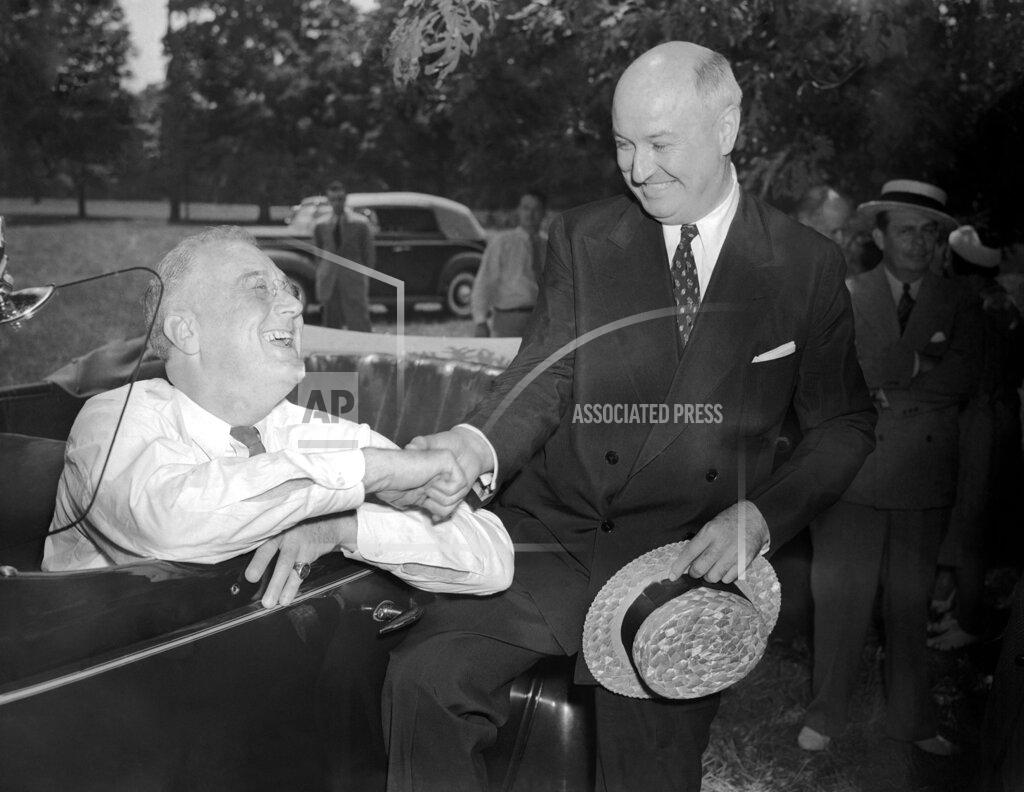
President Roosevelt sought today to discourage persistent reports that he was at loggerheads with Postmaster General James A. Farley on matters of administration political strategy and that they had reached the parting of the ways on the question of a third term in the White House. With Mr. Farley smiling at his side after the ceremonies that marked the transfer to the government of the site of the Roosevelt library on the family estate here, the President endeavored particularly to spike speculation on the political significance of their talks last night and this morning which observers believed would have a bearing on the fate of the Democratic party in 1940.
Newspaper photographers had made their pictures of the President and Mr. Farley when Mr. Roosevelt summoned White House reporters to the side of his open car to volunteer the information that his talk with the Democratic National Chairman was just another of those conferences which they had been holding for the past eleven years.
Their conversation last night and again this morning had been along the same tenor as the chats they began in 1928, said the President. If there was any story in their meetings, past and present, it was that they had shown effective results and that, in Mr. Roosevelt’s opinion, they would continue to be effective in the future. With this one remark, apparently intended to allay suspicions of an impending split in the political partnership that brought him and his chief vote-getter to Washington in 1933, President Roosevelt made his first observation on persistent reports that Mr. Farley had told Democratic Senators and others that he would do all in his power to block any attempt to renominate his “chief” for the Presidency in 1940.
The impromptu press conference began when the Postmaster General approached the President to ask him within the hearing of all present if he did not wish to tell in his presence about their conversations. Mr. Farley was in a hurry to get started for New York City and departed before the President finished his remarks. His only comment was given in an off-hand manner to reporters who had approached him before the press conference. He said that he had had a very interesting and constructive conversation with Mr. Roosevelt, but that Mr. Roosevelt would do all of the talking about it.
President and Mrs. Roosevelt signed today a deed transferring to the Federal Government twelve acres of the family estate as the site for a library to house more than 6,000,000 of the Chief Executive’s official documents and manuscripts.
Tool and die workers of Fisher Body plant No. 1 in Flint went out today on the twentieth day of the strike of skilled employes of General Motors Corporation, called by the C.I.O. United Automobile Workers of America.
Hope that the WPA strike situation might be adjusted satisfactorily before the end of the week was expressed by New York Mayor La Guardia yesterday after a conference with American Federation of Labor spokesmen at the Summer City Hall.
A broad bill by Senator La Follette designed to outlaw “oppressive labor practices” was reported favorably to the Senate calendar today by the Committee on Education and Labor.
Fred Brenckman, legislative representative of the National Grange, told the Senate Labor Committee today the National Labor Board was “flouting the clear intent of Congress” in its rulings pertaining to agriculture.
The money lure of professional football became too great today for Sid Luckman, Columbia University triple-threat star of last season. Luckman, 194-pound back, signed a two-year contract with the Chicago Bears of the National League.
The Detroit Tigers release oft-injured Dixie Walker. He signs with Brooklyn, with whom he will have his most productive years.
Argentina claims Antarctic land in the conflict with Britain and the United States. Argentina is preparing vigorously to oppose any attempt by the United States to extend the Monroe Doctrine into the Antarctic regions as a result of the new expedition to be led by Rear Admiral Richard E. Byrd. At the same time, it will dispute British claims to the South Orkneys, South Georgia, South Shetland Islands, Graham Land and all other islands in the vicinity of the Weddell Sea. One of the strongest reasons for Argentina’s opposition to the Monroe Doctrine has always been that the United States did not apply the Doctrine to prevent Britain from occupying the Falkland Islands in 1833 after they had been settled by Argentines. Argentina has always refused to recognize Britain’s sovereignty over the Falkland Islands, which appear on all Argentine maps as Argentine territory under the name of the Malvinas Islands.
Soviet Russia tonight rejected a Japanese memorandum of April 27 that alleged obstructionist tactics against Japanese oil and coal concessions in the northern half of Sakhalin Island and in turn complained of a long list of violations by the Japanese.
Japanese dispatches from Hsinking, Manchukuo, today asserted that 1,000 Soviet Russian-Outer Mongolian troops had crossed the Khalka River into Manchukuoan territory and precipitated heavy fighting with Japanese-Manchukuoan forces. The region, southeast of Lake Bor, has been the scene of sporadic clashes since May 11 over conflicting claims on the location of the Manchukuo-Outer Mongolia boundary. The Japanese say the Khalka River marks the frontier; Russians say the line lies east of the stream.
The Japanese reports said large-scale aerial combat also resumed and asserted that forty-four Soviet bombing and combat planes were shot down by Japanese aviators. The Hsinking reports said the Japanese lost only four airplanes in the clash. The forty-four Russian craft reported downed, they said, were made up of forty-two of seventy combat planes and two of sixty bombers in the fleet. An intensified artillery duel was continuing, the dispatches said. They reported that fifty of 100 tanks of the Soviet-Outer Mongolian forces were damaged by Japanese artillery fire.
The Japanese Army in Manchukuo reported today that Mongol troops had strengthened their foothold on the east bank of the Khalka River yesterday in the fighting between Mongol-Soviet and Japanese-Manchukuoan forces along the border between Manchukuo and Outer Mongolia. The Mongols, the Japanese reported, sent 2,000 infantrymen and 100 tanks to reinforce the remnants of the forces already stationed on the east bank of the river. The reinforcements were said to have been protected by artillery and aerial fire and to have run into a Japanese counter-offensive of heavy artillery and infantry units in the most vigorous flare-up of the border warfare in the past week.
[Ed: The truth is that a major Japanese attack is bogging down as the Japanese both take and inflict heavy losses. The attack will be abandoned tomorrow, and a month of stalemate follows, as General Zhukov builds up his forces for a decisive, crushing blow.]
Britain concedes to Japan the right to security in China, denying its belligerent status. Japan is suspicious of the British course of action. A recognition of the “special requirements” of the Japanese Army in China and a certain amount of cooperation with that army have been agreed upon as a formula upon which the British and the Japanese can negotiate a settlement of the Tientsin dispute, Prime Minister Neville Chamberlain told the House of Commons today.
The text of the formula approved by both governments as announced by Mr. Chamberlain is as follows: His Majesty’s Government in the United Kingdom fully recognize the actual situation in China where hostilities on a large scale are in progress and note that as long as that state of affairs continues to exist the Japanese forces in China have special requirements for the purpose of safeguarding their own security and maintaining public order in the regions under their control and that they have to suppress or remove such causes. or acts as will obstruct them or benefit their enemy.
His Majesty’s Government have no intention of countenancing any acts or measures prejudicial to the attainment of the abovementioned objects by the Japanese forces and they will take this opportunity to confirm their policy in this respect by making it plain to British authorities and British nationals in China that they should refrain from such acts and measures.
Those who inquired as to what this formula meant were told at Whitehall that it was admittedly ambiguous but that it should not be interpreted for one minute as meaning either a recognition that war existed or an extension of belligerent rights to Japan by Britain. Officials called particular attention to Mr. Chamberlain’s reply to supplementary questions in the House of Commons that the formula did not mean any change in the British attitude toward the Sino-Japanese conflict.
Foreign Secretary Viscount Halifax made a similar speech in the House of Lords and repeated an earlier statement by Mr. Chamberlain that the British would not have their foreign policy dictated by any other nation. To that attitude the government strictly adheres, Lord Halifax said. But while willing to publish this formula, with its almost infinite implications, the British insisted that it was not any more than a basis on which the Tientsin affair could be negotiated — or, at least, any more than, as Mr. Chamberlain said, a recognition of fact. Within the Japanese lines in China lie British concessions and colonies which, according to the government’s argument, Britain refuses to allow to become anti-Japanese centers.
The United States Government views with concern the increasing number of cases of violence against Americans by the Japanese military in China, Secretary of State Cordell Hull said today.
Dow Jones Industrial Average: 144.18 (-0.53).
Born:
Walt Bellamy, Team USA and NBA center (Pro Basketball Hall of Fame, inducted 1993; Olympic gold medal, 1960; NBA All-Star 1962-1965; NBA Rookie of Year 1962; Chicago Packers-Zephyrs-Baltimore Bullets, New York Knicks, Detroit Pistons, Atlanta Hawks, New Orleans Jazz), in New Bern, North Carolina (d. 2013).
Pete Nicklas, AFL tackle (Oakland Raiders), in Akron, Ohio.
Barry N. Malzberg, American sci-fi author (Revelations, Beyond Apollo), in New York, New York.
Naval Construction:
The Royal Navy Fiji-class (Crown Colony-class) light cruiser HMS Gambia (48) is laid down by Swan Hunter and Wigham Richardson Ltd. (Wallsend-on-Tyne, U.K.); completed by Wallsend.
The Вое́нно-морско́й флот СССР (ВМФ) (Soviet Navy) Project 7U-class (Storozhevoy-class) destroyer Skory (Скорый, “Fast”) is launched by Zhdanov (Leningrad, U.S.S.R.) / Yard 190.
The Вое́нно-морско́й флот СССР (ВМФ) (Soviet Navy) Minsk (Project 38)-class flotilla leader Tbilisi is launched by Marti Yard (Nikolayev, U.S.S.R.) / Yard 198.



 History Diaries