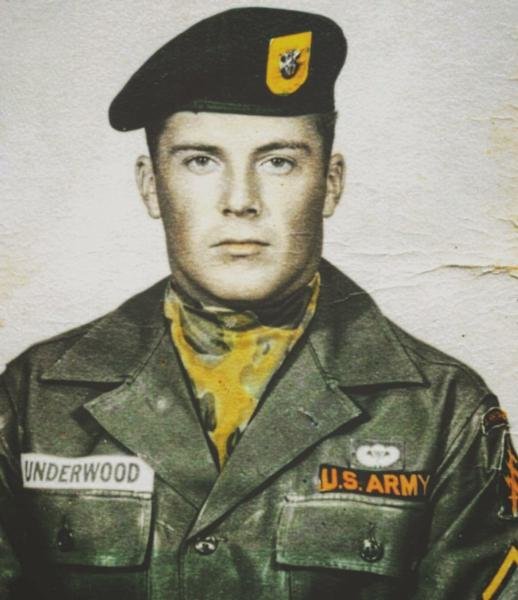
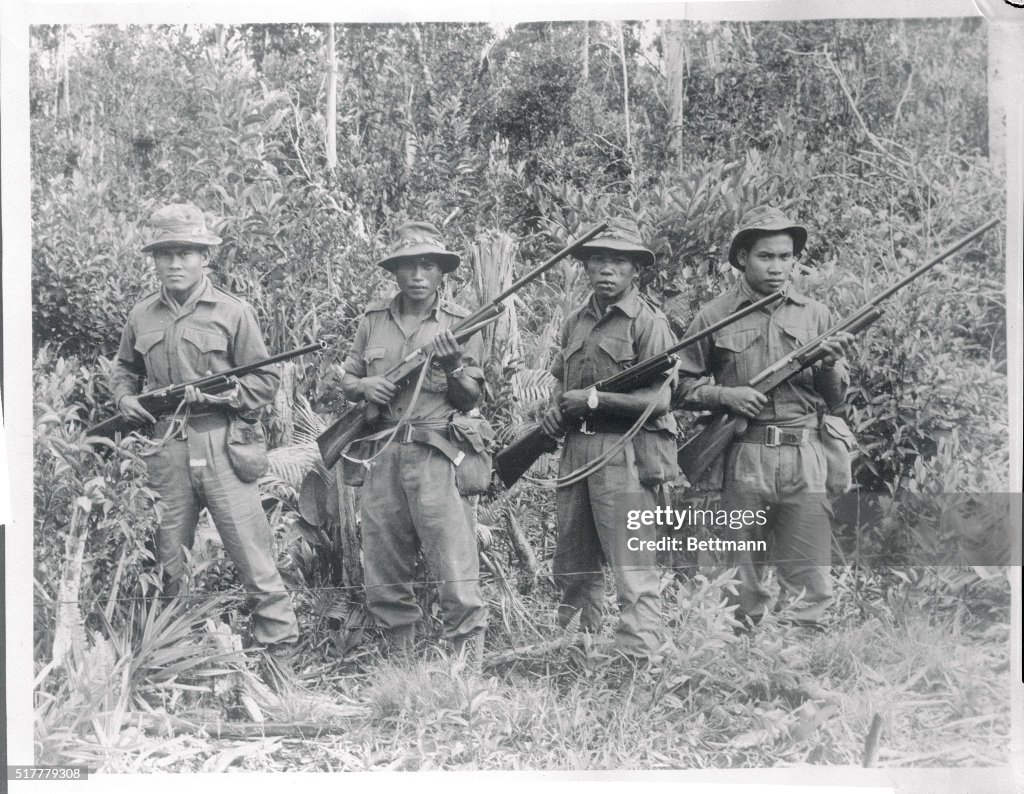
On July 23, 1964, SP4 Underwood was leading a convoy carrying building materials that had been picked up in the mountain town of Buôn Ma Thuột for a school. The SF team also picked up some Chinese Nungs that the U.S. military hired as laborers. The Nungs were not armed. There was also a platoon sized armed CIDG (Civilian Irregular Defense Group) Vietnamese Strike Force personnel for security. While heading back to the base camp at Boun Brieng, traveling along Hwy QL 14, in Darlac (Đắk Lắk) Province District, they entered a well-orchestrated ambush site consisting of a battalion sized element of NVA and Viet Cong soldiers. SP4 Underwood was killed along with twenty-four Vietnamese Strike Force personnel.
George is buried at Mount Wollaston Cemetery, Quincy, Norfolk County, Massachusetts. He is remembered on the Wall at Panel 1E, line 59.
An American Special Forces enlisted man was shot dead late tonight and a United States officer was wounded when Communist guerrillas ambushed a unit moving to a forward outpost in South Vietnam’s central highlands. An American Spokesman said Vietnamese casualties were expected to be high in the clash, the fourth ambush so far this week. Earlier today a powerful Communist unit ambushed a South Vietnamese mechanized relief force.
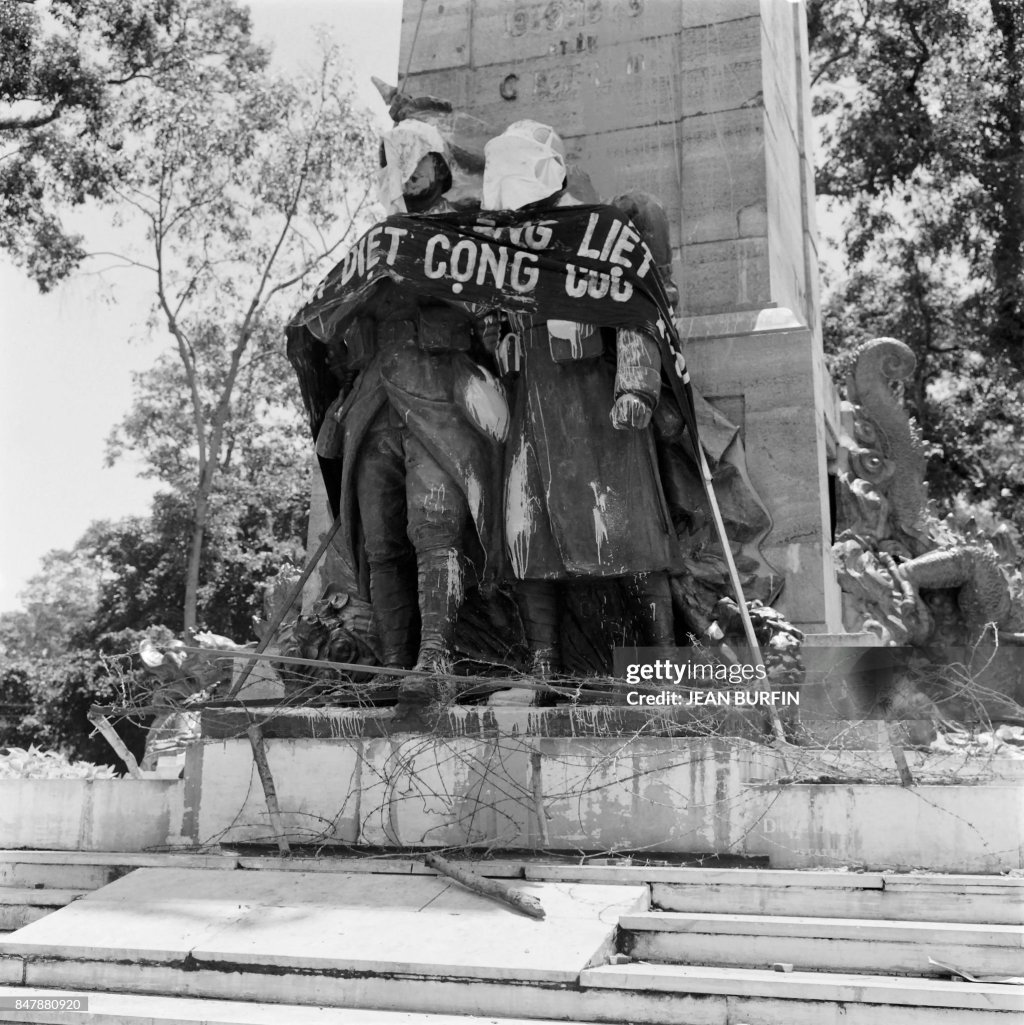
A detachment of several hundred South Vietnamese soldiers deployed the moment the Việt Cộng fired their first shots on a road 25 miles northwest of Saigon. The soldiers fought hard, engaging the Communists in a seesaw battle that lasted two hours after sunset. Seventeen were killed, 34 wounded and 3 missing. One of their 25 armored personnel carriers was destroyed. But South Vietnamese officers estimated that their men had killed 60 of the enemy, who have been staging daily ambushes lately. Several United States advisers were involved.
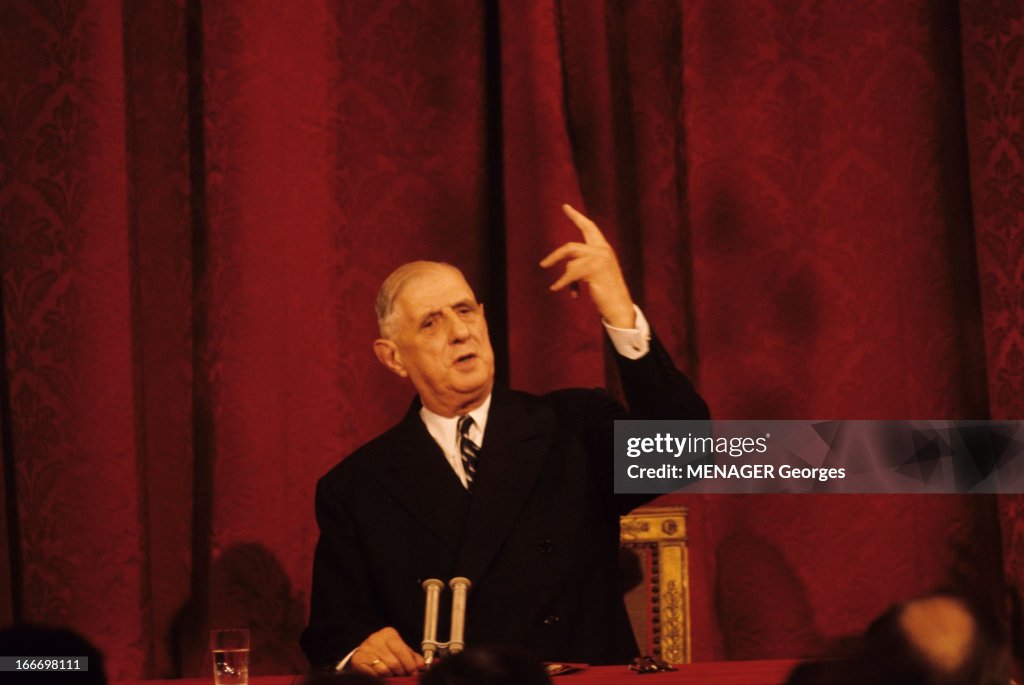
At a news conference in Paris, De Gaulle proposes that the United States, France, the Soviet Union and Communist China negotiate an end to the hostilities in Vietnam and Laos by agreeing to leave the Indo-Chinese Peninsula, guaranteeing its neutrality and independence, and providing economic and technical aid. President de Gaulle proposed today that the United States, the Soviet Union, Communist China and France agree to get out and stay out of the Indochinese peninsula as a means of ending the fighting in Laos and South Vietnam.
This was the first of two conditions for peace in Southeast Asia put forward by General de Gaulle at a news conference in the gilded Salle des Fetes of the Elysee Palace. The second was a proposal for a massive program of economic and technical aid to the peoples of North and South Vietnam, Laos and Cambodia once the fighting had ended. General de Gaulle named the four powers as the ones that have “direct responsibility” for the past and future of Vietnam. He noted United States military involvement in the guerrilla warfare there, but did not mention Soviet or Chinese support for Communist forces in Laos and Vietnam. France’s interest in the region springs from cultural and economic ties formed when the area was a French colony.
The French President’s latest proposals for peace in the troubled peninsula capped an hour-and-sixteen-minute discourse dominated by the general’s desire to establish France — now an atomic power, he emphasized — as a leading force in Europe and the world. General de Gaulle was critical of West Germany, France’s closest ally and he reminded the United States pointedly that “things have changed in Europe.” West Germany, he said, is at fault for the absence of a French‐German policy for European unity largely because Bonn refuses to believe that “the policy of Europe must be European and independent.” This was oblique criticism of West Germany’s concern for its political and military ties with the United States.
The United States cannot decide the war in South Vietnam militarily, the President said, and the people there do not support the conflict against the Vietcong guerrillas because it seems to them to be a foreign issue. The Americans. General de Gaulle remarked, are against all colonialism except their own. However, the general added, Europe “must preserve an alliance with America” as long as “the Soviet threat lasts.”
Ambassador Taylor meets with General Khánh to register U.S. disapproval of the recent calls by Khánh and Kỳ to extend the war into North Vietnam. Both meetings are reported to have been ‘heated’ but it is also reported that Khánh stands firmly against Taylor’s reprimands, arguing that the war has changed because of the presence of North Vietnamese forces. Khánh offers to resign at the second meeting; Taylor not only dissuades him but ends up cabling Washington that the United States should undertake covert planning with the South Vietnamese for bombing the North.
According to qualified sources, General Taylor told General Khánh at a meeting that such an extension of the anti‐Communist war would be contrary to the United States’ policy. The Premier is reported to have replied that, regardless of American policy, an extension was now in fact South Vietnamese policy. This policy was proclaimed in a government declaration Monday and in pub lie speeches by Premier Khánh and other officials in the last few days. United States officials at the meeting, including Deputy Ambassador U. Alexis Johnson, were startled by the firmness of Premier Khánh’s responses. They called a private evening meeting to survey the situation. General Taylor is to see the Premier again tomorrow.
After some tense exchanges, according to accounts of the meeting, General Khánh assured General Taylor that there were no basic policy differences only differences about timing and about what to announce publicly. Premier Khánh regards a battle cry as a means of whipping up popular support in his country for his government. After the meeting, the Vietnamese Defense Ministry issued a public statement disavowing warnings by the commander of this country’s air force that South Vietnam was ready to bomb North Vietnam immediately. This warning, issued yesterday by Air Commodore Nguyễn Cao Kỳ at Biên Hòa Air Base, was one of the public declarations to which General Taylor took exception.
The ministry’s disavowal, however, did not deny Air Commodore Kỳ’s acknowledgement that South Vietnamese “combat teams” had been dropped inside North Vietnam on sabotage and intelligence missions in past years — and by implication recently. One of General Taylor’s main points at this morning’s meeting, according to qualified sources, was that no such acknowledgment should have been given. Air Commodore Kỳ is reported to have been reprimanded by both Premier Khánh and General Taylor at this morning’s meeting. American officials privately declined to discuss the session, or even to confirm that it had taken place.
The concern in Washington is heightened by signs that Communist China still takes much more seriously than Washington the likelihood of attacks upon North Vietnam in the foreseeable future. Through mass rallies and other domestic propaganda, Peking began this week to acquaint its people with the possibility that they might have to rush to North Vietnam’s defense. Although they are still urging a political settlement, the Chinese have continued to stiffen their warnings against expansion of the war. In this, they are following the pattern of gradually intensified propaganda that they used first abroad and then at home, before they intervened in the Korean War in 1950. Communist commentaries have been putting together the periodic official and unofficial statements from Washington that plans are ready for direct attacks on North Vietnam.
Cambodia has accused South Vietnam of two new acts of aggression on their frontier. A letter sent Tuesday by Cambodia’s chief delegate, Voeunsal Sonn, to the President of the United Nations Security Council, Ahme Talbi Benhima of Morocco, was made public in New York today. It said that on June 11 “soldiers belonging to the armed forces of the Republic of Vietnam, from the post at Giang Thành Hà Tiên,” landed from two motorboats in Cambodian territory and attempted to kidnap some peasants. On July 1, the letter said Vietnamese forces at four points facing Cambodian territory “fired a number of shots,” one of which struck and seriously wounded a woman 220 yards inside Cambodian territory.
The death toll in Malay‐Chinese racial rioting rose tonight to 18, and the Prime Minister of Singapore warned that growing racial tensions threatened to destroy the Federation of Malaysia. The Prime Minister, Lee Kuan Yew, who is of Chinese descent, issued his warning as more than 10,000 policemen and troops sought to quell the rioting, which has virtually paralyzed this strategic port city. Sporadic clashes between gangs of Chinese and Malays were reported late tonight, although a strict curfew was in effect since 9 o’clock this morning. In addition to the 18 persons known to have been killed, hundreds have been injured and more than 1,000 arrested since the outbreak of violence Tuesday afternoon. Troops in battle dress patrolled strangely deserted streets in this normally bustling metropolis, which has a Chinese community of 1.7 million and a Malay community of 250,000. Most of the population stayed apprehensively at home, but in back streets sullen groups of Malays and Chinese, as well as thugs exploiting the disorder, occasionally collided.
Prime Minister Lee said at a news conference that the Singapore rioting was “just a danger signal of the real basic problem which must be faced.” He placed the chief responsibility for the generating of tensions that led to the rioting on Malay extremists and Indonesian propagandists. “If it does go on, I think Malaysia will be destroyed,” Mr. Lee said. The Prime Minister of the state of Singapore was one of the founders of Malaysia, which was formed September 16 from the former British territories of Malaya, Singapore, Sarawak and Sabah (North Borneo). Mr. Lee indicated that he felt that hope for restoring harmony to the multiracial nation lay in action by Malay leaders of the federal Government in Kuala Lumpur to check Malay politicians who have been making ethnic appeals.
U Thant sent a message yesterday to Archbishop Makarios, President of Cyprus, conveying his “growing concern” about interference with the freedom of movement that had been promised to United Nations peace‐keeping force in Cyprus. Mr. Thant called this freedom “absolutely essential” to the force’s proper functioning. The Secretary General declared that, despite weeks of negotiation between the government and the commander of the force, United Nations troops were still being denied access to the docks at Limassol and that observers continued to be obstructed in their duties when convoys left the port. In a similar message to Dr. Fazil Kutchuk, Vice President of Cyprus, Mr. Thant referred to continuing reports of infiltration of arms and personnel in areas controlled by members of the Turkish Cypriote community, particularly in the Kokkina Mansoura area. He asked “most earnestly” that the Vice President do everything in his power to put a stop to these activities.
The approval of sanctions against Cuba by a comfortable if not overwhelming majority appeared assured tonight in the conference of American foreign ministers. Although negotiations aimed at a formula that might make the sanctions resolution more palatable to all continued, it was virtually certain that 15 out of 19 votes would be cast to punish the Havana regime fox aggression against Venezuela. Diplomats here expected that Mexico and Chile would vote against the resolution and that Bolivia and Uruguay would abstain. Venezuela, as the complaining nation, cannot vote. The Caracas Government had accused the Castro regime of shipping for Venezuelan terrorists a cache of arms found on a Venezuelan beach, just before the Presidential elections in that country last December.
The West German Government reacted sharply tonight to statements by President de Gaulle at his news conference and reaffirmed that West Germany considered close relations with the United States and an integrated defense system “indispensable.” Government officials rejected the French leader’s assertion that the partners in the Western alliance were “subordinated” to the United States. “This characterization does not reflect the close ties that exist between Europe and the United States in the North Atlantic Treaty Organization,” a statement said. “It is regretted,” the statement continued, “that President de Gaulle judges so negatively the results accomplished so far of a policy carried out within, the framework of a treaty of friendship.”
Egyptian munition ship “Star of Alexandria” explodes at dockside in Bone, Algeria. 100 die, 160 injured, $20 million damage. According to foreign sources, the freighter, the Star of Alexandria, sailed from Algiers to Bone with a crew of 18 two days ago with ammunition and weapons of Soviet or United Arab Republic origin for the Algerian Army. The explosion occurred at 10 PM. The unloading of ammunition, it was reported, had already begun in a cordoned area of the port. Crewmen, longshoremen and Algerian soldiers were among the casualties. The National Liberation Front newspaper Ce Soir said that “certain signs” indicated that the explosion was a result of sabotage by counterrevolutionaries abroad. The front is the sole political party in President Ahmed Ben Bella’s regime.
Argentine police detained three men for questioning today in an investigation of a left‐wing terrorist organization that used an apartment house as an arms depot and headquarters. The police reported that they had found Cuban Communist literature and maps of strategic installations in the city and other areas.
President Johnson’s antipoverty bill passed the Senate tonight virtually intact after nearly 10 hours of often bitter debate. The vote was 62 to 33. Ten liberal Republicans joined with 52 Democrats in voting for the bill. Voting Against were 11 Democrats, most of them Southerners, and 22 Republicans, including Senator Barry Goldwater, the Republican candidate for President. If the President had failed to get some Southern and Republican support, the bill would have failed. The bill now goes to the House for action, possibly late next week. Its fate there is uncertain, but the relatively wide margin of Senate passage may influence the outcome in the House, for it indicates that a far larger amount of Southern support can be counted on than had been expected.
The bill did not escape unscathed. Several rural programs were eliminated. The original $962.5 million price‐tag was cut to $947.5. A states’ rights amendment giving state governors veto power over certain projects in their states was adopted. However, major parts of the bill, including programs to aid needy young people and to help conduct local attacks on poverty, were left virtually untouched. Senate passage was a major victory for President Johnson, for this was the first big piece of legislation bearing his exclusive stamp to get through either house of Congress. Other major bills passed this year, including the tax cut and civil rights, originated in the Administration of President Kennedy.
Senator Goldwater took no active part in the debate. He showed up shortly before final passage to vote, but did not make a speech. Earlier this week, Senator Goldwater had denounced the antipoverty programs as a “Madison Avenue” scheme designed to win votes for President Johnson in the election this fall. The long debate, centering much of the time on states’ rights, grew increasingly bitter as the bill neared a final vote. An effort was made to eliminate the Job Corps, a key feature of the bill. This was defeated, 61 to 33.
Three white employees of a plumbing firm in Greenwood, Mississippi, became the first persons to be arrested under the new Civil Rights Act, and were criminally charged with violating the civil rights of an African American man when they beat him up for trying to enter a local movie theater. Attorney General Robert F. Kennedy and J. Edgar Hoover, director of the bureau, said in Washington that the arrests were the first made under the law, enacted July 2.
The alleged violation involved the beating of a 21‐year‐old Black who had gained admission to a previously white motion picture theater. The defendants were identified as Willie A, Belk, 47 years old; his son, Jimmy A. Belk, 19, and Sam Allen Shaffer Jr., 40, all of Greenwood. The elder Mr. Belk is the operator of a plumbing company at which the two others are employed. “Specifically,” Mr. Hoover said, “those arrested are charged with, on or about July 16, 1964, in Leflore County, Mississippi, unlawfully conspiring to injure, oppress, threaten and intimidate Silas McGhee, a local Negro, in the free exercise of his rights of full and equal employment of the goods, services, facilities, advantages and accommodations of a motion picture house, the Leflore Theater, in Greenwood, a place of public accommodations as defined in Section 201, Title 2, of the Civil Rights Act of 1964.”
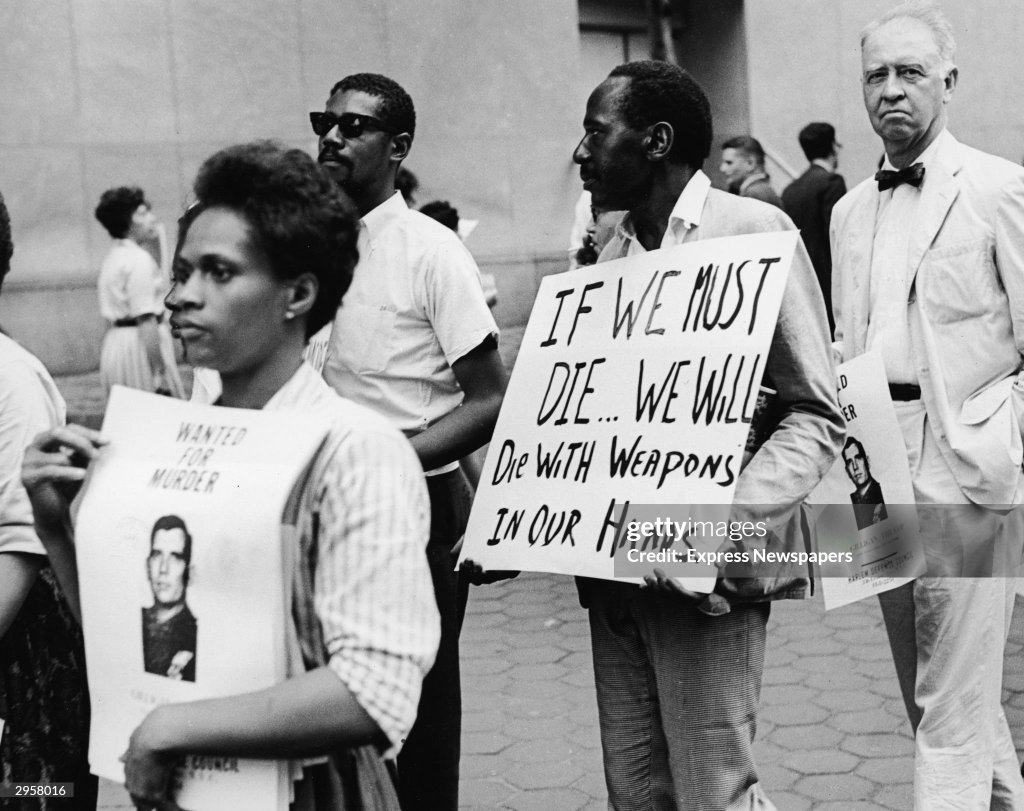
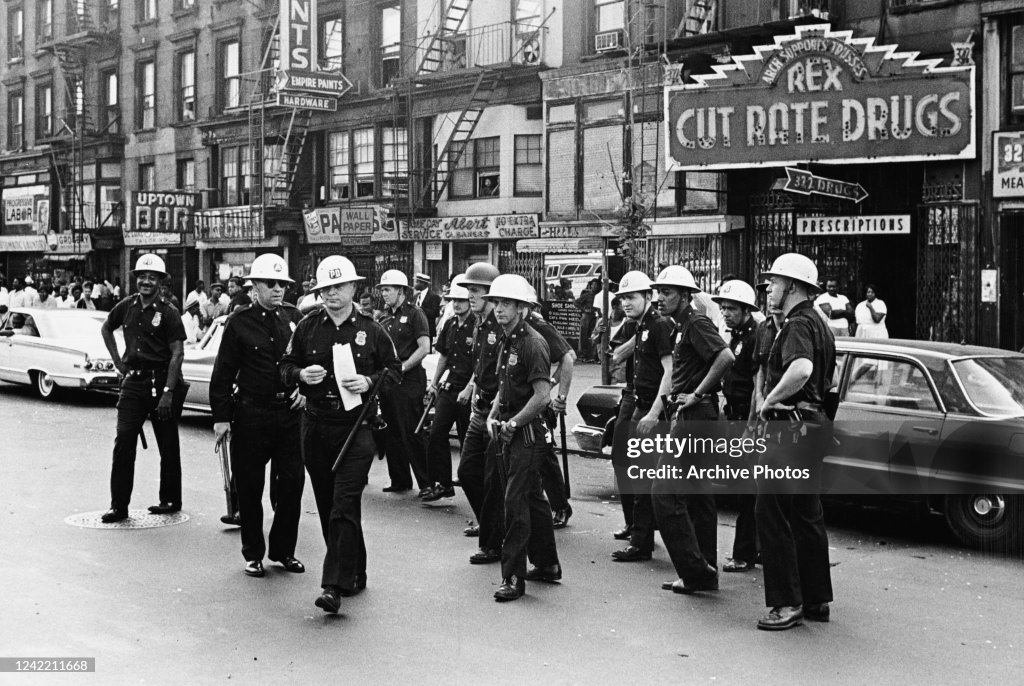
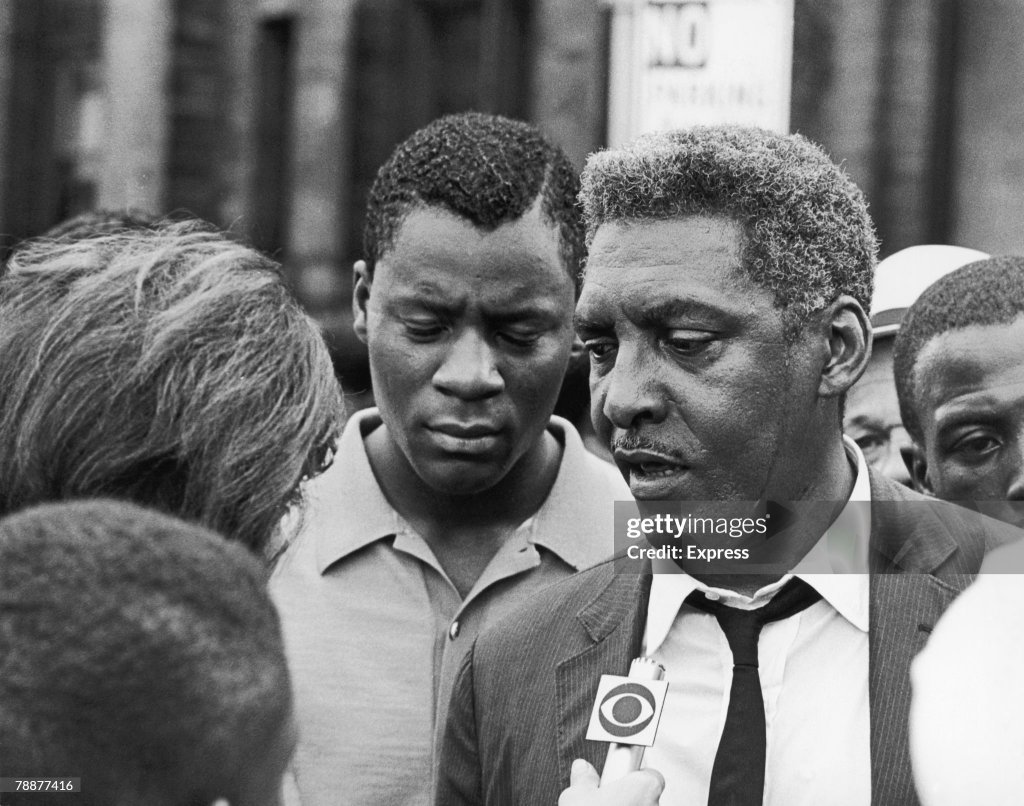
Relative peace returned to the city of New York last night for the first time since rioting and looting made Harlem a battlefield last Saturday night. Only isolated incidents broke out in the Bedford-Stuyvesant section of Brooklyn, and none were reported in Harlem. Rain, which began falling about midnight, helped keep people off the streets. In Lower Manhattan, several hundred youths jeered at 260 Congress of Racial Equality pickets who marched outside police headquarters, at 100 Centre Street, to protest alleged police brutality. A police inspector was stuck in the right eye by a stone as the police protected the pickets.
In the Brooklyn community, Black residents strolled the streets early in the evening, before the rain. Only 24 hours before, 122 persons were arrested and three men were shot as looters. At least 200 stores were damaged. The police reported that some windows were broken last night and that 19 persons were arrested for disorderly conduct and looting. A large force of policemen wearing helmets moved into the area yesterday in readiness for trouble. In the evening they were augmented by 22 mounted patrolmen stationed near the intersection of Nostrand Avenue land Fulton Street. Reinforced police units also, patrolled the streets of Harlem.
The injured inspector, Henry Yack, was struck by a stone thrown by a spectator when the police began to escort the CORE pickets to nearby subway stations when the demonstration ended at 11 o’clock. He was taken to St. Vincent’s Hospital in a police radio car for treatment. Eggs and garbage were thrown at the pickets, but the missiles fell short of their targets as the police kept the spectators at a safe distance. At one point, six youths were arrested on charges of disorderly conduct after a crudely lettered sign was thrown at the pickets from an automobile. The sign bore a drawing of a man, apparently a Black wearing a turban, with a dagger in his chest. The Rev. Robert Perrella of the Roman Catholic Church of the Most Sacred Blood near Police Headquarters, appealed to spectators to go home. He said he had been ordered to the scene by his superiors “to make sure none of the neighborhood young men get into trouble.”
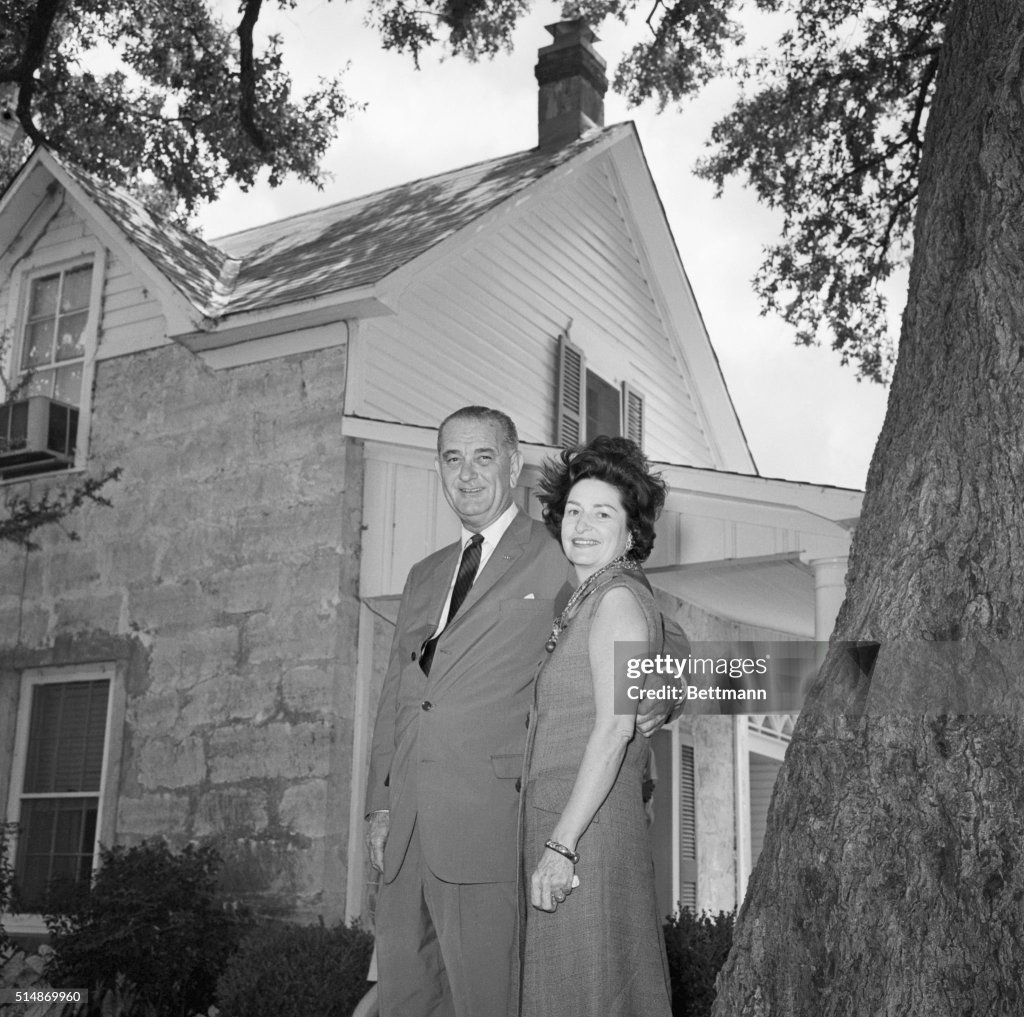
President Johnson and Senator Barry Goldwater will meet at the White House tomorrow to discuss a suggestion that they try to avoid inflaming racial tensions during this year’s Presidential election campaign. The meeting will begin at 5:30 PM, George E. Reedy, White House press secretary, announced today. An aide of Mr. Goldwater, the Republican Presidential nominee, approached a member of the White House legislative liaison staff to ask for an appointment for the Arizona Senator, Mr. Reedy said. “Of course,” he said, “the request was granted.”
Earlier in the day President Johnson told a group of businessmen that he would use “all the resources I have” to force both civil rights groups and their white antagonists to observe law and order. Senator Goldwater first took up the idea of a meeting with President Johnson when he stopped in Chicago on Monday on the way from Arizona to Washington. Edward T. Folliard of The Washington Post had mentioned the idea in a question he put to Mr. Goldwater during an airport news conference. At that time Mr. Goldwater said he would welcome a chance to talk with the President and to reach “an agreement that we, or our associates, would not, in any word we might say, add to the feelings of tension that exist today, partly because of the understandable feeling of the Negro and other minority groups that they have been treated badly.”
Mr. Reedy said the purpose of the meeting was “as stated by Senator Goldwater — to discuss the tensions that have been aroused” over the civil rights issue. It is understood, however, by those close to Mr. Goldwater that he will not attempt to persuade Mr. Johnson not to discuss the general question of civil rights in the campaign. The Senator does not regard this as practicable, he has indicated. What he seems to have in mind is the avoidance of words or deeds that could heighten animosity between the races.
The General Motors Corporation announced yesterday the highest sales and earnings in history for any company in both the second quarter and the first half of 1964. For the six‐month period, G.M. reported earnings of $1,138,000,000. In another record‐smashing report, the Chrysler Corporation disclosed marks in its sales and net income for the same periods. In the half year, Chrysler’s net reached $114.4 million.
On Wednesday, the Ford Motor Company proved a harbinger by issuing the first report for one of the “Big Three” automobile manufacturers. Ford, second in size to G.M., also broke all of its sales and earnings records this year. The six‐month earnings figure for Ford came to $324 million. All three companies soon will enter full negotiations with the United Automobile Workers on, a new contract. The present three‐year agreement expires August 31.
In Detroit, officials of the, auto union were quick to cite the profits of the Big Three auto makers in support of new contract demands. Ken Bannon, the union’s Ford Department director, said: “It is obvious that Ford’s profitability makes it possible for the company to cut prices, give Ford workers and their families equity, and still provide generously for its stockholders and executives.”
Top-ranking Government officials will remain underpaid even if Congress enacts the pending pay-rise bill, a report from the Committee for Economic Development said today.
The World’s Fair in New York was accused of violating the Constitution by refusing to permit peaceful picketing of a mural some Jews regard as offensive in the Jordan Pavilion.
The General Motors Corporation was selected today as the American participant in a joint United States‐West German program to develop a new tank. The Defense Department announced the choice after the two governments had agreed on the general characteristics of the vehicle for the 1970’s. The United States Army, handling the program on the American side, will negotiate a contract with General Motors for about $750,000 to cover work on the project over the next six months. Eventually, General Motors may receive more than $20 million, including funds for the development of test models.
In Boardman, Ohio, a suburb of Youngstown, brothers Forrest Raffel and Leroy Raffel, opened the first Arby’s fast-food restaurant. According to the company’s history, the operators of the restaurant supply company Raffel Brothers, Inc., originally wanted to call the chain “Big Tex”, but were unsuccessful in negotiating with the Akron businessman who owned the rights to the name. Forrest Raffel would say later, “We came up with Arby’s®, which stands for R.B., the initials of Raffel Brothers, although I guess customers might think the initials stand for roast beef.”
Four men, who had been feared dead after their motorboat disappeared in the Atlantic Ocean on July 14, were rescued alive by an American merchant ship, the Maiden, after their raft was spotted by a U.S. Navy plane about 420 miles off the United States coast. The men, all from Connecticut, had been aboard a yacht, the Gooney Bird before being forced to abandon ship.
Kansas City A’s rookie Bert Campaneris helps send the Minnesota Twins to defeat 4–3 with 3 hits, including 2 home runs, in his Major League debut. The first comes on the first pitch thrown to him, by Jim Kaat, just the second American League player to debut like that. The 21-year-old Cuban joins Bob Nieman as the only player since 1900 with 2 home runs in his first Major League game. Doc Edwards seals the win with an 11th inning solo homer.
Felix Mantilla’s sixth‐inning home run enabled the Boston Red Sox to defeat the Detroit Tigers, 4–3, today. Dave Morehead, Boston righthander, registered his sixth victory against 10 losses, but he needed help from Dick Radatz.
Tommy McCraw’s 11th-inning single gave the Chicago White Sox a 2–1 victory over the Los Angeles Angels today after the Sox had snapped Dean Chance’s string of scoreless innings at 27 in the first. Mike Hershberger walked with one out in the 11th and Hoyt Wilhelm, who pitched only the 11th, singled Hershberger to third. McCraw then came through with a single to right off Barry Latman.
Just here for my bat, Skip. Reliever Jack Baldschun, a lifetime .090 hitter, hits a 2-out 10th inning single to start a 3-run scoring outburst for the Philadelphia Phillies. Baldschun is then replaced by Dennis Bennett, who pitches a scoreless 10th for a 13–10 win over the Atlanta Braves. Johnny Callison has 2 homers and 5 RBIs for the Phils.
The Pittsburgh Pirates continued their assault on St. Louis pitchers today with 16 hits for an 8–5 victory over the St. Louis Cardinals and a sweep of the threegame series.
Led by Lew Burdette’s 2 singles, triple and homer, the Chicago Cubs down the San Francisco Giants, 13–4. Len Gabrielson adds a 3-run homer and Billy Williams a 2-run shot. Burdette’s 4-hit game is the second of his career: no pitcher in the last half of the 20th century will match that.
Dow Jones Industrial Average: 846.48 (-1.17).
Born:
Greg Best, American equestrian athlete (Olympic silver medal, 1988, 1992), in Lynchburg, Virginia.
Lyneal Alston, NFL wide receiver (Pittsburgh Steelers), in Mobile, Alabama.
Nick Menza, American thrash metal drummer, in Munich, West Germany (died of congestive heart failure during concert, 2016)
Died:
Thakin Kodaw Hmaing, 88, Burmese poet and peace activist
Arkady Mordvinov, 68, Soviet architect and construction manager
Jan de Vries, 74, Dutch scholar of Germanic linguistics and Germanic mythology.

 History Diaries