
Greece’s military rulers announced they were turning the nation back to the rule of former civilian leaders. Athens crowds shouted “Tonight fascism dies!” and “No more blood!” in jubilation. After a meeting of politicians called by President Phaidon Gizikis, former Premier Constantine Karamanlis, self-exiled in Paris, was asked to form the government. He will return to Athens early tomorrow. The military abdication resulted from the Cyprus crisis. The people of Athens rejoiced noisily and emotionally tonight at the announcement of the end of seven years of military dictatorship. As pedestrians and those in buildings in central Athens heard or sensed what had happened, a low babble of voices grew into sustained shouting. People strolling the crowded sidewalks in the post‐siesta part of the day became a huge crowd that surged toward Constitution Square and the pale yellow Parliament building that overlooks it. “Democracy!” the crowd began to shout, breaking the word into a rhythmic chant of syllables: “De‐mok‐ra‐tia.”
Nikos Sampson, installed as President of Cyprus when the national guard overthrew Archbishop Makarios, resigned and was replaced by Glafkos Clerides, widely respected President of the House of Representatives. Though there was some fighting, a tenuous cease-fire settled over the island after four days of warfare.
United States officials privately welcomed reports of steps toward the return of constitutional government in Greece and Cyprus. Secretary of State Kissinger postponed any public comments until the situation cleared in Athens and Nicosia. “We are mainly concerned at this point to get the fighting stopped on Cyprus,” an official said. Mr. Kissinger and his aides have been telephoning overseas leaders.
Premier Bulent Ecevit told the Turkish Parliament that 57 members of the Turkish armed forces had been killed and 184 wounded during the invasion and fighting on Cyprus, and that 242 were listed as missing. He gave figures after an Israeli radio report that 80 Turkish sailors had been drowned or killed and 110 were missing after Turkey’s air force accidentally bombed and sank a Turkish warship Sunday off the coast of Cyprus.
Greek President Phaedon Gizikis called a meeting to attempt to appoint a national unity government with the goal of peacefully preventing a war in Cyprus between Greece and Turkey. Former Prime Minister Konstantinos Karamanlis returned from exile to Athens on a Mystère 20 jet, made available to him by French President Valéry Giscard d’Estaing.
The assured supply by sea of oil and other essential minerals in the event of war with the Soviet Union has become the primary problem facing the Atlantic Alliance. The United States, in the opinion of strategic planners at North Atlantic Treaty headquarters in Brussels and in Washington and London, is, like many of its European allies, fast becoming a have-not nation, dependent for industrial vigor on imports from overseas. According to a recent survey commissioned by the United States Navy, a hundred minerals are imported to America, 16 of them in amounts greater than 100,000 tons annually. Last year, total imports of these minerals were 95 million tons. A quarter of a century hence, it is estimated, 160 million tons of these minerals and metals will be imported.
Energy imports in 1973 were valued at approximately $8 billion, consisting of two billion barrels of crude oil and refined products and one trillion cubic feet of natural gas. The figure may be more than $12‐billion in 1980. The problem facing the United States Navy and other treaty members is simply how to insure the raw‐material supply in time of war. The alliance gets its essential minerals, such as iron ore, bauxite and copper from four distant sources: the Persian Gulf, southern Africa, Australia and South America. As strategic planners see it, the sea lanes from the Persian Gulf to Western Europe and the United States have become the most important naval area in the world.
British Airways Flight 6356, flying to London after taking off from Belfast with 92 people, made an emergency landing in Manchester after an Irish newspaper and a news agency were tipped off by an anonymous caller that a gelignite time bomb had been placed on the aircraft. A two-pound bomb was found in a paper bag under a seat on the Trident jet, apparently after being placed there by a passenger who had flown to Belfast and left before the plane departed again for London. The plane, carrying a crew of 7 and 85 passengers, including James Flanagan, police chief of Northern Ireland, made an emergency landing at Manchester, where the bomb was discovered.
General Francisco Franco’s chief medical spokesman predicted a complete recovery for the 81-year-old Spanish chief of state. Manuel Hidalgo, director of the Madrid hospital where Franco was being treated for phlebitis and gastric complications, said the general might be released from the hospital this week. Dr. Manuel Hidalgo Huerta, head of the Francisco Franco Hospital, told surprised newsmen that the general, “medically speaking, can lead a life similar to the one he has led up to now, both physically and mentally.” Dr. Hidalgo’s words today appeared to prepare the way for the general to take back his powers and to relegate Prince Juan Carlos to his former role of King‐designate.
Ethiopia’s armed forces reportedly arrested former Prime Minister Endalkachew Makonnen, who resigned on Monday. Officials made no announcement of the arrest but accused Makonnen in a radio broadcast of creating dissension among the military. Meanwhile, Emperor Haile Selassie observed his 82nd birthday with his first public appearance since the three-month-old coup, warning that a return to peace and stability was “more than ever necessary.” New Prime Minister Michael Imru, appointed Monday night, was not present, nor were any other high-ranking government officials.
Sikkim’s 332 years of monarchical rule ended as Chogyal (King) Palden Thondup Namgyal swore in a five-man, pro-India cabinet. Kazi Lhendup Dorji, 72, leader of the popular movement that wrested power from Palden last year, heads the tiny Himalayan kingdom’s cabinet. The 52-year-old chogyal, who married New York socialite Hope Cooke in 1963, had made an abortive attempt to oppose the new constitution, which gives administrative powers to an Indian chief executive appointed by New Delhi, but signed it on July 4.
South Korea will apply unilaterally for membership in the United Nations at this year’s U.N. General Assembly following the failure of a joint attempt by the two Koreas for simultaneous admission. Foreign. Minister Kim Dong Jo made it clear his government’s new approach resulted from North Korea’s objections to joint entry providing for two separate seats on the grounds it was an attempt at perpetuating the territorial division of Korea.
U.S. and Canadian prisoners in a Mexico jail have abandoned their two-week hunger strike, according to diplomatic sources in Mexico City. The 70 men and 40 women, most of them sentenced or facing trial on drug charges, began their hunger strike July 9 over the severity of their sentences, the time spent waiting for trial and alleged torture by police at the time of their arrests.
The nude bodies of two daughters of prominent Guam families and the teen-age son of a judge were found shot in the head and neck in the bedroom of a vacationing politician. A public safety official said it appeared the girls had been sexually molested. The three were found gagged with their hands and feet bound in the ransacked home of Lins Faria, a candidate for the Guam legislature. Police identified the victims as Faria’s daughter, Jan Marie, 21, her boyfriend, Gregory J. Abbate, 18, the son of Judge Paul Abbate, and Mary Louise Farrell, 19.
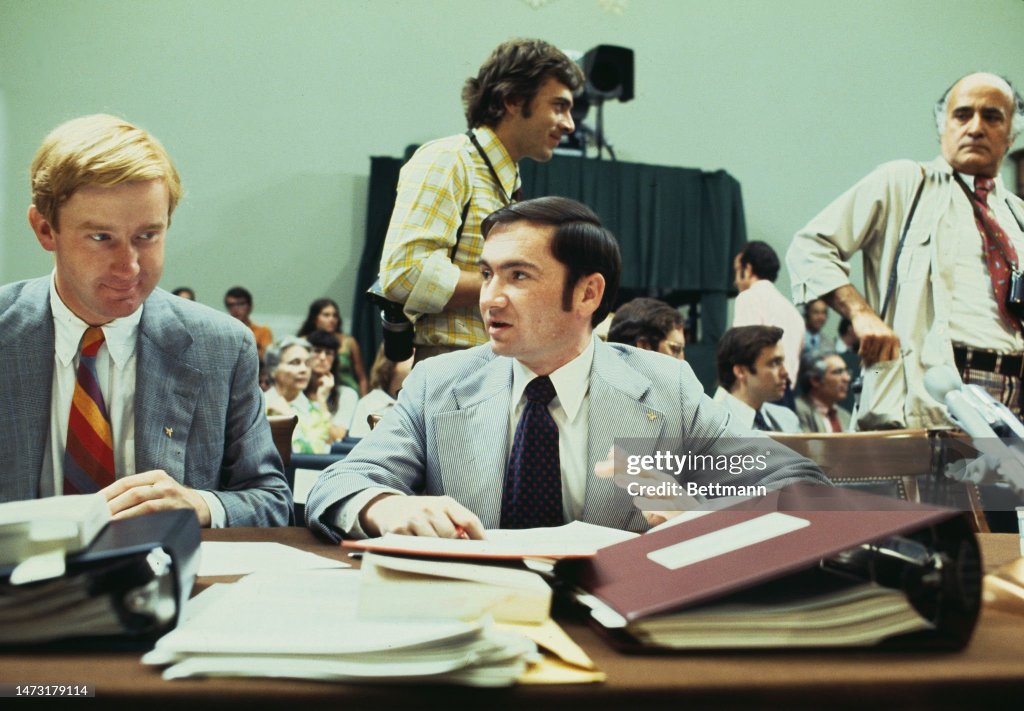
Senior Democrats on the House Judiciary Committee are redrafting the proposed articles of impeachment of President Nixon in an attempt to elicit broad, bipartisan support for formal charges. The formula, designed to get the widest Republican backing, was said to focus on two central articles: that the President played an active and central role in the Watergate cover-up and that he abused his authority by defying Watergate subpoenas and by taking secret steps to eavesdrop on citizens.
Representative Lawrence Hogan of Maryland announced that he would vote to recommend impeachment of President Nixon. He was the first Republican member of the Judiciary Committee to do so. Mr. Hogan, a candidate for his party’s nomination for Governor of Maryland, said he thought that his decision might end his political career. He said that the President had lied repeatedly, withheld necessary information from the system of justice, and concealed and covered up evidence.
Senate and House conferees agreed on compromise language to limit the power of the federal courts to order busing for school desegregation. The draft would still enable the courts to order busing beyond the school nearest or next nearest to the child’s home if necessary to guarantee the constitutional rights of minority-group children.
House and Senate conferees agreed today to cut nearly $1 billion from the Administration’s military weapons budget for this year and to ban tests of Minuteman missiles over the Northwestern United States. Winding up a month of wrangling over House and Senate versions of the weapons bills, the conferees also voted to allow the military service to gas and poison dogs in military research projects if the aim is to preserve human life. Negotiators from the Senate and House Armed Services Committees announced they had approved a $22.16‐billion weapons authorization for the year that began July 1, a cut of almost $1‐billion in the Administration’s request. The compromise was $340‐million more than the Senate had voted and $484‐million less than the House approved. The conferees accepted Senate amendment to drop all funds requested by the Air Force to test‐fire Minuteman missiles from silos in Montana over Montana, Idaho, Oregon and corners of Washington or California.
In the controversial matter of using dogs for lethal research, the Senate had approved a proposal by Senator Hubert H. Humphrey, Democrat of Minnesota, to prohibit the armed forces from using the animals in medical research with poison gases and other chemicals. The conference committee redrafted Mr Humphrey’s amendment to say that the provision “is not to inhibit research aimed at preserving human life.” Since both the Air Force and Army — the two services that bought beagles for poison research — have said their purpose ‘is to check substances that might be poisonous to humans, the rewritten amendment seemed to allow the Pentagon to do exactly what it had been doing with the dogs.
Senator Edward Gurney of Florida announced his withdrawal as a candidate for re-election to prepare his defense against charges of bribery, conspiracy and false statements to a federal grand jury. The 60-year-old Republican, who was a member of the Watergate committee, was completing his first term. “There is no sensible or sound way to conduct a statewide political race and prepare for, and go through, a major trial,” Senator Gurney said in a prepared statement. Florida election officials removed Mr. Gurney’s name from the official list of candidates, who had qualified before the noon deadline today. Senator Gurney’s withdrawal had been expected since last week when Florida Republican leaders began urging him publicly and privately not to seek re‐election.
David Parr, former special counsel to the nation’s largest milk cooperative, entered a guilty plea to a single charge of conspiring to make illegal contributions to campaigns of Senator Hubert Humphrey, Representative Wilbur Mills and others. It was accepted on the understanding he would testify if called.
The Transportation Department urged Congress to make the current 55 m.p.h. speed limit permanent in all states. Secretary Claude S. Brinegar said the department had concluded that the reduced highway fatality rate since the lower limit went into effect outweighed all economic arguments for raising the limits back to their original positions. The department estimates that about 1,000 lives have been saved each month this year. That is an average of 23% below last year’s fatality rate. The lower limits have come under attack from several industry groups, primarily truckers, who contend they have resulted in lower earnings and increased travel time.
In a battle over rising costs of homeownership, the Senate refused to repeal federal authority for regulating real estate settlement charges. By a 55-37 vote the Senate accepted the argument by Senator William Proxmire (D-Wisconsin) that the authority should be left on the books in an effort to hold down settlement costs, even though the Department of Housing and Urban Development has not used that power. The bill itself, on which debate is continuing, is aimed at reducing the closing costs, such as attorney’s fees, title fees and loan-arrangement costs, associated with buying a home.
A federal judge ordered immediate merger of the school districts in Louisville, Kentucky, and surrounding Jefferson County to facilitate a major desegregation plan this fall. The merger would make the new district the ninth largest in the nation, with about 140,000 students. U.S. Dist. Judge James Gordon issued the order after accepting a plan calling for the busing of 30,568 students. The merged system, with 28,000 black pupils, will be 20% black. A spokesman for the Louisville district said it would seek a stay of the order.
The Senate passed legislation to speed federal court procedures by requiring that defendants be tried within 90 days of arrest and within 60 days of an indictment. If arrest came before indictment, an additional 30 days would be allowed for a grand jury to act. The bill, passed by voice vote with few senators present and sent to the House, also contains stiff penalties for failure to meet the time limits, including dismissal of the case and possible discipline of prosecution or defense.
The House reversed itself and removed from a strip-mining reclamation bill an exemption from strict steep-slope regulations for so-called “mountaintop” mining which has scarred much of Appalachia. The congressmen, however, defeated a move to outlaw all coal waste impoundments similar to one which dammed and flooded Buffalo Creek, West Virginia, in 1972, killing 125 persons. Reversal of the action on mountaintop mining — which means cutting off the top of a mountain in order to expose a coal seam, often leaving a flat plateau — came when Rep. Patsy T. Mink (D-Hawaii) succeeded in substituting the section of the bill which had included the exemption.
The presiding bishop of the Episcopal Church, the Right Rev. John M. Allin, appealed to participants in a planned rebel ordination of women not to go through with it. Bishop Allin sent telegrams to the three bishops and 11 women involved, urging them to abandon the intended service in Philadelphia Monday. The three clergymen going against church policy are Robert L. Dewitt, resigned bishop of Philadelphia, and two retired bishops, Daniel Corrigan of Denver and Edward R. Welles of Maine. The women are already deacons, the first step toward becoming a priest. But even though ordained, it is expected they will be refused the right to serve.
An 8-year-old boy was arrested inside a locked-up Bank of America branch in Alameda with three pillow cases which he had hoped to fill with money, police reported. The youngster, who entered the bank through a roof air vent and slid down a rope to the floor, was also equipped with gloves, wire cutters, a Navy flight bag and a flashlight with extra batteries. A resident of the area noticed a flashing light inside the bank and called police. Officers said a 10-year-old accomplice ran off before they arrived.
[Ed: Eight and ten. Holy crap. Not sure whether to be appalled or impressed. Both?]
Groups of Indians carried out an ultimatum issued in March by smashing into houses of several white families who had settled on the Onondaga Reservation near Syracuse, New York. The County District Attorney had warned at the time that the law supported the warning by the tribal chiefs.
The National League triumphs in the All–Star Game at Pittsburgh, winning 7–2. Write–in choice Dodger first baseman Steve Garvey is the game’s MVP. Atlanta’s Ralph Garr goes into the All-Star break with 149 hits, the most this century (starting in 1933) before the break. He will end with 214 hits.
In a surprise statement released after the All-Star Game played in Pittsburgh, Hank Aaron, who had indicated on many occasions that he had no interest in the position, publicly declares he would accept a Braves’ offer to manage the team “simply because there are no black managers in baseball.” The superstar’s comments create an awkward situation the next day when Atlanta announces the organization has hired Clyde King to replace Eddie Mathews, dismissed three days ago.
Dow Jones Industrial Average: 797.72 (+7.36, +0.93%).
Born:
Stephanie March, American actress (“Law and Order: Special Victim’s Unit”), in Dallas, Texas.
Kathryn Hahn, American actress (“WandaVision”), in Westchester, Illinois.
Maurice Greene, U.S. Olympic sprinter, gold medalist in the 100m dash in 2000, winner of gold medals in three world track and field championships in 1997, 1999 and 2001; in Kansas City, Kansas.
Terry Glenn, NFL wide receiver (Pro Bowl, 1999; New England Patriots, Green Bay Packers, Dallas Cowboys), in Columbus, Ohio (d. 2017).
Larry Barnes, MLB first baseman, pinch hitter, and outfielder (Anaheim Angels, Los Angeles Dodgers), in Bakersfield, California.
Tara Williams, WNBA guard (Phoenix Mercury, Portland Fire), in Homerville, Georgia.
Died:
Soekiman Wirjosandjojo, 76, Prime Minister of Indonesia 1951 to 1952.








 History Diaries