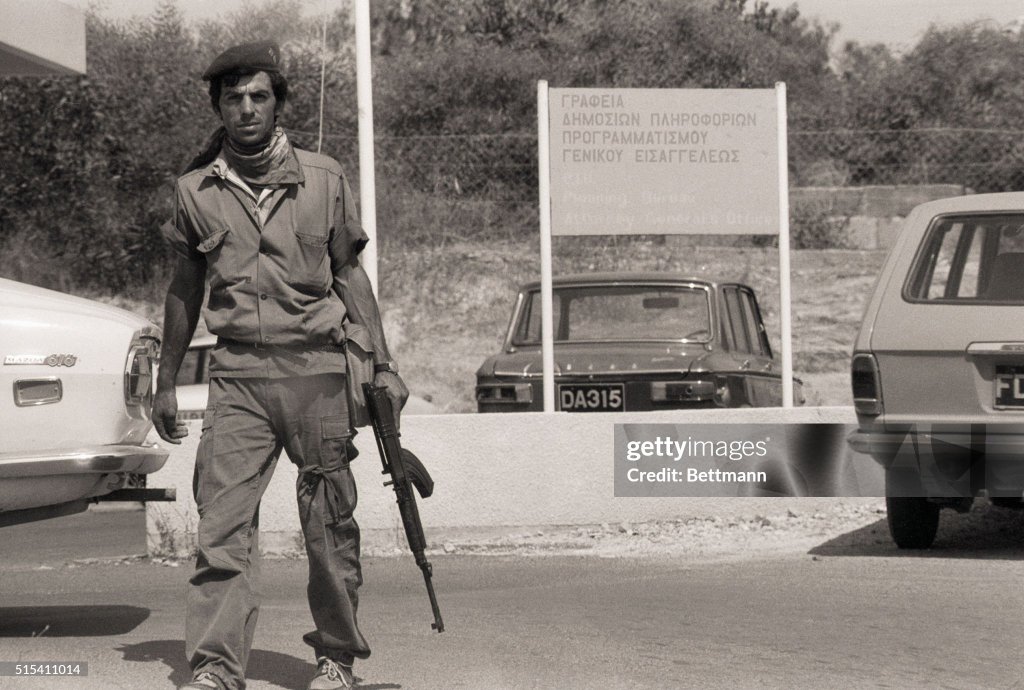
Greece made a concession in the Cyprus crisis by agreeing to replace the 650 Greek officers in the Cypriote National Guard. The officers led the coup that deposed President Makarios and that brought Greece and Turkey to the point of confrontation. The officers’ total withdrawal was a major demand of Turkey. The Greek decision, announced after several days of diplomatic pressure by the Western powers, was made at a meeting of the North Atlantic Council in Brussels. It remains to be seen whether the Greek decision to simply replace the officers will satisfy Turkey’s demand for withdrawal. The Greek ambassador to North Atlantic Council rejected allegations that Greece had been responsible for the coup. He said he hoped that the gesture of replacing the officers would be “appreciated at its proper value.”
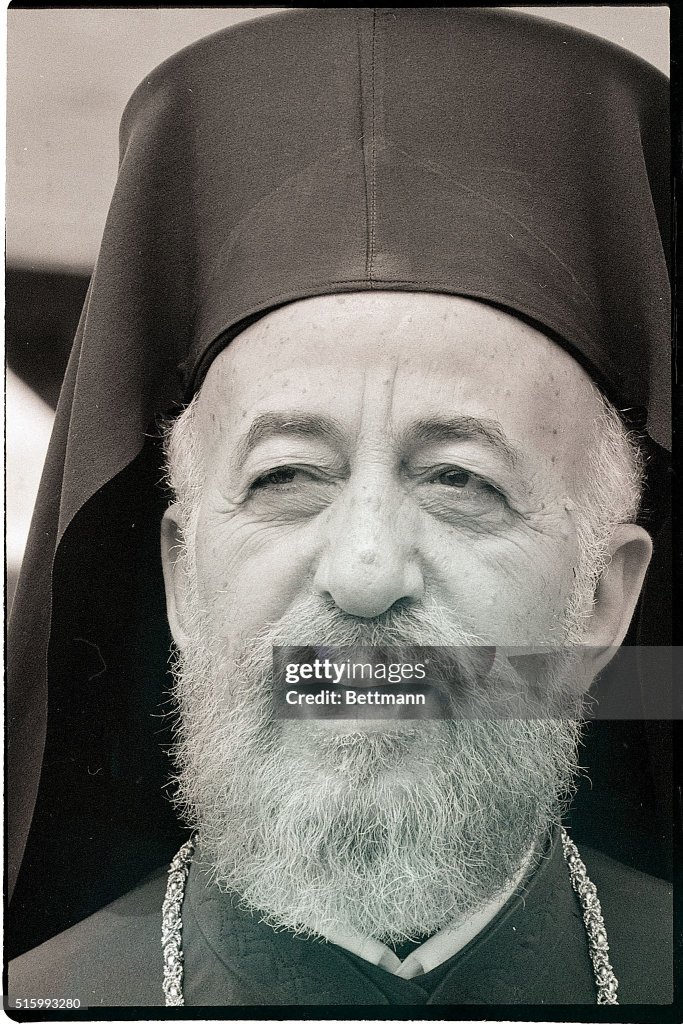
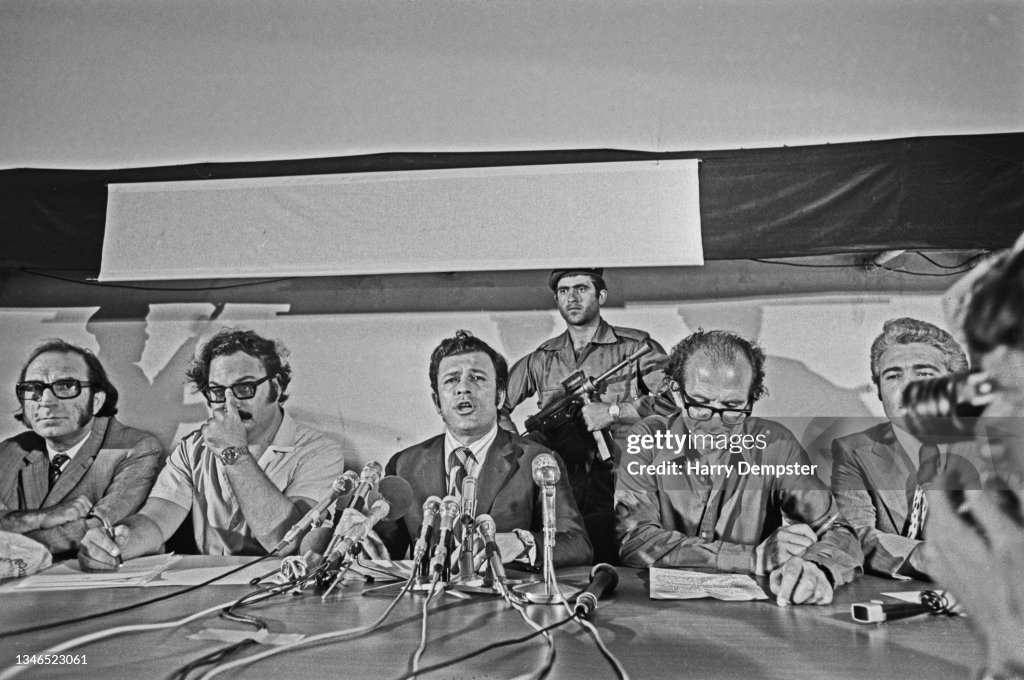
Nikos Georgiades Sampson, the newly proclaimed President of Cyprus, charged that the ousted regime of Archbishop Makarios had systematically tortured its political opponents and “flagrantly violated” the human rights of all Cypriotes. He attempted to support his allegations at a chaotic news conference by exhibiting purported victims of torture. Archbishop Makarios arrived in New York from London and said he wanted the United Nations to condemn the coup in Cyprus, which he called a “violation of the independence of Cyprus by the Greek junta,” and to ask that Greek officers be withdrawn from his country. He also told reporters that he was “satisfied — so far” with Washington’s actions since the coup.
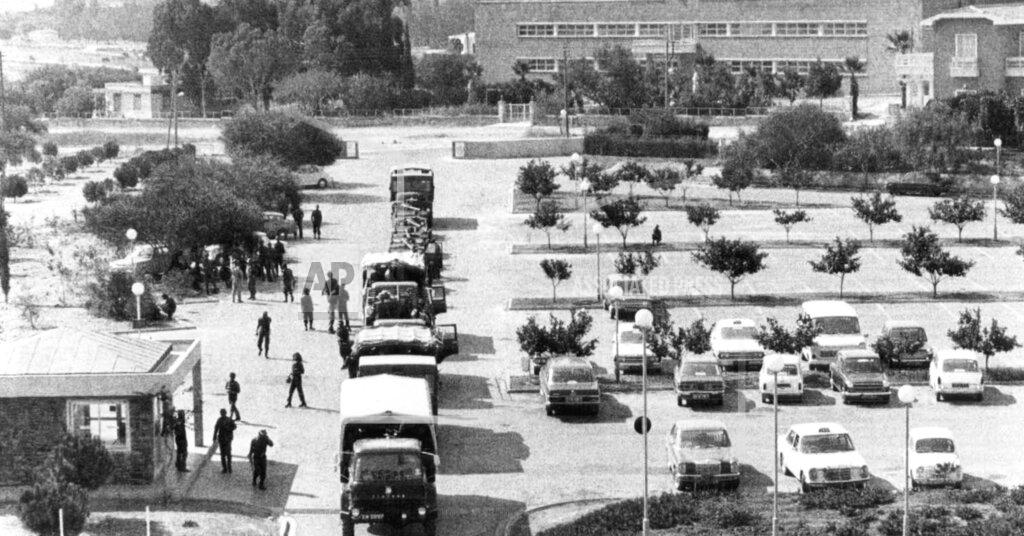
Turkey’s Parliament met in secret session over the Cyprus crisis today and then adjourned until Saturday. The army moved thousands of reinforcements to a coastal plain across from the Mediterranean island. Military convoys drove into the area before dawn and troops were seen leaping from trucks and pitching tents coastal forests. Turkish submarines were also sighted. Parliament met while awaiting the return of Premier Bulent Ecevit from talks in London. Deputy Premier Necmettin Erbakan said the legislators were briefed on the situation at the one‐hour emergency session. While Mr. Ecevit was still seeking a solution through talks with British leaders and the American Under Secretary State, Joseph J. Sisco, a Turkish opposition political party called for speedy intervention Cyrus.
Thousands of Turkish troops moved to the Mediterranean coast today and made camp in coastal forests only 40 miles from Cyprus. Army convoys entered the area before dark. Troops were seen moving into the woods with well‐drilled precision. In one sheltered bay, equipment was seen being loaded aboard about 15 transport ships. Guards lined the road to deter motorists from stopping.
In a news conference, Mr. Ecevit stressed the large dimensions of the crisis and the small dimensions of Turkey’s patience. Asked how long it would be before ‘Turkey made up her mind about invading Cyprus, Mr. Ecevit replied: “Not more than a day.” He softened the effect of this by saying he hoped for peaceful solution. But he said there must be a time limit and asserted that Greece was rapidly building up her position on Cyprus.
The right‐wing Democratic party said Turkey had the right to intervene under the 1960 treaty that established Cyprus and the party warned that time was running out. The National Salvation party —a minor partner in Mr. Ecevit’s coalition — had already urged military action to protect the Turkish‐Cypriote community of 110,000 on the island following Monday’s coup. Turkey has charged that Greece was behind the coup. The opposition leader, Staleyman Demirel, said today that the crisis had passed the point where it could be solved by the return of the deposed Cypriot President, Archbishop Makarios. “Turkey now does not even have a piece of rug to concede to Greece,” he said. “Friends and enemies alike now know this.”
Turkey extended its continental shelf westward about 2.5 million acres into the Aegean Sea over an area where Greece claims sovereignty. Observers said a map published in the official Gazette was certain to be contested by Greece, which claims a continental shelf around each of its 3,049 islands off the Turkish coast. The new move, against the background of the crisis in Cyprus, follows a May confrontation between the two countries over oil exploitation rights in the Aegean.
West German Chancellor Helmut Schmidt hailed the agreement between Iran and the Krupp iron and steel empire as a “textbook example” of how oil-producing countries can invest surplus profits in industrialized, consumer nations. German Industrialists said the agreement by which Iran purchased a 25.4% share in Krupp was the first known example of a Middle East oil-producing country investing directly in Western-owned industry.
President Antonio de Spinola warned Portugal that the post-revolution euphoria was over and that the country must combat anarchy threatening its freedom. “This climate of anarchy cannot continue,” Spinola declared. “We did not stage the revolution to allow the situation to go from one extreme to the other.”
The world’s tallest structure, a 646-meter Polish radio mast, is completed.
Israeli troops crossed into southern Lebanon and blew up three houses used by Arab “terrorists,” the Tel Aviv military command said. The homes were in the village of Bustan, about six miles from the coast.
Communist-led forces fired 34 122-mm rockets into the Da Nang air base, hitting the quarters of military dependents and killing 16 persons, Saigon reported. More than 100 shells were fired into Đức Dục district town 18 miles southwest of the air base, killing six civilians and destroying 200 homes. In the Central Highlands, North Vietnamese forces fired 1,000 shells into an outpost and penetrated the base with an infantry assault. Radio contact was lost with the base after it reported 105 North Vietnamese were killed.
In Hanoi, capital of North Vietnam, General Vo Nguyen Giap of the People’s Army of Vietnam gave the go-ahead to General Hoang Van Thai for preparation for the conquest of South Vietnam, starting with a preparatory mission on December 13, 1974 and a larger general offensive to complete the reunification of Vietnam, under Communist rule, by the end of 1976. South Vietnam would be conquered less than five months after the start of the invasion, with Saigon falling on April 30, 1975.
Kang Shin Ok, a prominent South Korean lawyer and advocate of civil liberties, has been arrested, his associates disclosed, apparently because he had denounced the military judge who had imposed death sentences on several of his clients, including the poet Kim Chi Ha. Kim Young Sam, the vice president of the New Democratic party, the major opposition group, was detained for interrogation, apparently only for a brief period. National Assemblyman Kim Young Sam, vice president of South Korea’s major opposition New Democratic Party, was picked up for questioning about a prepared statement in which he proposed repeal of a series of emergency decrees aimed at anti-government student groups. Officials charged that Kim’s statement, although not publicly released, constituted violation of the emergency directives. He was later released.
A 12-foot wing flap section from a Pan American World Airways Boeing 747 broke loose over Sydney, Australia, smashing into homes in two heavily populated suburbs. The pilot, Captain Graham Jones, 53, of Las Vegas said the flap tore loose as the aircraft was making its landing approach at 3,000 feet about 12 miles from the airport. The plane was on Flight 811 from Los Angeles via Nandi, Fiji Islands. No one was hurt in the incident.
Emergency food was being flown to about 150 travelers stranded by flooding along the Alaskan Highway in northeastern British Columbia and the southern part of the Yukon Territory. A Royal Canadian Mounted Police spokesman at Ft. Nelson, British Columbia, said the travelers, mainly vacationers, were cut off from towns by washouts and bridge collapses. The Alaskan Highway was closed to all but emergency vehicles between Ft. Nelson and Watson Lake, 335 miles to the northwest.
James St. Clair, President Nixon’s defense lawyer, told the House Judiciary Committee that a 1973 tape recording that Mr. Nixon has refused to give to the impeachment inquiry would prove that Mr. Nixon had ruled out a “blackmail” payment to E. Howard Hunt, a convicted Watergate burglar. The belated introduction of the evidence — a two-page edited White House excerpt from the transcript of a 90-minute meeting between Mr. Nixon and H. R. Haldeman — thus appeared to have left unsettled the central impeachment issue of the President’s attitude toward Mr. Hunt’s alleged demands for hush money.
The House Judiciary Committee made public five volumes of evidence that appeared to challenge President Nixon’s assertion that national security was the sole basis for White House involvement in wiretaps and the “plumbers” operations. The documents show that President Nixon and his top aides were aware in March and April, 1973, of the illegality of the secret White House “plumbers” activities, including the break-in at the office of Dr. Daniel Ellsberg’s former psychiatrist.
More than 1,500 of President Nixon’s most ardent supporters gave an enthusiastic demonstration of their confidence in him and his Administration tonight. Mr. Nixon, vacationing in California, informed them in telephone message that he planned to finish his second term despite efforts to impeach him. “We are going to continue until we win,” he said, and the Citizens Congress of the National Citizens Committee for Fairness to the Presidency filled a spacious ballroom at local hotel with an explosion of applause.
The nation’s total output of goods and services declined somewhat further in the second quarter, but the rate of inflation diminished, according to figures made public by the Commerce Department. The figures — preliminary and subject to revision — are for the gross national product. The price index for the G.N.P. — a measure of inflation that is often used but differs from the more familiar Consumer Price Index — showed inflation at a rate of 8.8 percent in the second quarter, a substantial improvement from the 12.3 percent in the first quarter.
The Senate passed a long-debated bill to put the program of legal services for the poor under an independent government corporation. The measure now goes to the White House, where sponsors said they were assured that an eleventh-hour concession would avoid a presidential veto. The new measure prohibits legal services employees from providing assistance in criminal, abortion, draft evasion and school desegregation cases. The final concession was acceptance of an amendment to remove authority for the Legal Services Corp. to obtain research work by grant or contract.
The General Services Administration ditched its plan for a joint computer system with the Agriculture Department, even though it still believes the move would have saved money. GSA decided that congressional misgivings over “Fednet,” its proposal for data systems shared by many government agencies, made the venture inadvisable. In announcing that GSA would go its own way, Dwight Ink, the acting administrator, said the agency had reached its conclusion “in view of concern expressed over the protection of privacy by members of Congress and elsewhere.”
The House Appropriations committee called for assurances that the government was getting a fair return for oil leases in the continental shelf and that there would be prompt exploration and development. The policy statement was in a report on the committee’s bill recommending nearly $3.7 billion for the Interior Department and related agencies. The total includes funds in a special energy appropriations bill approved earlier. Concerning the leasing of 10 million acres of potential oil-producing properties, the report said it might be wiser to lease fewer acres in 1975 and extend the program into future years in order not to spread private capital too thinly.
A federal appeals court upheld a lower court ruling ordering the school district of Portales, New Mexico, to provide bilingual instruction in elementary and high schools for Spanish-surnamed students. The ruling came on a class action suit filed several years ago by the Chicano Youth Association and parents of four Portales students. The Mexican-Americans argued that their children were receiving an inadequate education because of the lack of a bilingual program. The school district had contended that its failure was not unconstitutional because it did not result from direct discrimination.
A former aide to billionaire Howard Hughes has filed a federal court motion in Reno seeking to take depositions from President Nixon and his brother, Donald, for use in a tax evasion trial. The motion was filed by John Meier, accused of failing to pay nearly $1.7 million in taxes in 1969-70. A hearing on the motion was scheduled for August 1. Meier has contended evidence used to indict him in Las Vegas last year was gathered through an illegal telephone tap on Donald Nixon, a close friend.
The Olson House, immortalized by artist Andrew Wyeth in more than 200 paintings, was given to the state of Maine by film producer Joseph E. Levine. Levine told Governor Kenneth M. Curtis that the state would have to maintain the weathered farmhouse as a museum and could not charge admission. The building, in Cushing, Maine, is in the background of Wyeth’s famous “Christina’s World.” The painting shows Christina Olson, a crippled girl, in a field looking toward the house.
Rumor hardened into fact as Susan Hayward’s doctor confirmed that the actress had undergone an examination for a brain tumor in Atlanta’s Emory University Hospital, where she had been admitted a week ago. Neurosurgeon George T. Tindall said he had performed “a brain biopsy” to determine if the tumor was malignant or benign and that results were pending. He said the condition of the 55-year-old Academy Award winner was “good.” Miss Hayward was hospitalized at Los Angeles for several months in 1973, at which time her son, Tim Barker, was quoted as saying she had been suffering from multiple brain tumors. Miss Hayward won her Oscar for best actress in the 1959 film “I Want to Live.”
E. I. Du Pont de Nemours & Co. and eight other chemical manufacturers that together control 60 percent of the nation’s dye sales were indicted by a federal grand jury in Newark on charges that they fixed prices, pushing the cost of dyes to “artificial and non-competitive levels.”
Commercial diver Fred Brening failed to surface from a dive into a flooded dry dock pump well at the Brooklyn Navy Yard. Brening, who had only an hour’s supply of oxygen, was found dead the following day in a maze of pipes on the second level of the well.
The U.S. performs a nuclear test at the Nevada Test Site.
In Ireland, a group of women who played the sport of Gaelic football organized the Ladies’ Gaelic Football Association (LGFA). Representatives from the counties of Galway, Kerry, Offaly, and Tipperary met at the Hayes’ Hotel in Thurles, County Tipperary, almost 90 years after the Gaelic Athletic Association (GAA) had been founded in the same hotel. In September, the four teams and teams from another four counties (Cork, Roscommon, Laois, and Waterford) would play the first LFGA Championship tournament. The GAA would accord recognition to the LFGA in 1982.
With both the Kansas City Royals and New York Yankees playing catch‐up baseball last night, the 12,615 paid fans at Shea Stadium were rewarded with an extra “batting practice” in the first of the four‐game series. Batters on both teams sprayed a total of 25 hits, while fielders hobbled enough balls (six) to make it unenjoyable for the pitchers, Dick Tidrow of the Yankees and Paul Splittorff of the Royals, among others. The Yankees finally came out on top, 10–6.
Last night in Cleveland’s Municipal Stadium — another 10‐cent beer night, by the way — the world champion Oakland A’s beat Gaylord Perry, 3–2, sending him to his second straight defeat, He is now 15–3. Eleven days ago, in Oakland, the A’s stopped Perry’s consecutive‐victory streak at 15 — one short of the league record. This time the A’s spotted the Indians a 2–0 lead in the second inning, but won anyway.
Bill Freehan, a clean‐up batter with only 17 runs batted in, hit a two‐run homer to key a four‐run third inning that carried the Detroit Tigers to their first victory in five games, winning 5–3 over the Minnesota Twins. Freehan’s fifth homer of the season followed a walk to Al Kaline. Freehan moved into the No. 4 batting spot when Willie Horton went on the disabled list six days ago. Joe Coleman scattered eight hits in raising his record to 8–9 as the Twins lost for only the third time in their last 12 games.
The Houston Astros hammered the St. Louis Cardinals, 8–2. Lee May drove in three runs with his 16th homer and a bases loaded double, and the Cardinals committed three errors that opened the door to six runs in the seventh inning. May’s double was the key blow in the big inning as the Astros broke a 2–2 tie and knocked out Lynn McGlothen, who failed for the third time to win his 13th game.
The Los Angeles Dodgers beat the Montreal Expos, 7–5 at Chavez Ravine. Jim Wynn and Ron Cey hit two-run homers to highlight a seven‐run‐fourth, and Andy Messersmith (11–2) won his fifth straight game with a 10‐strike‐out performance in helping his teammates end a three‐game losing streak. The Dodgers sent 10 men to the plate in the fourth against Ernie McAnally (6–11), collecting seven hits. The Dodgers also announced that Tommy John (13–3) had been placed on the 21‐day disabled list. John ruptured a ligament in his pitching (left) elbow against Montreal Wednesday night.
Dow Jones Industrial Average: 789.19 (+4.22, +0.54%).
Born:
Derek Anderson, NBA shooting guard, small forward, and point guard (NBA Champions-Heat, 2006; Cleveland Cavaliers, Los Angeles Clippers, San Antonio Spurs, Portland Trailblazers, Houston Rockets, Miami Heat, Charlotte Hornets)
Alan Morrison, English poet, in Brighton, England, United Kingdom.


 History Diaries