Danzig reports from Polish sources today indicate that the brief lull there has ended and that Nazi activities there have been resumed. It is reported that more groups of German “tourists” are arriving. The discretion observed some time ago is now abandoned and these “tourists” march openly through the streets. In certain parts of Danzig Harbor the police have been replaced by Elite Guards, who refuse admittance to any persons not holding Gestapo [German secret political police] permits. This means that entry is denied to the Polish customs officers.
Polish economic discussions with Germany will take place next month with the purpose of intensifying reciprocal trade. The announcement of these discussions holds out hope for some measure of improvement in Polish-German commercial relations, but it is feared that no improvement in political relations is possible as long as Danzig continues to be militarized.
Military authorities here are making special preparations for the visit of British General Sir Edmund Ironside, Commander in Chief of overseas forces, who will arrive tomorrow by air. He will be accompanied by the Polish military attaché in London and will initiate staff conversations between the two countries.
The Polish Chief of Staff, General Julian Stachewicz, will represent Poland at these discussions, but Marshal Edward Smigly-Rydz and the Minister of War will also participate. The conversations will last three days, after which Sir Edmund will spend two days seeing the Polish Army and its fortifications. The press stresses this visit as an outward manifestation of future Anglo-Polish cooperation in the military field. It is understood that Sir Edmund will discuss a general plan for such cooperation in wartime, after which the details will be worked out by a permanent joint committee.
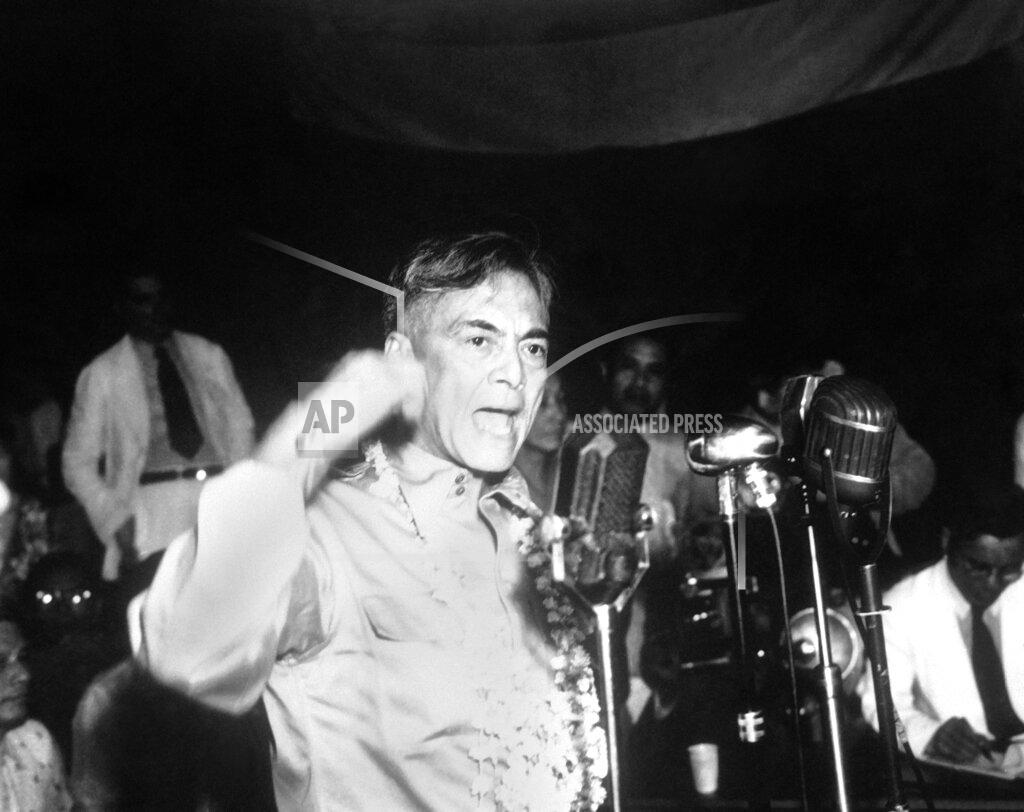
“Poland has decided to fight for Danzig if she has to fight alone,” Marshal Edward Smigly-Rydz told a reporter. “If all other methods of settling the Danzig problem fail and Danzig is occupied by the Germans, Poland will consider that a cause of war.” There will be no repetition of Czecho-Slovakia here. The Poles will not sit cooling their heels behind closed doors. They will remain masters of their own destiny. The Marshal of Poland has a unique position. There is no other commander-in-chief whose position or prestige is like his. He is the heir of the great and idolized Pilsudski and his appointed successor. “We will exhaust all methods of settling the question of Danzig peacefully,” the Marshal said. “Then if Germany persists in her plans for Anschluss, Poland will fight even if she fights alone and without allies. The whole nation is agreed to this.”
A scheduled meeting today of Vyacheslav Molotov, Premier and Foreign Commissar, with British and French envoys on the long-discussed three-power mutual assistance pact was postponed until tomorrow. Soviet authorities failed to explain the delay. It was not believed that the British and French representatives had received any last-minute instructions from London and Paris altering the situation. The British Ambassador, Sir Williams Seeds; William Strang, special British envoy, and the French Ambassador, Paul-Emile Naggiar, conferred frequently last week and received numerous communications from their governments but their nature was not disclosed.
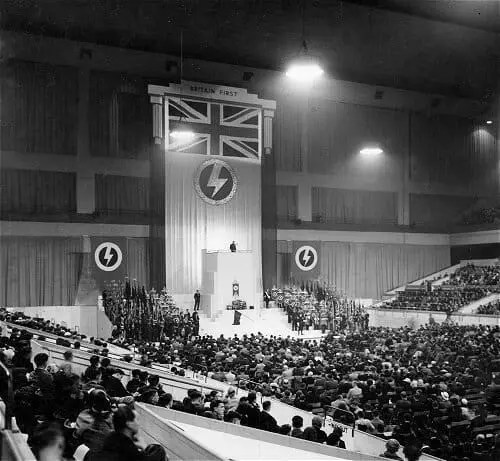
British Fascist leader Sir Oswald Mosley gave a speech in the Earls Court Exhibition Centre attended by over 20,000 people. He presented a plan that he said would “bring peace in our time and our children’s time” that called for a hands-off policy in Eastern Europe, disarmament in Western Europe, return of colonies to Germany and for the British Empire to concentrate on its own affairs. “Why is it a moral duty to go to war if a German kicks a Jew across the Polish frontier?” Mosley declared. “We are going, if the power lies within us… to say that our generation and our children shall not die like rats in Polish holes.” Mosley declares that one million British Fascists will refuse to fight in a “Jewish war.”
Winston Churchill gains support in London. The Sunday press advocates his inclusion in government. Prime Minister Neville Chamberlain’s refusal to reorganize his Cabinet threatened today to result in a serious political controversy at a time when government quarters were anxious to meet international problems with a demonstration of national solidarity.
The seriousness of the situation was indicated by editorials or leading articles on the subject in nearly every London newspaper. The Sunday Express displayed a front page banner line saying the campaign to put Winston Churchill in the Cabinet was a “Move to Drive the Premier Out of Office.” It added a headline that “Mr. Chamberlain Must Either Destroy His Opponents or Resign.”
Mr. Churchill, Conservative Party member but often a sharply spoken critic of the government, was First Lord of the Admiralty at the outbreak of the World War and subsequently held several other Cabinet posts. Lord Astor’s Sunday Observer, which usually supports the government, took Mr. Chamberlain to task for refusing to bring Mr. Churchill into the Cabinet. It described Mr. Churchill’s exclusion as “repugnant to the average man’s notions of national common sense and personal fair play.”
“The present Prime Minister is the last man to accept a new colleague thrust on him as a censor and opponent,” The Observer said. “On the other hand, Mr. Chamberlain and his retinue cannot have it both ways, either. They must admit that they need exceptional support from the Oppositions. Yet they refuse to lift a finger for that purpose. This promotes dissension and antagonism. “The serious thing as Ministerialists will find is that Mr. Churchill’s exclusion has become repugnant to the average man’s notions of national common sense and personal fair play.”
The Sunday Times featured an article by Lord Elton on the editorial page entitled “keep an unbroken national front.” The article referred to Opposition Leaders Clement R. Atlee, Sir Archibald Sinclair and David Lloyd George as “mischief makers” and said “recent propaganda against the Prime Minister has been both. inopportune and unfair.”
Lord Elton continued that Mr. Churchill undoubtedly would be brought into the Cabinet in war time, but that meanwhile the nation would be content to accept Mr. Chamberlain’s judgment “if he holds that the time for it is not yet.”
“We are crossing a perilous pass,” he said. “What most matters now after the building of an impregnable defense is that uneasy criticism should do no more to undermine the foundations of the national front and that the Prime Minister should know that he has an undivided nation at his back.”
Count Galeazzo Ciano, Italy’s Foreign Minister who is currently on a state visit to Spain, left the Barajas airport by plane this afternoon for Seville after a banquet in Toledo’s City Hall tendered him by General José Ituarte Moscardo, the Alcazar’s celebrated defender, who this morning showed him through the ruins in which the Nationalists resisted the siege of the Republican forces for nearly three months in the Summer of 1936.
Early today, three armed Arabs attacked and killed two Jews, Ephraim Ornstein and Dr. Joseph Rothfeld, who were surveying the fields of a Jewish settlement near Tiberias. Both victims were from Vienna. Dr. Rothfeld was known throughout Northern Palestine and also Trans-Jordan for his generosity in medical aid to all, irrespective of creed.
The plight of 2,600 Jewish refugees on four Greek ships outside Palestine territorial waters has aroused inhabitants of Palestine, who are demanding that local authorities assist them to disembark despite the six-month immigration ban. The British Government announced last Wednesday no Jewish immigration quota for Palestine would be issued for the next six months. The captain of one ship carrying 600 refugees wirelessed French authorities for permission to put in at a Lebanese port for food and water, saying he had attempted unsuccessfully to land his passengers at every port in the Mediterranean.
Far-reaching recommendations for revision of the patent and anti-trust laws are conveyed to Congress in the preliminary report of the Temporary National Economic Committee, made public today. The legislation proposed by the committee, some of which is already well on its way through Congress, includes fundamental procedural changes to speed patent law litigation; prohibitions upon the use of patents for restraint of trade; amendment of the Clayton Act to prohibit one corporation from acquiring the assets as well as the stock of a competing corporation, and civil remedies for enforcement of the anti-trust laws.
Those of the recommendations affecting recent business practices most profoundly are those barring use of patents for trade restrictions, which were recommended by the Department of Justice and approved by the committee in the light of verbal testimony from corporation executives showing the need for such legislation, and the amendment of the Clayton Act, long sought by the Federal Trade Commission, which would alter what has become the customary method of merging competing corporations.
While Senator O’Mahoney, committee chairman, emphasized at a press conference yesterday that the recommendations were distinctly preliminary in character, he said that the pattern of the report was suggested by that portion of President Roosevelt’s message to Congress in April, 1938, which said an economic investigation should be started at once “to preserve private enterprise for profit by keeping it free enough to be able to utilize all our resources of capital and labor at a profit.”
The report was said to have the approval of the entire committee, representing both houses of Congress and six government departments, with the exception of Senator King, who, Mr. O’Mahoney related, authorized the chairman to state “he is not in accord with some of these recommendations.” Senator King could not be reached to elaborate on his objections, but it was understood they related to the Justice Department’s recommendations for patent law changes, and to the proposal for civil penalties for anti-trust law violations.
With little likelihood left that they can win favorable action at this session of Congress on a bill to restore union wage rates for WPA workers, leaders of the American Federation of Labor turned yesterday to plans for a drive for new funds for the Public Works Administration, which provides full-time jobs at prevailing rates of pay for more than 30,000 members of AFL unions in New York and for hundreds of thousands elsewhere in the nation.
The PWA carries on large-scale construction projects under private contract and officers of the AFL have repeatedly set forth their belief that this method is preferable to the entrance of the WPA, a relief agency, into the heavy construction field. Colonel M. E. Gilmore, regional director of the PWA, announced last week that 87,500 persons were now employed on PWA projects in New York State but warned that the total would taper off rapidly until the end of this year, when the program would be 86 percent completed.
The unions in the building trades are the strongest group in the AFL. If they can win additional appropriations for PWA, thus assuring new jobs to take the place of those eliminated by completion of the current program, delay in their campaign for abolition of the new Federal Relief Act’s requirement that all persons on WPA work 130 hours a month for their security pay will be less disappointing to their members.
The response to the strike called by 125 New York City unions affiliated with the Building and Construction Trades Council indicated that fewer than 15,000 AFL mechanics had jobs on WPA. The PWA, which pays its skilled workers nearly three times as much in a month as WPA, has 31,718 persons working on its projects in this city, virtually all of whom belong to the AFL.
A decision by the AFL to concentrate its legislative efforts on passage of a new PWA bill might prove welcome to many members of Congress who wish to retain labor support yet hesitate to fly in the face of hostile public sentiment by voting for re-establishment of union wage scales on WPA while relief workers are out on strike.
Fritz Kuhn, national leader of the German American Bund, who is under indictment in New York County charged with the theft of $14,548 of bund funds and is under $5,000 bail on that charge, had a new brush with the law in Webster, Massachusetts early today and spent four hours in the local lock-up before friends scraped up $54 for nominal bail. Kuhn was arrested on charges of drunkenness and using profanity in public after his efforts to impress a local patrolman with his political importance failed and he was locked up. The police chief backed up the patrolman. Kuhn will be arraigned tomorrow before Police Judge Lewis O. Rieutord in Southbridge, eight miles from here.
The bund leader had been drinking late Saturday night in a Main Street restaurant with four other men, one of whom was a nephew of Anastase Andreivitch Vonsiatskoy-Vansiatsky, founder and president of the Russian National Revolutionary Fascist party and head of a Russian colony in Thompson, Connecticut. Vonsiatskoy-Vansiatsky, who is a frequent visitor in this village and is the husband of the former Marion B. Stephens, daughter and heiress of the late Norman B. Ream of Chicago, was not with them.
Labor hopes for $1 billion dollars for public works as WPA hopes fade.
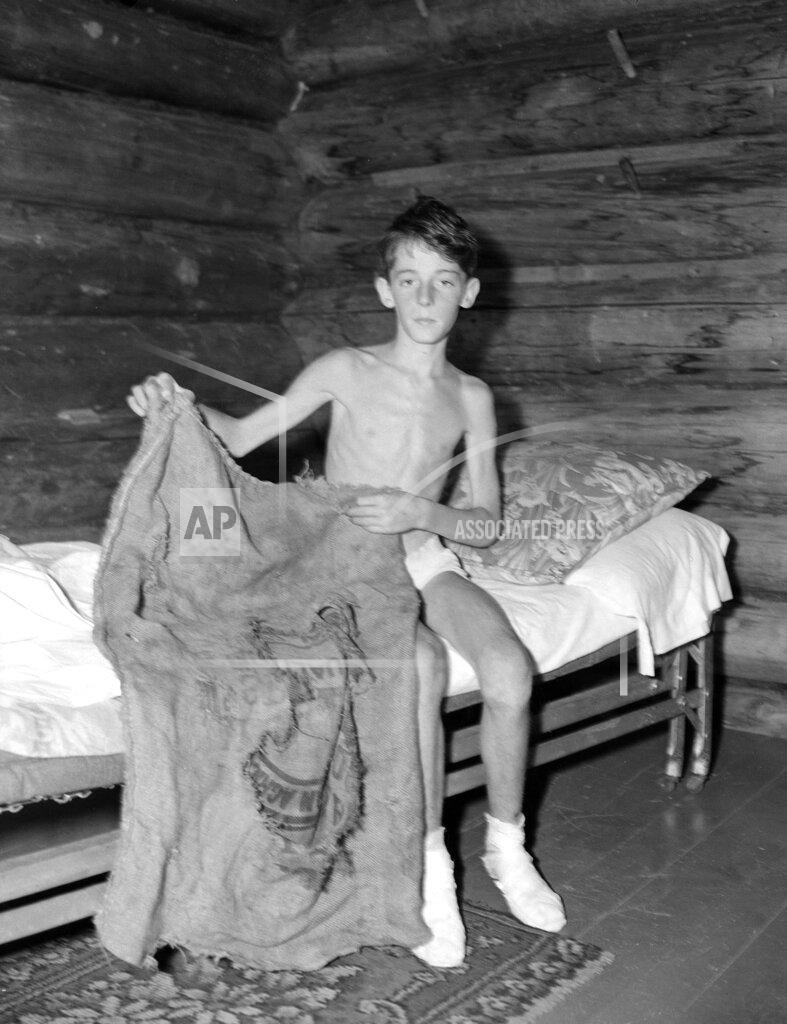
The Harlan, Kentucky, coal battle takes its second life. A wounded miner dies despite a blood transfusion.
Elliott Roosevelt denounced the Rev. Charles E. Coughlin in a national radio talk over the Mutual network Saturday night as anti-Semitic, “a compounder of stories” and as being financially interested in his silver monetization activities.
Congressional adjournment promises political and rhetorical respite in Washington. The pre-election contest will continue, but with less heat.
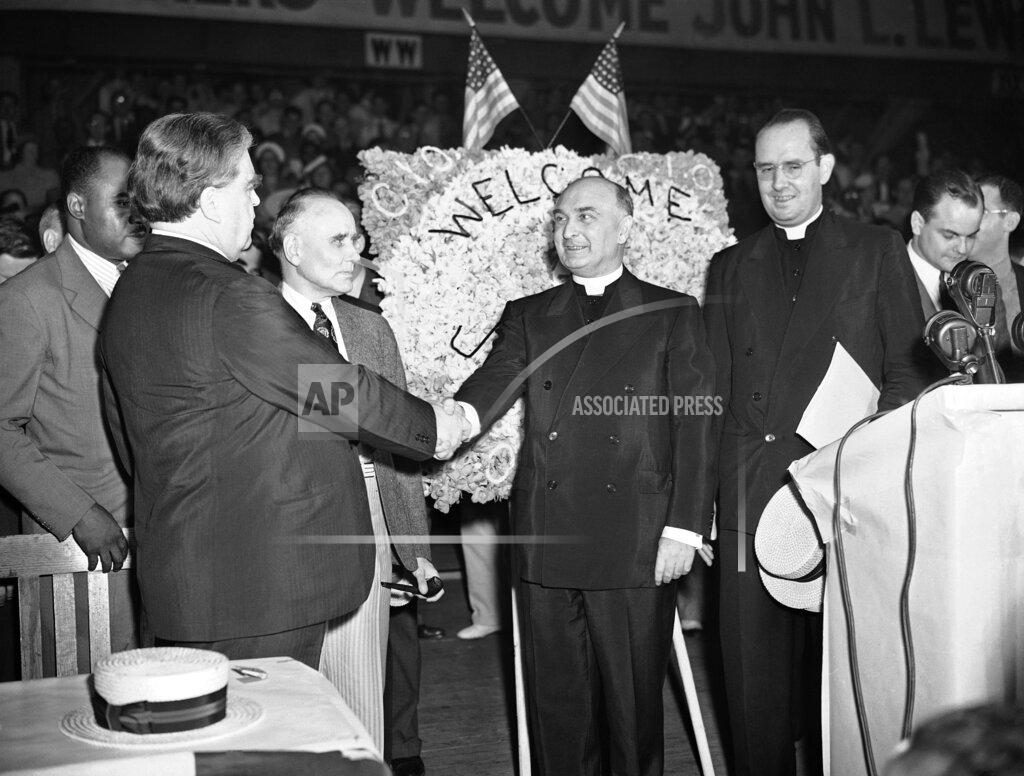
Representatives of the Packinghouse Workers Organizing Committee today voted to call a strike at seventeen plants of Armour Co. if the big packing firm declined to negotiate contracts with the C.I.O. union.
Trans-Atlantic flying is now commonplace. Taking passengers by air to Europe has changed from a dream to a regular occurrence.
An early diagnosis of cancer is promised with a new antigen injection test.
A Coast Guard inquiry will convene here this morning to determine why there was “a terrific explosion and wreckage flew everywhere” as the V-164, Coast Guard patrol and rescue flying boat, crashed into the sea 150 miles off New York.
English actress Vivien Leigh says she was sometimes told she sounded too Southern when filming “Gone with the Wind.”
Boston Bees All-Star shortstop Eddie Miller collides with teammate outfielder Al Simmons and fractures a bone in his ankle. He will be out for the season. The Bees beat the Reds, 3–0, behind Bill Posedel, before losing game 2, 4–3.
Japan threatens a raid into Siberia. A threat of a retaliatory Japanese air raid upon Soviet Russia’s Siberian air base at Blagoveshchensk was made in diplomatic protests today following the bombing of Fularki by Soviet fliers. The Soviet raid came before dawn in the deepest thrust yet made into Manchukuoan territory in the border warfare that has been waged spasmodically since early in May. Fularki is about forty miles southwest of the important Manchukuoan center of Tsitsihar and on the main railway line between Harbin and Hailar. It is almost 400 miles east of the zone on the Outer Mongolian border where most of the fighting has taken place, but somewhat closer to the nearest point of the frontier.
Aside from the fact that the raid was the third within a week by Soviet planes on railroad centers deep in Manchukuoan territory, significance was seen in the threat of retaliation against Blagoveshchensk, Soviet base 500 miles northeast of the bombed town.
Unofficial observers believed the Russian planes had launched their raid from that point and had demonstrated the vulnerability of the Japanese rail line by the ability of the Russians to attack from two directions. Seven persons were wounded and two buildings destroyed by the eight bombs that were dropped. One of the strongest protests in the border warfare was made both at Ulan Bator, capital of Soviet-protected Outer Mongolia, and to the Soviet Consul at Harbin in Manchukuo.
The Japanese yesterday reported that Soviet planes last Monday and Thursday had raided Halunarshan, important Japanese military base and railhead in Northwestern Manchukuo, about 125 miles from the Khalka River battlefront. The Japanese announcement said. eight bombs struck the railway station at Fularki, but failed to say whether tracks were damaged. The wounded were said to be both Russian and Manchukuoan residents of the town. One of the wrecked buildings belonged to a Russian, the other to a Manchukuoan, the Japanese reported.
The raid recalled repeated statements by Japanese military authorities in Shanghai that a Soviet-Japanese war might result if the Russians attacked important objectives in Manchukuo. Domei, Japanese news agency, reported that in addition to the protest radioed to the Mongolian capital, Japanese authorities made representation to Soviet consular authorities at Harbin, threatening retaliatory action if “these unlawful activities continue.”
The news agency said the Harbin consulate was told that the raid “differed radically from the border affair” and that responsibility for further developments will rest with the Soviet Union.”
The Chinese claim to have made a successful drive against depleted Japanese forces between Canton and Fayungshing. The Japanese have dropped more than 100 bombs at Liuchow, Kwangsi’s industrial center and the site of a cadet college. Casualties have been heavy. The Japanese blockade has been extended to Swabue on the South China coast, Hinghwa near Foochow, and Chuanchow, Tungshan and Chaoan, ports in Fukien Province. It is expected to be tightened soon.
The Navy Department in Tokyo announced today that Emperor Hirohito would review the combined Japanese Fleet off Yokosuka next Friday.
A fresh warning to the British to alter their “pro-Chiang Kai-shek policy” was issued in Tientsin today by Lieutenant General Masaharu Homma, Japanese Army commander there. He declared the negotiations that opened yesterday in Tokyo between Japan and Britain would end in prompt rupture unless the British agreed to change their policy in China. He predicted the formation of a new central government with jurisdiction over all important Chinese towns and ports and said: “Britain must abandon her hostile character if she wishes favorable treatment under such a new situation.”
Official British reports meanwhile said British missionaries would withdraw from Kaifeng, important Honan Province railway city, within a few days as the result of an ultimatum from anti-British demonstrators who warned them to quit the city by next Wednesday. The Britons, understood to number six, planned to hand over their missions to American missionaries. All had remained in the city during its occupation in June, 1938, by the Japanese.
Born:
Corin Redgrave, actor (“Excalibur”, “A Man for All Seasons”) and political activist, in Marylebone, London, England (d. 2010).
William Bell, American soul and R&B singer (“Tryin’ to Love Two”), and songwriter (“Born Under a Bad Sign”), in Memphis, Tennessee.
 History Diaries