Telephoned reports from Berchtesgaden, Germany, tonight stated that Chancellor Adolf Hitler conferred for two hours during the day with Albert Förster, Nazi leader of Danzig. The report said Herr Förster expressed the hope “to see the Führer in Danzig soon.”
The Danzig Senate apologizes to Brazil for yesterday’s arrest and manhandling of two Brazilian diplomats in the Free City.
Czechs cut the telephone wires of the German army. The Reich issues a warning that further tampering will be severely punished.
The Reich accuses the British Foreign Secretary Viscount Halifax of urging Germans to rise up against the government.
As another demonstration that Great Britain “means business,” Prime Minister Neville Chamberlain told the House of Commons today that virtually the entire reserve fleet of the navy would be mobilized at the end of this month and would take part in combined maneuvers of the navy and air force during August and September. For this purpose, Mr. Chamberlain said, 12,000 retired naval officers, reservists and pensioners would be called to report for duty July 31 for the remainder of the Summer. On August 9, he added, King George will review the reserve fleet of 130 warships of all types in Weymouth Bay, thus symbolizing Britain’s maximum readiness for any emergency. “Subsequent to this review,” said Mr. Chamberlain, “the ships will leave to ‘work up’ before the exercises. It is anticipated that the exercises will last approximately until the third week of September and that the reservists will be free to return to their homes after the ships have been reduced to the reserve at the end of that month.”
Likening the present attitude of the United States toward European quarrels to Victorian England’s spirit of “splendid isolation,” the Marquess of Lothian, Britain’s Ambassador-designate to Washington, tonight warned the British public against “overestimating” the unity of the two countries.
Two French newspaper executives were charged with espionage and taking money from the German government to publish defeatist propaganda. Two Frenchmen, M. Aubin and M. Poirier, connected with two of the best-known newspapers in Paris, have been arrested by a military order and imprisoned on the charge of having been in relation with certain agents of Hitlerian propaganda with the intention of spreading such propaganda in France. Great secrecy is being maintained regarding the alleged activities of these two men and, as their arrest is a military and not a civil matter, permission to publish their names here was refused. M. Poirier belongs to the commercial staff of the Figaro and M. Aubin was head of the information service of the Temps.
While this evening’s Temps kept silent on the matter, refraining even from publishing the fact of the arrests, tomorrow’s Figaro will publish the following paragraph: “During an inquiry into foreign propaganda in France the Department of Military Justice has involved a person employed in the commercial advertising department of our newspaper. This person had no relations with the editorial department nor any responsible function in administration nor any means of influence on the newspaper. He always conducted himself in a reserved and irreproachably correct manner.”
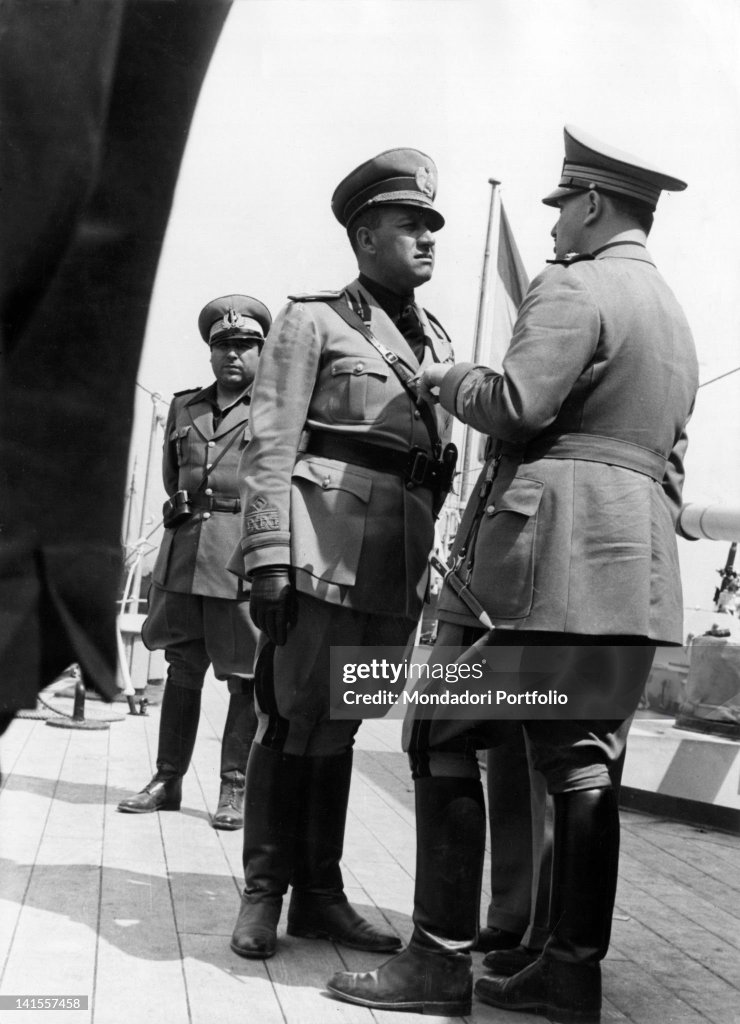
While his guest, Count Galeazzo Ciano, the Italian Foreign Minister, was visiting Santander today, Generalissimo Francisco Franco made an inspection tour of nearby Pasajes, where construction of defense works is believed planned. Pasajes, during the civil war, especially before the fall of Bilbao and Santander, developed quickly from a mere fishing port into another important Atlantic trade outlet on Spain’s northern coast. It has an enclosed and excellently protected harbor which must be entered through a narrow passage between low hills. From the sea or from the nearby French lighthouse at Hendaye it is hidden from view.
Whether fortifications have been constructed yet on the heights guarding the town is not definitely known, but work began in earnest five or six days ago on pillboxes, concrete machine-gun nests and emplacements for heavy artillery on the crests of the hills surrounding Irún and Fuentarrabia on the frontier opposite Hendaye, France. General Franco inspected these fortifications yesterday and the day before. The preparatory work being done on either side of the international highway, where many soldiers are employed, can be seen by anyone traveling from Irún to San Sebastián, including the French Ambassador, Marshal Philippe Pétain, who makes the trip frequently. General Franco’s military engineers directing the work are advised, it is said, by German and Italian technicians. This, of course, cannot be confirmed.
Count Ciano, accompanied by General Fidel Davila, Spain’s National Defense Minister, boarded the Spanish cruiser Almirante Cervera last night after attending grand ball organized in his honor by the municipal government here and witnessing a brilliant fireworks display over San Sebastián’s famous “Concha,” or shell-shaped beach, in which the Italian colors predominated. Count Ciano arrived at Santander at 11 o’clock this morning, to be welcomed by the provincial authorities. He went immediately to the site atop Mount Escudo where a monument to the memory of the Italian Legionnaires who fell before Santander was captured in August, 1937, was formally inaugurated.
A report that Italy had leased to Germany the port of Trieste for a period of ten years was discussed in Geneva and Paris tonight with considerable interest.
Italy begins an “Aryanization” program similar to the one in Germany.
Italy marks its first year of racial policy. A paper holds that Jewish influence was purged without incident.
The Italian Government has protested to the French Government against the cession of the Hatay Republic to Turkey, it was announced today. As a member of the San Remo conference of 1920 that granted the Syrian mandate to France, Italy now makes the “fullest reservations” against the transfer.
The general apprehension in Finland over the Anglo-Soviet talks for a guarantee pact on the Baltic States-interpreted here as an unveiled threat by Russia to take the first occasion to violate Finnish integrity in order to serve military aspirations-continues to increase as a result of statements that an agreement is nearly complete. Finland earnestly hopes the negotiations will prove fruitless because it is believed the Western powers will not be able to “sell,” as it is termed here, the idea to Finland and the other small Baltic States. An additional cause of uneasiness is given by the German explanation that a guarantee pact would compromise Finland’s declared neutrality, and, moreover, there are Swedish and Norwegian statements that an Anglo-Soviet guarantee of Finland would place her outside the Northern neutrality bloc, which consequently would be irreparably broken up.
The comparative calm reigning in Palestine during the last few days may be seriously disturbed again as a result of Colonial Secretary Malcolm MacDonald’s latest statement prohibiting all Jewish immigration to Palestine for the six months beginning October 1. Palestine Jewry is greatly disheartened at this latest blow. The sentiments of Jews are reflected in the Hebrew press representing all factions and shades of thought. The Jewish Agency declared: “The right of Jews to return to their country is a natural and historic right. It is not the Jewish refugees returning to their homeland who are violating the law, but those endeavoring to deprive them of the supreme right of every human being, the right to live.”
This contention is upheld in fiery editorials in the whole Hebrew press. Palestine Jewry’s reaction is best expressed in the Labor daily, Davar: “All the government can achieve are conditions turning transgression of the law into the law of life in this country.” The entire press is unanimous in condemning the penalization of legal refugee immigration, and is shocked at “MacDonald’s tremendous hurry in annulling the very remnants of Jewish rights recognized even by his own White Paper, the fulfillment of which has already proved impracticable and impossible.”
Mr. MacDonald’s new act undoubtedly has greatly weakened the position of the moderate Jews who have advocated cooperation with Britain and nonviolence. A further cause of anxiety here is the approaching world Zionist congress convening in Geneva in August. The departure of all the most important Zionists will leave Palestine Jewry practically leaderless just when a strong hand is needed to cope with the serious situation that may develop. Both Arabs and Jews here now seem to side with minorities in both camps who have always been insistent that the British Government for some unknown reason wants to have a disturbed Palestine.
A press association report that President Roosevelt had differed with Secretary Hull over the phraseology of a neutrality message which he planned to send to Congress brought a formal rebuke from the Chief Executive today in Washington. President Roosevelt issued a statement denouncing as untrue a press association report that he and Secretary Hull were at odds over the phraseology of a message on neutrality to Congress.
The Senate passed the bill amending the Social Security Act, and recessed at 6:14 PM until noon tomorrow.
The House adopted the measure for establishment of a Franklin D. Roosevelt Library at Hyde Park, New York, and adjourned at 5:40 PM until noon tomorrow.
Next in the Administration’s fight to revise the Neutrality Act is likely to be a gesture to keep its own record clear rather than to force Congressional action. Advisers close to President Roosevelt and Secretary Hull are convinced that Congress, in its present mood, will not enact a revision that would meet the Administration’s wishes.
Faced with this situation, Mr. Roosevelt and Mr. Hull are apparently agreed that they must continue to emphasize to the American people as well as some foreign countries that the attitude assumed by Congress does not have the concurrence of the Executive branch of the government. The present state of indecision is dictated merely by considerations of the technique to be employed; that is, whether it shall be a message to Congress, a radio speech by the President or remarks at his press conference tomorrow. Some members of the Foreign Relations Committee heard today that the President intends to send some communication to Congress on Monday.
In the opinion of Administration advisers, the rebuff occasioned by the House in putting back into the Bloom resolution the arms-embargo provision, and the stalemate in the Senate resulting from the Foreign Relations Committee’s vote to defer consideration to the next session of Congress, makes it likely that the question of foreign policy will play a prominent part next year in the Presidential campaign.
This consideration plays some part in the decision to “keep the record clear” by a White House pronouncement. It is expected that the Republicans, who, with a few notable exceptions, have voted consistently against the Administration on the “neutrality” question, will take it up as a national issue. The matter has already seriously divided Democratic ranks, and the defectors, added to the Republican vote in Congress, have been able to block the Administration’s moves.
Some Administration advisers think that whatever representative character the Neutrality Act might have had in relation to an early war in Europe has been lost because of the confusing parliamentary situation and the bitter debate. Some of them, it is true, are prepared to endure the uncomplimentary and even incendiary debate the Senate probably would produce if they believed that, in the long run, any concrete result would be achieved. But they do not think so.
As the American Federation of Labor laid an informal plea for restoration of WPA wage rates before President Roosevelt yesterday and prepared for a formal conference with him today, one of the President’s ranking aides criticized the methods of striking WPA employees and another took exception to their aims. Attorney General Frank Murphy, discussing the protest of WPA construction workers against the abolition in the new Federal Relief Act of union wage scales on WPA, said there must be no strikes against the government. He reported that agents of the Federal Bureau of Investigation had been assigned to investigate charges that persons wishing to work in Minnesota and Missouri were being intimidated by strikers.
Mr. Murphy’s declaration that there must be no strikes against the government was accompanied by a warning that the Department of Justice would “strike hard” against those “who would move in on conflicts of this kind and try to exploit them.” He said some evidence. of “racketeering” in connection with the WPA strikes had been discovered and was being acted upon. Colonel F. C. Harrington, National Work Projects Commissioner, who suggested that Congress write into the law a requirement that all relief employees work 130 hours a month for their security pay, declared in Chicago that he had no intention of asking Congress to change this provision.
The dismissal of workers who had stayed away from their jobs for five days continued in all parts of the country. Pink discharge slips went to 2,983 strikers in this city, bringing the total since the stoppage began to 7,897. Major Edmond H. Leavey, Acting WPA Administrator for New York City, said 20,380 mechanics were at work, an increase of 946 over Wednesday’s total.
A national check-up by the WPA showed that 92,770 persons were not at work Wednesday, a rise of more than 15,000 from Monday’s figure. One-day protest demonstrations were responsible for the increase, according to Corrington Gill, assistant administrator, who said the workers engaged in these stoppages were already back on the job. Reports from State WPA offices to the Washington headquarters disclosed that 12,906 workers had been dropped for violation of the five-day absence rule up to Wednesday night. Additional dismissals yesterday brought the total laid off to about 20,000.
In Chicago, Colonel F. C. Harrington put the number of strikers at 92,770, asserted he would not ask Congress to modify the relief law and insisted that the five-day dismissal rule be enforced.
In Pennsylvania the unions went ahead with plans to take their men off all WPA jobs. This was in the face of an ineffective strike in New Jersey.
The omnibus bill revising the Social Security Act was adopted by the Senate late today by a vote of 56 to 8, but it was amended to compel every State to pay from its own funds $10 to each recipient of old age assistance in order to qualify for Federal aid.
Attorney General Murphy joined the “Roosevelt for Third Term” movement among Cabinet members today.
The House, after listening for five hours to sharp attacks on the President, passed late today with minor amendments a Senate-approved bill to establish the Franklin D. Roosevelt Library at Hyde Park and accept the State papers and library offered to the nation by the President. The House voted 221-124, along party lines.
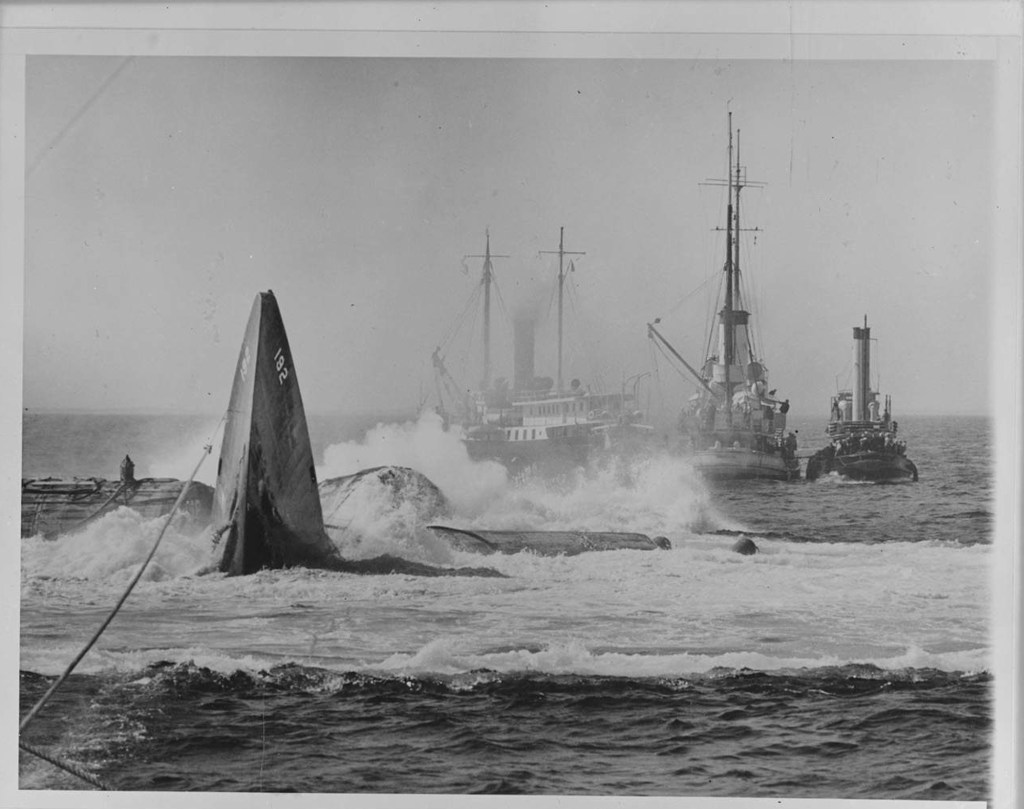
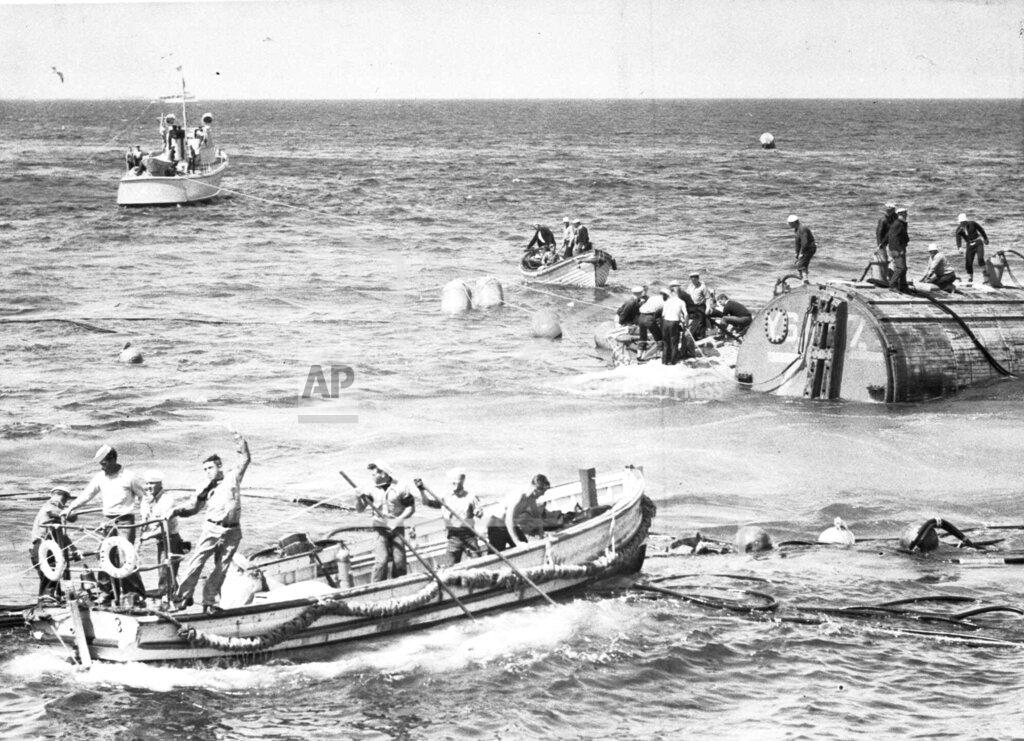
The bow of the sunken USS Squalus is briefly raised in the Isles of Shoals off northeastern United States, but the wreck slips under the surface again.
Attorney General Frank Murphy has sent two observers to Harlan County, Kentucky, in consequence of shootings in the soft coal district. The decision to assign the men from the Civil Liberties unit was reached last night, he said.
The American Federation of Actors, headed by Sophie Tucker, denies the charge of misuse of relief funds.
The appointment of Rear Admiral Richard Byrd as commanding officer of 1939-1941 Antarctic Expedition is announced.
The Boeing Model 307 Stratoliner is delivered to Howard Hughes. Hughes intends to use the long-range airliner for a Round the World flight but the coming war in Europe will force this to be cancelled. Five TWA model 307s will serve during the war as the USAAF C-75s. After the war they are overhauled and returned to TWA and serve for a time, but are soon eclipsed by planes such as the Lockheed Constellation and then by jets.
The Ripley Odditorium opens in New York. The collection of curiosities can be seen by the public.
The swashbuckler film “The Man in the Iron Mask” starring Louis Hayward, Joan Bennett and Warren William was released.
Frank Sinatra records his first song, “From the Bottom of my Heart,” with the Harry James Band.
The Boston Red Sox play their first night game, defeating the Indians in Cleveland, 6–5, in 10 innings. The Red Sox eked out a 6-to-5, tenth-inning victory over the Indians tonight after knocking Bob Feller from the mound with a six-hit barrage in the fourth, when they scored five times. Lou Finney’s pinch single drove in the winning run.
The Detroit Tigers exploded for nine runs in the 8th inning to down the New York Yankees, 10–6. It was the sixth consecutive Yankees loss.
Charley Gelbert’s homer got the Washington Senators off to a good start today, but Myril Hoag came through in the eighth with a timely hit to give the St. Louis Browns a 4–3 victory.
The Boston Bees outhit the St. Louis Cardinals twice today, but had to divide the doubleheader, dropping the opener, 5–3, and capturing the second game, 3–1.
Scoring two runs in the ninth on Jim Gleeson’s single and Carl Reynolds’s sacrifice fly, the Chicago Cubs came from behind tonight to beat the Philadelphia Phillies, 7–5, in a grudge battle that saw the rival starting pitchers ejected for fighting.
Chile continues to purse Nazi plotters who tried to foment a coup.
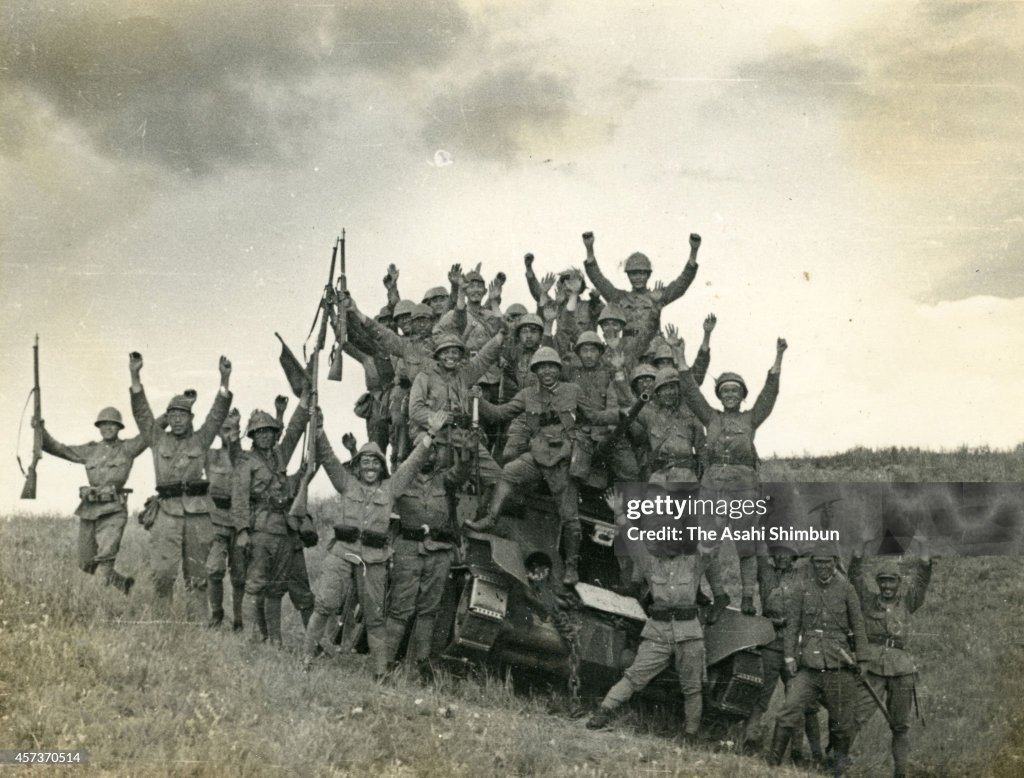
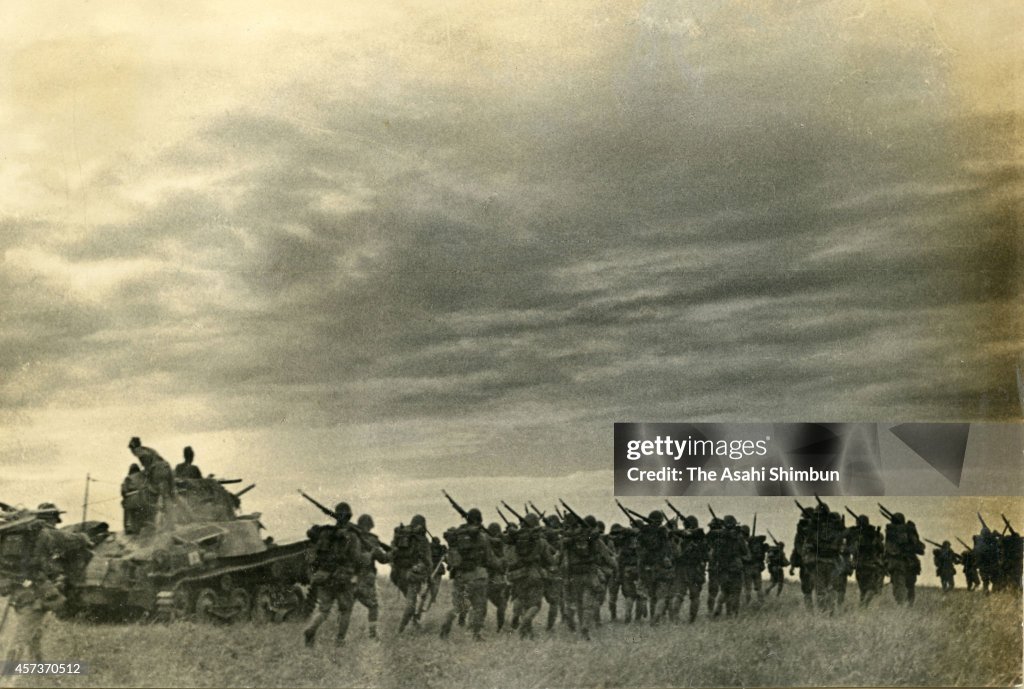
More conflicting claims are made on the Manchukuoan-Mongolian Front. Both the Soviets and Japan claim that they are winning and in control of the battlefield.
The Japanese Cabinet today approved the government’s proposals for the conference with Britain’s representatives and these were subsequently submitted to the Emperor. While official information is naturally withheld, circumstantial reports in the press indicate that Japan intends first to seek assurances regarding Britain’s future. neutrality in China and then to present detailed proposals for a solution of the Tientsin difficulties. In the phraseology of Domei, Japanese news agency, the policy that the Cabinet approved today turns on two points:
“1. To induce Britain to abandon her pro-Chiang Kai-shek and anti-Japan policy and to understand the new situation in China;
“2. To induce Britain to cooperate in the political and economic fields as well as in the maintenance of peace in Tientsin.”
The first condition is probably correctly interpreted by saying that Japan seeks the assurance that Britain will henceforth observe what Japan calls strict neutrality in China. What is meant by political cooperation remains to be explained. Economic cooperation implies the support by Britain of Japan’s North China currency policy. This would mean acquiescence in the Japanese-sponsored, provisional government’s seizure of the silver reserve now stored in the British and French Concessions.
The Associated Press reported that the Anglo-Japanese conference was expected to start tomorrow.
Messages from Tientsin declare that the Japanese blockade will not be relieved during the Tokyo conversations but intensified if the British attitude is found unsatisfactory. This is considered the proper attitude to show to the Japanese public, but British circles here understand that the blockade has, in fact, been considerably alleviated. The strippings have ceased and milk is entering the Concession in larger quantities. The Japanese Government has been allowed to understand that a continuation of indignities would make a bad impression in England and prejudice any hopes for the conference, and it is quietly eliminating the risks of fresh incidents, which would cause a furor in Parliament.
Dow Jones Industrial Average: 138.02 (+1.04).
Born:
Ray Errol Fox, American journalist, in Philadelphia, Pennsylvania.
Died:
Margaret Johnson, 20, American jazz pianist known as “Countess” and “Queenie” (Andy Kirk’s Clouds of Joy; Lester Young), of tuberculosis.
Naval Construction:
The Royal Navy Tree-class minesweeping trawler HMS Elm (T 105) is laid down by A & J Inglis Ltd. (Glasgow, Scotland); completed by Aitchison Blair.




 History Diaries