The Polish press published new reports today of a flow of arms and munitions from Germany into Danzig. The movement was described as “continuous.” The newspaper Dziennik Powszichny asserted that “the only difference that can be noticed now is that the militarization of Danzig is proceeding more secretly than before.”
Albert Förster, leader of the Danzig Nazis, was on his way to Munich today. The explanation here was that his chief purpose was to participate in a German art day at Munich this weekend. It was acknowledged, however, that he would meet Nazi party and government leaders and that there would be an opportunity for discussion of Danzig’s differences with Poland.
Ruy Barossa, Brazilian Chargé d’Affaires in Warsaw, and the Brazilian Consul in Gdynia, Poland, were arrested in Danzig yesterday. They had come from Gdynia, where Mr. Barossa had gone to meet his wife on her return to Poland from Brazil on the Polish motor ship Batory. The Chargé d’Affaires had taken a photograph in Danzig just before their arrest. The two men were taken to the police station in a patrol wagon, but Madame Barossa was allowed to follow in a police car. They were detained for two hours and then released without. apology. The camera was confiscated. They then left for Warsaw.
The newspaper Goniec Warszawski, anti-Semitic organ of the National Democrats, said Polish authorities had arrested the leaders of an organized group that had “smuggled” at least 3,000 Jews into Poland from the former Czecho-Slovak republic in recent months.
With Chancellor Adolf Hitler, Foreign Minister Joachim von Ribbentrop and Colonel-General Walther von Brauchitsch, Commander-in-Chief of the army, all vacationing, Berlin has settled down to a period of watchful waiting, disturbed only by bold headlines in the press declaring, “Poland in the Pangs of War Psychosis,” “Britain Plans a Bomber-Provocation Flight to Poland Over Neutral Nations” and “Britain Wants to Make Poland Courageous — British Bombers Over the Baltic!” The flight of twelve British bombing squadrons over France yesterday is dismissed with a shrug of the shoulders in official quarters in Berlin, with the observation, “Had it been 1,500 [planes] instead of 150 we would have been more impressed.”
The report that Britain intends to send a similar air fleet to Poland and perhaps to the Baltic nations is more critically received, however. How neutral countries would view such flights, it is acknowledged, is of interest to German quarters, which doubt that Britain would embarrass neutrals by asking permission to fly over their territory. Special requests, it is contended in Berlin, might force neutral nations to a decision that they might find embarrassing. There is no indication what attitude the German Government would take should a neutral country, particularly one with which it has a non-aggression pact, such as Denmark, grant such permission in the event of its being asked.
The Reich orders all drivers to report the condition of their vehicles. Violations are punishable by imprisonment.
The British Government today handed Parliament and the taxpayers a bill for £79,106,000, representing the cost of establishing conscription, calling up reserves and doubling the Territorial Army. All these measures were taken as part of the expansion of the British Army in preparation for a possible war with the Rome-Berlin Axis.
The extent to which the army is being expanded since Chancellor Hitler moved into Czecho-Slovakia may be seen from the fact that the figure contained in today’s supplementary estimates is more than half the net estimate for the army in 1939 presented to Parliament last March. The total net army estimate for the current year after the deduction of grants in aid from other branches of the government and from the colonies is now £227,261,000.
However, the increased cost of expansion will not bear directly on the taxpayers since all but a token payment of £100 from revenue will come from the £350,000,000 consolidated fund established by the Defense Loan Act. It is interesting to note the amount to come from this source, for this supplementary estimate for the army alone is within £11,000,000 of the total taken from this source for all three fighting services in the estimates for 1938.
Some £35,500,000 of the new estimates is the result of general measures connected with the expansion and acceleration of the defense. program for the army, an explanatory note said. The bulk of the rest of the sum is composed of £27,962,000, representing the cost of the militia, and almost £22,000,000 for doubling the Territorials-the British equivalent of the National Guard-and calling up them and the reserves for an extra period of training.
In addition to this expenditure, which was tabulated for the public today, the British also announced treaties embodying financial obligations in connection with their reciprocal alliances with Greece and Rumania. The Board of Trade will guarantee about £5,500,000 of Rumanian bonds as to principal and interest. The bonds will run for twenty years at 5 percent yearly and the money raised from their sale will be used for the purchase of United Kingdom goods.
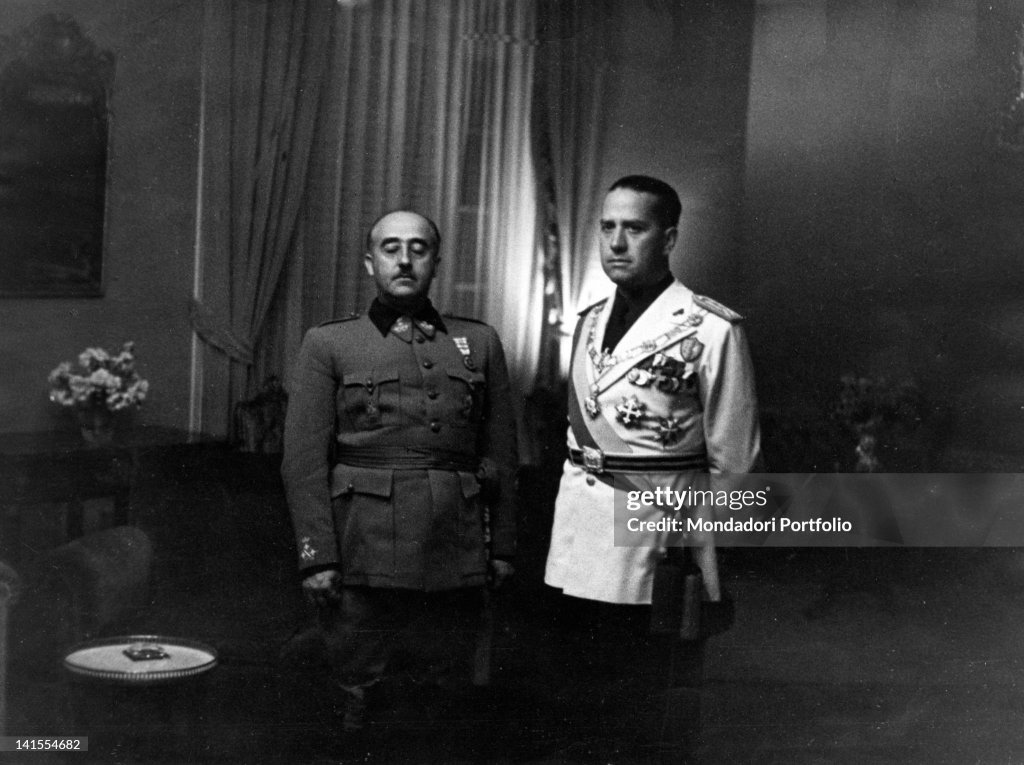
Count Galeazzo Ciano, the Italian Foreign Minister, with his entourage flew across Northern Spain this morning from Barcelona to Vitoria and then proceeded by automobile to the palatial private residence put at their disposal for the next three days in Zarauz, a picturesque Basque coast resort several miles west of here. After an intimate luncheon and a brief rest there, Count Ciano drove into San Sebastián for his first meeting with Generalissimo. Francisco Franco this evening. They talked for two hours at Ayete Palace, where General Franco is making his residence during the Italian Foreign Minister’s visit to Spain’s Summer capital.
Dino Grandi was recalled as Italy’s ambassador to London. The British government was snubbed by not being given any formal notification.
The names of the first Americans known to be involved in the expulsion of foreigners from Italian Tyrol were communicated to the United States Embassy here this morning, and Ambassador William Phillips promptly went to the Foreign Ministry to ask for an explanation. He received the same mystifying reply as the British, Netherland and Swiss envoys received on Monday and yesterday. Every foreigner must get out of Tyrol for “political and military” reasons. But today a new and more ominous note was introduced with a communiqué that frankly stated the measure had been taken by the Ovra, secret police, for which reason it is now clear that questions of espionage play a part in the complicated motives behind the move.
Here is the text of the communiqué: “For reasons of a political and military character based on reports from the Ovra concerning the activities of some elements belonging to Western powers resident in Bolzano Province, the Ministry of the Interior has decided upon the following measures: An immediate exodus beyond the frontier, or to the other ninety-three provinces of the kingdom, of all foreigners temporarily in Bolzano Province; the departure after a longer lapse of time of all foreigners with fixed residence in Alto Adige, so as to give them time to settle their private affairs. Some envoys of foreign countries, such as France, Switzerland and Britain, have gone to the Palazzo Chigi, not to make protests, which would have been rejected, but to get information on the situation. The Under-Secretary of Foreign Affairs furnished the necessary clarification and the envoys mentioned above took note thereof.”
As will be seen, the communiqué itself is by no means clear. There is still no satisfactory explanation why the lucrative tourist trade should be ruined, grave hardships inflicted on foreigners who must, with few exceptions, be quite innocent, the whole native population of Austro-Italians shaken to its foundation and all with such urgency. Obviously, there is a strong impulsion that is driving the government to this alarming measure, and it is inevitable that the international situation with its warlike possibilities should be blamed by many observers.
The Vatican extends papal indulgence by radio. Distant listeners can share equally with those present to receive benediction.
Newspapers in Sofia, Bulgaria hinted tonight that Germany had sponsored formation of a new Balkan bloc by Bulgaria and Yugoslavia. Newspapers hint that the Reich backs a new Balkan bloc. Plans for a virtual alliance of Bulgaria and Yugoslavia are reportedly taking shape.
All over Northern Ireland today the big drums reverberated to the whack of sturdy fists while thousands of Orangemen marched through flag-bedecked streets in celebration of the anniversary of the Battle of the Boyne in 1690.
Dr. Juan Negrín, former Premier of the Spanish Republic, sailed for Europe yesterday on the French liner Normandie after spending two and a half months in the United States and Mexico working out a solution for the problem of finding homelands for 500,000 refugees from Spain, who are now living precariously in France, most of them in refugee camps.
The immigration of Jews into Palestine will be halted at the end of September and no new quota will be issued for the following six months because of the Influx of illegal immigrants, Malcolm MacDonald, Colonial Secretary, announced today. In a written answer to a Parliamentary questioner, Mr. MacDonald said that the resumption of immigration quotas after March 31, 1940, would “depend upon the circumstances then prevailing.”
Declaring that the British Government had announced its readiness to facilitate the entry of Jews into Palestine up to the figure of 75,000 during the next five years, he explained that “during the last few months there has been an organized attempt to defeat the proper regulation of immigration by traffic in illegal immigrants and as many of these illegal immigrants are Jews from Poland and Rumania, the movement even threatens to some extent our effort to help refugees.”
Previously it had been announced that illegal immigrants would be deducted from future quotas, Mr. MacDonald continued, but these numbers have now reached such proportions that he had authorized the High Commissioner to announce that no quota would be allowed for the six months beginning October 1.
President Roosevelt today in Washington appointed three executive assistants to the President.
[Ed: One of the three is Lauchlin Currie — who is an agent for the Soviet Union.]
The Senate considered amendments liberalizing the Social Security Act, confirmed the appointment of Paul V. McNutt as Federal Security Administrator and recessed at 6:02 PM until noon tomorrow.
The House considered calendar bills, as the Ways and Means Committee decided to delay action until the next session on proposals to tax future government securities, and adjourned at 5:25 PM until noon tomorrow.
President Roosevelt today retained the key to plans for adjournment of Congress as leaders groped about for strategy by which they might push forward the Neutrality Bill and the lending program, action on both of which he has demanded before the session ends. In a move to clear decks for the adjournment drive, the Ways and Means Committee voted to delay until next session action on the Administration’s proposal to remove tax exemption from governmental securities. Committees in both branches prepared at the same time to place the “deferred-until-next-session” stamp on various legislation, including that dealing with railroads, the Labor Act amendments and other subjects.
The Ways and Means Committee turned the securities tax proposal over to the tax subcommittee headed by Representative Jere Cooper of Tennessee for a further study during the Summer in connection with general tax revision to be undertaken next year. Before taking this action, leaders of the committee had satisfied themselves that the President would not renew his demand for the passage of the measure at this session.
Despite various conferences during the day between the leaders at the Capitol and officials at the White House and State Department, the feeling was growing that the neutrality legislation was dead for this session. This impression prevailed despite recurring reports that the President was contemplating another message on the subject, calling in possibly sharp terms for modification of the existing arms embargo.
The next attempt to break the deadlock between Congress and the Administration over revision of the Neutrality Act will have to come from the White House, according to all the indications today.
Signs were accumulating, meanwhile, that the President would have to take further steps if he expected enactment at this time of any appreciable part of the lending program. Hearings were started this morning by the Senate Banking and Currency Committee, with Secretary Wallace as the first witness, but while this hearing was in progress the House Banking and Currency Committee laid aside the proposed $845,000,000 expansion of the housing program, a part of the President’s plan.
Nearly 5,000 WPA strikers in this city and thousands elsewhere in the nation were dismissed yesterday as William Green, president of the American Federation of Labor, told union executives in Washington that the remedy for reduced hourly wages on WPA was to be found in Congress, rather than in strikes on. Federal relief projects. Although the walkout of skilled construction workers here was called by the Building and Construction Trades Council, representing 125 AFL unions, with the active support of the State Federation of Labor, Mr. Green said the WPA strikes had been “spontaneous” in character and were never ordered by the American Federation of Labor.
Strikes, according to Mr. Green, have not been called by the AFL “because we fully recognize the fact that the remedy lies with Congress rather than through strikes on WPA projects.” Despite this disavowal of responsibility for the stoppages that have taken more than 75,000 WPA workers from their jobs in various parts of the country, Mr. Green said the federation would fight for restoration of union wage rates on WPA with all the resources at its command and promised to intercede with President Roosevelt for the reinstatement of dismissed strikers.
After hearing Mr. Green and George Meany, president of the State Federation of Labor, declare. that union men would not work for substandard wages for anybody. the emergency conference of 200 AFL executives adopted a resolution urging President Roosevelt and Congress to re-establish the old WPA wage scale. Mr. Green named union officers to call on the President and Congressional leaders. Several speakers indicated complete sympathy with the relief strikers. One suggested that all government construction jobs be halted until Congress restored the prevailing wage and another held the President responsible for abandonment of the prevailing wage principle in the new Federal Relief Act.
In Chicago, Colonel F. C. Harrington told his WPA aides that 650,000 employees would have to be laid off September 1 under the 18-month provision.
The first breach in the Administration program for old-age assistance based on equal contributions by the federal and state governments was effected in the Senate today by a coalition of Southern members and New Deal followers on both sides of the chamber. By a vote of 43 to 35 the Senate adopted an amendment by Senator Connally to revise the Social Security Act so that the federal government would contribute on a 2–1 basis with the States on pensions for the needy aged up to $15 a month and one-half the cost of any excess up to an additional $10 of federal money for pensions.
Thus, on a $35 pension, the federal government would pay $20. Since no state now pays that high a pension, the federal government would be committed, if the plan is enacted, to a considerably larger share than the ratio of 20 to 35. No state in the Old South has a pension as high as $15 a month under the old-age assistance feature of the Federal law.
The amendment was adopted with the support of Senator Barkley, the majority leader; Senator Harrison, chairman of the Finance Committee, which had rejected it; Senator Borah, who made a closing appeal, and others, over the economy protests of Senators Byrd and Vandenberg. Any estimate as to its ultimate cost was only a guess, it was admitted in debate. Senator Connally presented yesterday a letter from Arthur J. Altmeyer, chairman of the Social Security Board, stating that the new plan might cost anywhere from $63,000,000 to more than $100,000,000 a year; he set $80,000,000 as a probable figure.
Senator Byrd calculated that the cost would go to $200,000,000 a year. He and Senator Vandenberg argued against creating this permanent addition to the deficit.
The Senate confirmed Paul V. McNutt as Federal Security Administrator today after an airing in debate between Senators Bridges and Minton of the organization of the “Two Per Cent Club” of Indiana, under which State employes pay a levy on their salary into the Democratic party’s war chest.
John L. Leech, a former organizer for the Communist Party in Los Angeles, testifying today in the deportation hearing of Harry Bridges, czar of the West Coast maritime unions, affirmed that Bridges in 1936 was a member of the Communist Party. Pointing to Bridges, who sat in the hearing room, the witness said he knew him as a Communist. Leech swore to the truth of an affidavit he made on August 30, 1937, to C. J. Wise, a Portland immigration official. In the affidavit Leech said he joined the Communist Party in September, 1921, and resigned in 1936 and that to the best of his knowledge and belief Bridges was a member of the Communist Party of the United States. He had attended two Communist Party meetings at which Bridges was present and at which Bridges was introduced as Comrade Rossi.
Guns of pickets and National Guardsmen in Harlan, Kentucky killed a miner, seriously wounded a militia officer and felled four others today in the most serious of recent outbreaks of strife in the “Bloody Harlan” soft coal field. Two other miners were beaten. While the troops were bringing to jail 250 men arrested at the scene of the clash between pickets and soldiers, a second outburst of bullets from the weapons of the soldiers wounded Hubert Green, a High Splint miner, and his mother, Mrs. Kizzio Green, on a Harlan street.
Governor Chandler, at Ashland on a tour of the area where seventy-one persons were drowned in last week’s floods, ordered 300 more National Guardsmen to Harlan, doubling the strength of the troops. The Governor’s order included tanks and machine-gun companies.
In his order, the Governor said: “This violence is in all probability due to the incendiary speech made by William Turnblazer [president of the Harlan District United Mine Workers] Sunday. Before that the situation was quiet in Harlan County and peaceful picketing of mines was carried out. Now the pickets come to the line armed and this trouble results. This is a direct challenge to law and order in the State. We must accept this challenge and meet it. Outsiders are coming into Kentucky to cause this violence and participate in it. I shall request that the Harlan grand jury indict Turnblazer for inciting riot and George Titler should be kept in jail. Their methods are typical of those of violence advocated by John L. Lewis.”
A graphic arts group asks for a boycott of Nazi typefaces.
Officials of the General Motors Corporation, executives of the C.I.O. Automobile Workers and the Federal conciliator, James F. Dewey, began negotiations this afternoon for a settlement of the General Motors tool and die strike.
Admission to the World Fair is cut for big groups. The rate is reduced from 75 cents per person to 50 cents for groups of 500.
A mysterious explosion, followed by a solid sheet of flame, engulfed the navy’s aircraft carrier USS Ranger (CV-4) from water line to flight deck today and left in its wake a tangled mass of burned machinery and a black, charred hull. The fire raged for three hours before it was put out at 5 PM. Damage was estimated at $50,000.
In the only Major League game scheduled today, Mac Brown hurls a shutout and the Pittsburgh Pirates blank the Brooklyn Dodgers, 3–0, to move into a tie for fifth place in the National League pennant race.
The Trinidad and Tobago Red Cross Society was founded.
In defiance of warnings of disaster from foreigners who have been long connected with steam navigation on the Upper Yangtze River, Chinese crews and pilots are bringing the remnants of “free” China’s ocean-going merchant marine through the narrow, treacherous Yangtze gorges to Chungking, 1,500 miles from the sea. Progressively forced up the Yangtze as Japanese troops advanced westward in Central China last year, fifteen Chinese oceangoing ships, each of several thousand tons, were concentrated near Ichang following the fall of Hankow last Autumn. From Ichang, which is the gateway to the gorges, the ships have been working their way toward Chungking for seven months.
Breaking all precedent in Yangtze navigation, the first has just arrived off Chungking, looking like an ocean liner in comparison with the steamers that normally are seen on the river in the summer. Moving cautiously, the vessel was held back until the summer rises in the river produced just the right level of water to permit her to struggle through dangerous stretches, thus negotiating rapids that have brought disaster to many smaller ships. The steamers that run in the gorges usually are of less than 1,000 tons. They are about 200 feet long and have special power and extra rudders and propellers. The new arrival is 340 feet long, 100 feet longer than the biggest boat that had negotiated the gorges before, and is an ordinary single screw, single rudder coaster. The ship’s pilot received $10,000 for bringing the vessel through the gorges.
Foreigners connected with Upper Yangtze navigation doubt that all of the fourteen other large vessels now en route from Ichang will arrive. Some fear that a typical sudden rise in the river may smash up one or more ships in one of the narrow gorges and block navigation indefinitely. There is no possibility of the use of the vessels on the river above or below here so they will probably be broken up there if they reach Chungking.
While Japanese officials publicly profess earnest hopes that the Tokyo negotiations with Britain will succeed, anti-British agitation is spreading through the country. There is danger that by allowing this agitation to spread amid significant absence of official disapproval the government may be creating a Frankenstein monster capable of preventing a settlement. Every telegraph pole in Tokyo is plastered with anti-British slogans. Mass meetings of vociferous patriots, harangued by retired generals, were to be expected, but a more sinister development is the spread of anti-British meetings organized by Municipal, Prefectural and Village Councils.
In the official view these are spontaneous meetings. When the Foreign Office spokesman was asked if the government considered this unbridled agitation was endangering the success of the conference on the Tientsin blockade, he could only say that control of such movements lay with the Home Office. However, “spontaneous” the meetings may be, every Japanese knows that meetings of which the authorities disapprove are not permitted, particularly in wartime.
Similar agitations are reported from China and Japanese readers apparently are naive enough to believe the Chinese masses in the occupied regions are eagerly flocking to anti-British demonstrations. One sample will illustrate the color of the news that is being supplied: Announcing that workers on the Peiping-Tientsin railway are forming an anti-British society, Domei, Japanese news agency, explains that these workers were formerly “virtually enslaved by the British.” In a well-policed country, like Japan, where speech is systematically controlled, official acquiescence in such agitation is tantamount to approval. If the Cabinet hesitates to say a word that would extinguish the anti-British campaign, presumably it is because the elements behind the agitation are too powerful.
British warships are speeding toward trouble points along the China coast in anticipation of new incidents in the series that has created serious British-Japanese tension. The 1,375-ton destroyer HMS Diamond is en route to Tsingtao, where British officials fear further demonstrations like that on Monday when the British Consulate and the British Hong Kong and Shanghai Bank buildings were stoned and damaged. Britons said the demonstration, by men in Chinese garb, was Japanese-inspired. The escort vessel HMS Lowestoft, which hurried to Tsingtao after Monday’s demonstration, left for an undisclosed destination.
The escort vessel HMS Sandwich is due tomorrow at Tientsin, where the Japanese Army’s blockade of the British and French Concessions entered its fifth week. Tientsin Britons lack warship protection for the first time since early in the blockade because the escort ship Falmouth has departed for Weihaiwei. Aboard is Major General A. E. Grassett, commander of the British Army forces in China.
The difficulty of Britain’s position in China was emphasized by dispatches from Chungking quoting H. H. Kung, the Chinese Premier, as declaring “every concession or acquiescence Britain makes to Japan will be regarded by the Chinese Government as an unfriendly act.” He expressed the hope that the Tokyo talks would be confined to the Tientsin deadlock and avoid general principles.
The Japanese birthrate is down because of war, with 304,319 fewer babies born.
Dow Jones Industrial Average: 136.98 (+2.42).
Born:
Bill Cooper, NFL fullback and linebacker (San Francisco 49ers), in Carrollton, Ohio.
Phillip Adams, Australian humanist and broadcaster (“Late Night Live”), in Maryborough, Victoria, Australia.
Died:
Juanita Hamel, 48, American artist and writer whose syndicated stories and illustrations appeared in newspapers across the United States in the 1910s and 1920s.
Naval Construction:
The U.S. Navy Folgal 58-foot motor torpedo boat USS PT-1 is laid down by the Fogal Boat Yard (Miami, Florida, U.S.A.).
The U.S. Navy Gleaves-class destroyer USS Monssen (DD-436) is laid down by the Puget Sound Navy Yard (Bremerton, Washington, U.S.A.).

 History Diaries