Communist Việt Cộng guerrillas inflicted a staggering defeat on government troops in a two‐day-long battle just ended, military sources reported today. It apparently was the biggest battle of the war. The Việt Cộng killed, wounded or captured 200 South Vietnamese soldiers. During the fighting the Communists ambushed and battered a major government relief force sent to the rescue of this outpost 120 miles southwest of Saigon.
It was the second major battle in Chương Thiện Province in which the Việt Cộng demonstrated massive strength by assembling as many as three battalions in offensives that held captured ground for as long as two days. A force of more than 1,000 Việt Cộng guerrillas attacked this small Mekong Delta outpost — one of the Government’s last remaining footholds in Communist-dominated Chương Thiện Province — and all but destroyed the adjacent village of Vịnh Chèo.
The provincial chief, Lieutenant Colonel Lý Bá Phẩm, said yesterday that the Communists also had seized more than 100 weapons from the Government troops. Surveying the ruins of what had been a prosperous village adjoining this post, Colonel Phẩm remarked bitterly: “The guerrilla war is over in my province.” Government relief columns, reinforced after being beaten back and battered yesterday in a six‐mile‐long Việt Cộng ambush, finally reached the outpost around noon yesterday after a running battle with the guerrillas, who faded before their advance. The relief troops found the village in ruins. The guerrillas had burned 42 houses and shops in the center of town. Virtually every house that remained standing was pockmarked by bullets.
United States advisers at the scene could testify to the deaths of only 10 Communist soldiers, whose bodies dangled from the barded‐wire surrounding this mud‐walled fort. But estimates of Communist casualties ranged as high as 300. Vietnamese military sources said the Việt Cộng dead and wounded were carried away when the main Communist force broke contact late Saturday or early yesterday. Vietnamese and American military men disagreed on the size of the guerrilla force. Estimates ranged from one reinforced battalion to a full regiment.
They agreed, however, that there were more than 1,000 well-armed Communist guerrillas in the attack on this outpost and in the extensive ambush the Communists laid on the relief force sent from the provincial capital six miles to the north. United States military sources said the Communists had prepared ambush to intercept the relief force regardless of the direction from which it came. Five government companies, reinforced by two additional platoons, were sent to the rescue across flooded rice paddies and canals lying between the provincial capital of Vị Thanh and the beleaguered outpost. All five companies ran into the guerrillas, who surrounded, one of the columns and cut it to pieces, according to the province chief.
Most of the government’s 39 killed and 129 wounded were in the ambushed relief column, which was approaching from the east. Nineteen government soldiers were still missing today and were believed captured. Among the wounded was the deputy province chief, Major Trịnh Hữu Nghĩa, who was shot in the chest. United States and Vietnamese officers had high praise for an American doctor, Major Jon Bjornson of Mill Valley, California, who performed surgery for 24 consecutive hours on the seriously wounded. The bullet that felled Major Nghĩa, was removed by Major Bjornson before the Vietnamese was flown to a hospital at Cần Thơ.
As soon as the extent of the Communist force was realized, the province chief requested air support, which came in the form of two pairs of A‐1E Skyraiders. They raked the Communist positions with bombs and cannon fire. Government artillery fired more than 300 rounds in support of the encircled militiamen and the outpost under attack. Government casualties at the outpost totaled 19 killed, including 9 civilians, and 20 wounded.
Premier Nguyễn Khánh has charged that regular North Vietnamese troops took part in attacks on South Vietnamese installations near the border several days ago. He warned that his government would “soon take new, special steps to halt this Communist invasion.” He made the remarks yesterday during an inspection tour 370 miles north of Saigon, near the northern frontier. He did not specify what new measures against North Vietnam he had in mind. One could be a “tit‐for‐tat” operation involving bombing a North Vietnamese hamlet for every hamlet in the South destroyed by the Việt Cộng. General Khanh said that in recent Communist attacks in the northern provinces of Quảng Trị and Thừa Thiên “many young men” from the North Vietnamese provinces of Hải Phòng (Haiphong) and Thanh Hóa were captured by troops.
Seventeen Taiwan‐trained “commandos,” said to have been captured after landing in North Vietnam, have appeared before a Communist military court on charges of espionage, the Chinese Communist press agency Hsinhua said in a report from Hanoi yesterday. The agency said 26 “United States‐Chiang Kai‐shek agents” landed in North Vietnam a year ago to set up a guerrilla base and carry out sabotage, espionage and “psychological warfare.” Nine of them were killed, it said.
General Ne Win, Burma’s chief of state, and Premier Chou En‐lai of Communist China expressed concern today over what they called the “deteriorating situation in Southeast Asia,” especially in South Vietnam and Laos. The Foreign Ministry, in a communiqué issued tonight on Premier Chou’s visit here, said the two leaders also had agreed that the 14-nation Geneva conference should be convened to deal with the Laotian problem. Premier Chou and his Foreign Minister, Marshal Chen Yi, arrived Friday and left for home early today. The unheralded visit has aroused interest in diplomatic circles.
The Government of Cyprus met in an extraordinary cabinet session in Nicosia today. The cabinet was reported to have taken “important decisions” on dealing with clandestine arrivals of Turkish soldiers on the island. A news blackout was placed on the ministerial deliberations, but they were known to have included the possibility of a new recourse to the United Nations Security Council. It was believed possible that the Greek Cypriots might impose a blockade from the sea on the Tylliria region along the northwest coast. It is in this area that the smuggling of Turkish arms and men has been going on for some time. The cabinet session was called after reports from Ankara yesterday said the Turkish Government had confirmed the recent arrival in Cyprus of an unspecified number of Turkish soldiers.
As the cabinet was meeting under the chairmanship of Archbishop Makarios, President of Cyprus, news agencies reported from Ankara that the government there was now denying the earlier confirmation. A source close to the Presidential palace said that “at the cabinet meeting, which was also attended by military experts, important decisions were taken to deal with the situation.” It was understood that General Michael Karayannis, who commands the Greek Cypriot National Guard, attended the meeting, but that General George Grivas was absent. The informant said the meeting had been “a preliminary review,” both political and military, of the new development.
United Nations officials have been trying for some time to bring peace to the troubled Tylliria region and to control the smuggling of arms. They have had no success, and the Greek Cypriots have been expressing their impatience. Observers here feel that, if the Government were to move to reduce the Tylliria redoubt, by land or sea, the Turkish Cypriots would fight fiercely to protect their vital supply line. It is feared in neutral quarters that such a development might provoke Turkey to intervene militarily. Greek and Turkish Cypriots have been fighting for more than six months since Archbishop Makarios announced his intention of abrogating the Constitution, under which the Turkish minority’s representatives can veto legislative actions.
The Soviet Union has warned the Western powers that giving West Germany access to nuclear weapons through the proposed allied nuclear force would greatly increase the risk of an atomic world war. It also stated in diplomatic notes delivered yesterday that the Soviet Union would be forced to take “appropriate measures” to meet the “new situation” that Western moves toward establishment of the force had produced. The notes were delivered to the embassies of the United States, Britain, West Germany, Italy, the Netherlands, Turkey and Greece. These are the nations that are considering joining the force, which would be composed of surface ships armed with nuclear missiles and manned by crews from the participating countries under allied command.
The Soviet notes said the Western powers were using the proposed Atlantic alliance force to camouflage their policy of giving West Germany access to nuclear weapons. They took issue particularly with a Western plan for a test of the mixed-manned fleet aboard a United States Navy rocket‐firing ship, the Biddle. It was clear, the notes said, that such activities would ultimately give West Germany access to nuclear weapons, even though there were at present no plans for equipping the Biddle with nuclear weapons. The West German contingent in the ship’s crew would be the second largest after the American, they added. Already West German military circles are “setting the tone” in the North Atlantic Treaty Organization in many ways and are using it for the realization of their “revanchist plans,” the messages said. It added that the German “militarists” made no secret of the fact that they planned to assume a dominant position also in the allied force.
Communist China was reported by a Japanese newspaper today to have expressed support of Japan’s claim to the Kurile Islands, which the Soviet Union has held since the end of World War II. The support was reported to have come from Mao Tse‐tung, Peking’s leader in the ideological dispute with Moscow. “Communist China, in principle, is in favor of Japan’s demand to the Soviet Union for the return of the Northern Islands,” Mr. Mao was quoted as having said. The newspaper Asahi Shimbun reported that a Japanese Socialist delegation which had visited Peking quoted Mr. Mao to that effect.
A Soviet submarine boldly surfaced during United States naval exercises in the Pacific last year and snatched a new antisubmarine detection device, The Sunday Times said today. The newspaper based its information on “reports now current in London.” The article said the device, called a sonobuoy, could be dropped from search planes to detect submarines hiding in layers of the ocean that normally swallow up sound‐detection waves.
Twenty-two people died, and 128 became seriously ill, when they were accidentally poisoned during a memorial service in the Greek village of Stylia, 40 miles from the city of Patras. The victims were attending a mnemósynon, an orthodox memorial service for the late Grigorios Apostolopoulos, and were served koliva a traditional food associated with the service. The widow had accidentally put a powdered insecticide on the dish of wheat and raisins while preparing it, after having mistaken it for powdered sugar.
Mauritania established diplomatic relations with the Soviet Union.
Senator Barry Goldwater and his supporters continued confidently today to predict his first‐ballot nomination for President next Wednesday, despite a developing civil rights battle that will be taken to the floor of the 28th Republican National Convention. The civil rights dispute, brewing in San Francisco during the last week of maneuverings by Goldwater men and the supporters of Governor William W. Scranton of Pennsylvania, sharpened today with the publication of the draft platform that will be presented to the convention. Senator Goldwater, unruffled as ever by these diversions on his flank, said in a television interview that he now counted on 739 first‐ballot votes — the highest total he has personally claimed so far. The convention opens at 10 AM tomorrow in the cavernous Cow Palace in suburban Daly City.
Republican platform drafters completed their work today, pledging “victory” abroad and less federal government activity at home. Like the portions released yesterday, the final sections of the platform were very much in the image of Senator Barry Goldwater. As he rolled toward the nomination, his supporters on the Platform Committee easily beat down moderating amendments. The forces of Governor William W. Scranton pledged to fight for changes on the floor of the convention Tuesday. They will definitely move at that time for a stronger civil rights plank. They may also, depending on developments, call for a denunciation of extremist groups and for a pledge of continued Presidential control of nuclear weapons.
The Platform Committee chairman, Representative Melvin R. Laird of Wisconsin, denied tonight the Scranton charges that the committee had produced a platform tailored to Senator Goldwater. “It is not a Goldwater platform,” Mr. Laird said. “It is a Republican platform, and I am sure it will be overwhelmingly sustained by the delegates Tuesday. This document truly represents the mainstream of this convention.”
On civil rights the draft platform pledged “full implementation and faithful execution” of the new law. But on another page, it included language apparently reflecting the “white backlash” against Black demands for racial integration. This was a statement of opposition to “federally sponsored inverse discrimination, whether by the shifting of jobs or the abandonment of neighborhood schools for reasons of race.” Some Black groups have demanded racial quotas in jobs and reshuffling of school populations to overcome past discrimination. But there is no present proposal for any Federal legislation to those ends, and the new Civil Rights Act specifically excludes such Federal action.
The drafters called for a cut of at least $5 billion in Federal spending. They asked for further reduction in taxes, including the repeal of wartime excise taxes. They pledged to balance the budget.
Governor William W. Scranton challenged Senator Barry Goldwater today to a debate on the floor of the Republican National Convention. The Pennsylvanian issued the challenge in a letter that was largely a scalding attack on his rival for the Presidential nomination. He said he represented the “vast majority of Republicans who have soul‐deep differences with you over what the Republican party stands for.” At one point, Mr. Scranton declared that Mr. Goldwater’s positions on several issues were “absurd and dangerous.” “Ridiculous,” was the Senator’s first reaction. Later the Senator returned Mr. Scranton’s letter to him — much as one government rejects a diplomatic protest from another government.
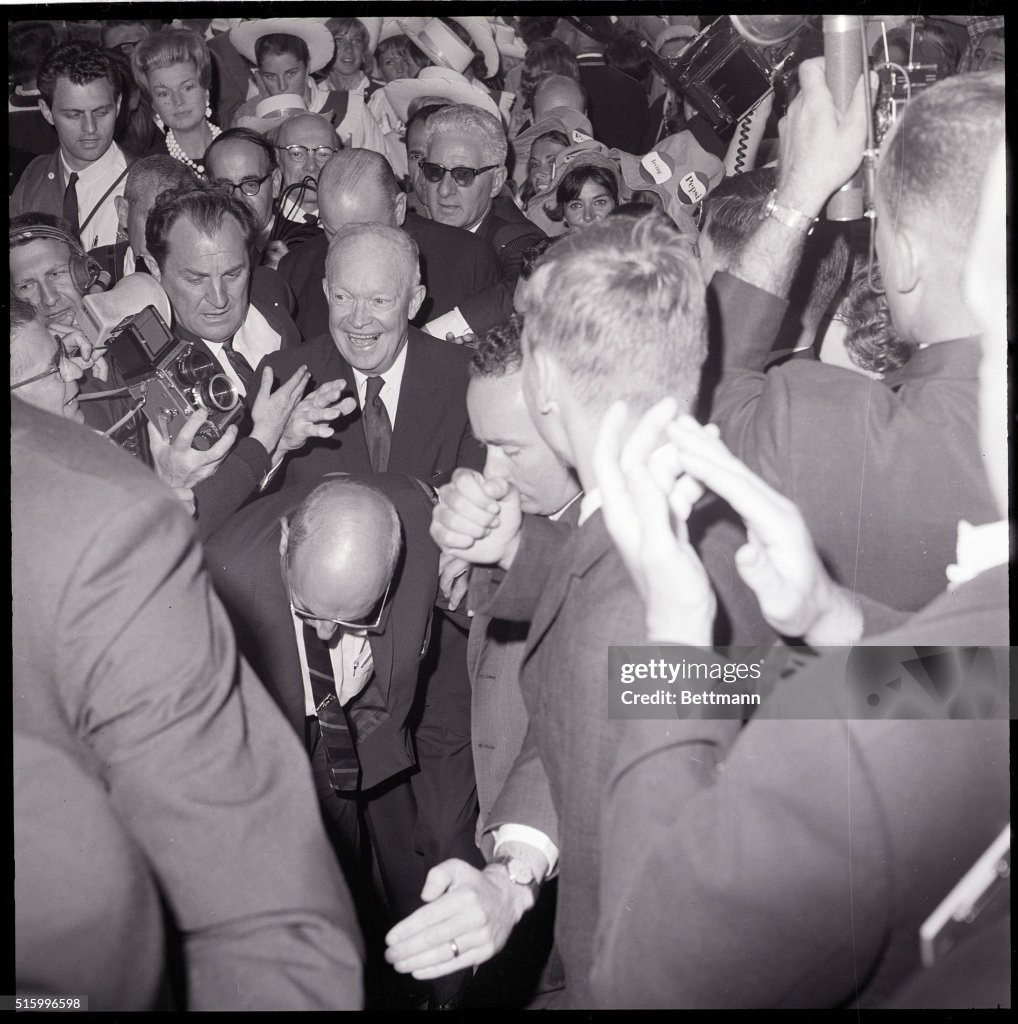
Former President Dwight D. Eisenhower warmly embraced Governor William W. Scranton tonight at a $500-a-ticket fund‐raising gala that Senator Barry Goldwater failed to attend because of what he described as “unforeseen problems.” Mr. Scranton and his wife, Mary, arrived at the party in the Civic Auditorium and paid their respects to General and Mrs. Eisenhower. Mrs. Eisenhower kissed both the Governor and his wife, and the general put his arm around Mr. Scranton as they shook hands. Mr. Goldwater. who not long before had received a tart letter from Mr. Scranton challenging him to a debate at the convention, sent his regrets to the party host, Senator Thurston B. Morton of Kentucky, G.O.P. campaign chairman.
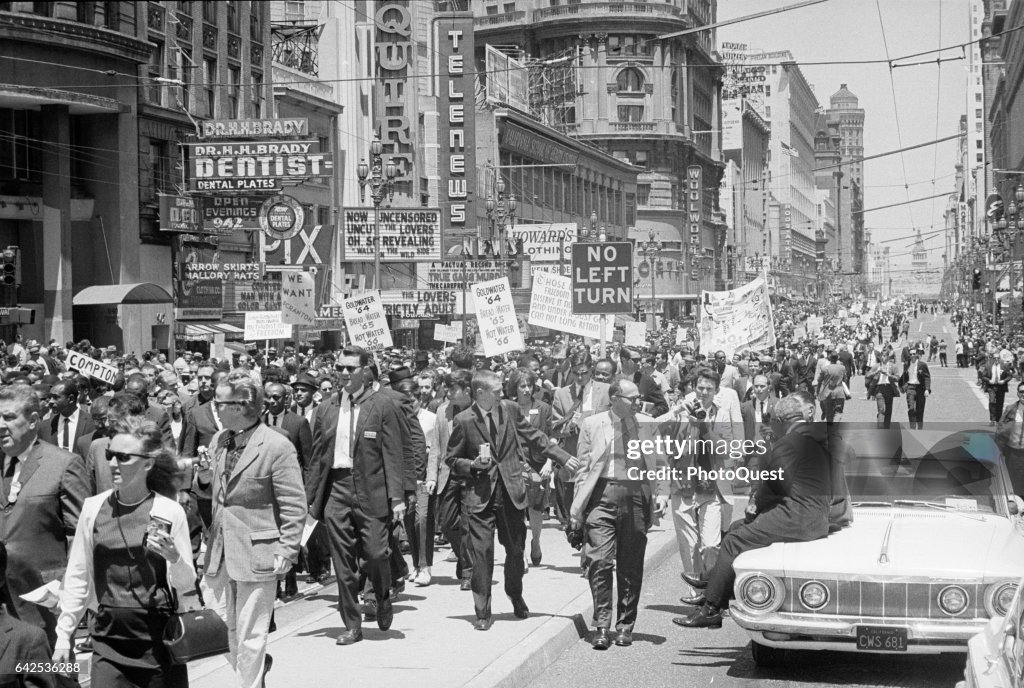
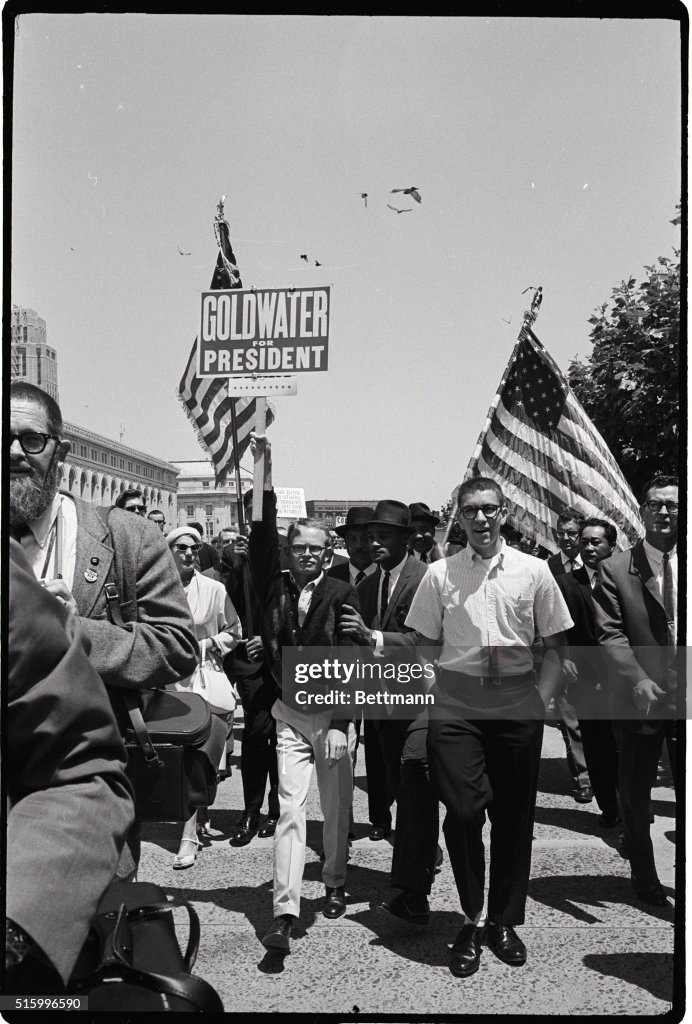
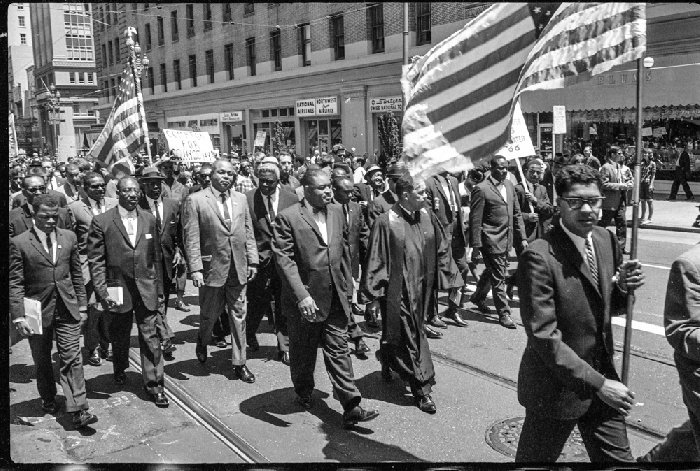
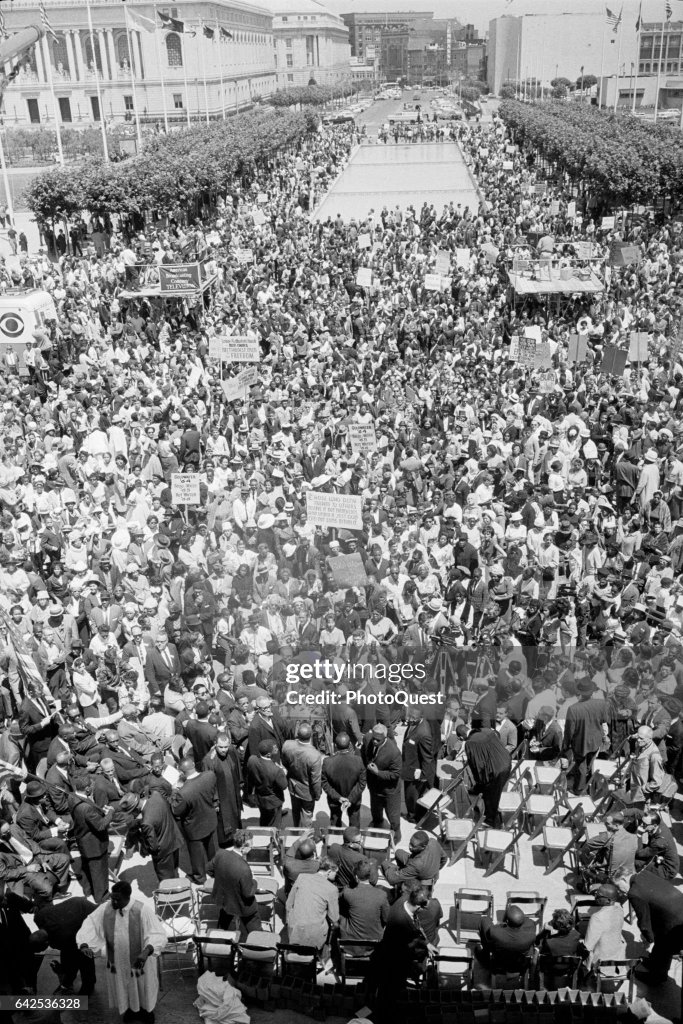
About 40,000 civil rights supporters in San Francisco took part today in a parade and demonstration against Senator Barry Goldwater’s Presidential candidacy. The crowd in the City Hall plaza was addressed at the end of the parade by Governor Rockefeller, former Ambassador Henry Cabot Lodge, and Senators Jacob K. Javits and Kenneth B. Keating of New York. However, these political leaders — anti‐Goldwater Republicans all — steered away from attacking the Arizona conservative.
The parade began at the foot of Market Street and moved up the street to the Civic Center, where a platform had been constructed on the City Hall steps. From there, leaders of the major Black organizations that have led the civil rights drive attacked Senator Goldwater in bitter language. When Governor Rockefeller took the microphone and did not add to the verbal assaults on Senator Goldwater, the crowd became restive. Its humming murmur of discontent interrupted and distracted the Governor.
A. Philip Randolph, head of the Brotherhood of Sleeping Car Porters, told the throng: “I cannot see how any Negro with any self‐respect can even give the slightest presumption to Barry Goldwater as President of the United States.”
The Rev. Booker Anderson of the National Association for the Advancement of Colored People said: “We are here to register our protest to the nomination of Barry Goldwater.”
John Lewis, national chairman of the Student Nonviolent Coordinating Committee, said: “No political party can expect to survive that nominates a man like Barry Goldwater for the Presidency of the United States.”
Dr. Hamilton T. Boswell, a local Black minister and cochairman of the group that organized the demonstration, invited the crowd to join a picket line against Senator Goldwater at the Cow Palace when the Republican National Convention opens tomorrow morning.
Senator Barry Goldwater rode a wave of Southern adulation today and suggested that Governor George C. Wallace of Alabama withdraw from his Presidential campaign. In the course of a vigorous activity Mr. Goldwater said it would not be wise for either political party to promise new actions in civil rights until the Civil Rights Act of 1964 had been thoroughly tested. The conservative Arizonan said he now had 739 “firm” delegate votes for the Presidential nomination in the Republican National Convention balloting, plus 115 others leaning toward him. Mr. Goldwater appeared before a caucus of the Florida delegation, at a reception for Southern delegates and at a party of the Washington State delegation.
Mr. Goldwater said that segregation was “wrong morally, and in some instances constitutionally.” He said he would enforce the Civil Rights Act and use the “moral power” of the Presidency to help end discrimination. He told several hundred people at the Southern states reception at the Mark Hopkins Hotel that if the Republican nominee “can’t get his foot in the door in the South, he is not going any place” in the election. He indicated to the Washington delegates that he did not hope to realign the Republican party as a wholly conservative body. He said that it was important that both political parties “have ample room in their tents for people who call themselves conservatives and those who call themselves liberals.”
Jackson, Mississippi Mayor Allen C. Thompson and Jackson’s businessmen stood together today against the White Citizens Council in a decision to comply with the Civil Rights Act. This was the first time since the Supreme Court’s desegregation ruling 10 years ago that such a significant break with Mississippi’s racial orthodoxy had occurred. It may pave the way for peaceful integration of the public schools here in the fall. Integration of hotels, motels and restaurants without a court of the new Civil Rights Act was a humiliating defeat for council leaders who have long imposed a rigid pattern of segregation on this city of 150,000. One reason Mississippi has remained adamant to the social change is that the capital city, largest in the state, has been under the spell of council doctrine. Many of the city’s most influential business and civic leaders have served on the board of directors of the Jackson council.
While business interests in other Southern cities have led the way for integration to keep the channels of commerce open, Jackson business leaders either remained silent or went along with the council’s policy of massive resistance. After the Civil Rights Act was enacted, however, a majority of the board of directors of the Chamber of Commerce issued a statement urging immediate compliance with the public accommodations section. A few hours later, to the surprise of many Mississippians, Blacks were eating and sleeping in the city’s better restaurants and hotels. Mayor Thompson said he agreed with the business leaders. He said that although he found the law “repugnant” it “must be obeyed until changed.”
The New York Board of Rabbis, the world’s largest representative rabbinic body, sent a telegram to Governor Paul B. Johnson Jr. of Mississippi yesterday expressing shock over the beating of Rabbi Arthur Lelyveld of Cleveland by two white men. In the telegram, the board said, “We pray that you will use your strong influence as governor to change climate of opinion in your state so that repetition of these unlawful and inhuman acts will become impossible.” At the same time, the board, with a membership of more than 850 Orthodox, Conservative and Reform rabbis, sent a wire to Rabbi Lelyveld extolling him for “having offered yourself on the altar of freedom and dignity of man.” Rabbi Lelyveld and two other men, in Mississippi working in the civil rights movement, were attacked on Thursday in Hattiesburg.
The French comic strip Gai-Luron, created by Gotlib, appeared in print for the first time.
Mickey Wright earned her 4th and ultimately final U.S. Women’s Open golf title by defeating Ruth Jessen in an 18-hole playoff.
In Kansas City, Pete Ward belts a homer in the game 1 victory as the Chicago White Sox beat the Athletics, 3–1. Ward adds a grand slam and 5 RBIs in game 2 as the Sox come back from a 4–2 deficit to win, 11–4. Manny Jimenez has a pair of roundtrippers for Kansas City.
The New York Yankees played the Cleveland Indians to a 2–2 tie today in a rain‐swept doubleheader that was delayed, interrupted and finally halted after 6½ soggy innings of the first game.
The Houston Colts’ Nellie Fox singles home Eddie Kasko with two outs in the bottom of the ninth to end a wild 5-4 victory over the San Francisco Giants at Colt Stadium. Tempers are hot as the Texas heat with players and managers from both teams getting run by umpire Lee Weyer. San Francisco’s Billy O’Dell is thumbed as he makes warm-up tosses after arriving from the bullpen. An angry Gaylord Perry grabs Fox’s bat when it’s all over and smashes it to pieces before handing it to the batboy.
Born:
Judi Evans Luciano, American actress (“Guiding Light”, “Days of our Lives”), in Montebello, California.
Gaby Roslin, English television presenter known for “The Big Breakfast”, in London, England, United Kingdom.
Mike Schwabe, MLB pitcher (Detroit Tigers), in Fort Dodge, Iowa.
Mike Varajon, NFL fullback (San Francisco 49ers), in Detroit, Michigan.
 History Diaries