In a speech before the House of Commons British Prime Minister Neville Chamberlain reaffirmed support for Poland and made it clear that Britain did not view the Free City of Danzig as being an internal German-Polish affair and would intervene on behalf of Poland if hostilities broke out between the two countries. Prime Minister Neville Chamberlain made it plain for the first time today that any aggression against Danzig, whether by armed invasion or by internal change, would be covered by the British guarantee to Poland and would be resisted accordingly. In a carefully drafted declaration to the House of Commons, previously approved in every detail by France and Poland, the Prime Minister gave precision at last to his momentous pledge of three months ago to help Poland against any threat to her independence.
“Recent occurrences in Danzig,” Mr. Chamberlain said, “have inevitably given rise to fears that it is intended to settle her future status by unilateral action, organized by surreptitious methods, thus presenting Poland and other powers with a ‘fait accompli.’ In such circumstances any action taken by Poland to restore the situation would, it is suggested, be represented as an act of aggression on her part and if her action were supported by other powers they would be accused of aiding and abetting her in the use of force.”
If this should happen, Mr. Chamberlain warned, the issue “could not be considered as purely a local matter involving the rights and liberties of Danzigers, which, incidentally, are in no way threatened, but would at once raise graver issues affecting Polish national existence and independence.” He added: “We have guaranteed to give our assistance to Poland in case of a clear threat to her independence, which she considers it vital to resist with her national forces, and we are firmly resolved to carry out this undertaking.”
Mr. Chamberlain did not say Poland would be the sole judge of what might constitute a “clear threat.” But in an earlier passage of his statement, he declared Danzig was of “vital strategic and economic importance” to Poland and that “another power established in Danzig could, if it so desired, block Poland’s access to the sea and so exert an economic and military stranglehold upon her.” This was the same thing as saying that the British Government regarded any change in the status of Danzig without Poland’s consent as a “clear threat” and that Poland would be justified in bringing the Anglo-French pledges into operation.
The statement, as read to the Commons, was almost the same as the draft approved by the Cabinet and sent to Warsaw for approval last week. The Poles requested what officials here termed “minor alterations” and Mr. Chamberlain made them cheerfully and without question. It was no wonder that the Poles were overjoyed tonight and that even Mr. Chamberlain’s critics at home were relieved by the statement he had made.
Len Harvey defeated Jock McAvoy at White City Stadium in London to win the British light heavyweight boxing title.
Prime Minister Neville Chamberlain’s speech in the House of Commons made a deep and favorable impression in Warsaw, but no optimistic view prevails regarding the Danzig situation. The present lull, it is stated, should not yet be regarded as a prelude to peace. Mr. Chamberlain, it is emphasized, confirmed not only the fact that Britain was ready and determined to stand by Poland’s side, but also declared that Germany had destroyed international confidence, and therefore it is held here that it is up to Germany to produce new facts to disprove and dispel suspicion.
Until Germany shows that she is genuinely interested in settling the Danzig question peacefully, there is reason, it is felt, not to take too seriously the present easing of the tension. Indeed, responsible circles here regard the present situation as mere tactical maneuver on the part of Germany. Chancellor Adolf Hitler, it is observed, was invited by the European peace front to seek a common. solution of the Danzig problem; it is for Germany to decide now whether this thorny problem will be settled by peaceful means with a compromise acceptable to both Poland and the Reich or whether the present tension will continue and the war menace will overshadow Europe.
Official German reaction to Prime Minister Neville Chamberlain’s statement on Danzig is summed up in these words: “It might be advisable for British statesmen in the future to label their speeches since they are turning them out, so to speak, on a conveyor belt.” Treating the statement from this viewpoint, German political circles found nothing new or startling in it. “It neither clarifies nor changes the situation in any way,” is the Wilhelmstrasse opinion, “but it is surprising that the Premier in no way, recognized, or gave expression to the wishes of the Danzig people themselves.” This attitude is characterized as “typical of the British who never paid much attention to self-determination.”
The unwillingness of the British Government to recognize the “illogical and unjust nature” of the Danzig statute is regarded here as proof that “London is deliberately forgetting the real issue” and is “desperately seeking a State that will take up the sword against Germany in the interest of Britain’s political and strategic aims.”
France and Britain unite their programs to meet the Axis threat to colonies in Africa and the Middle East.
Festive Spain welcomes the Italian Foreign Minister, Count Ciano. The press denies that the visit presages a military pact with the Axis powers.
Italy expels Tyrol foreigners. Those in the German-speaking area are told to leave within 48 hours. Foreign residents of Italian Tyrol have received orders from the police to leave the region within forty-eight hours, it was learned tonight. So far twelve Britons, fifteen Frenchmen, fifty Hollanders and a number of Swiss citizens are known to be involved. No Americans are yet affected so far as can be ascertained tonight.
Information about these orders comes from diplomatic sources. It has been denied by the Ministry. of Popular Culture, and the Foreign Ministry also says it knows. nothing about the move. It will be recalled that the former Austrian minority has just been told to make the choice of going into the Reich or definitely becoming good Italian Fascisti.
One of the strangest features of today’s move is that the Foreign Ministry really seems to have had nothing to do with it. Swiss Legation officials are known to have gone twice to the Palazzo Chigi trying to get information about what was happening but without success. Apparently, it was the Ministry of the Interior that gave the orders — that is to say, it is a police measure. The various members of the diplomatic corps whose citizens are involved evidently intend to go easy until the matter comes within the ken of the Foreign Ministry. In any event a series of strong oral protests almost certainly will be made tomorrow.
The difficulty so far is that no reason has been given for the expulsions, and if the situation remains that way it could constitute a grave breach of international custom. The residents themselves have been told by their diplomatic representatives to ask for reasons.
In Francoist Spain, Julián Besteiro was sentenced to thirty years imprisonment for aiding rebellion. Professor Julian Besteiro, who was convicted by a military tribunal of “helping prolong the Spanish civil war,” was sentenced today to thirty years’ imprisonment. Professor Besteiro, 69 years old, a Socialist leader and a Professor of Philosophy, headed the Madrid Defense Council, which ousted Premier Juan Negrin and surrendered the city to the Nationalists last March 28, after which Generalissimo Francisco Franco’s forces entered the city without firing a shot.
He was tried Saturday by a military tribunal of four generals and two lieutenant colonels on charges. of “aiding rebellion.” The government prosecutor, Acedo Colunga, a former student of the defendant, demanded the death penalty.
It is now possible to give fuller information on the serious disorders. that have just been suppressed in the Asturias region of Spain. Trouble had been brewing for many months. Many thousands of outlaws, formerly militiamen of the Republican Army of the North, had been living in caves in the mountains without sanitation, medical supplies or adequate food. Straitened circumstances forced them to extend the scope of their marauding expeditions up to the point where their depredations became a real menace to the security of the countryside.
The Civil Guard was charged to deal with the situation. A detachment of that famous corps was sent into the precipitous scrub-covered mountains near Oviedo. After a few preliminary skirmishes, the outlaws retired farther into their fastnesses, where 2,000 men, armed with machine guns, thousands of rounds of ammunition and hand grenades, awaited the onslaught with grim determination. knowing that the alternative to fighting was death.
The Civil Guard, advancing through extremely difficult territory, stumbled on greatly superior forces. An alarm reached Oviedo, where the Military Governor called out the garrison to the relief of the hard-pressed Civil Guard. In the course of a single day’s engagement there were 150 casualties. News of the battle encouraged sporadic outbreaks in other parts of the provinces. The rebels, with intimate knowledge of the caves and subterranean galleries in the mountains, evacuated some districts, only to appear quickly in others. It was not until the full seriousness of the situation was realized and the Sixty-second Division was rushed to the scene to reinforce local troops that order was restored.
Niculetta Nicolescu, head of the women’s branch of the Legionary Movement in Romania is arrested and tortured. Her breasts are cut off and she is put to death after being raped.
In Syria, Bahij-al-Khatib is appointed chairman of the Council of Commissioners, replacing the office of President.
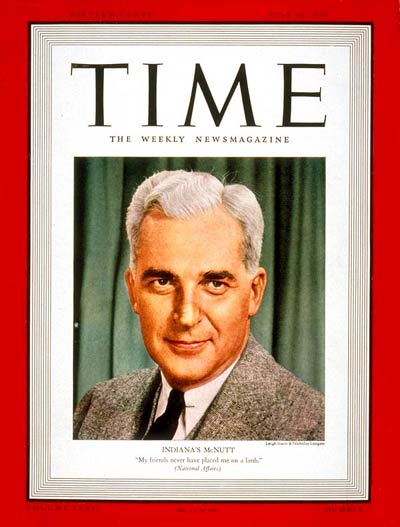
This day in Washington, President Roosevelt selected Paul V. McNutt as Federal Security Administrator. He attended the funeral of Secretary of the Navy Swanson in the Senate Chamber.
The Senate met only for Secretary Swanson’s funeral. After receiving the $2,660,000,000 loan fund bill it adjourned at 1:27 PM until noon tomorrow.
The House, which also received the lending bill, considered District of Columbia measures, completed Congressional action on two bills relating to war veterans’ compensation, received the Sabath and Keller bills to restore the prevailing wage in the WPA and adjourned at 4:15 PM until noon tomorrow.
The Administration’s new lending program went before Congress today in the form of parallel House and Senate bills proposing the authorization of new-type credits totaling $2,660,000,000. The bills were introduced by Senator Barkley, the majority leader, and Representative Steagall, chairman of the House Committee. on Bank and Currency. The program was amended from its original form in one substantial particular, in that it omitted a projected extension of $500,000,000 in foreign credits. Instead of that item, the bill proposed that the $100,000,000 lending authorization of the Export-Import Bank be enlarged to $200,000,000.
The program would provide for use of $40,000,000 already appropriated for rural electrification and $100,000,000 already appropriated for loans to farm tenants to assist them in buying their land, in addition to sums proposed to be authorized by the row law. Rounding out the program in a separate bill is an increase of $800,000,000 in the loan authorization of the United States Housing Authority.
Paul V. McNutt, high commissioner to the Philippines and active candidate for the Democratic Presidential nomination in 1940, was chosen today by President Roosevelt to be Federal security administrator. The appointment was regarded as one of the most politically significant made by the President in his second administration. Barring unexpected changes in plans, the President will send the nomination of Mr. McNutt to the Senate tomorrow. Friends of the former Indiana Governor understood that Mr. Roosevelt would make it plain at his regular press conference tomorrow that Mr. McNutt was being “drafted” into the new security post as a reward for three years of “distinguished” foreign service.
Although members of his Administration ordinarily are precluded from political activities on their own behalf, President Roosevelt is understood to have agreed that Mr. McNutt should continue his campaign for the Presidential nomination with the understanding, however, that his ambitions in that direction would be discontinued if and when the President should decide to seek nomination for a third term.
The Navy Department will probably ask Congress at its next session for two more 45,000-ton “superships” — the fast battleships of what will become the Iowa-class. Although a change in the international situation or the present favorable attitude of Congress toward national defense might easily alter plans, it was learned today that naval officials are anxious to continue construction of 45,000-ton ships, two of which were just started at the beginning of this fiscal year on July 1, and which today were named the Iowa and New Jersey.
Expert naval opinion holds that despite the costs of these great ships — $93,000,000 to $100,000,000 apiece — it would be a mistake to revert to the 35,000-ton type, six of which are now building in this country. The construction of two more ships of this type, in addition to the two for which Congress has just appropriated funds, would be in a sense economical, it is argued, since they might be built from much the same plans as those used in construction of the Iowa and New Jersey.
But even more important, four ships of the same general type would form a technically homogeneous tactical unit of great power and great mobility, undoubtedly the most powerful division of battleships in the world. If two more battleships are started a year from this time, they will increase to ten the number of capital ships under construction in this country. However, the great majority of these ships are still blueprint dreams, and the eight now contracted for will not be ready for active service with the fleet until 1942, 1943 and 1944, well after the present period of acute international tension is expected to reach its climax.
These ships, which will represent the first replacements in almost two decades, for some of the oldest of fifteen battleships now in commission, will not augment the fighting power of our fleet until sometime after new battleships in other navies have been commissioned. This lag cannot be attributed to construction delays, for the first two of the eight ships — the only two sufficiently advanced to indicate construction progress — are said to be up to schedule, and are now considerably more than a third completed.
U.S. Senator Borah asks for an open debate over neutrality and calls for an old-fashioned battle on the Senate floor. The first test in the Senate battle over neutrality legislation, itself the key to adjournment plans for the present session of Congress, is expected in the Foreign Relations Committee when two determined groups face each other across the conference table. One will be the Administration leaders and their followers, intent upon modifying the embargo features of the Bloom bill, already passed by the House, and then on shoving the amended measure through the Senate. The other group will be made up of the “isolationists” or “non-interventionists,” who are equally intent upon maintaining a mandatory restriction against the shipment abroad of arms and materials of war.
The Administrationists saw the first ray of light tonight in a situation which had grown darker almost daily for the last week, so far as the neutrality legislation was concerned, when they received word that Senator Borah, a leader in the movement for a mandatory arms embargo, opposed any attempt to bottle up the question in committee. The Administration leaders had been put on notice previously that opponents of the revisions sought by the President would resort to “every honorable and legitimate means” to prevent substantial changes in the present law. They had taken this to mean that the opposing Senators would employ tactics of delay and obstruction, starting with moves to postpone committee consideration and running later into a filibuster on the Senate floor.
The president of the American Bar Association tells a group that the Supreme Court is shifting.
Harry Bridges, the West Coast leader of the Congress of Industrial Organizations, denied today that he was or had been a Communist, as the deportation hearing opened. It may determine whether he is to be sent back to Australia. [Ed: He is, of course, lying.]
Many striking WPA workers face ouster. The first dismissals for five-day absences are due tonight.
The AFL assails Congress for ending the prevailing wage law.
Hearings by the Dies committee investigating un-American activities will be resumed August 1.
Sophie Tucker, president of the American Federation of Actors, walks out of a courtroom. Testimony about the misuse of relief funds by union leaders continues.
A rebellion of Ecuadorian troops of the Cayambe battalion at Quito last night was quickly ended by carabiniers and by lack of support among other military units, according to the newspaper Universo. The revolt is said to have been promoted by Captains Burbano and Carillo in the absence of higher officers. The two were imprisoned with a group of radicals who presumably intended to aid the insurrection. The government withheld comment on the situation. It is rumored the plotters favored Colonel Luis Larrea Alba or General Alberto Enriquez Gallo, both former. Presidents.
A military uprising was quelled in a hurry in Quito, Ecuador today and several politicians were arrested for what the government called revolutionary plotting. The government announced that Captain Humberto Burbano and Captain Carlos Carrillo, both retired and members of the Revolutionary Vanguard Leftist group, entered the Andinos Cayambe barracks at midnight, intimidated the guards with pistols, and took the battalion officers prisoners. On trying to take a second battalion prisoner, the men were stopped and the revolt put down.
An alleged plot to seize government buildings in Santiago, Chile yesterday while Chilean armed forces were taking an oath to the flag at Cousino Park was reported today to have been frustrated with the arrest of eight persons. The so-called “plot against public order” was said to have involved several retired army officers and carabineros who already were in jail on charges connected with the killing of participants in last September’s unsuccessful Nazi coup.
The eight persons detained yesterday out of nearly two-score arrested for questioning were described as “merely instruments of the plot.” Deputy Juan Rossetti, who attended a conference of garrison chiefs and Members of Parliament last night at the Interior Ministry, where the results of the police investigation were outlined, quoted the Interior Minister as saying that the scheme involved “persons without political influence.” The police were said to have been led to the plotters by “several denunciations.”
U.S. Secretary of State Cordell Hull met with Kensuke Horinouchi, the Japanese Ambassador to the United States. During their conversation Hull emphasized that while the present interests and rights of the United States in the Far East were highly important, the serious question was whether all of China and the Pacific islands were to be “Manchurianized” by Japan, with international law destroyed and treaty observance abolished and all other nations excluded from that half of the world.
The United States protests the Chungking raid and tells the Japanese envoy of its disapproval of bombing that menaced Americans.
Former Chinese premier Wang Chingwei will lead a new political party. The Japanese herald the move.
Dow Jones Industrial Average: 133.79 (+0.55).
Born:
Mavis Staples, singer (The Staple Singers – “I’ll Take You There”), actress and civil rights activist, in Chicago, Illinois.
Lawrence Pressman, American actor (“Man from Atlantis”, “Hellstrom Chronicle”), born in Cynthiana, Kentucky.
(John) “Fritz” Richmond, American folk musician (washtub bass and jug), and recording engineer, born in Newtown, Massachusetts (d. 2005).
Ahmet Taner Kışlalı, Turkish politician, journalist, and educator, born in Zile, Tokat, Turkey (d. 1999).
Naval Construction:
The Royal Navy Bar-class boom defense vessel HMS Barndale (Z 92) is laid down by Lobnitz & Co. Ltd. (Renfrew, Scotland).
The U.S. Navy prototype-class (110-foot wooden hull) submarine chaser USS SC-449 is laid down by the Luders Marine Construction Co. (Stamford, Connecticut, U.S.A.).
The Royal Navy “N”-class destroyer HMS Noble (G 84) is laid down by William Denny & Brothers (Dumbarton, Scotland). She will be transferred before completion and enter service for the Netherlands as the HNLMS Van Galen (G 84).





 History Diaries