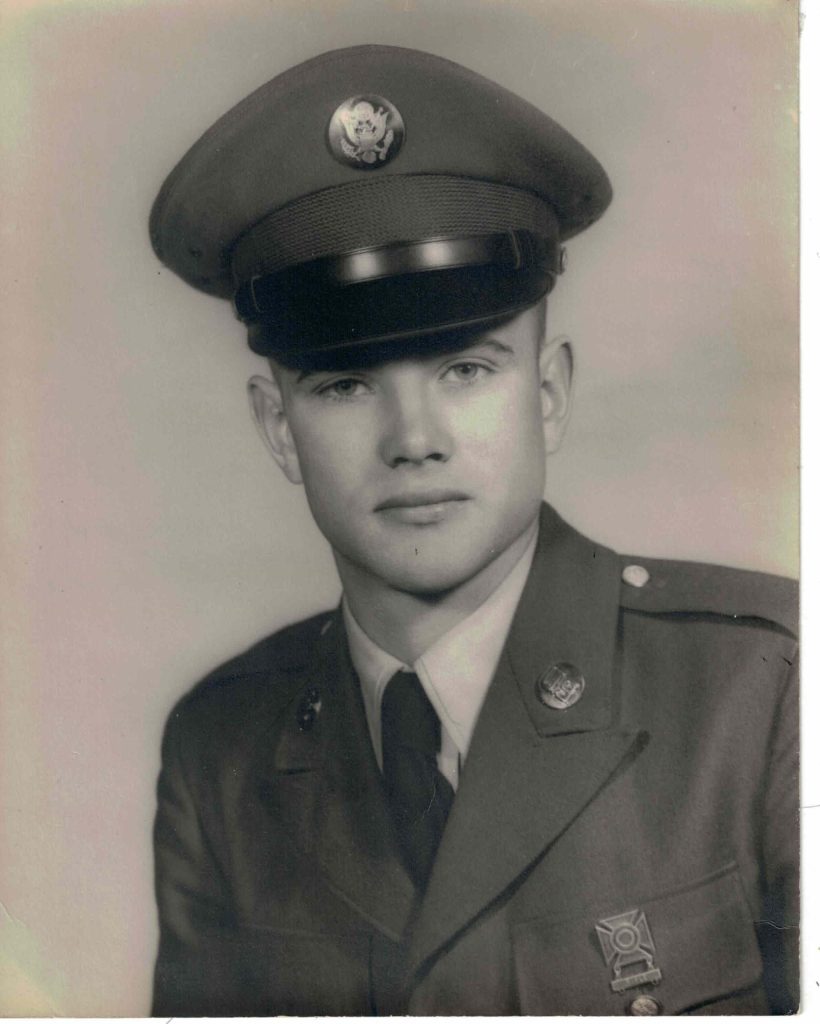
Lockard was a crewman on a UH-1B helicopter which was hit by small arms fire while in action just 15 miles from Saigon. He was hit in the neck and died that afternoon in a Saigon U.S. Naval Hospital.
Leonard is buried at Oak Hill Cemetery, Vanderburgh County, Indiana. He is remembered on the wall at Panel 1E, line 57.
Reports have reached Washington that up to 4,000 Greek soldiers and a smaller number of Turkish troops have secretly landed in Cyprus in recent weeks. It is thought that there is some exaggeration in the numbers, but it is difficult to determine how much. The indications of large‐scale infiltrations of men, as well as arms, have added to anxieties here about Cyprus. Officials fear that the situation will get out of control and lead to war between Turkey and Greece unless mediation efforts in Geneva lead to a new round of negotiations soon.
The clandestine landings of Greek and Turkish troops from small boats have greatly augmented the levels that each country tacitly agreed to maintain when the United Nations sent a peacekeeping force to the island three months ago. Under the treaty that made Cyprus independent in 1960, Greece had kept 950 soldiers on the island, and Turkey 650. A force of several thousand British troops has been reduced to about 1,000 men since the arrival of United Nations troops. There are about 6,000 men in the latter force. Greek and Turkish troops were specifically excluded from the international peacekeeping force and it had been assumed that the original contingents would not be augmented.
The United States has become increasingly involved in urgent diplomacy that has two principal objectives. The first is to prevent Turkey from exercising her treaty right to intervene militarily to protect the rights of the Turkish Cypriot minority. Ankara has threatened invasion on several recent occasions and Greece has vowed to respond by coming to the assistance of the Greek Cypriot majority.
The second and even more difficult objective of United Nations and United States mediators is to find a way in which the 500,000 Greek Cypriots and about 100,000 Turkish Cypriots on the island can live together in peace. Thus far the positions of the two communities on Cyprus, and the Governments in Athens and Ankara, have been incompatible. President Johnson failed to move the two sides in direct conversations here last month with Premiers George Papandreou of Greece and Ismet Inonu of Turkey. A new attempt to open discussions between Greece and Turkey is now being made in Geneva by the United Nations mediator, Sakari S. Tuomioja of Finland. Mr. Johnson has sent former Secretary of State Dean Acheson to try to help bring the parties together.
Despite having once led an attempt to secede from the former Belgian Congo, Moïse Tshombe was named as the new Congolese Prime Minister by his former enemy, President Joseph Kasavubu, who fired Premier Cyrille Adoula and fled into exile. Tshombe, brought in to halt a mutiny in the Katanga region, would serve for more than a year, and would be dismissed by President Kasavubu on October 13, 1965. Tshombe’s first act was to order several thousand Katangese gendarmes to come back to the Congo in order to receive amnesty.
The pro‐Communist Pathet Lao is bringing in new antiaircraft defenses as result of the pounding inflicted by Royal Laotian Air Force T‐28 fighter ‐ bombers, military sources reported today. The sources said four 37‐mm antiaircraft guns had been seen in the Phou Kout area just west of the Plaine des Jarres and 13 miles east of the neutralist strongpoint of Muong Soui. The Pathet Lao has been reported massing here for a major attack. Military sources also reported that Communist China had sent antiaircraft batteries totaling “about 10 guns of small caliber” to Phongsaly, capital of the northernmost province on the Chinese border.
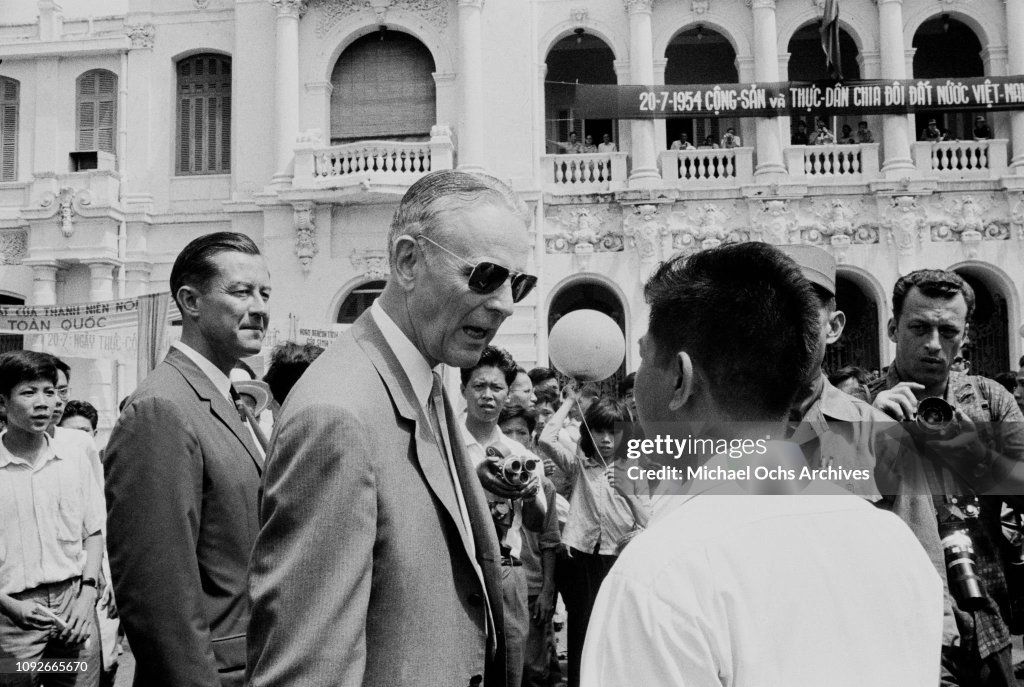
South Vietnam celebrated today its first Air Force Day. Under United States tutelage, the air force is becoming an effective weapon in the war against the Communist Việt Cộng. Ceremonies at the newly expanded air base at Da Nang, where propeller‐driven fighter‐bombers of South Vietnam are lined up beside jet aircraft of the United States, showed the integrated operations of the air forces of the two countries. When three B‐57 tactical bombers of the United States Air Force whistled to a halt this morning on the concrete, two‐mile‐long runway, the new American Ambassador, General Maxwell D. Taylor, was waiting for them. Out of the seat behind the pilot of one of the sleek jets scrambled General Nguyễn Khánh, Premier of South Vietnam.
Elements of two South Vietnamese Army divisions were reported to have begun a major operation to clear Communist forces from the outskirts of Saigon in an area north of Chương Thiện. The action is at the edge of the Plain of Reeds, 15 miles west of Saigon. So far, the Government troops were reported to have killed 68 guerrillas and captured 73 suspects at a loss of nine men killed and 28 wounded. A United States Army enlisted man riding in an armored personnel carrier was killed by a land mine and two other Americans were wounded in separate clashes today. The American who was killed this morning was the 249th United States serviceman to die in South Vietnam, and the 153rd to be killed in combat. Two Americans have actually been killed in this fighting. The other, one of the wounded, died later this day in a Saigon hospital after his helicopter was hit.
Pravda reiterated today Soviet statements that the appointment of a military man as United States Ambassador in Saigon indicated “the Pentagon might be intending to extend the war in Asia.” If this should be the case, the official Communist party newspaper warned, it would “amount to a most dangerous gamble.” The article, by Viktor Mayevsky, one of the paper’s leading commentators, quoted Premier Khrushchev’s statement that “local wars now being conducted could under certain conditions turn into a big conflict that could touch off a world conflagration.” Mr. Khrushchev made the statement Wednesday in an address to new graduates from Soviet military academies.
An anti-war petition, circulated by the National Committee for a Sane Nuclear Policy, and signed by more than 5,000 university and college professors, was presented to the U.S. Department of State for delivery to President Johnson, asking that the United States not enlarge its involvement in the Vietnam War and proposing international mediation to declare North Vietnam and South Vietnam neutral. “The administration was not listening,” a historian would note later, and would send more than 5000 American troops before the end of the month. It read:
“We, 5,000 American college and university educators, urge a neutralized Vietnam. It would end the terror and suffering in this war‐ravaged land. It would end the continuing loss of American and Vietnamese lives. It would be preferable to deeper involvement or irresponsible pullout. We therefore appeal to you, Mr. President, not to enlarge the scope of the war, but instead to work for a neutralized North and South Vietnam, as separate, federated or reunified states, protected by international guarantees and peacekeeping forces against all outside interference.”
Burma’s military Government is giving new indication that it intends to press its campaign against Communist guerrillas and dissident tribesmen despite the seasonal rains. The Government announced yesterday that its forces killed more than 100 rebels during the first week of July. It was the second time in a month that the rebel casualty toll for a week passed 100. In other years the monsoon season has slowed action against the rebels, who have been in arms almost since Burma got her independence from Britain 16 years ago. This year, however, the regime of General Ne Win appears intent on making the monsoon work for the Government.
The Parliament of France approved a reorganization of its national subdivisions to take effect in 1968, with the increase in the number of Départements of metropolitan France 90 to 95. The two départements around Paris and its metro area were divided, to be replaced by seven new départements over the next four years. Seine (governed by Paris) was split into the new départements of Paris and Seine-Saint-Denis, while Seine-et-Oise (governed from Versailles) was split into Essonne, Val-d’Oise, and Yvelines. Parts of both the old départements were used to create Hauts-de-Seine and Val-de-Marne.
Chancellor Ludwig Erhard emphatically defended his pro‐United States foreign policy before his Cabinet today. The Chancellor defined the main goals of his government as the reunification of Germany and the security of the Federal Republic. He said neither was attainable without wholehearted United States support. As Dr. Erhard addressed his ministers, Franz Josef Strauss, a leader of the “Gaullist” faction in the Government coalition, again called on West Germany to follow French policy lines more closely. Speaking at a congress of his Christian Social Union, the Bavarian wing of the Government party, Mr. Strauss urged formation of a confederation of the six Common Market countries, or as many as would join.
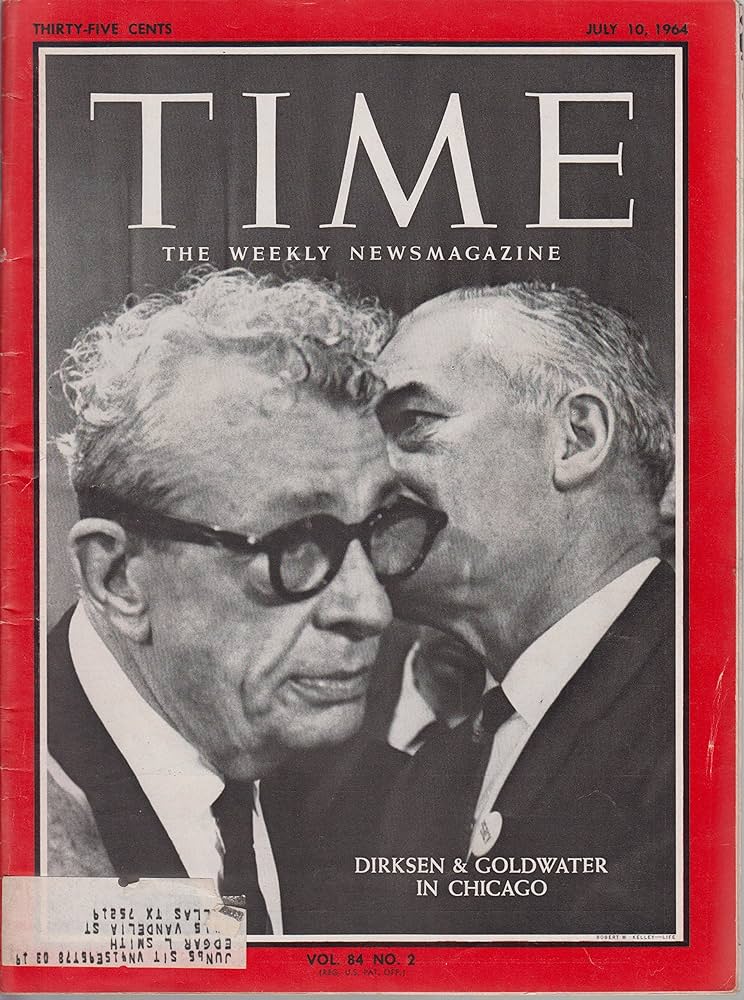
Senator Barry Goldwater, sweeping toward a first‐ballot nomination, gave Republicans and the country a preview today of his Presidential campaign. In a speech to the Platform Committee, he called for stronger opposition to Communism abroad and “a minimum of government” at home. An enthusiastically pro‐Goldwater crowd in the hearing room at the St. Francis Hotel put on the wildest demonstration of the pre‐convention week.
The cheers were especially loud when the Senator demanded a firmer foreign policy and when he suggested that the rights of white persons as well as Blacks must be respected. But Senator Goldwater was not trying to please only his committed supporters. He spoke of “the great base of principle” on which Republicans agree and called for party unity in the campaign ahead. The proceedings were carried over national television networks.
The dominant Goldwater forces on the Platform Committee followed the unity theme by accepting a number of planks proposed by Governor William W. Scranton. In a closed session that lasted through the night, the Platform Executive Committee approved intact or in modified versions the Scranton language on the United Nations, foreign aid, Cuba, medical care for the aged, Social Security, agriculture and urban needs. But the platform drafters rejected four planks pressed most strongly by the Scranton men. There were a strong civil rights plank and proposals to condemn extremists, to pledge continued Presidential control of nuclear weapons and to oppose a national right‐to‐work law.
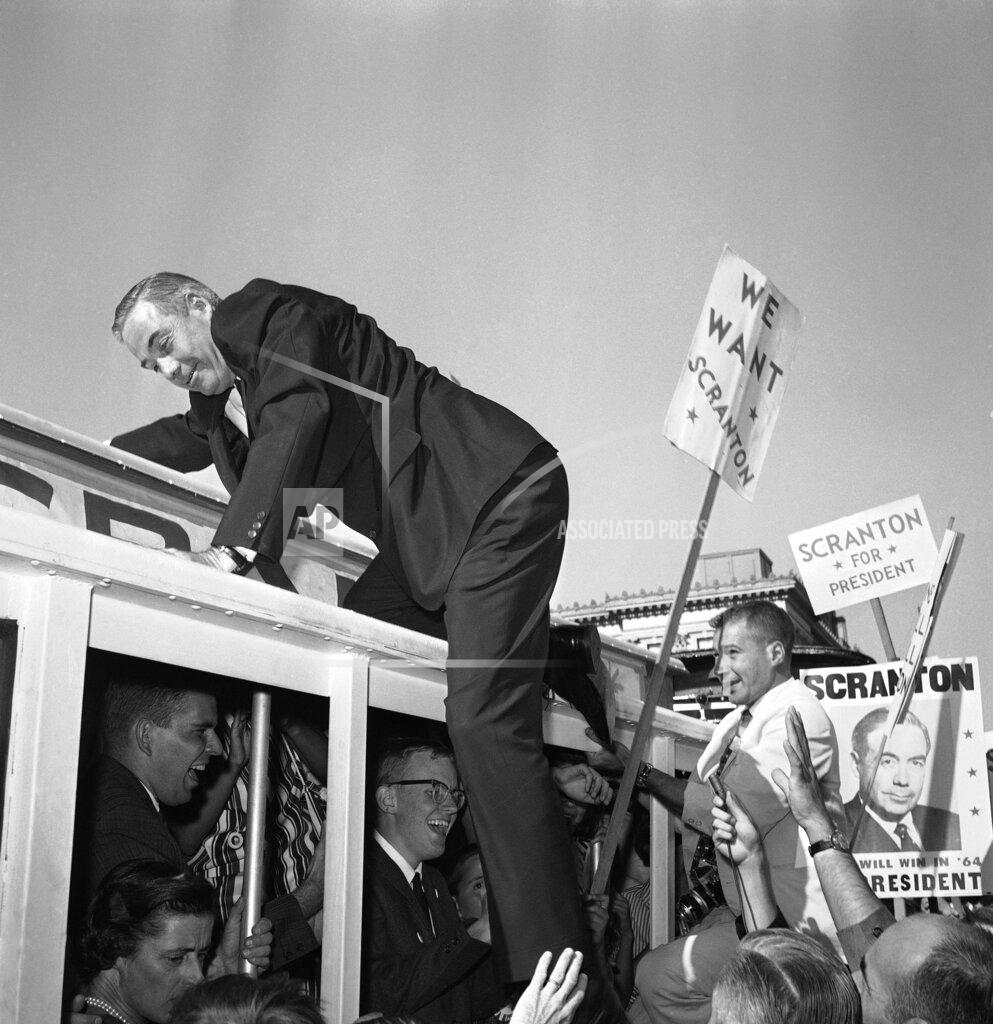
The odds lengthened today against Governor William W. Scranton’s finishing in either first or second place on the Republican ticket. The Pennsylvanian still maintained, however, the active front of a fighting candidate for the Presidency. He is the people’s choice, with polls to prove it, he said, and when that fact gets through to the delegates they will respond favorably to his candidacy. He reported that mail and telegraphed support totaled “hundreds of thousands.” He does not want the Vice-Presidential nomination, he repeated, and seems determined to make sure that Senator Barry Goldwater, the prospective Presidential nominee, does not offer it to him.
When the Governor was asked in a news conference whether he would adopt the stance of Senator Goldwater and withdraw as a candidate if the party platform violated his principles, he replied: “Certainly I would, but I don’t believe a word of what he says on that matter.” The Arizonan had already noted that a Governor who called him ignorant, a shooter from the hip and other uncomplimentary names would not make the best candidate for the Goldwater team.
Former President Dwight D. Eisenhower has been thinking aloud to his immediate companions the last few days what he calls the “hysteria” sweeping the country for and against the candidates for the Republican Presidential nomination. The general, who is due to arrive in San Francisco Sunday for the party’s national convention, has continued to discuss this subject on the way west in his private car aboard this special train, He left Harrisburg yesterday. In an impromptu news conference today on a stop in Chicago, he reaffirmed that he would not play the role of a kingmaker at the convention, opening Monday. “I’m trying my best to see that the whole party gets together as a unit,” he said. “If it doesn’t, I’m going to be disappointed.”
President Johnson cited today new gains in the economy and favorable comments of several independent observers to answer Senator Barry Goldwater’s charge of “fiscal irresponsibility” in his Administration. At another of his impromptu news conferences the President mainly steered clear of domestic politics. But when asked about the Arizona Republican’s charge, he was ready with statements by such normally conservative sources as Henry Ford 2d and the Morgan Guaranty Trust Company on the good health of the economy the dollar.
When a questioner asked the President to comment on Mr. Goldwater’s recent statement that “as of now” Mr. Johnson could beat any Republican, he replied: “I think the Republican Party has enough problems without my adding to them in any way.”
J. Edgar Hoover, director of the Federal Bureau of Investigation, disclosed today that the bureau ‘s force in Mississippi had been increased to 153 agents because of the civil rights drive. This is roughly 10 times the number normally stationed in the state. Mr. Hoover flew here this morning from Washington at President Johnson ‘s request and opened an FBI field headquarters, which covers two full floors of the First Federal Savings and Loan Building. His disclosure of the bureau ‘s build‐up came at a news conference following the headquarters ceremony, which was attended by Governor Paul B. Johnson Jr., Mayor Allen C. Thompson and other state and local officials.
The FBI director, who was accompanied by a number of his top assistants, spent the night here after conferences with Governor Johnson, State Attorney General Joe T. Patterson and others. His aides said that before his return to Washington tomorrow he might visit Philadelphia, Mississippi, focal point of the continuing search for three civil rights workers missing since June 21. Mr. Hoover said in reply to newsmen ‘s questions that he thought the three were dead and that “there is, at the present time, no positive indication that there is an imminent break” in the investigation. “The investigation is intensively being carried on,” he said. “This may be a prolonged effort. But it will be continued until it is solved, until we find the bodies of those three men that have disappeared and the persons who may be responsible for their disappearance.” The missing men are Michael Schwerner, 24 years old, and Andrew Goodman, 20, both of New York, and James E. Chaney, 21, of Meridian, Mississippi.
At his news conference Mr. Hoover emphasized that FBI agents were not here to protect the participants but, rather, to investigate violations of Federal law. “We most certainly do not and will not give protection to civil rights workers,” he declared. “In the first place, the FBI is not a police organization. It is purely an investigative organization. “The protection of individual citizens, either natives of this state or [those] coming into the state, is a matter for the local authorities. The FBI will not participate in any such protection.” Despite the director ‘s statement, his pledge of cooperation with state and local law enforcement officials and their promises of similar action in return, it is evident that the FBI and the Justice Department intend to make the Federal Government ‘s presence felt strongly in Mississippi and to put an end to the anti‐civil‐rights disorder if possible.
While the search for three missing civil rights workers goes on, there is a feeling among investigators that they will never be found unless someone talks. “This search is now more or less going through the motions, although I am sure it is sincere,” said a man who has been close to the investigation. “The best chance of solving the crime,” he continued, “lies with the intensive detective work being done by the FBI and other authorities.” Although the search has spread to adjoining counties in this east central Mississippi hill country, the investigation continues to center around the Neshoba County town of Philadelphia, the burned church that the workers had come here to inspect, and their arrest, imprisonment and reported release
The three — Andrew Goodman, 20 years old, and Michael Schwerner, 24, both white and from New York, and James Chaney, 22, a Meridian Black — have been missing since June 21. The three were among the first wave of several hundred volunteers who are spending the summer in Mississippi, conducting schools and voter registration projects among Blacks. A few hours after arriving in nearby Meridian they came here to inspect the ruins of a Black church used for civil rights meetings. They were arrested and held in jail for about five hours, according to local authorities. Deputy Sheriff Cecil Price said they were released to return to Meridian about 10:30 PM after Mr. Schwerner posted bond on a speeding charge. Two days later their station wagon was found burned in a swamp.
President Johnson dispatched 400 sailors from the nearby Meridian Naval Air Base to help the State Highway Patrol and the Federal Bureau of Investigation search the terrain for the missing men. For the first few days the search centered around Philadelphia and the area where the car was found. The searchers carefully combed woods, farms, ponds and rivers. Later, as the search widened, was virtually restricted to roadsides. The fact that the search has spread so far does not discount the possibility that the bodies of the three men, if they are dead, could have been disposed of in the immediate area. After searching in adjoining counties, one team of sailors was brought back for a second search of the terrain where the car was found.
It has been learned that some of the officers who knew of the arrest of the three men had been told that the three were to have been kept in jail for 72 hours before being released. Why this plan was not carried out has been described as a focal point in the investigation.
A rabbi and two other white civil rights workers were beaten in Hattiesburg, Mississippi today by two segregationists wielding metal weapons. The rabbi and his colleagues were returning from voter registration work with Blacks. They were accompanied by two Black girls from Hattiesburg, who were not harmed. The rabbi, Arthur J. Lelyveld of Cleveland, 51 years old, was reported to be in good condition at Methodist Hospital in Hattiesburg. He had a deep gash over the right eye, contusions on the chest and abdomen, and a cut over the left ear. The two other rights workers — Lawrence Spears, 21, of Los Altos, California, a Stanford student, and David Owen, 19, of Pasadena, California, an Oberlin (Ohio) College student — were released after treatment. Mr. Owen had a gash on the back of the head. Mr. Spear had contusions on the arm.
One of the Black girls said she thought she could identify the assailants. The Federal Bureau of Investigation said it was investigating the case. Mr. Spears and Mr. Owen gave the following account of the incident: The three whites were walking near railroad tracks in an uninhabited part of town. The girls, local civil rights workers from Hattiesburg, were with them. A pick‐up truck stopped along the highway. In it were two whites, one about 60 years old, the other about 35. One of them said, “We’re going to get you.”
Manager Charles W. Mathews reported that the Gemini Program Office had been reviewing and evaluating plans for Gemini-Titan (GT) missions 4 through 7. GT-4 would be a four-day mission using battery power. GT-5 would include radar and a rendezvous evaluation pod for rendezvous exercises early in the flight. The duration of this mission would be open-ended for a period of seven days, contingent upon the availability of fuel cells. GT-6 would be a standard rendezvous mission of perhaps two days’ duration. GT-7 would be a long-duration mission with an open-ended potential of 14 days.
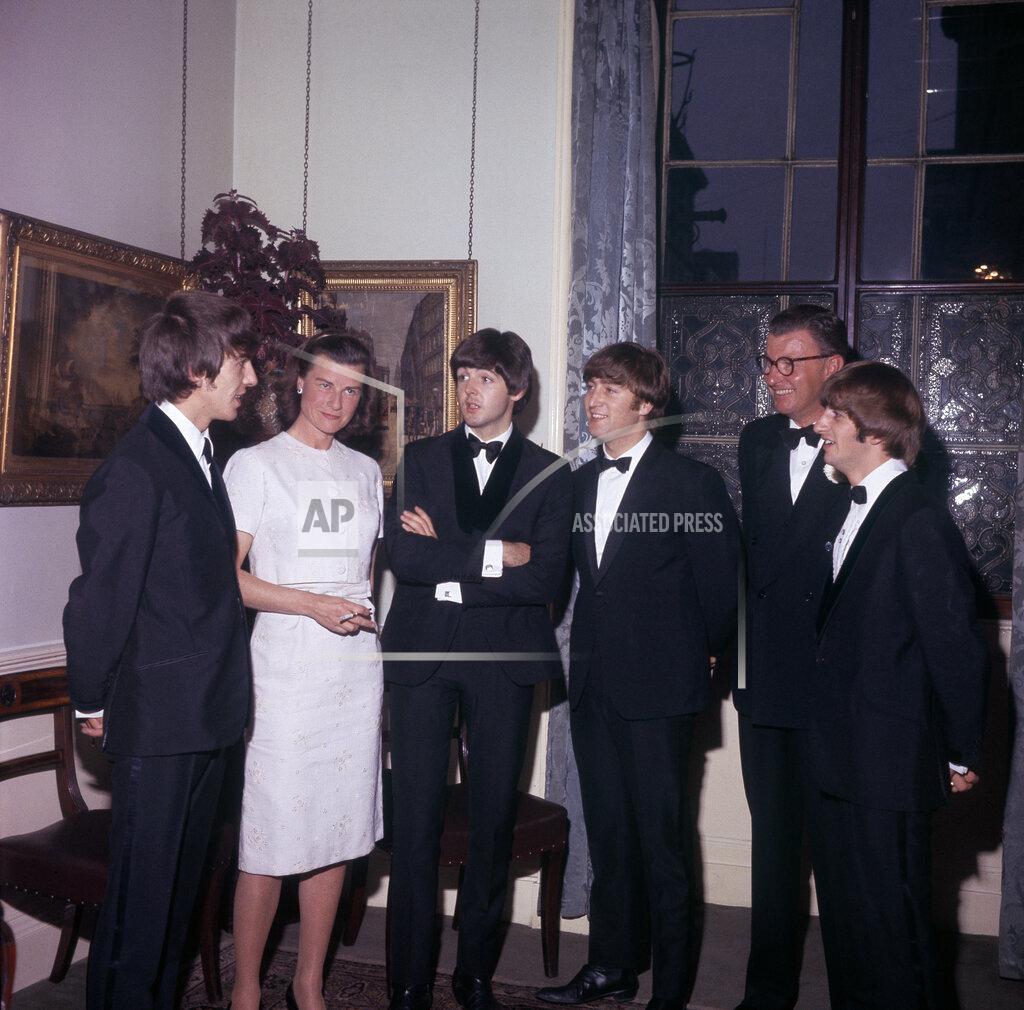
The Beatles release “A Hard Day’s Night”, their 3rd studio album.
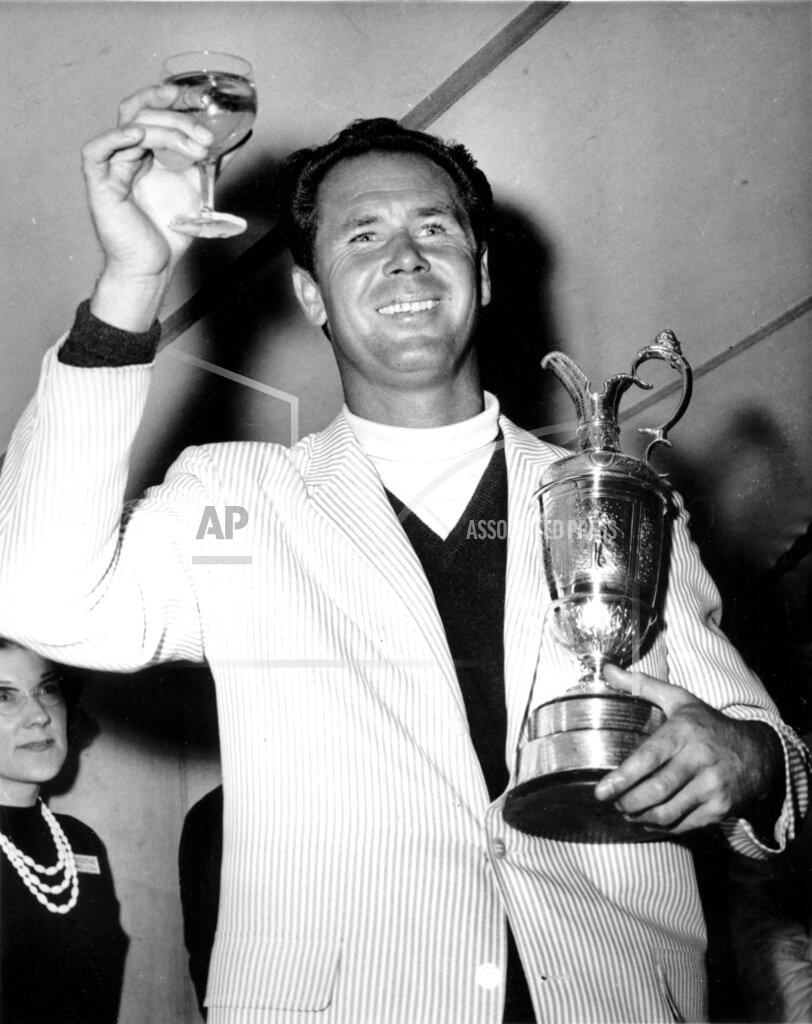
Golfer Tony Lema won the British Open at the Old Course at St Andrews in St Andrews, Scotland. He finished five strokes ahead of runner-up Jack Nicklaus. It was Lema’s only major championship win; he would be killed in a plane crash two years later, on July 24, 1966.
Juan Pizarro, with help from Hoyt Wilhelm, became the American League’s second 12game winner tonight as the Chicago White Sox defeated the Los Angeles Angels, 7–4, in the opener of a doubleheader. The White Sox also won the second game, 6–1. The White Sox, who had gone scoreless for 18 innings before picking up two runs in the fifth inning of the first game, shelled five Angel pitchers for 13 hits, including three each by Floyd Robinson and Gerry McNertney.
Dick McAuliffe’s third home run of the night, a three‐run drive in the third inning, led the Detroit Tigers to an 8–3 victory tonight over the Boston Red Sox in the second game of a doubleheader. The Red Sox won the opener, 7–6, on Dalton Jones’s two‐run pinch homer in the ninth.
Jesus Alou becomes the first Giant with 6 hits in a game in almost 40 years, as San Francisco beats the Cubs 10–3. All 6 hits are against different pitchers.
Bob Friend, the Pittsburgh right‐hander, allowed only six hits, all singles, and batted in a run tonight as the Pirates whipped the Milwaukee Braves, 5–1. The Pirates touched Tony Cloninger for three runs in the third inning on singles by Bill Mazeroski, Jim Pagliaroni and Friend and Bob Bailey’s double.
Dow Jones Industrial Average: 847.51 (+2.38).
Born:
Urban Meyer, American football coach (BCS National Championship 2006, 2008 University of Florida, 2014 Ohio State University; Bowling Green University, University of Utah; NFL Jacksonville Jaguars), in Toledo, Ohio.
Sam Kennedy, NFL linebacker (NFL Champions, Super Bowl 23-49ers; San Francisco 49ers), in San Mateo, California.
Donovan Small, Jamaican NFL defensive back (Houston Oilers), in Kingston, Jamaica.


 History Diaries