A Nazi leader hurls defiance in Danzig, telling mass meetings that Hitler will “liberate” the free city. Thousands of Nazis held rallies in Danzig. Tens of thousands of perspiring Free City residents of two communities, wearing heavy brown, black and gray uniforms, cheered Danzig District Leader Albert Förster’s reassertion of confidence that Herr Hitler would “liberate the Free City.” The Nazi leader demanded that Poland give up privileges to store arms on the so-called Westerplatte, on the western shore of Danzig Harbor. This Polish munitions dump on the fringe of the city of Danzig long has been the subject of quarrels between Poland and Danzig in the League of Nations.
Meanwhile, the United States Minister to Poland, Anthony J. Drexel Biddle Jr., arrived unannounced in the Free City on what was believed to be a visit to inform himself concerning the Danzig situation. During the afternoon he picnicked with United States Consul C. Porter Kuykendall, Mrs. Kuykendall and City Councilor Boetcher, who is attached to the Danzig Senate Office for Foreign Affairs.
First Herr Förster spoke at Oliva, picturesque town near the Baltic Sea. There he warned Poland that Danzig had adequate defenses against any “aggressive” action the Poles might be contemplating. Then he appeared at the harbor city of Neufahrwasser, near the Westerplatte munitions depot, where he counseled citizens of the community to “smash Polish influence wherever possible.”
“The construction of the competitive Polish harbor of Gdynia, less than ten kilometers [slightly more than six miles] from the spot on which I stand, has been a decisive factor in forcing us to recognize the necessity of political union with Germany,” Herr Förster said. “Now it is up to you to prove to the world that this is a German harbor.”
A Nazi takes charge of Prague University.
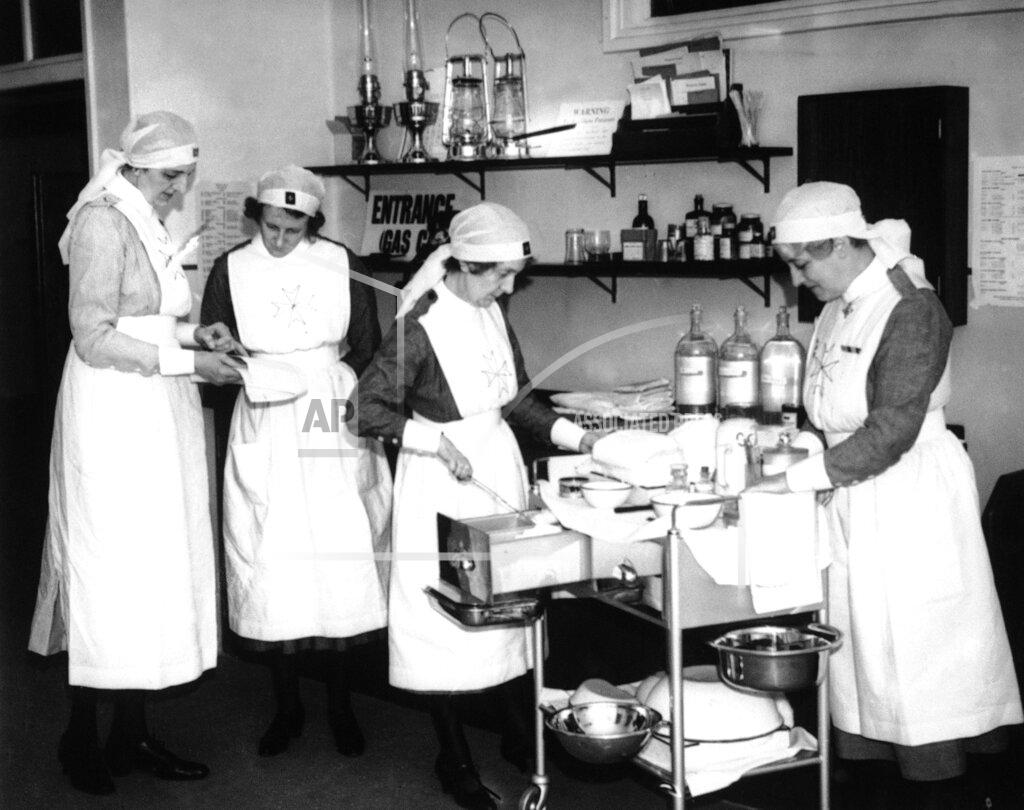
Nazis oust Catholic nurses from hospitals in Vienna.
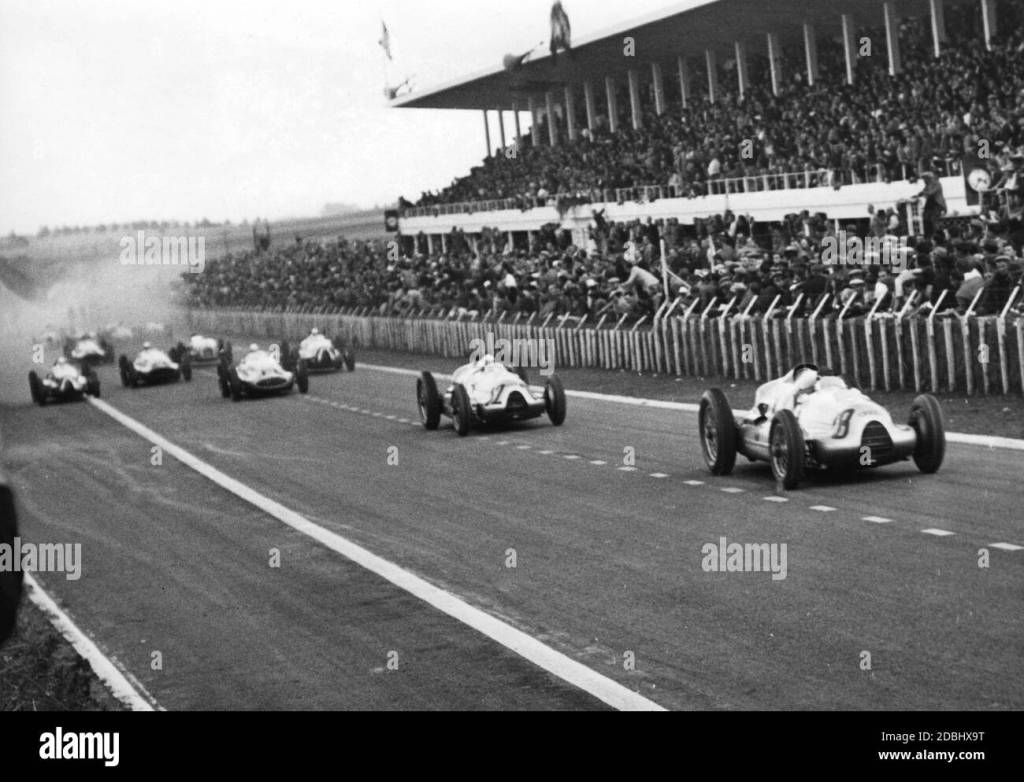
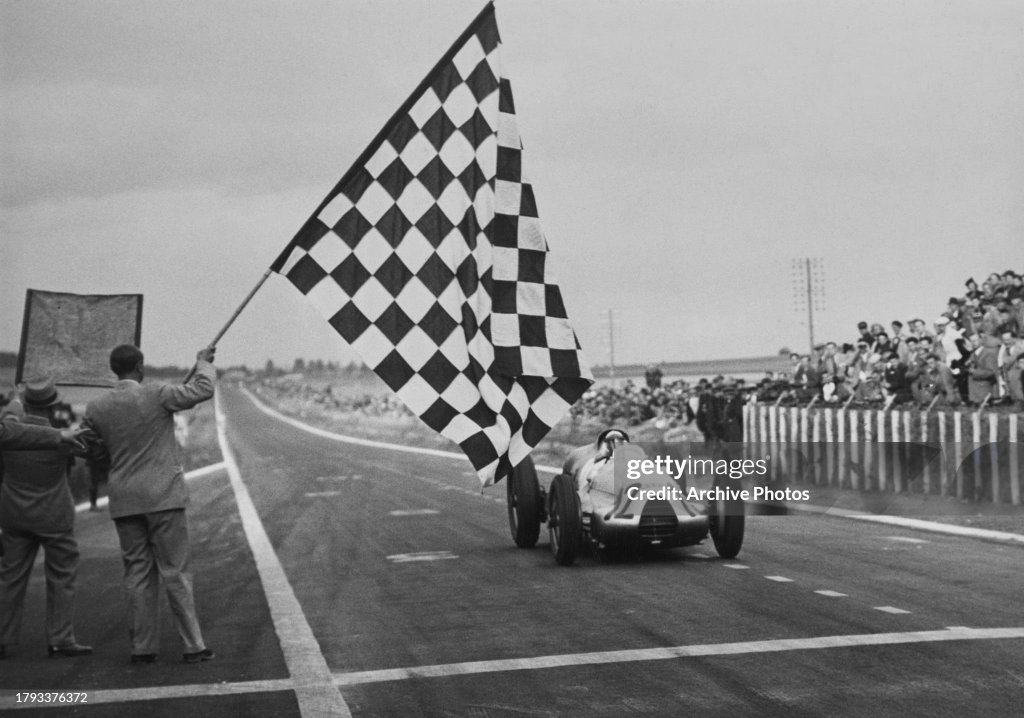
Hermann Paul Müller of Germany won the French Grand Prix.
A “go ahead” signal has come from Warsaw, with the result that Prime Minister Neville Chamberlain is expected to deliver his long-awaited pledge about Danzig in the House of Commons tomorrow. The Polish Ambassador, Count Edward Raczynski, arrived back in London by air this evening and expressed himself as well pleased with the cool and confident atmosphere of Warsaw and with the consultations he had with his government in the past few days.
The Poles, as well as the French, have given their approval to every word of Mr. Chamberlain’s long statement as submitted to them after last Wednesday’s Cabinet meeting in London. What is more, the Poles are said to be grateful for the British Government’s readiness to give an unequivocal warning against direct or indirect aggression in Danzig. It is now denied that the Poles ever asked Mr. Chamberlain to wait until a more critical time, or that they were negotiating a compromise over Danzig, an inference drawn in some quarters from the silence of the last few days.
The explanation now offered is that the British asked whether Poland wanted the declaration made in a hurry; that the Poles said there was no need to rush it, and that they were perfectly willing to wait until Monday if that suited Mr. Chamberlain’s parliamentary convenience. Negotiations may come later, but not now. In any case, the British declaration should sweep away many doubts if it lives up to advance reports. It will make plain that Danzig is covered by the sweeping terms of the British guarantee of March 31, pledging help against “any action which clearly threatened Polish independence and which the Polish Government accordingly considered it vital to resist with their national forces.”
It will assure the Poles of Britain’s help in resisting any attempt, whether coming from within or without Danzig, to rob them of their rights in the Free City, and it is expected to point to the fate of Czecho-Slovakia less than six months after the settlement of the so-called racial question of the Sudetenland as a reason why the Polish Government would be wholly justified in considering any unilateral change in the status of Danzig, “peaceable” or forcible, as a menace to Polish independence.
As such the statement will be something of a milestone, another stage in the revolution that has taken place in British foreign policy since the Germans marched into Prague. It will be intended to set at rest, if any declaration can do so, suspicions that Britain might allow Poland to be the sole judge of what constitutes a threat or that Britain might encourage a “peaceful” cession of Danzig to Germany by the methods of the Runciman mission in Czecho-Slovakia just a year ago.
Nobody would have dreamed six months ago that Danzig, of all places, would be where the British would draw the line of resistance to Chancellor Adolf Hitler. Of all the territory sought by Nazi Germany it is the most German on “racial” grounds, and nobody in Britain disputes its German character. Nevertheless, the British have discovered that the banner of racial self-determination” can be used by the Germans as a cloak to cover other more serious aims; those in this country who urged the Sudeten “settlement” on ethnological grounds now admit they have learned a lesson, and British public opinion is in a mood at the moment to “stop Hitler” anywhere.
If there remains any confusion in the British public mind over the rights and wrongs of the Danzig issue, tomorrow’s statement, it is hoped in London, will clear it up and will also prove Britain’s determination to Germany and to the rest of the world. Colonel Adam Koc, leader of the Polish economic mission to London, came with Count Raczynski tonight ready to resume negotiations with the British tomorrow.
London feels relief as war threat recedes. The stock market, dominated by world news, recovers on news of Danzig.
Churchill urges a British military alliance with the Soviet Union.
This evening’s Anglo-French-Soviet conference at the Kremlin produced “no definite results,” according to a brief communiqué read over the official radio tonight. Previous Soviet communiqués had either been limited to the bare announcement that another conversation had been held or contained deprecatory characterizations of the Anglo-French proposals. Thus tonight’s communiqué indicates that the negotiations are likely to drag on for some time, and the fact that it is not definitely derogatory argues against immediate danger of a rupture. Today’s talk — arranged at the request of the British and French. negotiators after yesterday’s meeting with Vyacheslav M. Molotov, Soviet Premier and Foreign Commissar — was the longest yet held in these negotiations.
[Ed: Stalin is playing games with the West. He has resolved on a policy of carefully encouraging war in Europe, and being prepared to take advantage of the chaos to grab whatever he can. His ultimate hope, of course, is a general collapse, leading to the red flag from Vladivostok to the English Channel.]
Count Ciano, the Italian Foreign Minister leaves for Spain. A closer tie is expected.
Speaking on the theme, “It is on ourselves, above all, that our destiny depends,” French Foreign Minister Georges Bonnet at Toulouse today emphasized what he meant two weeks ago at Arcachon when he said that if the United States clearly indicated that it would support the Anglo-French alliance from the first day of war all danger might be removed at once. Today he avoided hypotheses that might be misinterpreted, as was done with the Arcachon speech, and told his audience they must count first on themselves for preservation “of that degree of political stability in the world and for liberation from the daily fear for their frontiers and their territory.”
“Life cannot go on decently,” he said, “as long as everyone wakes up in the morning wondering if the day will bring violence and war. That is why the French Government has demanded and the French people have so magnificently responded to the appeal that the country be ready to resist force and all efforts at domination.”
To the British M. Bonnet paid a warm tribute for their enormous contribution to the common cause. The union of aim and method had never been so close, he declared. To the recent agreement with Turkey, he attached great importance. He once more expressed hope that a successful termination would soon be reached in the negotiations with Russia.
Much political importance is being attached to the conversations to be held at Bled during the next two days between Premier George Kiosseivanov of Bulgaria, who arrived here today from Berlin, and Alexander Cincar-Markovitch, the Yugoslav Foreign Minister. It is expected that they will discuss the attitude of Yugoslavia and Bulgaria to Germany, and also Bulgaria’s attitude toward the Balkan bloc.
A German broadcast today announcing that Bulgaria and Yugoslavia definitely intend to lean to the Axis powers is not substantiated. Rather, in keeping with the strict neutrality that is this country’s basic policy, it is expected that Yugoslavia will make every effort to discover a formula whereby, while drawing even closer to Bulgaria, she will not further the Bulgarian irredentist claims in Dobruja, since this would adversely influence Yugoslav relations with Rumania.
The municipality of Budapest in Hungary has ordered Jewish peddlers and junk dealers operating in the markets for secondhand goods to go out of business. Extreme Right circles urge that such dealers be segregated in a “ghetto” and identified with a yellow badge.
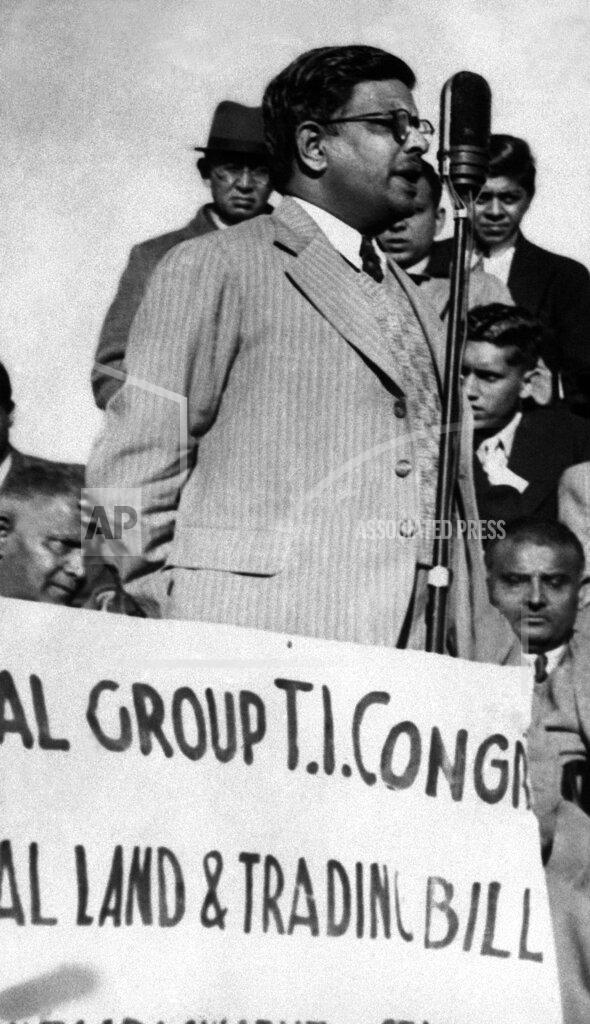
A meeting of 6,000 Indians, held at the Indian Sports Ground in Johannesburg South Africa, launch the Passive Resistance Campaign against apartheid and racial policy in South Africa
President Roosevelt’s power over Congress, strengthened by a close victory on monetary legislation last week, is expected to be tested on at least two points — neutrality and lending legislation — this week, with speedy or long-delayed adjournment of the legislative body depending upon the outcome. With any number of considerations tending to influence individual members of Congress and confuse the situation, a possible vote in the Senate Foreign Relations Committee Tuesday upon neutrality legislation and reception of the Administration’s lending bill in the Senate and House tomorrow should clarify matters somewhat.
Evidence of new friction between the Administration and Congress developed today when Senator Barkley, majority leader in the Senate, announced that he would introduce the lending bill to authorize “self-liquidation” loans of over $3,000,000,000 in the Senate, but that Representative Steagall of Alabama, chairman of the House Banking and Currency Committee, would submit it in the House. It was understood originally that the bill would be sponsored in the House by Representative Rayburn, majority leader. Mr. Rayburn refused comment upon the fact he would not do so, but it was understood that he disapproved of some of the provisions.
Senator Barkley said that the terms of the bill would not be revealed until noon tomorrow. There were conjectures as to whether provision to provide $500,000,000 for loans to foreign countries had been. included in the measure, in view of widespread and outspoken criticism in Congress of such lending. While there is little possibility that the lending bill will reach the floor of either house this week, since it is probable that public hearings will be held upon it, Congressional sentiment is expected to crystallize soon after its terms are made known and the public’s reactions to them are felt.
With a national election approaching, and realization general in Congress of the possible effect of further heavy government spending upon preliminary campaigns as well as the final outcome, indications were that Congress would approach. the lending program warily and with an extremely inquisitive eye as to how the proposed loans are to be made and controlled. The chief test for the Administration this week, however, will come upon whether it can get a neutrality bill of the type it wants to the floor of the Senate. Some New Dealers say in private that domestic political considerations, as well as international issues, surround consideration of the neutrality measure.
The first back-to-work movement among the WPA workers who are striking throughout the nation to compel Congress to restore the prevailing rate of wages in the new Emergency Relief Act was reported yesterday from Washington. At the same time, Lieutenant Colonel Brehon B. Somervell, WPA administrator here, expressed doubt that the American Federation of Labor could make good its threat to “shut down better than 90 percent” of WPA projects throughout New York City today, since many projects employed no AFL men.
In the national capital, the Workers Security Federation advised its 30,000 members in twenty-seven States to return to work today. The federation was recently organized from local WPA unions and the unemployed. Many members were formerly in the Workers Alliance.
J. Clark Waldron, publicity chairman of the federation, in announcing the back-to-work movement, explained that “all our group desired was an effective protest” against the new Relief Act provision for a minimum of 130 hours’ work a month. “This does not mean,” he remarked, “that we have ceased to protest certain provisions of the Relief Bill.”
In New York, however, Henry V. Rourke, national organizer of the federation, took sharp issue early this morning with the statement by Mr. Waldron and said the publicity chairman had not been authorized by the officers of the federation to advise members to go back to work. Mr. Rourke said members of the Unemployed and Project Workers Union, a New York State affiliate of the federation, would remain on strike. He said a meeting of twenty-seven members of the executive board would be necessary to authorize a back-to-work move and that no such meeting had been held.
The U.S. Solicitor General Robert H. Jackson warns the American Bar Association that the United States may cut the fees of lawyers.
The long-delayed hearing on the deportation of Harry Bridges, the West Coast CIO Communist leader, will begin tomorrow morning on Angel Island, which is reached in a thirty-two-minute boat ride in a small government steamer from San Francisco. Bridges is charged with being a member of a party which seeks the overthrow of the government by force and violence. He is by birth an Australian whose several moves toward becoming naturalized have never been consummated. The case has attracted such public interest that the Immigration Service has opened the hearing to the press, an unusual procedure. The rest of the public will not be able to get in, because government passes to the island will not be available.
The staff of 140,000 is ready to start its most ambitious inventory, the 1940 U.S. Census.
The Boston Red Sox win 4–3 and 5–3 to sweep a 5-game series in Yankee Stadium. Joe Cronin drives in runs in both games, giving him 12 games in a row with an RBI. The Yankees’ lead is now 6½ games, down from 13½ on July 1, a letdown that manager McCarthy attributes to “emotionalism” due to the Gehrig tribute.
The New York Giants beat the Brooklyn Dodgers 14–8 at Ebbets Field, even though Zeke Bonura grounds into his Major League record 5th double play in two consecutive games. He grounded into 3 in yesterday’s nitecap.
Kirby Higbe beats the Boston Bees 3–1 on a 6-hitter to give the Philadelphia Phillies their 1st win after 11 straight losses.
Brazil expels the Japanese. A court upholds a decree permitting the punishment of foreigners.
Mongolians reportedly face a suicide corps. The Japanese are poised for attack against strong artillery. A Japanese “suicide corps,” prepared today for an attempt to drive 2,000 Soviet Mongolian soldiers across the Khalka River in the sixth day of hostilities on the vast Mongolian plain. The Soviet-Mongolian troops were described as the survivors of the force which continued to hold in the center of the line when Japanese-Manchukuoan troops pushed both Mongolian flanks back across. the river two days ago. The “suicide corps” faced the menace of Soviet fire from thirty light artillery pieces and ten heavy guns on a higher plain west of the Khalka and overlooking a slope down which the Japanese must pursue the 2,000.
The Soviet-Mongolian troops last night were slightly less than two miles from the Khalka within a triangle formed by the Khalka and Khorsten Rivers along the border between Outer Mongolia and Manchukuo. A Kwantung Army spokesman said the Japanese-Manchukuoan forces had advanced one and one-fourth miles after occupying two heights, Noro and Nomonhan, in the center of the line in simultaneous night attacks under cover of a thunderstorm Friday. But officers acknowledged potential danger remained because there are numerous points, particularly south of Nomonhan, 150 feet above the prairie, where the Soviet-Mongolians may cross the shallow but swift Khalka under cover of their artillery. There is a menace also in the Soviet aircraft which demonstrated its activity after the Japanese alleged it had been destroyed.
Forty Soviet planes yesterday raided two strategic points along a thirty-mile communications line in what appeared to be only a gesture because the northernmost point reached was eleven miles from Hailar, important railroad center in Manchukuo about 120 miles from the Khalka River fighting. The hit-and-run raids caused no damage as the planes dropped their bombs on empty fields and fled before they were challenged by Japanese aircraft, according to the Japanese report, The Soviet-Mongolian fliers have avoided damaging temples.
Japanese indicated they would be satisfied with a victory in which their foe was driven across the Kralka, leading to an impression that an armed peace might prevail unless the Soviet-Mongolian forces launched a counter-offensive.
A Soviet counterattack today defeated the southern prong of the Japanese offensive in the Mongolian-Manchukuoan border area. After the Soviet counterattack today threw the battered, depleted Japanese Yasuoka Detachment back, it was dissolved and Yasuoka was relieved. The two armies will continue to spar with each other over the next two weeks along a four-kilometer (2.5-mile) front running along the east bank of the Khalkhin Gol to its junction with the Holsten River. Zhukov, whose army is 748 km (465 miles) away from its base of supply, has assembled a fleet of 2,600 trucks to supply his troops, while the Japanese suffer severe supply problems due to a lack of similar motor transport. This will have important implications for the fighting later this month, as well as the decisive battle in late August.
Relations between British and Japanese military forces in Tientsin were further strained today when the Japanese commander there refused to receive the visiting commander of British troops at Hong Kong. The snub came when the British officer, Major General Arthur E. Grasett, sought to call on General Masaharu Homma to resume the contacts that existed prior to the Japanese blockade of the British and French Concessions.
General Grasett left later for Peiping to inspect the British Embassy guard. From there he plans to return to his Hong Kong headquarters without further efforts to see Japanese military officials in North China.
Japanese sentries continued to handle severely Britons seeking to pass Japanese barriers around the British concession. Many Britons reported that on reaching the Japanese “stripping sheds” they were sent back repeatedly to the foot of the waiting lines to make them “lose face” before Chinese spectators.
British ships seeking to receive and discharge cargoes here and at nearby Tangku, at the mouth of the Hai River, made no headway. At the direction of the Japanese, Tangku wharfmen refused to handle cargo for British ships and in Tientsin the Japanese military prevented British vessels from approaching their own wharves.
President Quezon of the Philippines announces his intention to run for another term.
 History Diaries